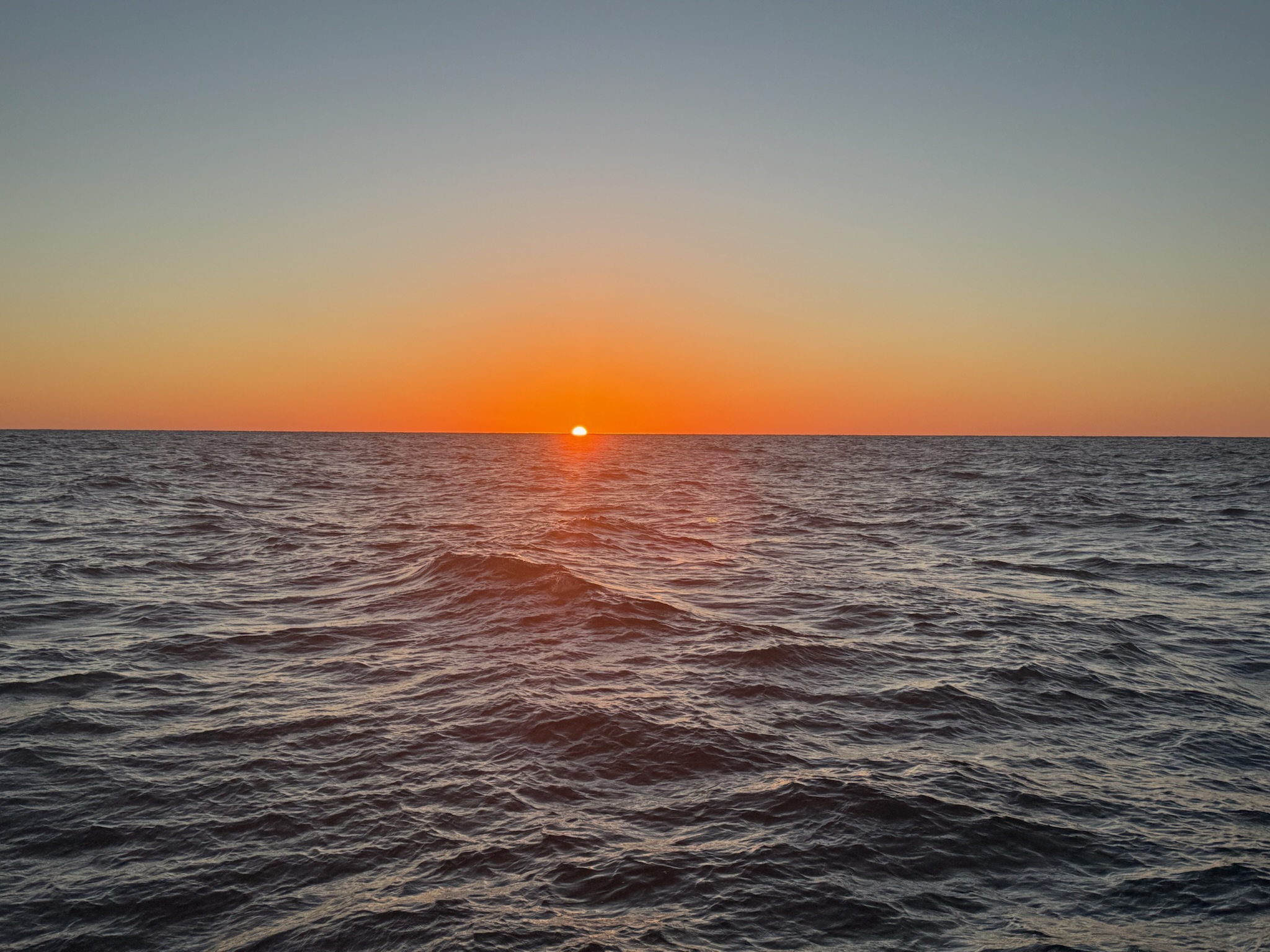
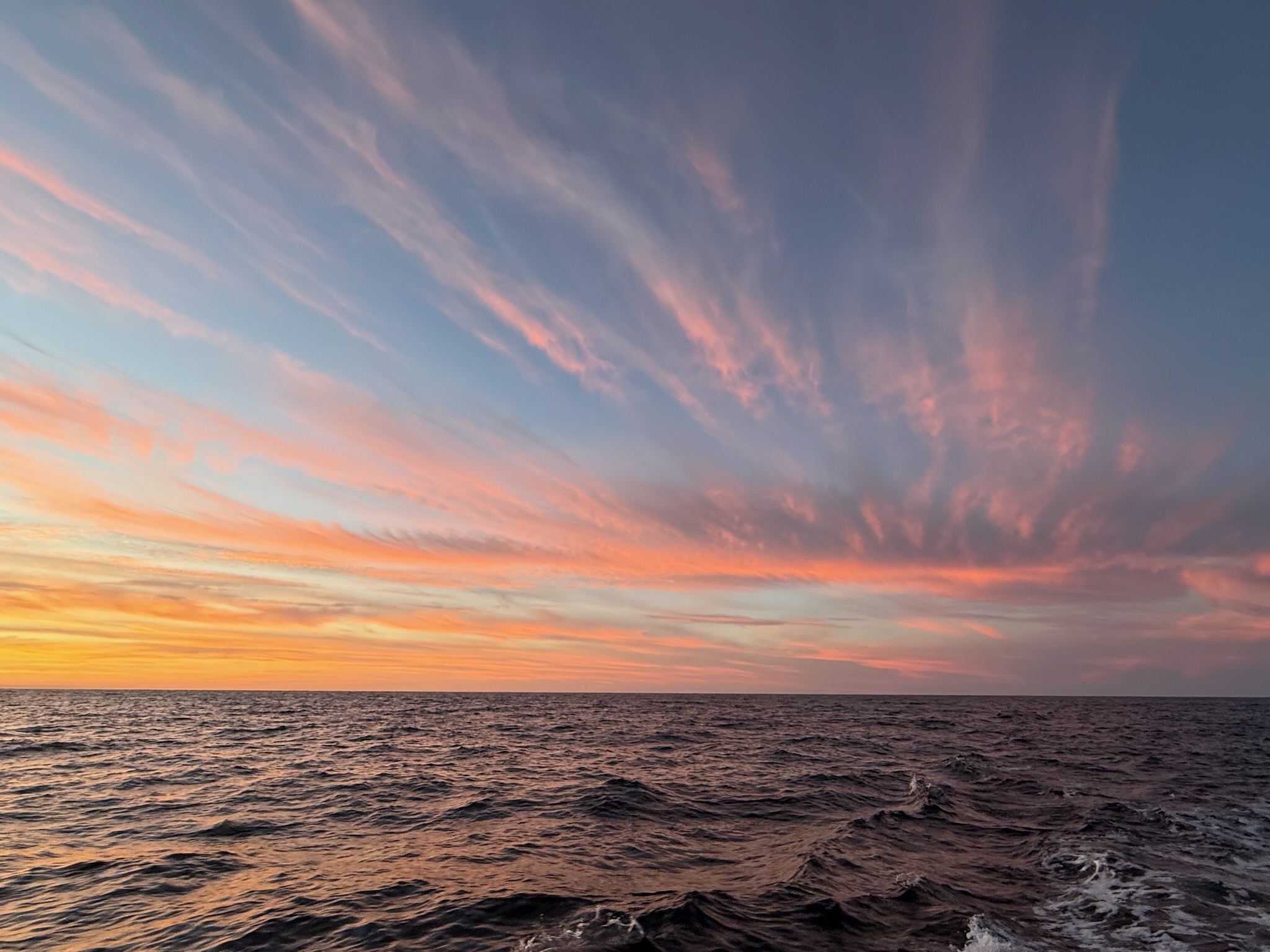
Friday November 14 — By midnight, we were nearly across the Gulf Stream. Eric was able to put the autopilot back onto auto navigation mode. Our speeds improved, and Eric moved the RPM down to 1600, where we were averaging about 6-knots. The winds had calmed down and were now coming from the aft, so the ride improved. Keith’s seasickness subsided, and he didn’t seem to be catching Christi’s cold. Eric was still fighting the cold. Christi’s cold had turned into a sinus infection. It was a dark night. The moon didn’t rise until 0200, and when it did, it was only a crescent, so it only helped a little with illumination. Here was dawn:

Friday was a much better day at sea than Wednesday and Thursday had been. The seas were calmer — 3 – 4 feet at 5 – 6 seconds with wind chop waves of about 1-foot, all coming from the starboard beam. It was significantly warmer than the Chesapeake had been, and the temperatures were pleasant at 75-degrees. We were averaging high 5s/low 6s at 1600 RPM all day, although at one point, when the current was with us, we sped all the way up to 7-knots for a short while and at another point, when the current was against us, we slowed down to the low 5s for a short time.
We saw in the news that declassified documents disclosed that Amelia Earhart had been a spy. We’d wondered why there was such a big display about Amelia Earhart and the massive search to find her downed plane at the Postal Museum when she had never worked for the post office. We’re still not sure how exactly she fit into the post office, but we feel like for them to feature her so prominently in their museum, there must have been a connection. Also, we’re thankful that we have Starlink and can get the news in the middle of the ocean. On our circumnavigation, all we had was the BBC over the radio once in a while (if we were lucky). It made the time at sea go by so much faster to have lots of online content available. Here was sunset:
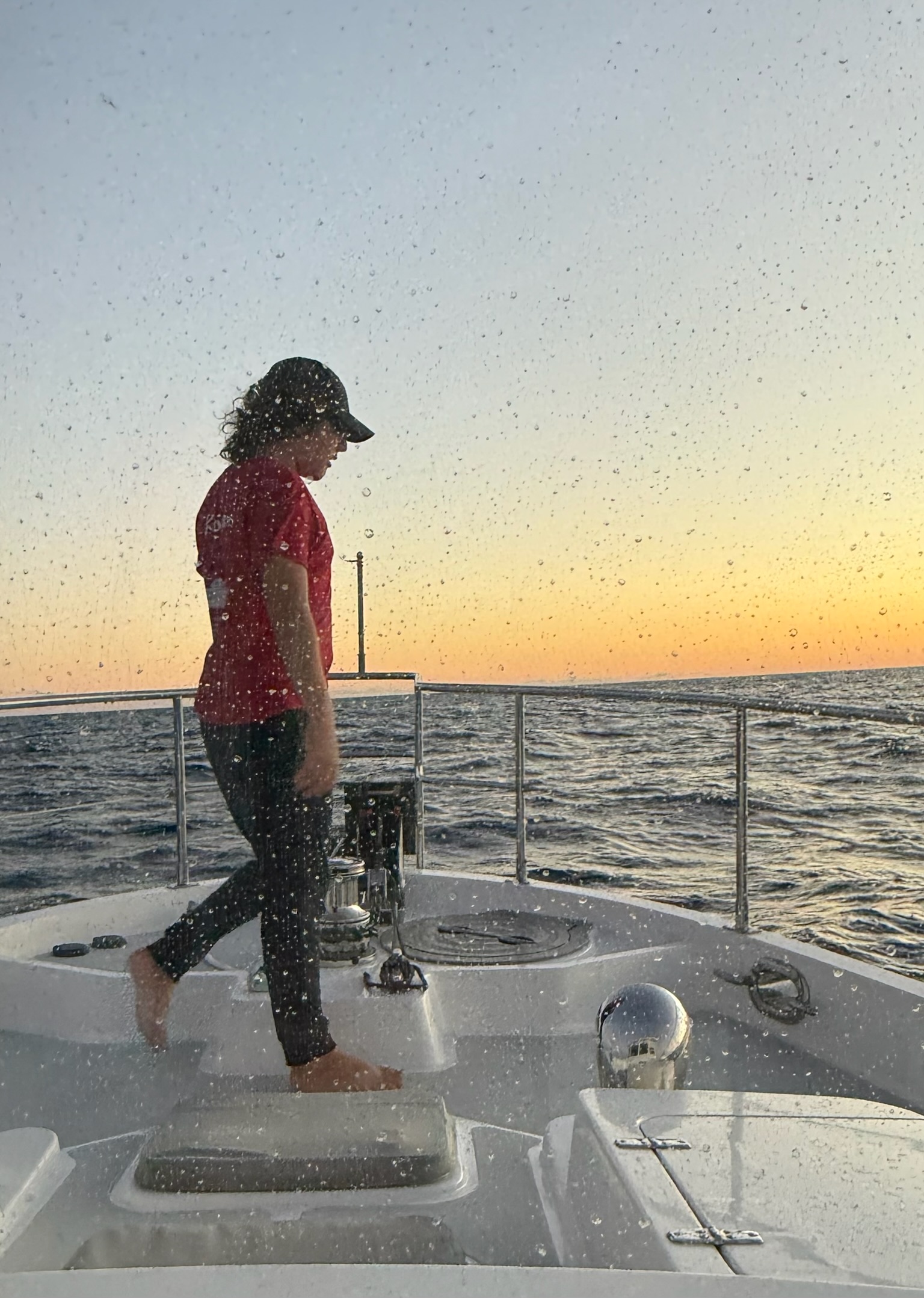
And Keith playing on the bow at twilight.
By midnight, the seas had flattened out even more and the ride was quite pleasant. We were making great time — too good, actually. Eric actually slowed us down to 1575 RPM because we were on track to arrive at our destination in the middle of the night. Even at 1575, we were still doing 6.6 knots. We figured we must have been in a Gulf Stream counter eddy, as the auto pilot was struggling, indicating an especially strong current. He eventually took us off auto navigation mode as the current was pushing us about 17-degrees off course and it was more than the poor autopilot could take. He instead had the boat steer to a heading.
That current lasted until almost noon on Saturday. Once we finally slowed down, Eric put us back on auto navigation mode and sped us back up to 1600 RPMs, making our speed in the low 6s. The seas were still pleasant. Swells were 3.5 – 4.5 feet at long intervals with about .5 – 1 foot of wind chop. It was a sunny day, though there were low clouds on the horizon.
We were still on track to arrive before dawn, but Eric thought it would be okay. It was a wide, straight channel into the lagoon with a sand bottom anchorage near the entrance. We could pull in and anchor without having to navigate inside the lagoon. This was the twilight on Saturday.
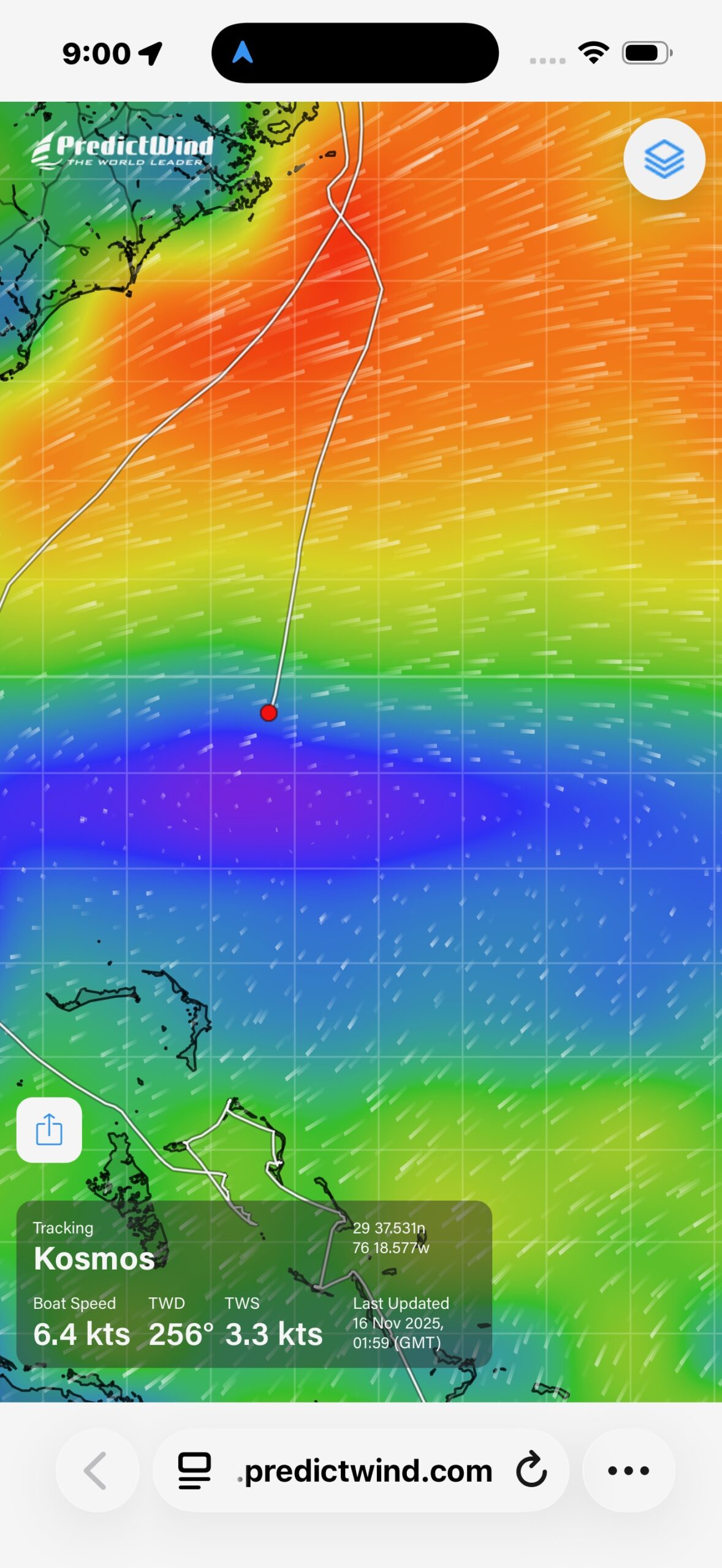
Here was what the sea conditions looked like on Saturday at 2100. We’re the red dot in the middle. The line attached from the dot shows where we have transited on this passage. The other line showed the path we’d taken north back in June.
That ugly storm (red was the worst, orange really bad, yellow also bad) was why we’d needed to go to The Bahamas instead of Bermuda. Had we stayed at the northern latitude, we’d have been caught in that storm. But by going south, we’d escaped it. Eric was pleased with himself for doing such a good job of timing this passage. Had we left even 8 hours later, we would have been caught in the storm. And had we left any earlier, we would have been caught in a storm that had passed right before we’d left. It was a narrow weather window, but Eric had routed carefully and knew we’d make it (unless the weather were to change drastically from the forecast).