Continued… We headed inside the museum. There was a big exhibit on the Wisconsin, as well as two different films about her in two different theaters. Our big take away was that the US spent ridiculous amounts of money on her and barely used her.
In 1940, President Franklin Roosevelt ordered the battleship in preparation for entering World War II. Construction on the Wisconsin began in January 1941 and was completed in a record breaking 39-months. She was commissioned in April 1944 and sent to the Pacific in September 1944 to join the “greatest armada ever assembled int the Pacific ocean.” Even though the Wisconsin was designed to accommodate less than 2,000 crew, she had nearly 3,000 crew onboard. That explained why the beds were in such weird places…
The Wisconsin engaged in combat in Okinawa in March 1945 and “played a vital role in every major Pacific naval operation…” She was decommissioned in 1948. She was recommissioned in 1951 and sent to Korea, where she destroyed strategic bridges, tunnels, railroads and supply stations with her 16-inch guns. In March 1952, an enemy shell hit the deck. Three crew were injured and the deck was damaged, but they were able to quickly repair the damage. It’s the only direct hit the ship has ever taken. She was decommissioned again in 1958.
She was recommissioned yet again by President Ronald Reagan in 1988. This recommissioning was very controversial. She’d been mothballed for decades and was in bad shape. The government spent a lot of money to get her back up to par along with a tremendous amount of more money to modernize her. The restoration/modernization project took two years.
in January 1991, President George H.W. Bush sent her to the Persian Gulf. The Wisconsin was the lead ship and coordinator vessel for initiating hostilities in the first Gulf War. The Wisconsin launched a series of Tomahawk missiles into Iraq in a predawn attack. It was the first time cruise missiles had been used in battle. In addition to the more modern missiles, the WWII era 16-inch guns destroyed command posts and artillery batteries. She was decommissioned again in September 1991. She was stricken in 2006. While she was a military vessel for 62 years, she’d only had 14-years of active service. In 2000, she was donated to Nauticus to be used as a museum.
Unfortunately, we can’t remember the dollar amounts that the films cited for what it cost to build, operate, maintain, retrofit and upgrade her, but the numbers were mind blowing. Because the numbers to operate her were so astronomical, we understood why the government was so quick to decommission her after each war. And, given that they’d already sunk so much money into her, we could understand why the government would want to reactivate her during war times to try to get some more mileage out of those already spent funds. For example, one of the films proudly highlighted that in Iraq, they were able to use some of those stockpiles of WWII weapons. But since bringing her back into service meant sinking tons more money into her, was it a wise fiscal choice? Wouldn’t it have been cheaper to scrap those old weapons/munitions and bring in modern weapons/munitions on a different vessel? We realize that the Wisconsin played an important part in each of those wars — but was the part she played big enough to justify all the money that it cost us taxpayers?
Next to the Wisconsin exhibit, there was another museum within the museum called The Hampton Roads Naval Museum, but it was closed today.
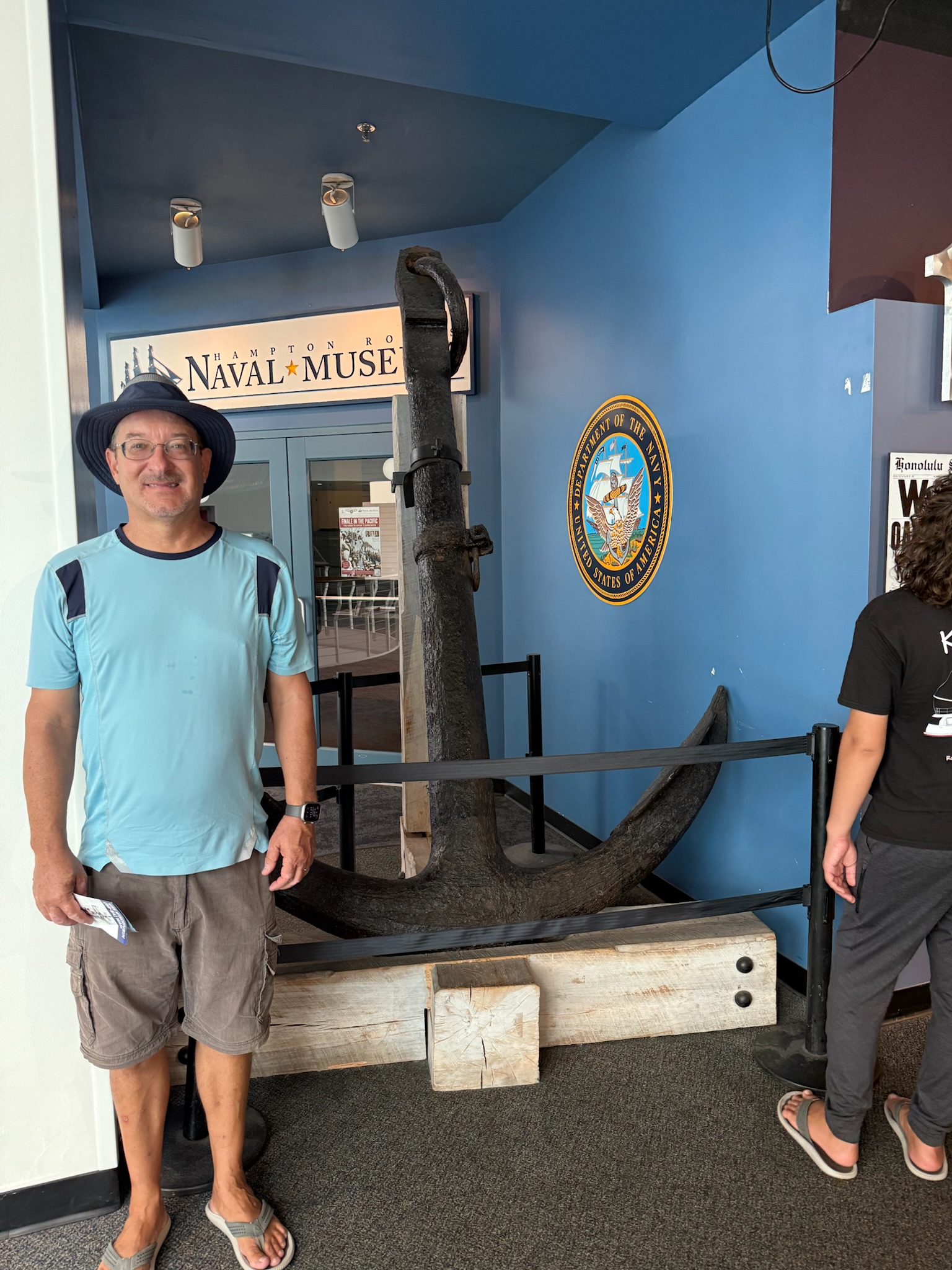
We moved on to the next exhibit, which was about the history of Norfolk. There were signs with bits of trivia. For example, in 1827, the Norfolk Naval Shipyard solved the problem of fixing hulls by creating the dry dock — they’d flood a chamber with water, float the ship in, then remove the water from the chamber. Portsmouth rightly claims credit for opening the first dry dock since Norfolk Naval Shipyard is actually in Portsmouth, not Norfolk.
Christi’s favorite bit of trivia was that in 1789, Thomas Jefferson stopped in Norfolk on his way back home from a trip to France. Upon arrival, he found out that President Washington had appointed him as the nation’s first Secretary of State!
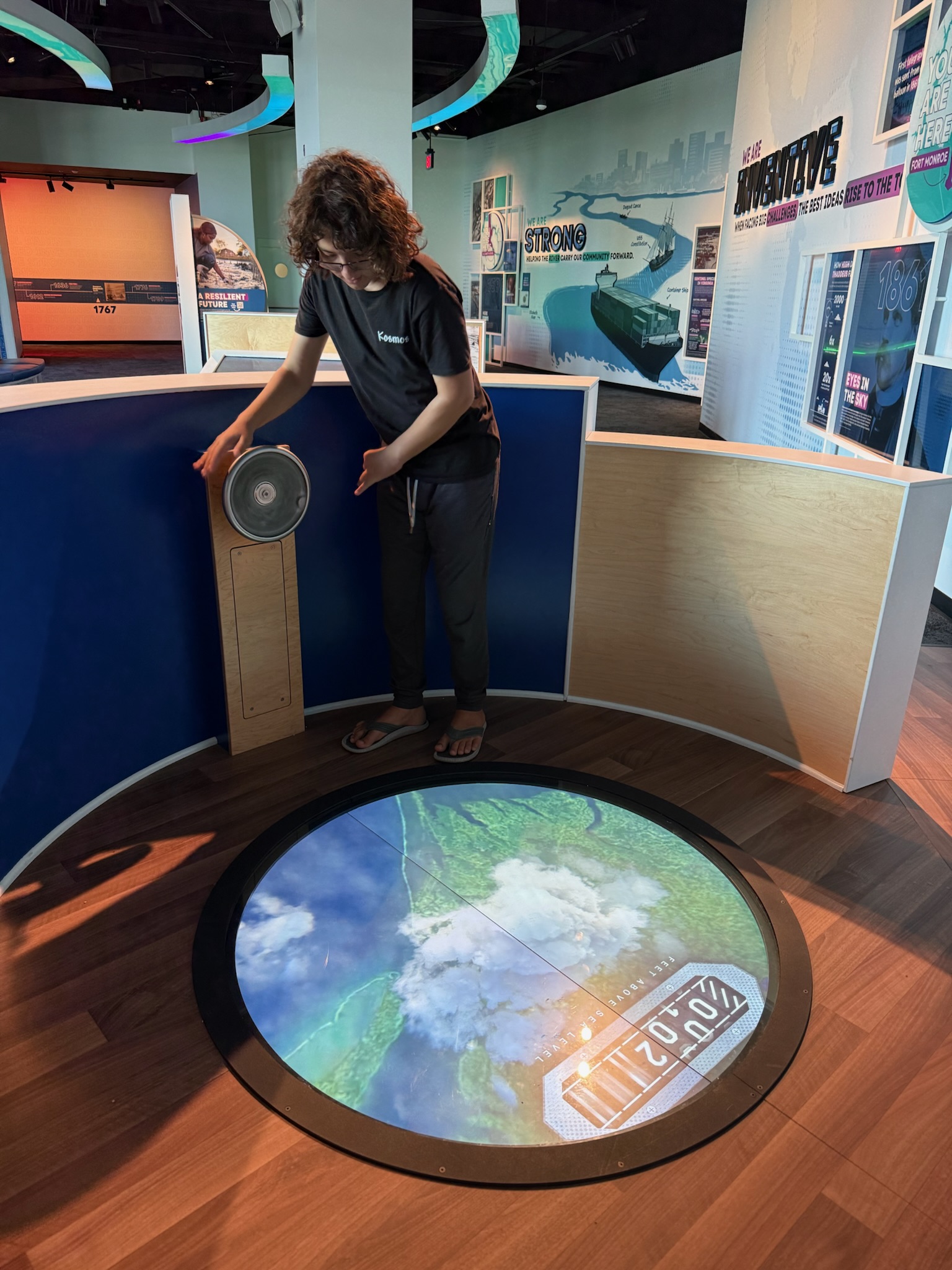
Many of the trivia signs had interactive activities accompanying them. For example, in 1862, Thaddeus Lowe took areal spying to a new level. He realized that if a person went up in a balloon over water they could see more than doing so over land, ho he tethered his balloon to a coal ship in the Hampton Roads. He was able to see for miles beyond Norfolk. The balloon went up 2,000 feet. There was a screen that simulated being in a balloon, showing what the view of the area was from different heights.
There was a large exhibit on all the great things the US Navy is doing now in terms of conservation efforts. “The navy is committed to protecting the environment and safeguarding marine resources while conducting necessary training and testing.” They made a big deal about not being exempt from environmental laws and that they are recruiting soldiers to do environmental protection type jobs. There was an exhibit on sonar, a technology that uses sound waves to detect objects underwater. We found the science of how it works to be interesting.
There was a relatively small exhibit about the Chesapeake Bay. It is the largest estuary in the US and one of the most productive ecosystems in the world. There were several fish tanks, some relatively large, highlighting some of the species in the bay itself and the rivers/wetlands/forests that are part of the bay’s ecosystem.
There was a surprisingly interesting exhibit on the Port of Virginia. Much of it focused on import/export. The Port of Virginia exported more agriculture than any other port on the east coast, contributing $82 billion to the economy. Top agricultural exports were soybeans, peanuts, wood and cotton. Some shocking facts: 77% of seafood in the US is imported, but much of it is caught in the US, exported for processing, then imported back in; likewise, most cotton grown in the US is exported to other countries for manufacturing and imported back in as finished clothing. 42% of the nation’s coal passed through the Port of Virginia, and the coal was used primarily for the steel industry. A surprise to Christi was that the coal was mixed with the iron ore and limestone to create the steel — she’d thought the coal was simply used to melt the metals; she hadn’t realized coal was actually an ingredient in steel. Another big export was auto parts. The single largest commodity (total amount of both imports and exports together) was furniture. .
Routing ships could be complicated since the port shared its waterway with the largest navy base in the world. Eight different organizations worked together to keep traffic flowing safely and efficiently: the Coast Guard, ship agents, pilots, tug companies, the Virginia Maritime Association, the Port of Virginia, Customs and Border Protection, and the Navy. The Port has recently widened the channel to allow two way flow of ultra-large container ships, making it the widest channel on the east coast. They were planning to dredge it to 55 feet deep to make it the deepest, as well.
In Virginia, 730,000 jobs — 1 in 5 — were tied to the maritime industry. The top jobs were: electrician, pipe fitter, crane operator, welder, painter and machinist.
There was a wind farm 27-miles offshore from Virginia Beach. Since the signs said “will provide energy to as many as 660,000 homes” and “will create hundreds of clean energy jobs,” it was unclear to us whether it’s already in operation and still growing or if it is still under construction. They addressed pushback about the industry waste by making signs explaining that there was already a company in existence that recycled old wind turbine blades into fuel for cement kilns.
The wind farm display led to a large display about sailing ships. That had mostly interactive exhibits and was fun. Needless to say, the primary focus was on working with the wind; ie different sails and different sail positions for each type of wind, etc.
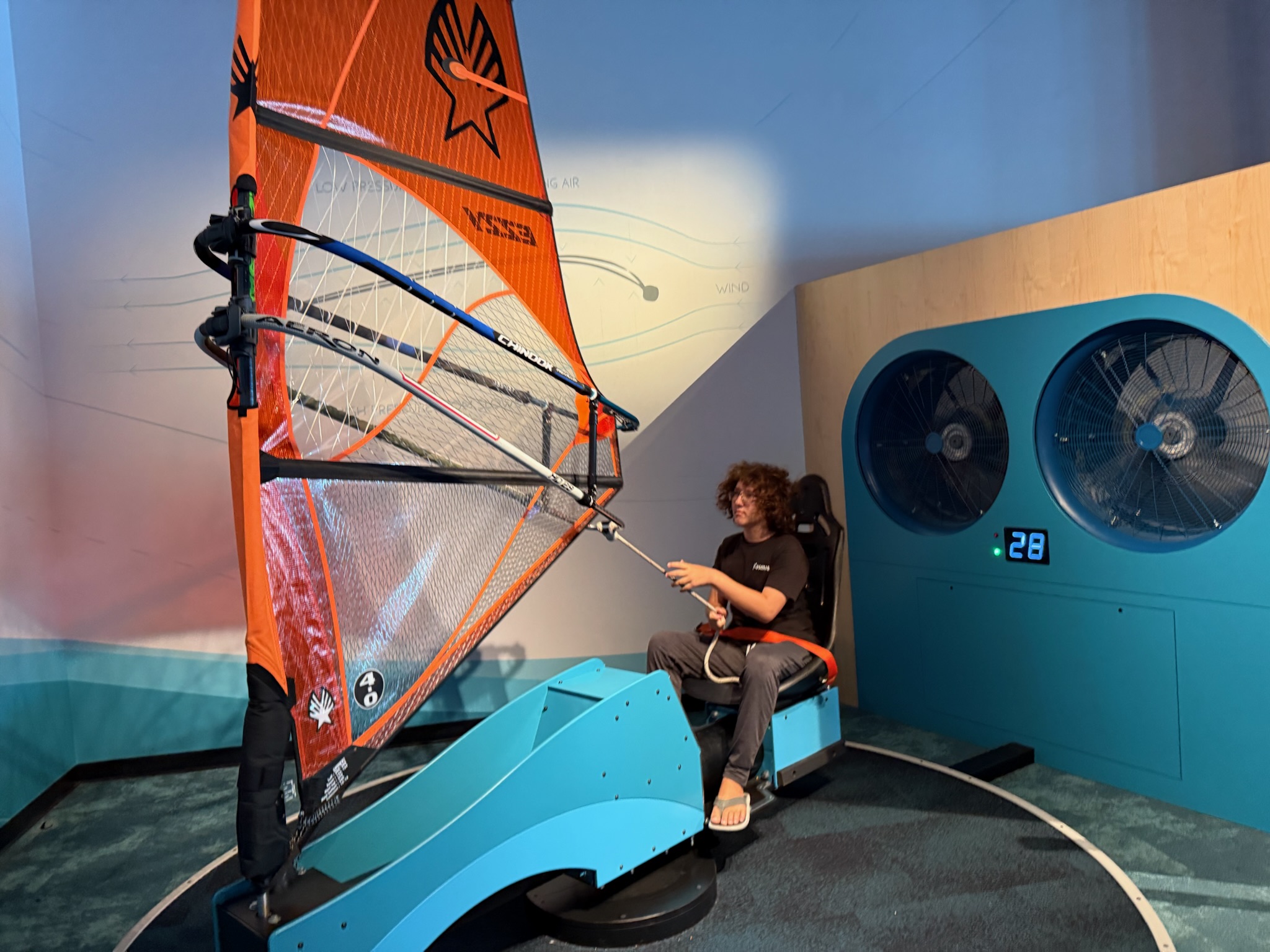
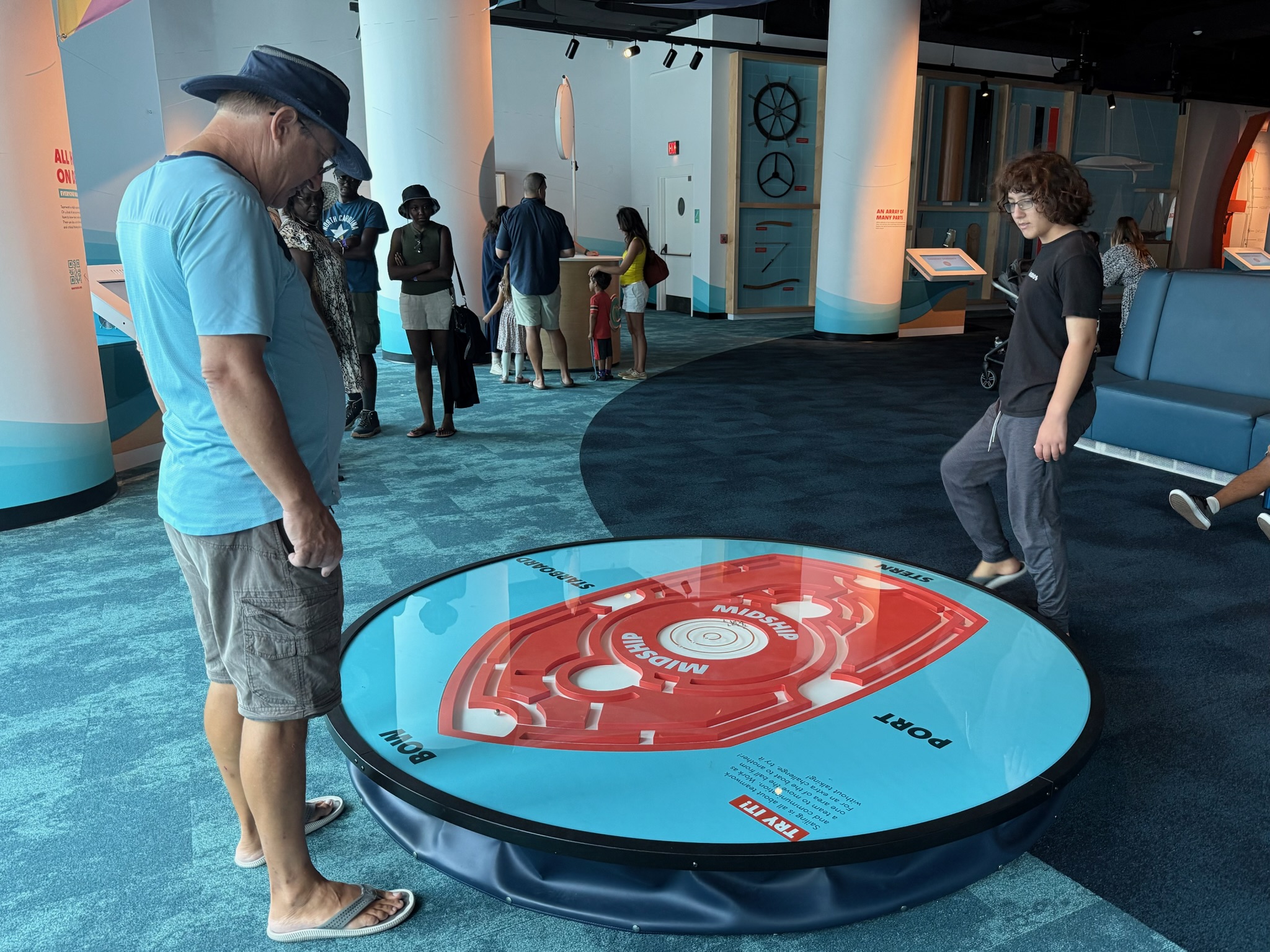
There was also some information about boats that was useful for non-sailors, such as how hull shapes affect how the boats move, how wind affects waves, how the motion affects the center of gravity, and how different types of gear works.
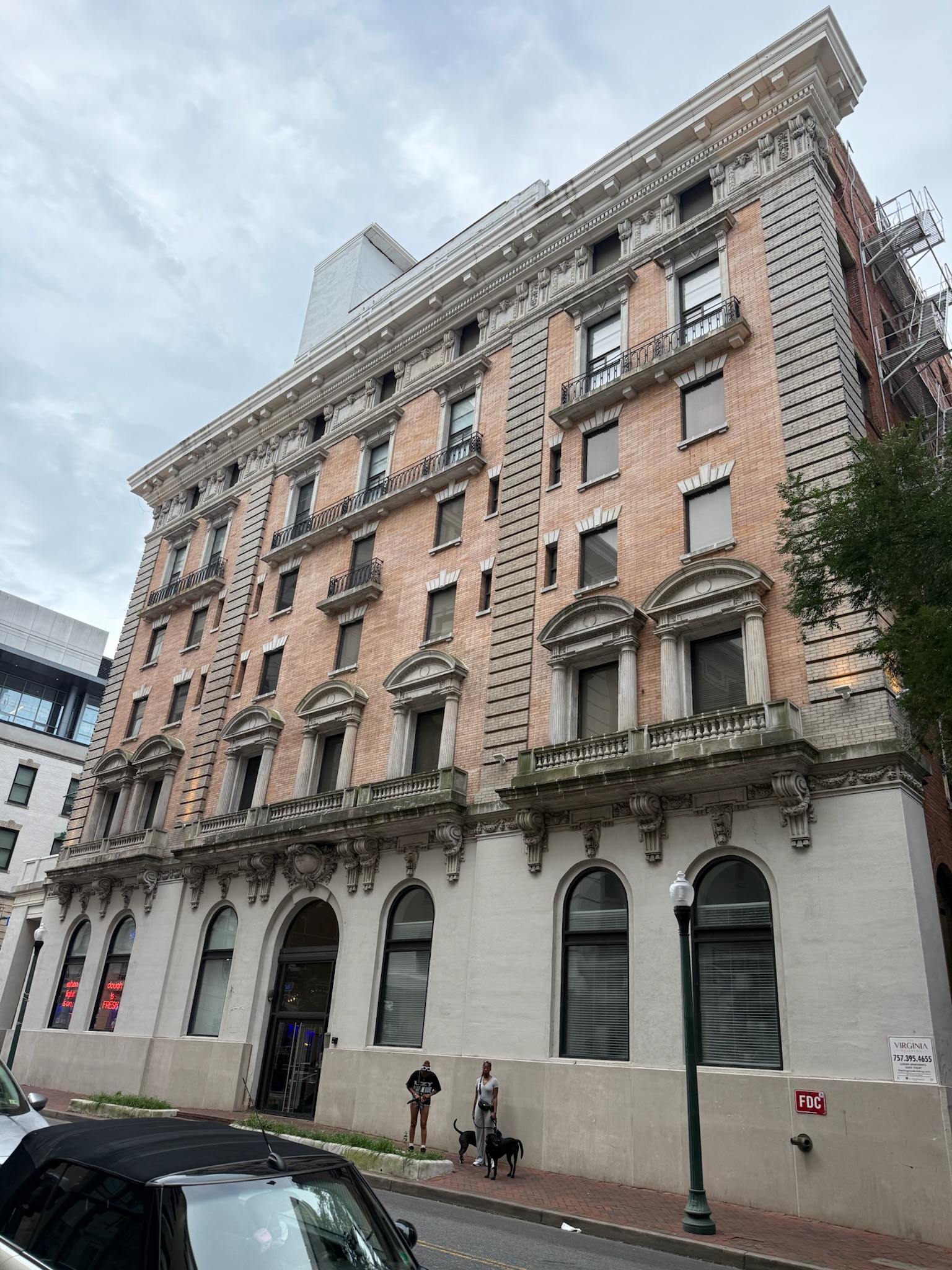
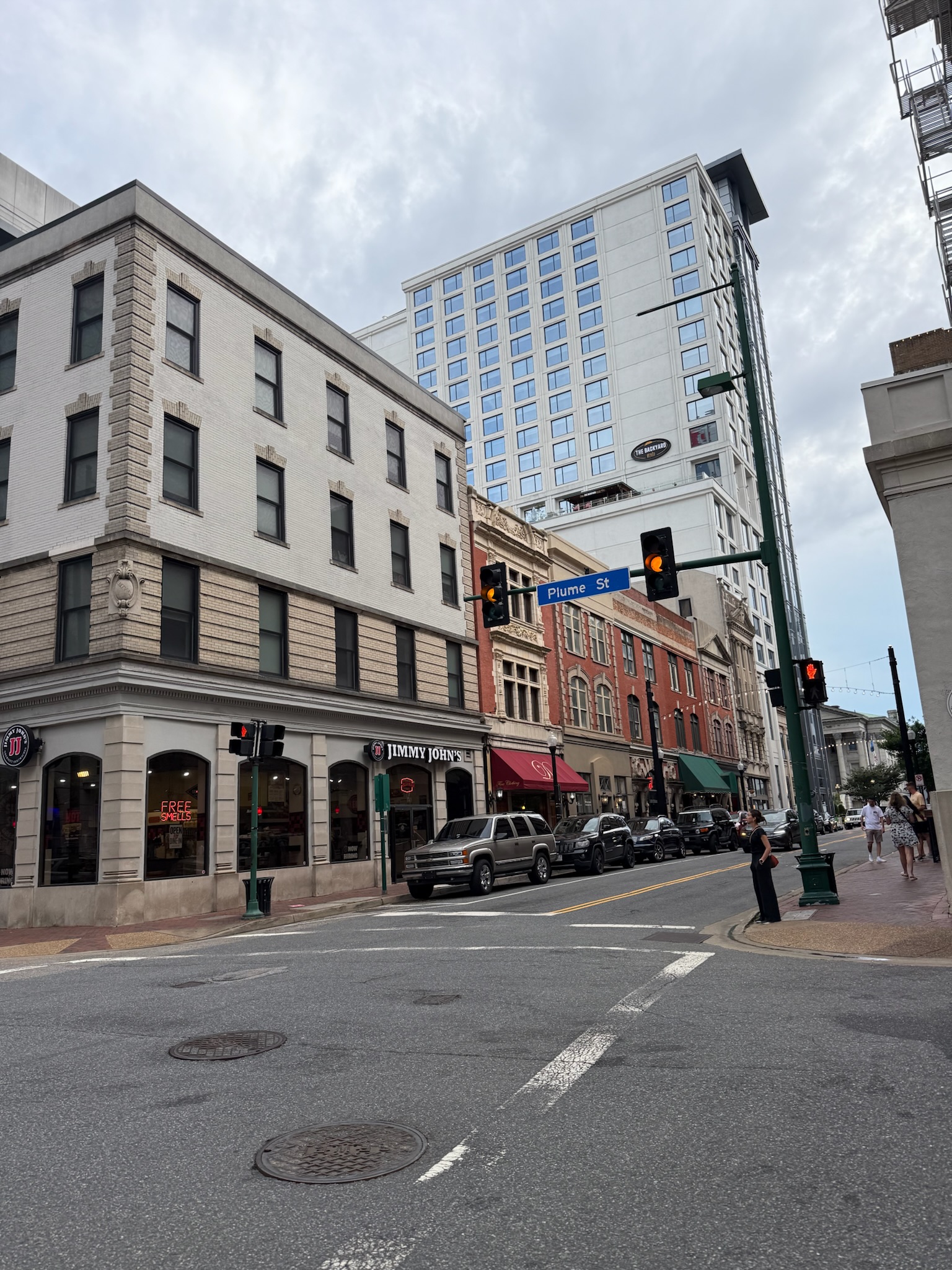
On the way home, the map app routed us back to the freeway along different roads than we’d taken in. We realized there were plenty of historic looking buildings around; they’d just been overshadowed by the newer towers.