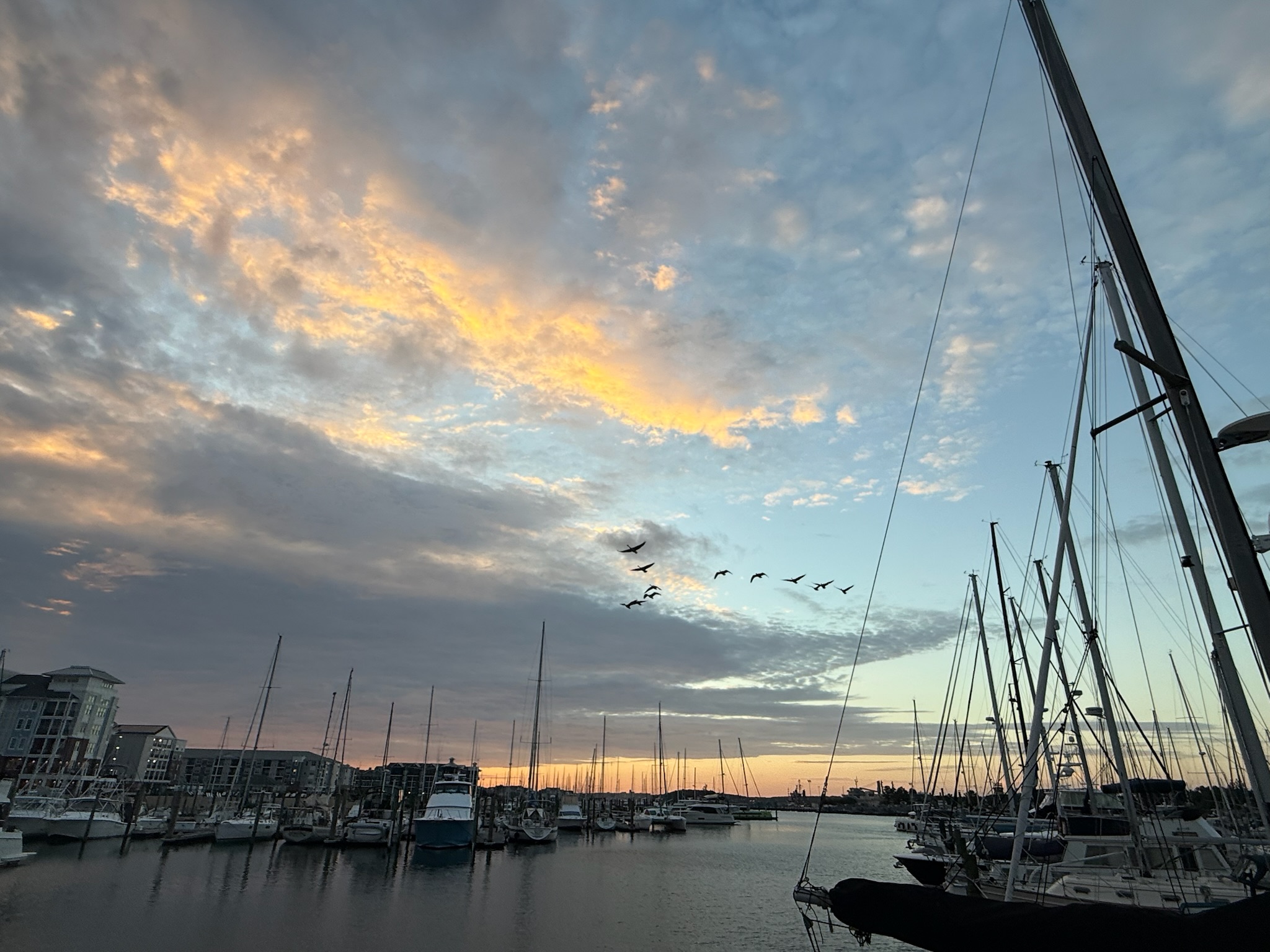
The sunrise on Wednesday, August 6 was blocked by the clouds, but had a neat golden lighting effect.
It was a mellow day. Eric and Christi took care of chores while Keith went to camp, then after camp we ran some errands to prepare for our upcoming passage. One of the errands was a trip to Trader Joe’s in Virginia Beach to stock up on passage food.
On Thursday, it was cool and windy in the morning. We needed to put in sweatshirts to go out! However, the cool didn’t last long. By late morning, it was hot and humid again.
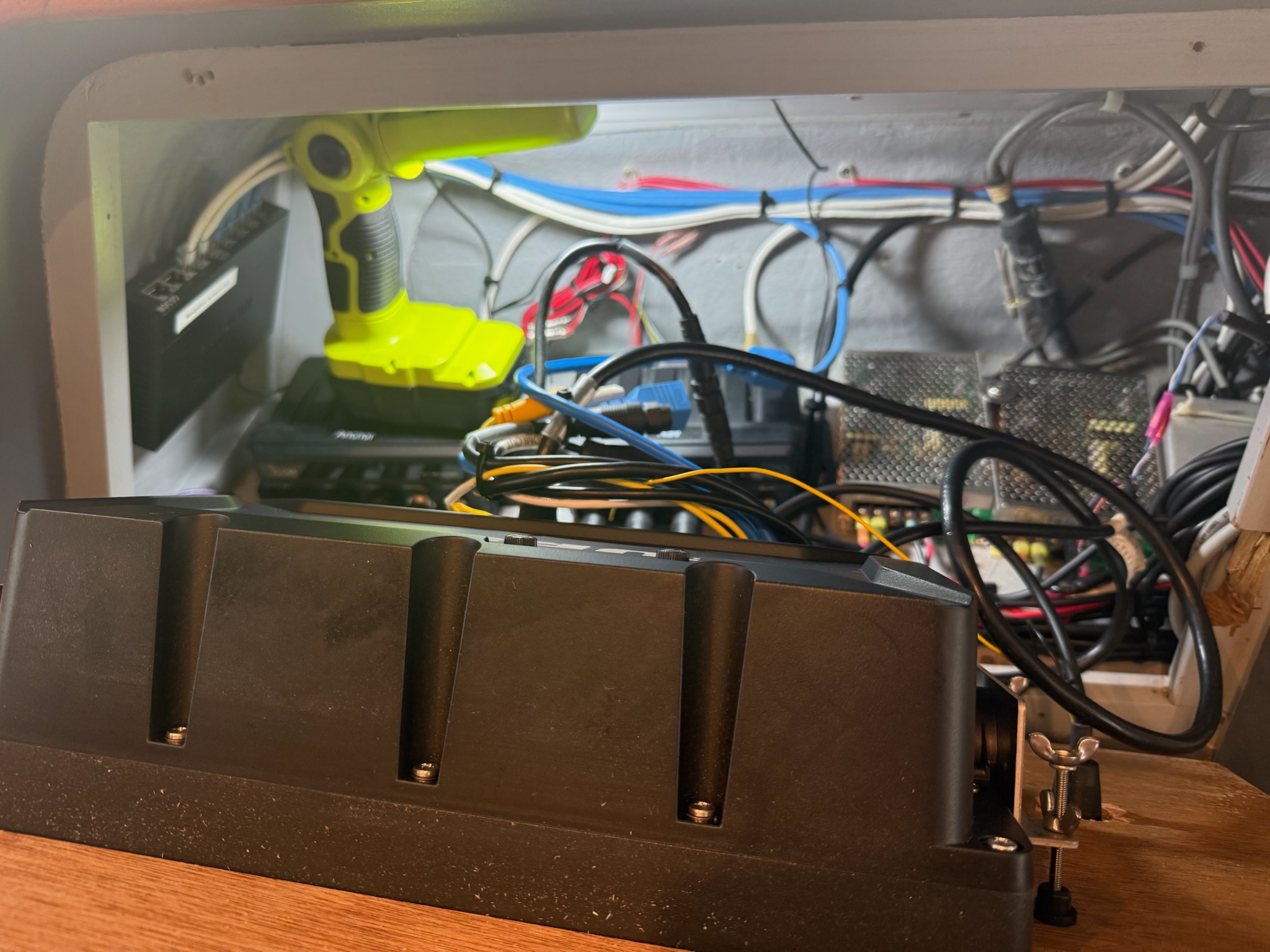
In Deltaville, Eric had noticed that the power supply to the radios wasn’t properly secured. There was only one screw in them, and they did move around when he pushed on, which meat they’d moved in big seas.
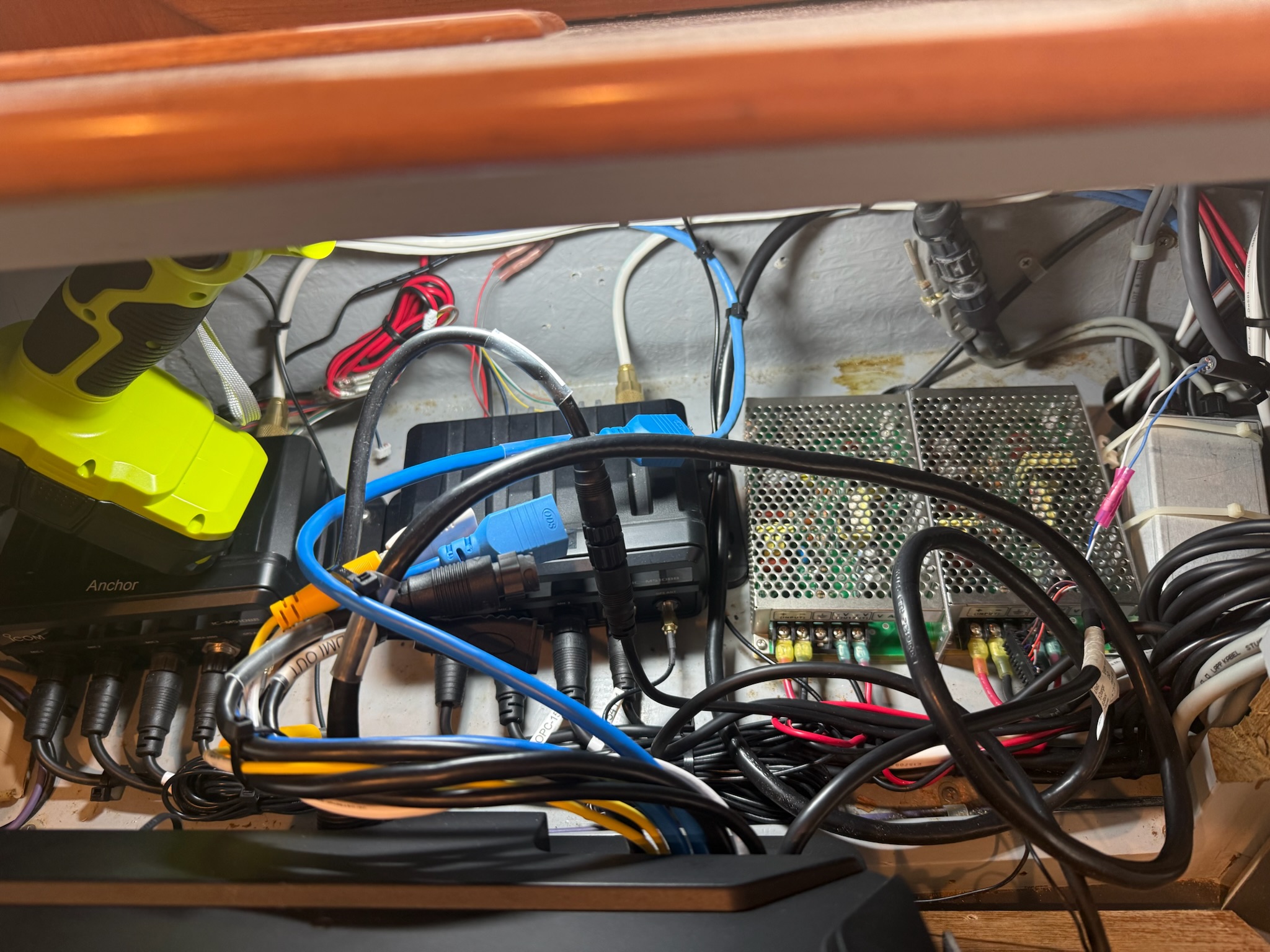
This morning, he opened up the panel and secured it. While he was working in there, he noticed that there was a connector box that was also unsecured. Eric suspects that the radio installer guy had moved it during the DC to DC voltage converter install and never re-secured it when he was done. Eric was pleased to report that everything behind the panel was secure now.
After we picked Keith up from camp, we went to Y Not for a late lunch. In the evening, we went to the Thoroughgood House, which was a historic home, for a Clue-style murder mystery. The City of Virginia Beach was putting on the special event for free as part of the year-long ongoing national celebration of the 250th year of the American Revolution. Both Karen and Miss Roxy had seen it advertised in the local community and had told us about it. Unfortunately, Karen and her family couldn’t attend, but Miss Roxy did, and so did Blue Heeler.
The Thoroughgood House was located near the Lynnhaven River, not far south from the outlet where the river flowed into the Chesapeake Bay. The neighborhood it was in was lovely — mostly residential, with pretty, mostly one-story homes on larger lots. There was free parking in front of the Visitor’s Center.
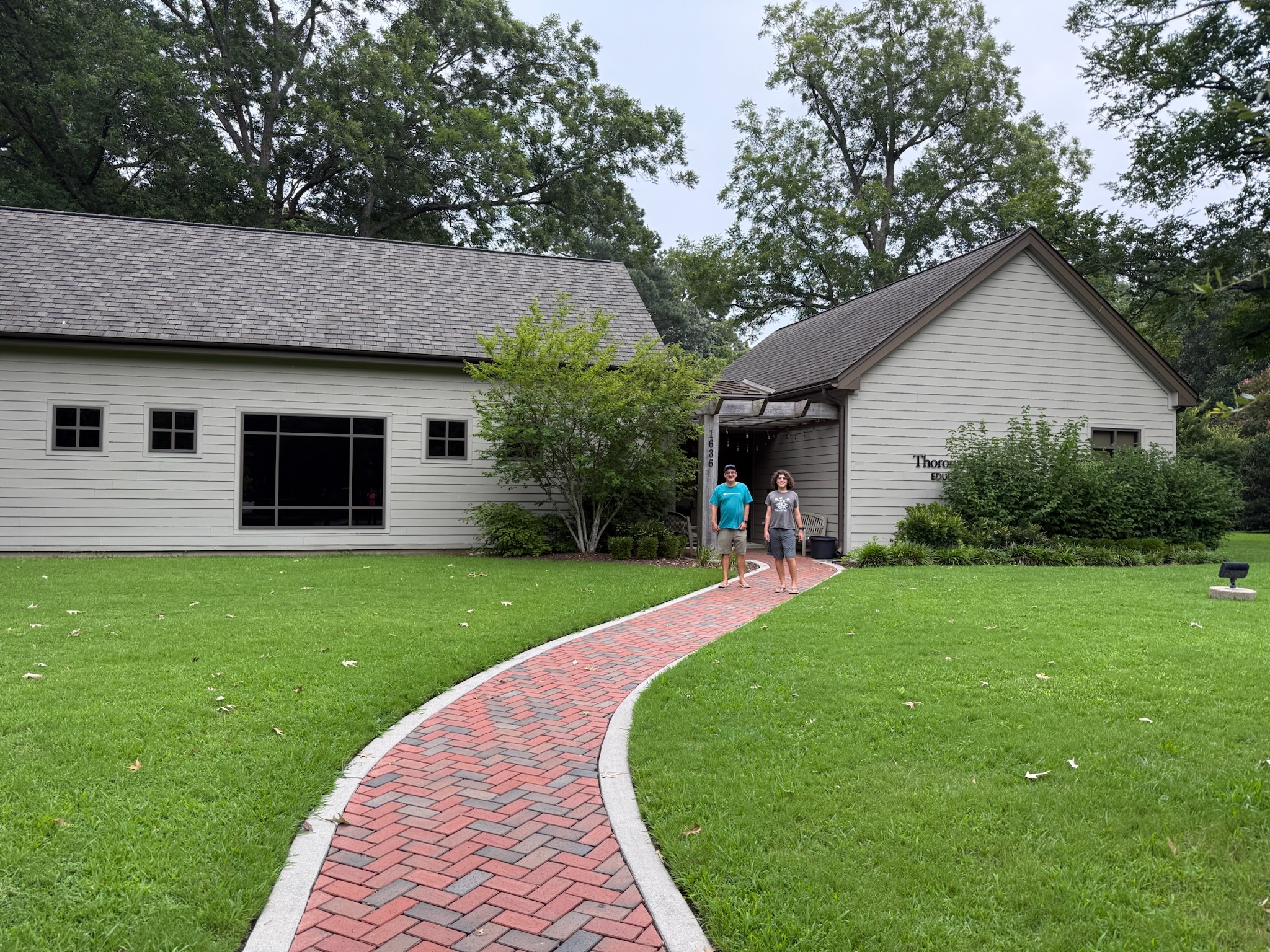
Since we’d arrived a few minutes early, we perused the Visitor’s Center while we waited. The first few signs gave some information on Virginia’s very early history that we’d already learned at Jamestown and at First Landing State Park. One of the signs tied some seemingly separate information together: it was believed that the Powhatan tribe attacked the Chesapeake tribe, decimated them, and ran the survivors out of the area because the Chesapeake had allowed the English Roanoke colonists to settle amongst them (remember that Chief Powhatan was afraid of that prophecy — it made sense that he might think that the Chesapeake, who wouldn’t submit to him, would partner with the whites to create this new nation that would conquer the Powhatan).
Adam Thorowgood moved to Virginia in 1621. He was listed on the 1624/1625 Virginia census as an 18-year old indentured servant. While in servitude, he learned the tobacco trade. By 1626, Adam gained his freedom and purchased 150 acres of land with 100 pounds of gold that had been left to him by his father. He returned to England and married Sarah Offley, the daughter of a prominent London merchant, in 1627. He brought her to Virginia in 1628.
In 1635, he received 5,350 acres of land as a reward for transporting 107 people to Virginia, which at the time, was the largest private patent ever awarded. He later received another patent for 150 acres for bringing the first three Africans to Virginia. And he bought more land, so all in all, he amassed 6,500 acres. On the property he owned was the Chesipean archeological site. From the artifacts found, Historians believe the indigenous people living on this land were wealthy, cosmopolitan, and connected with international trade networks, particularly with the Dutch (the British didn’t give themselves a monopoly on trade with the colonies until 1650, and even after the monopoly, illegal trade with the Dutch continued).
Throughout the rest of the exhibit, Adam, Sarah and their descendants’ personal stories were told in the context of the bigger historical picture. Since we’ve covered the bigger picture in other posts, we’ll just share some of the interesting tidbits of new information that we learned here.
Adam was from a Puritan background, but he became an Anglican. After Adam was awarded the previously unclaimed (by the colonists) land south of the James River, Adam and Sarah moved there and helped established the new county. They hosted the Anglican Church services in their home until a church was built in their area. Adam was regarded as the founding settler of the area and the most politically and socially powerful resident.
Adam and Sarah had four children, who all married prominent people in the community. Adam was a court commissioner. He and his descendants served in the House of Burgess, on court juries, and in the militia throughout the 17th and 18th centuries. Adam died suddenly in 1640.
A year later, Sarah remarried to John Gookin. She and John had one daughter, and John died in 1643. This daughter also married prominently. Sarah continued to run the plantation on her own. In 1647, Sarah married again, this time to the youngest son of the Royal Governor of Virginia, named Francis Yeardley. A chief of a native village asked Francis and Sarah to educate his son. They took the boy in and not only educated him, but converted him to Christianity. It sounds like the natives were supportive of the conversion. Francis died in 1655. Sarah died in 1657.
Adam and Sarah had lived about two-miles from here. It sounds like the original home was under more modern house lots, so only some limited excavations have been done on the original home, which was where many of the artifacts and information in this museum originated. Most of the rest of the information came from court records. One of the records indicated that they had a malt house to convert grain to malt for brewing. It may have been the first malt house in Virginia. Even though they were extremely wealthy, artifacts recovered from their home indicate that, while they some had some fine items consistent with the upper class, overall, their lifestyle did not reflect their wealth.
As was briefly mentioned in First Landing, in the Chesapeake Bay, pirates attacking merchant ships and raiding homes near the shore became a problem in the late 17th and early 18th centuries. In 1690, the governor ordered Adam’s grandson, Argail Thorowgood, to watch for pirates at the mouth of the Lynnhaven River and report all incoming ships to the militia. Witchcraft was also a big scare at about that time.
The historic home on this site was built by Adam’s great-grandson, Argall Thorowgood II, around 1704. He died in 1719, while the house was still under construction.
In 1730, more than 200 slaves from Norfolk and Princess Anne (the county Virginia Beach was in) counties escaped to the Dismal Swamp in the largest slave uprising of the colonial era. They were captured, and many were hung. After that, the General Assembly ordered slave patrols.
In 1775, when Lord Dunmore offered freedom to any slave who fought for the British, seven of the Thorowgood slaves ran away and joined the British military. One of the slaves was named George Wise. After the war, the British relocated him and his family to Nova Scotia, where they were given 40-acres of land. Apparently, there were racial tensions between the black and white Loyalists who had been resettled in Nova Scotia. Mobs of white Loyalists burned down the homes of black Loyalists. 1200 black Loyalists moved to Sierra Leone, Africa, but George and his family stayed in Nova Scotia. in The signs didn’t say whether the rest of the Thorowgood slaves were returned to them after the war.
On November 14 – 15, 1775, Lord Dunmore’s forces attacked Kempe’s Landing, which was just a few miles away from the house. Seven Patriots were killed and 18 captured, including William Thorowgood. They were the first Virginia casualties of the American Revolution.
In one of our Yorktown posts, we’d talked about how in 1781, General George Washington had coordinated with the French military to trap the British at Yorktown. We’d mentioned that in early September of that year, a French navy fleet under Admiral de Grasse had stopped the British from sending reinforcements and supplies into the Chesapeake Bay while Washington and his French counterpart, the Compte de Rochambeau, were marching their ground troops down to Virginia. On September 18, Washington and Rochambeau boarded de Grasse’s ship in Lynnhaven Bay to discuss their plans for the siege. It was the first time the three commanders had met together face to face.
The spelling was modernized to Thoroughgood in the 20th century. In the 1950s, it was renovated to look like a typical house in the 17th century would have looked like — so what a house would have looked like in Adam and Sarah’s era, not the era when it was built. It opened to the public as a historic museum in 1957.
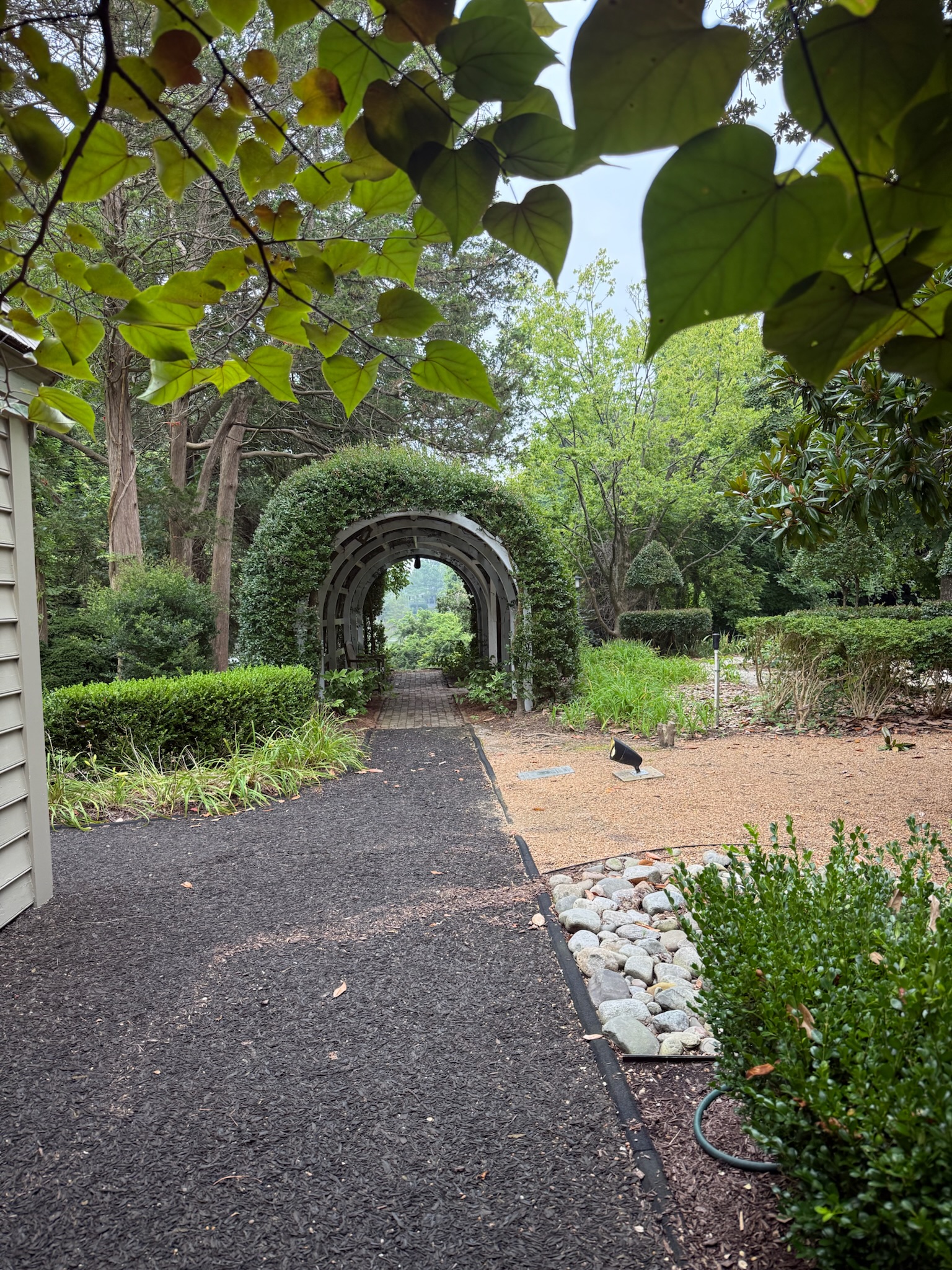
At 1730, the murder mystery participants were called outside to the back patio of the Visitor’s Center to go over how the game worked. Once outside, we realized there was a garden area behind the Visitor’s Center/house, but we never made it over to the garden.
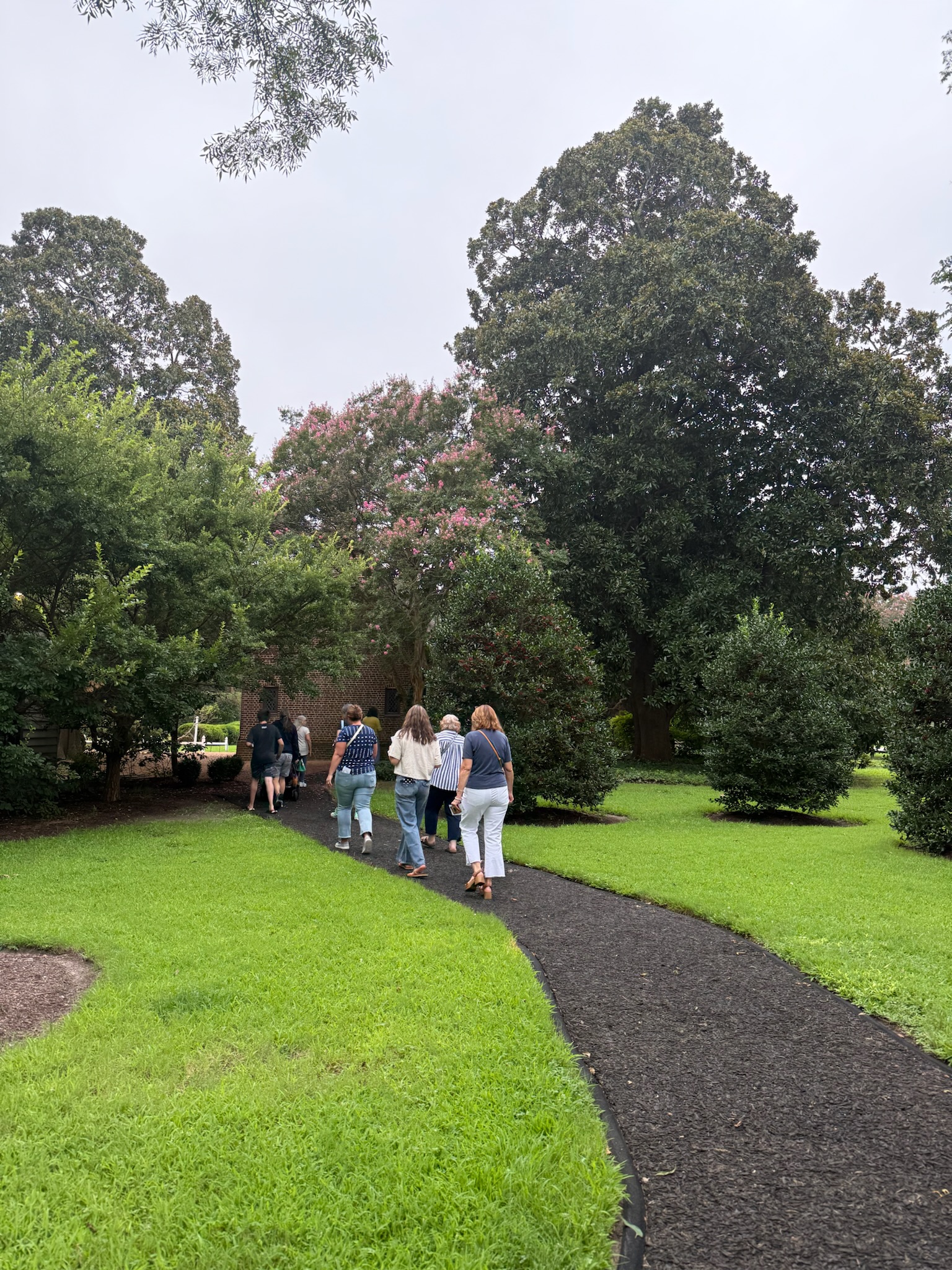
They passed out cards with a list of suspects, weapons and locations. The suspects were historical figures and the weapons were historical events. We were trying to find the person who killed the British rule over the colonies, where it happened and with what weapon. Keith audibly groaned at this. We would tour the house, and in each part of the house, would meet a suspect and hear their version of the events that took place. They’d also pass out clues along the way. We were allowed to share information. We set off down the short path to the house.
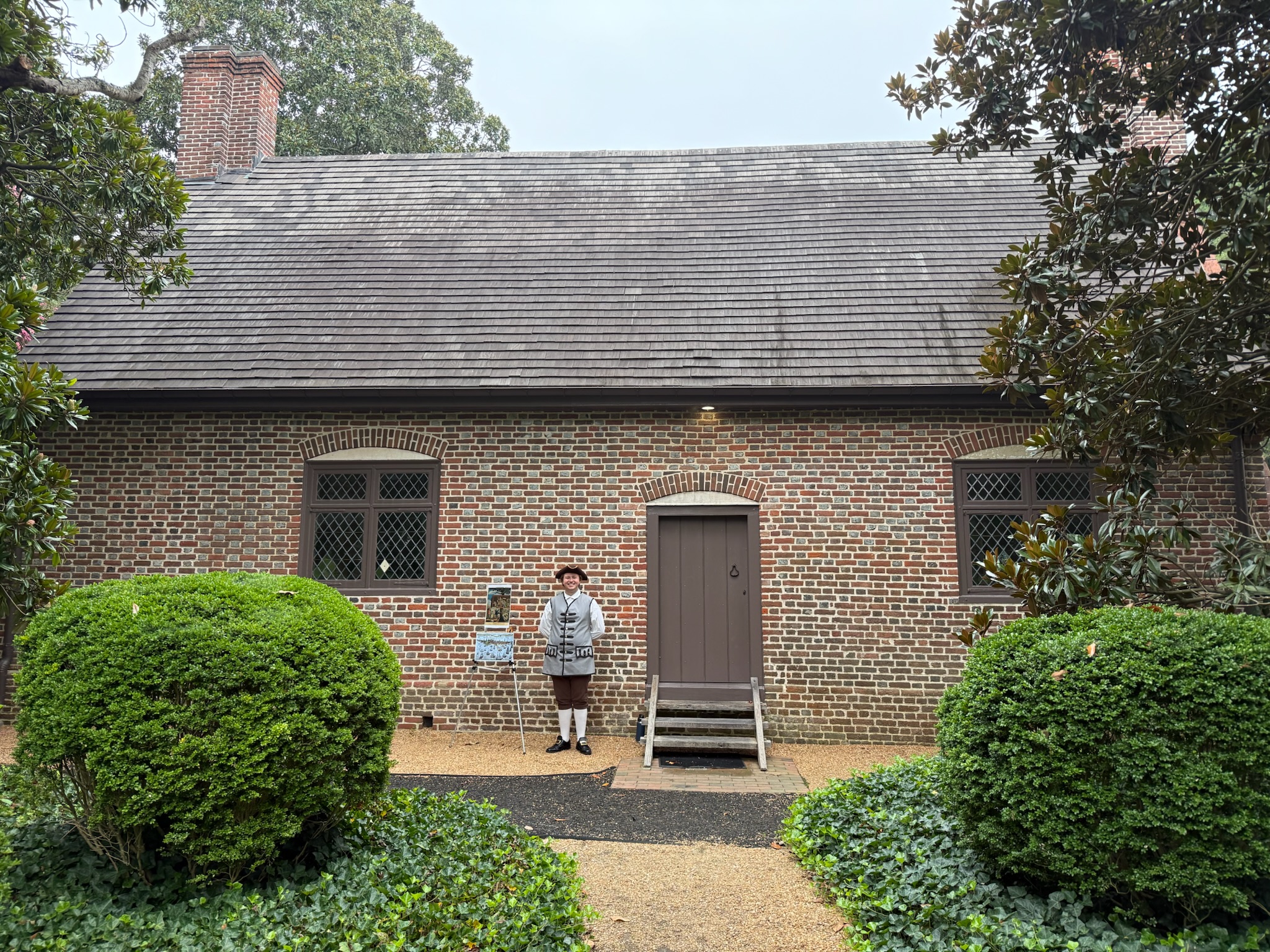
We were greeted at the front door by Patrick Henry. Patrick told us about how he was raised in Virginia. He’d tried being a farmer and a proprietor, and failed at both. But, since he was a great orator, found his calling in law and politics. He became a prophet for the cause of the American Revolution. As a member of the House of Burgess, he championed resistance to the Stamp Act of 1765. He was most famous for a speech he gave “…but as for me, give me liberty or give me death!” That speech became a rallying cry for the revolution. He helped draft the Virginia State constitution and served as governor of Virginia for two terms while the war was in full swing. He said he was proud to be a major contributor to the lead up to the murder of British rule, but he was not the actual killer.
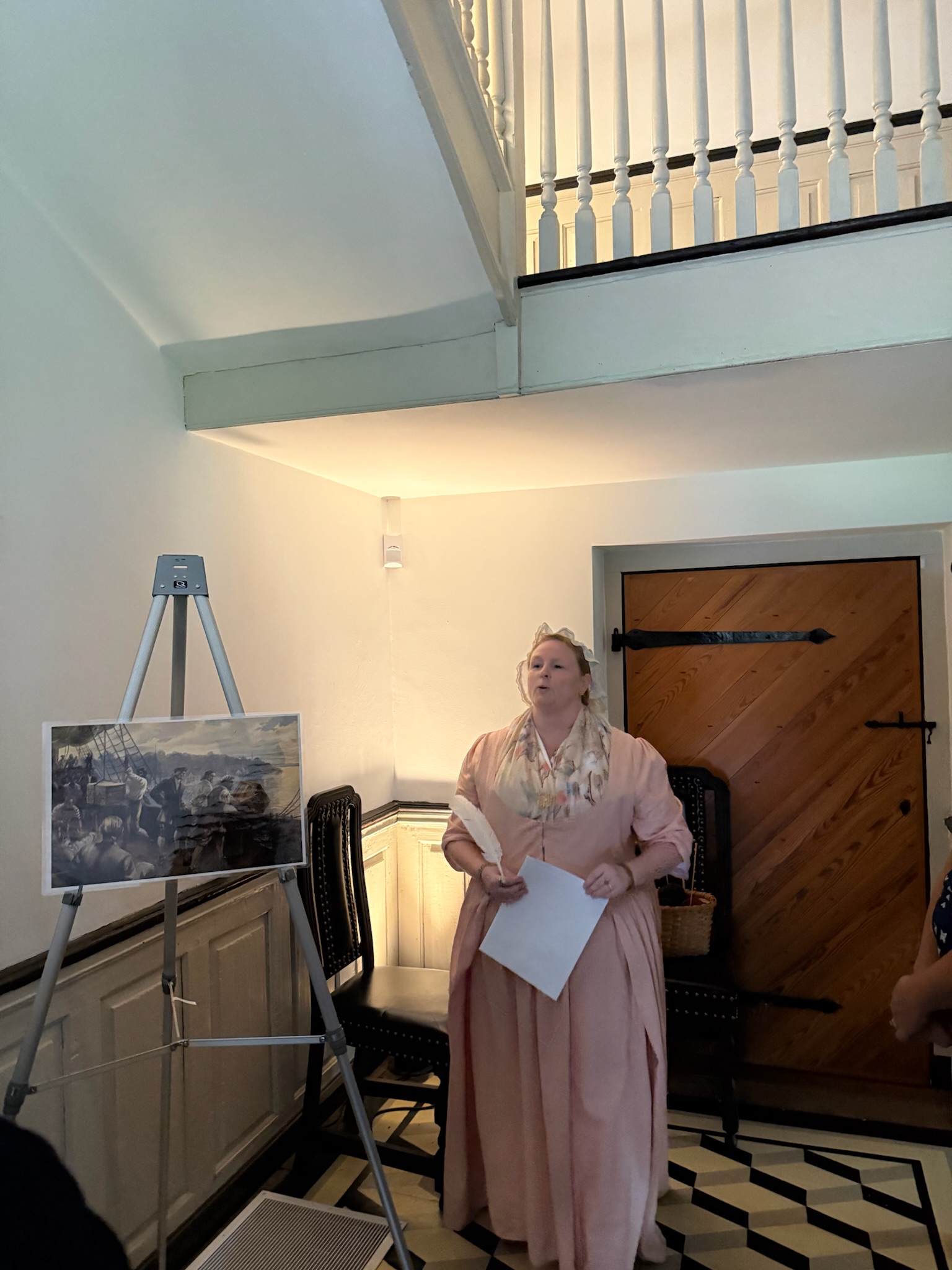
Inside the foyer, we were greeted by Martha Washington. We knew that George had no biological children of his own, but we had no idea that he had raised two families! Martha told us that she had had four children with her first husband. Her husband and older two children died. She married George when her remaining children were two and four, and he raised them. The girl died when she was 17 and the boy died in adulthood. Upon the boy’s death, George and Martha took custody of and raised his kids.
Martha told us about how she had aided the troops on the lines in a number of ways. She said it was a struggle for her to continue to care for their plantation at Mt. Vernon while they were living in Pennsylvania and later DC while George was president. She said several times that her husband was able to accomplish so much because she was behind him, helping him. She said that when George died she was so grieved that she couldn’t go to the funeral, but many important people came to offer condolences to her at her home. She also stated that she was proud to have helped with the lead up to the murder of British rule, but she was not the actual killer.
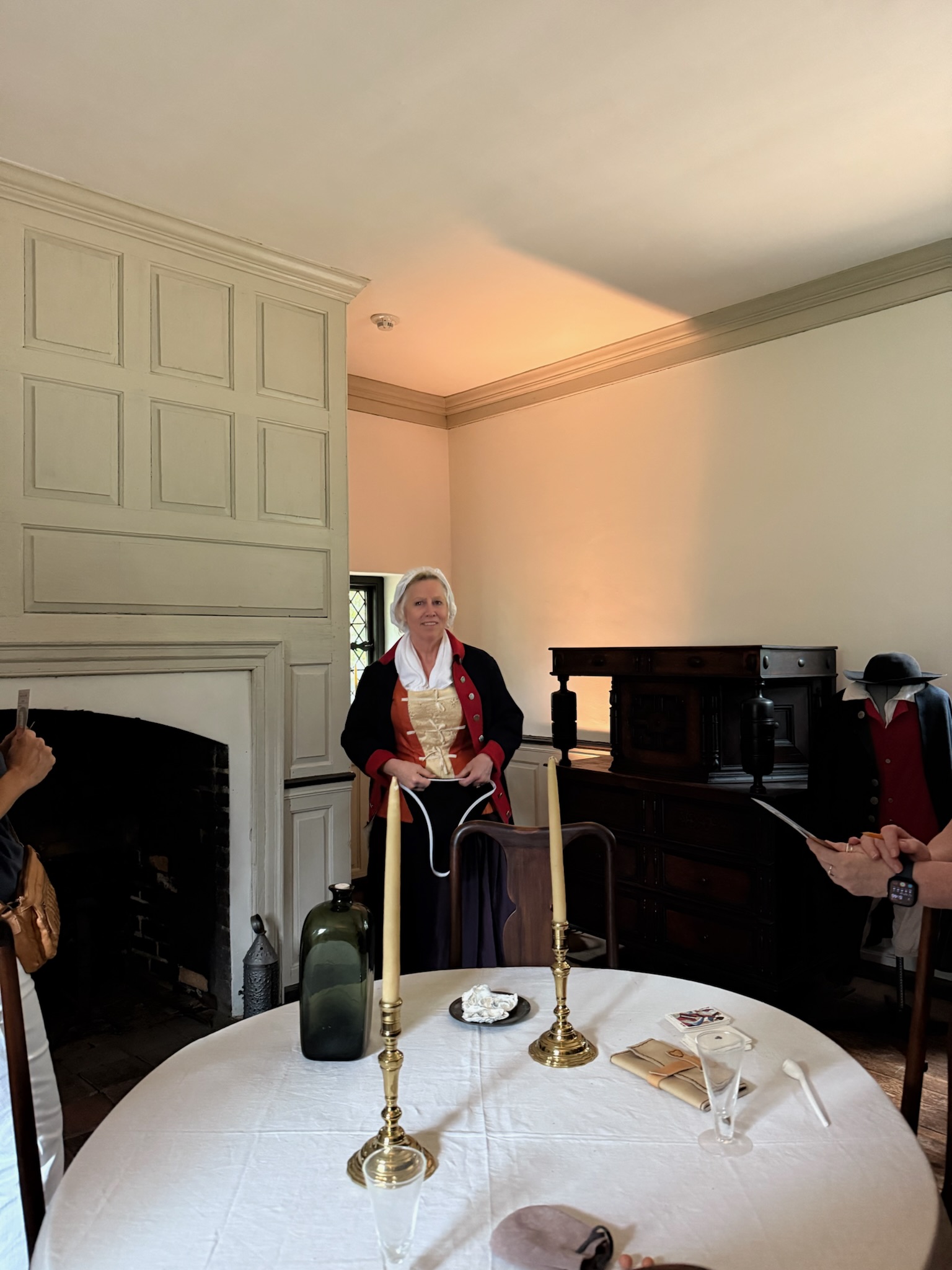
Next we went into the parlor, where we were greeted by Anna Marie Lane. None of us had ever heard of her before. She told us that when the war started, she didn’t want to be a nurse or seamstress or some other job aiding the troops that women on the front lines were relegated to — she wanted to fight. She served alongside her husband as a soldier in battles, pretending to be a man. They didn’t do physicals back then; the only health requirement was to have your two front teeth so that you could open the gun powder that went inside the musket. They didn’t bathe or change clothes often, so it was easy to hide her gender from the men. She was hurt in a battle and never got medical attention – probably to hide that she was a woman – which left her with a permanent limp, but she kept fighting even with the limp. She served in the Battle of Yorktown. When the war was over, she requested a pension from the military. The military didn’t know what to do with her because she didn’t properly fit any of the categories. Eventually, the military awarded her a pension of $100 year, which was extraordinary because the average pension for soldiers was $40 per year.
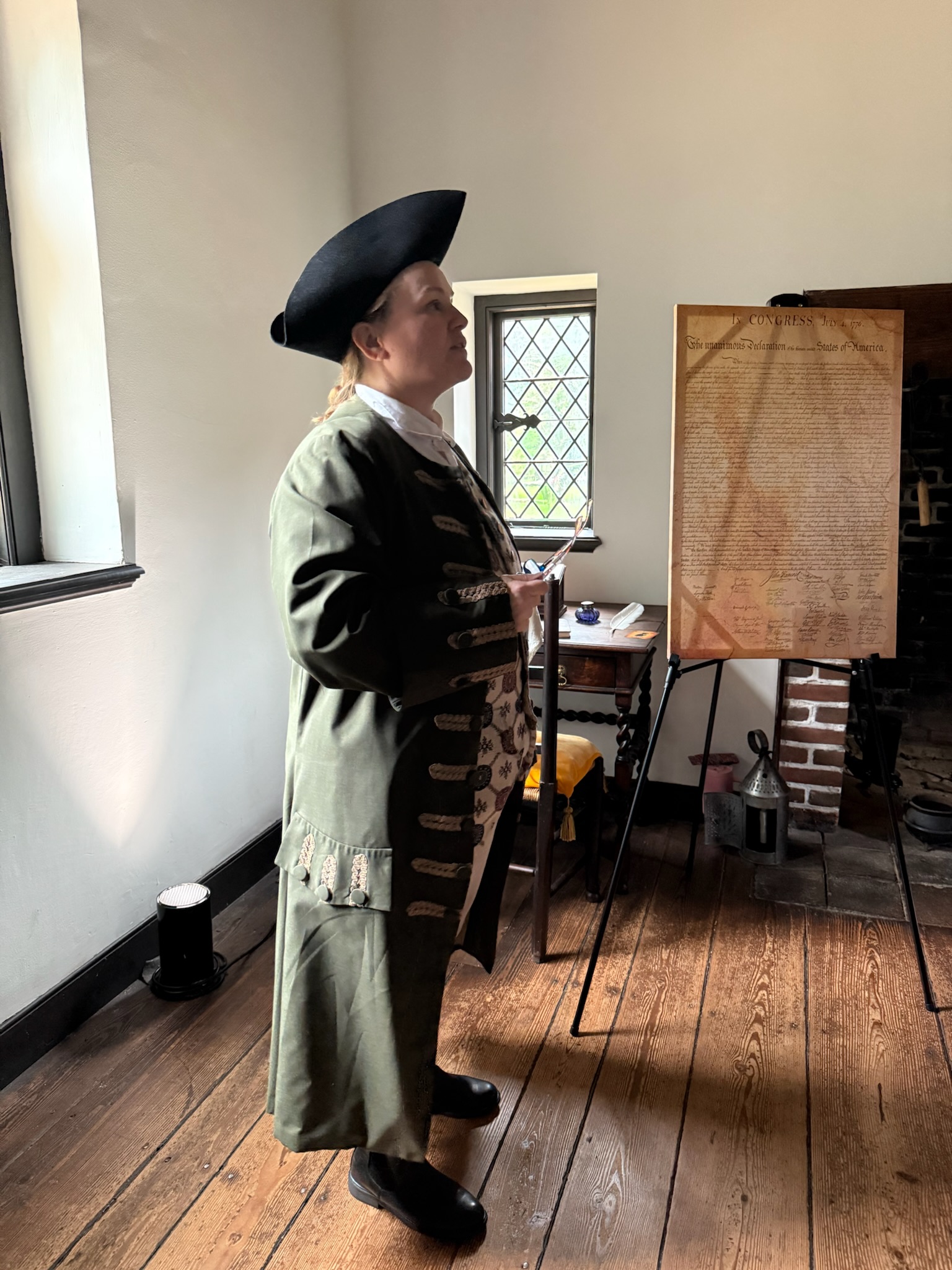
We went upstairs to an office where we were greeted by Thomas Jefferson. He told us he was a lawyer, scientist, philosopher, architect, inventor and statesman. He was active in politics and opposed Great Britain’s control of American affairs. He drafted the Declaration of Independence. He became a governor of Virginia during the war, an ambassador to France, and the third president of the United States. The majority of what he talked about was his internal struggle — he was the son of a wealthy Virginia plantation owner and had inherited a lot of money that was made via slavery. He owned slaves himself. However, he personally opposed slavery. He justified his hypocrisy to himself by stating that he knew he couldn’t do the work he did for the greater good without slaves caring for his personal daily needs and bringing in money so he could continue to focus on politics instead of working for money. He also stated that he was proud to be a major contributor to the lead up to the murder of British rule, but he was not the actual killer.
From there, we moved to the next room over, a bedroom. Gilbert du Montier, the Marquis de Lafayette greeted us. He told us he was born in France to an extremely wealthy and prestigious family. He inherited his money when he was very young. He was an enthusiastic supporter of the American revolution. In 1776, when he was 19, he went to America to serve as a major general under George Washington. He had no military experience, but money and connections to highly influential people could apparently buy positions of power in the US at that time, too. To be fair, the Marquis did help tremendously in the war effort. He valiantly served in battles. He was injured during a battle and went back to France, where he was a key player in getting France to join the Revolution. After returning from France, he returned to American military service and participated in the Battle of Yorktown. After the war ended, he returned to France and was a key player in the French Revolution. He also stated that he was proud to be a major contributor to the lead up to the murder of British rule, but he was not the actual killer. The person playing the Marquis spoke with an accent that was not French, and it drove Keith bananas to listen to him.
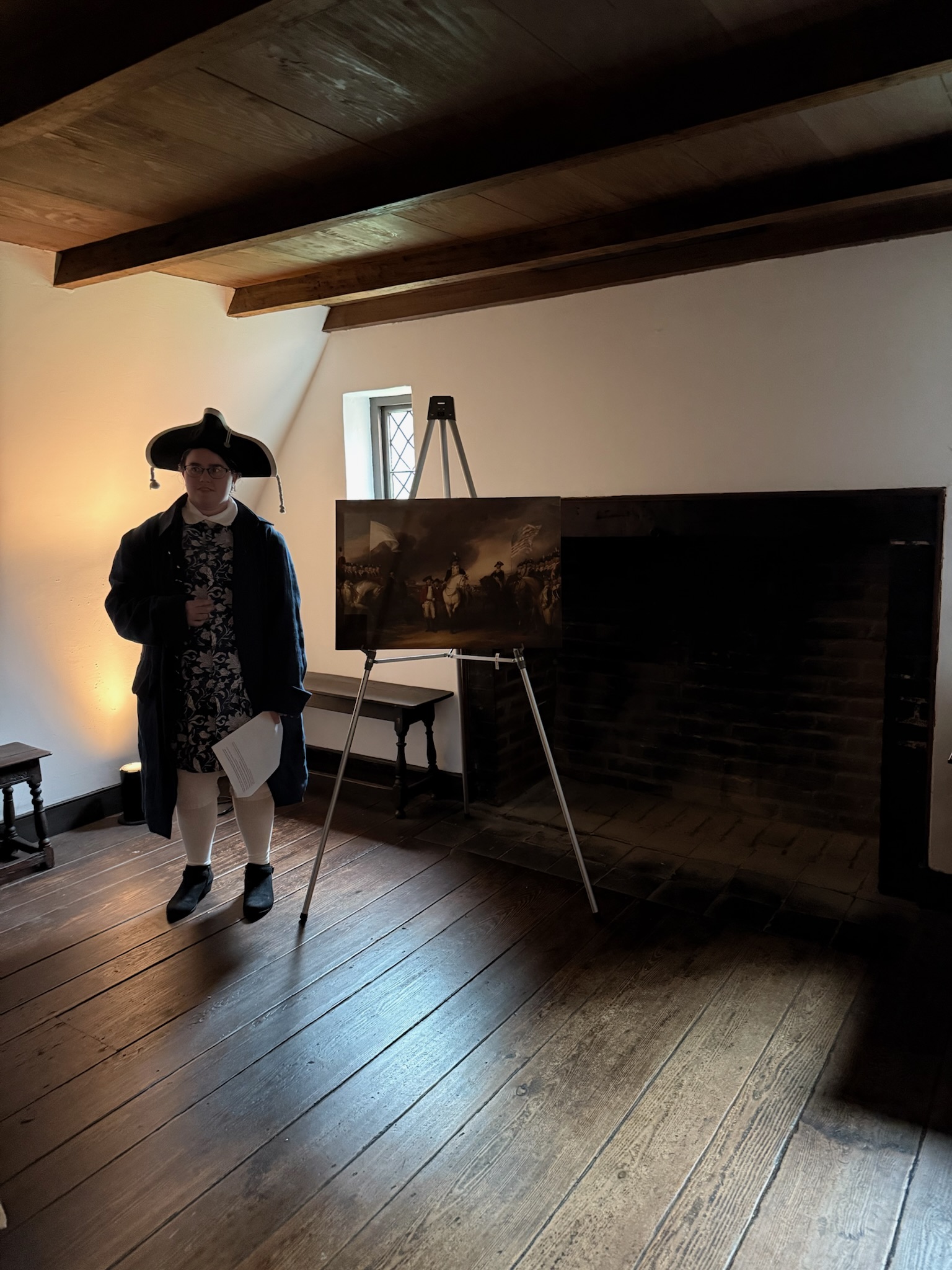
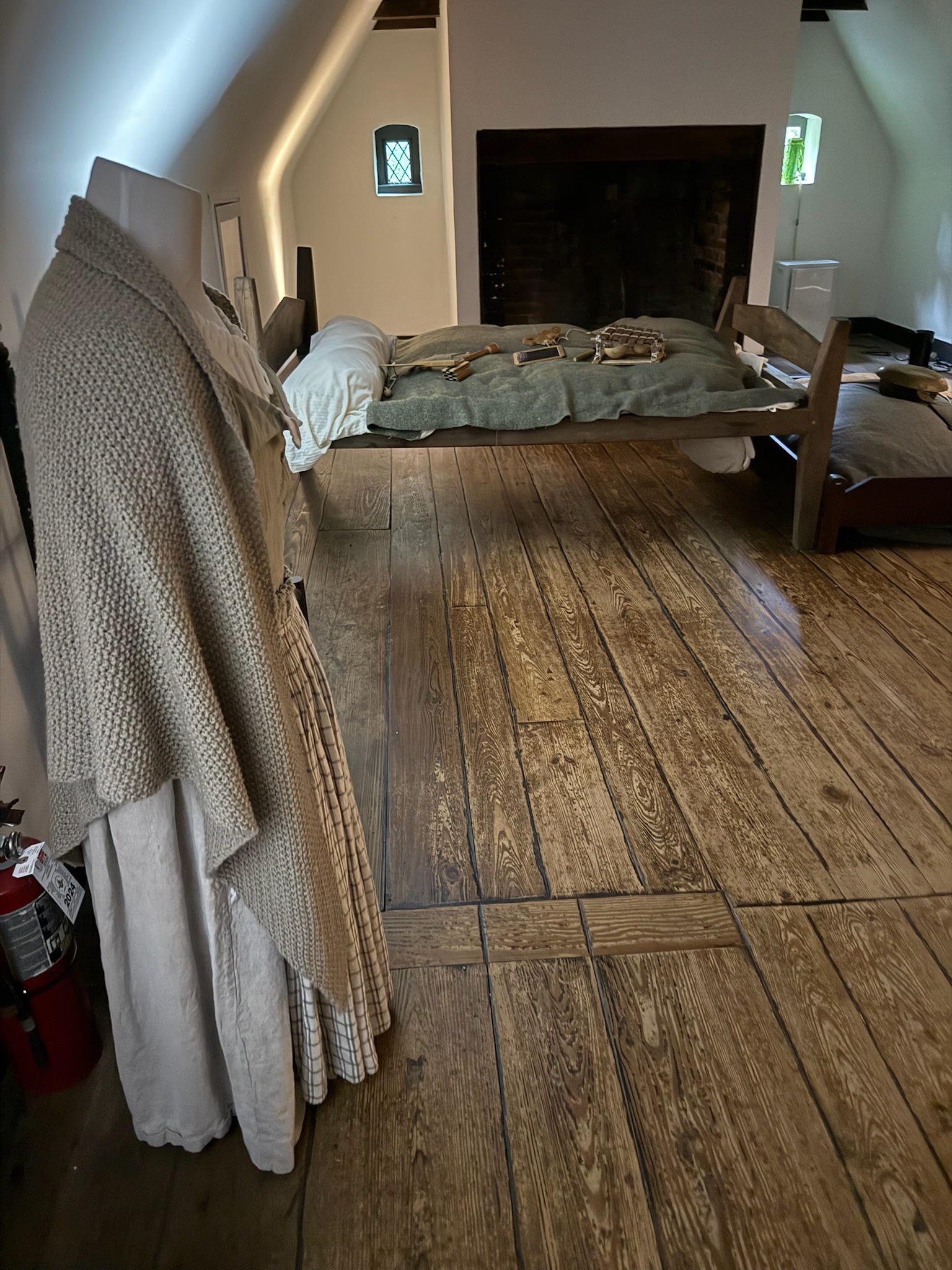
Going into this, we knew that the weapon was the Battle of Yorktown. At this point, we knew the murderer had to be Anna: 1. she was the only one who hadn’t denied being the murderer and 2. She was at the Battle of Yorktown. There was one more room upstairs that we had walked by, a loft that was set up as a bedroom.
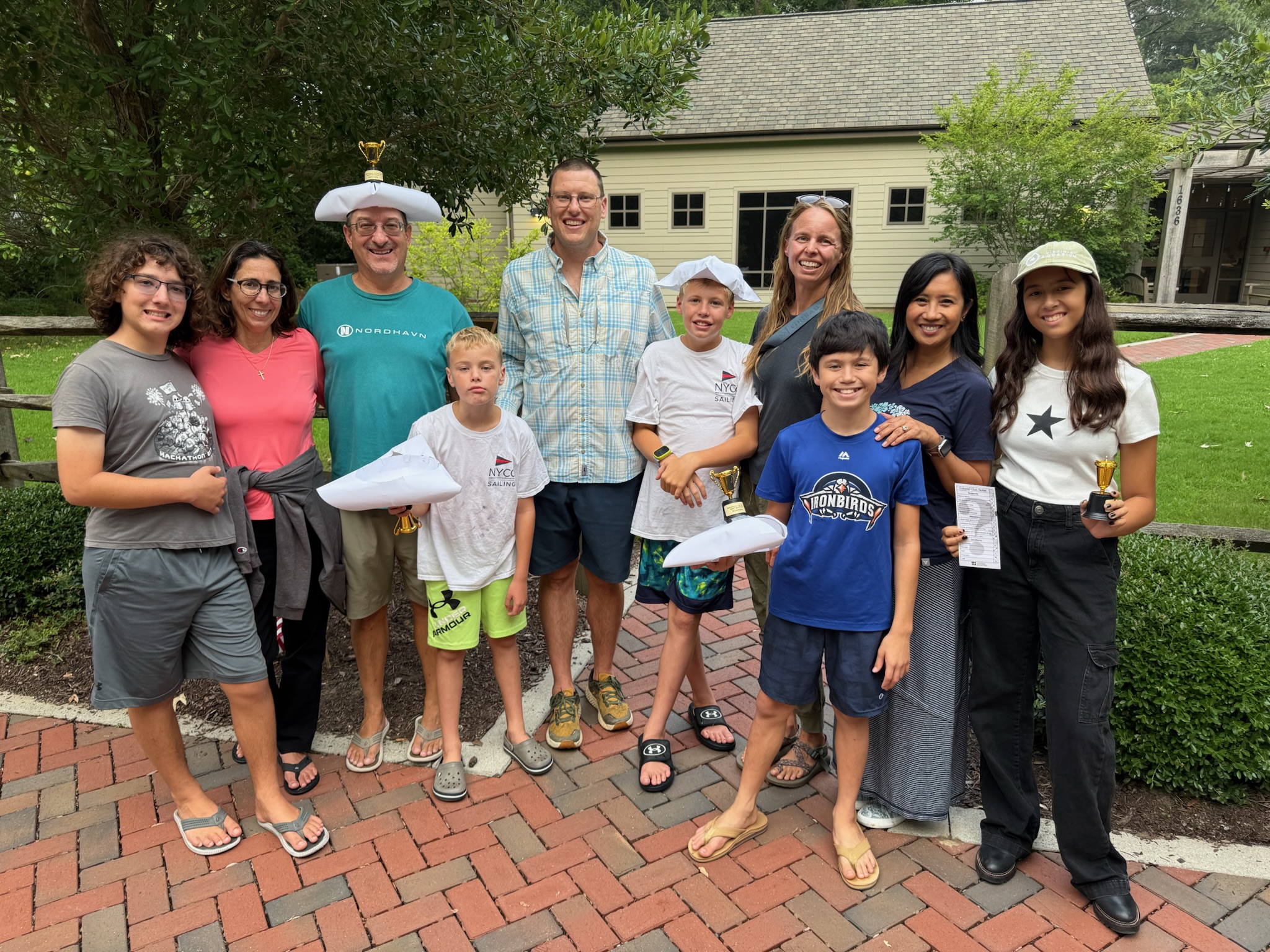
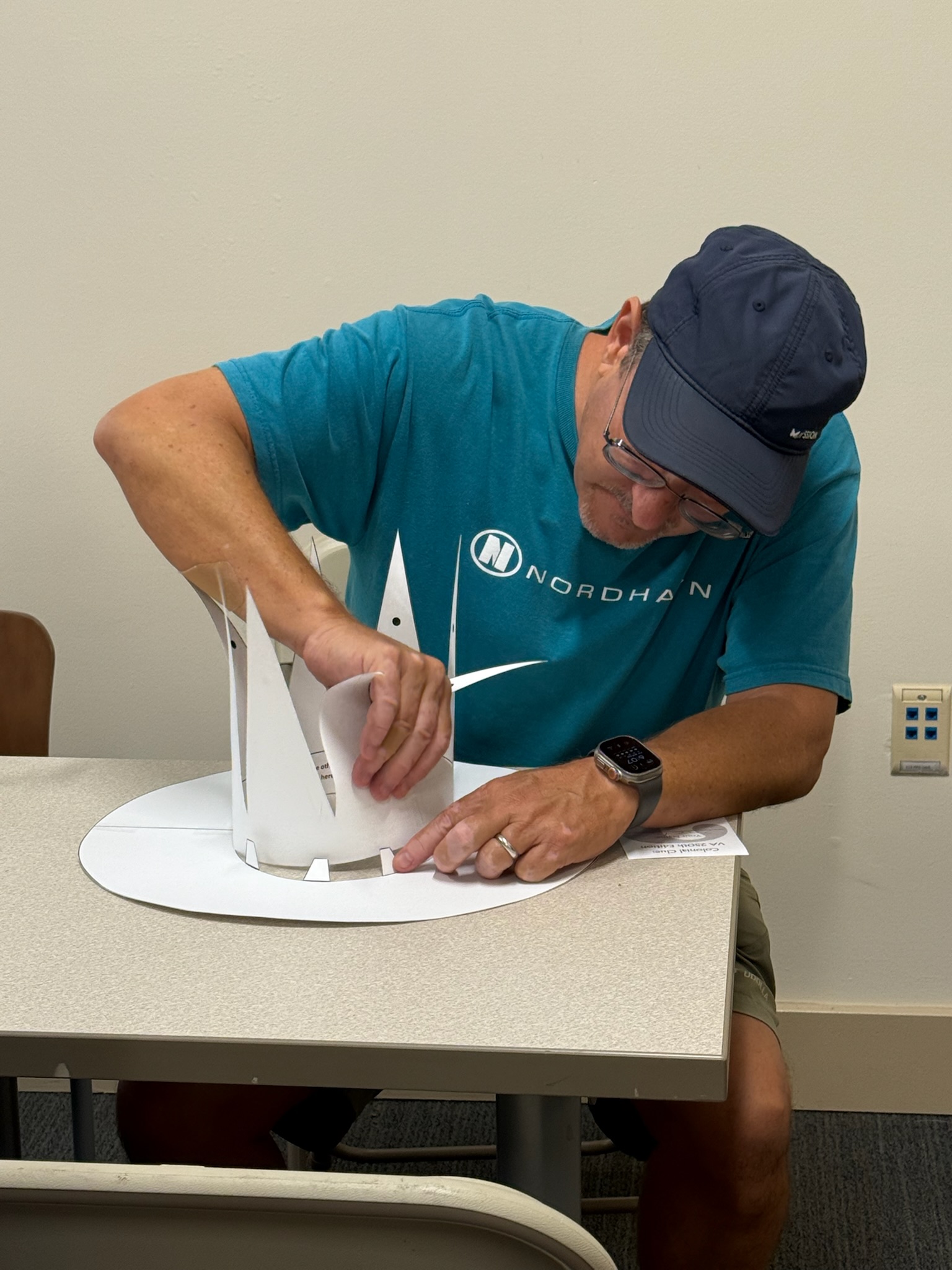
When the event was over, we were escorted back to the Visitor’s Center, where we were given participation trophies. The kids were invited to make tri-corner hats. Keith declined, so Eric made Keith’s hat for him.
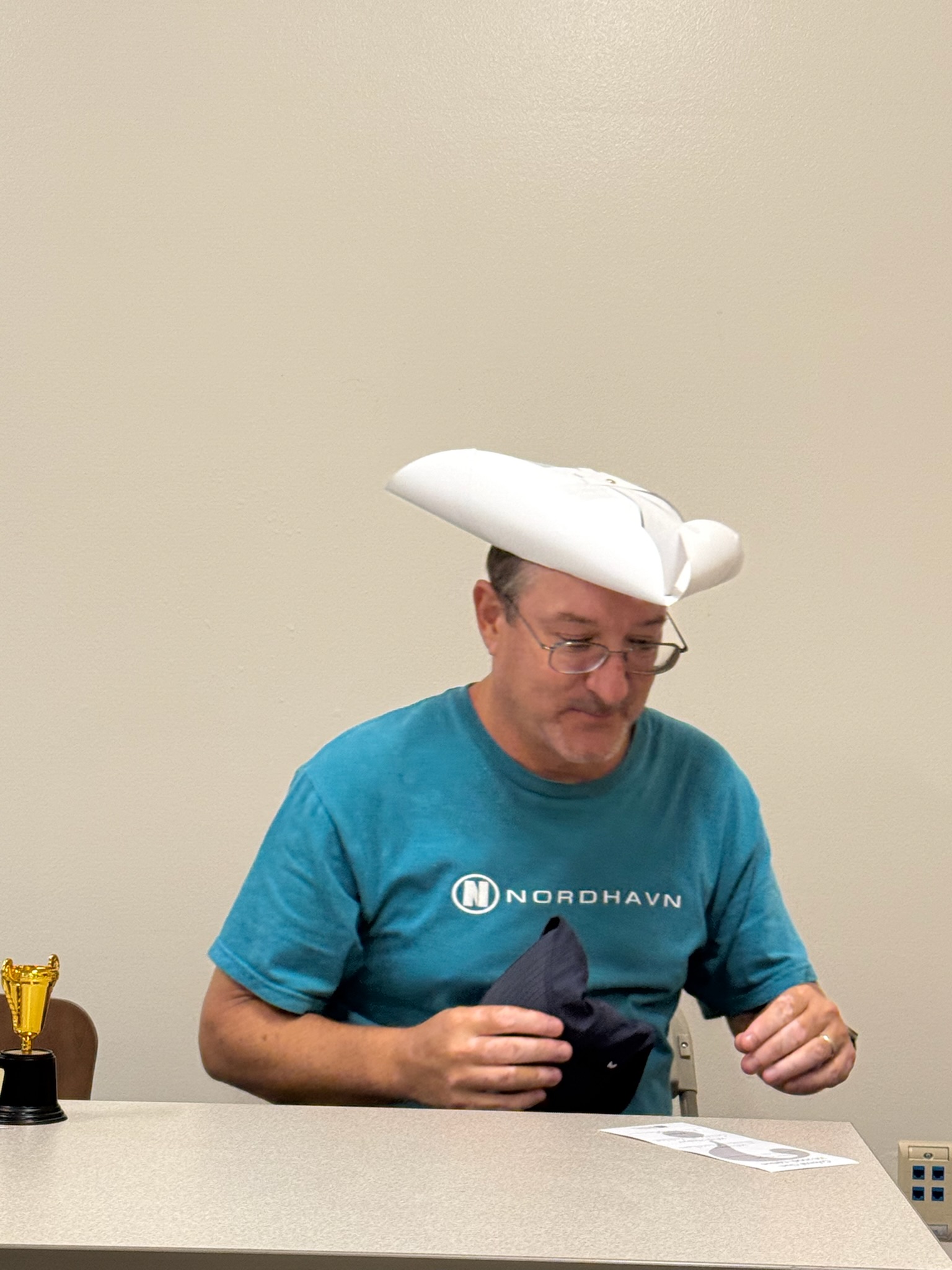
Everyone in our group stuck their participation trophies on their hats.
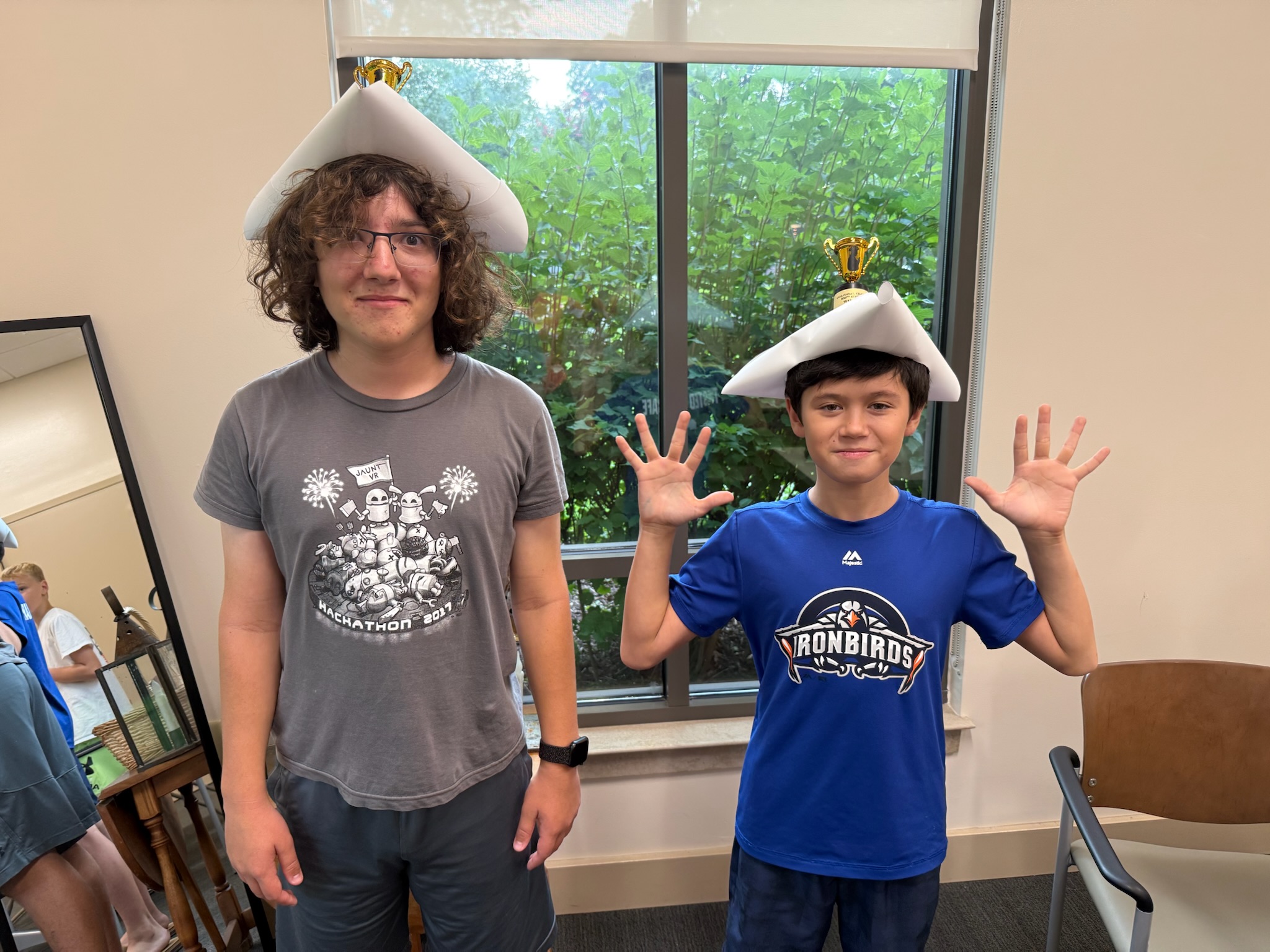
Group shot as we were departing.