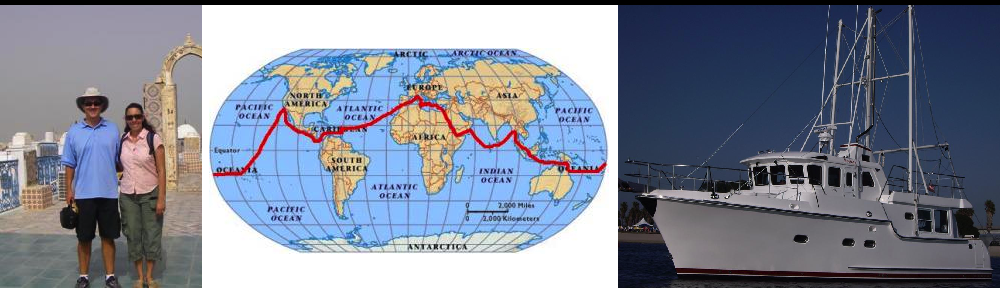
Monday, August 11, 2025 — In the early morning, the weather was great and there were lots of people out. Eric and Keith started the day out with a 1.4 mile walk, heading west along the waterfront towards downtown. Directly next to the large metal condo complex near the marina office (in yesterday’s photos) was a large development of newer- looking townhouses, and they saw mostly these townhomes for the majority of the walk.
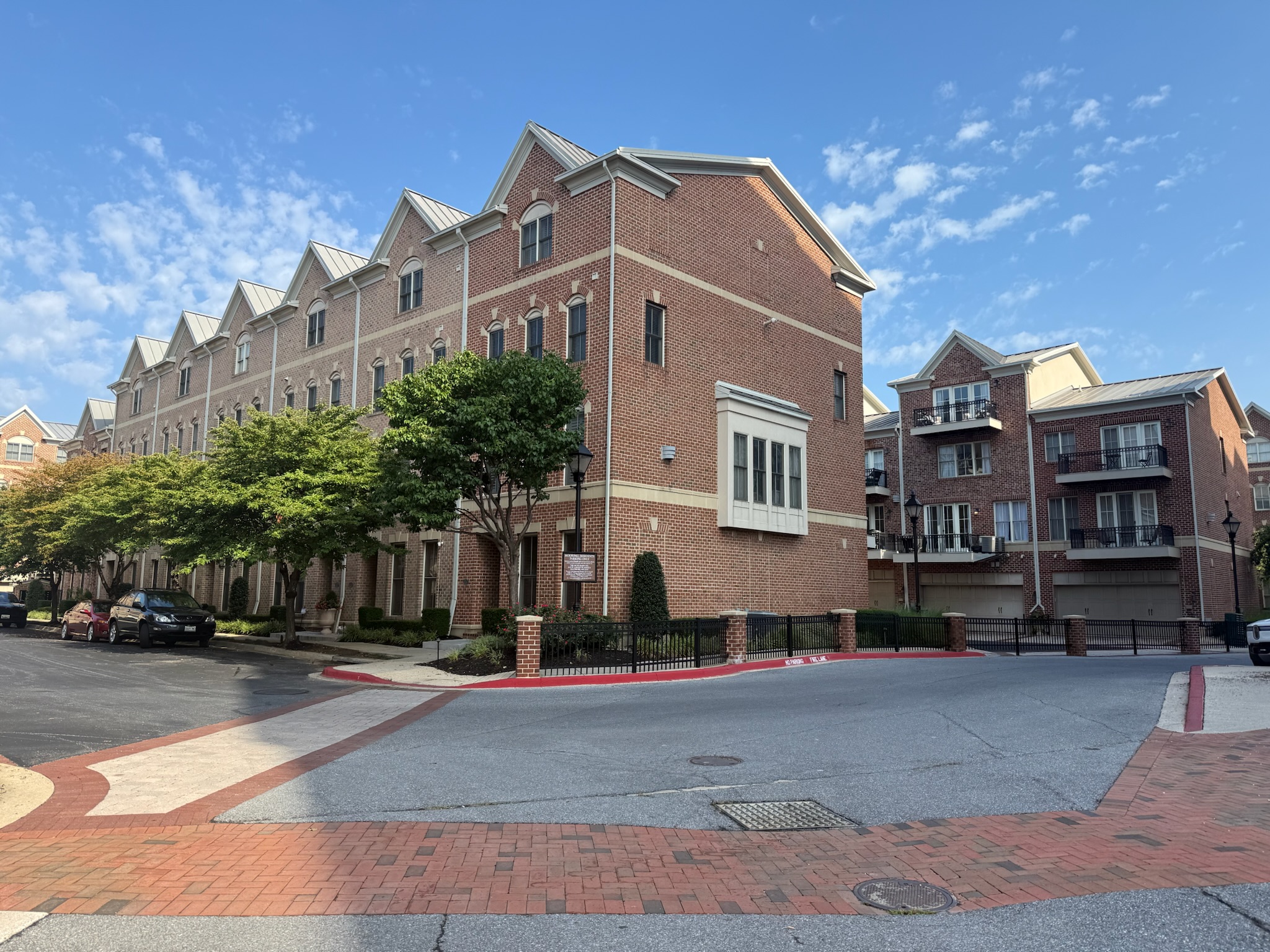
We’d decided to go to Ft. McHenry today. Since there was a ferry stop near us and one at the fort, it looked like it would be easy to get there. We walked east along the waterfront for 1/4 mile to the Canton Waterfront Park Terminal. Here is a shot taken from the ferry terminal looking back towards the marina.
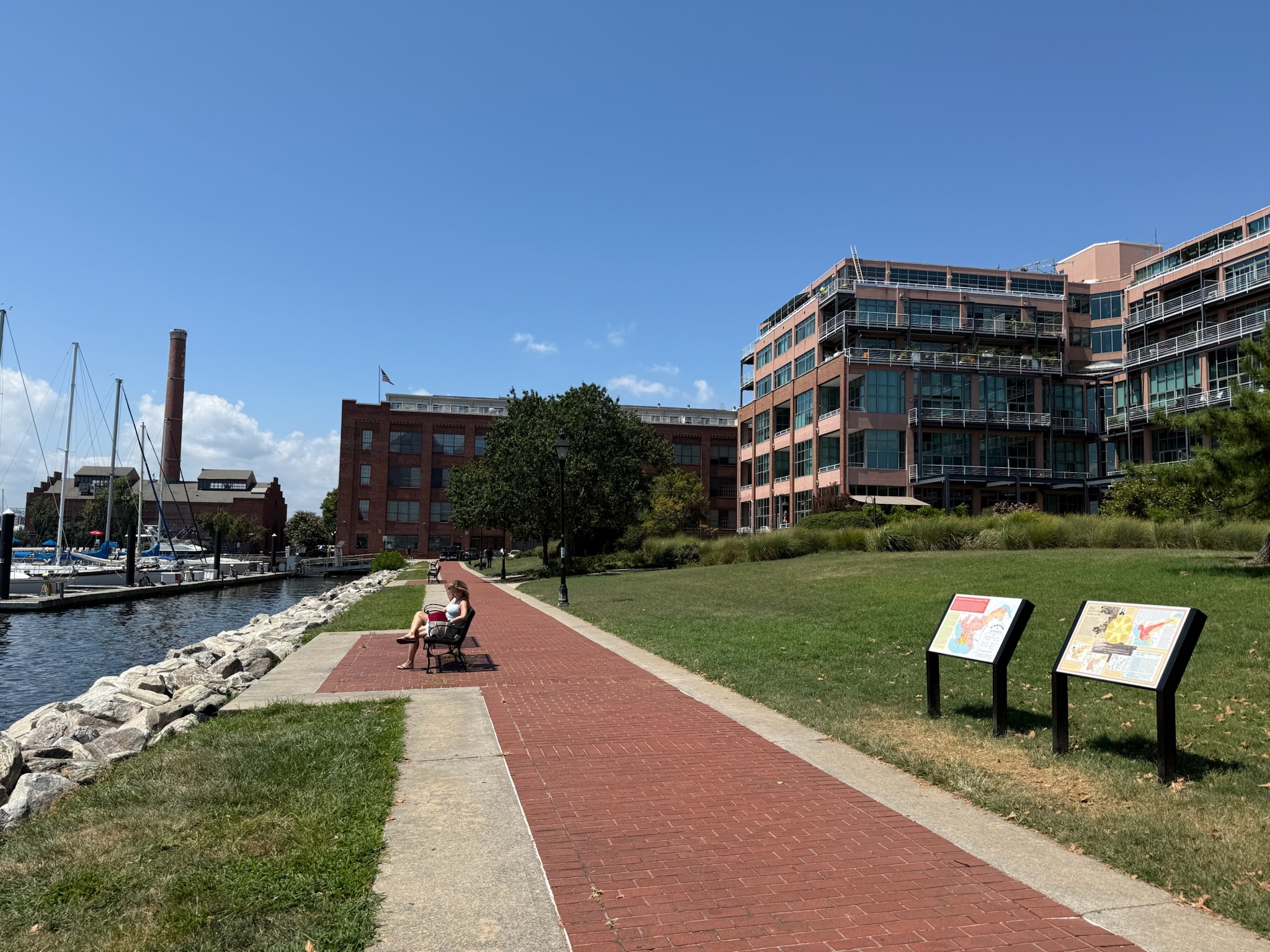
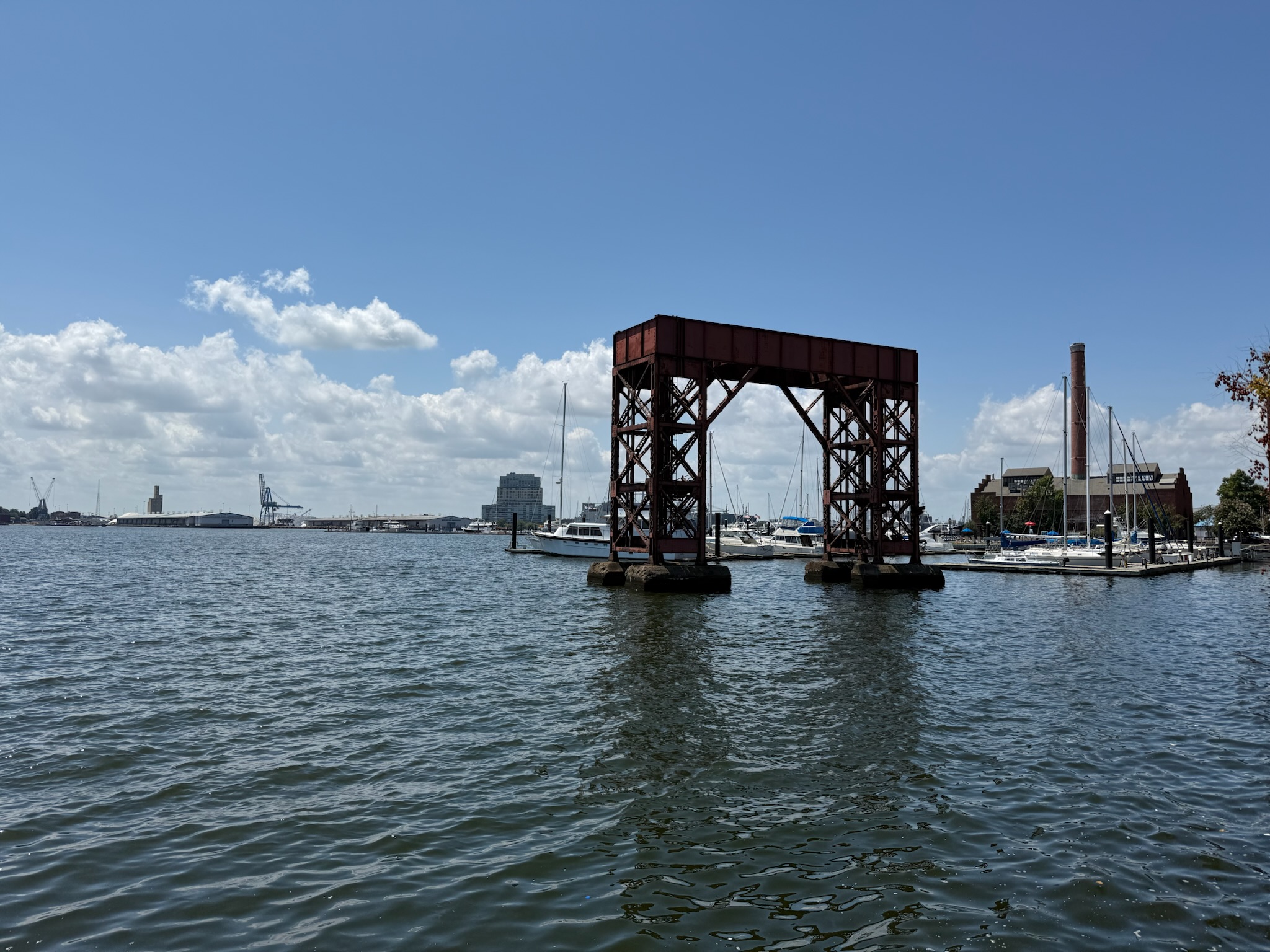
The signs in the park gave a brief history of Canton, one of America’s oldest and most successful industrial districts by connecting a manufacturing hub with maritime shipping and rail shipping. The land was originally a large, rural estate called Canton. In 1828, a group of businessmen decided to turn the 2.5 miles (3,000 acres) of marshy coastland into a planned industrial community. They built roads, wharves, housing for workers, and laid railroad track. Between 1829 – 1850, ironworks, copper works, distilleries and fertilizer plants were built. In 1870, the company bought more land, increasing the holding to 4,000 acres. They created a brewery in an area now called Brewer’s Hill. They also built massive rail yards to handle to ship-to-rail cargo. Oil refineries and canneries moved in. By 1900, a creek was filled in to create even more land. The Canton Company sold off most of their land by 1948. The Canton area’s industrial activity peaked around 1950, and in the 1970s, aging plants and changing global economics led to its decline. Today, its industries include biotech, information science, warehouses and specialized manufacturing. The southernmost portion of Canton is still devoted to shipping and raw materials. This was what was left of a railroad transport bridge used to land cars that were transported by ferries from 1871 – 1969, though this particular piece had been built in 1912. It was owned by the Pennsylvania Railroad.
We were a little confused by the ferry map, both about the routes and the prices.
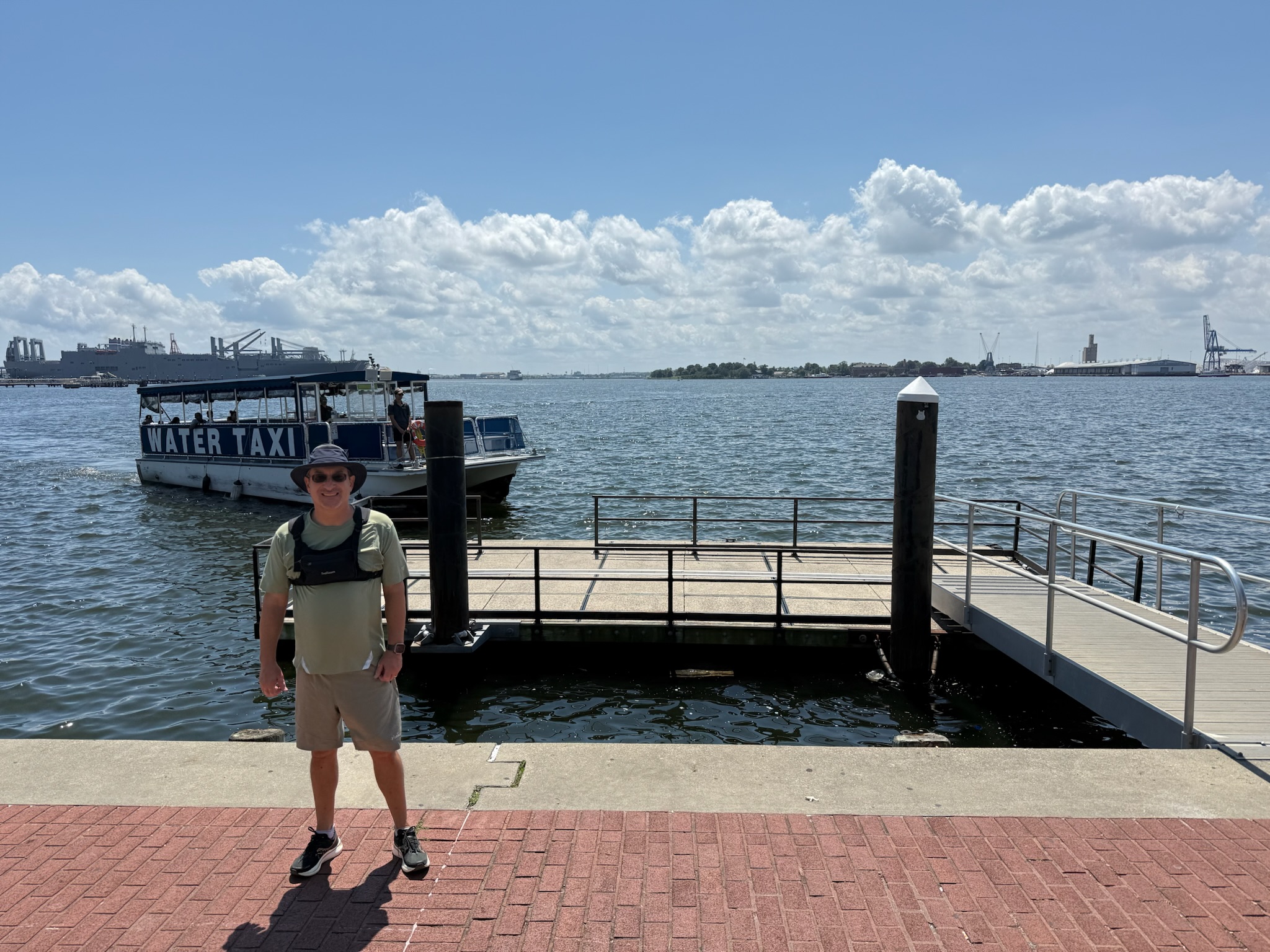
When we boarded, the captain told us that this particular route was free, but some routes were not. The route that ran to Fort McHenry didn’t run on Mondays. The closest we could get was Locust Point, which was about 2-miles away from the fort. He explained that at the end of the street that the terminal let out on we could catch a free bus that would take us the rest of the way. The Locust Point terminal was between an industrial looking complex and what looked like a large office complex.
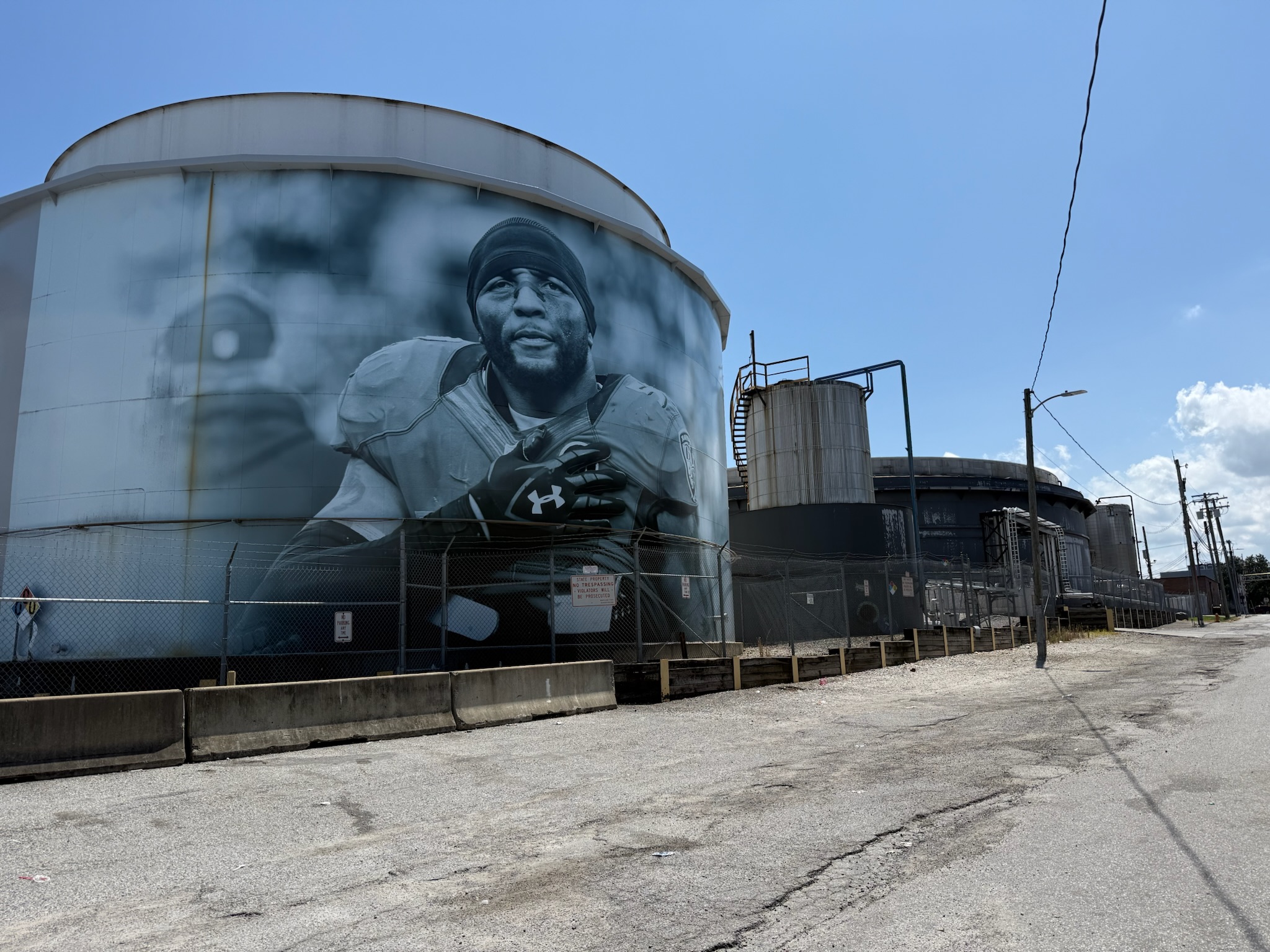
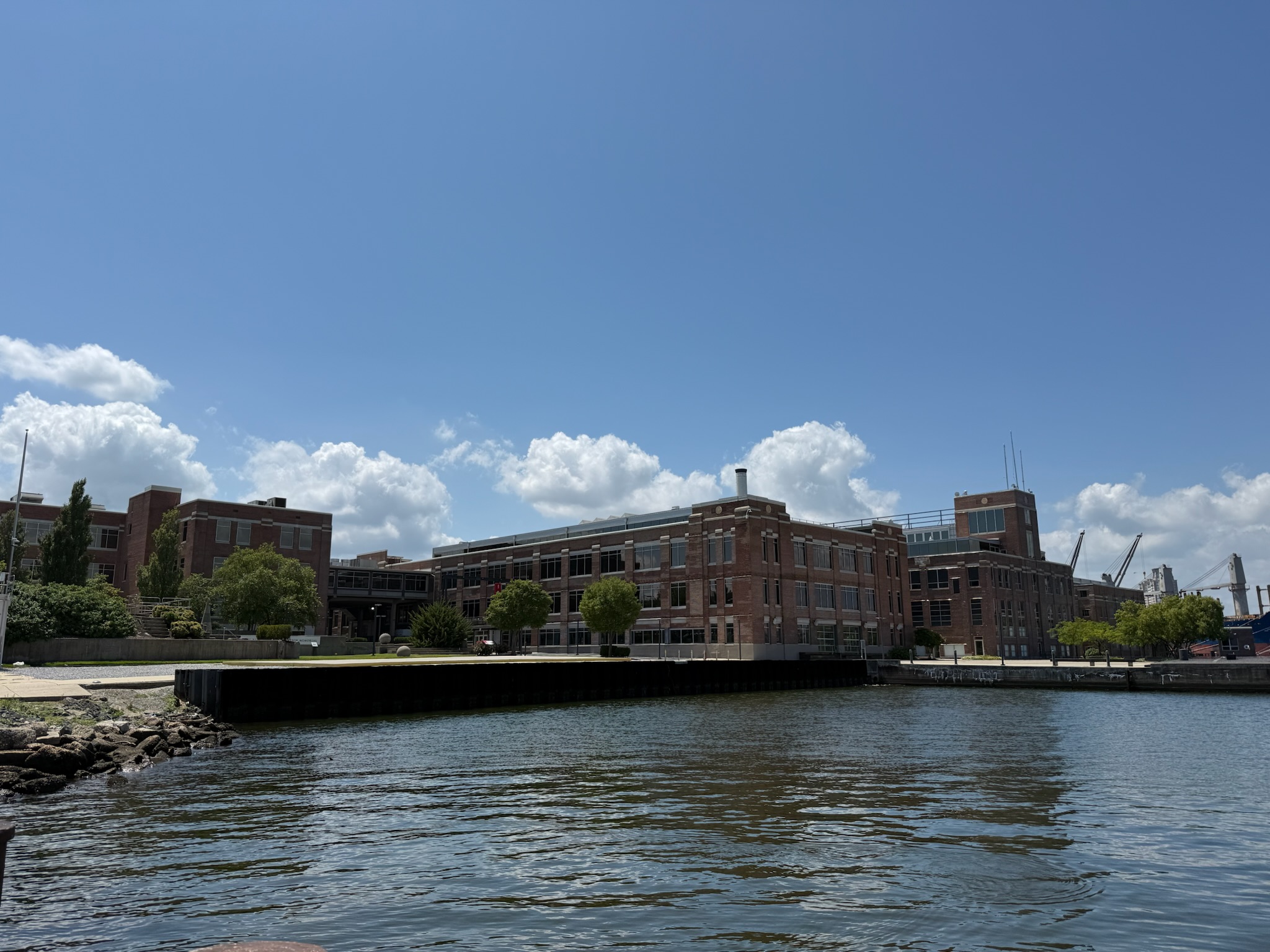
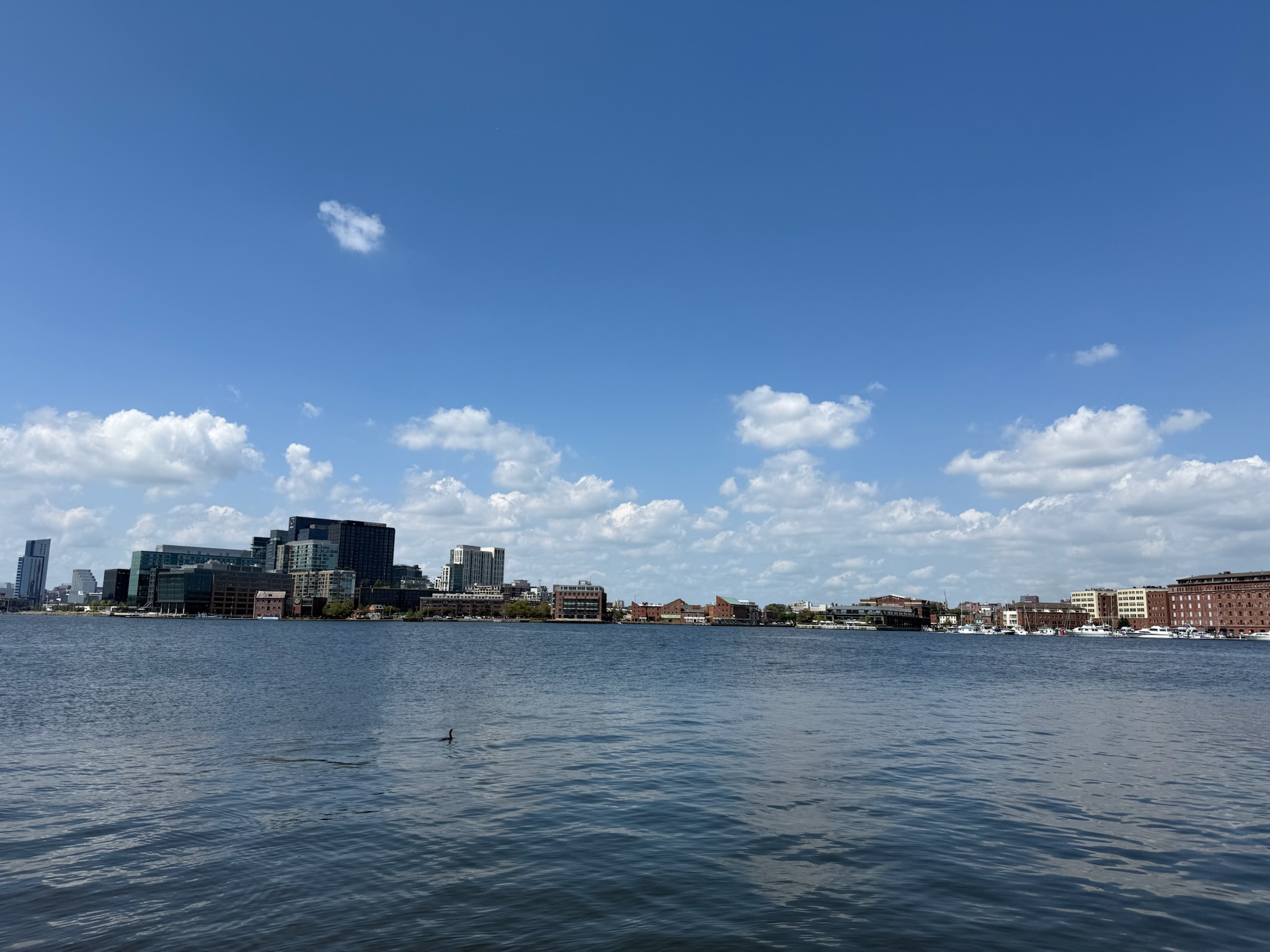
There were nice views of downtown from the terminal.
The temperature had crept up all morning. By the time we’d exited the ferry, it was hot and humid out, but it wasn’t unbearable like it had been a couple weeks before. The walk to the bus stop was .9 miles, and Keith was seriously regretting that he’d done the walk this morning. The scenery along the way was almost exclusively very narrow townhomes with no setbacks, which made the street feel a tad bit claustrophobic.
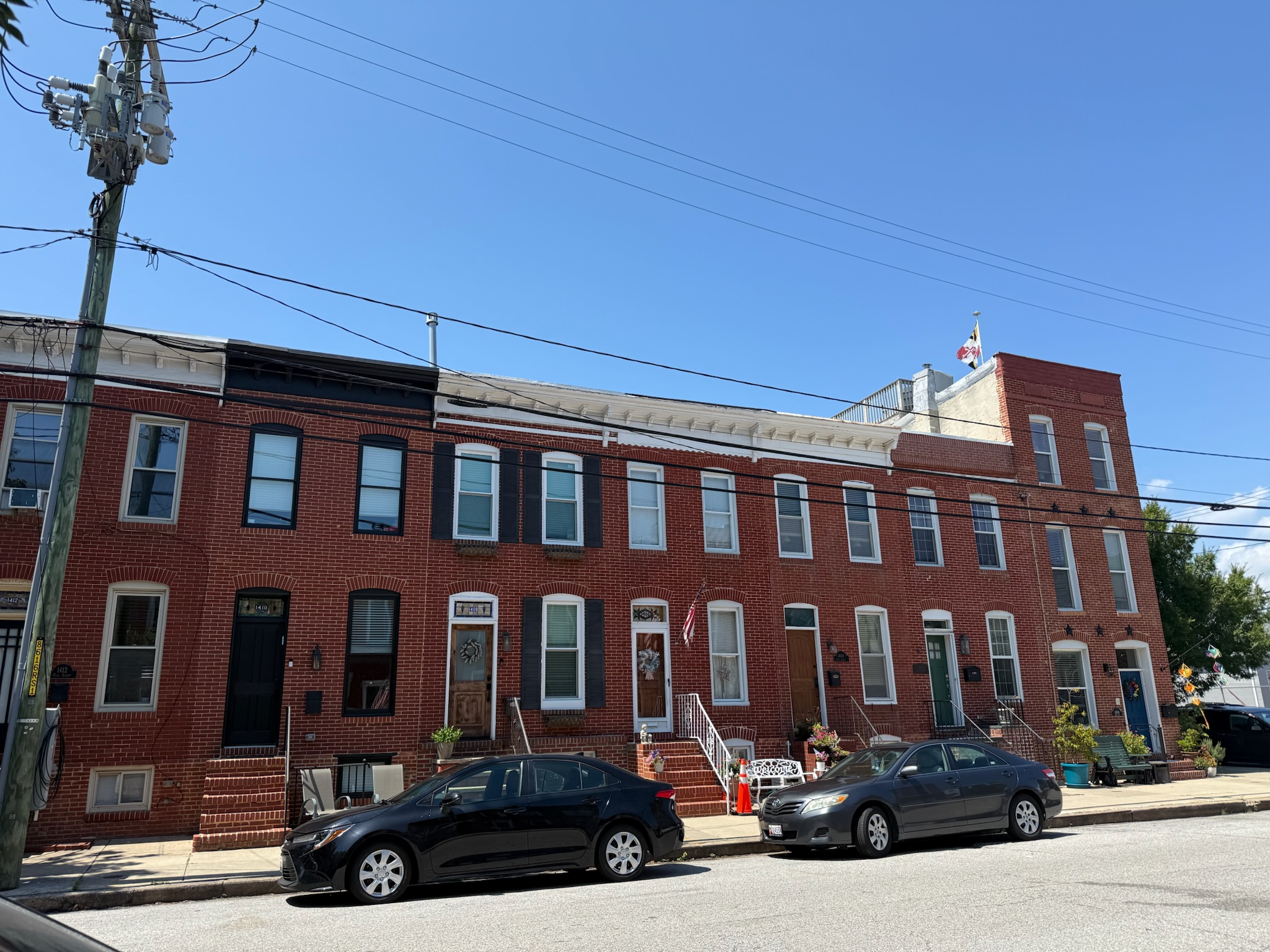
At the main road, we turned west and found the bus stop near a park with a historic looking church across the street. A sign in the park gave a brief history of Locust Point. It was established as a point of entry in 1706. In 1814, soldiers marched along that road that the bus stop was on to defend Fort McHenry. Nearby port facilities served as a federal supply camp during the Civil War and equipped America’s “Arsenal of Democracy” during World War II.
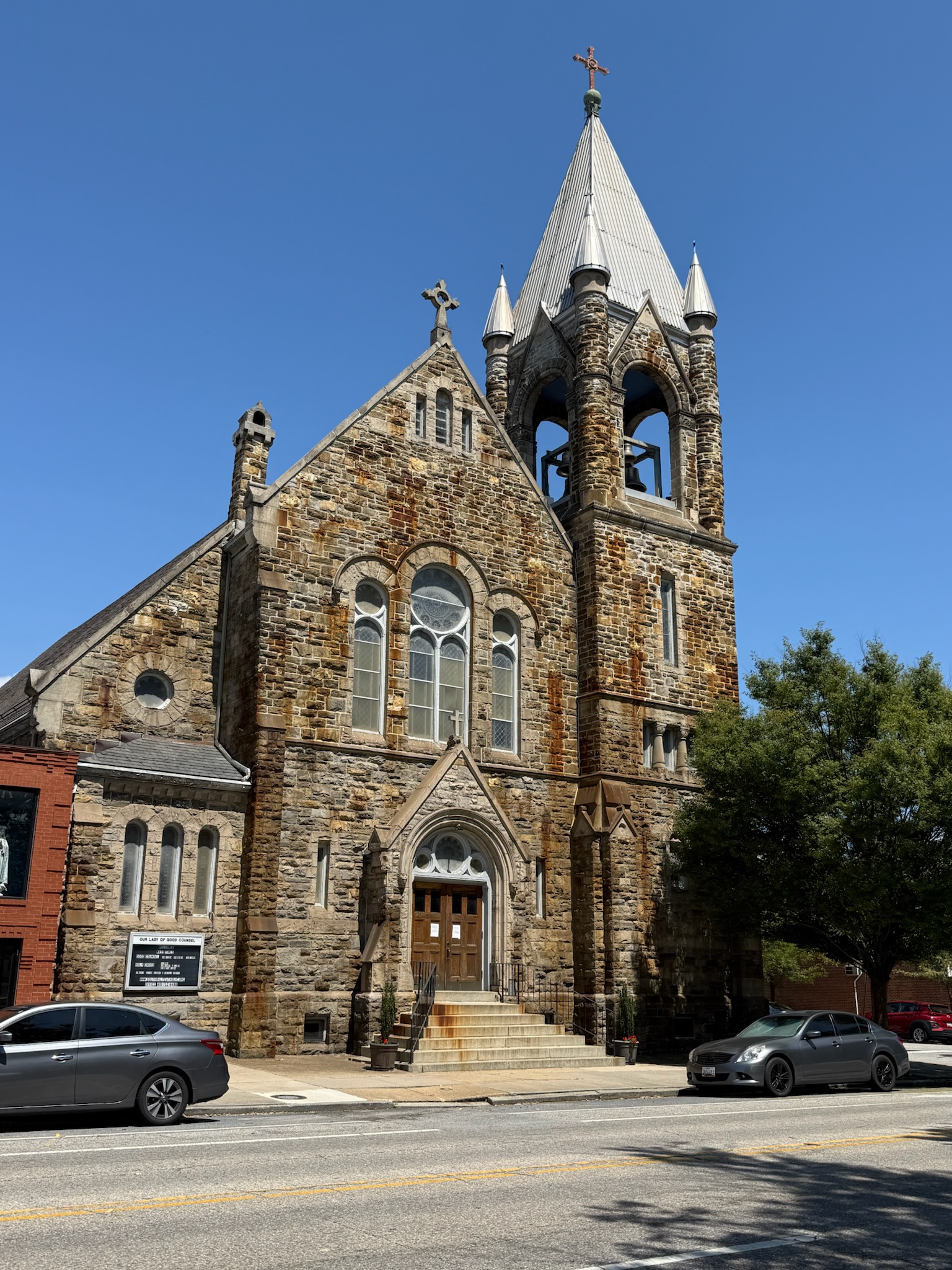
While we waited at the stop, we noticed that the majority of the traffic on the road was big rigs with containers. Not long after the bus picked us up, we crossed a bridge that was backed up with big rigs waiting in a line. The bus drove on the wrong side of the road to go around them.
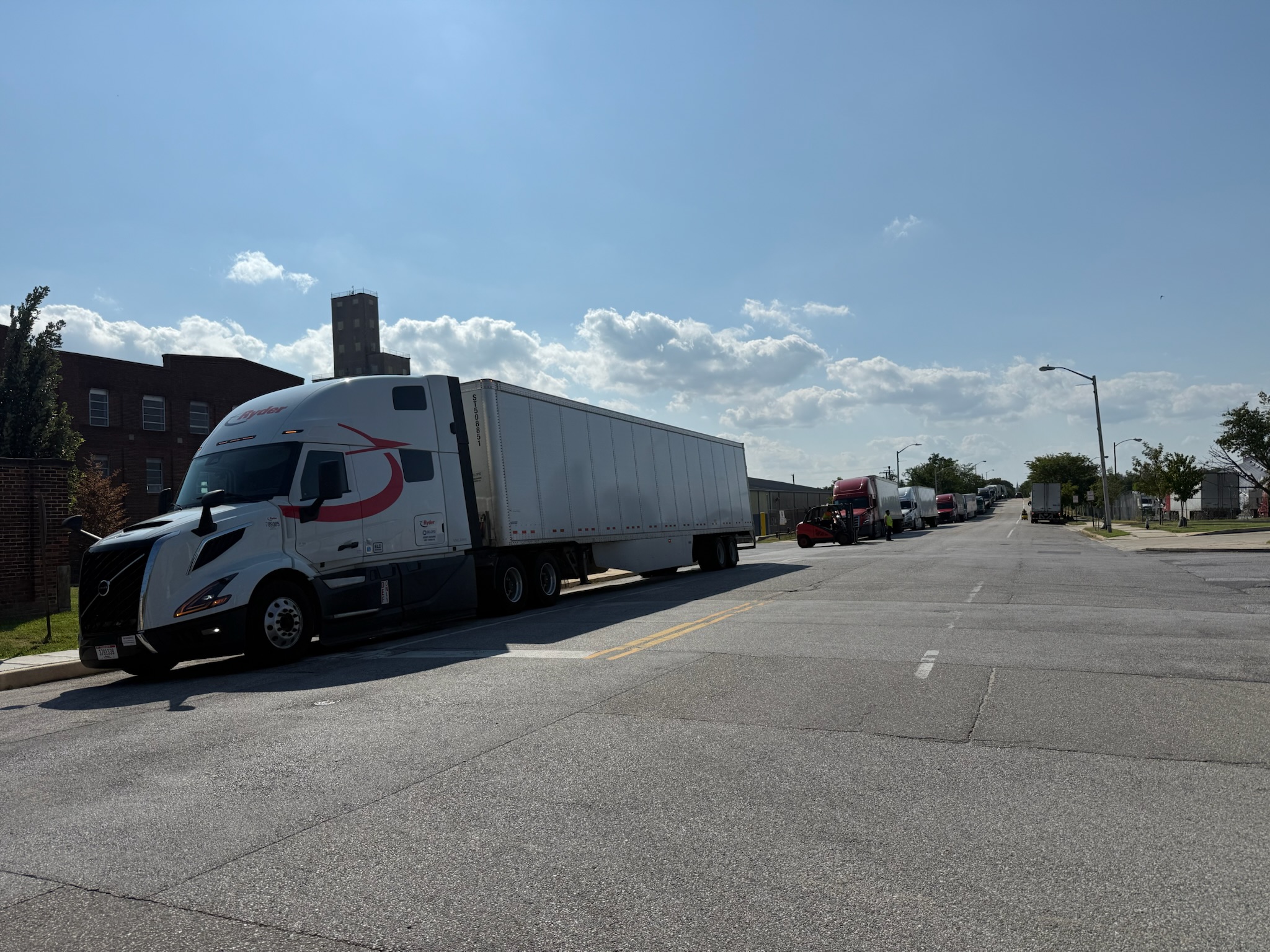
It dropped us off where the road dead-ended. There were two gated entrances: one into an industrial compound and the other into Ft. McHenry. It was kind of odd to see the serene, park-like setting directly next to the busy industrial complex.
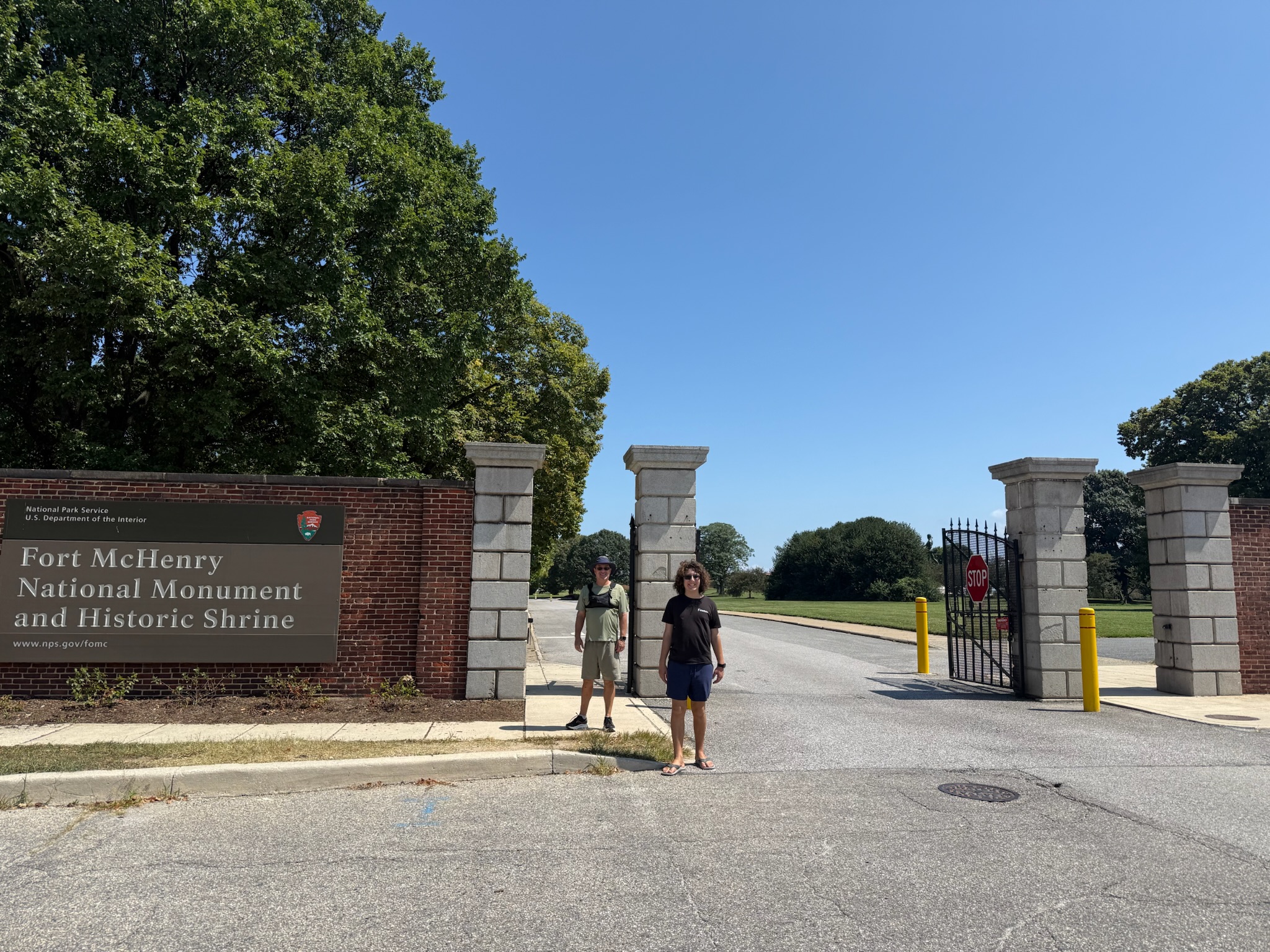
On the way to the visitor’s center, we passed a statue of Orpheus, who was a legendary figure in Greek mythology known as a musician, poet, and prophet. The statue was dedicated to Francis Scott Key.
It was kind of a long walk between the fort entrance to the visitor’s center.
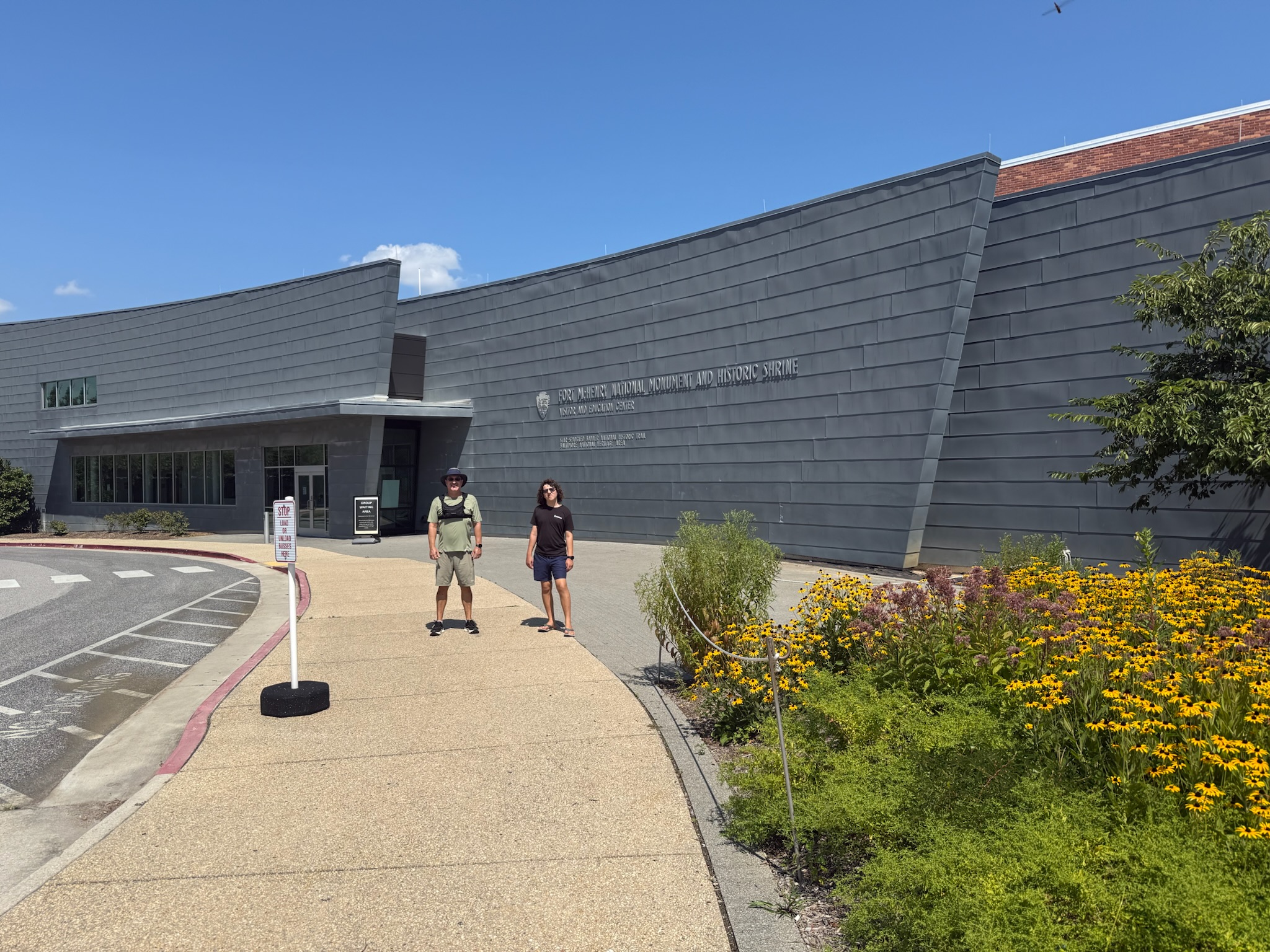
When we went inside, the park rangers told us there was a movie was about Francis Scott Key writing the Star Spangled Banner that was about to begin and ushered us into the little theater. In June 1812, the United States declared war on Great Britain for many reasons: 1. Great Britain was capturing American merchants and conscripting them into the British navy. 2. America had declared itself neutral in the war between Great Britain and France, but both the French and British Navies were seizing American merchant ships for trading with the enemy. The US was essentially forced to pick a side, so they picked France. 3. Great Britain still had Canada and was encouraging the Native Americans to resist the US’s westward expansion. The US was hoping to get control of Canada and have less opposition to westward expansion. 4. War would unite the democrats and republicans against the federalists, shoring up more power for one side. They also thought war would bring prestige. Officially it was called the War of 1812, but it was dubbed The Forgotten War because it was often glossed over in recounts of American History. The war lasted almost three years, and neither side could claim victory.
In the summer of 1814, the British were raiding cities along the Chesapeake coastline. Key was a well-connected Maryland lawyer, known for being an eloquent speaker. In September 1814, Key was on an American flag-of-truce vessel in the Chesapeake, helping to negotiate the release of an American prisoner from the British. The British leaders he was meeting with told him they were going to attack Baltimore, then held the ship so that it couldn’t warn the Americans/help in the battle. He watched the attack from the ship, which was about 3 – 4 miles away. After 25-hours of fighting, it became quiet. He knew the battle was over, but he had no idea who’d won. When dawn broke on the 14th, he could see that the flag at Fort McHenry was still waving, indicating that the US had won the battle. Seeing the flag inspired the song.
While the words were his, the tune was not. Key’s words were published in a local Baltimore publication with a footnote that the words should be sung to the tune of “To Anacreon in Heaven,” which was a well known ditty that had been written in England around 1770. In a matter of hours, the whole city was singing it. Even more periodicals published the words, and the song spread like wildfire to other cities. At the start of the Civil War, the Star Spangled Banner was adopted as the rallying cry of the Union. In 1889, the US Navy made the Star Spangled Banner the official tune for flag raising. By the 1890s, patriotic organizations would encourage people to stand and sing the song during their events. Starting in 1910, there were various attempts to get the song officially recognized as the national anthem. In 1916, President Wilson signed an executive order for the US Army and Navy to use the Star Spangled Banner as the national anthem. On March 3, 1931, it was finally legally made the official national anthem for the United States via a bill signed into law under President Hoover. To be fair, the reason official adoption was slow was because there was strong opposition to representing our national identity with “an English drinking song” about violent war. But popularity won in the end.
After the film, we pursued the small exhibit area in the visitor’s center. They had a timeline of events that occurred between 1777 and 2014. Many of the events they chose to highlight were … to be continued…