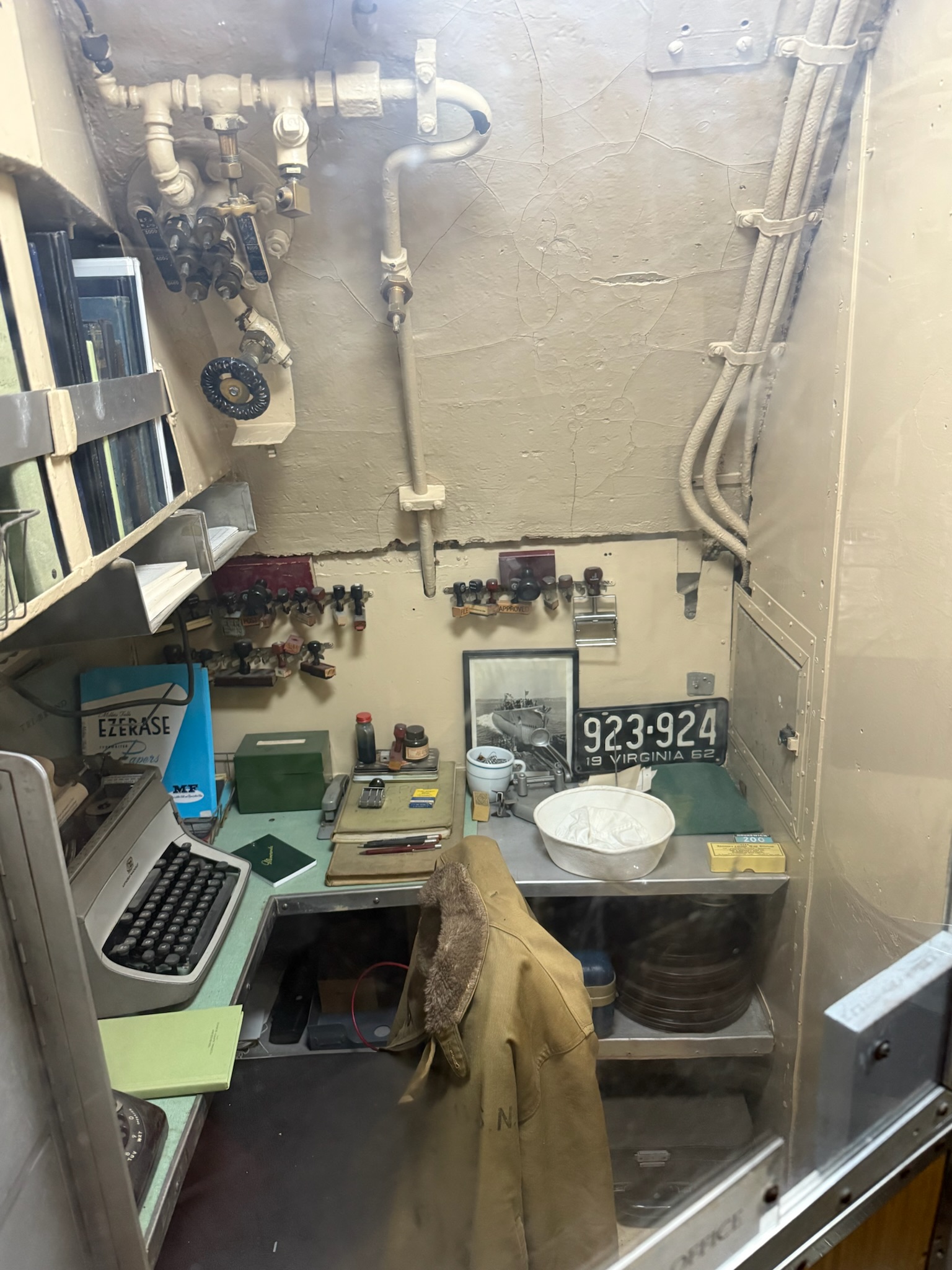
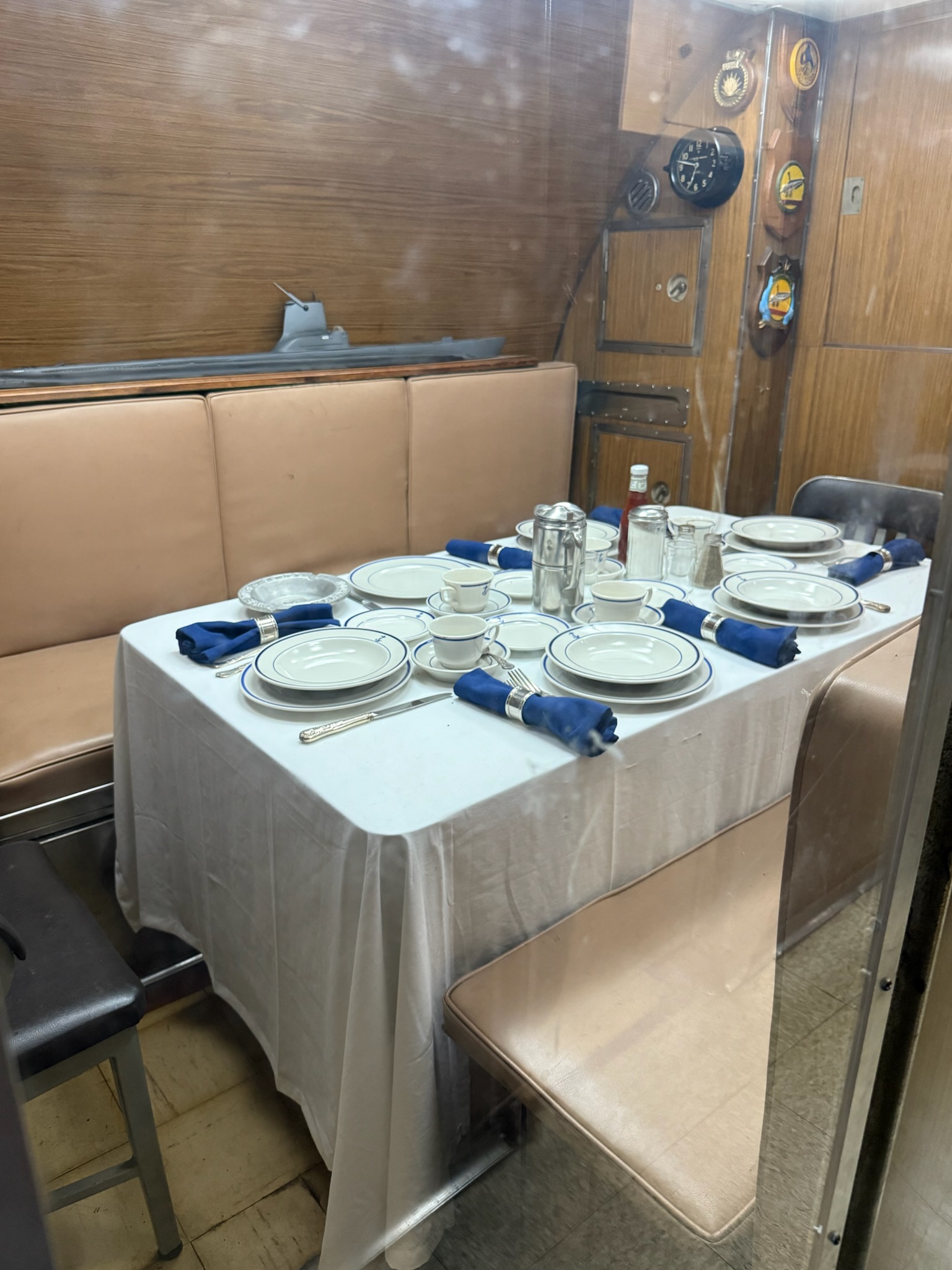
continued… Next was a narrow hallway with a string of tiny rooms. The sign said that the other battery was under this set of rooms. Two rooms were offices. Four were staterooms. Even the officer’s were crammed into unbelievably tight spaces. There were five beds in the Chief Petty Officers stateroom and 3 in the Officer’s staterooms. Only the Captain had a private room, and it was barely big enough for the tiny bed, folding desk and chair. One was the Wardroom, or dining room for the officers, which was much nicer than the enlisted men’s. One was the Wardroom’s kitchen.
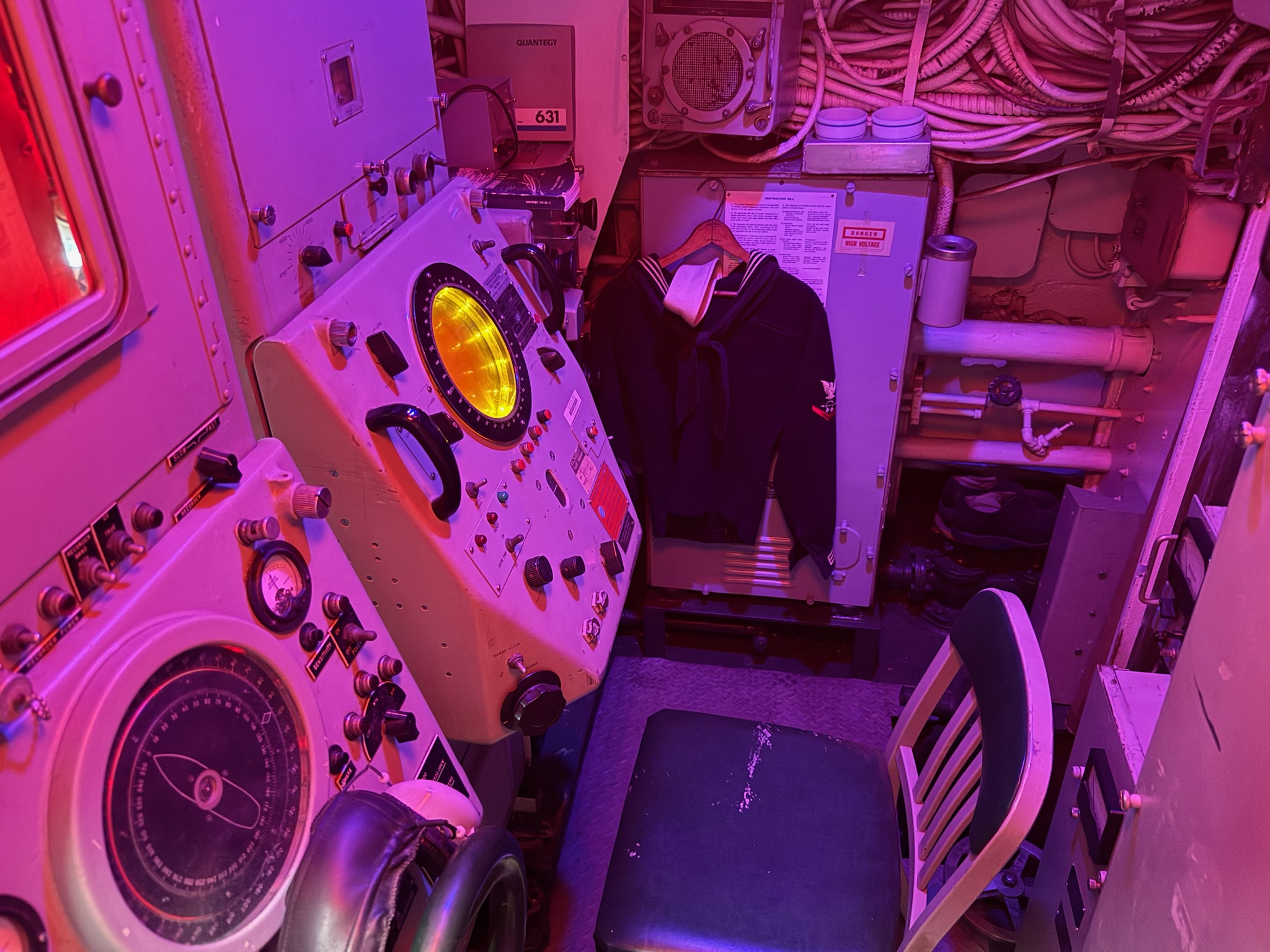
We’d finally made it to the Forward Torpedo Room at the front of the submarine. The Sonar Shack was a small, closed space off to the side. It was playing sounds that were typically heard over sonar. There was both an active and passive sonar onboard, and there was always someone manning each unit while underway — although the active sonar wasn’t always on. Passive sonar was basically a microphone that listened for ships/submarines and tracked them. The active sonar was used for navigation, but it made a ping sound, so it was turned off when they wanted to be stealthy.
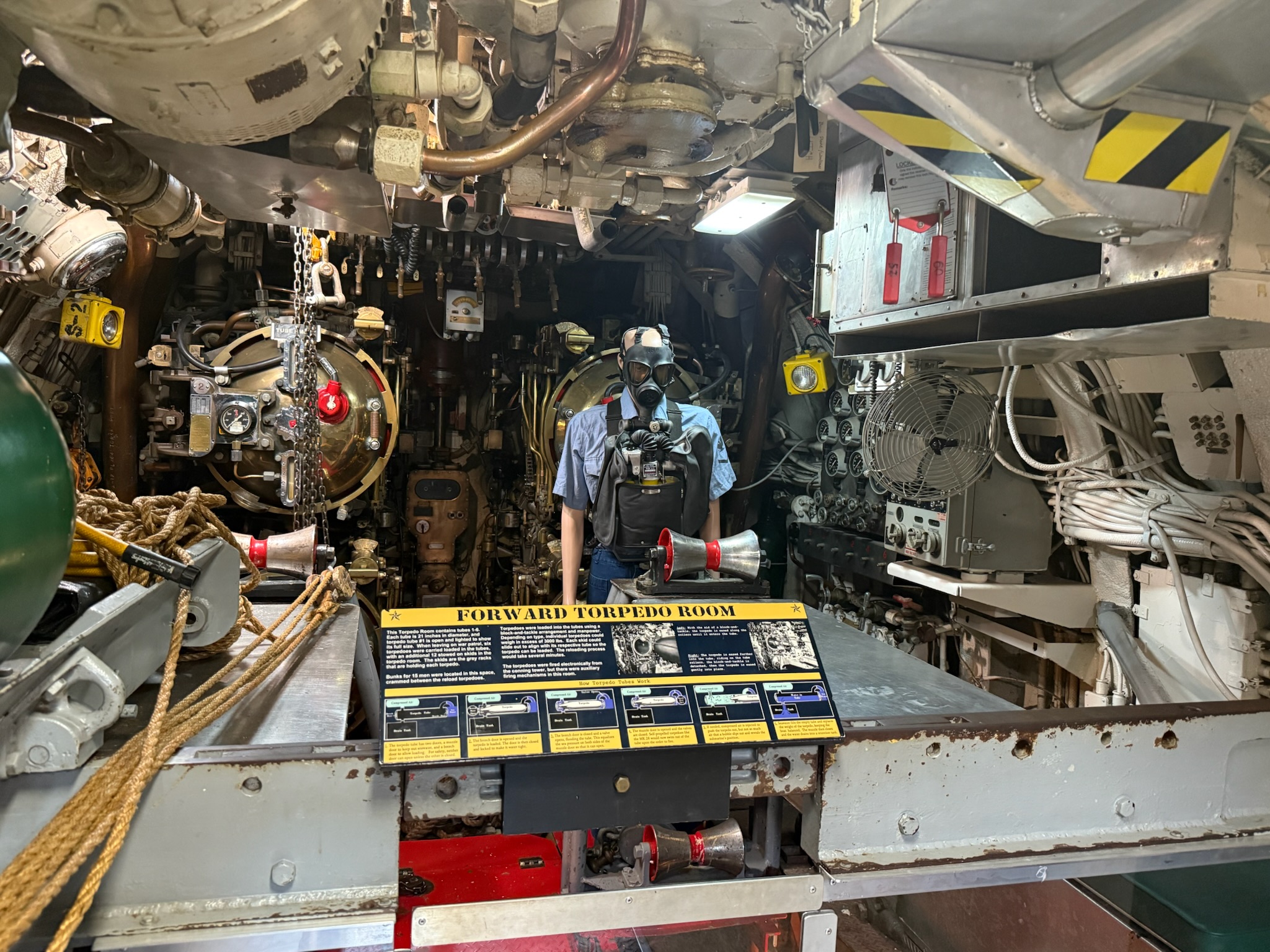
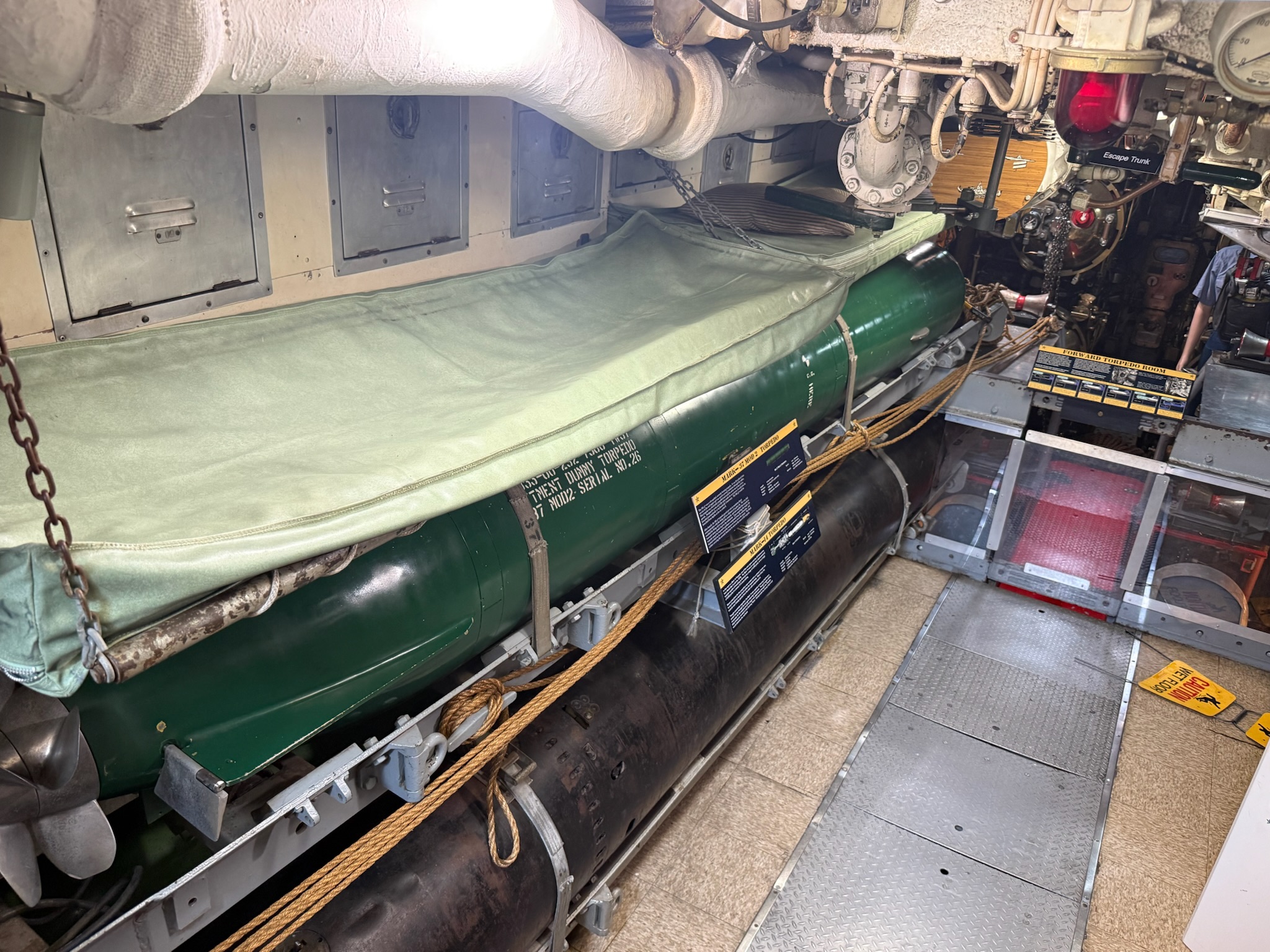
There were 6 torpedo tubes up here, each 21 inches in diameter. The tubes were kept loaded, with 12 more ready to be loaded. There were two kinds of torpedos aboard. At first it was just the Mark-14, which went where directed prior to launch. Thus, if the target moved, the missile would miss. Then in the 50s they added the Mark-37, which could be maneuvered by the Conning Tower after launch until the missile acquired the target, then it would home in on the target, ensuring a hit even if it moved. Christi knew this technology existed, she was just surprised at how old it was. The torpedos weighed as much as 3,000 pounds each.
Fifteen bunks were crammed into this space, with people sleeping on and/or under the torpedos.
A sign said that the word Torsk was the Norwegian name for Cusk, which is a type of cod fish. The Torsk was a Tench class submarine, and it sounds like it means it was the same model as the SS Tench. As we were climbing the stairs to exit to the top of the submarine, we almost had heart attacks when we looked up and saw what appeared to be a suicide.
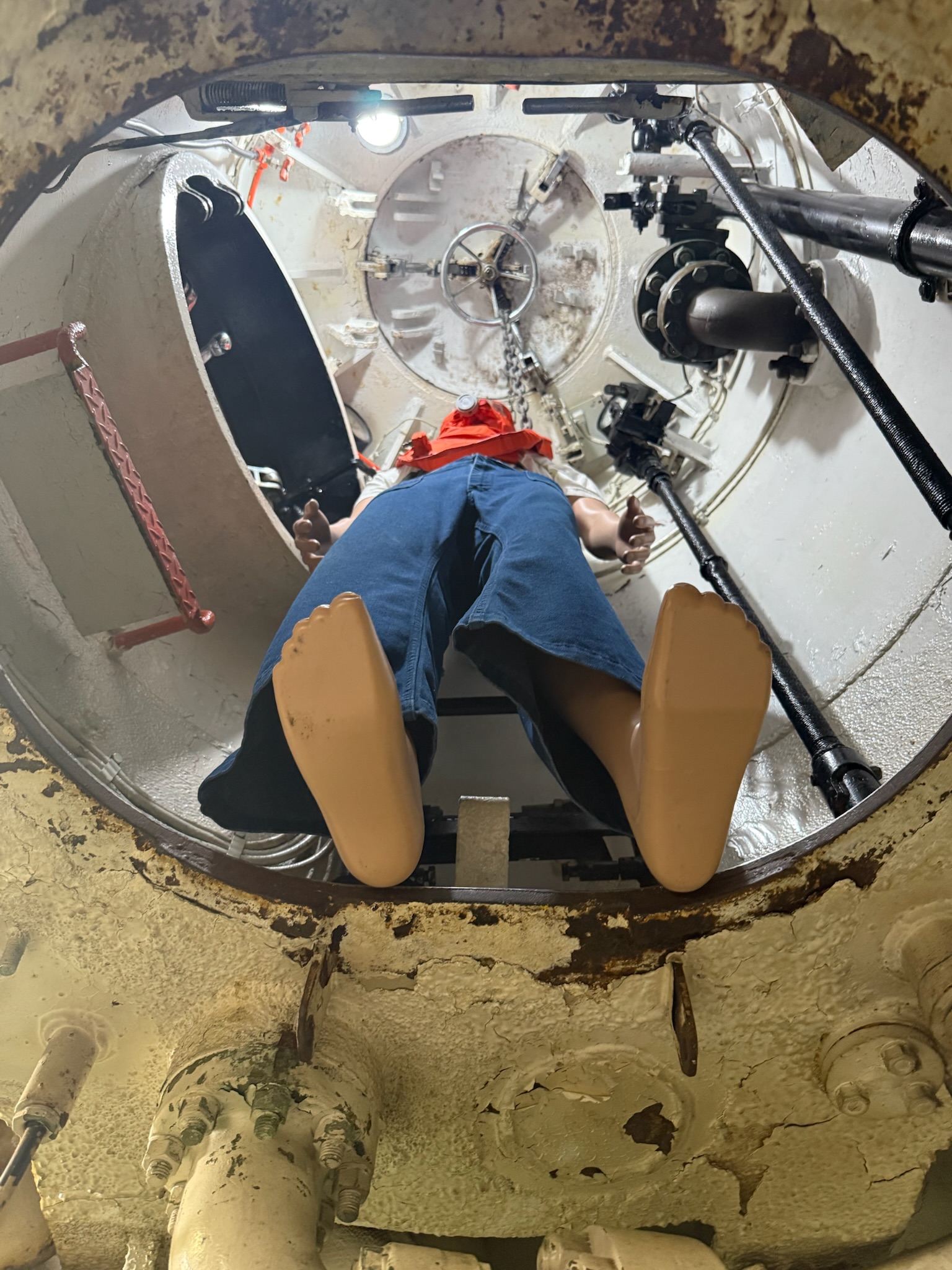
None of us had noticed a sign explaining what it was; our assumption was that they were showing that crew used to go in and out of the hatch this way. Here were Eric and Keith in from of the Conning Tower, which was not open.
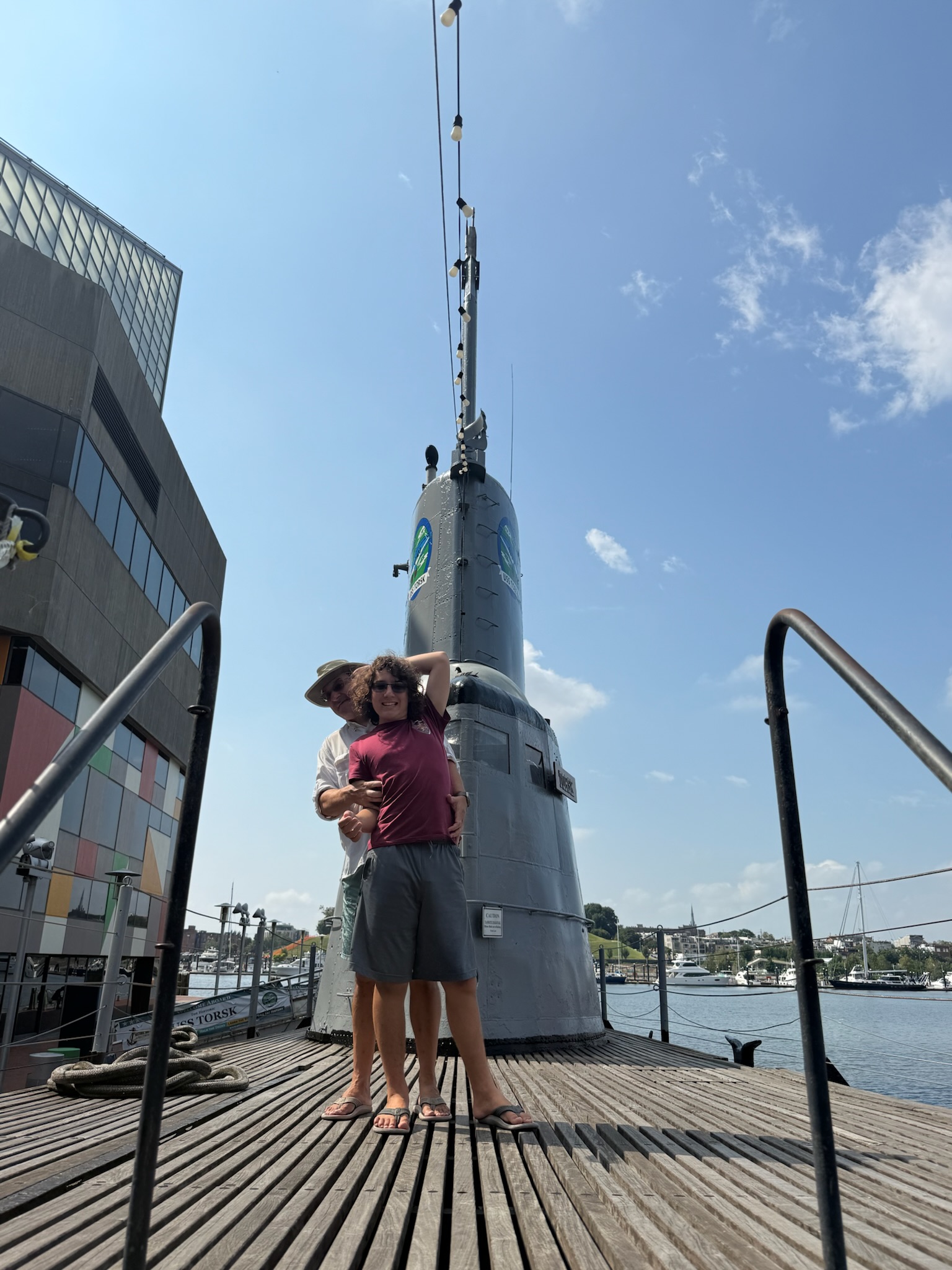
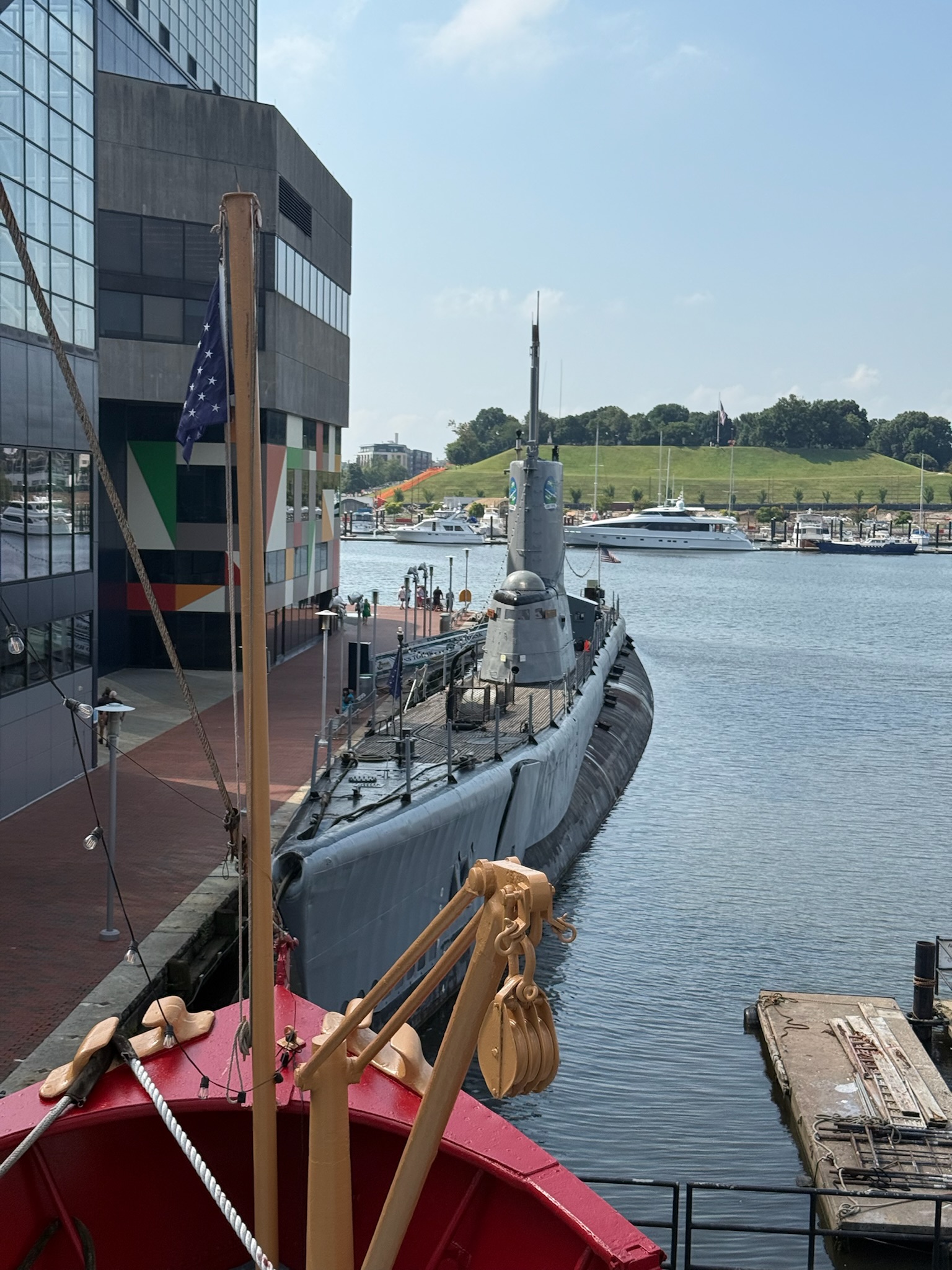
To give you a sense of how long the submarine was, look at how far the back of the ship was from the entrance and compare to the photos taken from the front.
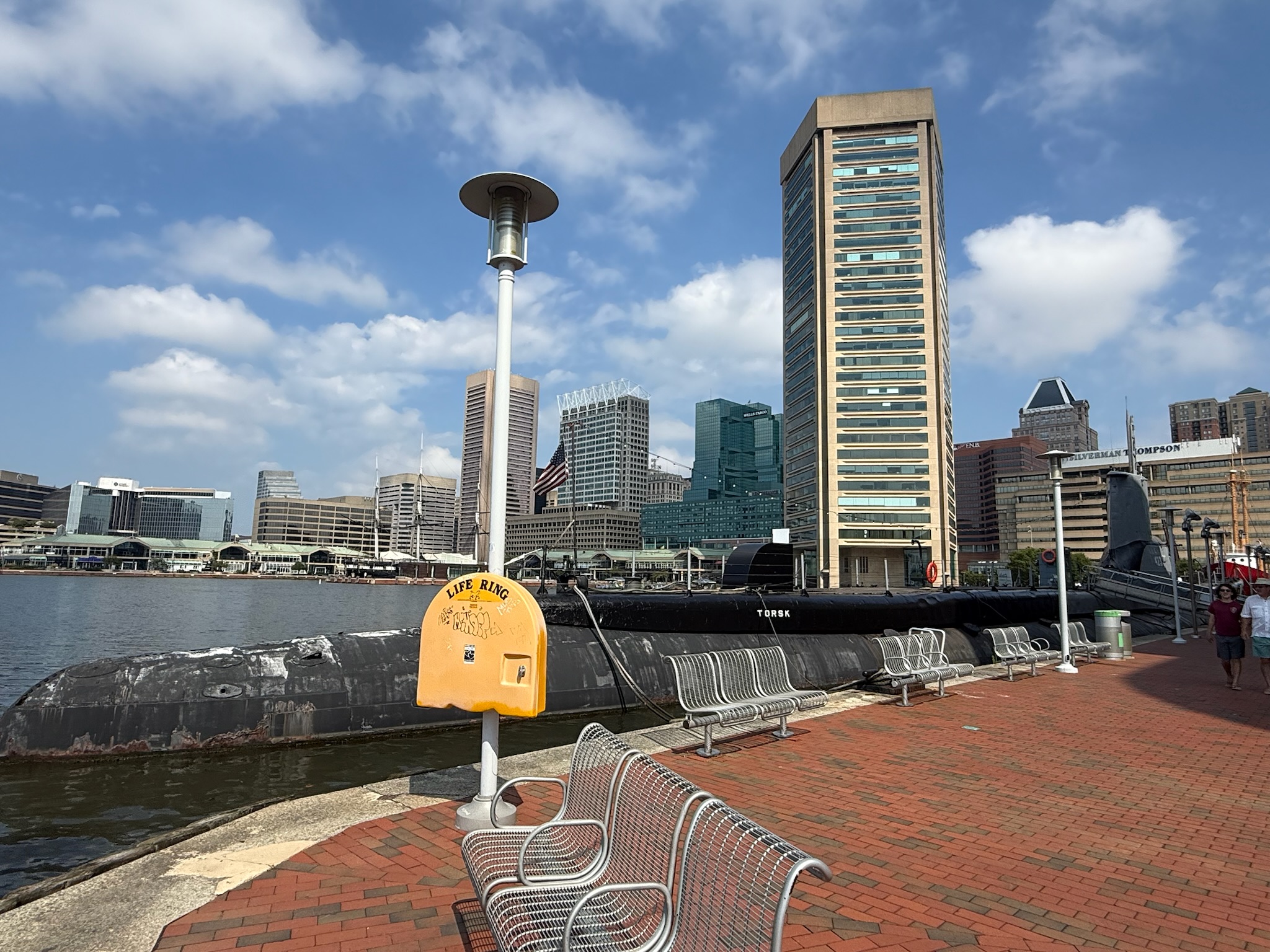
From the Torsk, we went next door to the Lightship. We’d wanted to go to the Lightship museum in Portsmouth, but it had been closed that day, so we were excited to finally get to see one.
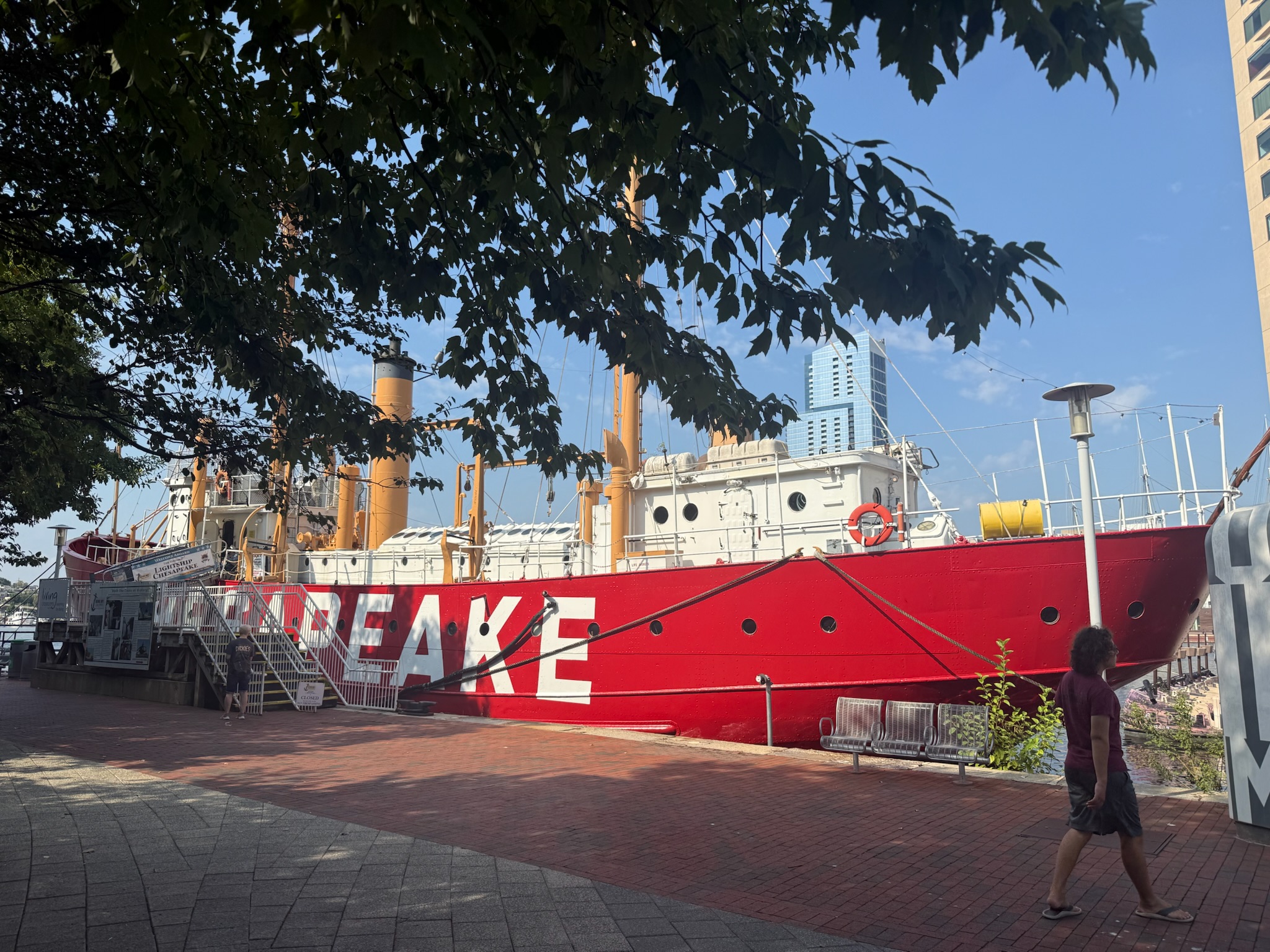
The Chesapeake was the 116th Lightship built, a class LS-100. The first lightship station was established in 1821. It was a specially built boat permanently anchored in the Elizabeth river near where it merged with the Chesapeake Bay to mark the safe approach to Norfolk/Portsmouth. By the end of 1822, four more lightships had been put into service around the Chesapeake Bay to mark dangerous shoals in places where it wasn’t feasible to build a lighthouse. The bright red color made them highly visible by day and they had beacon lamps burning atop the mastheads at night. In fog, they utilized fog horns and bells. The lightships helped provide safe navigation to America’s waterways for 160 years.
Initially, lightships were managed by The Lighthouse Establishment within the US Treasury Department. The Lighthouse Board was created in the 1850s to reform navigation aids and add more uniform standards to the lighthouses and lightships. In 1910, the the US Lighthouse Service, under the Department of Commerce, replaced the Board. In 1939, The US Coast Guard took over responsibility for managing navigation aids.
Lightship use peaked in 1909, with 56 stations on the Atlantic and Pacific Coasts, the Great Lakes and Gulf of Mexico. Advances in technology after World War II brought about the steady decline of lightship use. The development of deepwater offshore platforms for the oil industry meant that it was possible to build offshore lighthouse structures. Automation meant that people no longer had to man the lighthouses. In shallower areas, automation allowed for unmanned lighted buoys. The last lightship was retired in 1983.
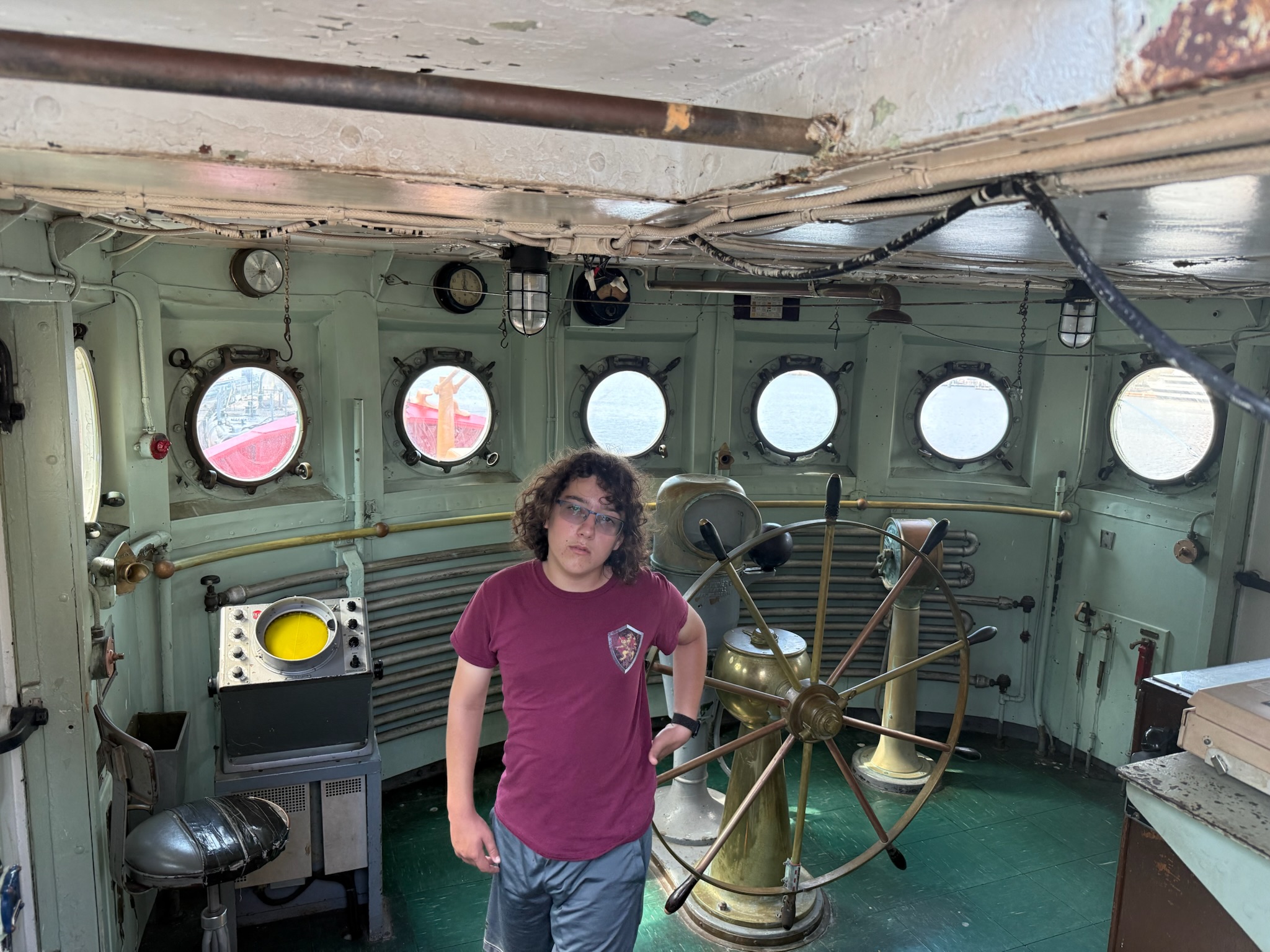
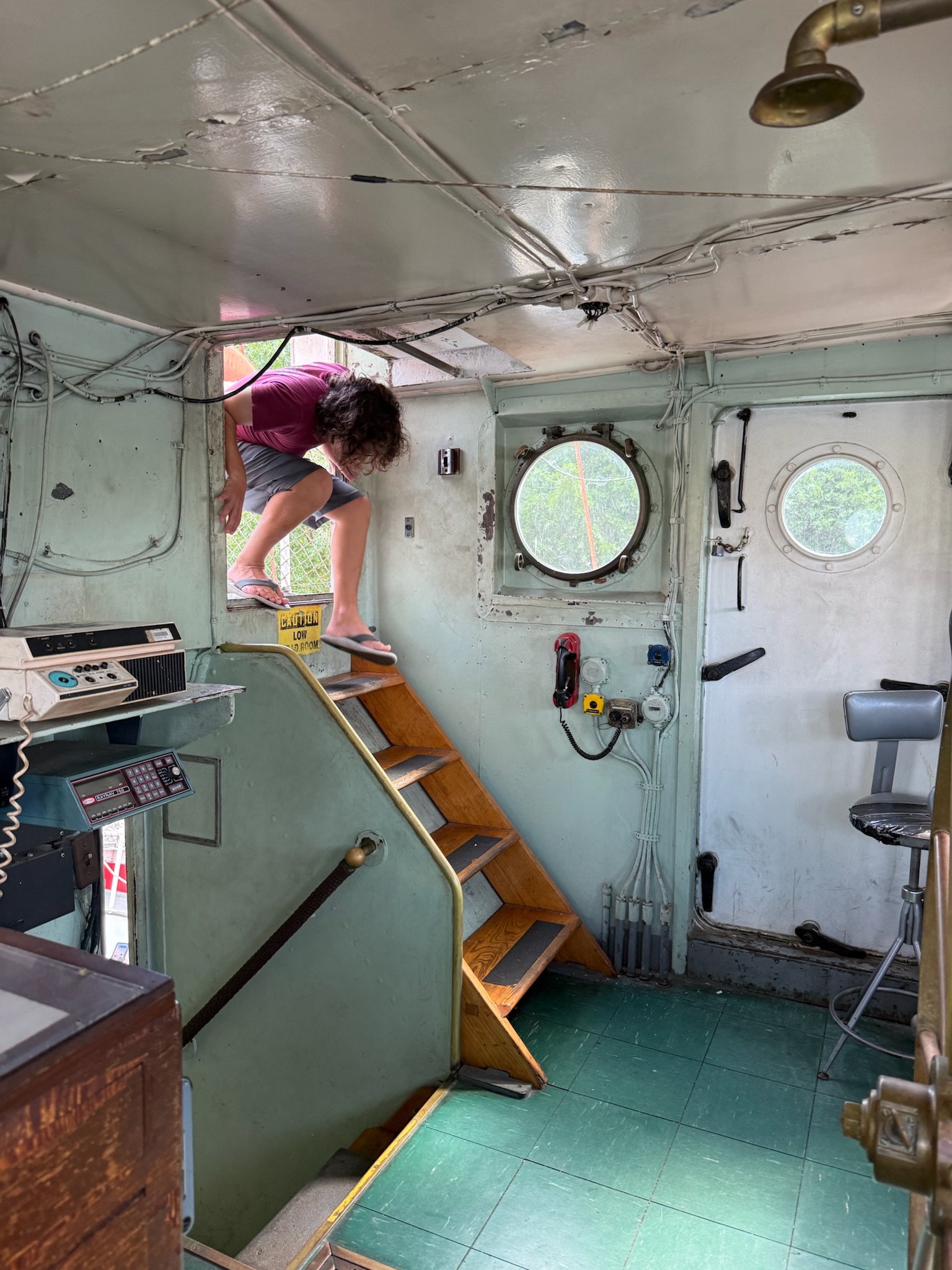
The tour began in a small open area, where we could either enter the pilot house or follow hallways along the port and starboard sides of the boat. We went into the pilot house first. The Chesapeake was build in 1930 and was among the most modern, capable and comfortable ships of the time. She was built of steel and designed for a crew of 16, though there were often less onboard at any given time. She had a diesel-electric power system (steam was what was common at the time) with an 1140 amp, 325 hp electric propulsion motor powered by four diesel engines/generators. She could do 10-knots. She had impressive signaling equipment, with a 1,500 watt, 13,000 candlepower electric beacon lamp atop each mast, an electric foghorn, radio beacon and fog bell. She had a 7,000 pound mushroom anchor, designed to hold in any weather (plus a second one on board as a backup). She cost $274,424 to build and was in service as a manned navigation beacon for nearly 40 years. From 1942 – 1945, she was utilized as a patrol and inspection boat as part of WWII, but was returned to being a lightship after the war. In 1970, she was transferred to the National Park Service and used as a sea-going environmental classroom. In 1982, she was turned over to the City of Baltimore and later became part of the Baltimore Maritime Museum. From there, we went up to the top deck through the door made for midgets.
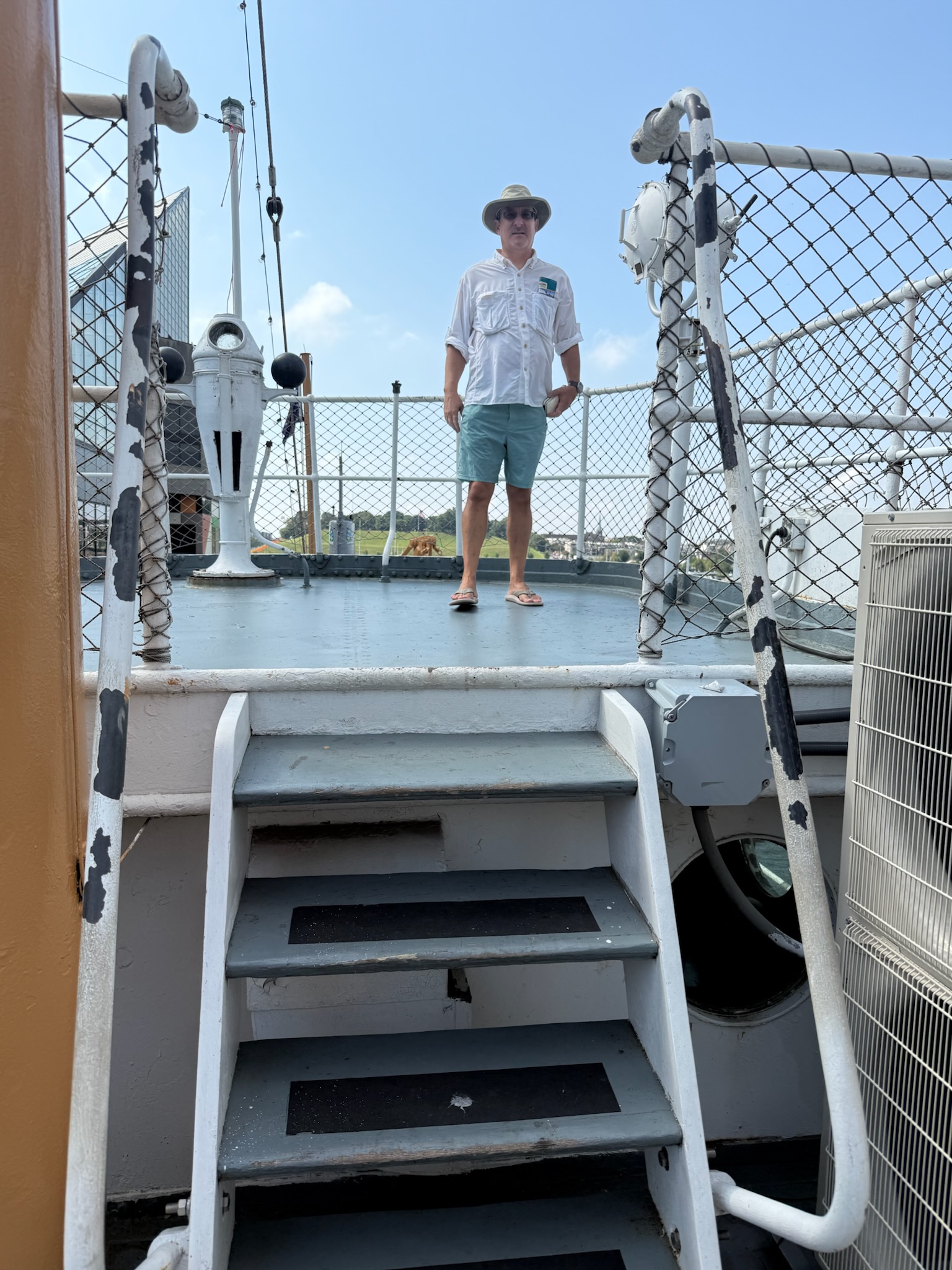
The beacons had a Fresnel-type lens, which bend and magnify light into a concentrated beam, and were 55-feet above the waterline, making them visible for 14-miles. The lights had to be regularly serviced, which meant climbing the masts, even when the weather was bad and seas were rough. But on older ships, the lamps were oil and had to be serviced daily, including trimming the wicks and cleaning the soot off the glass and reflectors.
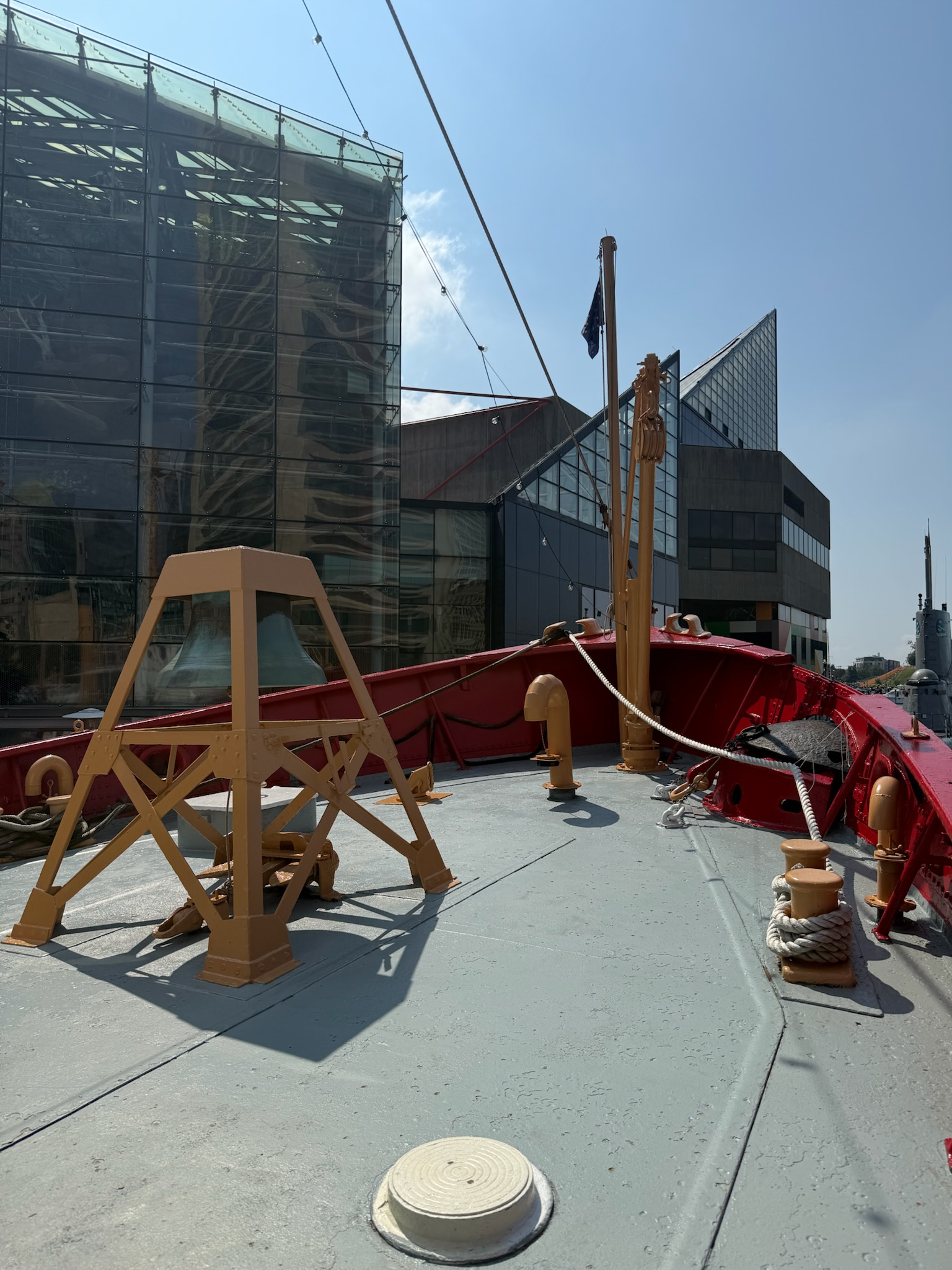
There was a nice view of the USS Torsk from the bow.