continued… There was a presentation on muskets at noon outside the entrance to James fort, so at 1150, we headed back to the fort and found seats for the presentation. All in all, it was only about 7-minutes, but it was fascinating to hear about why the musket was the weapon of choice, how it was (dangerously) operated, and the military strategies the colonists used. Here was a clip of him firing the musket.
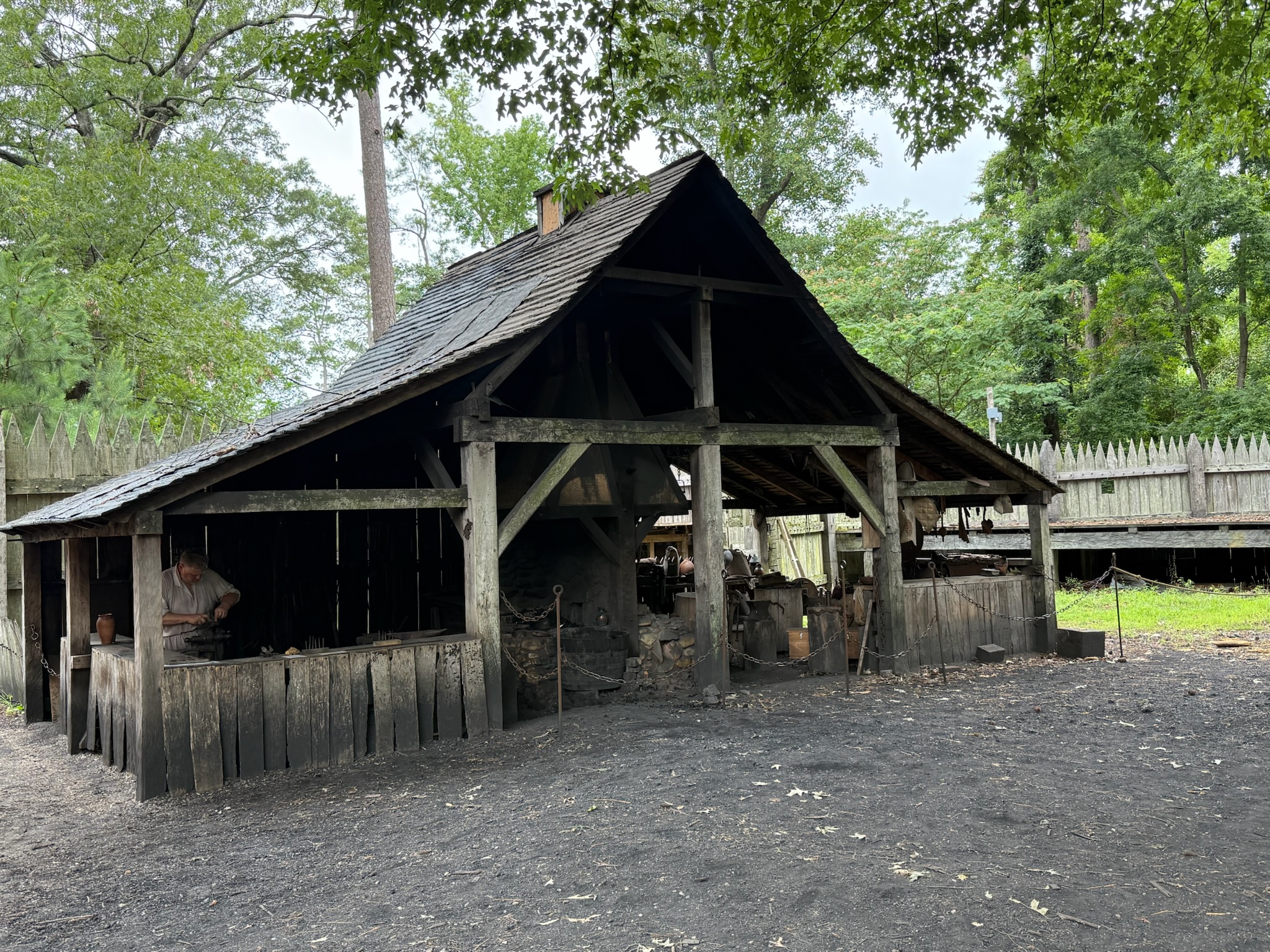
We headed inside the fort and went to a demonstration at the blacksmith shop. He made a nail for us.
The weather was looking ominous. The forecast said it was supposed to clear up in the afternoon, so we decided it would be a good idea to go inside the museum and finish exploring the outside area later. We started with a movie about the earlier history of Jamestown, which gave a good overview of what the exhibits in the museum covered.
The first exhibit was about the indigenous people. Archeological evidence indicate that humans have lived in Virginia for 17,000 years, which contradicts the popular theories that the indigenous people arrived after the ice age ended. The paleo-Indians lived in groups of extended families that moved seasonally. During the Archaic period 10,000 years ago, the environment warmed, making food more plentiful, and thus the population grew significantly. Around 1200 BC, they began making pottery and cultivating crops, which made it possible to stay in one location year round. Once they were less nomadic, society became more complex.
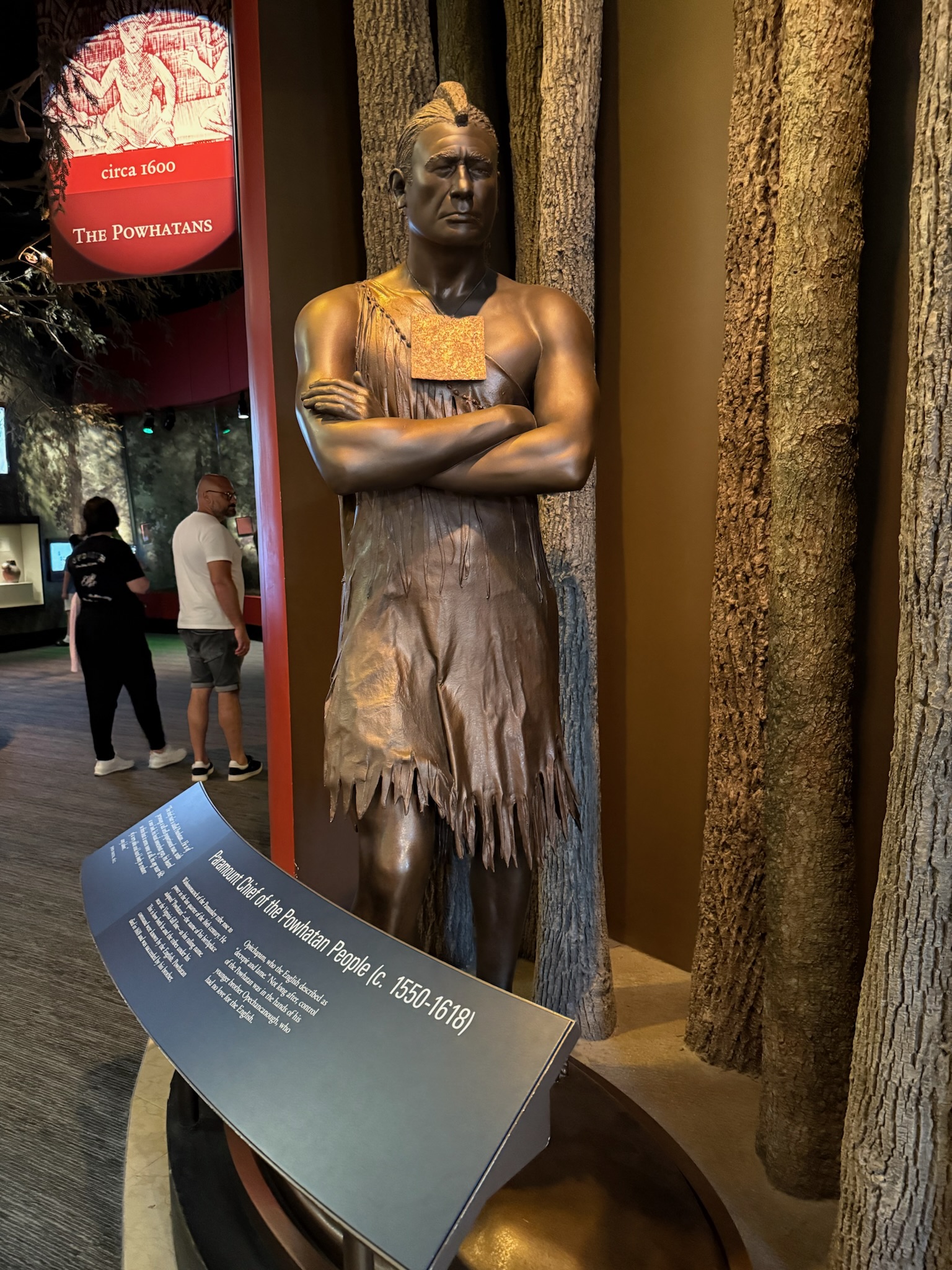
In the early 17th century, there were several different tribes in the Tsenacommacah (the indigenous name for what is now called Chesapeake) area. The Powhatan was a single tribe that managed to conquer all the other tribes in the area before the colonists had arrived. It was believed that when the colonists arrived, the Powhatan controlled a total of 14,000 people in 32 tribes that were spread amongst 150 villages. There had been a prophecy that a nation would arise which would end the Powhatan empire.
The Spaniards and Portuguese had already visited the Chesapeake prior to the arrival of the British. In 1561, Spanish explorers kidnapped an indigenous person from Virginia and took him to Spain. In 1570, the Spaniard Jesuits returned to establish a mission on the York River. They brought back the kidnappee with them. Much to the Spaniards’ surprise, the kidnapee went back to his tribe instead of staying with the Jesuits. Five months later, the Jesuits ran out of food and asked the kidnapee for help. He responded by organizing the indigenous people to attack the mission. The indigenous people killed all of the missionaries except for one boy. The Spanish military showed up later to retrieve the boy. The military hung several of the indigenous people in retribution for wiping out the mission. Between that incident and the prophecy, the people in the Tsenacommacah were, generally speaking, leery of white people.
In 1562, a group of French protestants called the Huguenots established a fort in what is now South Carolina, but it was abandoned within a year. In 1564, they tried again with a fort in what is now north Florida. A year later, the Spanish conquered and destroyed the French fort. In 1585, Sir Walter Raleigh funded a British colony on Roanoke Island in what is now North Carolina but then was Virginia. Lack of supplies led to the abandonment of the settlement in less than one year. In 1587, Raleigh funded another British colony, but the colonists disappeared and it became known as the “Lost Colony.” The Powhatan later told the Jamestown colonists that they’d killed the “Lost Colonists.”
In our post about our tour of Ft. Monroe, we’d mentioned that the colonists had initially landed in Poynt Comfort and wanted to set up their colony there, in large part because the indigenous were welcoming. But we hadn’t mentioned that they’d already tried to stop in what is now Virginia Beach and couldn’t because they were attacked by the locals and two men were wounded.
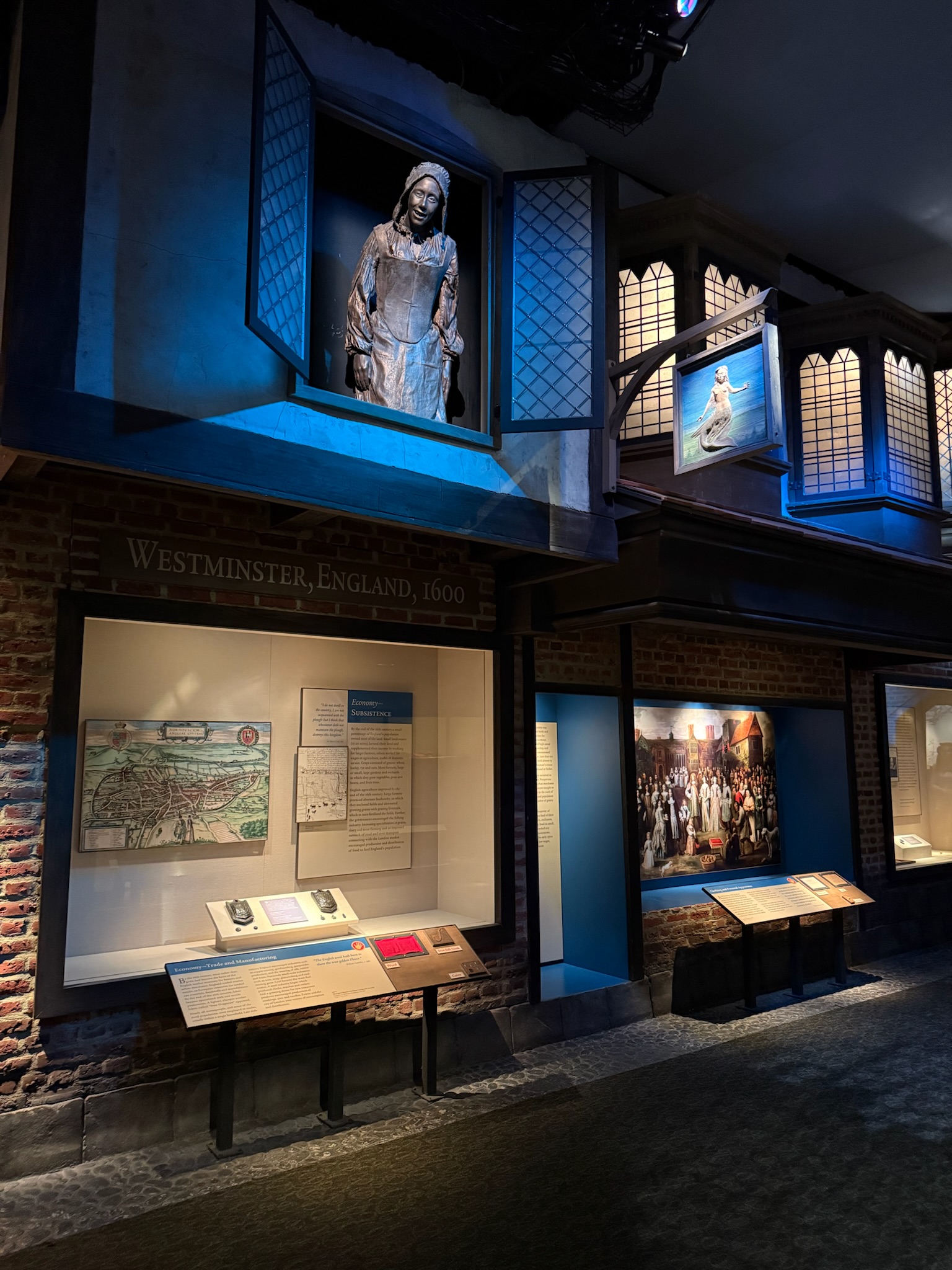
There was a display on what life in England was like when the settlers came to Virginia — this was an era when most people lived in small agricultural communities, but changes in agriculture had displaced many poor farmhands. They were going to the cities in search of work. The cities were rapidly growing, and most of these displaced people did not fare well in the cities. We found out that Queen Elizabeth I, who reined from 1533 – 1603, had never married and was called the Virgin Queen. The North American coast was named Virginia in her honor. She refused to expend money for overseas colonies, but was supportive of colonies that were privately funded and granted monopolistic charters to companies willing to invest in such ventures. When she died, King James I took over the throne and continued in the strategy of using private charters to facilitate colonial growth. King James I is probably best known for sponsoring a new translation of the Bible called the King James Version. He died in 1625.
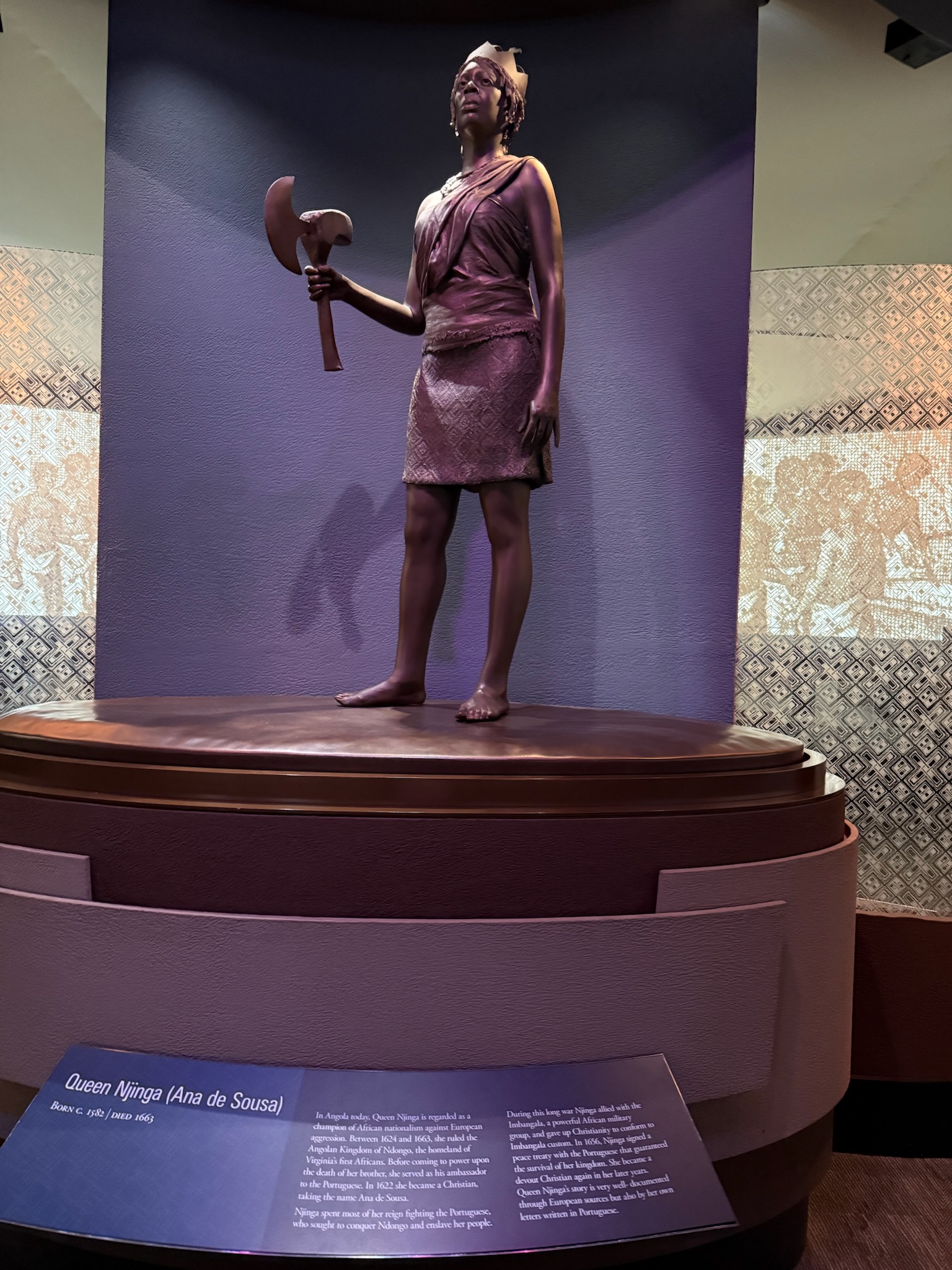
There was a display about the Angolan people, which was the culture of the majority of the slaves in the early days. Much like England, Angolans mostly lived in small villages of a couple hundred people or less, but there were cities with tens of thousands of people. Angolans were known as skilled metalworkers and cloth weavers. In Angolan custom, if someone was a foreign enemy in war time, they could be captured and held as a slave. When the Portuguese colonized the Angolan countries in the 1500s, they started purchasing these slaves from the Angolan capturers and exporting them to the Spaniards in the New World. As the slave trade grew, the Portuguese started hiring mercenaries to go out and capture slaves for them. The mercenaries took thousand of Angolans.
There was a big display on the Virginia Company of London, the investment company that had funded the Jamestown and Maine colonies. In 1606, King James I gave the Virginia Company exclusive rights to settle Virginia. The mission was to extend the bounds of English civilization, find wealth, convert the locals to Christianity, create jobs for England’s unemployed, find a route to the Orient, and tap into the resources of the New World.
The Virginia Company paid all of the costs of establishing the colonies, and they owned the land and all resources. All the colonists were required to work as indentured servants of the company for 4 – 7 years. The Virginia Company raised money by enticing people to buy shares of their stock, which cost 12 pounds 10 shillings — or the equivalent of 6-months wages for the average man — per share.
The leadership of the Virginia Company recruited colonists by offering free food, clothes, tools, housing, and transportation. Lower class people were enticed to sign up by the prospect of upward social mobility. In later years, the opportunity to buy land was added as an incentive. However, the supplies provided were often low quality and insufficient, and the colonists suffered. The Maine colony failed after one year.
The costs of operating the colonies were enormous. Jamestown had been expected to become financially self-sufficient relatively quickly, and that did not happen. As the Virginia Company needed more and more money to cover costs, they devised a scheme to attract more investors: if you bought a share you were entered into a lottery and could win a valuable prize, such as a gold cup. In 1616, when it couldn’t pay the dividends that it had promised to investors, they offered 100 acres of land per share of stock owned in Virginia as payment in lieu of cash. In the early 1620s, company was reorganized multiple times as a result of mismanagement. It sounds like there was a bankruptcy somewhere in there, too. The company was eventually suspended for fraud and their charter revoked. In 1624, Virginia became a royal colony, answerable to the king’s Privy Council. On a side note, the situation with the Virginia Company eerily paralleled what happened with the French Panama Canal Company. On another side note, in 1612, the king extended the Virginia Company’s charter to include the Bahama Islands.
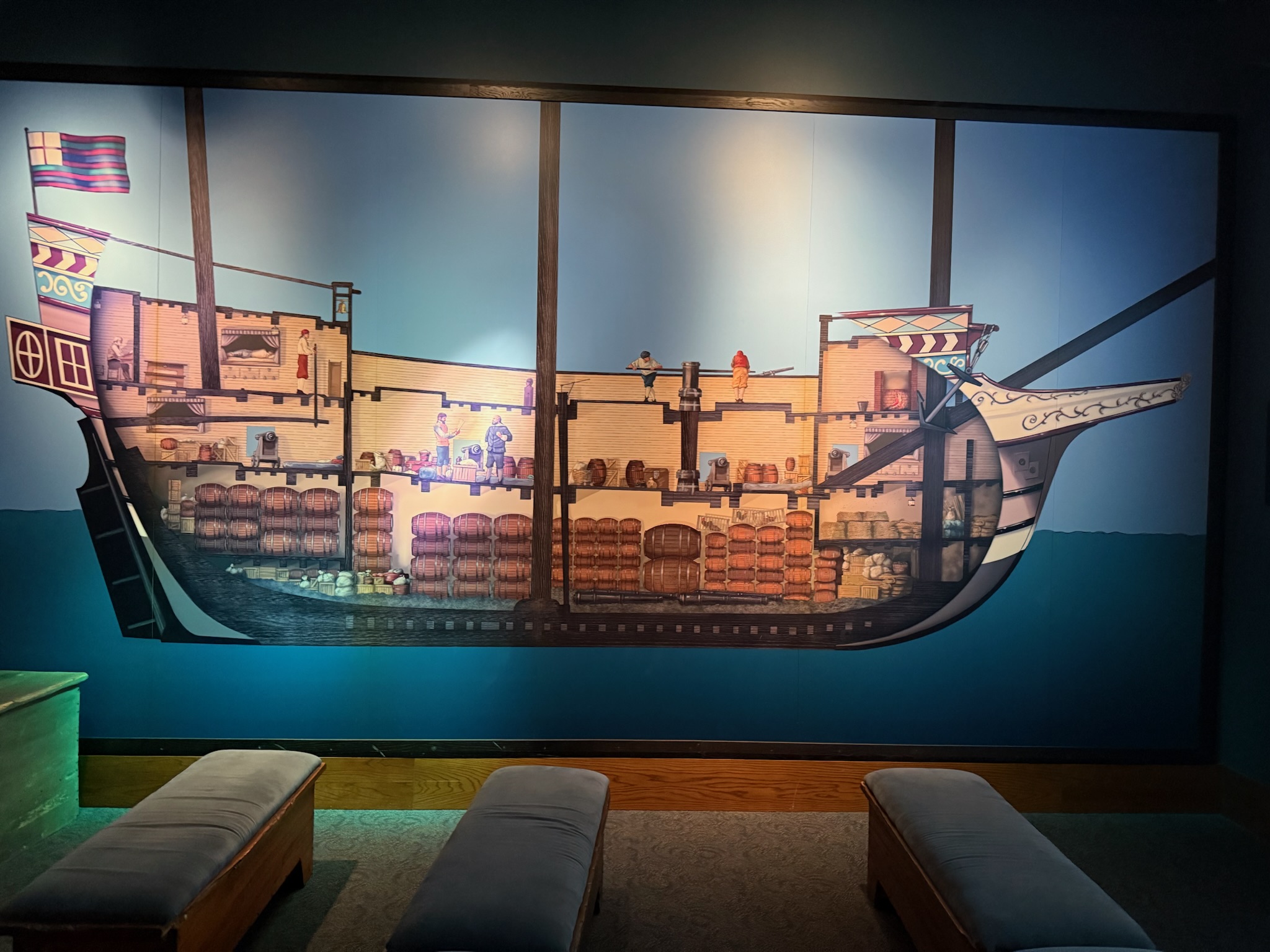
We finally got to the exhibits about Jamestown itself. The colonists arrived in Poynt Comfort in April 1607 and used it as their base while they scouted for a permanent location that met the criteria set forth by the Virginia Company: a peninsula in a river which could be easily defended and where ships could be unloaded close to shore. The expedition was led by Captain John Smith. The settlement was established in May 1607 and named Jamestown in honor of King James I. The local indigenous tribe, the Paspahegh raided them, so the settlement was quickly walled off into a fortress.
Food was a problem from the very beginning. They’d arrived too late in the year to plant the crops they’d brought seed for. The first ships carrying supplies from England didn’t arrive until early 1608, and after that, supply ships were sporadic and often the food was rotten. Dysentery and typhoid plagued the settlement. Less than a year after the founding, the fort burned down and had to be rebuilt. By May 1608, only 38 settlers were still alive.
In the autumn of 1609, two things happened: 1. A fleet with several hundred new settlers arrived. However, their flagship, Sea Venture, had been carrying food and other important supplies along with the new leadership for the colony, and it wrecked off Bermuda. 2. John Smith’s aggressive tactics to procure food made the indigenous mad, sparking warfare. Then Smith left to go back to England, leaving the colonists without leadership. Between the lack of food and supplies and the attacks from the indigenous on anyone who set food outside the fort walls, chaos resulted. Military law was enacted with harsh punishments for breaking rules. They survived by eating their horses and any creature that wandered into their fort, such as rats and snakes. We’re pretty sure that the movie claimed they’d also eaten their fellow deceased humans, but the signs didn’t say that.
In 1610, the Virginia Company’s biggest investor, Baron de la Warr, was appointed Lord Governor and Captain General of Virginia. When he arrived in June of that year with supplies, only 90 out of the 250 colonists were still alive, and the remaining colonists were actually in the process of abandoning the colony. De la Warr’s fortuitous timing saved the colony from failure. De la Warr buffed up the fortress and retaliated against the indigenous, killing the chief and his family. Poor health forced De la Warr to return to England the following year.
All men were required to be part of the militia and had to participate in weekly drills and training. The Virginia Company supplied every male colonist with weapons for defense, including a sword and sword belt, a bandolier for ammunition and a musket. Every man also had a knife or dagger to be used both as a weapon as a tool. Pikes and axe-bladed halberds were carried as symbols of rank. Half the men were required to have suits of plate armor.
Tobacco had been introduced to England in the 1560s and was rapidly adopted. John Rolfe arrived in Jamestown in 1610 with the idea that he’d start growing tobacco. It was believed he had procured seeds for sweet scented tobacco plants while in Bermuda. In 1614, he exported a small shipment that was well-received in England. Tobacco quickly became the colony’s biggest cash crop. The colonists also exported lumber, potassium carbonate (used for making soap and glass), pine tar and pitch (for shipbuilding), and plants believed to have medicinal value.
As the tobacco industry grew, so did the need for indentured servants. Due to high death tolls and bad conditions, The Virginia Company was having a harder and harder time recruiting people. In 1619, slavery was adopted to fill the void. It sounded like the earliest Africans were viewed as indentured servants rather than slaves. They lived in the same quarters as the white indentured servants. Many eventually became free and were allowed to purchase land and live in society the same as white people. Many prospered, and some even imported white indentured servants and black slaves of their own.
Some other important things happened in 1619, as well: 1. Military law was replaced with British common law. A representative government of sorts with elected community delegates was formed. The delegates also acted as a court system, providing redress of grievances. At that point, there were no property restrictions. 2. Settlers were allowed to purchase land for themselves after their period of servitude ended. 3. Colonists were instructed to observe an annual day of Thanksgiving to the almighty God. 4. The Virginia Company started recruiting English women to be wives for the settlers. Wives, daughters and maidservants of settlers had started coming over in 1608 (but the settlers had to pay the female’s ship fares out of their own pockets.) The Virginia Company had started allowing women to come as indentured servants in 1618. But recruiting women specifically to be wives was a new concept. Between 1620 and 1621, 146 bride-to-be were imported. They lived with married couples until they found a husband. The husband had to pay the company 150 lbs of leaf tobacco as reimbursement for the cost of bringing her over. Since this was more than what it really cost, the company profited from this wife-importing business.
There was a display about Pocahontas. Her real name was Amonute and Pocahontas was a nickname meaning “playful or mischievous.” She was the daughter of the leader of the Powhatan. Her Christian name was Rebecca. She first met John Smith in 1607 after Smith was captured and taken to her father. Smith claims she rescued him from death, though now historians believe he wasn’t really about to be killed; due to a cultural misunderstanding, Smith had just misjudged the situation. After that, when tribespeople went to the fort, Pocahontas went as one of her father’s official representatives. She brought them food. At one point, she warned Smith that her father had planned an ambush. After Smith left in 1609, Pocahontas stopped coming.
By 1613, the English and the Powhatan had been at war for four years. The English kidnapped her and held her for ransom for over a year. While in captivity, she learned English, received religious instruction, became a Christian and renounced her old life. Apparently, in the culture of the Tsenacommacah, kidnapping women and children from other villages during warfare was a common practice. Culturally speaking, the kidnapees were expected to accept their fate.
In April 1614, she married John Rolfe, who was a widower. The marriage led to peace between the colonists and the Powhatan. In 1616, the Virginia Company invited the Rolfe’s, their infant son, and some of her Powhatan relatives on a PR tour of England. In March 1617, shortly before they were supposed to return to Virginia, she became ill and died.
War broke out again between the the colonists and the Powhatan in 1622. One third of the colonists died. In 1624, Virginia became a royal colony that now answered to the monarchy. The governor was appointed by the king and had to balance the interests of the monarch with the interests expressed by the local elected representative government.
In 1644, war broke out yet again between the colonists and the Powhatan. The Powhatan were angry that the colony was spreading and turning so much land into tobacco farms. They launched surprise attacks on farms in outlying areas. About 1/4 of the colonists died. It ended in 1646 with a truce whereby the colonists agreed to leave certain enclaves of land for the natives, but the natives had to essentially submit to the authority of the British government. They also had pay an annual tribute to the governor and agree to support the colony against invading tribes.
In the early days of slavery, most of the people captured were Angolans, who had already been exposed to European ways under the colonization of the Portuguese — including being converted to Christianity. The Angolans, both captured and freed, developed a cohesive sense of community. But as slavery spread, people from all over Africa were captured. Many slaves came from cultures that were very different from the Europeans’. The whites’ attitudes about blacks hardened. Blacks were moved to separate housing from the white indentured servants. In the 1640s, the government started passing laws to restrict the rights of black people, indigenous people and women. In 1660, slavery was codified into law. Over the next 45 years, a series of legal decisions determined that slavery was a life-long status, children of slave women were slaves no matter the race/status of the child’s father, non-whites were not allowed to vote, hold political office, testify in court against a white person, purchase white servants, carry weapons, or marry another race — but they still could purchase land.
At the end of the museum exhibit was another movie with more details about the later years of Jamestown, which had also been covered in the museum exhibits. Bacon’s rebellion was the primary focus. To be continued…