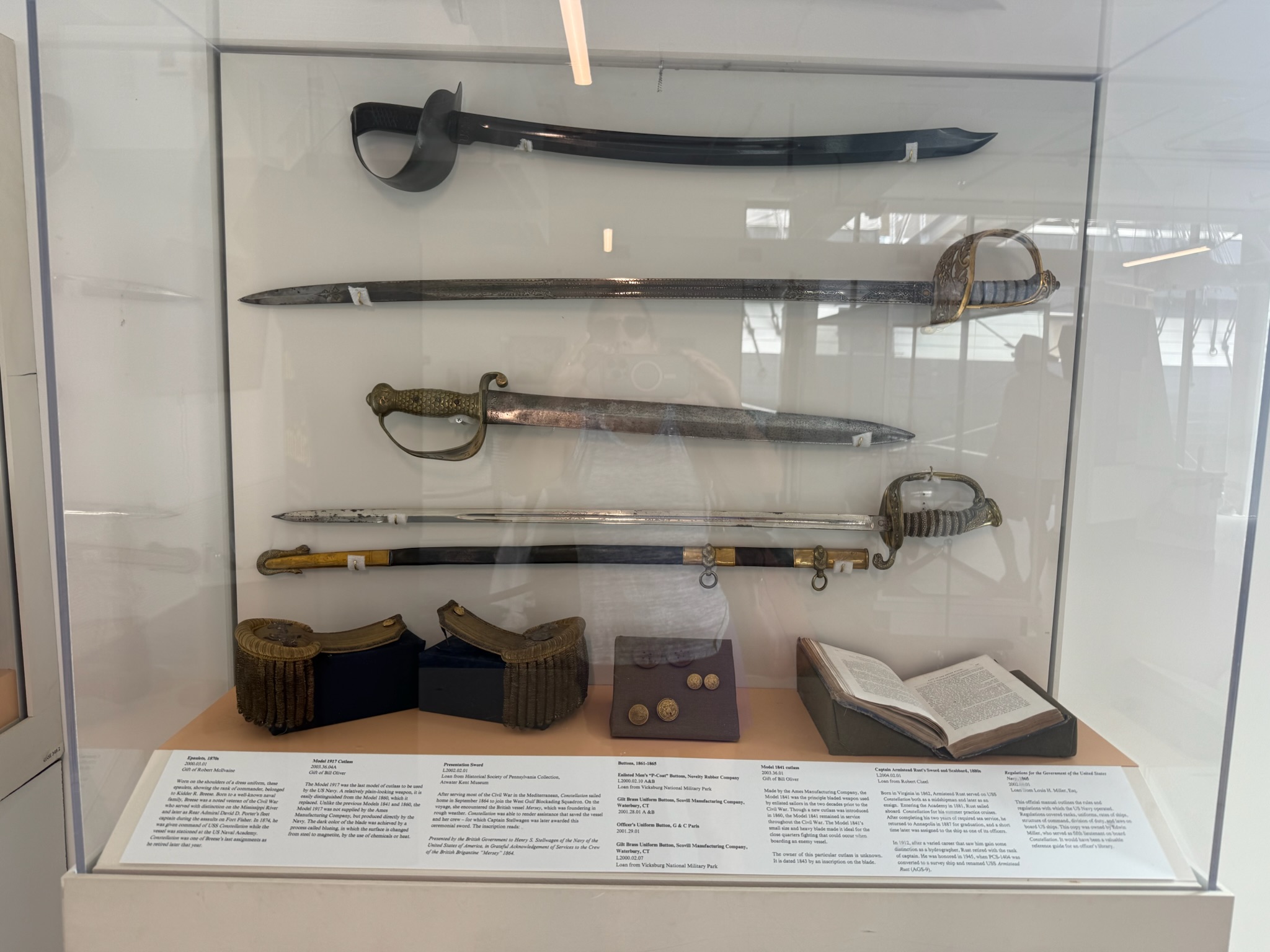
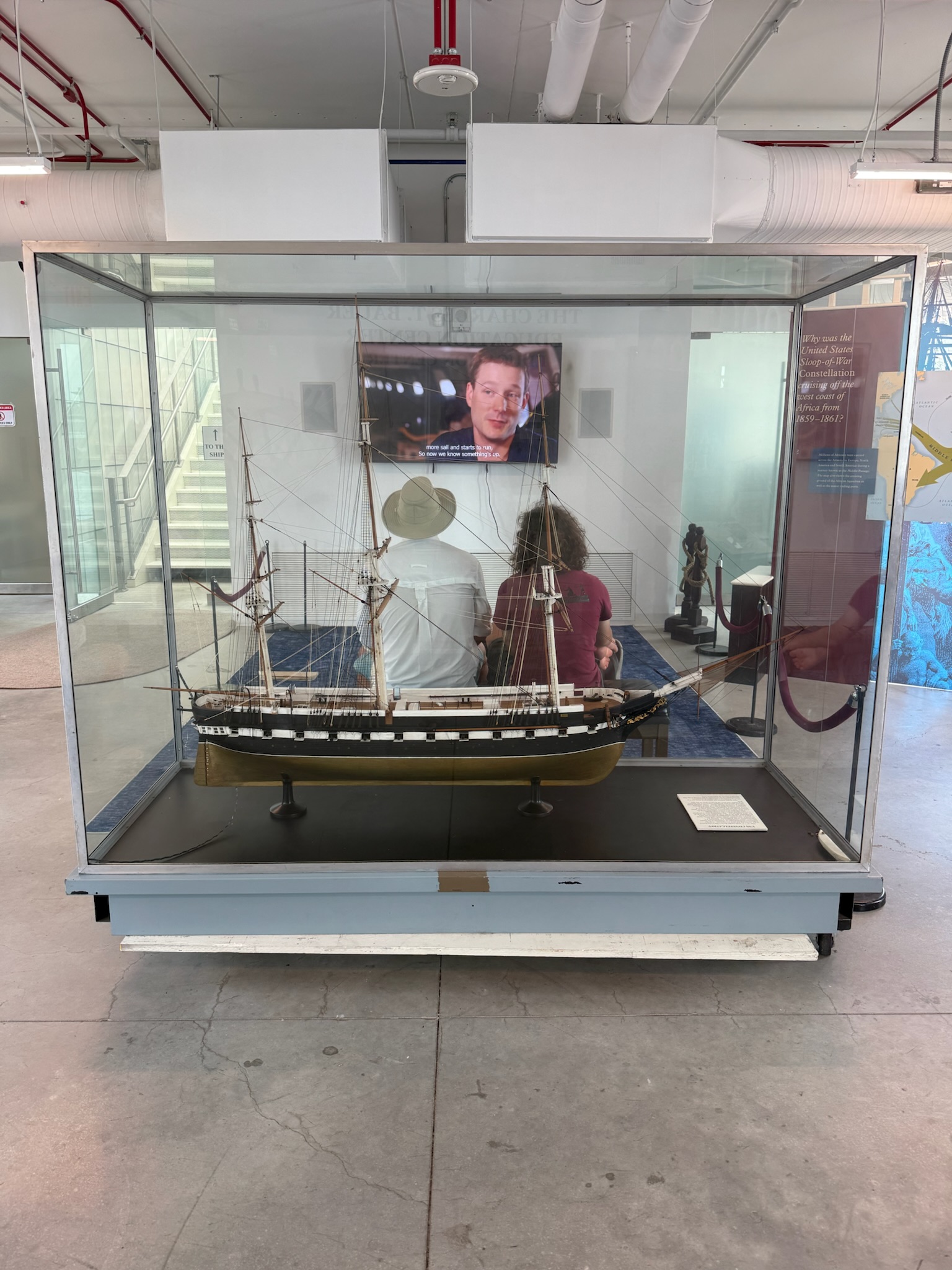
continued… The museum was in a single room. It focused primarily on the history of the slave trade and the USS Constellation’s role in trying to stop the illicit trade after slavery was outlawed. There was also an assortment of artifacts from various years that the USS Constellation was in service and a video playing on a loop. Since it was air conditioned, we were happy to linger in the museum and enjoy the cool air.
In our own personal travels this summer, we’d learned about the inception and progression of slavery in Jamestown. When we visited Fort Monroe, we learned a little bit about the abolition of slavery in 1865. In Yorktown, we’d learned that during the Revolutionary War, more and more colonists opposed slavery and by 1784, five states had already banned slavery. When the fledgling new American government was drafting the constitution in 1787, they set a 20-year moratorium on federally banning slavery, hoping that in 20-years they’d come up with viable political and economic alternatives for the states that relied on slavery.
Picking up where we left off… while abolition within the US didn’t happen until much later, internationally transporting slaves became a focal point within a few years of the country’s inception. In 1794, the US passed a law prohibiting transporting slaves from the US to a foreign country. In 1800, the US outlawed all American participation in international trafficking of slaves and authorized the Navy to seize ships transporting slaves. In 1807, the importation of slaves into the US was made illegal, and if we read the signs right that bill went into effect in 1808 (though it’s possible that there were two separate bills). In 1819, congress authorized the US navy to patrol the African coast in search of slave ships. In 1820, the US declared the trading of slaves to be an act pf piracy and those convicted subject to the death penalty. However, despite these laws, the slave trade from Africa was still booming in the US because no one was enforcing these laws. While the navy had authority to do so, there wasn’t an assigned detail.
Meanwhile, on the world stage… In 1807, British Parliament declared the slave trade illegal. The Royal Navy was dispatched to Africa to patrol for slave ships. By 1817, Portugal, Spain, France and the Netherlands had also abolished the slave trade and had agreed to allow the Royal Navy to search ships belonging to their countries to see if they were slave traders. By 1840, Sweden, Brazil and other countries had also abolished slavery and allowed the Royal Navy to search their flagged vessels, as well. In 1841, England, France, Russia, Prussia and Austria all signed a treaty agreeing to search one another’s flagged boats for slave-traders.
Great Britain repeatedly tried to get the US to allow our flagged vessels to be searched, but the US Congress staunchly refused. And for good reason! As we’d learned in Ft. McHenry, one of the reasons the US had declared war on Great Britain in 1812 was because they were capturing American merchants and conscripting them into the British navy. At this point, less than 30-years had passed and the Americans still did not trust the Royal Navy.
In 1839, a Spanish ship called the Amistad was transporting slaves to Cuba, and was overtaken by the captives. The ship was sailed north and ended up in US custody. The Spanish government demanded the ship and cargo back. The US refused. The case went to the Supreme Court, who freed the Africans. The case thrust the slave trade into the national spotlight.
It was estimated that at least half the slave traders were running under the American flag (though some were flying fake flags and actually belonged to other countries) so they wouldn’t be inspected. It sounded like Great Britain did some threatening and, combined with the mounting public pressure from the Amistad case, in 1842, the US signed the Webster-Ashburton treaty with Great Britain to start jointly patrolling the west coast of Africa. Hence, the US Navy created the African Squadron.
From 1842 – 1859, there were never more than six US sailboats patrolling on the African Squadron, and usually it was just four. They were usually slow, heavy boats that couldn’t catch the fast slave ships. In total, they caught only 22 slave ships. In a similar timeframe, the Royal Navy usually had one to two dozen boats on patrol, used both steamships and sailboats, and had caught about 600 ships and freed 40,000 captives.
In 1859, the Navy upgraded to eight ships, with four of them steam, and made the USS Constellation the new flagship of the fleet. In favorable conditions, she could attain 14-knots, making her fast enough to catch the slave traders. As was stated in the last post, this iteration of the fleet became far more successful.
When slave ships were captured, the ship was impounded and sold at auction. The captains were required to post bond and await trial. The crews were taken to the nearest port and released. The newly freed slaves were taken to Liberia.
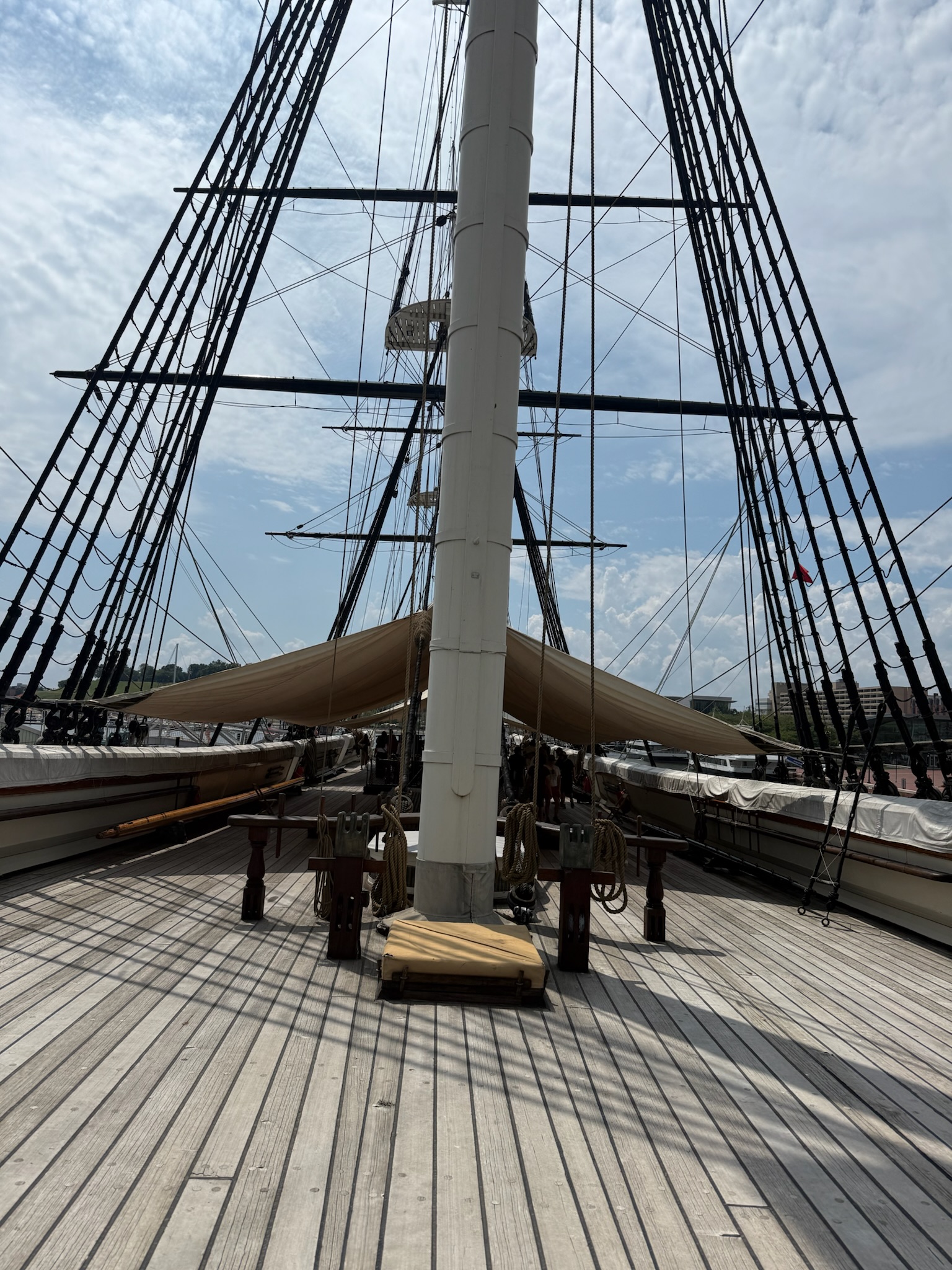
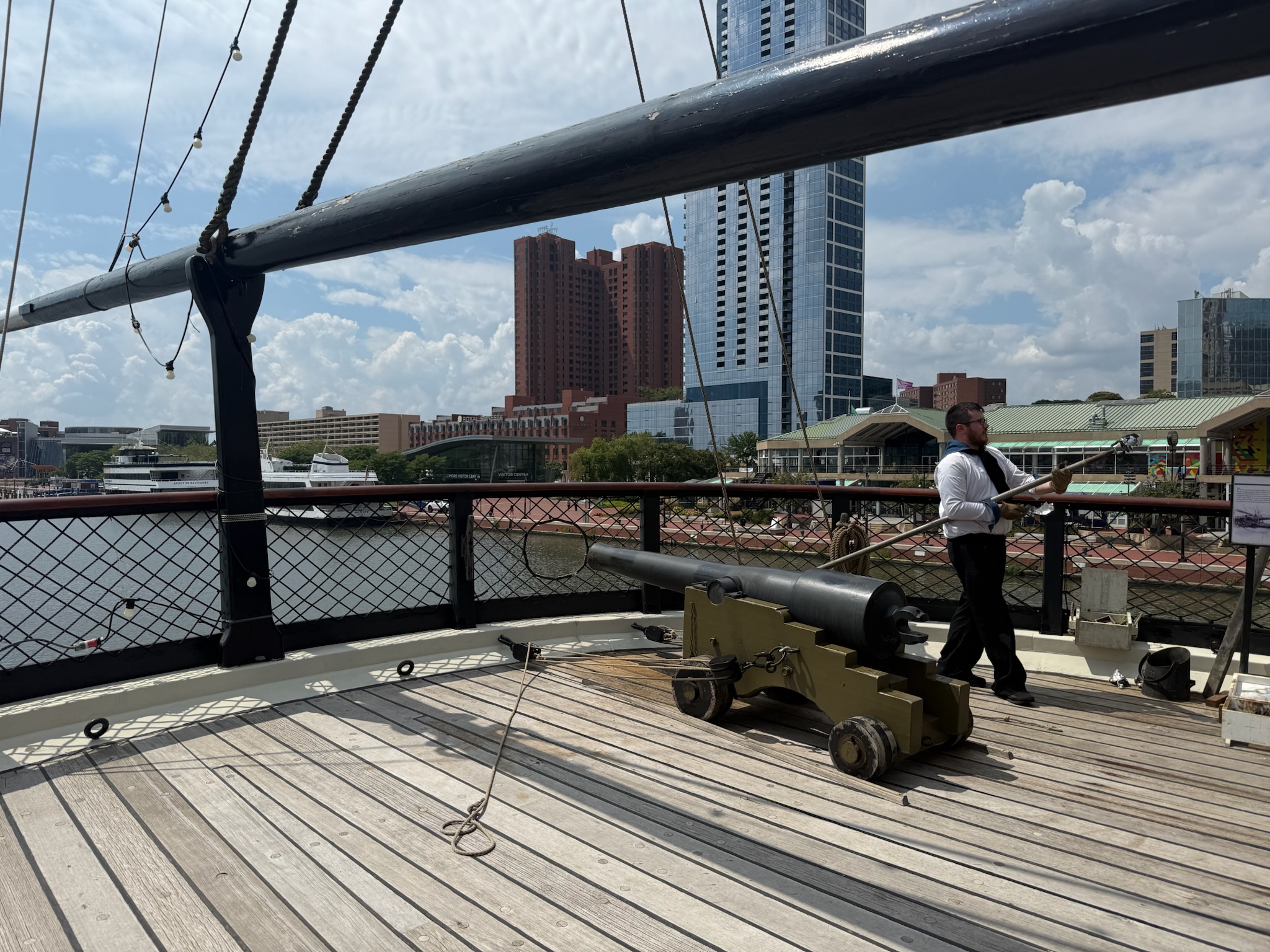
As we were finishing up in the room, we heard a cannon fire. We went up the stairs to the spar deck of the ship (spars are the poles that support the sails and rigging), and were hit by a wall of heat about 2/3 of the way up the staircase. On deck, we asked how often the firing demonstration was done. We were sad to find out it was only once a day. Darn! This was the very front (forward) of the ship.
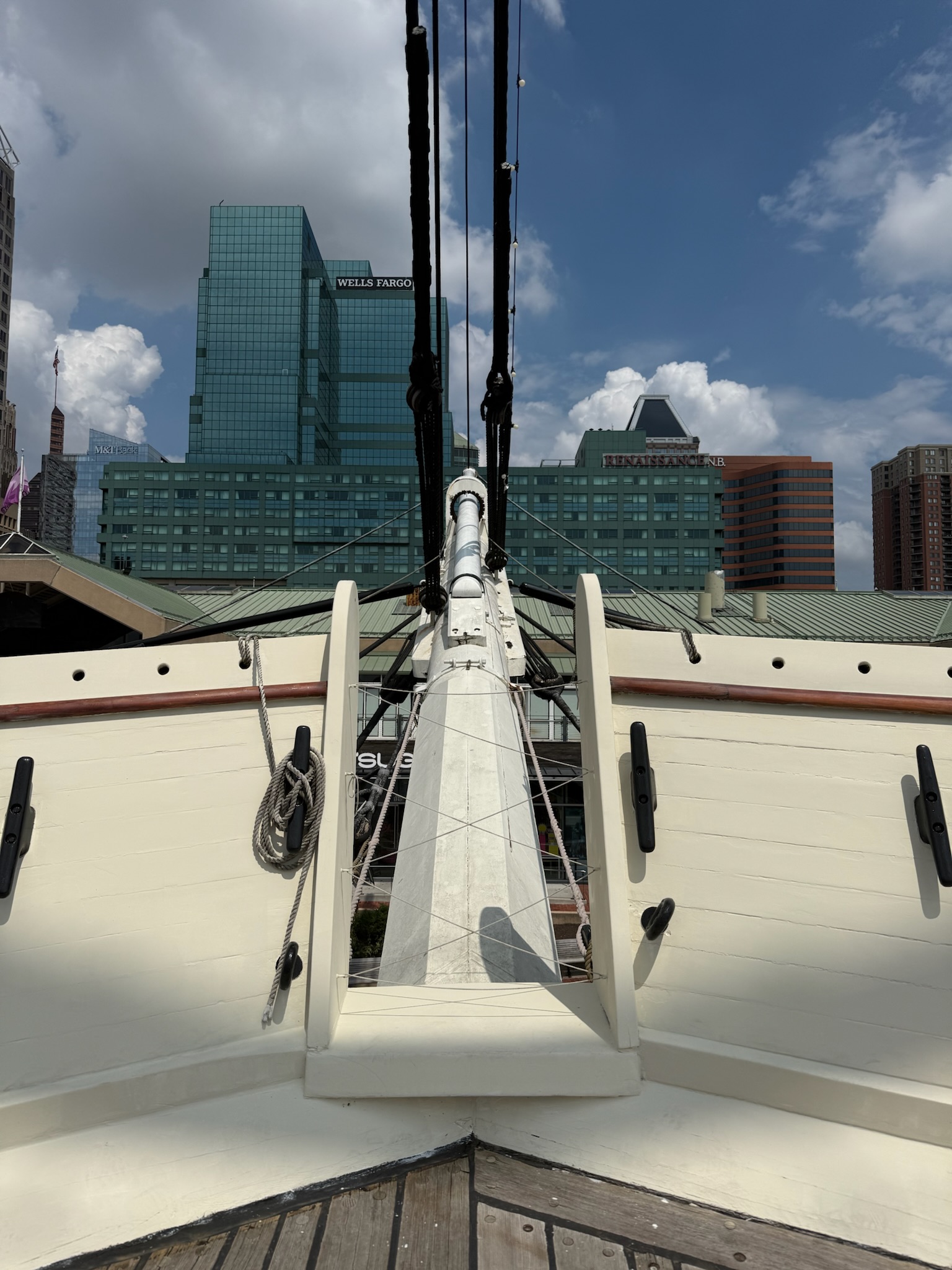
Looking back (aft) from the front.
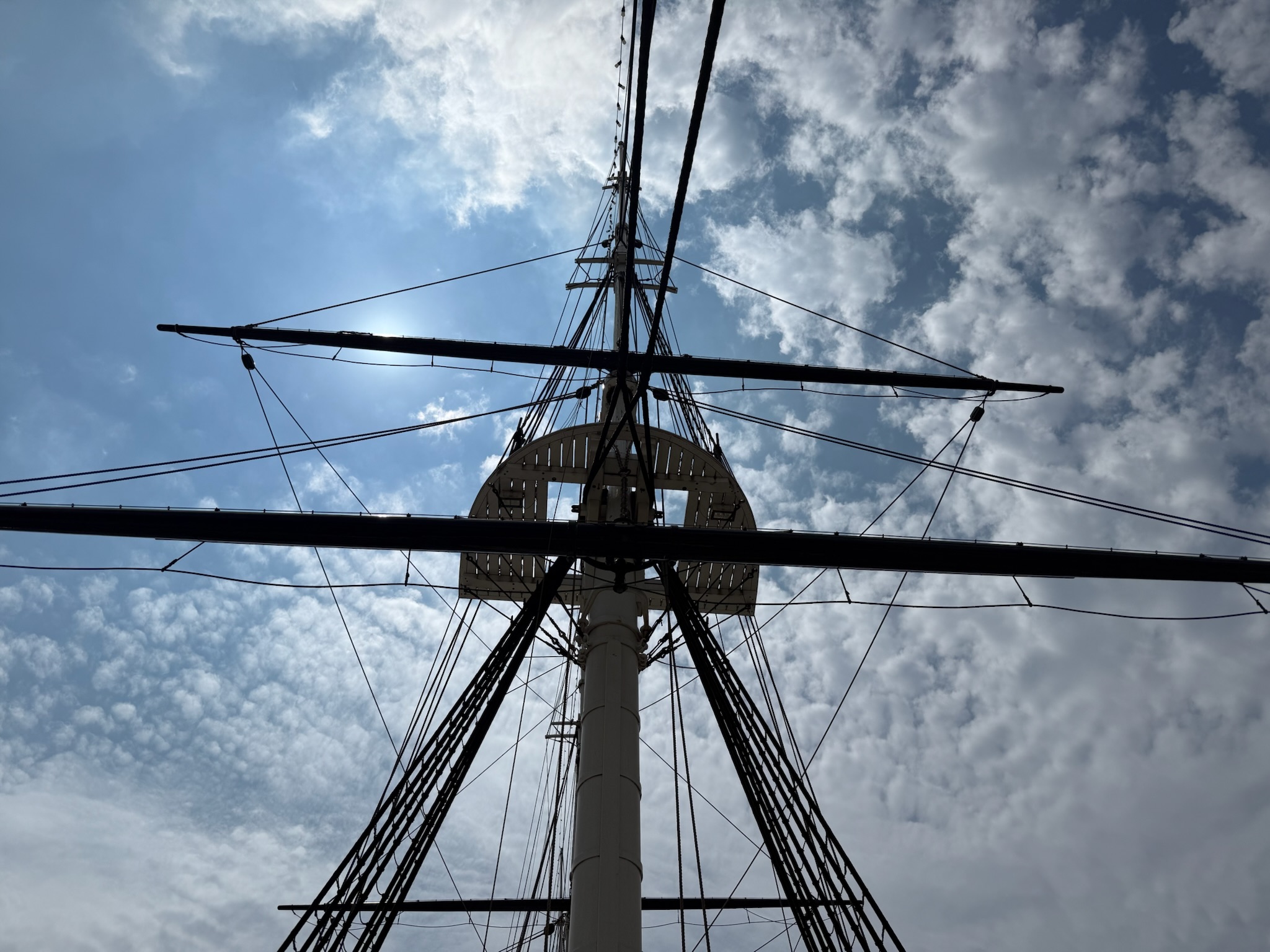
Looking up from the front. When on patrol, someone was stationed up there at all times to look for ships to pull over and inspect.
The cannon that had just been shot. We were warned it was still hot and would burn us if we touched it. We found out that, while the majority of cannons were on the next deck down, two cannons were kept on the spar deck.
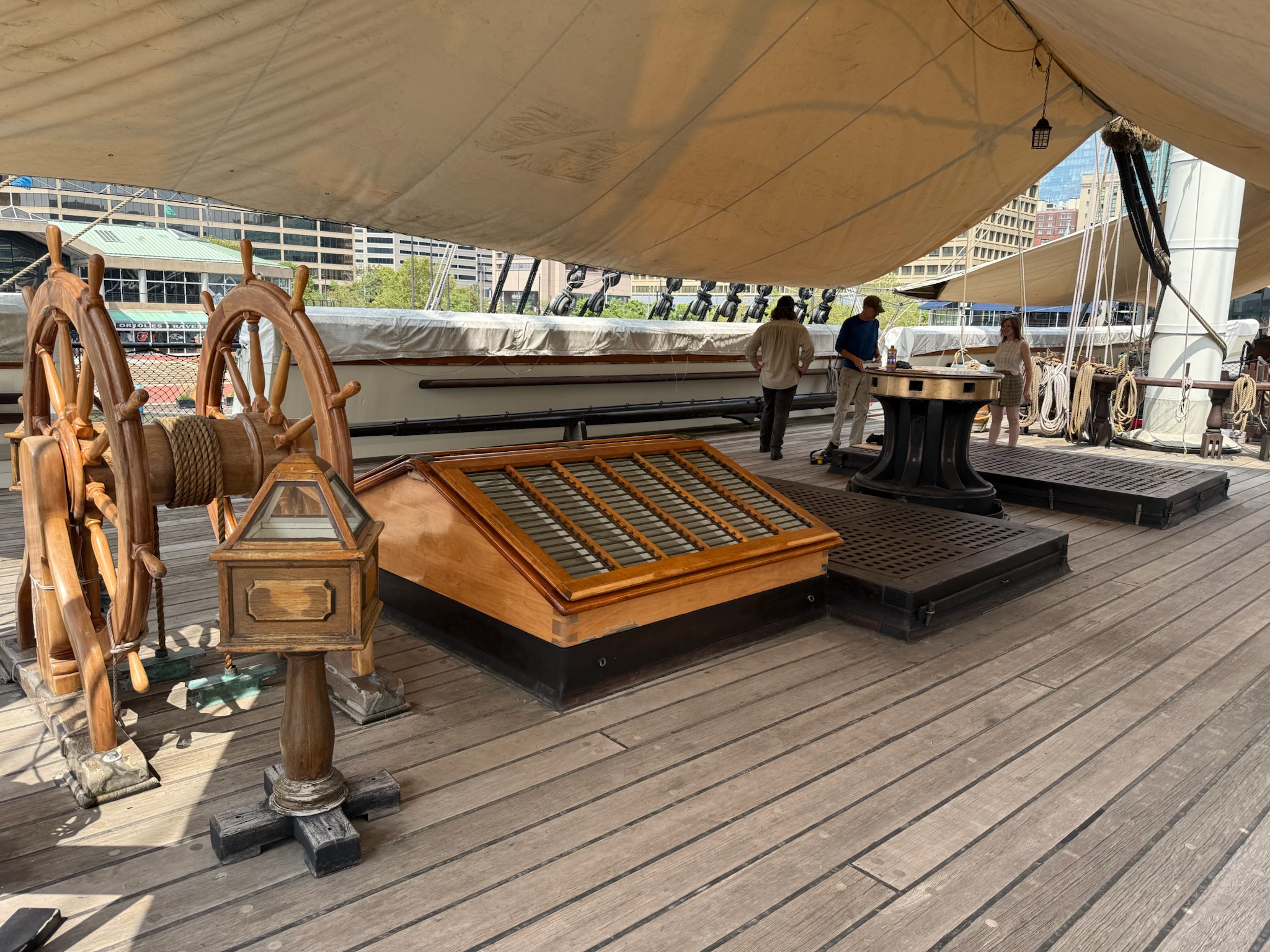
The ship had a double-helm (steering wheel), because in bad weather, it took the strength of more than one person to control the steering wheel. As many as four people could steer at once, and usually there were two men on duty during a typical watch. There were two magnetic compasses installed, one on each side, so that the compass could be easily seen from either side of the wheel. The compasses were internally lit so they could be seen at night, too.
The black and gold round device to the right was called a capstan. Christi had thought it was simply a big windlass (device that raises and lowers the anchor/chain), and she wasn’t wrong. Capstans were used for hoisting anything heavy. In addition to the anchor/chain, it was also used to hoist spars, sails and dinghies. It was manually operated — a rope would be put around whatever was being hoisted, crew would stick levers into the holes at the top, and wind the capstan around and around until the rope had pulled the item up on the deck.
From there, we headed down the stairs to the gun deck. This was the port side of the deck, taken from near the aft (back) of the ship. To the right, you can see that the capstan went through the top deck onto this deck, too.
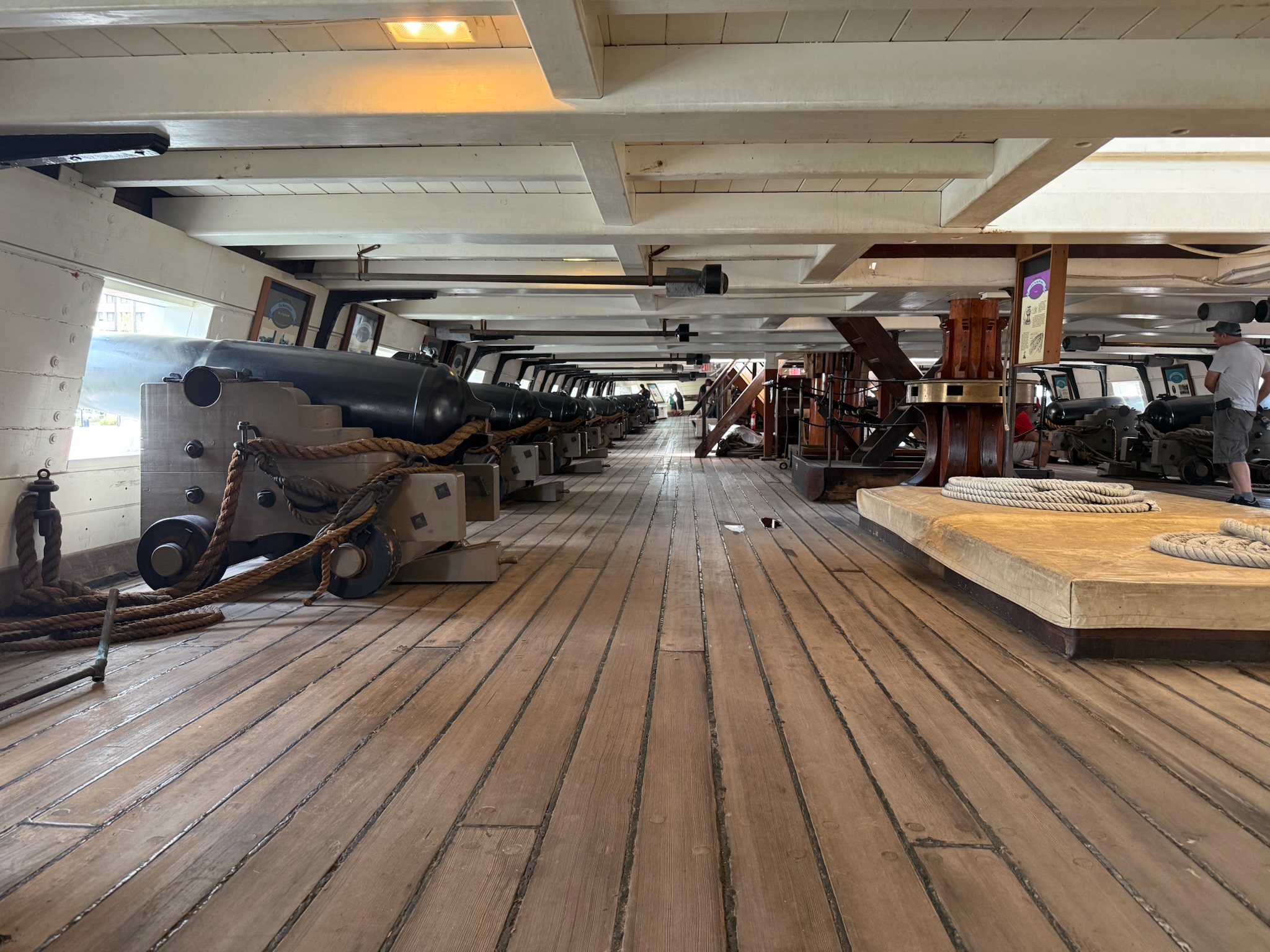
The Captain’s cabin was at the back of the gun deck. It was a suite of six rooms used for sleeping, administration, dining and entertaining. To be continued…