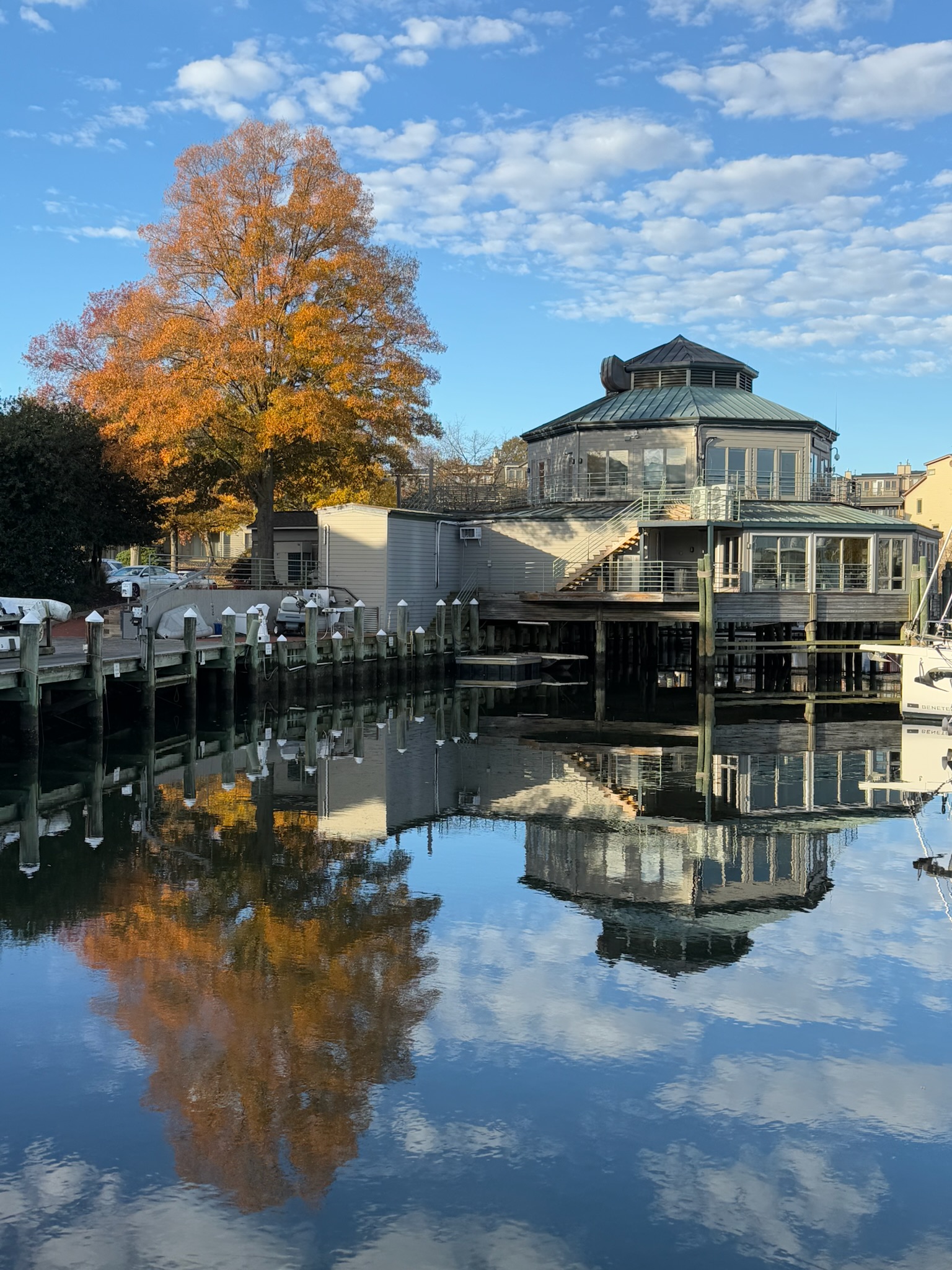
Wednesday, November 5, 2025 — It was a sunny and relatively warm morning at 64-degrees Fahrenheit — the warmest day we’ve had in weeks. It was nice that it was pleasant out as we did all the last minute things that needed to be done before we left on the long passage, including returning the car. Here was another shot of how pretty it was in the marina right now.
As Eric was disconnecting the electrical cables, he noted that the Y-connector was looking like it was beginning to deteriorate. We noted that we should replace it soon.
We untied from the dock at 1100. We’d decided to make this passage on Sunday. Since then, the forecast has deteriorated. As of yesterday, the conditions were not supposed to be good at any point of the 5-day passage, but they also weren’t supposed to be terrible for any of the days, either. We’d debated postponing the trip, but decided that we’d rather be uncomfortable at sea, on our way to warmer weather, than uncomfortable in the cold in Annapolis. We’d never planned to have Kosmos in a cold location and simply did not have the proper gear onboard, and we couldn’t take the cold anymore.
This morning, the forecast had worsened even more. The conditions wouldn’t be good on the first or last day of the voyage. We decided to still go — Eric determined that since the Chesapeake was protected, it wouldn’t be too terrible on day one. And he’d run Kosmos at a higher RPM to try to get to Bermuda faster, thus minimizing the discomfort at the end. We ran at 1750 instead of our typical 1650.
As was forecast, we had uncomfortable conditions the Chesapeake. The wind speed was 15-knots true. It started as head seas, with a steady flow of sea spray coming over the bow and hitting the windows. At first it was dead on the nose, then shifted to the starboard quarter (front, right corner), then starboard (right) side. Eric was on the edge of seasickness the whole time. Neither Christi or Keith were feeling good. We also had to keep a diligent watch, as we’d seen three crab traps and twice had to change course to evade them. Keeping that focus was harder when we weren’t feeling good. In good news, the closet squeak was gone!
After we’d already left, the forecast changed to a gale warning in the evening/night. There was also warning of a container ship losing 33 containers in North Carolina that they estimated would be routed by the currents onto our exact path, so we had to be on the lookout for underwater hazards once we exited the Chesapeake Bay.
A little before 1400, the wind jumped up to 26-knots true. The sea conditions worsened. Sea spray went from a steady flow to constant. The bilge pump alarm was periodically going off. Eric thought it was tied to the bilge sensor; he thought the sloshing of the water made it seem like there was more water in the bilge than there was. Our speed was abysmal at 4.8 knots, so we increased RPM to 1850, which took us to 5.3 knots.
A bit after 1400, the bilge pump went on and didn’t turn off. Eric went down to the engine room to see what was going on in the bilge. The sensor had fallen off its mount and was in the water. Argh. It probably had gotten loosened when we’d cleaned the bilge, and the intense motion had dislodged it. He zip tied it back into place. All seemed to be fine.
Not too long later, it happened again. The bilge pump went on and didn’t turn off. Eric checked the bilge again. All looked okay, so he changed the bilge pump setting from auto to off. If the alarm went off, we’d turn on the pump.
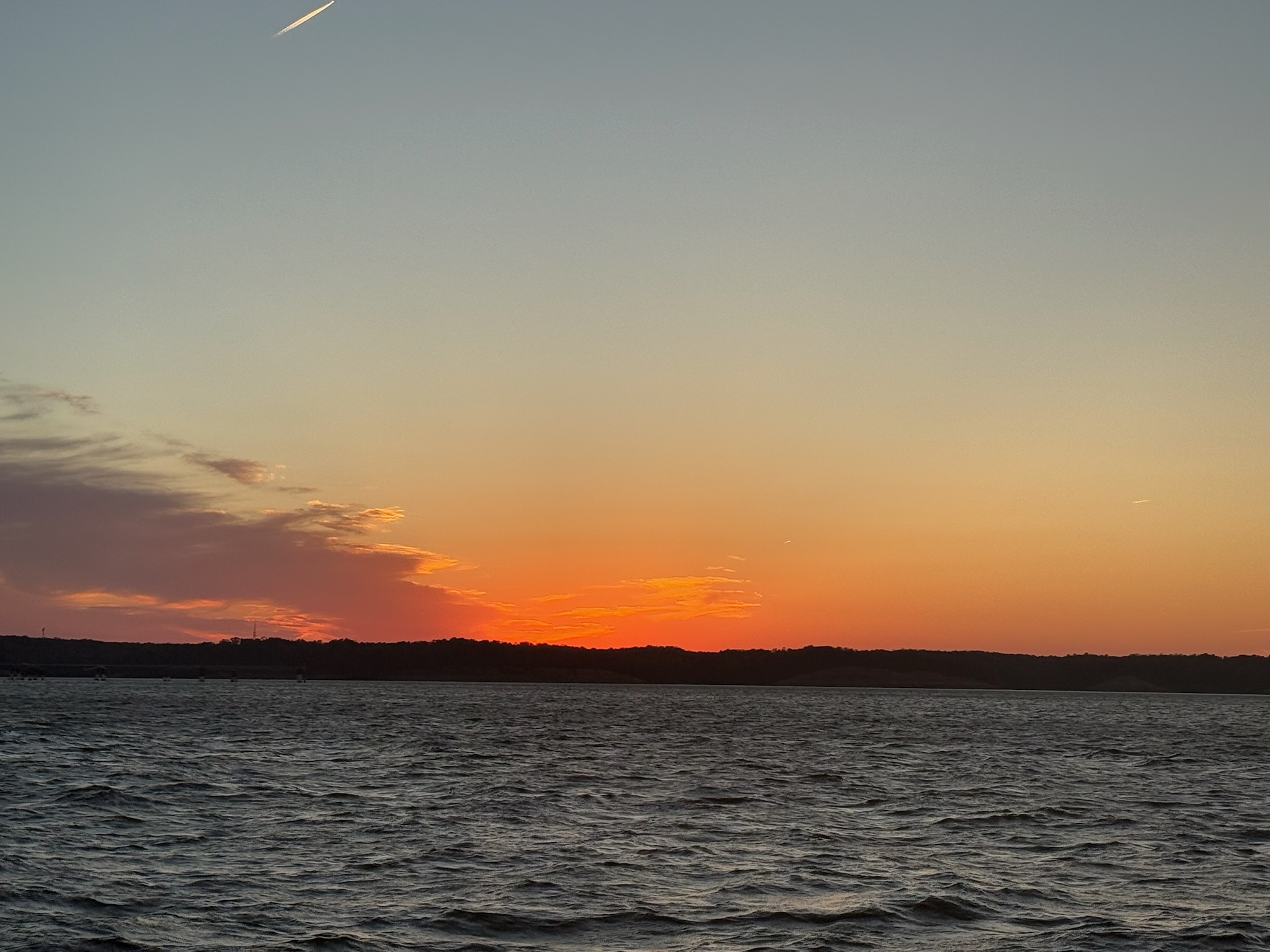
Not that long after that, the alarm sounded. We ran the bilge pump, but just minutes later, the alarm sounded again. Then again. Eric went down again to check. There was some water in the bilge, indicating a leak. He turned off the freshwater pump in case it was a freshwater leak and closed some through hulls that could be potential sources of the leak. He was hoping that had fixed the problem. The sunset had been blocked by low atmospheric clouds, but the sky was still colorful.
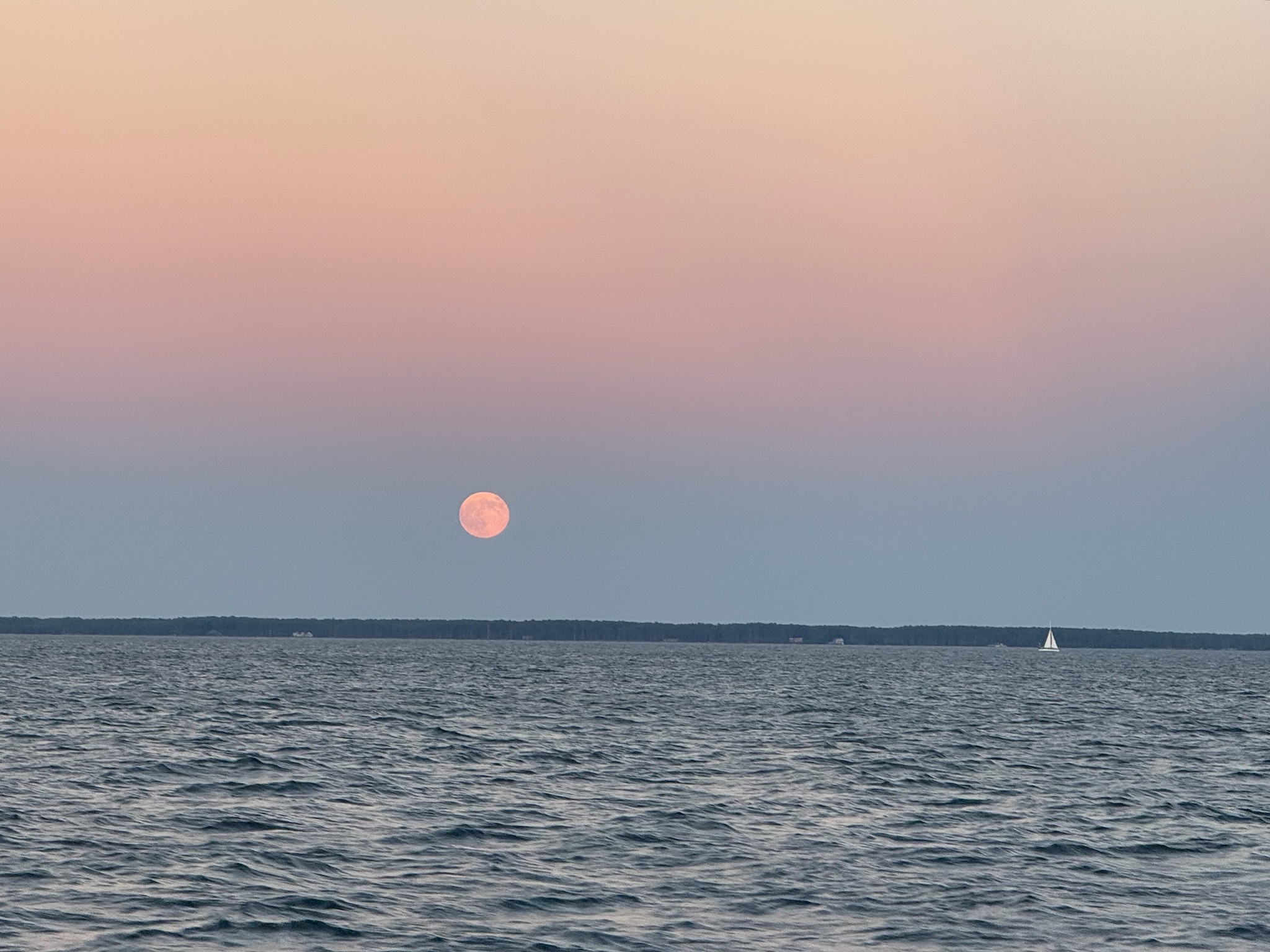
This was the full moon rising as the sun was setting.
Not long after that, the alarm went off again. He went down to the engine room and determined that the bilge pump wasn’t working. He tried to track the source of the leak that was bringing in the water, but being down there made him sea sick. Since he couldn’t work on the bilge situation in all the motion, we determined that our best bet was to find an anchorage. We were near the Potomac, so he picked an anchorage near the mouth that looked like it should be easy to navigate into, even in the dark.
We relied on the high-water bilge pump to go on as needed. It was blinking on and off constantly. We suspected that the severe motion was making the water slosh around so much that it was messing with the pumps ability to pump the water out. We eventually switched to manual mode for that pump, too. We had a timer, and we’d turn it off for 5-minutes, then run it for 30-seconds, then turn it off for 5-minutes, etc.
One we turned into the river, the wind and waves were now coming from the port forward quarter (front, left corner). We were still taking water spray over the bow. Not long after we turned into the river, the seas calmed down and Eric was feeling better, so he went in the engine room again to try to find the leak. He determined it was coming from the lazarette. We decided it was best to wait until we were anchored to open up the laz.
Navigating up the river in the dark was a little scary. Fortunately, the full moon was very bright, which helped a lot. It certainly made the foam on the wave crests glow brightly, which made the river look almost magical. We were very worried about getting caught on a crab pot.
We turned off into one of the tributaries and it really calmed down a lot. We were no longer taking sea spray over the sides of the boat. We figured now that the seas were calm, we could just leave the high water bilge pump on auto. It went on for a few seconds, then went off and stayed off. From that, we knew that the water was coming in from someplace that was not typically underwater, but had been exposed to water today in the rough seas.
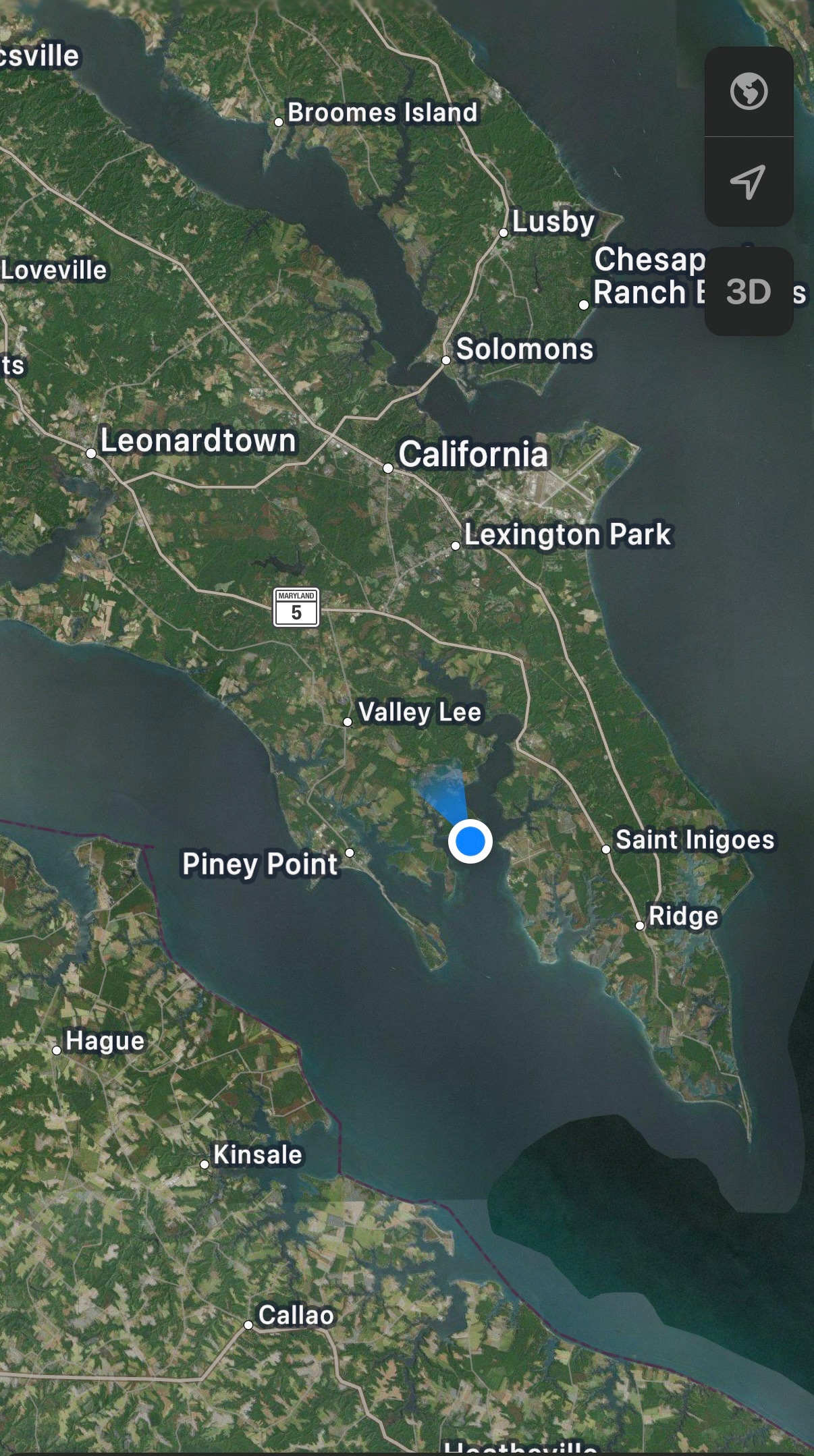
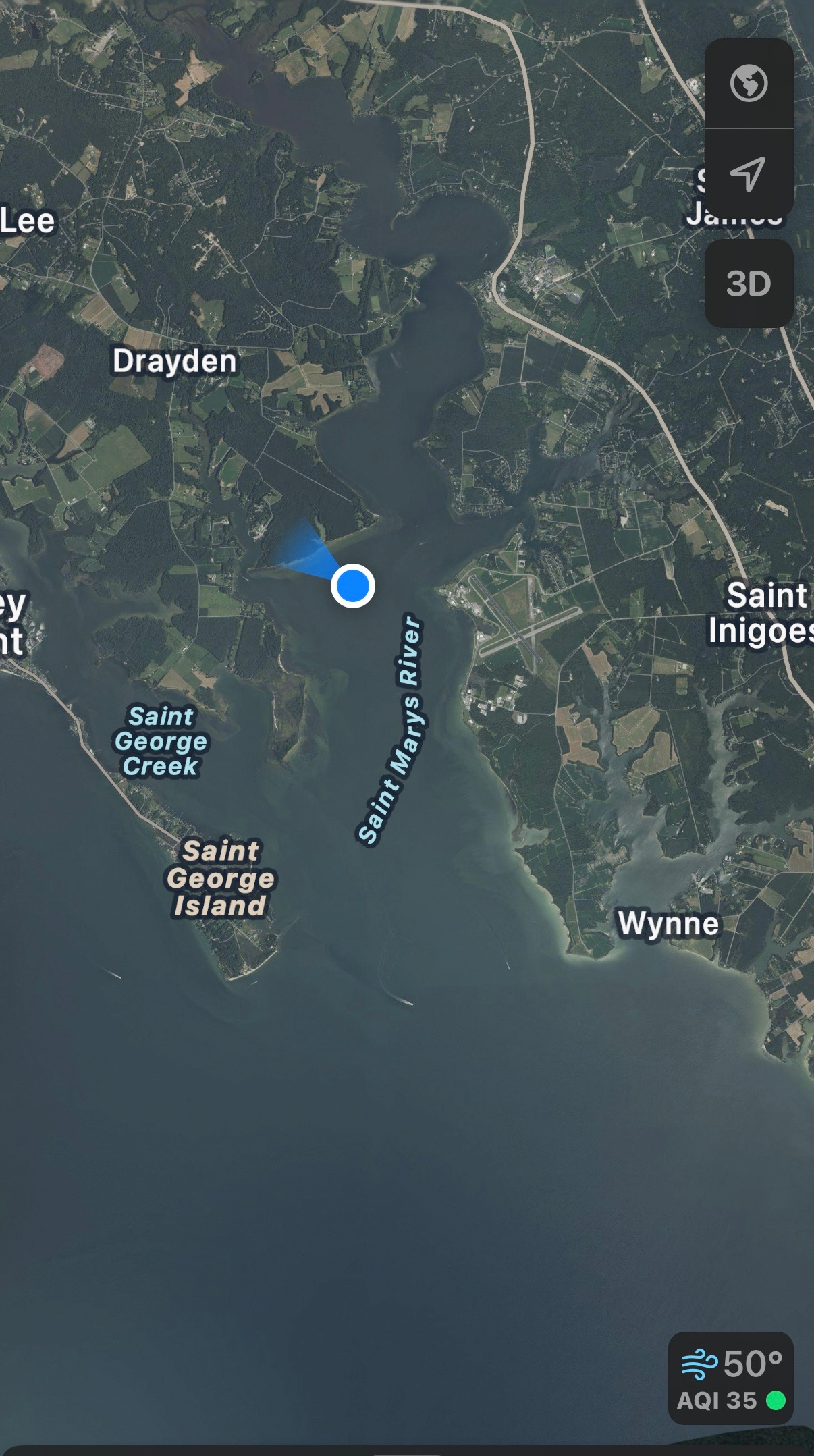
Much to our relief, there were no other boats in the anchorage. Dropping the anchor was smooth – though cold – and the anchor held. It was a very calm anchorage, which we all were thankful for. The water was completely calm and still, which felt wonderful after such a rough ride. The first map shows how far up the Potomac we’d come. The second gives more detail about the tributary that we’d entered.
It was now after midnight and we were all exhausted. Eric scoped out the laz and determined that the seal around the hatch, which had been recently replaced, was the source of the leak. Water had been getting into the cockpit when we were in the big waves, but now that we were in a calm anchorage, the cockpit was dry.
Eric used the manual bilge pump (the hand pump) to get the last of the water out. We waited a little bit to confirm that there really was no water coming from anywhere else, then went to bed around 0100.