continued… Next, we crossed a footbridge over to the Franklin Delano Roosevelt (FDR) Memorial. We apparently were doing the loop backwards, as we entered through the exit. Eric had been before, but Christi and Keith had not. Christi had been expecting a single structure. She was not prepared for how extensive it was.
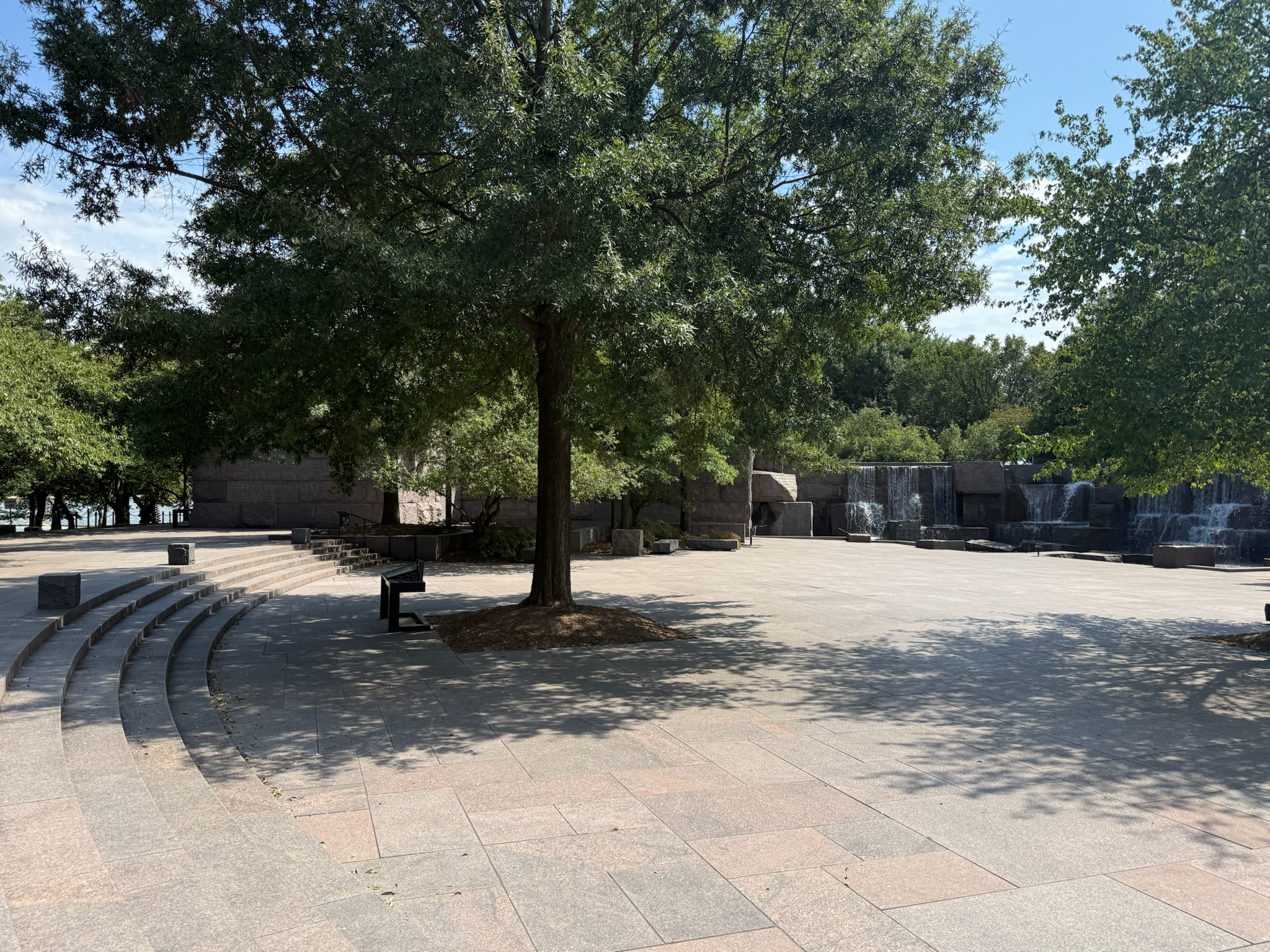
The section we entered into was called Room 4 and covered Roosevelt’s fourth term in office. It definitely wasn’t a room in the sense that it was enclosed. The “rooms” were separated by artistic sculptures. The sign said the goal was to create the feeling of a secluded garden with quiet alcoves.
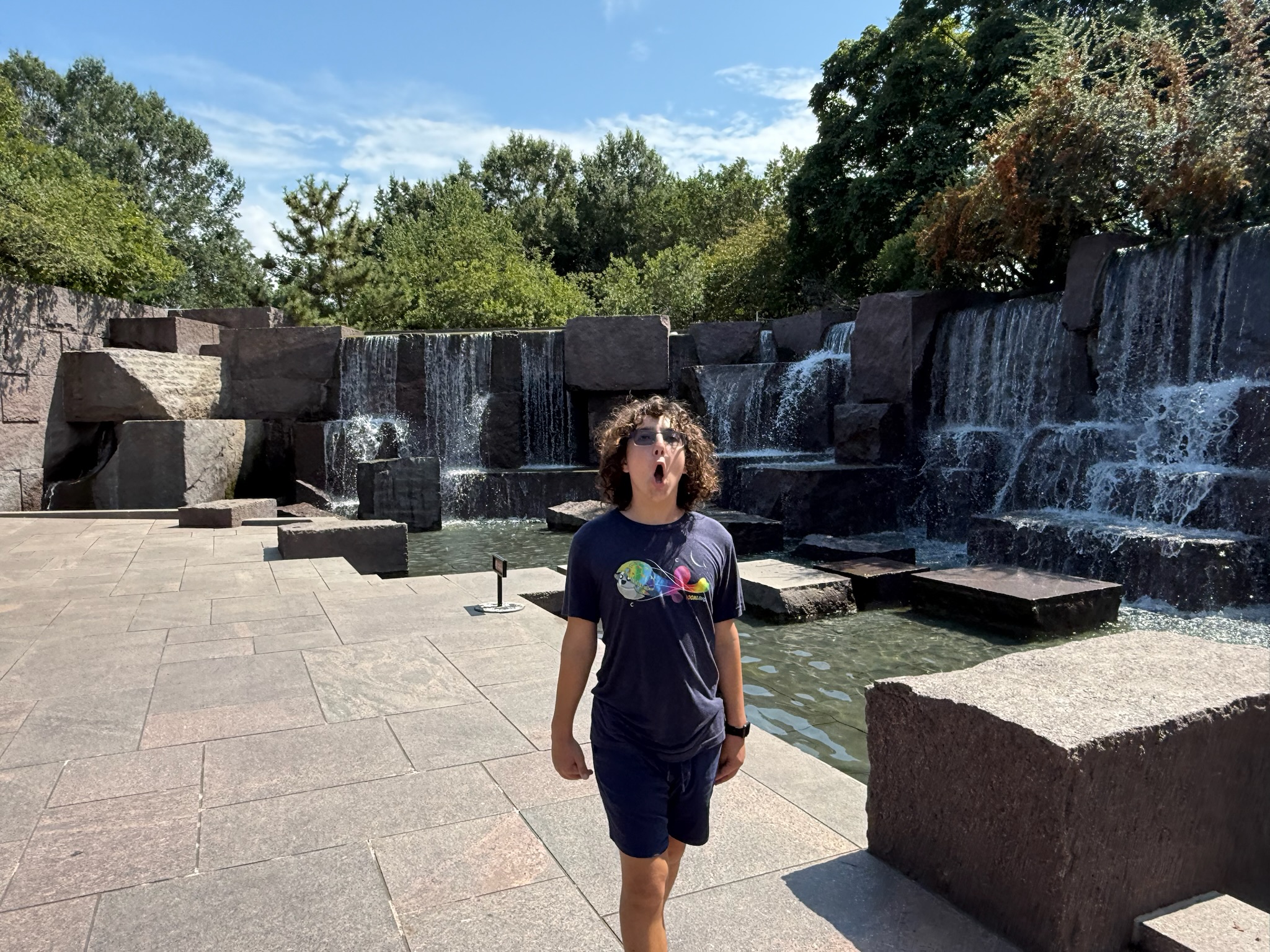
We’re not completely sure which photos were from which room, but we’ve kept the photos in chronological order so you have a sense of what it looked like walking through it from back to front. Every “room” had a water feature of some sort. Every “room” had quotes from Roosevelt inscribed on the walls.

FDR was president of the United States from 1933 – 1945. He was elected during the Great Depression and re-elected three more times. He was the only president elected to a fourth term. He died in April 1945, less than 3 months after his fourth term began. He had been working on negotiating post-war agreement. World War II ended in September 1945.

Room 3 covered his third term, which was 1941 – 1945. World War II began in 1939 and Roosevelt immediately allied with Great Britain, secretly supplying the Allies with weapons without congressional approval. The US entered into the war at the end of 1941. He pushed hard for the creation of the United Nations. ln 1942, twenty-six countries signed on to the UN.

Interestingly, a sign acknowledged that the memorial omitted more controversial issues that tarnished his legacy, such as the incarceration of Japanese-American citizens during WWII and his New Deal Housing Act only helping white citizens.


A sign had said that the reason water was so prominent in the memorial was because it was an important facet of FDR’s life. As a boy, he loved to fish, swim and sail. He was Assistant Secretary to the Navy. As president, he traveled over 110,000 miles on the sea. But most importantly, FDR utilized water therapy to try to regain use of his legs after he lost his ability to walk from polio.


Room 2 covered his second term, which was 1937 – 1941.

He had easily won re-election. It was believed his popularity was in part due to regular radio broadcasts, called Fireside Chats, where he would speak to the American public confidently and optimistically, reassuring them. Most people had never heard a president’s voice before the Fireside Chats began, and this direct connection the people felt with the president as a result of these broadcasts was powerful.

Room 1 covered his first term, from 1933 – 1937. The Great Depression had begun in October 1929. One in four Americans was out of work. People were angry at how the Hoover Administration had handled the economy. Then governor of New York, Roosevelt ran on the promise for a “New Deal for the American People.”


The Prologue room was at the entrance. It was a statue of him sitting in his wheelchair. Etched behind him is a quote from Eleanor Roosevelt about how he presided with dignity from his wheelchair. In 1921, FDR contracted polio and was never able to walk unassisted again. FDR hid this information from the public. The memorial opened in 1997; however, the Prologue section was added in 2001 because becoming disabled was pivotal in shaping who he grew into as a person — strong, courageous, and infinitely patient with never ending persistence.
Interestingly, his uncle, Theodore Roosevelt, also overcame a severe childhood illness and personal hardships, yet went on to become US president. Many argue that Teddy Roosevelt had the biggest effect on changing the course of world history of any US president. Transforming world history must run in the family!

After walking through the memorial, we went into the visitor’s center located at the entrance. It was small and focused on the creation of the monument. This memorial was originally approved by Congress in 1955, but it took until 1990 for a design to be agreed upon. This was not the only FDR memorial in DC. In the 1960s, Friends of FDR dedicated a small memorial to him at 9th and Pennsylvania Ave NW.
At this point, we were all hungry. To be continued...