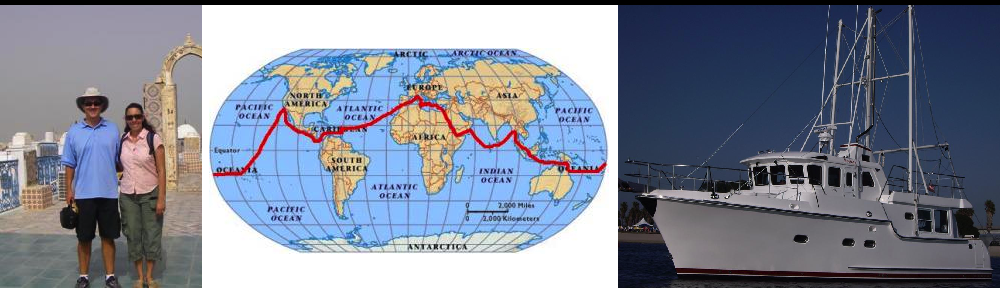
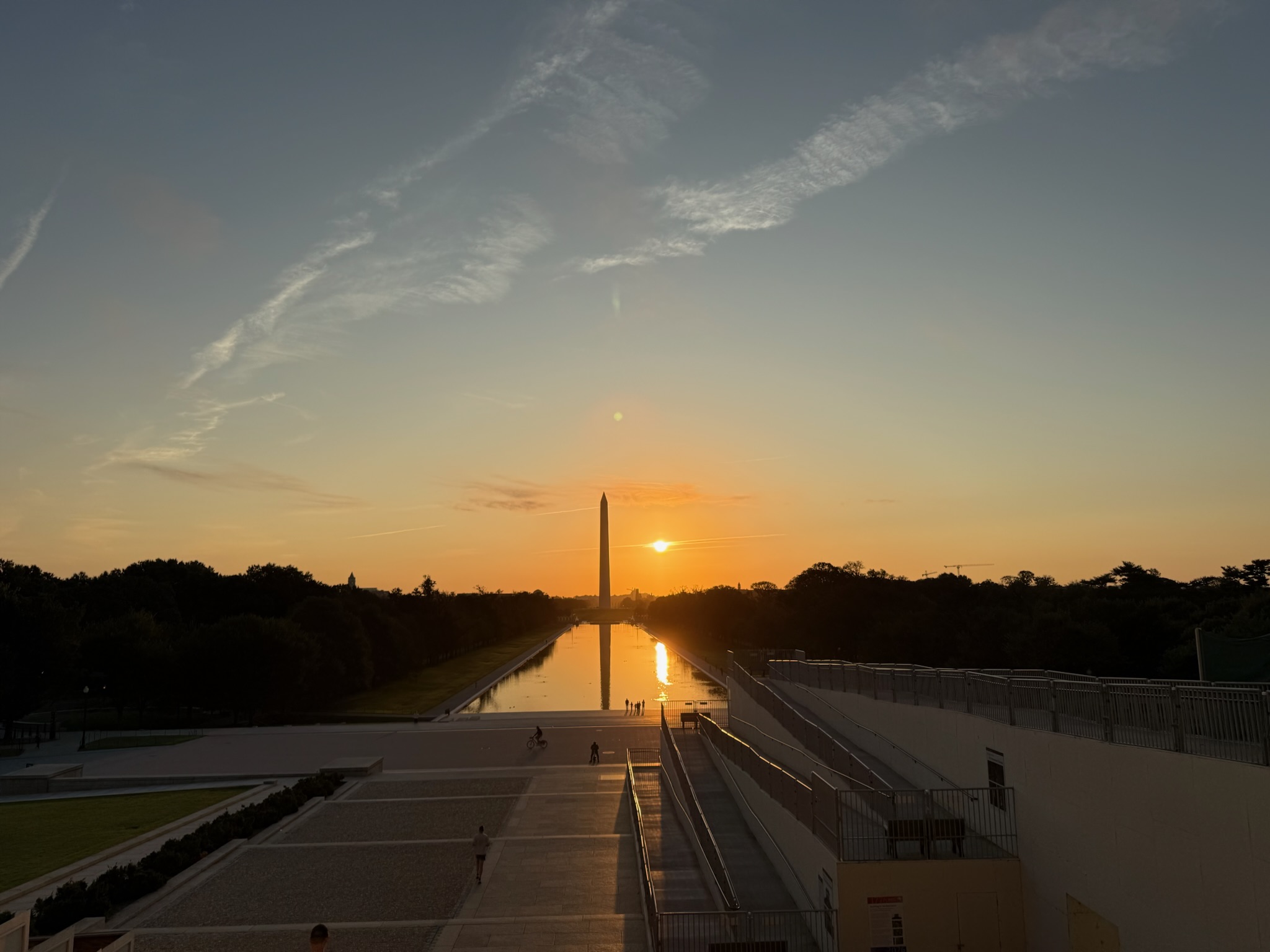
Monday, September 22 — Eric went for a run this morning to the Lincoln Memorial. He saw the sunrise behind the Washington Memorial.
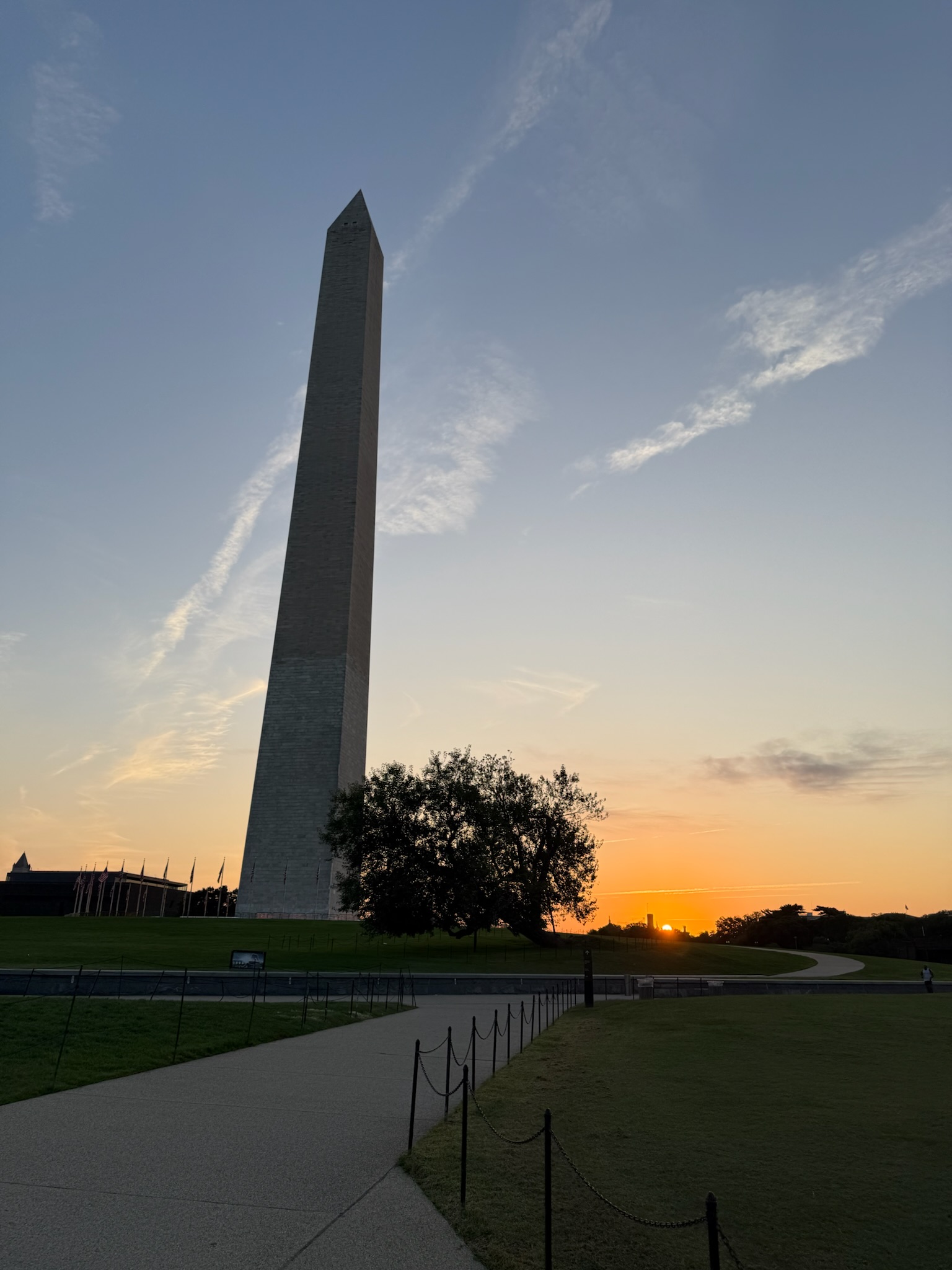
The Lincoln Memorial glowed in the early morning sun.
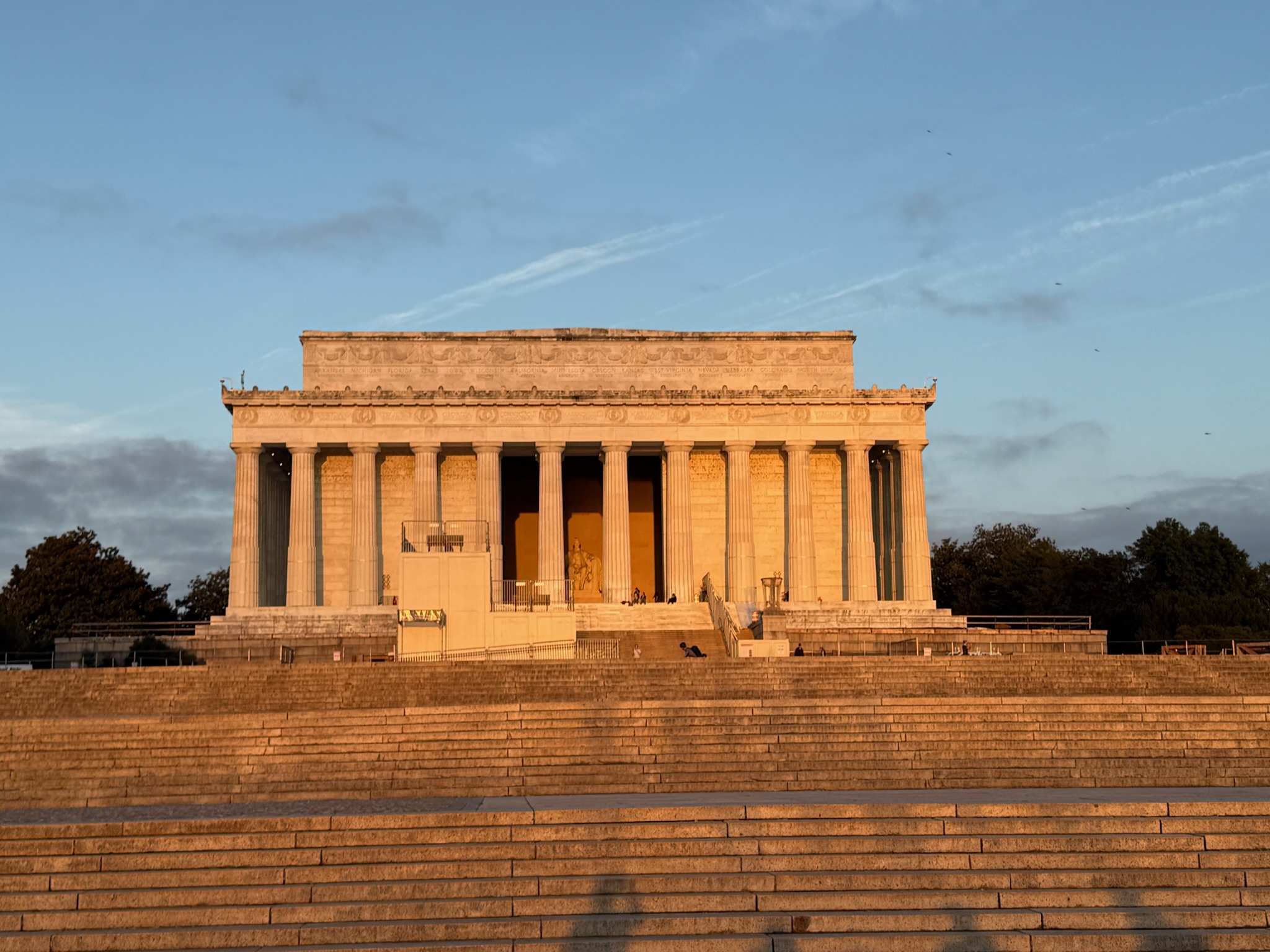
He went inside and said hi to Abe.
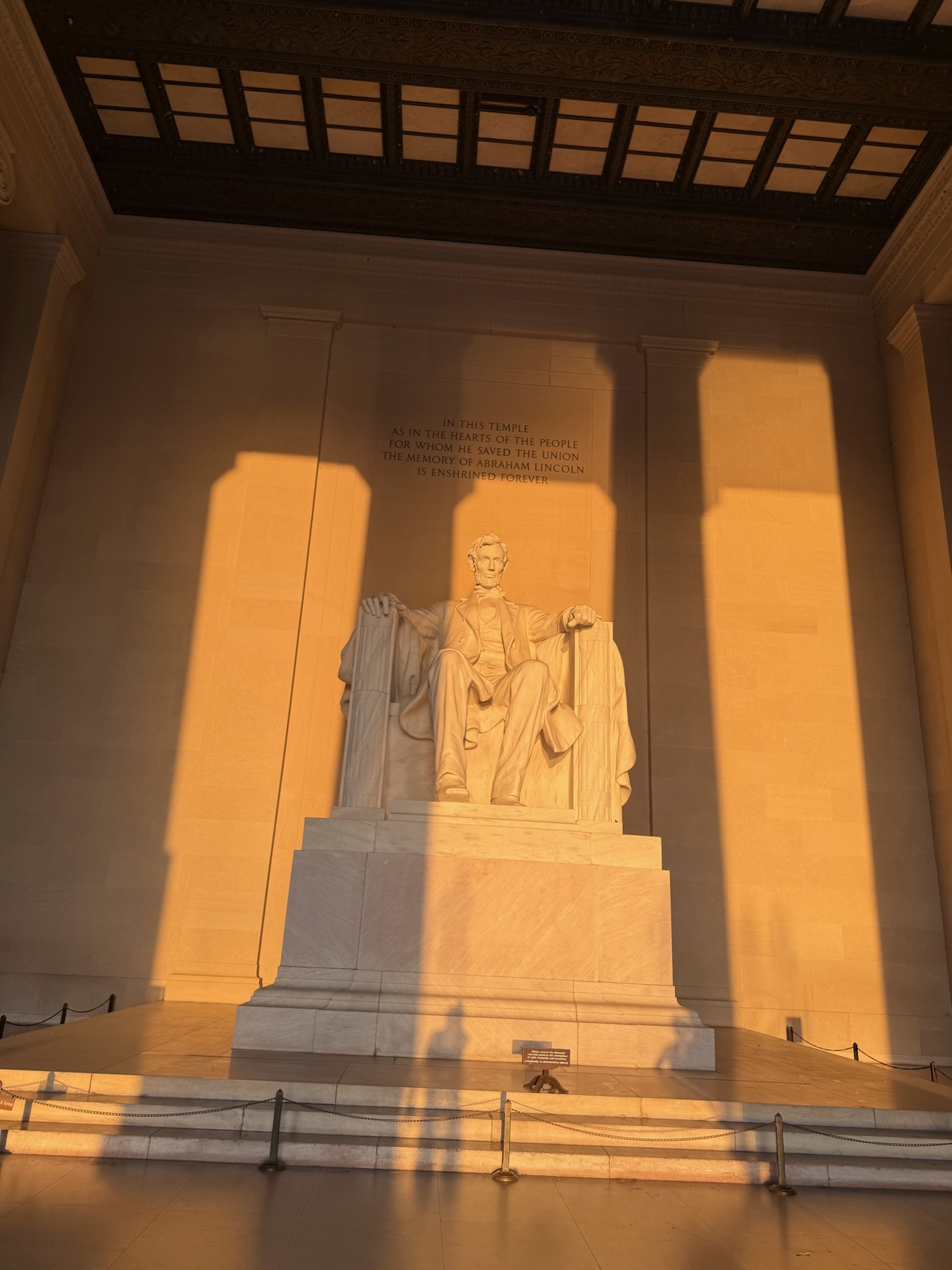
View of the Washington Memorial from the Lincoln Memorial stairs
Back at the boat, Christi enjoyed the lovely morning, even though the sunrise was blocked by the tall buildings.
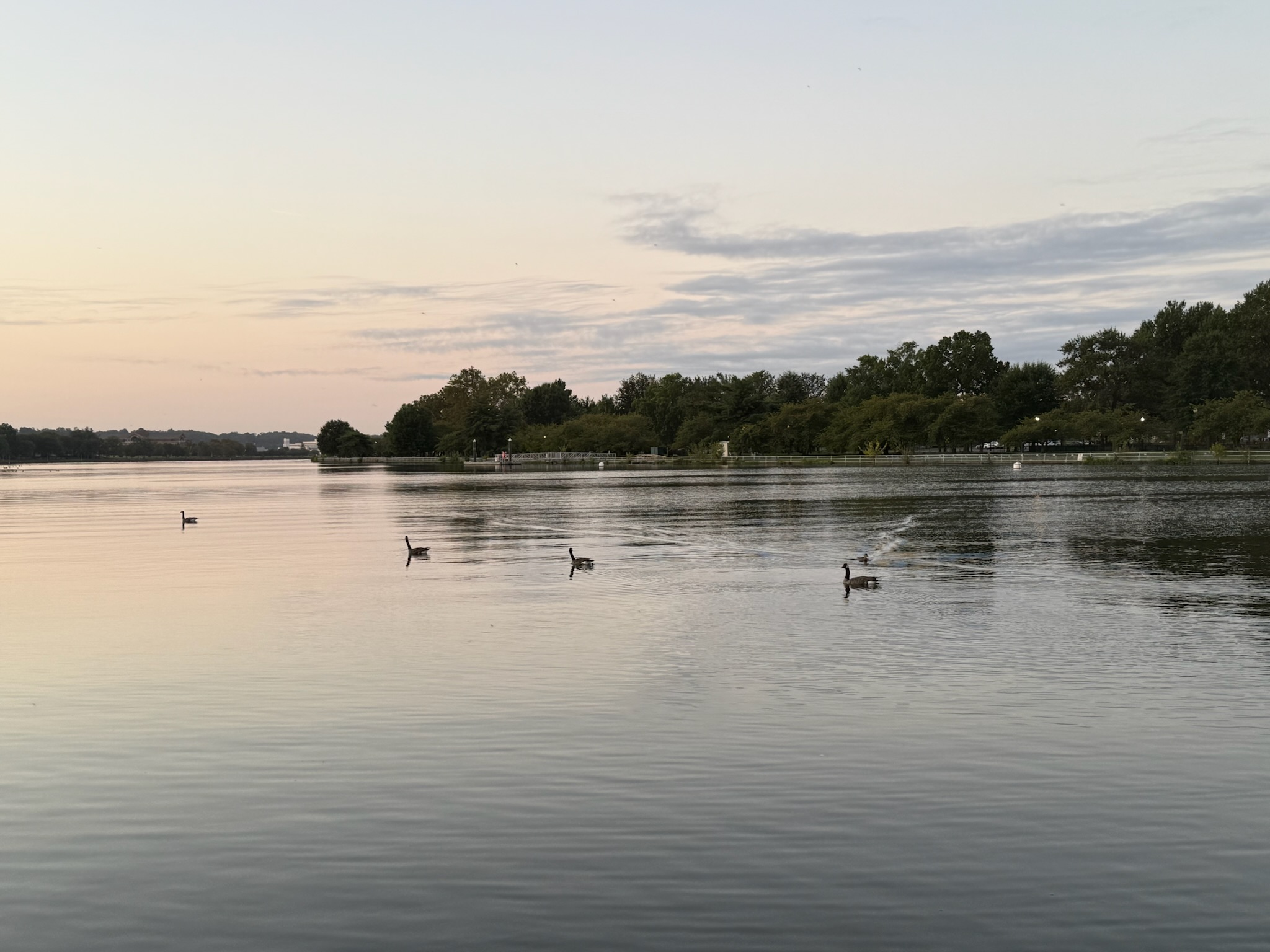
With lots of birds around.
Today’s outing was to the Air & Space Museum. As we were perusing the museum’s website for hours, we saw that, while it was free to get in, we needed to reserve tickets in advance. We took the first available tickets, which were for 1300. At 1215, we caught the free shuttle to the National Mall. This time, instead of heading west, we crossed over to the east side of 7th Street NW. This sculpture/fountain graced the southwest corner of the Air & Space building.
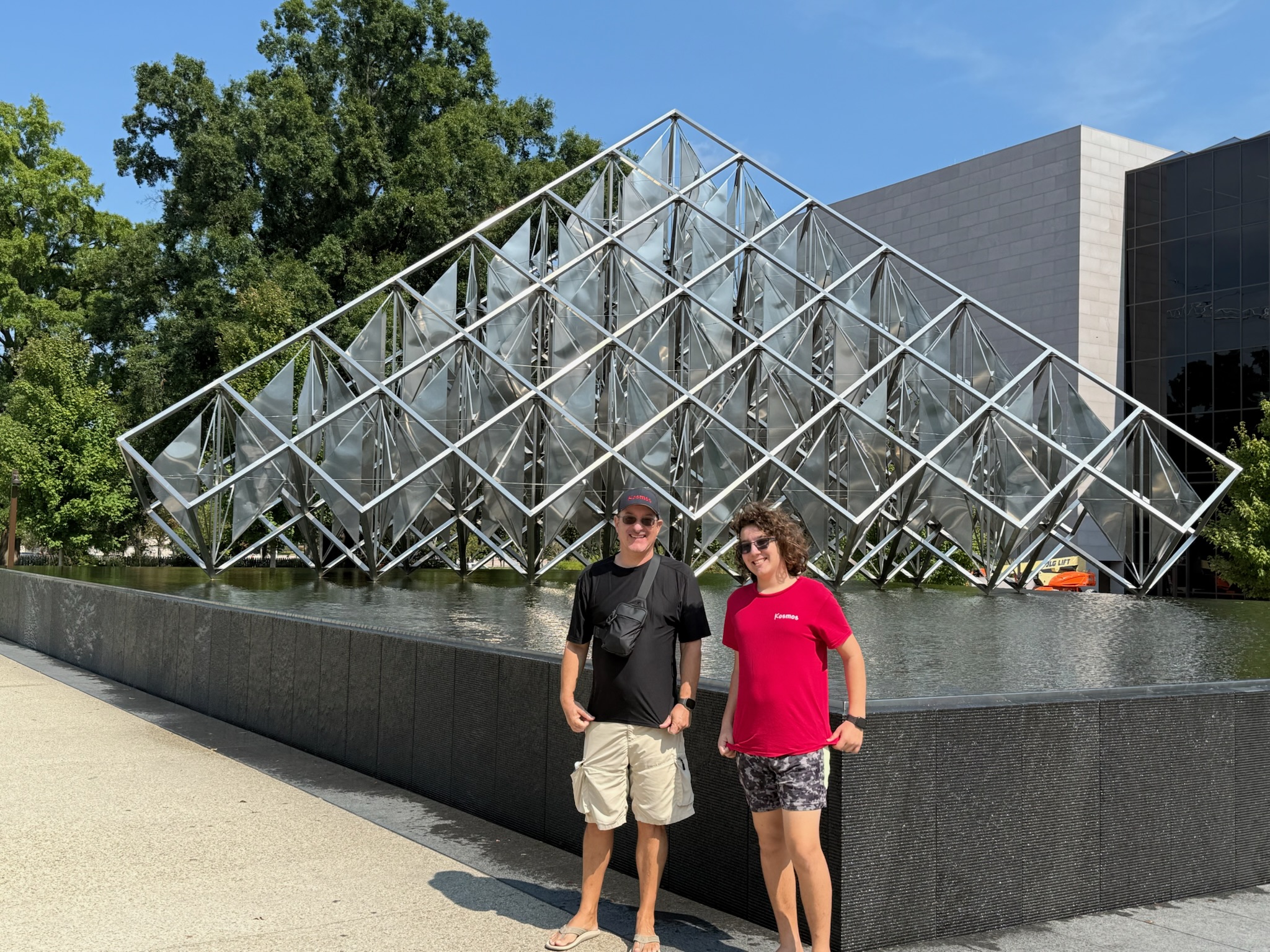
It was a surprisingly long walk from the corner to the building’s entrance. This museum was huge!
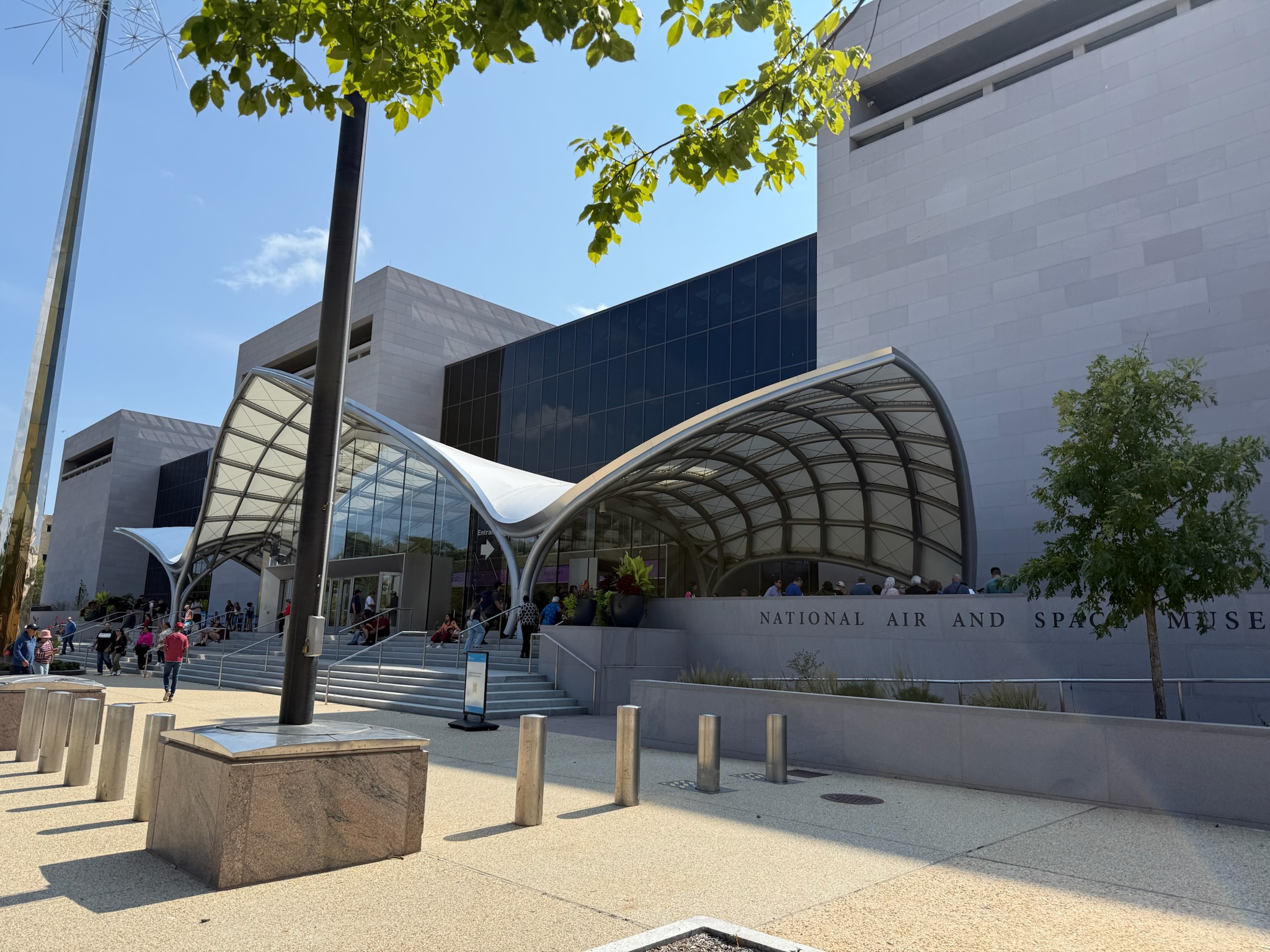
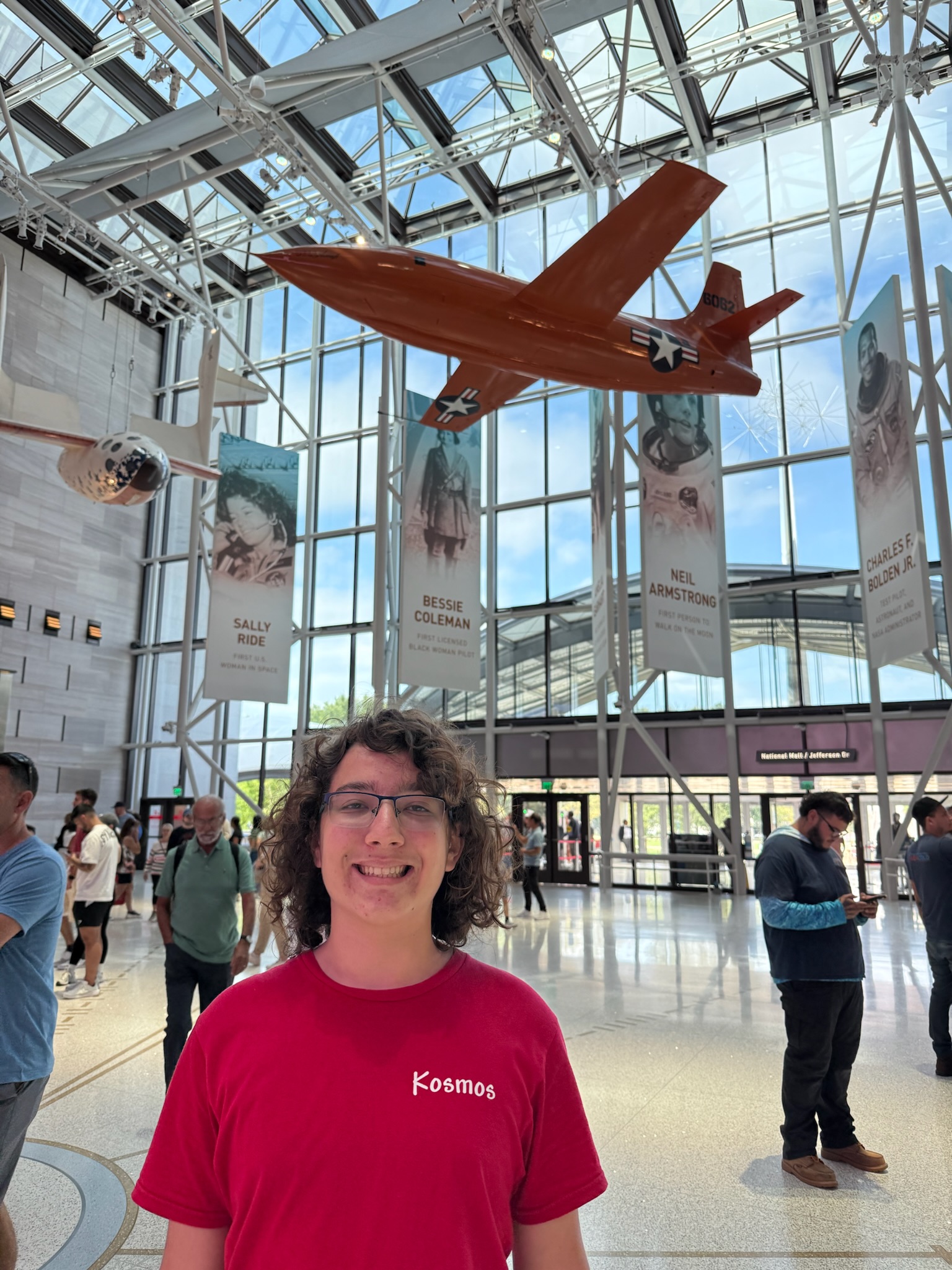
We arrived at 1250, and got into the entrance line (to the right above). Someone was checking everyone in line to ensure they had tickets for 1300. Promptly at 1300, they opened the doors and let us all in. What was normally a lobby in most museums was active exhibit space here; offering a taste of what we’d see in the rest of the museum. The orange plane above Keith was the real Bell X-1. It was built in 1945 and did nearly 1,000 miles per hour. We’d seen a replica and learned about it at our recent visit to the San Diego Air & Space Museum. The partially visible white plane behind it was SpaceShipOne.
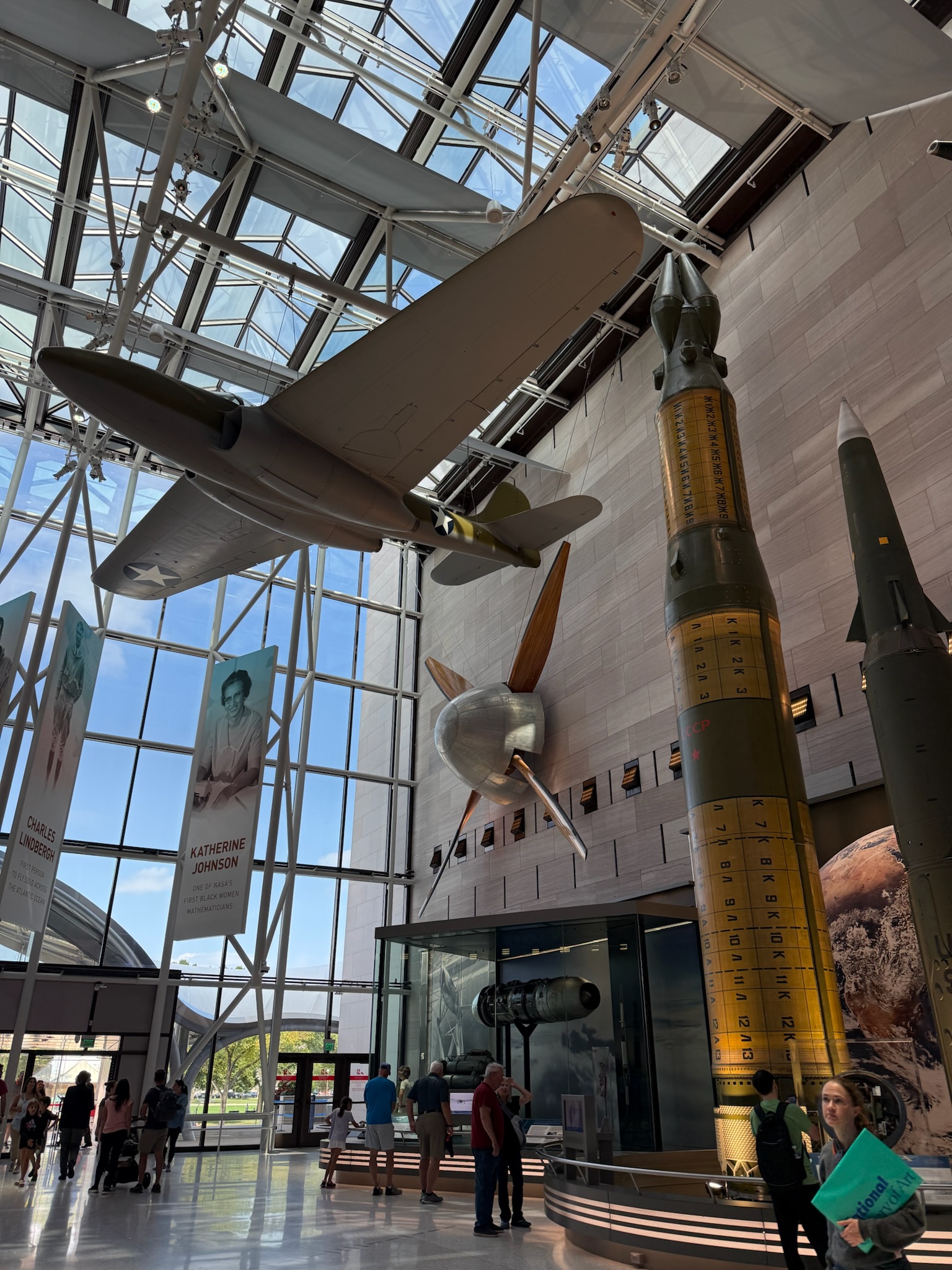
Bell XP-59A, NASA wind tunnel fan, SS-20 Pioneer, and Pershing II.
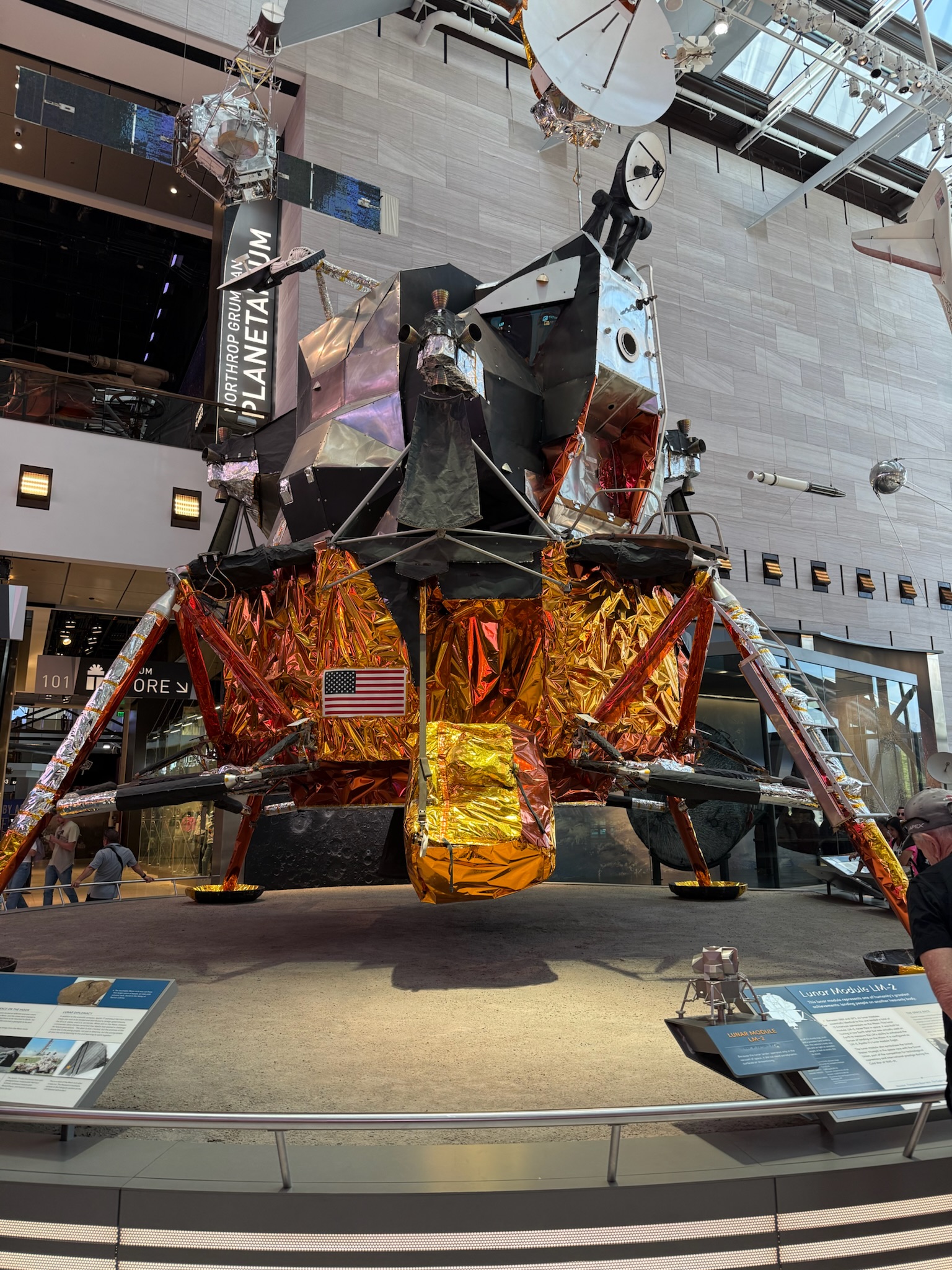
Satellites with cameras were originally invented to spy on other countries. NASA utilized the technology to create the Lunar Orbiter, which took photos of the moon surface from 1966 – 1967. They utilized experts in the intelligence community to read the satellite images and map out the surface of the moon in order to decide where the astronauts should land.
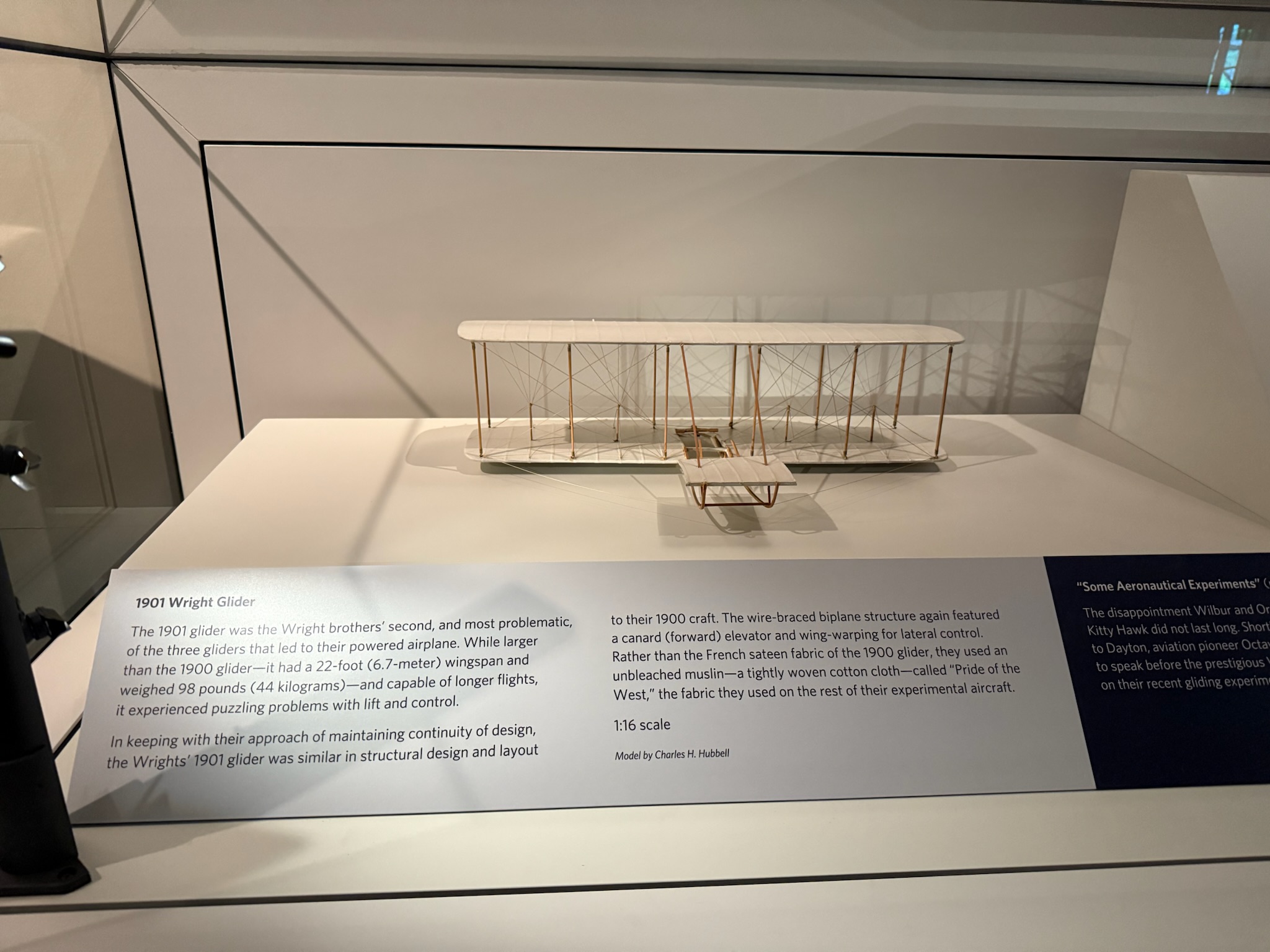
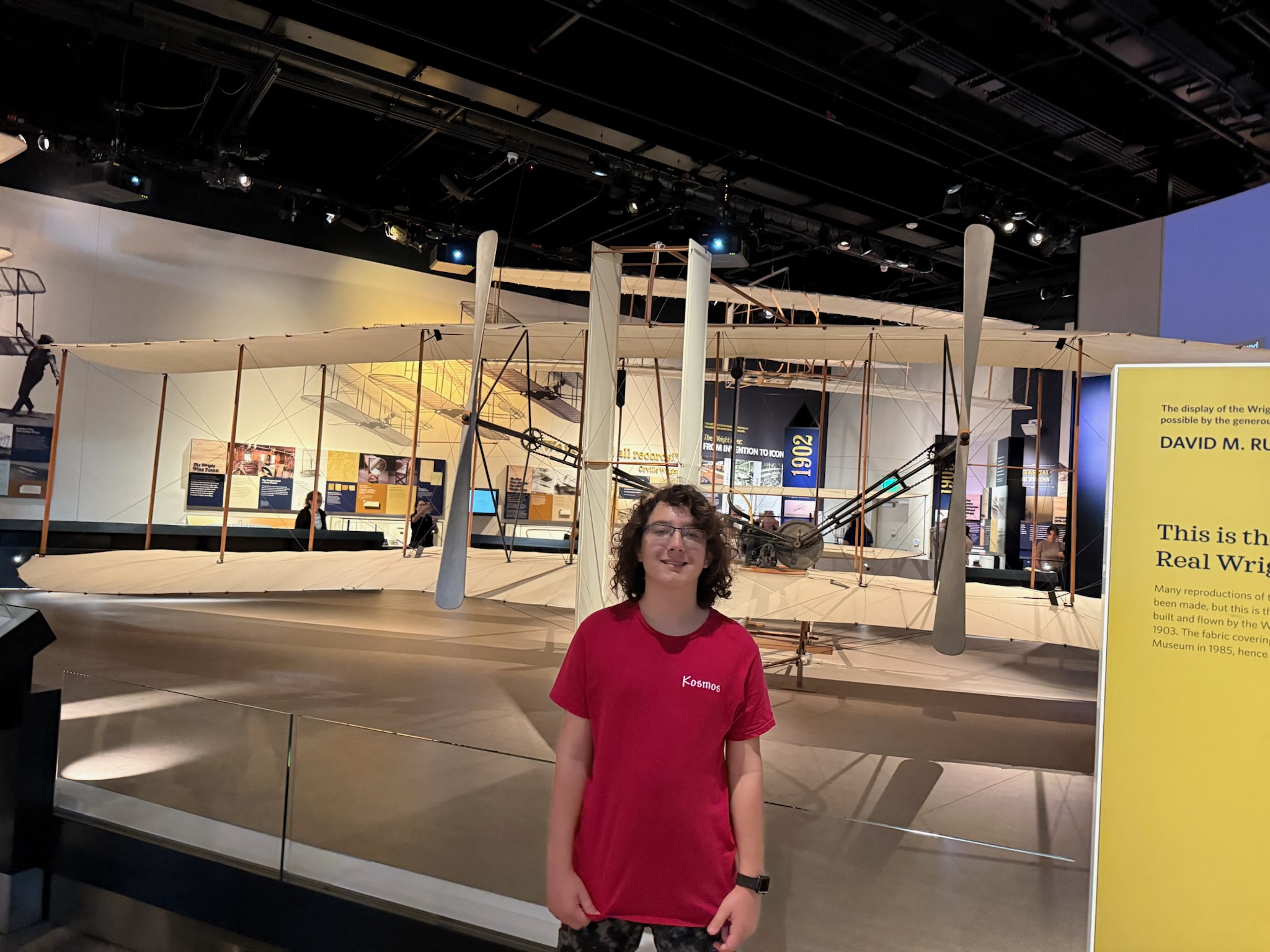
The first room that we went to was about Orville and Wilbur Wright. The brothers were bicycle mechanics who invented the modern airplane and pioneered aeronautical engineering. They started by building a glider in 1900. It didn’t work very well, so they made another iteration of it in 1901, the biggest glider ever built at the time. It also didn’t work very well. Suspecting that the scientifically accepted calculations for lift and drag that they’d based their gliders on was incorrect, they utilized bicycle technology to invent a machine to measure lift and drag forces on a wing. Then they created a wind tunnel using a box and fan to simulate flight. This test confirmed their suspicions: the scientifically accepted calculations were incorrect. They built a substantially larger wind tunnel to test various wing shapes. Based on this data, the third iteration of the glider, built in 1902 had longer, narrower wings that warped for lateral balance, an elliptical elevator for pitch control and a vertical tail. Since the pitch, roll, and yaw could all be controlled, It was the world’s first fully controlled aircraft.
With that accomplishment, they set about creating a propulsion system. They decided the propellors needed to be more like rotary wings than like a boat propellor. They chose two 8.5-feet, slow-turning wood propellors that was connected to the engine via a chain in sprocket system similar to a bicycle. Their employee, Charlie Taylor, helped design and built the 12-horsepower engine. The crank case was made out of aluminum, which was the first time this material had been used in an aircraft. It was successfully tested on December 17, 1903. They made four flights, the longest of which was 59-seconds and 852 feet, with an altitude of 14-feet. It was the first heavier-than-air, powered aircraft to make a sustained controlled flight with a pilot aboard. Sadly, during their lunch break, a gust of wind pushed the plane and damaged it. This was the actual original Wright Flyer. We’d also seen a replica and learned about the Wright Brothers at our recent visit to the San Diego Air & Space Museum.
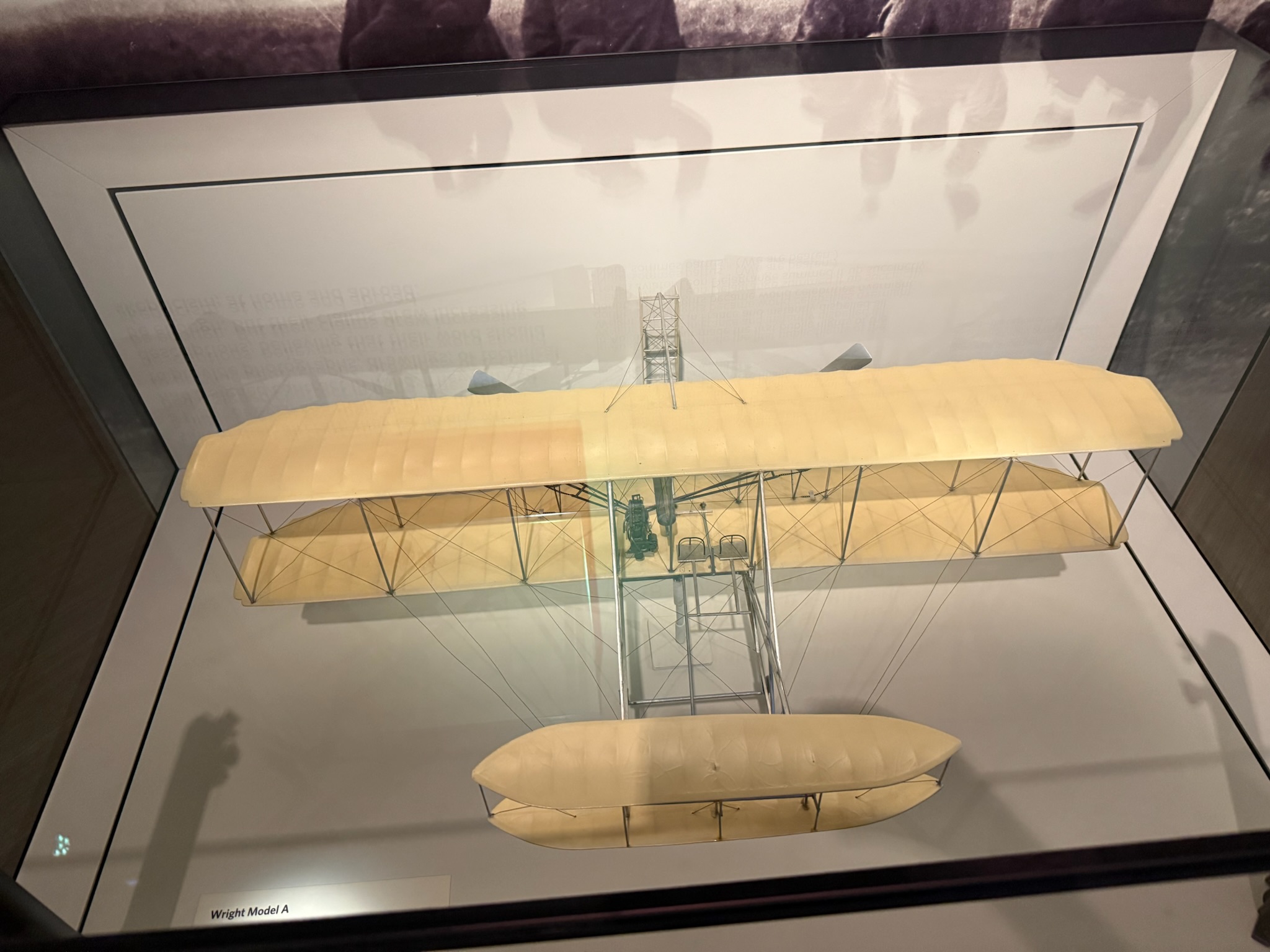
While the 1903 model had achieved powered flight, it still wasn’t a practical airplane. In 1904, they made another iteration of the plane that worked, but not well enough. In 1905, their third iteration was a success. They flew in circles, doing a total of 24.5 miles in 39-minutes. They secured patents in the US and Europe and started looking for customers. They didn’t announce their invention to the public until 1908, after they had contracts with the US government and a French investment group. Once they went public, they were instant celebrities. This was a model of the plane that they used for their exposition flights.
Other companies had been working on airplanes at the same time as the Wrights. As soon as the Wright plane’s physics became known, these competitors were able to also make working products, many of which sold better than the Wright planes. The Wrights filed patent infringement suits against the competitors, but in 1917, with the advent of World War I, the US government pooled the patents on airplanes and halted patent suits.
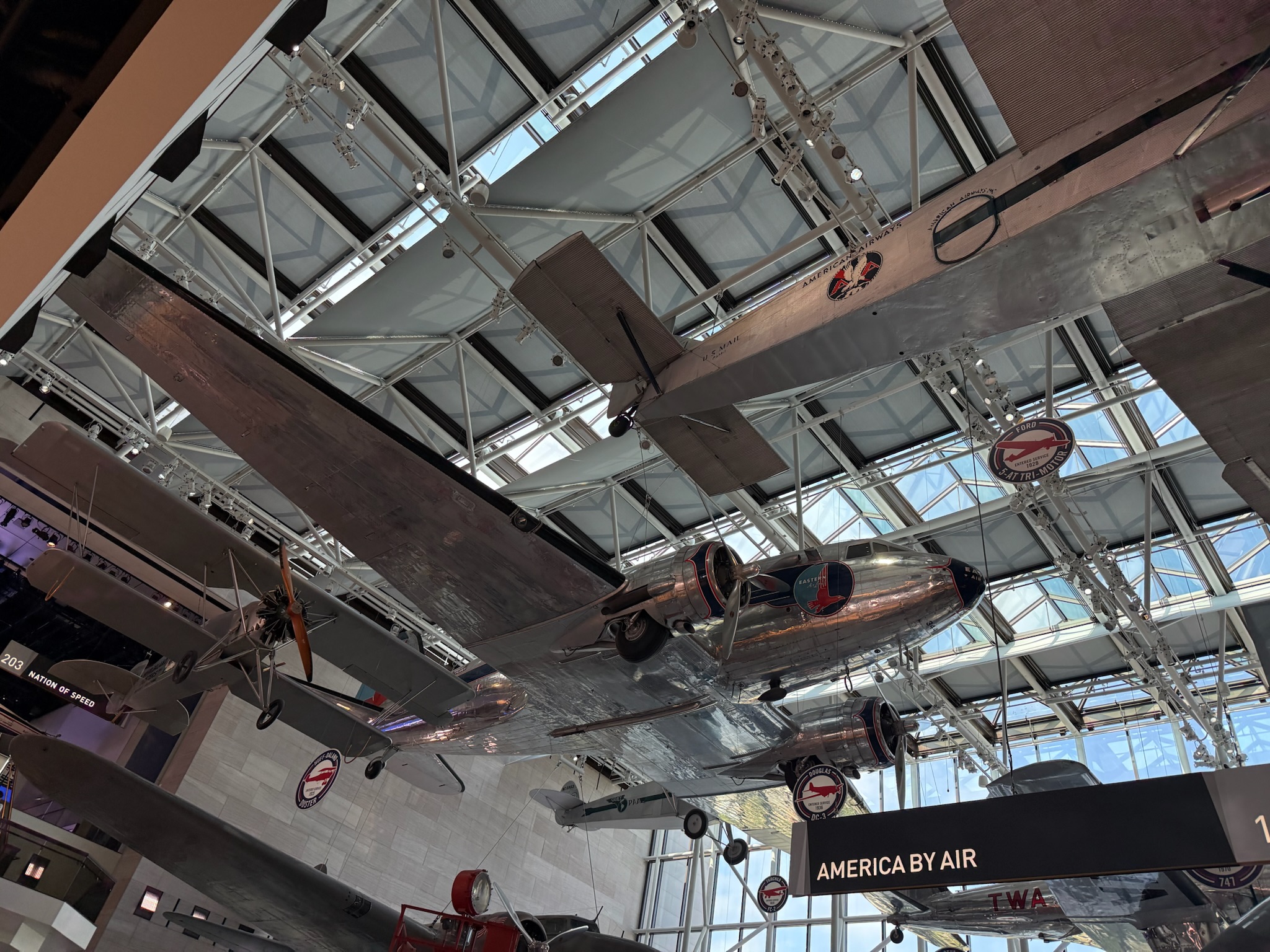
From there, we moved into the room called America By Air. As the name implied, it focused on US politics regarding air travel, the ups and downs of specific US based airline companies, and the how the US’s cultural and technological shifts affected the airline industry. The three topics often blended together. For example, in 1978, the US deregulated the airline industry, lifting restrictions on fares and access to routes. Deregulation led to more routes and more frequent service — and thus more people flew, which led to lower fares and a general cultural shift towards travel. The deregulation caused new airlines to open and some established airlines to expand, but other established airlines wound up shutting down.
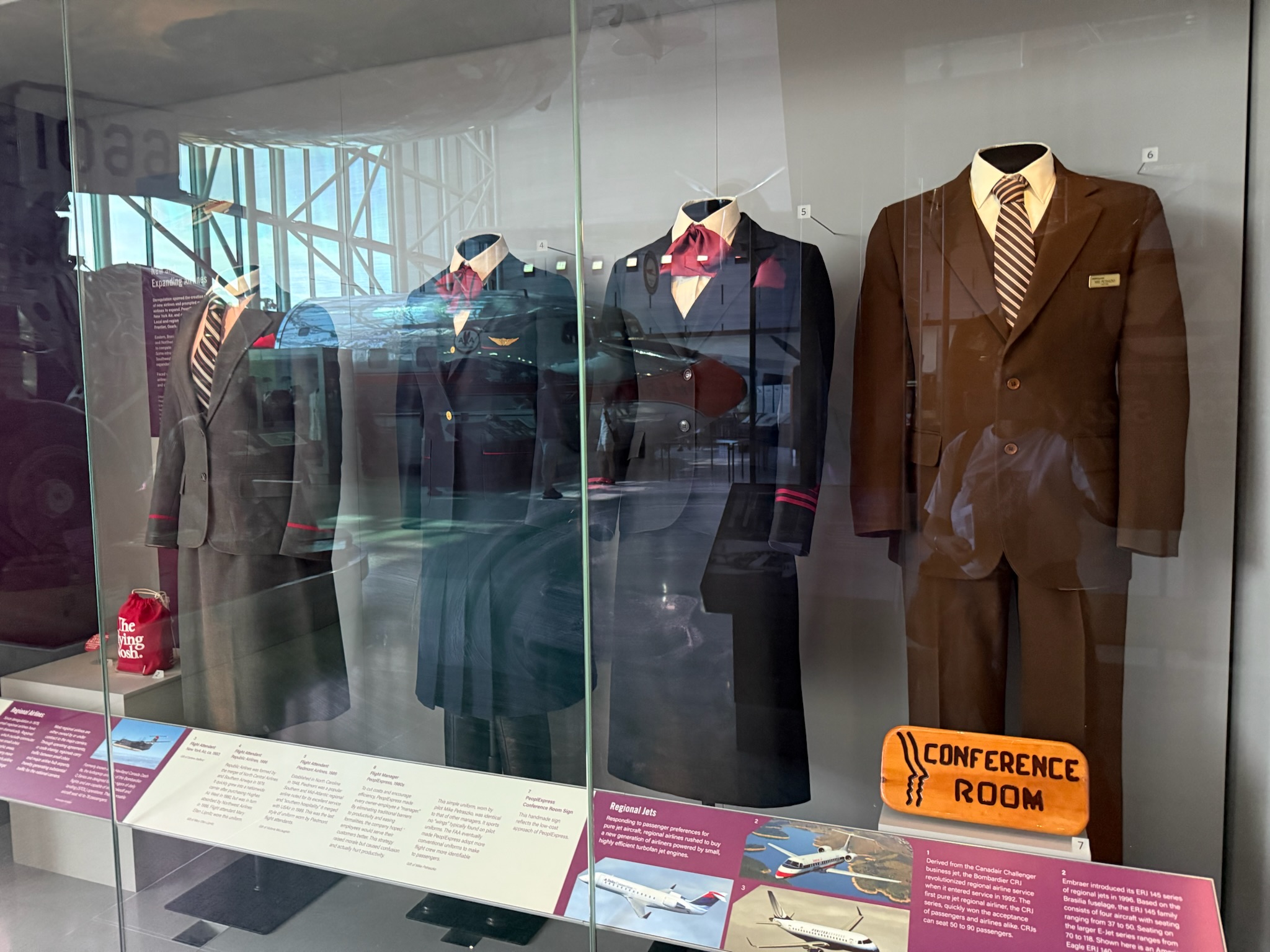
Another example of a cultural shift as a result of laws was when it became illegal to discriminate in hiring on the basis of age, appearance, gender, marital status or sexual orientation. Once airlines could no longer only hire hot young girls as flight attendants, uniforms became more conservative and respectable.
By the end of World War I, passenger service barely existed. The primary use for airplanes at that point was for delivering postal mail. After Charles Lindbergh flew across the Atlantic in 1927, there was a sudden interest in passenger air travel. Several companies began operating flights, but they were incredibly expensive and not very comfortable. After World War II ended, ticket prices came down, leading to a huge increase in air travel. By the mid-1950s, air travel was utilized more than trains for domestic travel and more than ships for international travel. The industry had to rapidly advance technology for navigation and air traffic control as flight routes increased. In the late 1950s, commercial jet planes were introduced, allowing the planes to be larger and faster, with lower operating costs than piston engines. The switch to jet engines revolutionized the industry. There was a Douglas DC-7, which was the last piston engine airplane that Douglas produced, that we could go into. In 1958, it was replaced with the jet powered DC-8.
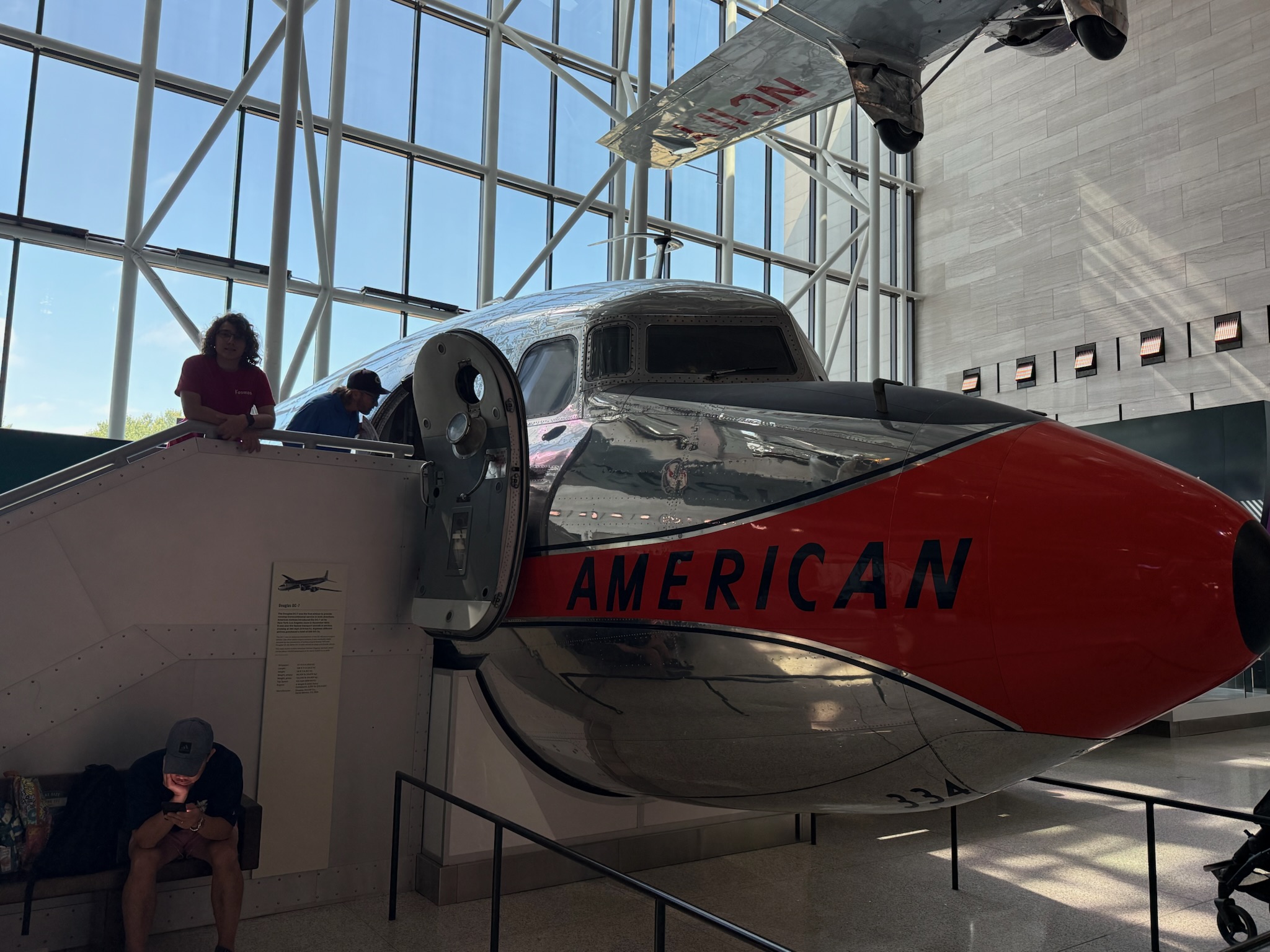
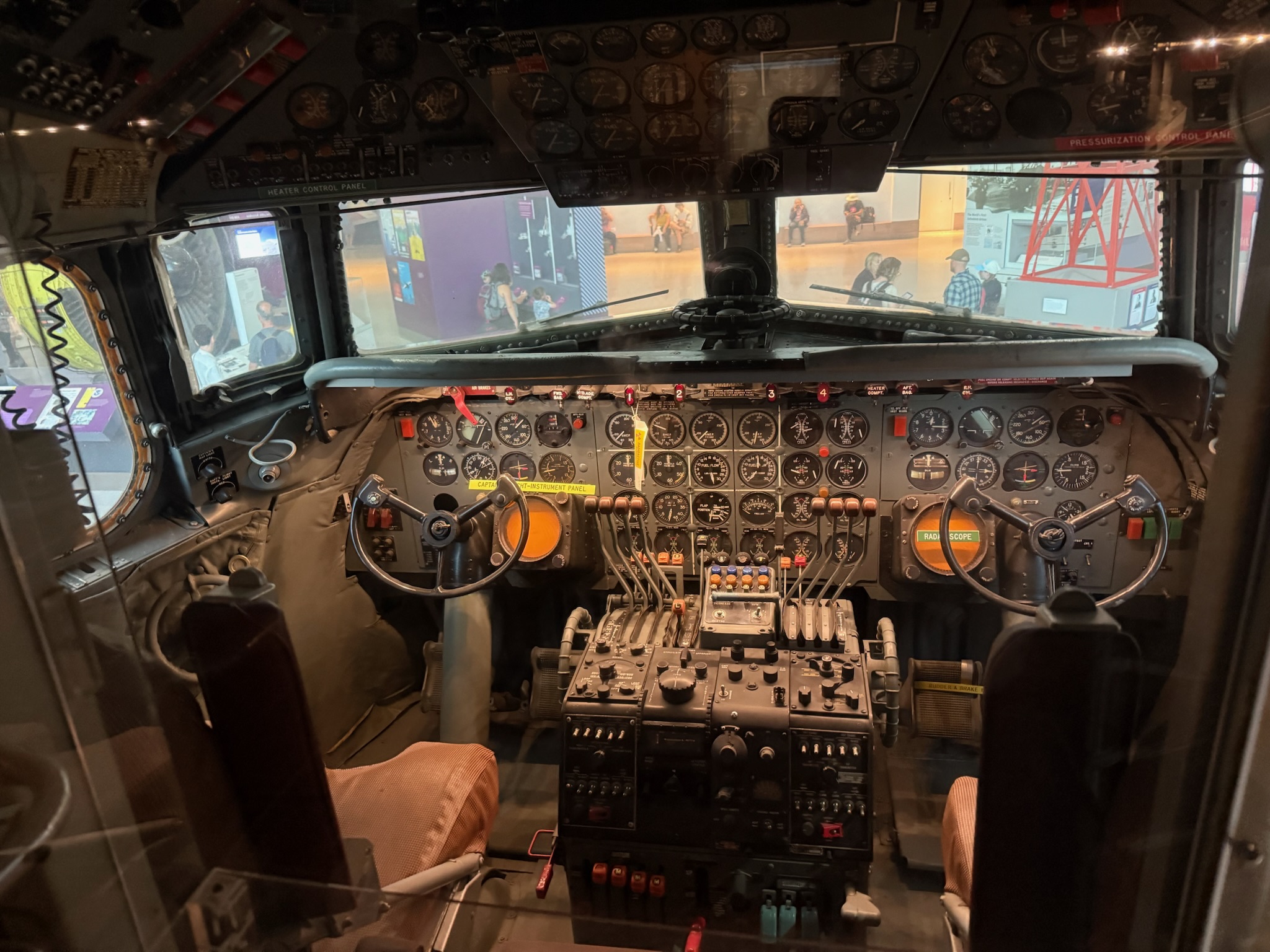
There was a sign that talked about the air traffic controller strike in 1981. Instead of giving in to the demands of the strikers, then-President Reagan fired all 13,000 people on strike. This lead to a tumultuous time in the industry until the staff could be replaced. Another sign talked about how increased airport security has “dulled the luster air travel once had.”
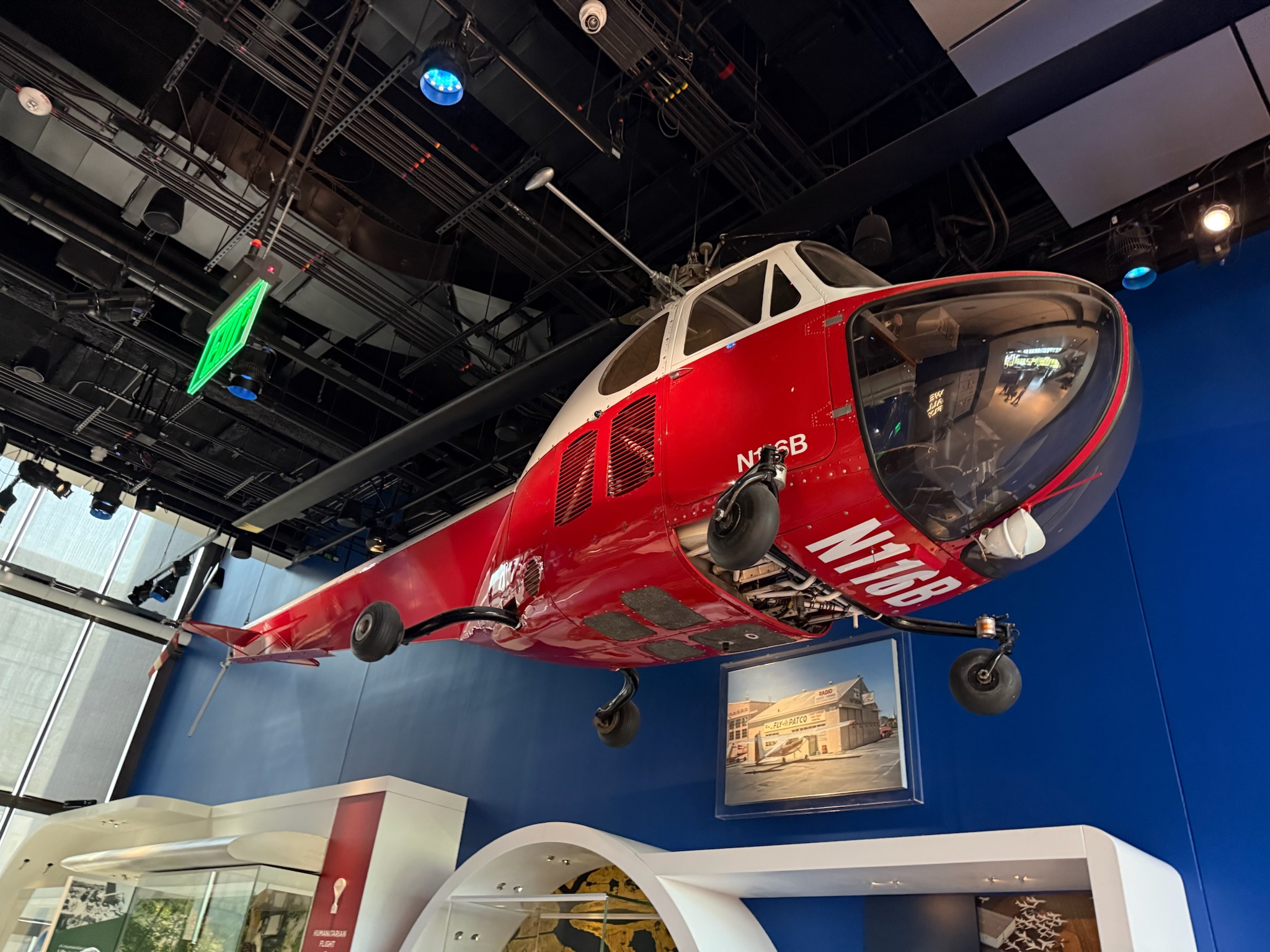
We then moved into a room titled Innovations. The first display was a Bell Model 47-B helicopter. In 1946, it was awarded the first civilian helicopter certification by the US Civil Aeronautics Authority. It was in service for 40-years, utilized for a multitude of tasks, such as news chopper and crop duster. In 1989, a world hovering record of 50-hours, 50-seconds was set in one of these models.
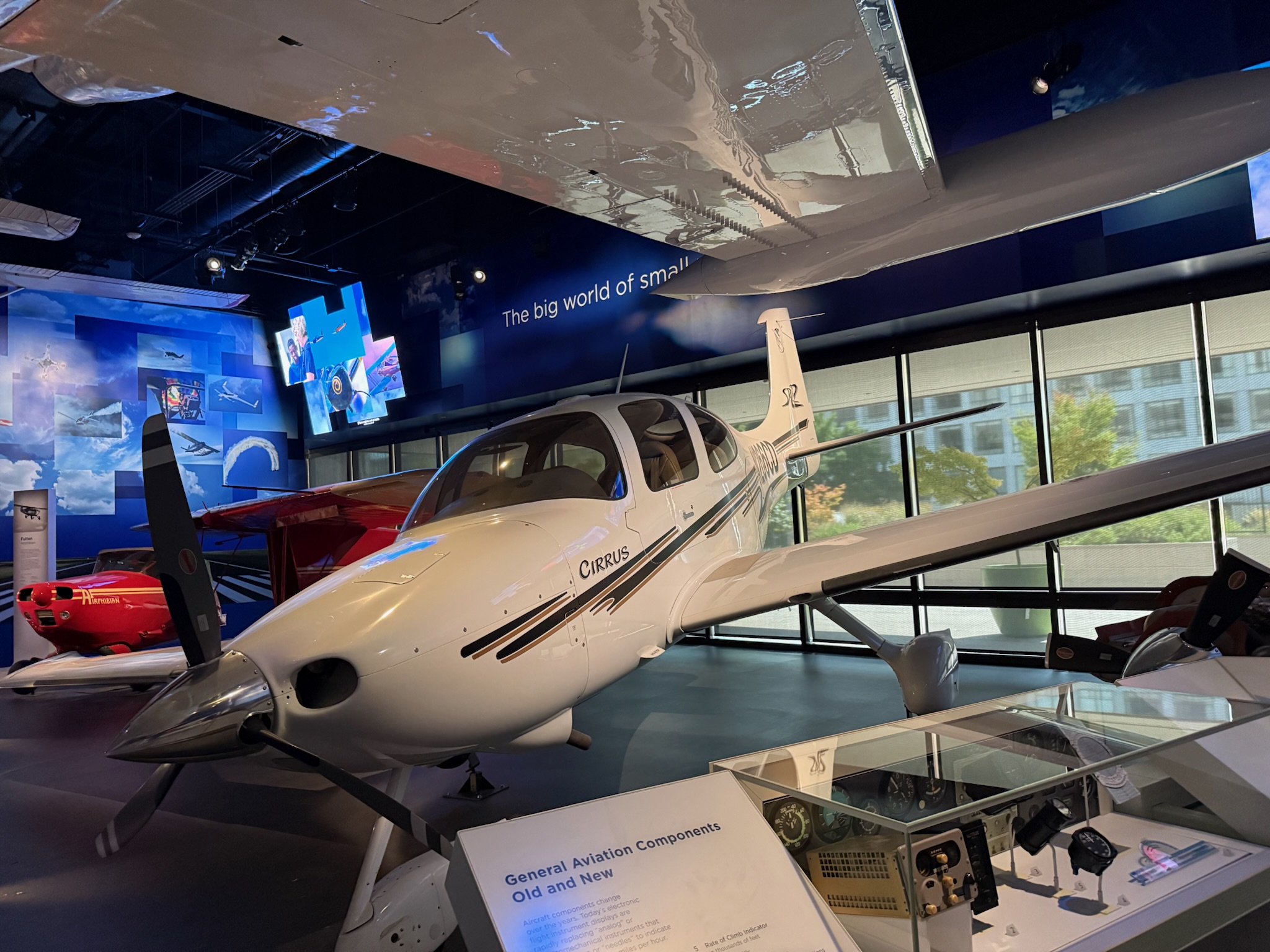
In 2003, The Cirrus SR22 was the first single-piston engine aircraft with fully integrated computer-screen electronics to be certified by the FAA. Previously, such computer-screen integrated technology was only allowed on commercial and multi-engine aircraft. It instantly became the best seller of its class. Cirrus had already revolutionized the safety aspect of the market in 1999, when they added a parachute to their planes. In case of emergency, the parachute could be launched, softening the impact of a crash.
There was a display about flying cars. Many working prototypes have been made, but manufacturing isn’t viable because of different sets of needs/rules/requirements for road vehicle vs air vehicles.
There was a display about the use of aviation for humanitarian needs, such as bringing in supplies to those in need, such as after a natural disaster and/or transporting out people/animals in need, such as people in need of surgery.
There was a display about the use of aviation in pest control, farming, and firefighting. It listed the many used for aerial photography — from aiding with cartography, to assessing damage after a disaster, to monitoring health of an ecosystem, to finding things previously unknown. For the previously unknown, they showed a photo of a pyramid in a Mexican jungle. From our own travels, we remembered that the majority of hawngs in Thailand were discovered by airplanes.
There was a display on utilizing private planes. Two-thirds of Fortune 500 companies use them, as do many athletes, since they save time, provide privacy and security, and can fly into and out of airports of any size. And they run on the company’s schedule. For companies that have offices/plants in multiple locations, it makes sense to have their own planes. It got into the history of this type of travel and the various planes that were commonly utilized.
The last display in this room was a small one on drones. They highlighted a few drones that have been created to do things like deliver goods and crop dust, but which haven’t been green-lighted for use yet as the regulators grapple with aircraft control, safety regulations, determining who can operate drones, etc.
There were three more rooms on this floor that we had yet to explore, but we were already starting to feel like our brains were full. Realizing we couldn’t see the whole museum today, we headed upstairs to the rooms that we wanted to see the most.