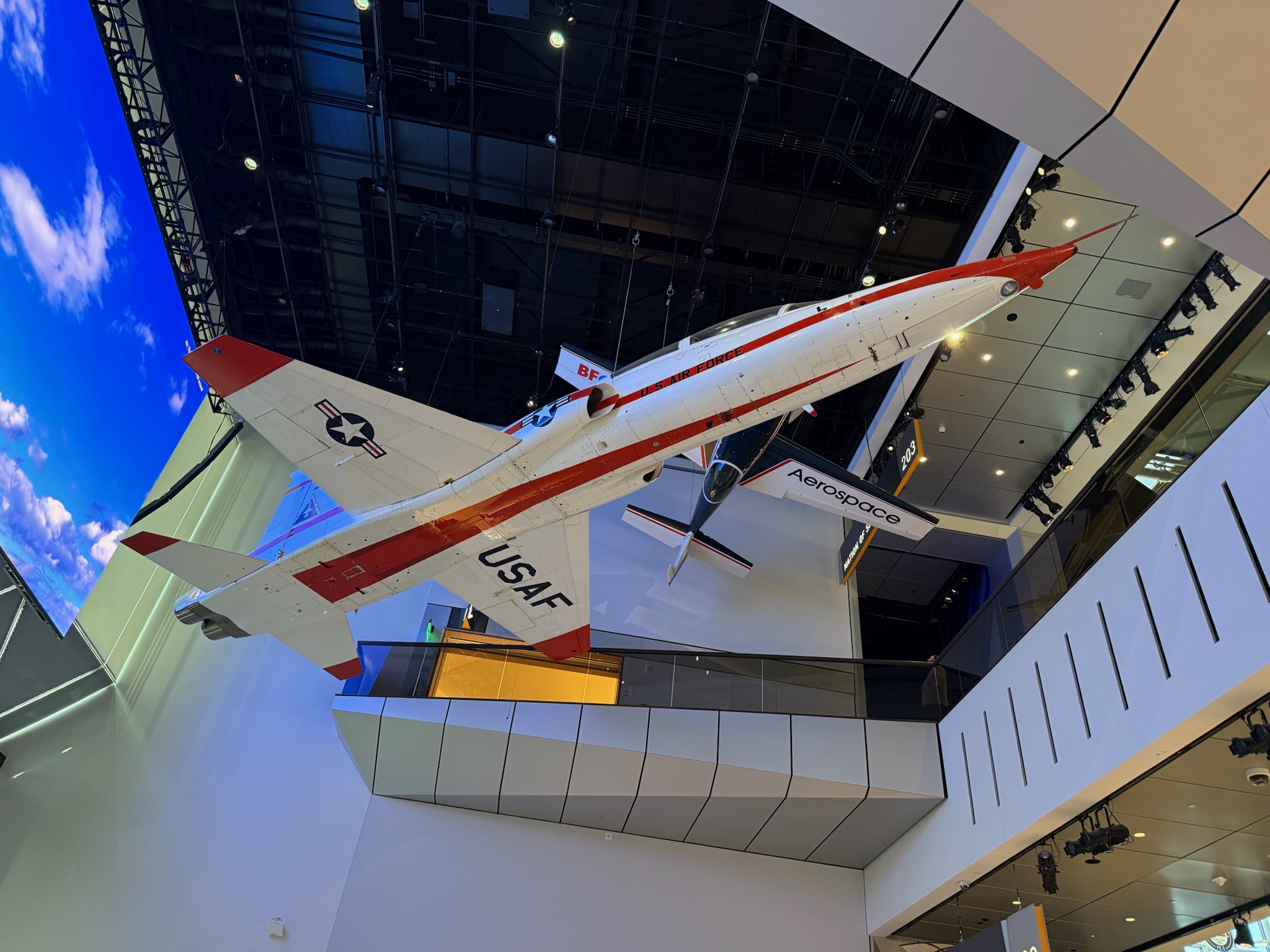
continued… we were already starting to feel like our brains were full. Realizing we couldn’t see the whole museum today, we headed upstairs to the rooms that we wanted to see the most. This Northrop T-38 was hanging over the stairwell. Jacqueline Cochran set eight world records in this jet. At the time of her death in 1980, she had broken more speed, altitude and distance records than any other pilot — than 200, including breaking the sound barrier. Fun fact – she emphasized her femininity and had a line of cosmetics called Wings to Beauty!
Upstairs, the first room that we went into was called Destination Moon. In October 1957, the Soviet Union launched the world’s first satellite, called Sputnik. In 1958, the US responded by creating a new government agency called the National Aeronautics and Space Aviation (NASA), whose goal was to put a man into orbit. The space race was on!
In January 1959, the Soviet Union’s robotic spacecraft, Luna One, left Earth’s orbit and got within 3,700 miles of the moon. In March 1959, the US launched a spacecraft, called Pioneer IV, that successfully left Earth’s Orbit. We think this is a replica of Pioneer, but we’re not sure. It can be hard to match the signs on the ground with the objects hanging from the ceiling.
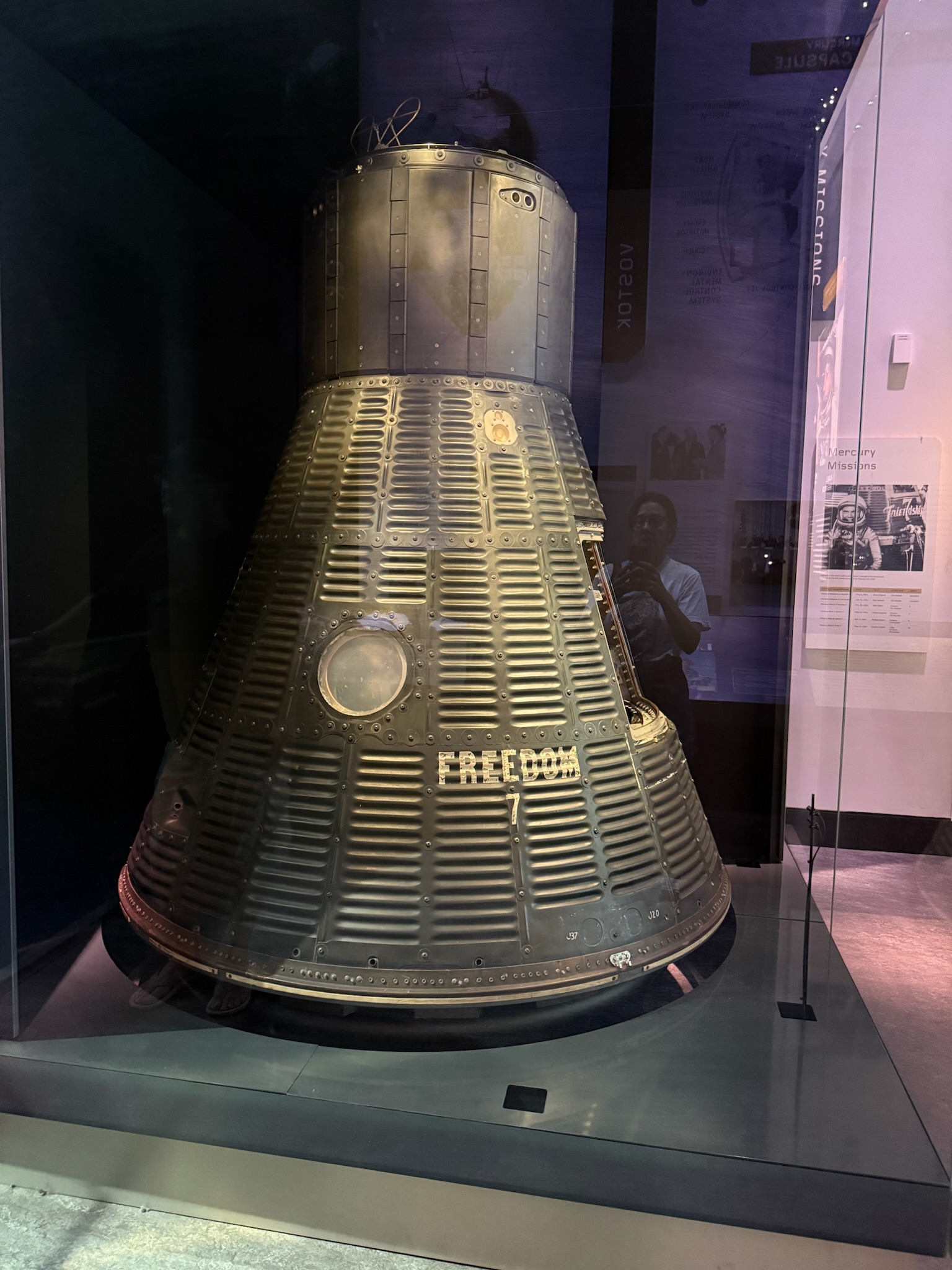
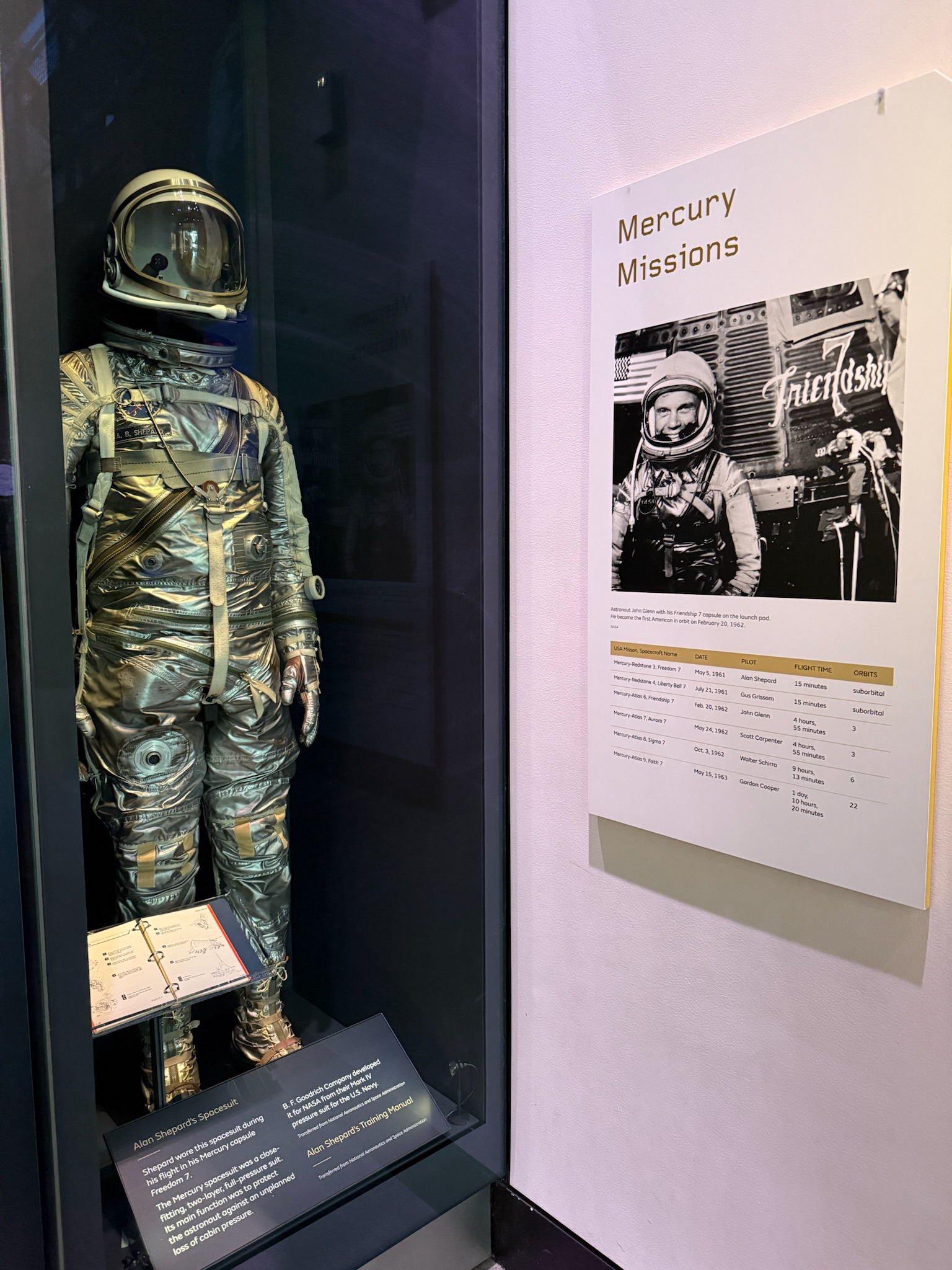
In September 1959, the Soviet’s Luna Two hit the moon. In October 1959, Luna Three transmitted images of the dark side of the moon. In 1960, the Soviet’s successfully sent dogs to space and back. In January 1961, the US successfully put a chimpanzee into a suborbital mission. In April 1961, Soviet Yuri Gagarin became the first human in space when he did one orbit around the earth in a mission that lasted 108 minutes. In May 1961, American Alan Shepard, Jr. flew a suborbital mission lasting 15-minutes in the Mercury Capsule Freedom 7.
This was the suit that Shepard wore. In the early days, they were modified pressure suits like what was worn by pilots for high altitude flights.
The Soviet’s victory of putting a man into space first made the US look weak. A few days later, the failed covert operation to create a Cuban revolt made the new president, John F. Kennedy, look bad. In an effort to save face and look more powerful, Kennedy asked congress to fund a program to put a man on the moon before the decade ended. Congress did.
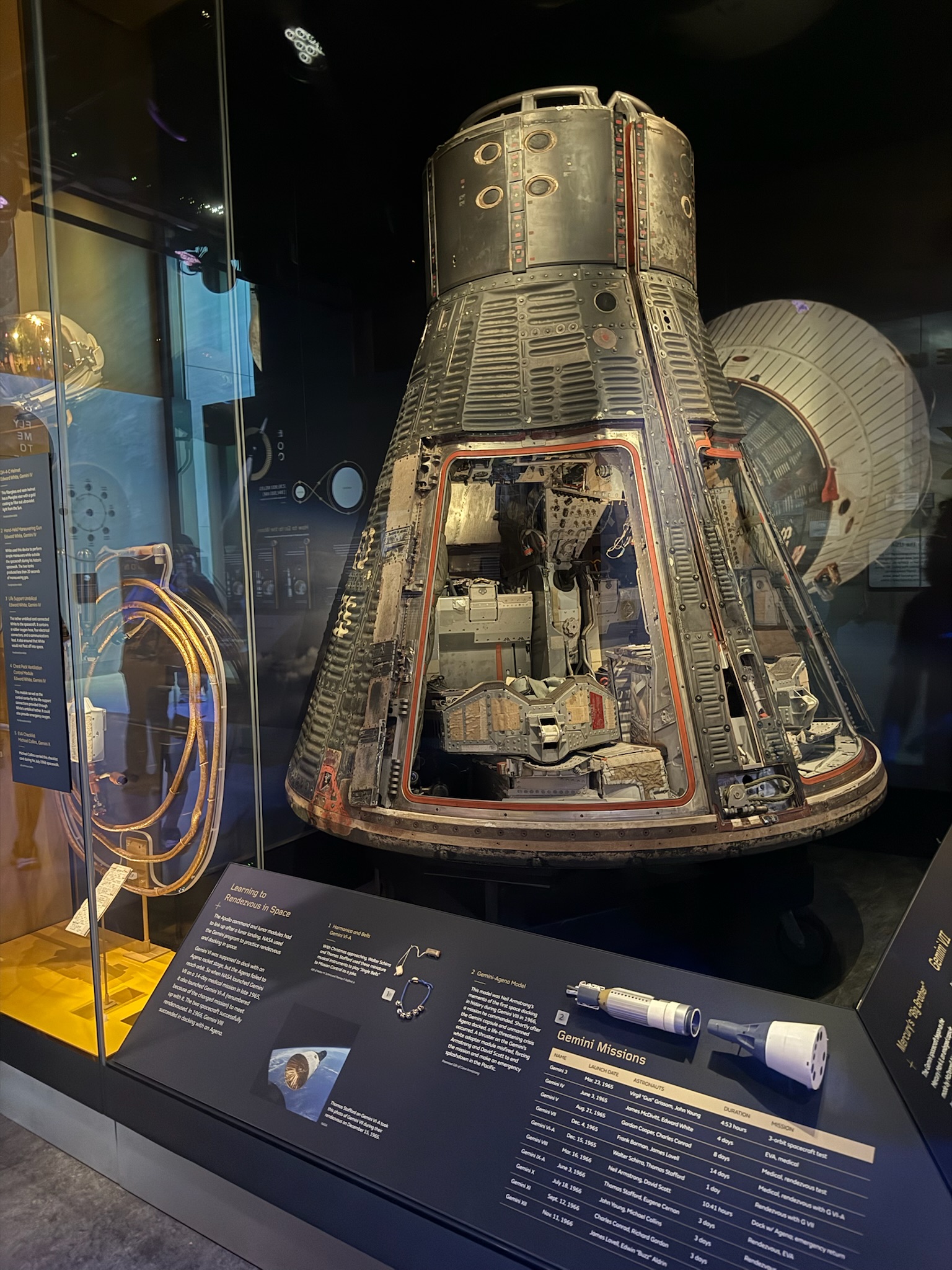
The moon landing mission was called Apollo. After figuring out the logistics and physics involved to make Apollo happen, NASA realized that they first needed to do some research on things like how to live in space. They also needed to do some practice runs on things such as walking in space and linking up the lunar lander to the main rocket in space. To do accomplish the research/practice, NASA created the Gemini program as the precursor to the Apollo program. Gemini ran several missions where they sent crews of two astronauts out into space. In June 1965, on Gemini IV, Edward White became the first American to walk in space (the first person to walk in space was Soviet Alexei Leonov in March 1965). In March 1966, Neil Armstrong commanded the Gemini VIII mission and made the first successful docking in space. This was a Gemini capsule.
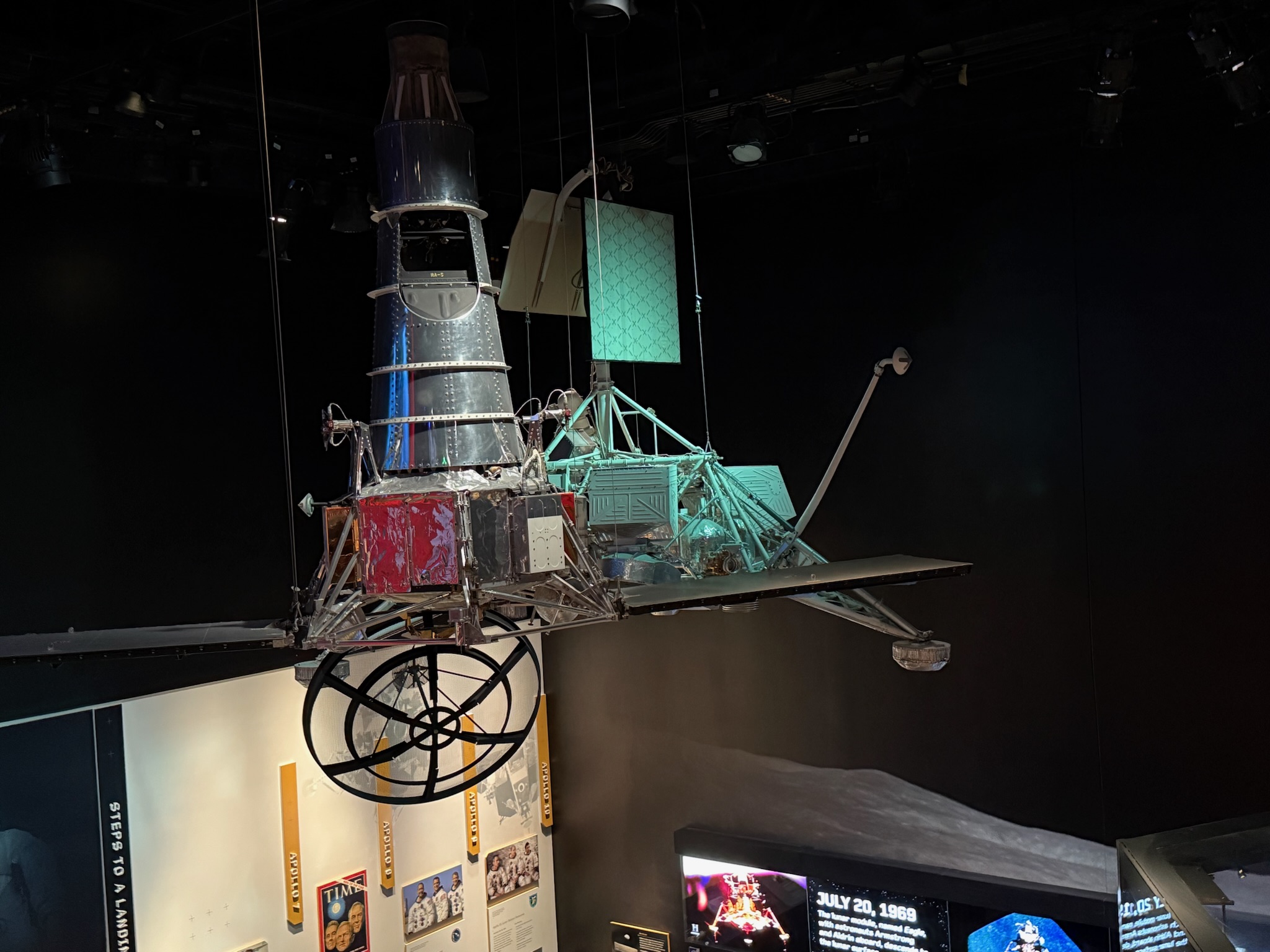
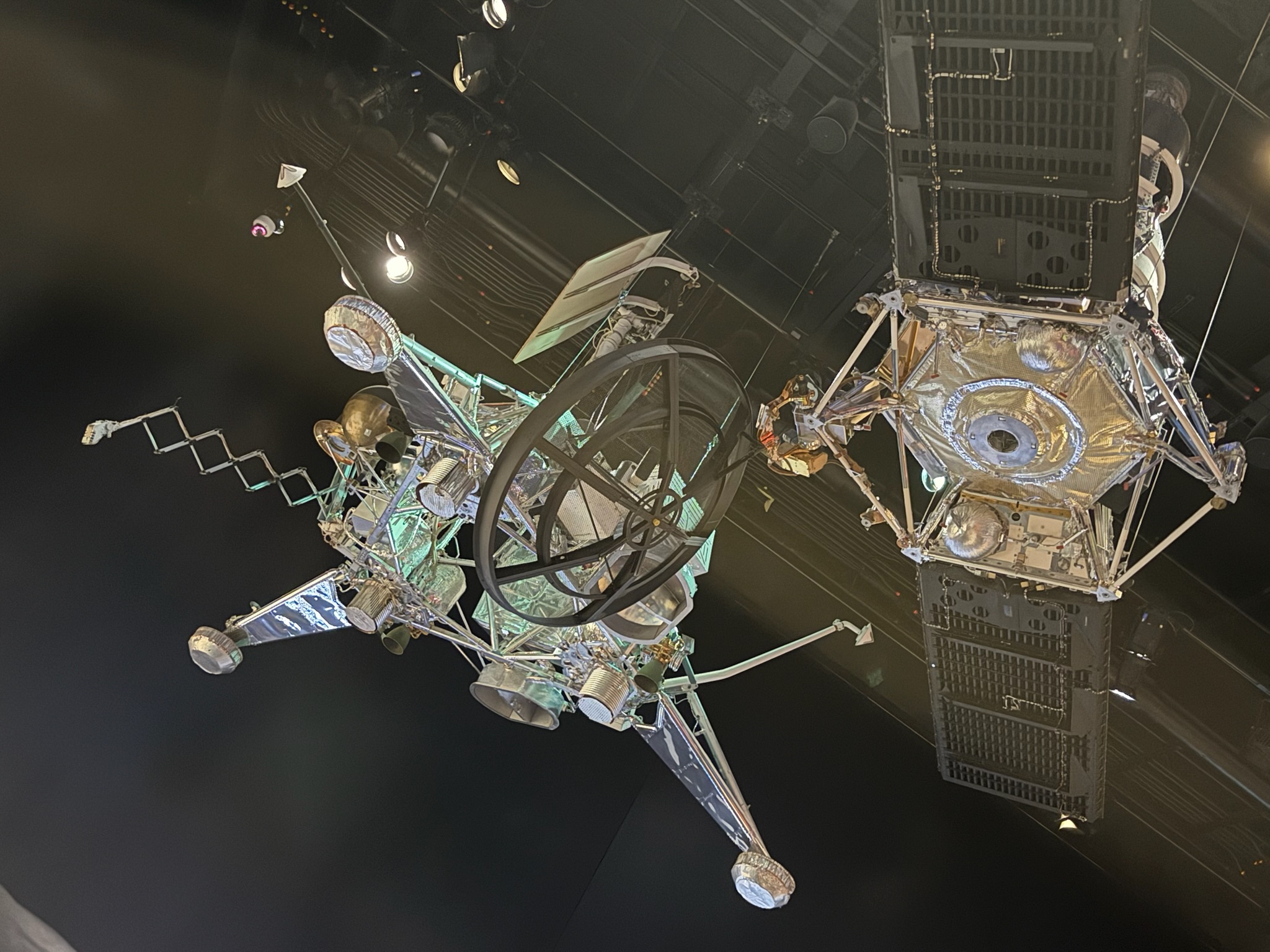
Meanwhile, the Soviets were still beating the US to important milestones. The first robotic spacecraft to land on the moon was Soviet Luna 9 in February 1966, beating the US’s Surveyor 1 by four months. Surveyor 1 analyzed the composition of the soil, proving the surface was solid and could support the weight of the spacecraft and astronauts. The Soviet Luna 10 entered the moon’s orbit to capture images of the dark side of the moon in April 1966, beating the US’s Lunar Orbiter One by four months. The US also launched Ranger spacecraft to take images, as well. We think these are replicas of Ranger and Surveyor, but we’re not 100% sure.
Sadly, 1967 brought a tragedy to both country’s space programs. In January, Edward White and two of his two of his fellow astronauts died in a cockpit fire while training on Apollo IV. Three months later, Soviet cosmonaut Vladimir Komarov died while on a mission. He had spent one day in space and died in a parachute failure after a series of systems failures onboard.
In Autumn 1968, the Soviets sent two spacecraft around the moon with animals onboard. While the missions were successful with the animals, it was determined that humans may not have survived. The Soviets secretly canceled their human missions, though they kept their robotics missions active until 1976. In December 1968, the astronauts aboard Apollo 8 became the first humans to orbit the moon
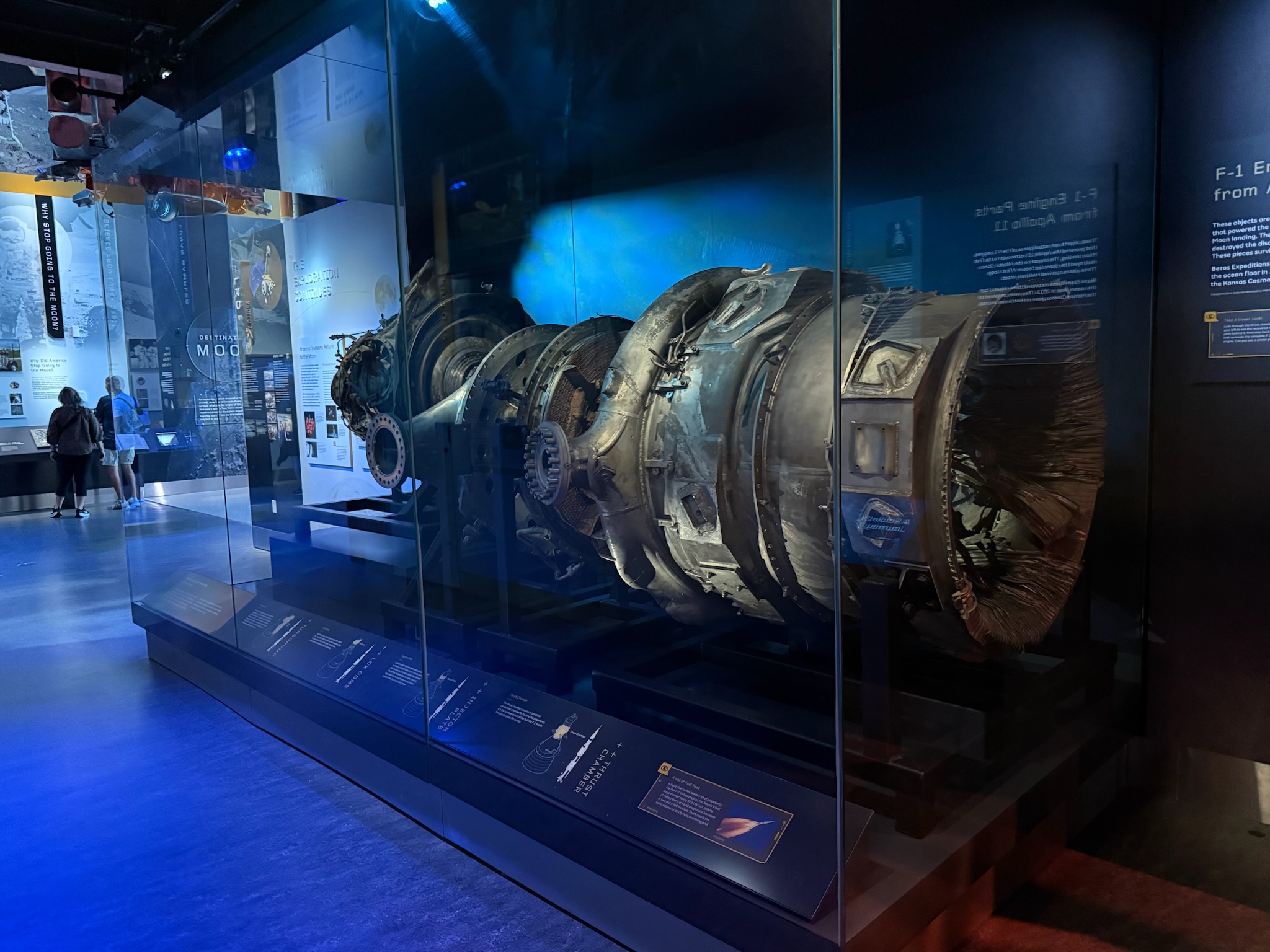
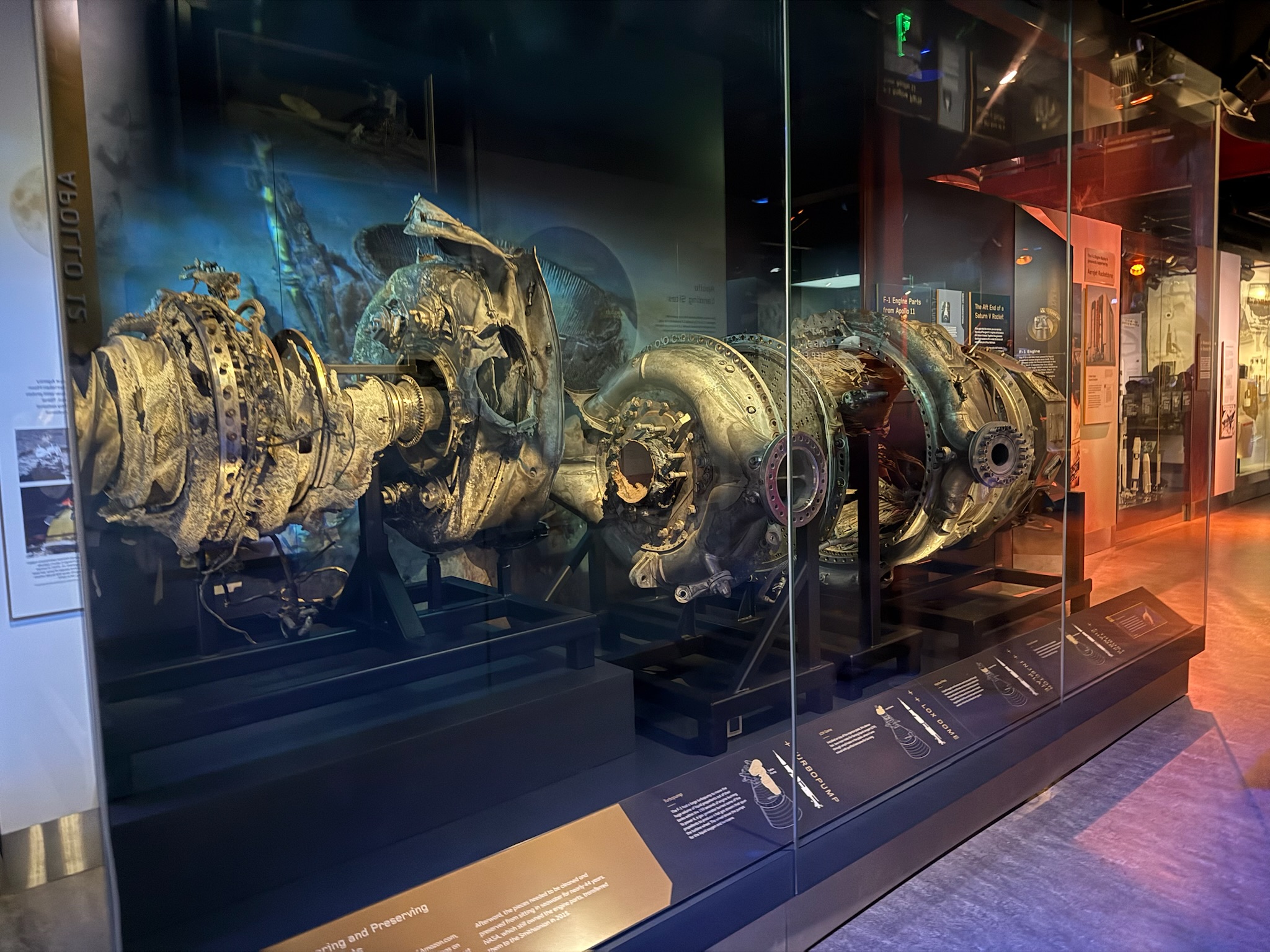
Neil Armstrong became the commander of Apollo 11 mission, which made the first moon landing in July 1969. The rocket that they used for this mission was called the Saturn V, which was powered by five Rocketdyne F1 engines. This is a piece of a F1 that was put up against mirrors so it looks like multiple complete engines (the goal being to give visitor’s a better sense of what the actual 5-engine rocket had looked like).
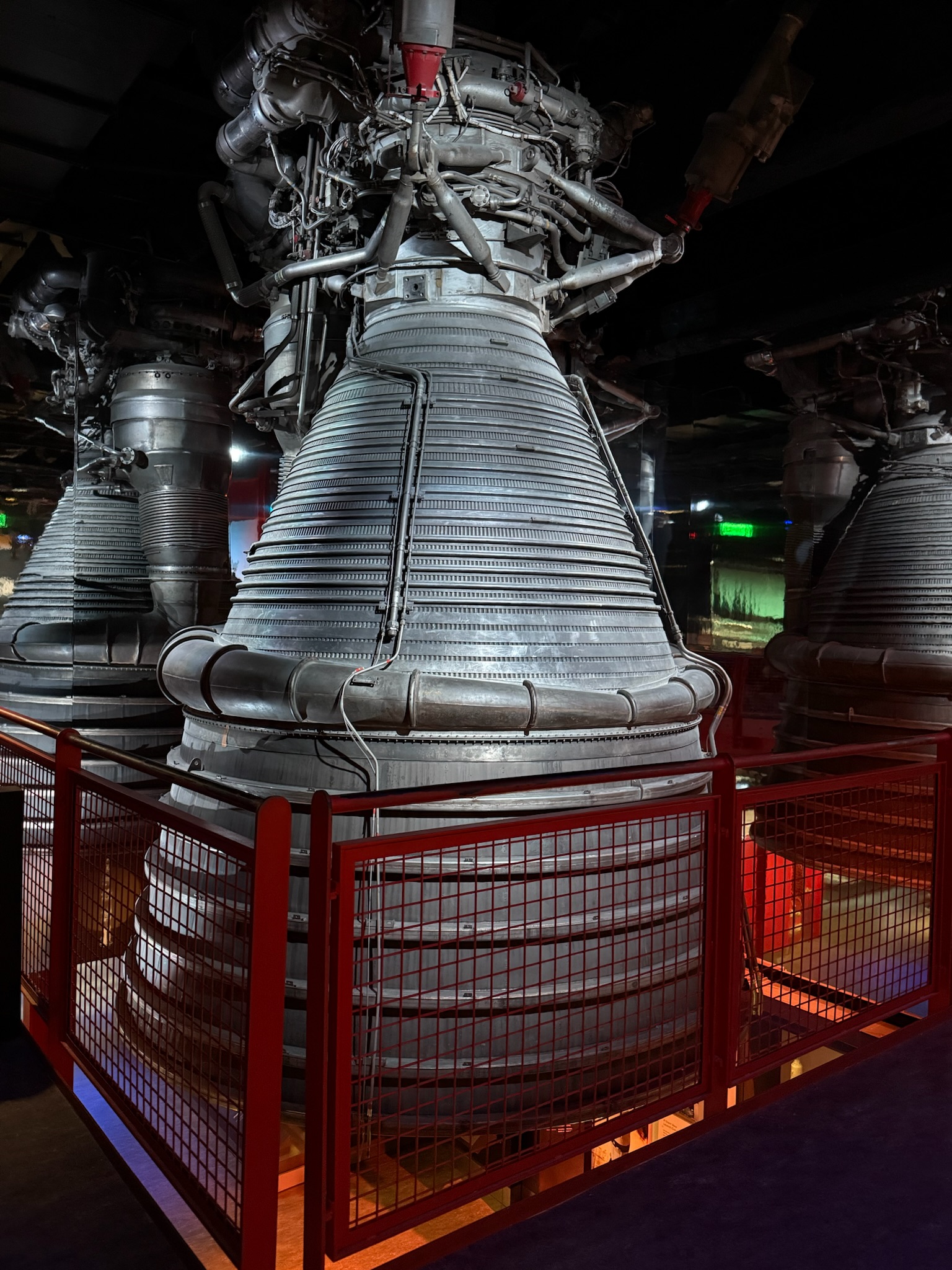
Apollo 11 landed in the southwestern portion of the Sea of Tranquility because it was near the equator on the near side of the moon, and thus needed less fuel to reach. It was flat and looked clear of hazards. Armstrong was also the first human to walk on the moon. He and fellow crew member Buzz Aldrin spent 2.5 hours on the surface gathering samples, setting up experiments, and doing ceremonial duties, such as planting an American flag.
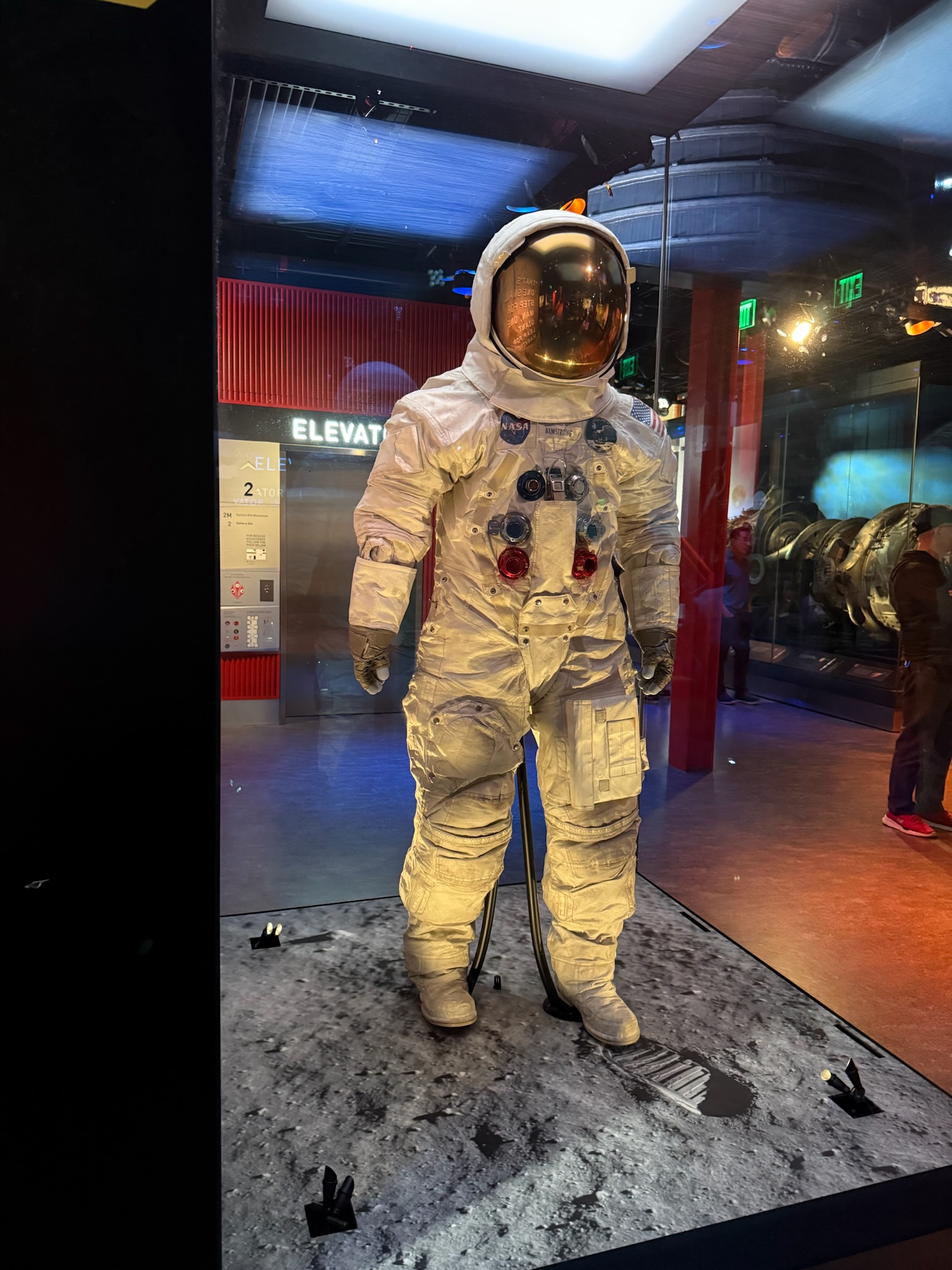
This was the space suit that Armstrong wore on the first moon landing. It was basically a form-fitting spacecraft, providing air, protection from extreme temperatures, radiation and space debris, and a communication device. The suit was multilayered. The outer layer was apparently a cloth made of fiberglass that was coated with teflon. They also wore backpacks with portable life support systems.
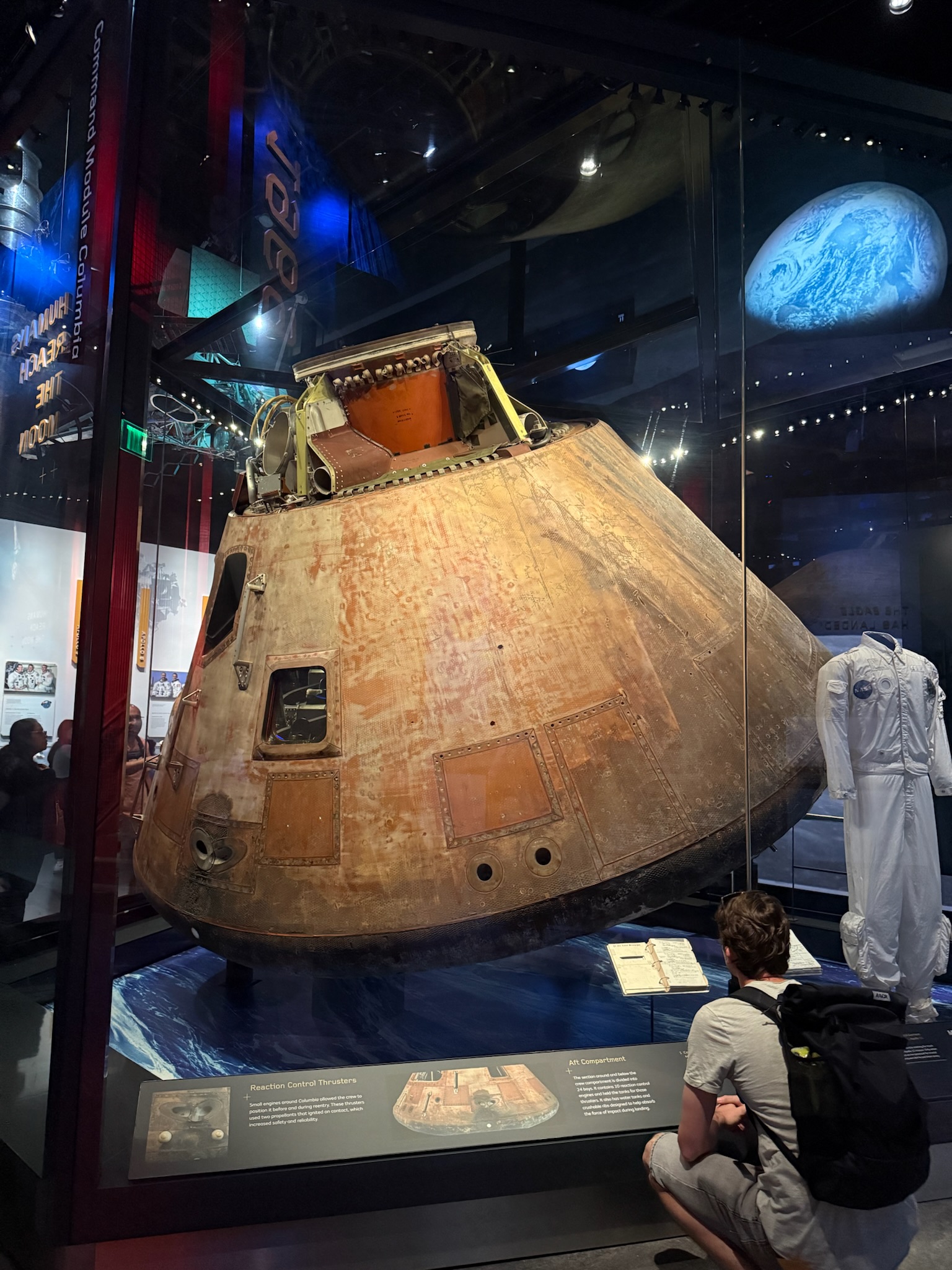
Upon reentry into Earth’s atmosphere, most of the Apollo 11 rocket burned up. Only the Columbia command module made it back intact. It carried the crew and the samples they’d collected from the moon.
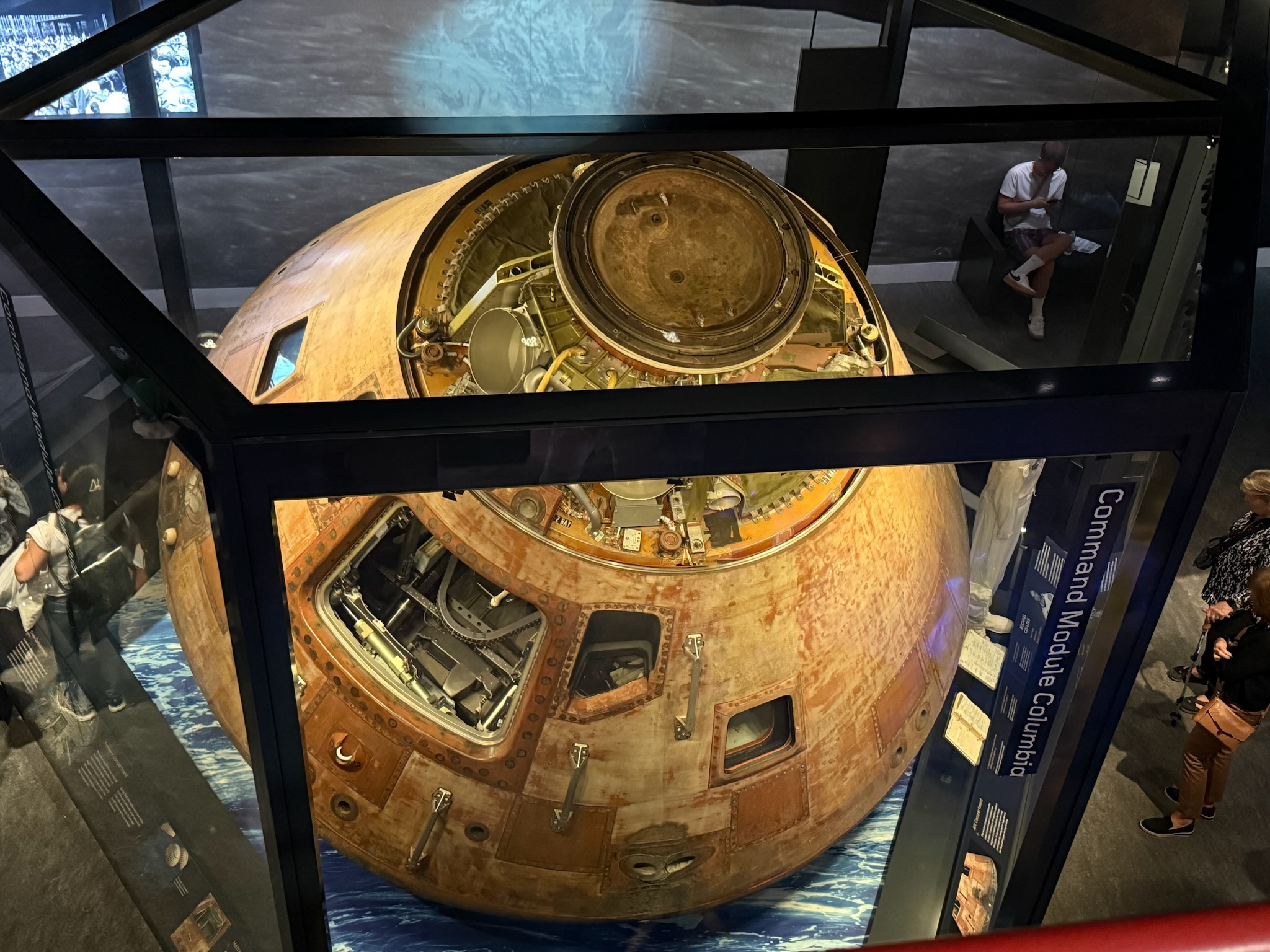
View of the command module from above.
According to the signs, in 2013, Jeff Bezos funded a mission to find and salvage the burned up ruins of the Saturn V rocket. He gave the remains to NASA and NASA donated these two engine segments to the Smithsonian.
There were several displays about life onboard, such as the food they ate (mostly freeze dried), how they made water, how they went to the bathroom (Keith has no interest in being an astronaut after seeing that), medical supplies they had onboard, emergency items/survival gear they had onboard, etc.
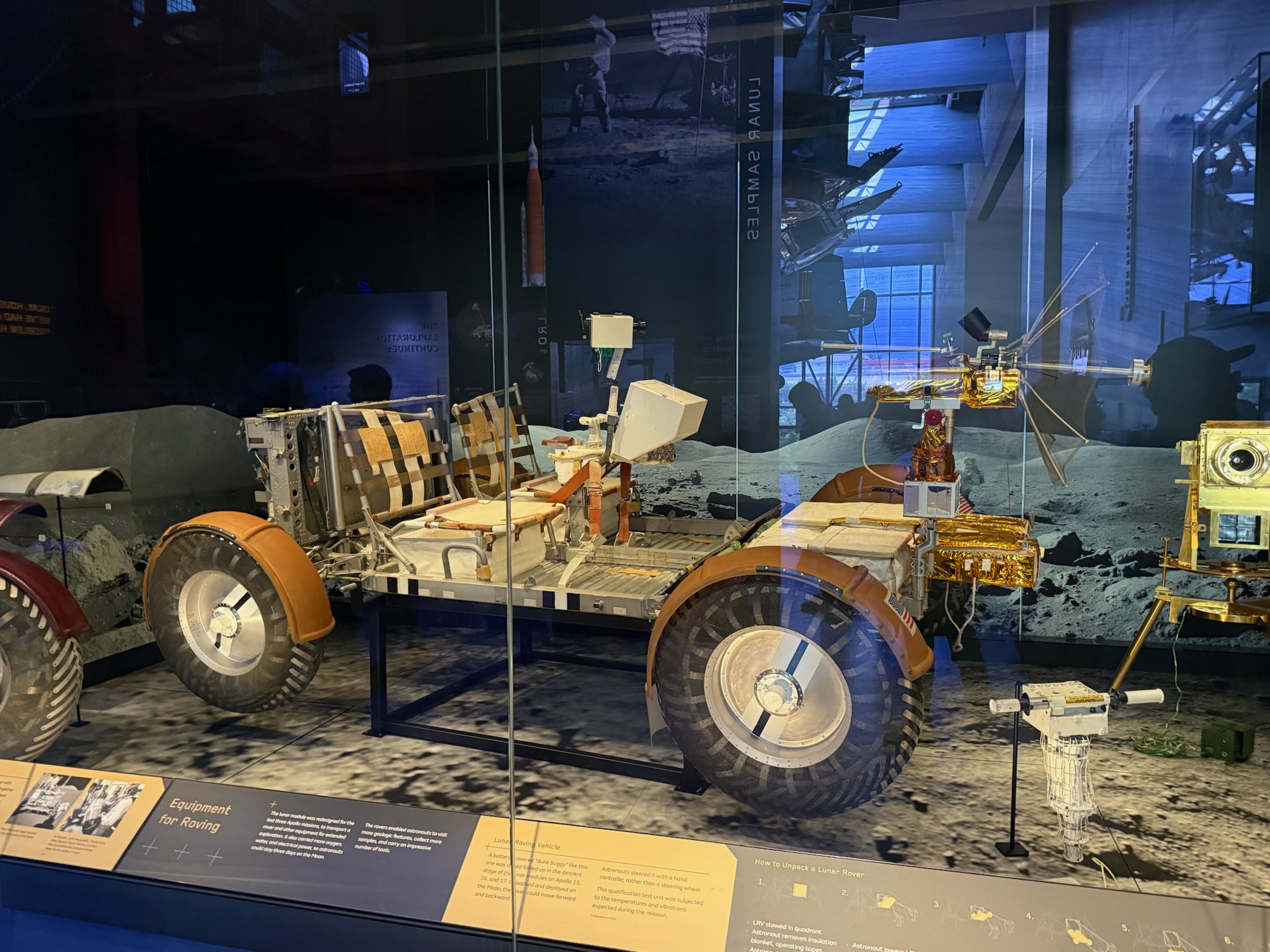
From there, there were small displays about subsequent moon landings and surveillance. Apollo 12 also landed on a flat site. Apollo 13 failed because an oxygen tank exploded en route to the moon, forcing the astronauts to return to earth. Apollo 14 landed on a slightly rougher, more scientifically interesting area. Apollos 15, 16 and 17 had astronaut driven rovers and lunar modules. With better gear, and more confidence about their ability to safely land in more diverse landscape, the last three missions went to rougher terrain that they thought would yield better scientific results. This was the Lunar Roving Vehicle used in the last three missions. It was was battery powered, could go in forward or reverse, was operated with a hand controller instead of a steering wheel, and was stored folded up during the flight and unfolded/deployed on the ground.