continued... As we learned in Yorktown, after declaring independence back in 1776, the Continental Congress worked on forming a central government as the war raged around them. By November 1777, they had adopted The Articles of Confederation, which was the first constitution of the US. The states were sovereign entities and the national government had extremely limited powers. One of the few powers the new federal government gave itself was to create a central postal system.
By 1787, it was clear the new government wasn’t working out because of the severely limited ability to function. This was when they began drafting the current Constitution and Bill of Rights. The first amendment in the Bill of Rights was as much about protecting mail service from censorship as protecting dissenters, journalists, etc. From what we gathered, it sounded like during the interim years, the Post Office just kept running as it had been since it was created in 1775. In 1792, legislation specific to the Post Office operations was finally passed. Back then, news was most commonly spread through the mail. Congress understood that mail and newspapers were both critical components that made the engine of the Republic run. Congress decided that rates for newspapers would be lower than letters in order to help facilitate the spread of information. Back then, newspapers were often only one letter size page. Because the letters were subsidizing the newspapers, letters were expensive to mail. Congress also forbade Postal workers from opening mail unless it was undeliverable as addressed. While the contents were still considered private, the workers could try to discern from the contents where the letter was supposed to go.
In 1800, the Post Office began using the “hub-and-spoke-system” that is still in use today. Certain post offices were selected as distribution centers, where mail for large areas was processed and sent on.
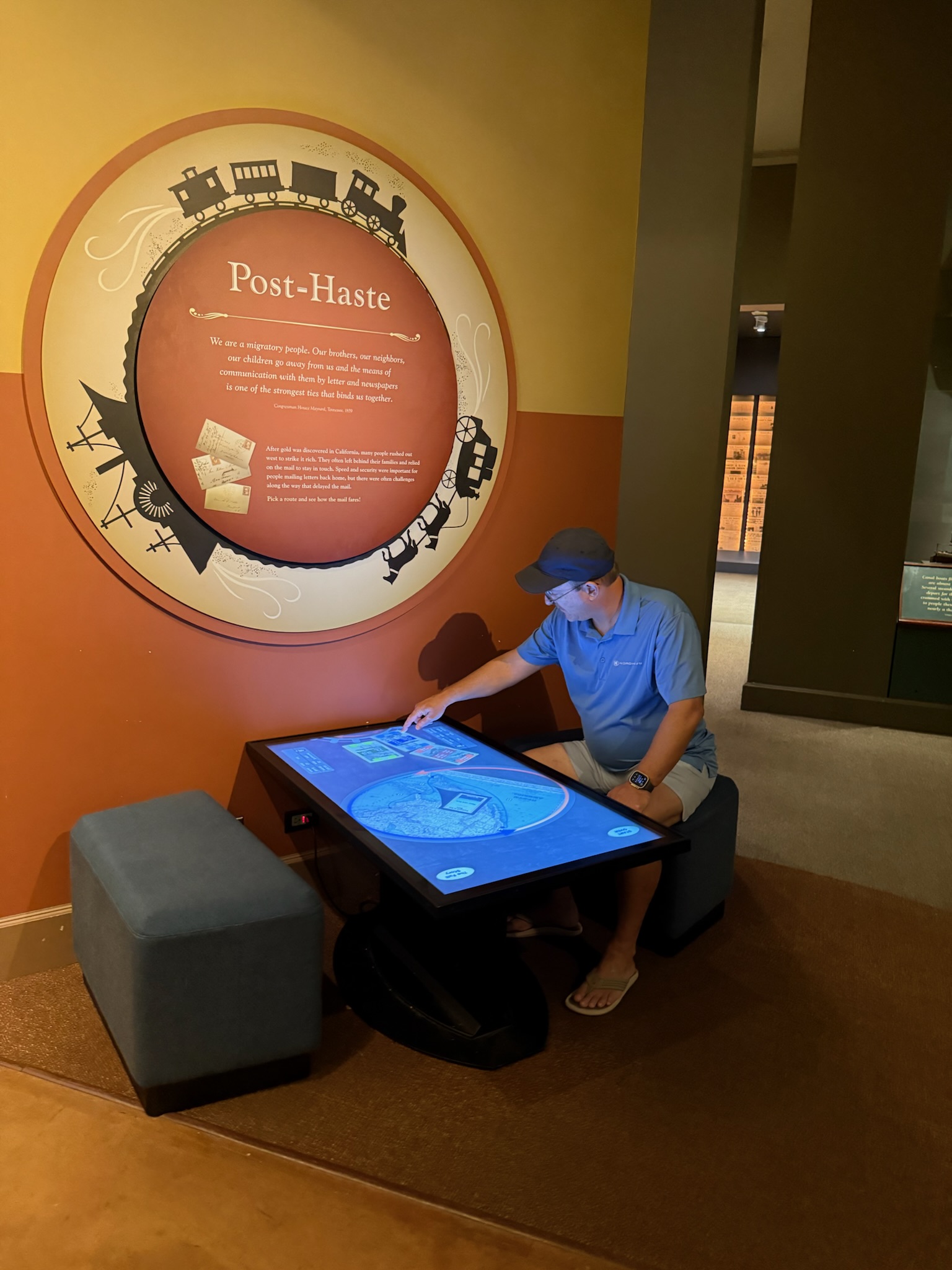
When gold was discovered in California in 1848, getting mail to/from California became a priority. The Post Office contracted with several shipping companies. Some ships went all the way around Cape Horn, but the faster service was by splitting the route up: Ships on the east coast going between the US and Panama/Nicaragua, an intermediary to carry the mail across the isthmus, and ships on the west coat going between Panama/Nicaragua and San Francisco.
By 1851, mail could get all the way across the country via three overland routes, but each route only ran once a month. A twice-weekly single overland route was established in 1857. The Post Office awarded the contractor who worked the route, John Butterfield, a six-year contract at $600,000 per year. When establishing routes out west, Congress was concerned with more than just the mail. Congress understood that civilization would form along the mail routes, so establishing the route was a critical piece of growing the nation. One of the last displays in the room was a game where you could see the challenges that were faced on each of the western routes.
Postage rates varied based on number of sheets of paper and destination. In 1845, Congress lowered rates and made pricing more uniform. In 1847, Congress authorized the first adhesive postage stamps: a 5-cent stamp showing Benjamin Franklin and a 10-cent stamp showing George Washington. In 1851, Congress dropped rates again, down to 3-cents. To put it in perspective: a letter from New York to California had been 40-cents in 1847 and was only 3-cents in 1851. The lower rates led to another explosive growth in the utilization of mail.
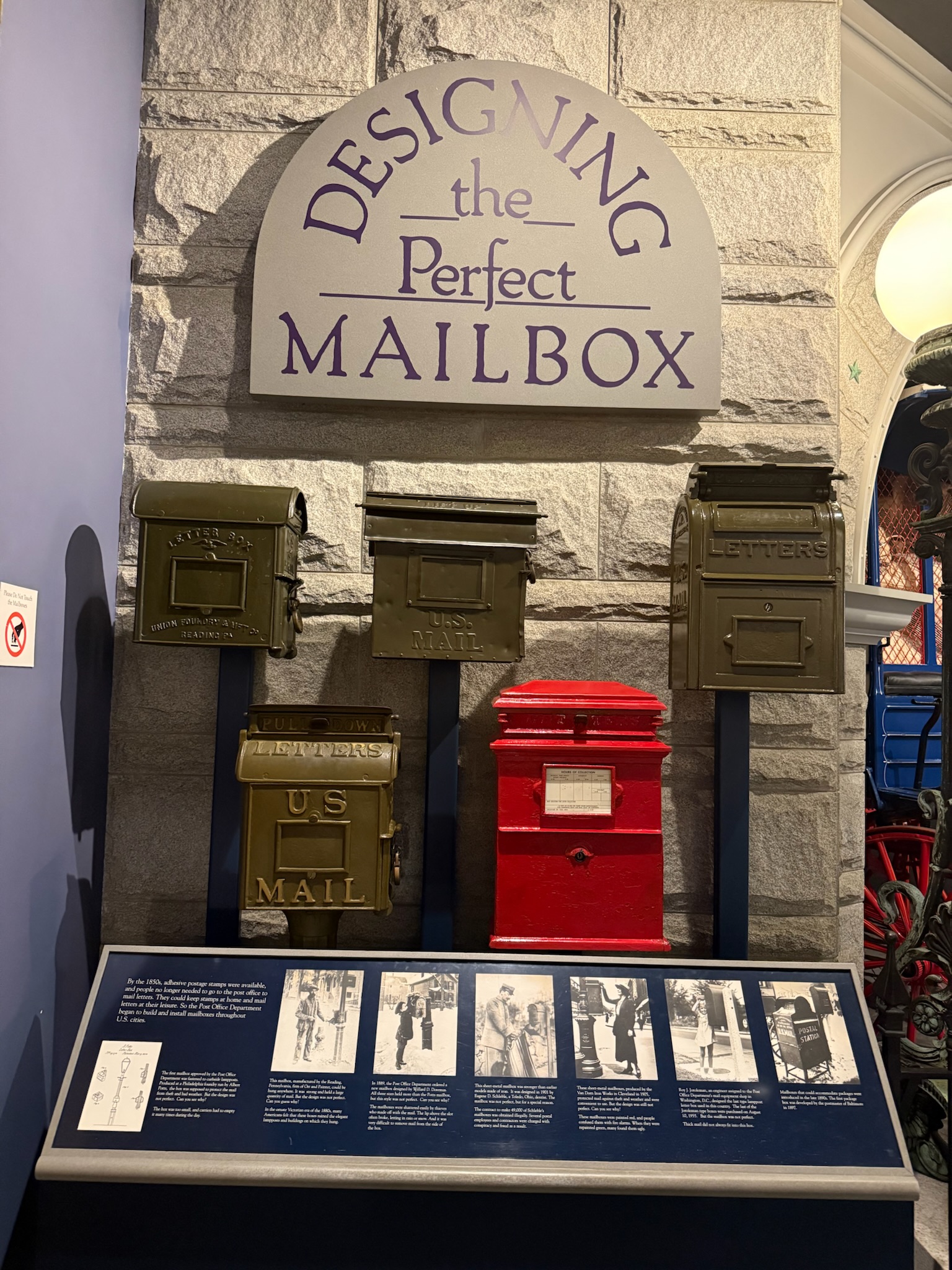
In 1855, pre-paid postage stamps became mandatory. The use of pre-paid postage meant that people didn’t have to go to the Post Office every time they needed to send a letter; they could pre-purchase stamps and mail letters at their leisure. So the Post Office Department began building and installing mail collection boxes throughout cities. It took several tries before they got it right. Some were vulnerable to weather intrusion, some were vulnerable to theft, and most of them were’t big enough, so they had to be serviced by the postmen several times a day.
Prior to 1863, people usually picked up their mail from the post office because there was an extra 1 – 2 cent fee per letter for a carrier to deliver the mail to their home (and the letter carriers were contractors, not Postal employees). In 1863, free home delivery was instituted in 49 cities. It was a smashing success, increasing the Post Office’s revenue by ten-times more than the cost of the delivery men. It also provided jobs to Civil War veterans (side-note: due to the shortage of men during the Civil War, some women were hired to deliver until a male replacement was found). By the end of the 19th century, nearly 10,000 letter carriers were employed in over 400 cities. The delivery men knocked on each door and only delivered the mail if someone was home to personally receive it. They worked 7-days a week, with low pay and no vacations. In 1889, the delivery men formed a labor union.
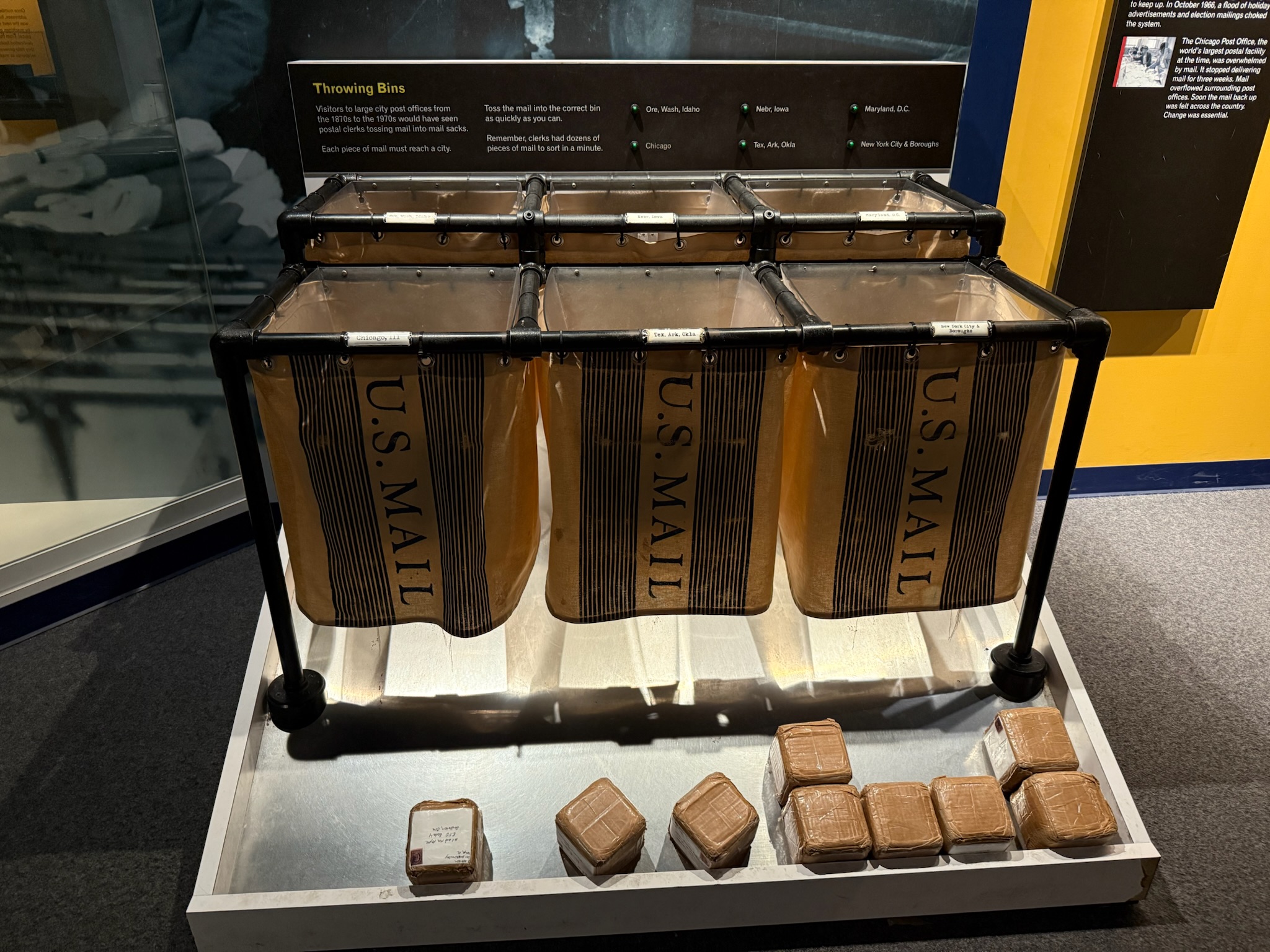
These mail sorting bins were introduced in the 1870s and used until the 1970s.
There was a sign that talked about the rise of mail order catalog business in the late 1800s. Seed catalogs and shipments were considered crucial to the economy, so they were given lower postage rates.
The sign didn’t say when the Dead Letter Office actually opened, but in the area devoted to the late 1800s, there was a sign about it. Undeliverable mail was sent to this office, where a team of people tried to figure out the letter’s proper destination.
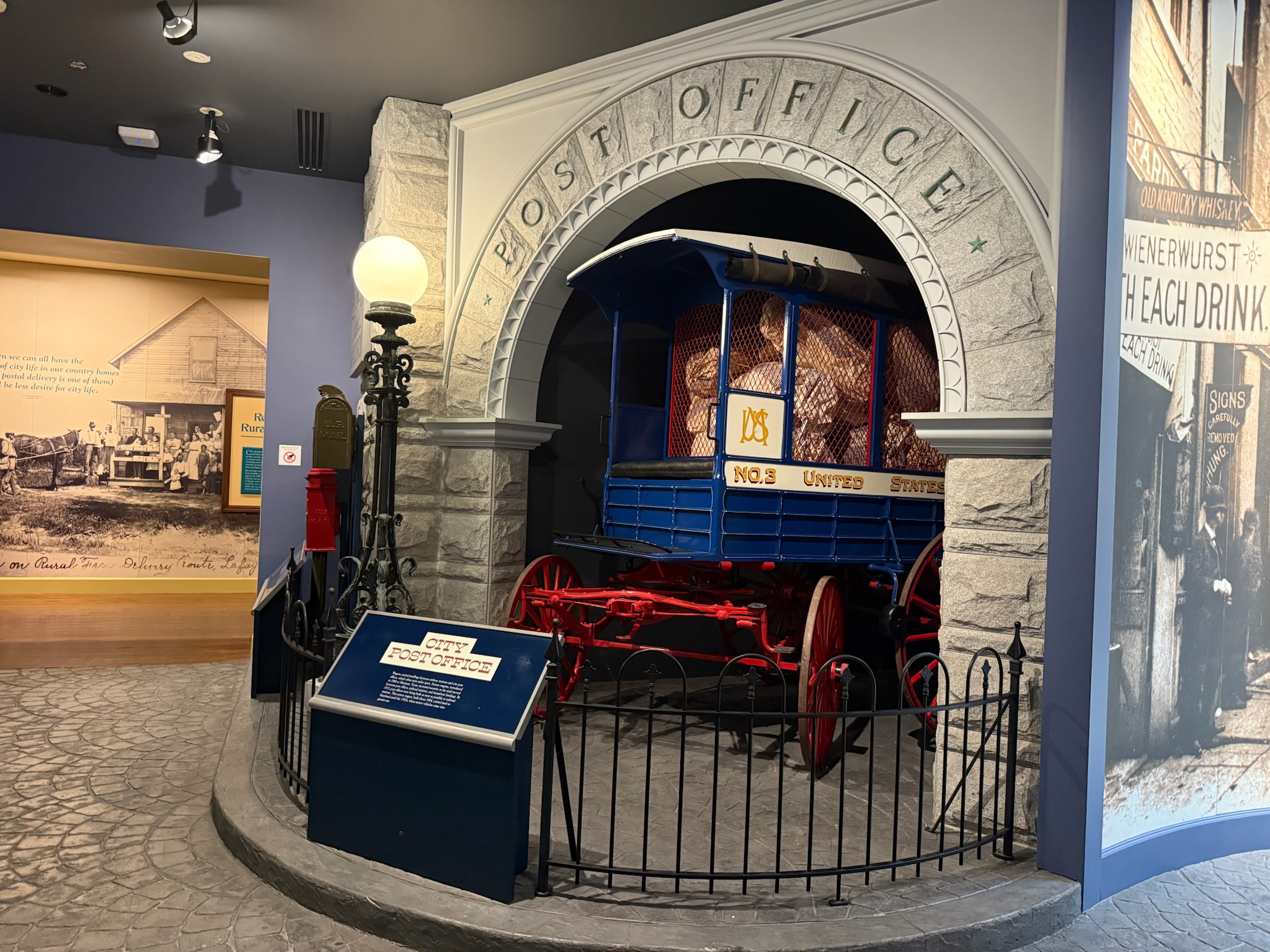
In 1886, these screened in wagons were implemented to move the mail between the post offices and railroad stations.
In 1891, a black man named John T. Jackson became the postmaster in Alanthus, VA. The sign said that for a long time, blacks and white employees were segregated from one another. We did not see a sign indicating when desegregation occurred. Mr. Jackson served as postmaster for 49 years.
Moving the mail between urban Post Offices was becoming more difficult as traffic congestion was an ever growing problem. Often, street cars were utilized to move mail between the Post Offices. In 1893, the Post Office began using pneumatic tubes to move mail under the city streets. The carrier tubes could hold 600 letters and traveled at 35 miles per hour. However, sometimes the tubes got stuck, and getting the tube out could be difficult — they occasionally needed to dig it up! The tubes were abandoned in the 1950s.
People in rural areas began to complain that their postal rates were the same as city-folk, despite the fact that in rural areas, people still had to go to the local Post Office to pick up their mail. In 1896, they started testing home delivery in rural areas. Congress designated 44 rural routes in 29 states and appropriated $40,000 for the trial service. Even though it wasn’t profitable like city delivery service was, the free rural delivery had a lot of popular support and thus was established in 1902.
Up until 1913, packages were limited to 4-pounds. The Post Office introduced Parcel Post, where pricing for packages was determined by size, weight and distance. To operate this pricing system, zones were created.
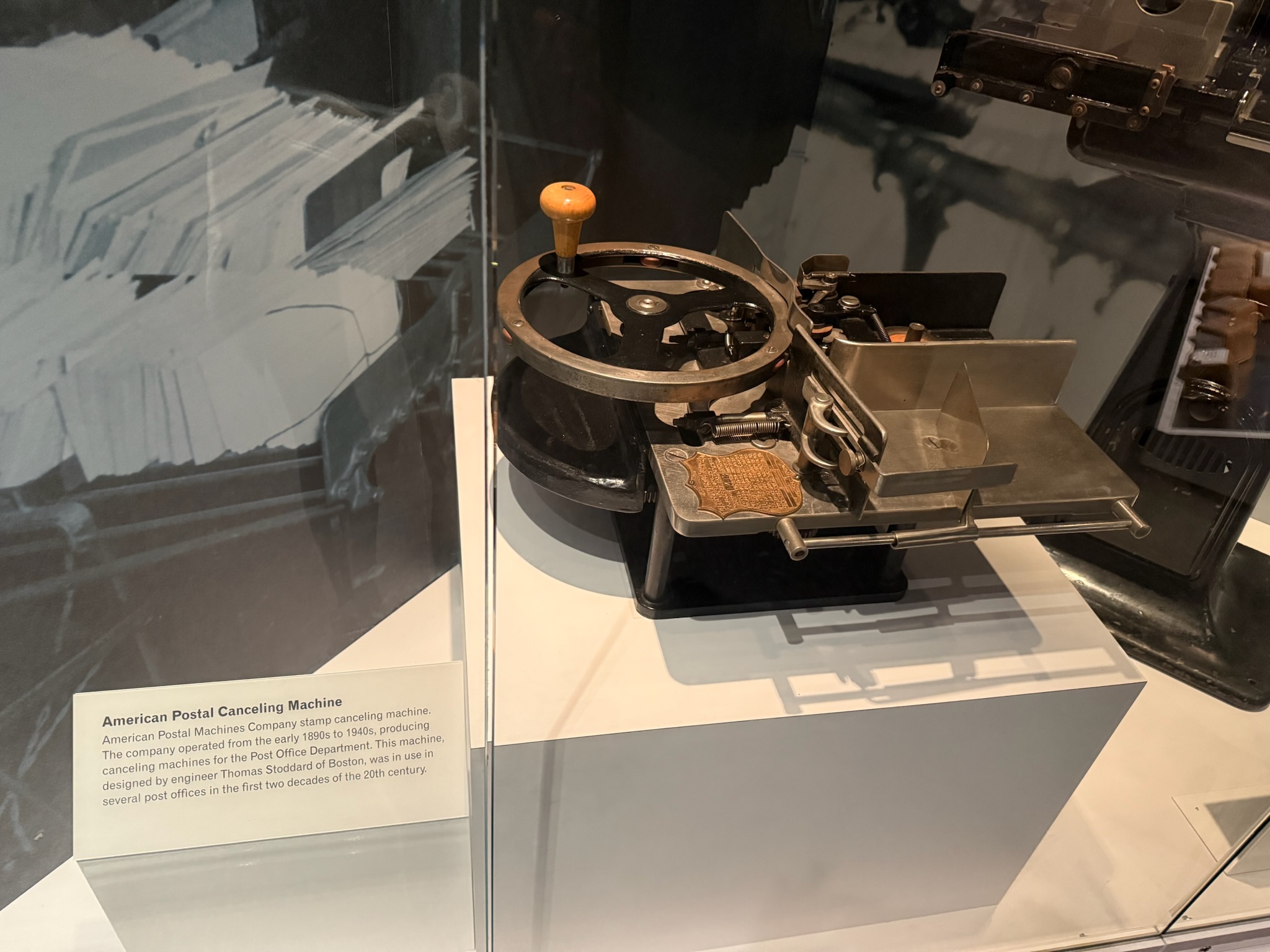
In 1917, the Post Office began implementing machines: buckets and conveyor belts moved the mail and machines that postmarked and/or canceled the postage stamp. Prior to the machines, marking devices called “hand stamps” and inking pads were used to indicate that the letter was now in the system (postmark) and that the stamp could not be reused (canceled). Postage meters were introduced in the late 1920s.
Also in 1917, the delivery men union joined the American Federation of Labor. Delivery men estimated they spent about 2-hours a day waiting on people to answer the door. In 1923, the Post Office decided that every home must have a box or slot so that mail could be securely delivered without a personally receiving it.
Collection boxes began appearing in the early 20th century as package boxes, which were placed next to the letter boxes. In 1931, they started phasing out the letter boxes and used the collection boxes both for letters and packages.We didn’t take a photo of a collection box, but we feel like those boxes are as iconic to American culture as the trucks the postmen drove.
After World War II, mail volume grew every year, doubling between 1946 and 1966. Dependent on federal subsidies, the Post Office couldn’t hire people or buy machines fast enough to keep up with the ever increasing volume. To be continued…