
continued... After World War II, the Post Office couldn’t hire people or buy machines fast enough to keep up with the ever increasing volume and they were taxed to their limits. In order to help move mail faster, in the early 1960s, they created the Zoning Improvement Plan — AKA ZIP code — system. The first number indicates region, second and third number city and the last two indicate the specific post office it goes to. Now ZIP codes are used to shape everything from voting districts to marketing campaigns.
It sounds like in the 1960s, they also began implementing machines capable of reading the printed word, meaning that humans didn’t have to process the mail anymore. In 1982, the Post Office starting putting barcodes on mail so that machines could process the mail even faster. The barcodes started with the zip code, but as mail processing has become more sophisticated, they’ve added more numbers to the barcode. Nowadays (at least when the exhibit was made) it’s a 31-digit barcode that sorts the specific route’s mail into the order in which it is delivered.
In the early days of barcoding, postal workers hand-typed the information into barcode printers. Over the years, the machines have become sophisticated enough that they can read the address, print and affix their own barcodes, and sort the pieces of mail into appropriate sorting bins without any human intervention. The machines can even read all but the worst handwriting. If an address is undecipherable, the machine takes a photo and sends it to a Remote Encoding Center, where a person figures out the address, sends it back to the machine, and then the machine prints and affixes the barcode.
In 1971, The US Postal Department was replaced with the US Postal Service (USPS). They changed their logo from a horse and rider to the profile of the eagle about to take flight that is still used today. Then-president Nixon proclaimed July 1 National Postal Day.
In the 1980s, the Post Office built 21 bulk mail centers. We knew bulk mail meant when a company sends out a large quantity of identical items at a discounted rate. What we didn’t know was the company prints the address, barcode and postage, sorts the mail into order by ZIP code, stacks it onto a pallet in order and ships the pallet to a bulk center for processing. The bulk mail system helped reduce the amount of work at the local post offices, while making the mail processing faster and easier.
Thanks to the steady increase in automation over the last century, nowadays, only a few hands have to physically touch the mail to process it. What used to be a series of single task machines is now an integrated system that can do almost everything automatically. The increase in automation has led to an increase in services, such as letter tracking, which were unimaginable a few decades ago. But people still operate, supervise, maintain and design the machines. There were several signs highlighting the engineers who custom designed and built the various pieces of innovative equipment specifically to meet the Post Office’s needs.
According to the sign (which was probably several years old) the Post Office currently process over 600,000,000 pieces of mail each day with hundreds of millions of delivery locations.
After we finished the rooms about the history of the Post Office, we went across the hall to the room about the Postal Inspector Service. Postal Inspectors are first responders to any disaster — natural or manmade — where the safety of the postal workers and/or security of the mail is at risk. They find, secure, and help to get services back to normal by facilitating the delivery of mail to dispersed and traumatized disaster victims.
One of their duties is to deal with finding perpetrators who send dangerous items through the mail. It cited the situation in 2001, where someone mailed letters containing the toxin anthrax to two US Senators and members of the media. Microscopic spores leaked out of the envelope during transit, sickening postal workers along the processing and delivery route. 5 people died and 17 got sick from anthrax exposure. The Postal Inspection Department identified the collection box where the letter had been mailed and decontaminated every facility that the letter had passed through.
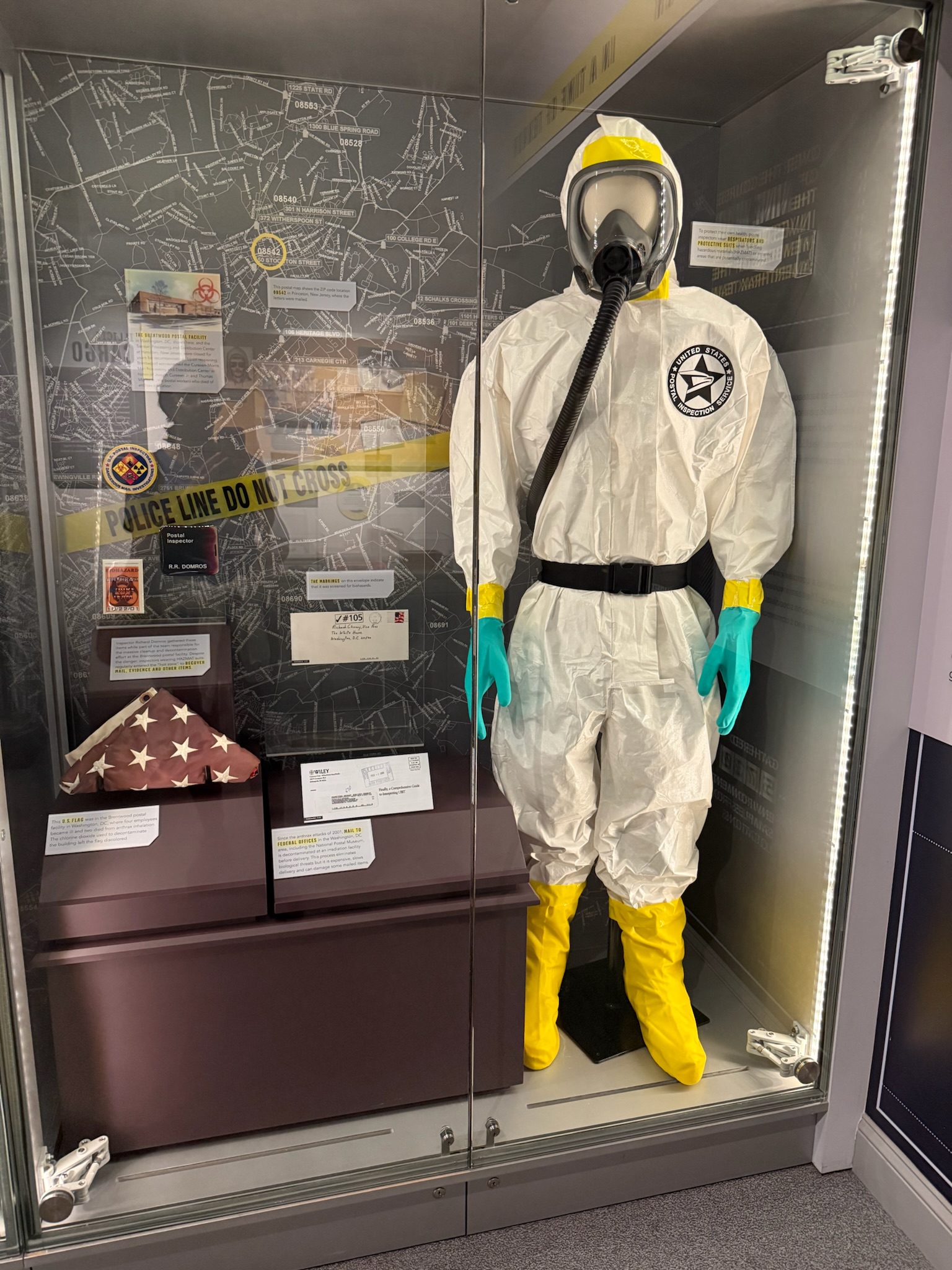
The Postal Inspectors worked jointly with the FBI, several other law enforcement agencies, and a team of specialized scientists to find the perpetrator(s). The sign said the case was closed in 2010 because the culprit committed suicide. This incident was also highlighted at the Spy Museum in the terrorist attack section that we didn’t want to write about. If we remember correctly, the Spy Museum said that the perpetrator(s) were never caught, but the strain of anthrax was traced back to a biodefense research lab in the US. Per the internet, the FBI was getting ready to charge one of the people who worked in the lab, but he committed suicide before being indicted.
Shortly after the incident in 2001, the Post Office started using biohazard detection equipment in the large mail sorting facilities. The Post Office now also irradiate all mail going to federal offices prior to delivery.
Another display was about the Unabomber, Ted Kaczynski, who mailed bombs to targets from 1978 – 1996. The Postal Inspectors identified what his packages tended to look like and had all employees watch for suspicious packages. Packages were pulled that did indeed contain bombs, probably saving lives. The Postal Inspector teamed up with the FBI and the Bureau of Alcohol, Tobacco, Firearms and Explosives (ATF) to find the perpetrator. He was finally caught when his brother tipped off authorities.
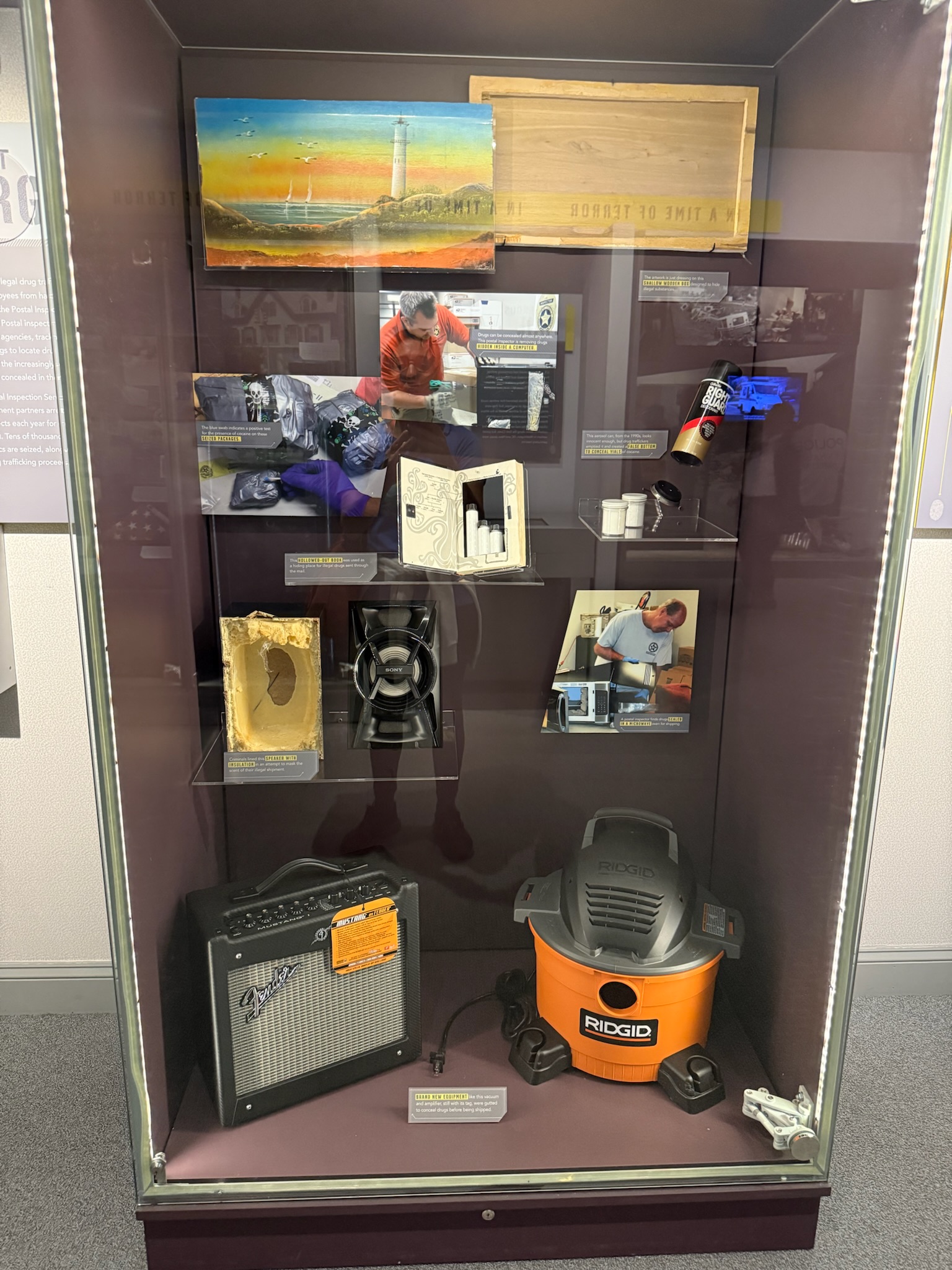
Another display said that tens of thousands of pounds of illicit drugs were seized from the mail and thousands of arrests and indictments were made each year against people who traffic the drugs through the mail. Postal Inspectors use tips, intelligence from other agencies, tracking techniques and trained dogs to locate drug shipments. A display case had some of the items that drugs had been found hidden inside.
The Postal Inspectors also investigate mail fraud scams, including hundreds of investment fraud scams per year. Fun fact: Charles Ponzi, the original pyramid schemer from the 1920s, was selling guaranteed postage coupons as a part of his scheme. There were several displays about various types of mail fraud scams, from low quality merchandise sold so the scammers can get your credit card number, to fake sweepstakes, to the aforementioned get rich quick investment schemes. There were a couple of displays about fake sports memorabilia, too, which apparently is a big business.
One of the Postal Inspectors most high profile busts was Jim Bakker from Praise The Lord Club (PTL). From 1984 – 1987, he was selling partnerships to an entertainment complex owned by PTL. Bakker claimed there were only 25,000 slots, but oversold memberships by $178- million. The Postal Inspectors worked with the FBI and IRS to convict him of tax, wire and mail fraud. Another high profile case was a billion dollar art forgery ring where the bogus art was shipped via the mail. Postal Inspectors worked with the Department of Justice, the Federal Trade Commission and Interpol to crack the case. When they executed the raid in 1991, they found over 100,000 pieces of fake copies of works from artists such as Dali and Picasso.
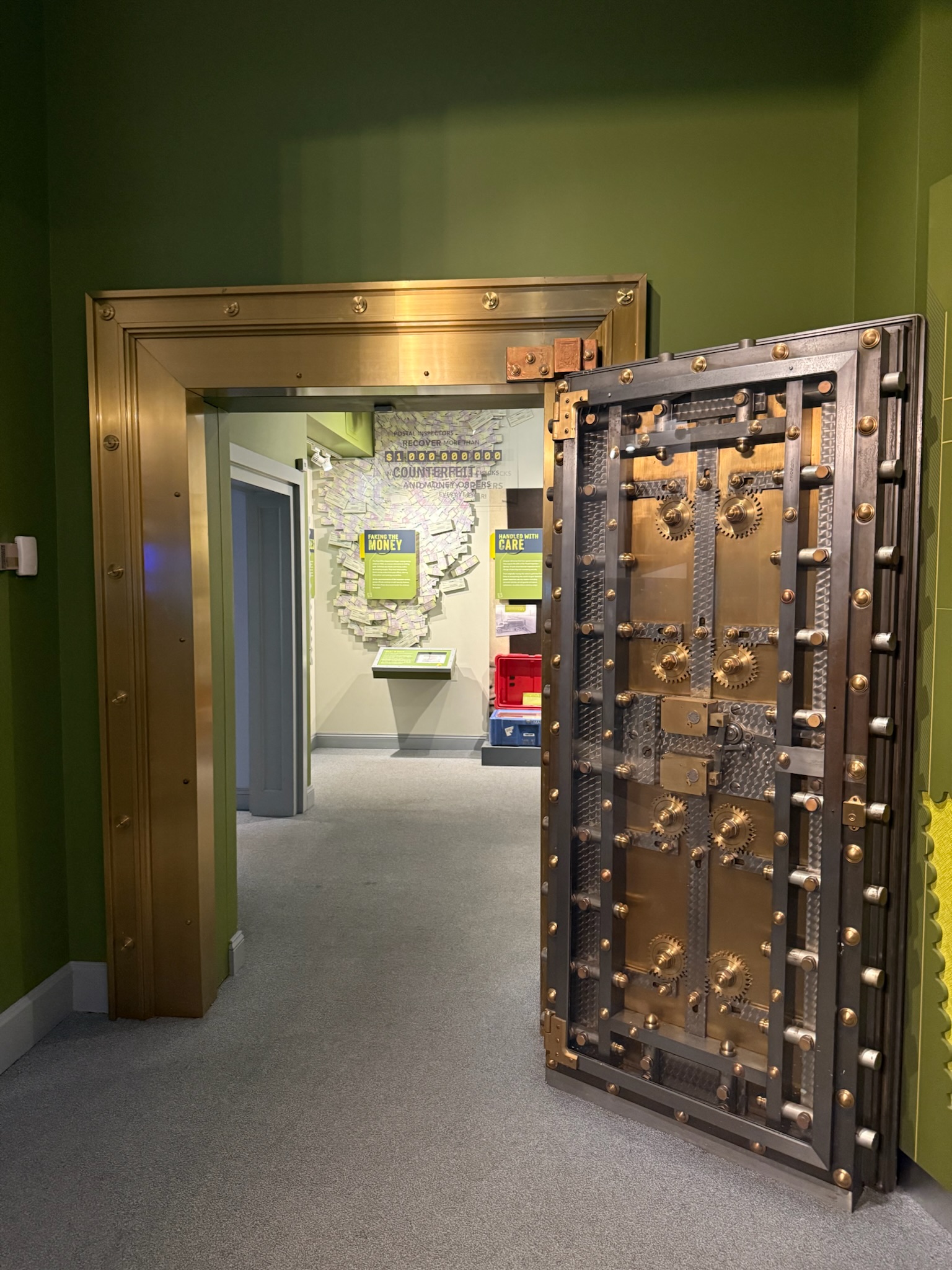
Quite a few other displays detailed creative criminal schemes to steal mail in transit, such as a hijacking mail trucks and robbing trains. In one instance, a man hid in a suitcase to steal air mail. Postal Inspectors also personally escort high value shipments. There was a display about the extensive extra measures that may be taken to protect these prime targets. Interestingly, when the US Treasury’s gold was moved to Fort Knox in 1936, it was shipped via the Post Office.
Stamp forgeries and counterfeit money orders were also of primary concern for Postal Inspectors. There was a sign explaining how to identify a real money order: there was a woven security thread and a watermark. There was a display about the forensic tools that were used to find the perpetrators of forgeries and to prevent crimes. Interestingly, for crime prevention, they used many of the same tools detailed in the Spy Museum, such as cryptography and recording devices disguised as common objects.
The Post Office started issuing money orders in 1863 to provide a safe alternative to mailing cash. In addition to trying to counterfeit money orders, thieves try to steal real money orders or alter real money orders. In 1997, perpetrators broke into a Post Office and stole the money order machine. They burned the post office down to hide the evidence of the robbery. They used 60 of their self-printed money orders, totaling $40,000, around the DC area until they were finally caught after a check cashing place reported receiving a money order with its receipt still attached.
Once we finished in the Postal Inspector room, we went across the hall to… to be continued…