
Keith had to write a report for school on a topic of interest to him. We decided to post it so he can share it with the new potential players that he meets.
Dungeons and Dragons, known as D&D for short, is a strategic roleplaying game. There are a variety of things you can do in D&D. The entire premise of the game is that you are someone else, somewhere else. That someone else could be a dragonborn monk, an elvish wizard or an orcish ranger. The somewhere else could be a dark dungeon, a mighty forest, or the open ocean.
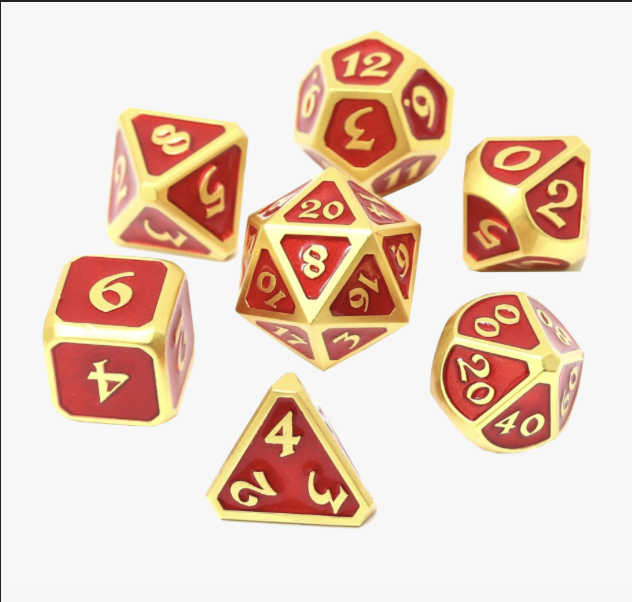
The core part of D&D is rolling dice. For the ease of play, people abbreviate dice names. They call them “d” and then the number of sides there are on the dice. For example, a d6 is a six-sided dice.
There are many more types of dice than just a d6! There is a d20, d12, d10, d8, d6, d4 and a d100. You will be rolling the d20 the most often. A d20 is used whenever you need to try to do something, such as attacking an enemy or trying to jump over a pit. A d100 is used for wild magic and loot tables (rolling to see what loot the party gets). The other dice are used for pretty much everything else, such as rolling for damage.
Generally, there is a main quest in any D&D campaign. This can be simple, such as eradicating a nest of giant spiders or it can be complicated, such as unraveling a plot to destroy a kingdom.
You can play as many different characters. There are many ways to customize your character, so it’s almost impossible to end up with identical people. There are 12 classes, each with 4 subclasses. You also have a choice of 16 backgrounds and 10 different races. There are also 68 different feats (extra abilities that hone your character’s powers), making a total 522,240 different options. This is also not including subclass features, such as battle master’s maneuvers, fighting styles, class abilities such as eldritch invocations, different stats, choosing different spells and subraces!
There are 20 levels in the game. There are two ways of gaining levels: experience points and milestones. In the experience method, killing monsters or completing quests will give you experience. You need increasingly more experience to gain levels. In the milestone system, you gain a level when you complete a quest, such as defeating a particularly powerful enemy or saving a village.
Generally, the quests you are on become more complex and important to the realm as you progress in levels. For example, a level 1 quest would be killing some goblins, level 5 would be defeating a criminal organization or evil guild, level 10 would be saving a kingdom from being taken over by mind flayers, level 15 would be ending a war between the different dimensions and level 20 would be killing an apocalypse beast or slaying a god.
Magic is very important in D&D. Many people think that wizards are the only ones who can cast spells, but this is not true. 8 of the 13 classes start off with magic, and 2 subclasses give access to the magic system. In addition, 3 subclasses and 4 races give access to one or two spells. While many classes and subclasses don’t have direct access to spells, 5 subclasses and 3 races give access to magic abilities. Also, 3 backgrounds give access to spells and 6 feats give you access to spells. In all, it is rather difficult to create a character with no spells at all!
The spell system for D&D is simple in some ways and complicated in others. There are 9 levels of spells. There is an easy way to determine when you unlock a new spell level: At what character level you gain access to a new spell level = double the spell’s level -1. For example, you would get level 6 spells at character class level 11. There is no such thing as level 10 spells, so you get the highest spell level at character class level 17. You have spell slots. With those slots, you can cast spells using a spell slot of the spell’s level or higher. Depending on the spell, using a higher level spell slot may make the spell more potent. Spell slots are one of the most important ways to balance magic, as once you use all your spell slots you must rest before you can re-use your spells again.
There are some irregularities to the spell system. Rangers and paladins can only get spell levels 1-5 and unlock them more slowly than regular spellcasters. Warlocks have the normal spell levels, but all their spell slots are for the highest level of spell they can cast.
There are many different “modes of play” in D&D. You can be a hack-and-slash player, who simply uses one or two main abilities. You can be a more advanced player that uses every ability at their disposal. You can be a midmaxer who tries to squeeze every last bit of power out of the character creation system. You could be a roleplayer, who doesn’t care so much for fighting, but instead loves the story and getting into the groove of their character. You can be any of these things or something entirely different. What ever style of play you want to be in, there is one for you.