continued…Much to Keith’s horror, once we got back to Highway 30, Eric and Christi decided to go back to Gettysburg to see if the museum was open. After our mega museum tour this summer, Eric and Christi had promised Keith we could take a break from museums, so he was mad that they’d broken their promise. But Eric and Christi felt like it would be a crime to literally drive through Gettysburg and not stop at a museum about an event that was so important to our country’s history.
As we neared the Military Park, we saw there was a line of cars entering, so we figured it must be open. Parking was free.
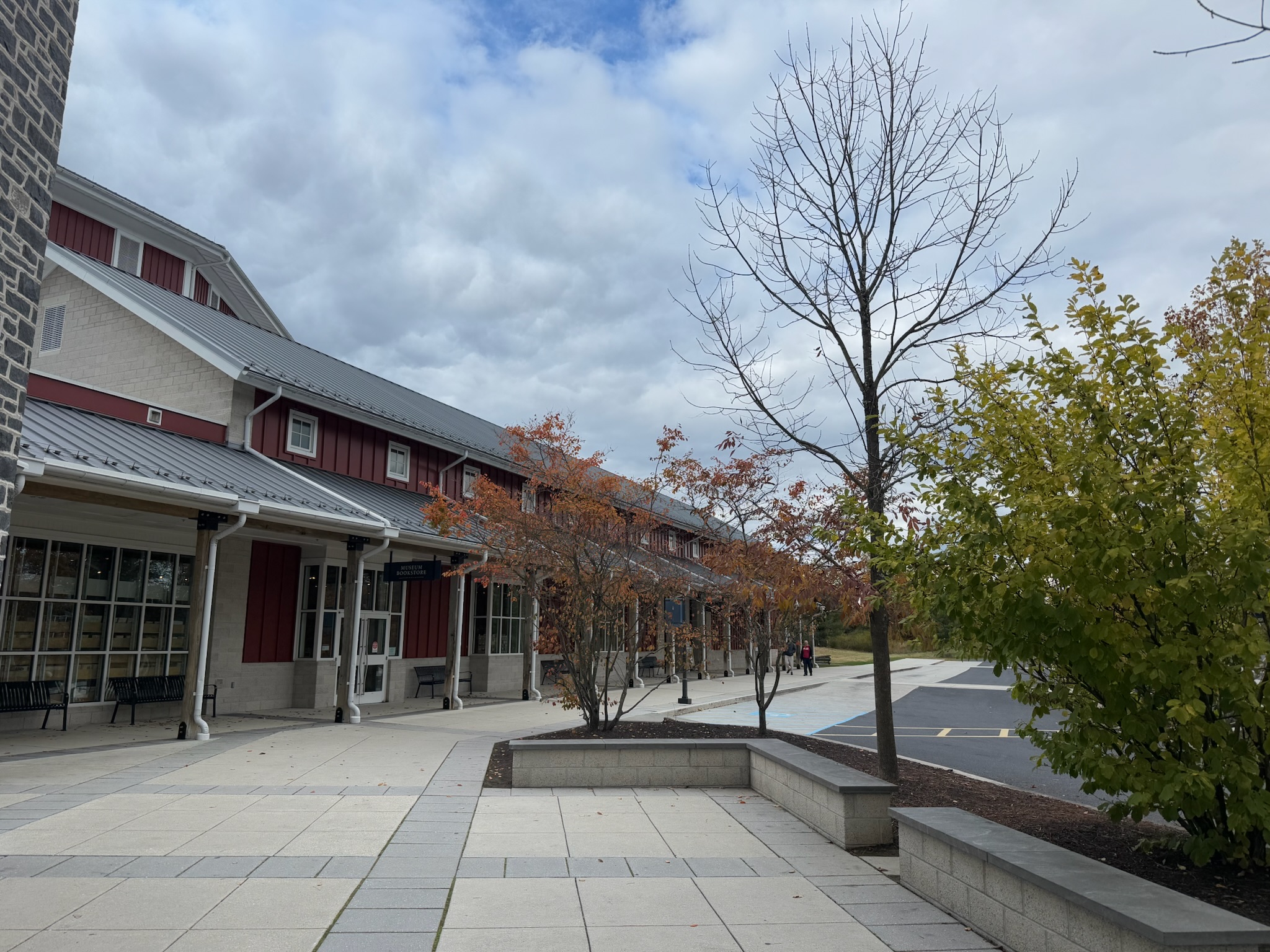
Tickets to the museum were $14.75 per person for ages 13 and up. The “Film, Cyclorama and Museum Experience package” was an additional $6 per person. We had no idea what the Cyclorama was, but we were told it was cool and worth the extra money. They also gave us a AAA discount, which helped offset the extra cost.
The movie was starting in just a few minutes, so we went into the theater first. It was about the lead up to the Civil War, the beginning of the war, the Battle of Gettysburg, the aftermath of that heinous battle and dealing with all the bodies, and the address Lincoln made at the dedication of the cemetery. The movie emphasized that the Battle of Gettysburg was a turning point in the war.
The quick overview was that the Civil War lasted for four years and was the bloodiest in the nation’s history. 2% of the population — 720,000 people — died. In the Battle of Gettysburg, 11,000 people died and another 40,000 were wounded, captured or went missing.
After the movie ended, everyone in the theater was ushered up an escalator to the 360-Degree Cyclorama Experience. We entered a large, round room with a giant painting covering the wall. We wrote wall as singular, since it was round and there were no edges. The guide said that it depicted the Battle of Gettysburg and had been painted over 100 years ago. The guide said that these giant paintings used to be a thing, but once movies came out, the trend died. He said that there were only two of these giant 360 paintings left in the United States.
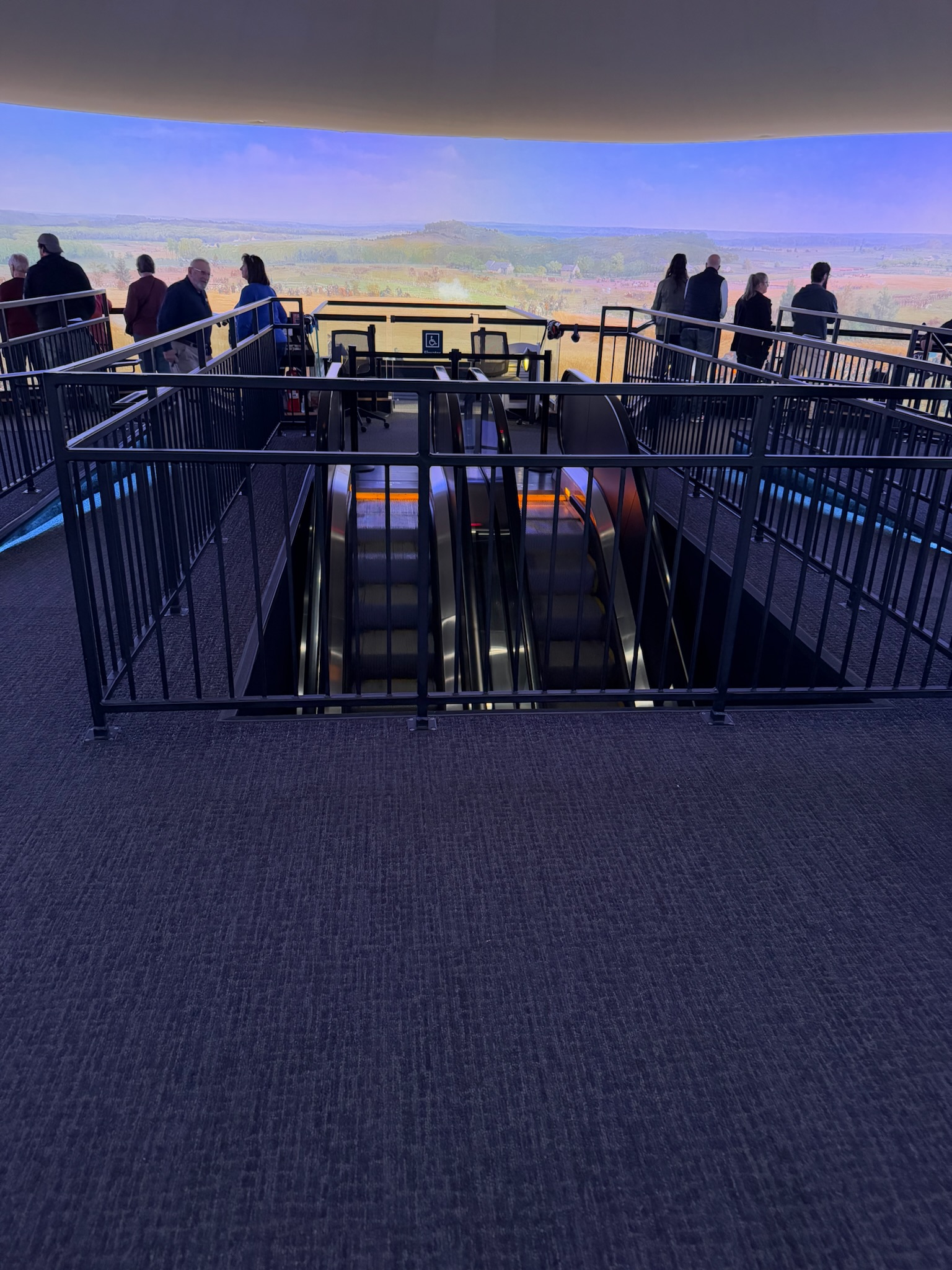
The area between the spectator area and wall had decor, like rocks and bushes, to help set the scene and make it feel all the more realistic. Once everyone was in the room, they shut off the lights and the show began.
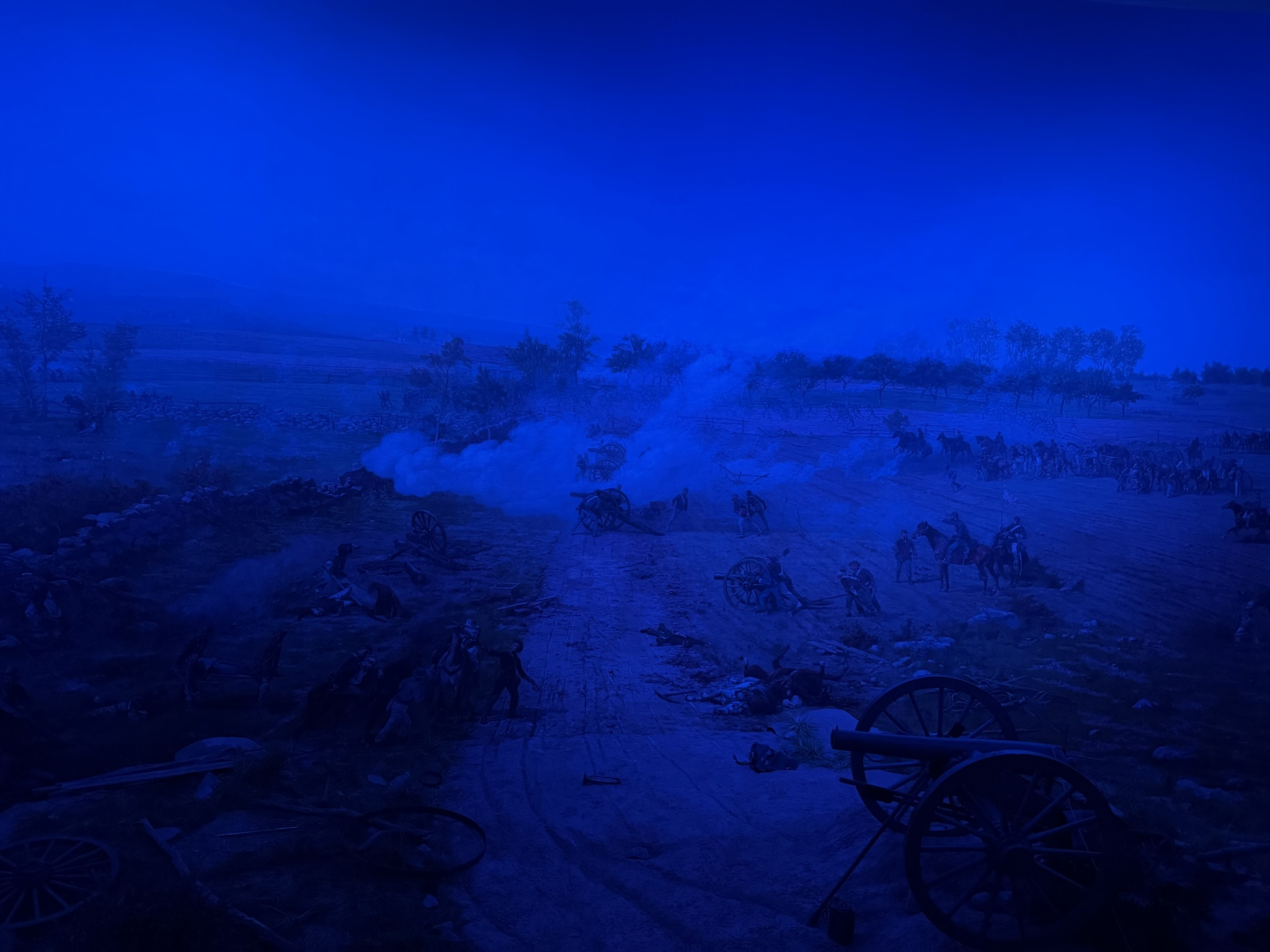
The battle had begun in the wee hours of the morning, before the sun came up.
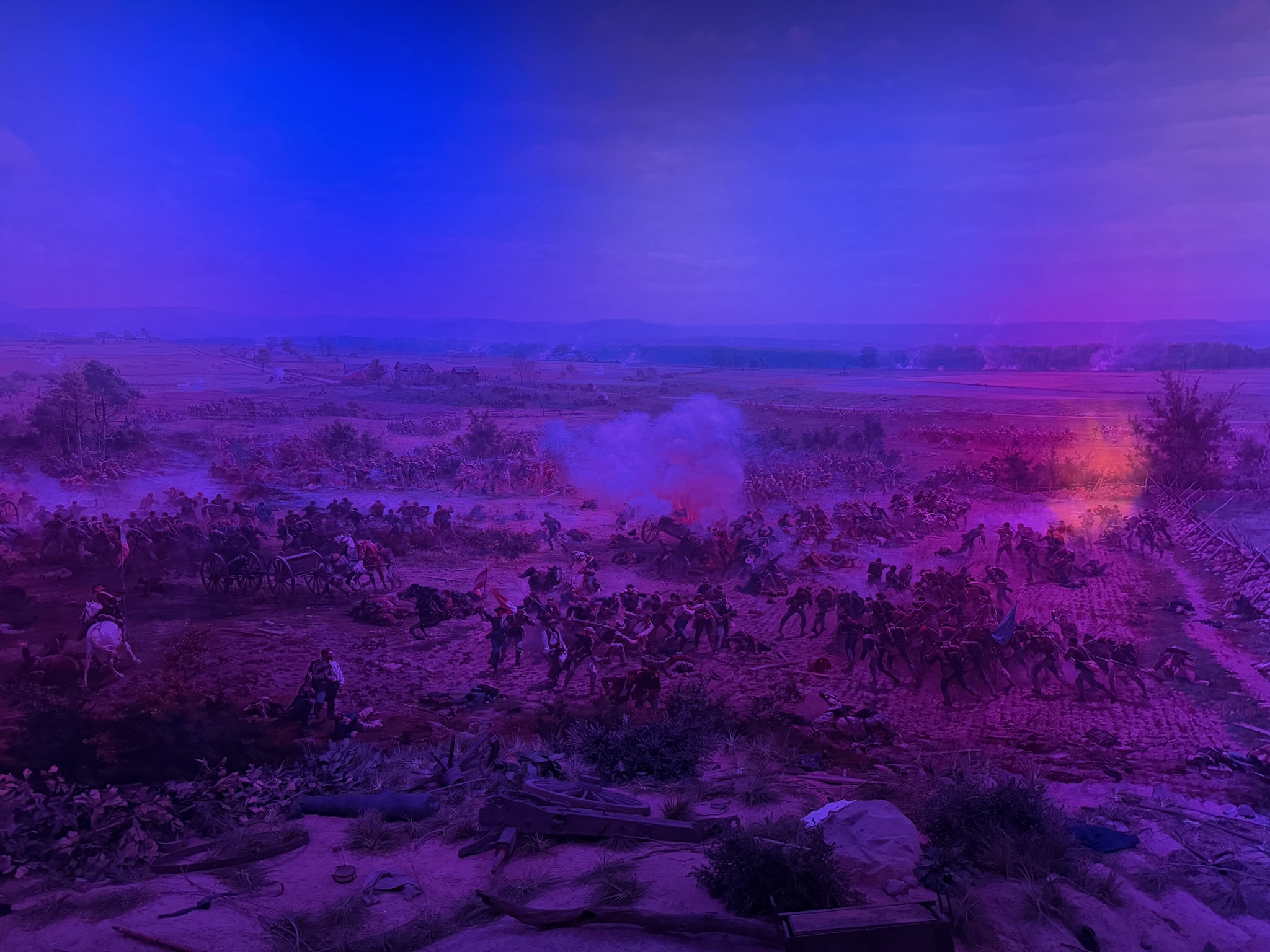
By using clever lighting and sound effects, we watched the darkness fade into morning, then progress into midday and then evening as the battle waged around us.
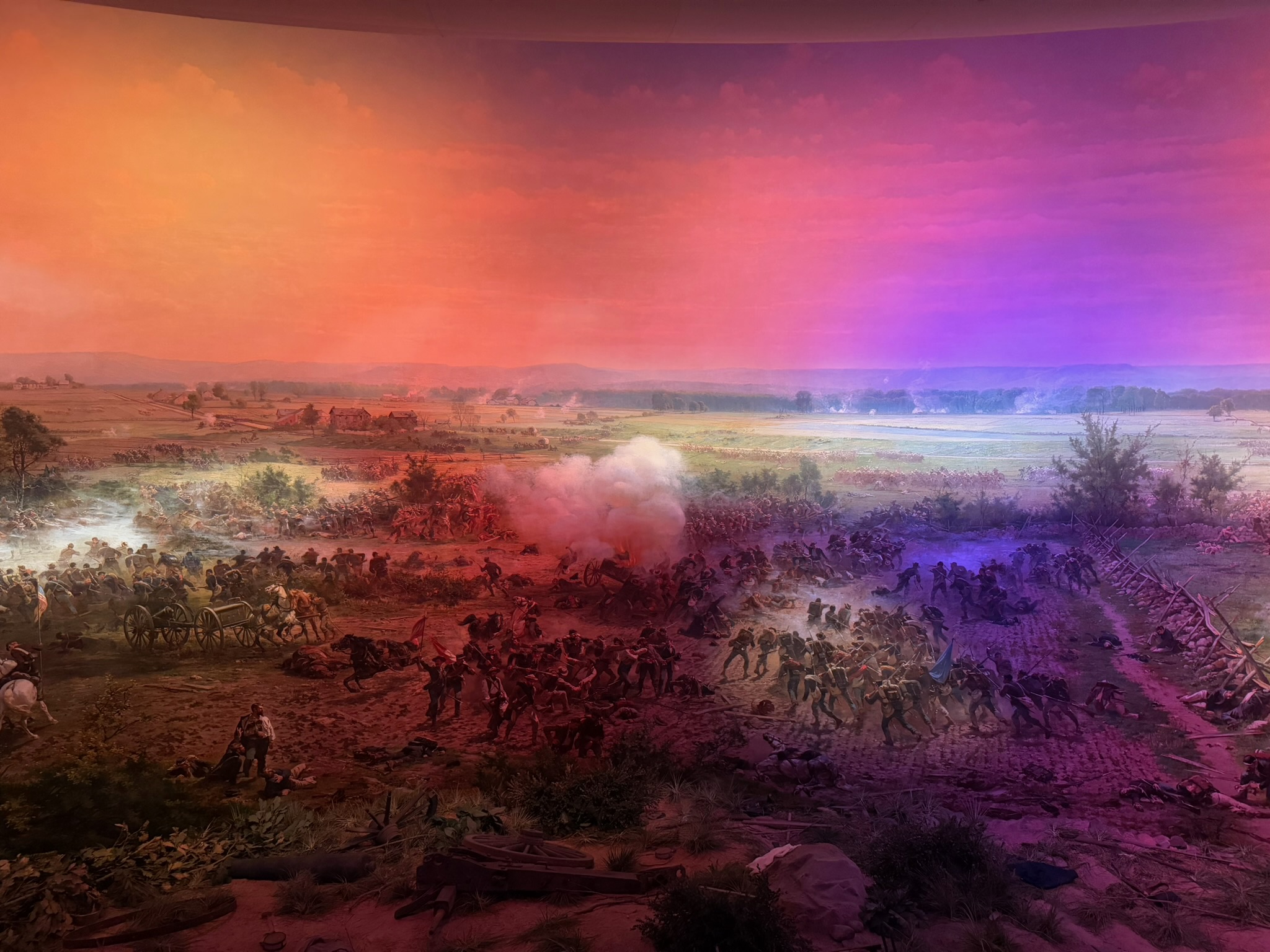
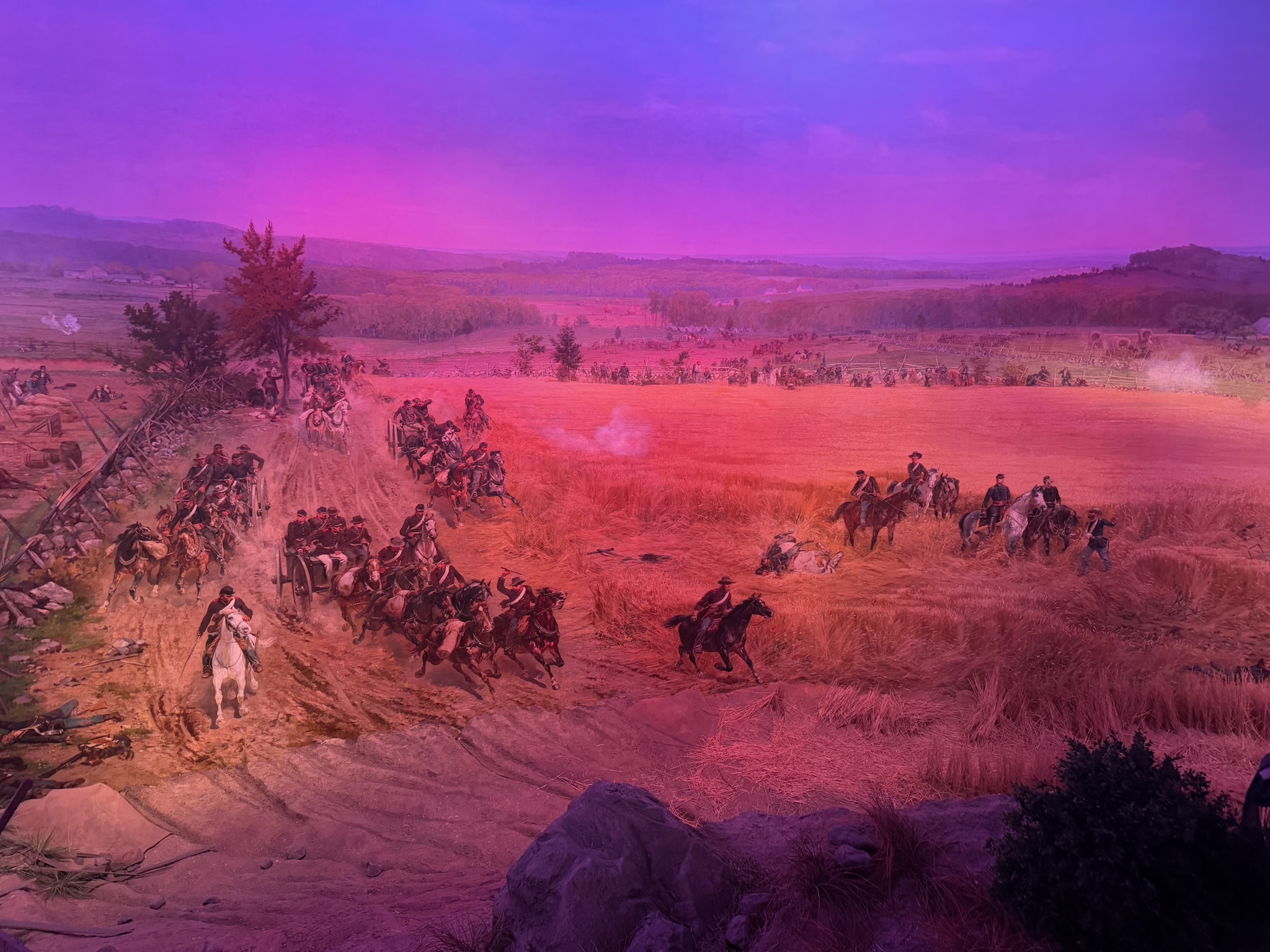
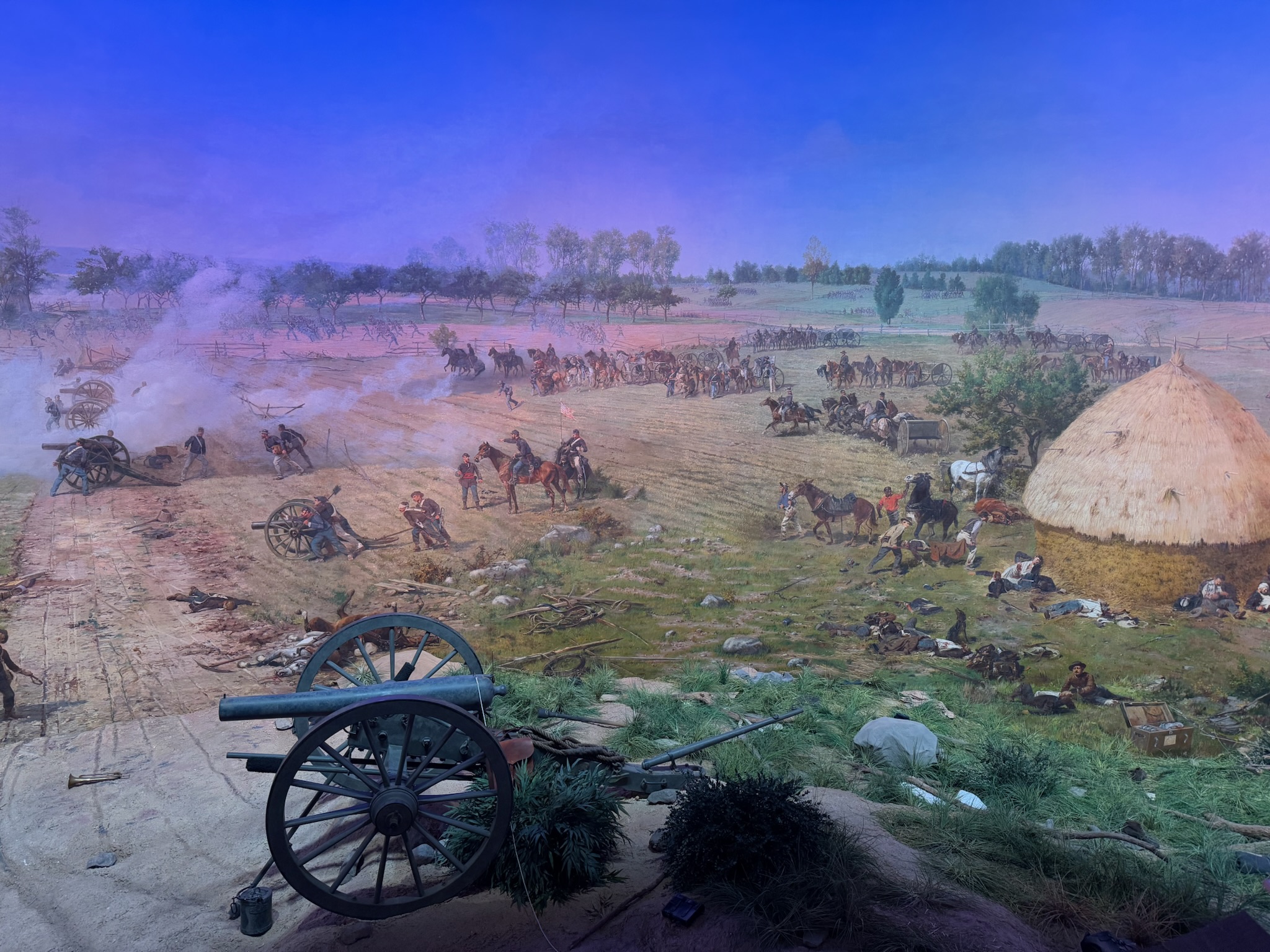
They used red lights to simulate cannon explosions.
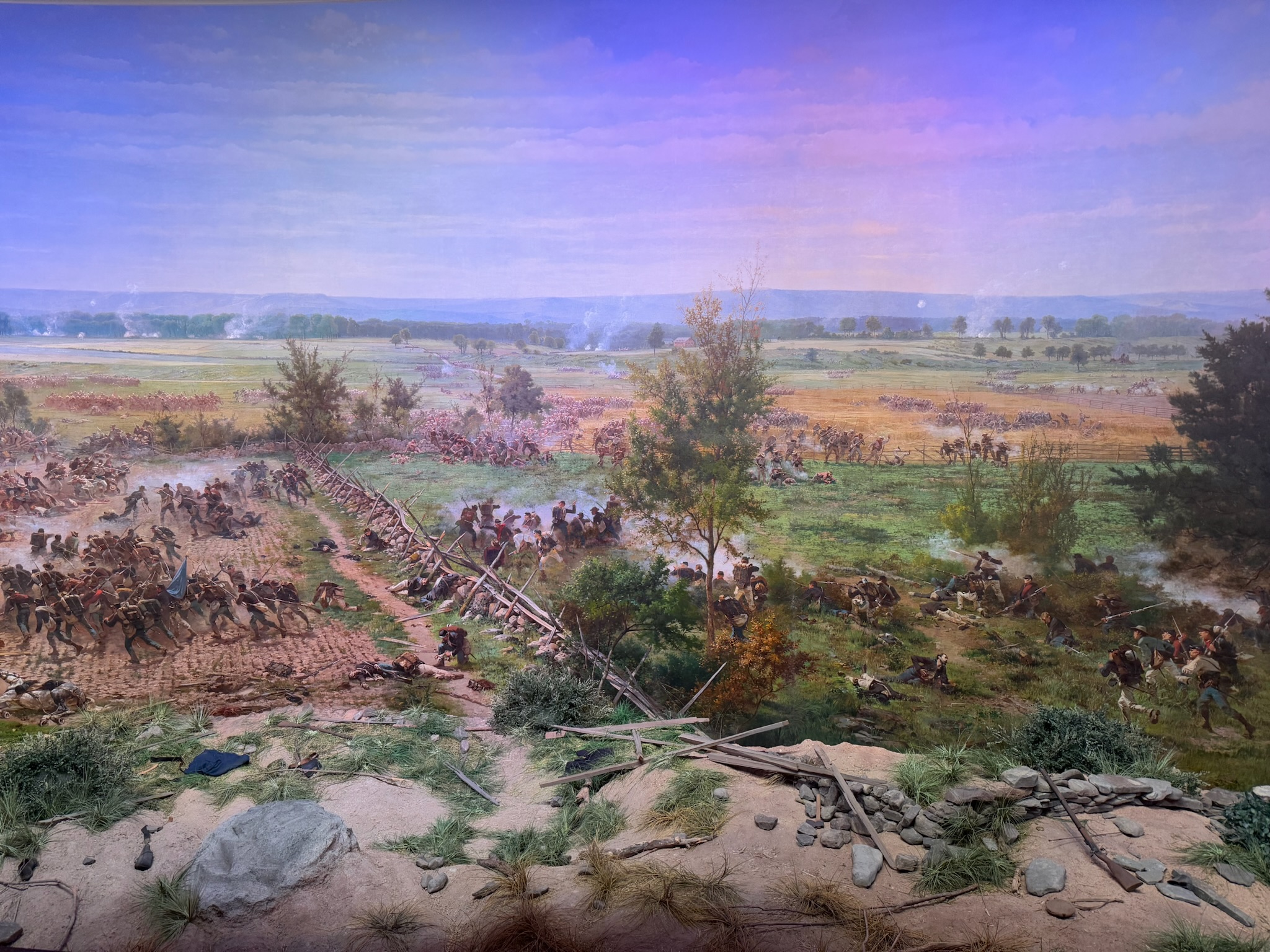
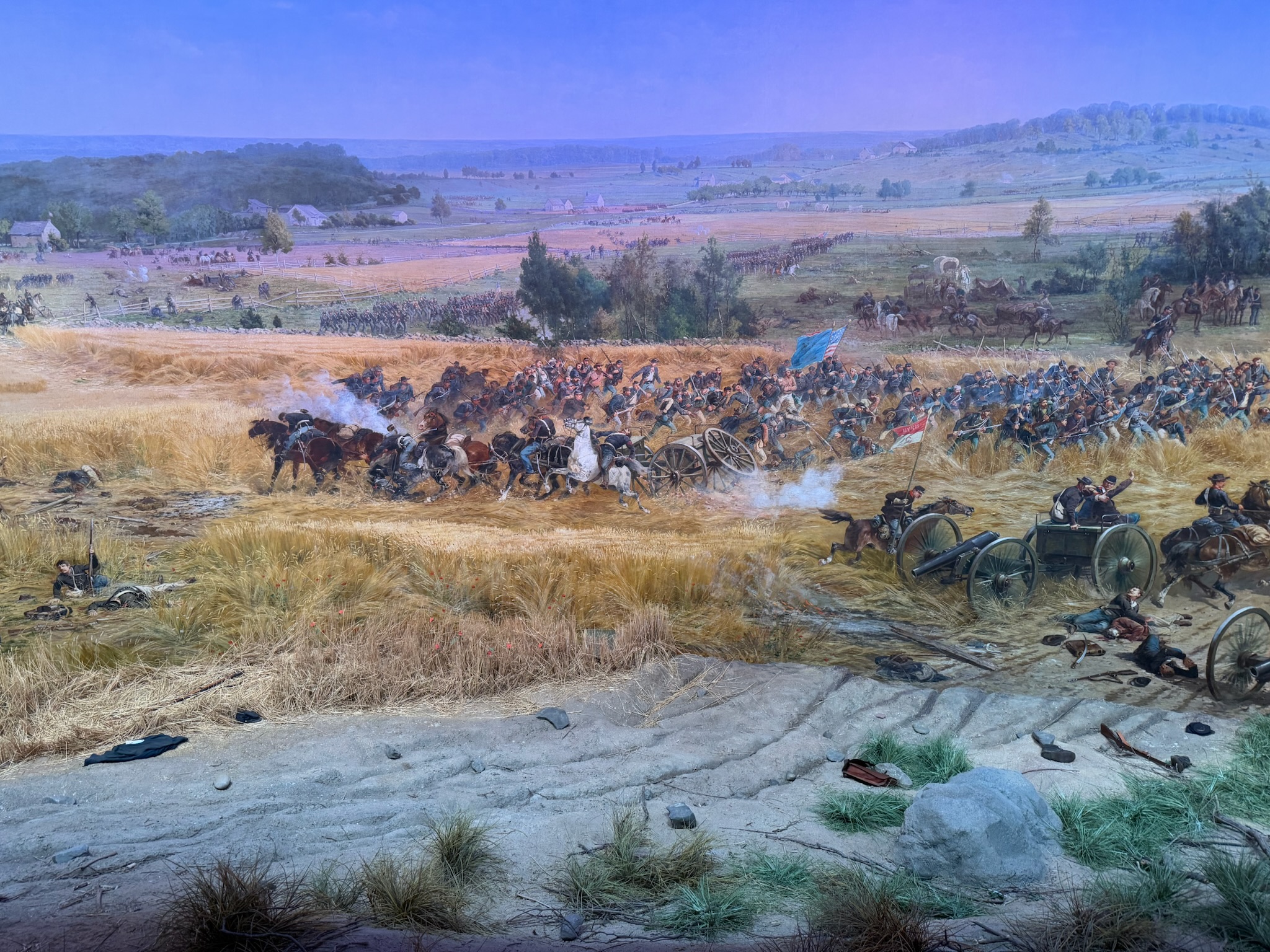
It really was a neat experience and it was definitely worth the extra few dollars. Outside the room was a sign about the cyclorama. It was named “Battle of Gettysburg” and was painted by Paul Phillipoteaux in the late 1800s. He spent months in the US researching this project, including taking photographs and talking to battlefield guides to ensure that he accurately painted the blockades in the right locations, etc. It was originally 377 feet by 42 feet — four stories tall and as long as a football field! It sounds like 15-feet of sky were cut away at some point. Phillipoteaux painted at least 8 of these cycloramas over his career.
In 1884, the cyclorama was displayed in Boston, where 200,000 people went to see it over the several years it was featured. It sounded like back then, a narrator told the story of the battle as part of the show. The painting was in private hands until the 1940s. In the 1950s, President Eisenhower approved a program to improve national park services. As part of that effort, in 1960, a new visitor’s center was built at Gettysburg. A portion of the building was constructed specifically to house the cyclorama. In the late 1990s, restoration efforts began on the painting. It was a 6-year, multimillion dollar international effort.
From there, we went into the museum. The museum was set up to move in one direction, ensuring the visitor would see the exhibits in the proper chronological order. As we’d learned at Yorktown, at the time the country was founded, slavery was already a hot-button issue. Since it was so divisive, the founding fathers decided to kick the can down the road for 20-years and revisit the topic again after the country had a chance to become rooted and economists could (hopefully) figure out a new system to replace slavery.
As the country rapidly expanded, there were fierce debates about whether slavery would be permitted in the newly added territories/states. The debate wasn’t only about human rights; it was also about the economic and political parity. As we’d learned in Jamestown, large plantation owners with slaves had giant advantages over small family farms without slaves. This issue of slave owners having unfair economic and political power had been a problem from the early days of slavery. Tensions between the north and south were high and there were already rumblings on both sides that it would be best to split the country into two.
In 1854, Congress attempted resolved the matter of slavery in new states by passing the Kansas-Nebraska Act, which let the new territories choose for themselves. In 1856, Kansas was poised to become a state. They voted to allow slavery. Anti-slavery activist John Brown and his five sons moved to the state and incited violence using guerrilla warfare tactics. In 1856, they murdered five proslavery men in an event now called the Pottawatomie Massacre. On October 16, 1859, Brown led an attack on the federal armory at Harper’s Ferry, Virginia. He had hoped to capture muskets and give them to slaves, sparking a rebellion. He was caught and hanged, and he became a martyr for the anti-slavery cause. Interestingly, the troops that caught him were under the command of Robert E. Lee, then colonial in the US Army.
It was believed that the winner of the presidential election of 1860 would be pivotal in shaping the direction the country took. The Republicans opposed slavery completely. The Democrats were split. Northern Democrats endorsed “popular” sovereignty, where each state decided the slavery issue for itself. Southern Democrats wanted slavery preserved where it existed and the protection of slaves as property in the new western territories.
Republican Abraham Lincoln had promised not to attack slavery where it existed, but opposed it from being allowed in any new territories. But the southerners were dubious of his promise — they believed he’d try to end slavery in the south if he won. Interestingly, Abraham Lincoln’s name did not appear on the ballot in nine of the southern states! However, since the northern states had far more voters than the southern states, Lincoln still won the presidency with 59% of the electoral college votes and 40% of the popular vote. The election was contested by two of the losing candidates.
On December 20, 1860, South Carolina declared independence from the United States, using the model of the Declaration of Independence written by Thomas Jefferson. By February 1861, six more states had seceded: To be continued…