continued… The attack on one side of the line began at 1530, the other at 1600. At 1800, fighting began at a third location. The fighting continued until nearly midnight, with 19,000 casualties in total. The signs described how copious amounts of dead bodies were strewn over the landscape and the earth was red, soaked with blood. The Confederates had again performed slightly better, but the Union had done a good job of keeping most of their ground.
Per one sign, Union commanders agreed to stay put on the high ground and maintain a defensive strategy. Per another sign, the Union army attacked the Confederates at dawn on July 3 in one spot and fought for seven hours.
It sounded like once the fighting ended in that spot, General Lee decided to attack the center of the Union line. James Longstreet, who was assigned to lead the charge, was dubious that the Confederates could win, but followed orders. That assault began at 1300, with 160 cannons firing on the Union. Nearly 100 Union cannons fired back. Some of the gunners bled from both ears from the concussion. At 1500, in 90-degree Fahrenheit (32-degrees celsius) heat, what is now referred to as Pickett’s Charge commenced. 12,000 Confederate soldiers came out of hiding in the woods, formed a nearly one-mile wide line, and marched towards the Union lines. They were shot at as they marched, and men were continuously falling. With each fall, the men would “close ranks”, meaning the men still marching would move closer together to fill the gaps left by the fallen soldiers. There were “stout rail fences” in between the Confederate and Union soldiers that “proved to be a deadly obstacle.” It took the Confederates about a half-hour to reach the Union line. They briefly broke through the line, but quickly retreated. The Union soldiers cheered at the retreat. Nearly half the Confederate soldiers were killed, wounded or captured.
While Pickett’s Charge was taking place, three-miles east of Gettysburg, another battle began. The Union and Confederate calvary had happened to cross paths and the 1,000 horsemen on each side charged headlong into one another. In total, 7,000 calvary troops battled it out until dusk. The descriptions of horses falling over and crushing their riders were gruesome. Neither side was victorious.
Once those last two battles ended, everything was quiet as both sides regrouped and waited for the other to initiate another attack. Then at midnight, in a driving rain, the Confederate troops began to vacate Gettysburg under the cover of darkness. They took 4,000 prisoners of war and 6,000 wounded Confederate soldiers. The uninjured marched. The wounded had been loaded onto a 17-mile long wagon-train whose destination was medical facilities in Virginia. Hundreds of the men in the wagon-train never made to Virginia; many were captured, got lost, fell behind or died along the way. The morning of the 4th, the Union army began to chase them.
As the soldiers on both sides headed south, they left behind thousands of men who were seriously injured that were lying on the battlefields amongst the seven thousand dead men and three-thousand dead horses. The tortured cries from the injured men was haunting. The townspeople and volunteers from around the region searched for survivors in the pouring rain and took them to the field hospitals.
It was summertime and hot — the corpses were attracting vermin and the stench was horrifying. Volunteers buried the dead in shallow, temporary graves, usually near where they fell, with markers listing the known information about their identities. Since it was raining, the ink bled on many of the markers.
Almost as soon as the fighting had started on July 1, homes and other buildings (ie churches, barns, taverns, etc) in the area began to be confiscated to be used as field hospitals. By July 4, there were more than 100 of these makeshift hospitals to service the 7,000 Confederate soldiers who could not be transported and the 8,000 wounded Union soldiers who were left behind. About 100 Union surgeons had stayed behind to treat the injured. One of the surgeons said that on July 4 they had 1,000 men waiting just in his hospital alone — in their efforts to get to everyone as quickly as possible, they had four operating tables going 24-hours a day. Fortunately, the Army medics were aided by volunteer civilian nurses, who also brought supplies such as food, medicine and bandages with them. There was a disturbing photograph of a pile of amputated limbs outside a field hospital.
It sounded like the medical care had not advanced much since the Revolutionary War. Half of the soldiers who died during the Civil War perished from disease, not from battle injuries. One sign said that the Union army recorded 149,000 cases of typhoid resulting in 35,000 deaths and 1.8 million cases of dysentery resulting in 44,500 deaths. It was believed that the Confederates had even higher numbers of typhoid and dysentery. We knew from our tour of the USS Constellation that during the Civil War, the death tolls and illness rates in the Army were significantly higher than the Navy.
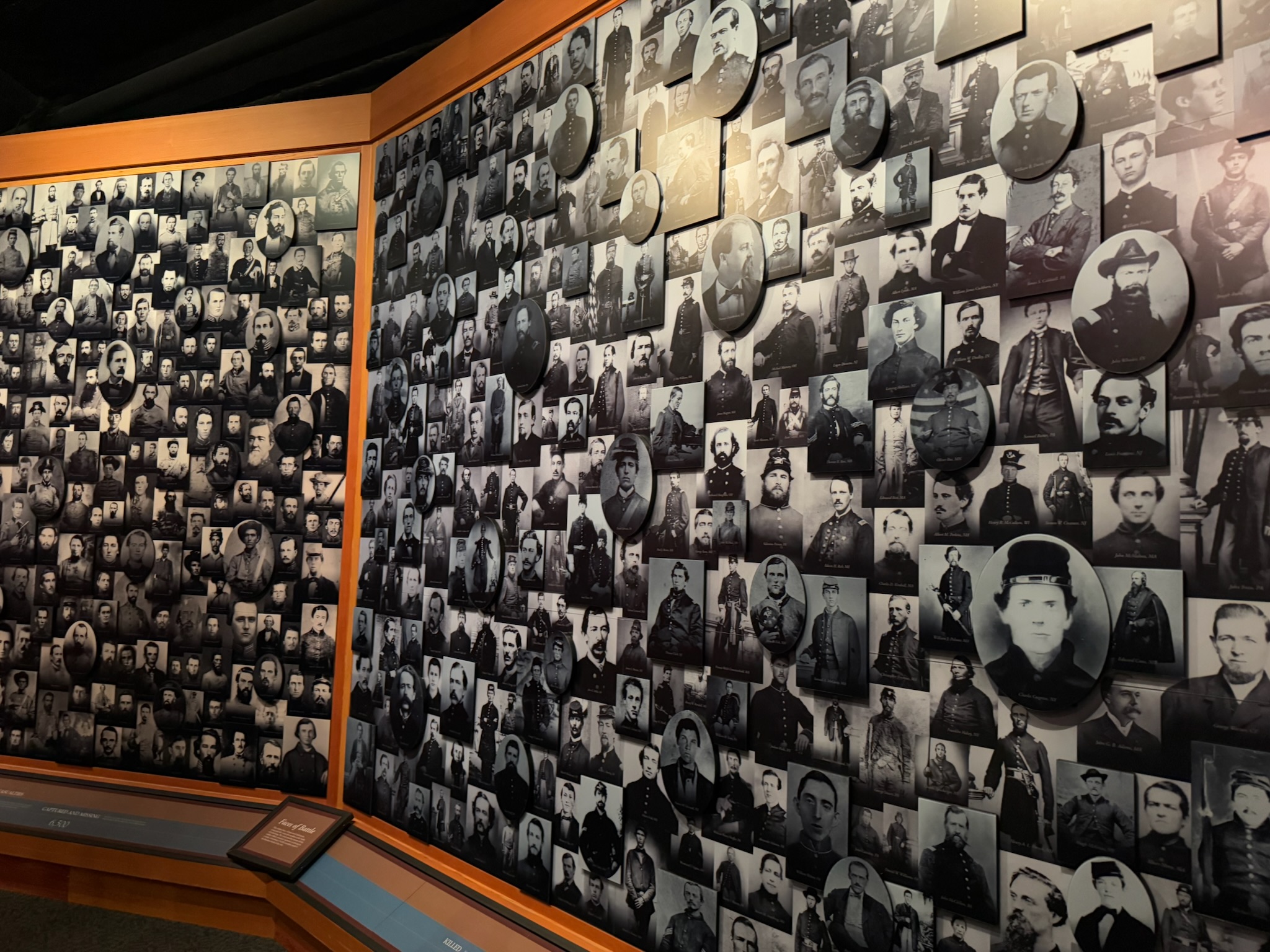
There were a lot of personal stories about individual soldiers; their brave fighting and their heinous injuries/deaths/captures. Most stories were heartbreaking. One sign commented that most of the trees that had been in the range of fire died soon after the battle. War is a terrible, terrible thing.
Once the dead and injured were dealt with, the residents of the small town of Gettysburg were faced with the daunting task of cleaning up the destruction. The streets were torn up from the artillery. Crops were destroyed, and nothing could be replanted until the bodies were moved off their farm fields. Several homes and barns on the battlefield had been burned down. Many of the remaining homes had been seriously damaged, as well as ransacked for food, clothing and valuables. Residents had to decide if they wanted to repair/rebuild or start over somewhere else.
Within a few days of the battle ending, thousands of civilians arrived in Gettysburg. Some were looking for loved ones. 1,500 bodies were claimed by family/friends and shipped out for formal burial. Helping families search for bodies and embalming them for shipment and reburial became a big business in Gettysburg. Other visitors were looters who were combing the fields for valuables. Looters who were caught were prosecuted.
The 8,000 prisoners of war and the battlefield were guarded by a few hundred Union soldiers that had stayed behind. The prisoners were moved by trains to prison camps. Between the two sides, there were 150 prison that housed 400,000 soldiers and sailors during the course of the war. The camps on both sides sounded horrible. They were overcrowded, food was scarce and infectious diseases rampant. 13% of the prisoners — 50,000 people in all — died in the camps.
In mid-July, the Union army opened a new general hospital east of town. The patients at the field hospitals were steadily transferred over, and one by one, the field hospitals closed. When residents finally got their homes/buildings back, they were bloodied inside from all the injured. Four months later, the new Army hospital was still treating the injured from the Gettysburg battle.
To be continued…