continued… Three weeks after the battle ended, Gettysburg attorney David Willis wrote to the Pennsylvania governor and proposed a new cemetery location in Gettysburg where the soldiers in the temporary graves could be properly buried. Wills got the approval from the governor and purchased the 17-acres of land. He hired a landscape architect, who designed the cemetery as a semi-circle, with soldiers of each state buried together in distinct sections.
Moving the bodies from the temporary graves to the cemetery sounded like it was a tough job. Wills paid contractors $1.59 per body moved. 3,555 bodies were moved within two years. It sounds like they were diligent to make sure all the Union soldiers bodies were moved… and it sounds like many Confederate soldiers bodies were overlooked for a decade. After the overlooked bodies were finally exhumed, they weren’t buried at the cemetery in Gettysburg — instead, they were shipped south.
The dedication ceremony for the Soldier’s National Cemetery was on November 19, 1863. As Gettysburg was the largest battle of the Civil War, the dedication of the cemetery was a prominent event. 20,000 people attended, including important leaders such as the Secretary of State, Secretary of War, governors, generals, foreign dignitaries and White House staff. With all the demands of the war and a desperately ill son, President Lincoln wasn’t sure that he would be able to attend. But he made it. The main speaker was a well known statesman named Edward Everett. President Lincoln was asked to only deliver “a few appropriate remarks.” Lincoln wrote his now immortal 272 word address the night before the ceremony.
“Four score and seven years ago our fathers brought forth on this continent, a new nation, conceived in Liberty, and dedicated to the proposition that all men are created equal.
Now we are engaged in a great civil war, testing whether that nation, or any nation so conceived and so dedicated, can long endure. We are met on a great battlefield of that war. We have come to dedicate a portion of that field, as a final resting place for those who here gave their lives that that nation might live. It is altogether fitting and proper that we should do this.
But, in a larger sense, we can not dedicate—we can not consecrate—we can not hallow—this ground. The brave men, living and dead, who struggled here, have consecrated it, far above our poor power to add or detract. The world will little note, nor long remember what we say here, but it can never forget what they did here. It is for us the living, rather, to be dedicated here to the unfinished work which they who fought here have thus far so nobly advanced. It is rather for us to be here dedicated to the great task remaining before us—that from these honored dead we take increased devotion to that cause for which they gave the last full measure of devotion—that we here highly resolve that these dead shall not have died in vain—that this nation, under God, shall have a new birth of freedom—and that government of the people, by the people, for the people, shall not perish from the earth.”
Christi had always believed that the famous quote was only an excerpt from a larger speech. She was surprised to find it was the entire speech.
Back to the Civil War portion of the story… On July 4, 1863, the Union won another important victory at The Battle of Vicksburg, Mississippi. The Union now essentially had control of the Mississippi River, which was the heart of the supply chain to much of the Confederate territory. While these two big back-to-back victories served as a major turning point that improved the chances of a Union victory, the war was far from over.
The Union Army caught up with the Confederate Army near the Potomac, where they’d “dug in,” which we thought probably meant set up barricades to protect their camp. On the morning of July 14, the Union attacked the Confederate camp, only to find that most of the Confederate soldiers had fled across the river — back into Virginia — during the night.
The battles continued. The war continued to be an economic boom to the north. Supplying the Union army with food, uniforms, weapons and other supplies bolstered various manufacturing industries. Hundreds of miles of new railroad track was also laid to help the supply chain. By mid-1864, the Union had steadily gained ground in the south, but at a huge cost of Union lives.
The tremendous loss of life demoralized the northerners and support for the war waned — many wanted to let the south go to end the blood shed. The fact that the wealthy could easily escape the draft caused animosity — poorer families were angered that they were burying their fighting age males while the wealthy families were unaffected. As the election of 1864 approached, the support for Lincoln and the Republicans waned. The Democrats were promising an immediate cease-fire and peace negotiations, which was looking ever more appealing. But in September, there were two major Union victories. Northerners began to have faith that the Union could win the war, after all, and support for Lincoln surged again.Lincoln was reelected in November 1864.
The south was economically devastated by the war. The battlegrounds for the war were primarily in the south, bringing destruction to many towns. Supply lines had been cut off, making supplies difficult to procure and expensive. 40% of livestock were killed – which was a devastating number in a primarily agrarian economy. Many southern families were pushed into poverty. Thousands of southern refugees moved from farms to already overcrowded towns. Civilians were rapidly dying off; by the end of the war, an estimated 50,000 southern civilians died. Needless to say, the southerners were also getting desperate to see an end to the war.
On April 2, 1865, the Union Army was able to break through Confederate lines in Virginia. The Confederates retreated and the Union chased them. Lee’s army “melted away as it ran — men dropped by the side of the road from hunger, wounds, exhaustion and despair.” On April 9, Lee surrendered. The Union’s primary focus was on mending the rift in order to reunify the country, and in a show of good faith, agreed to give the Confederates 25,000 rations to feed the starving men and allowed the Confederate soldiers to keep their horses. On April 11, President Lincoln gave a speech from the balcony of the White House encouraging both sides to restore practical relations. On April 14, President Lincoln was assassinated.
When the war started, there had been four million enslaved people. While many had escaped during the war, the remaining slaves found themselves suddenly free. The 13th amendment to the Constitution, which abolished slavery and involuntary servitude in the United States (except as punishment for a crime) was ratified on December 6, 1865.
Up until this point, every section of the museum had a relevant clip from the movie that we’d watched prior to entering the museum playing on a loop. So if you hadn’t paid for the movie, you didn’t miss anything, as the entire movie was shown via the various clips. The movie was an overview, and the various museum exhibits gave the details that supported the overview.
The last few exhibits had information not contained in the movie. One room was about the plight of the emancipated blacks as they had to figure out how to make a living and overcome racism. There was also a video playing in that room, but it was not an of the movie we’d seen at the beginning.
The last room was about the Park. In 1864, before the Civil War ended, the Gettysburg Battlefield Memorial Association formed to ensure that the Gettysburg battlefield was preserved. Over the years, the park acquired properties that were part of the battle and restored them to how they were during the battle (ie tearing down newer structures and replacing walls/fences that had been removed after the battle). In 1895, Congress established the Gettysburg National Military Park, which took over for the Memorial Association. The Military Park was overseen by the Department of War. The military also used the park for training purposes and in World War II, used it as a prisoner of war camp. Interestingly, Captain Dwight Eisenhower was stationed here in 1918 to train soldiers on tanks. In 1950, Eisenhower purchased a farm in the area. He used as his presidential retreat while in office, then lived there after retirement.
In 1933, the War Department turned over the battlefield to the National Park Service. The park currently encompasses 6,000 acres and 26 miles of road. There were currently 1,400 statues, sculptures, markers, and tablets standing where the armies had once fought. Initially, only markers honoring the Union were allowed, but in the 1890s, the War Department began to mark the Confederate army, too. Two million people visit the park each year.
When we finished at the museum, we stopped by the cafe for hot beverages. As we were exiting the building, we noticed a statue of Lincoln that we’d missed on the way in.
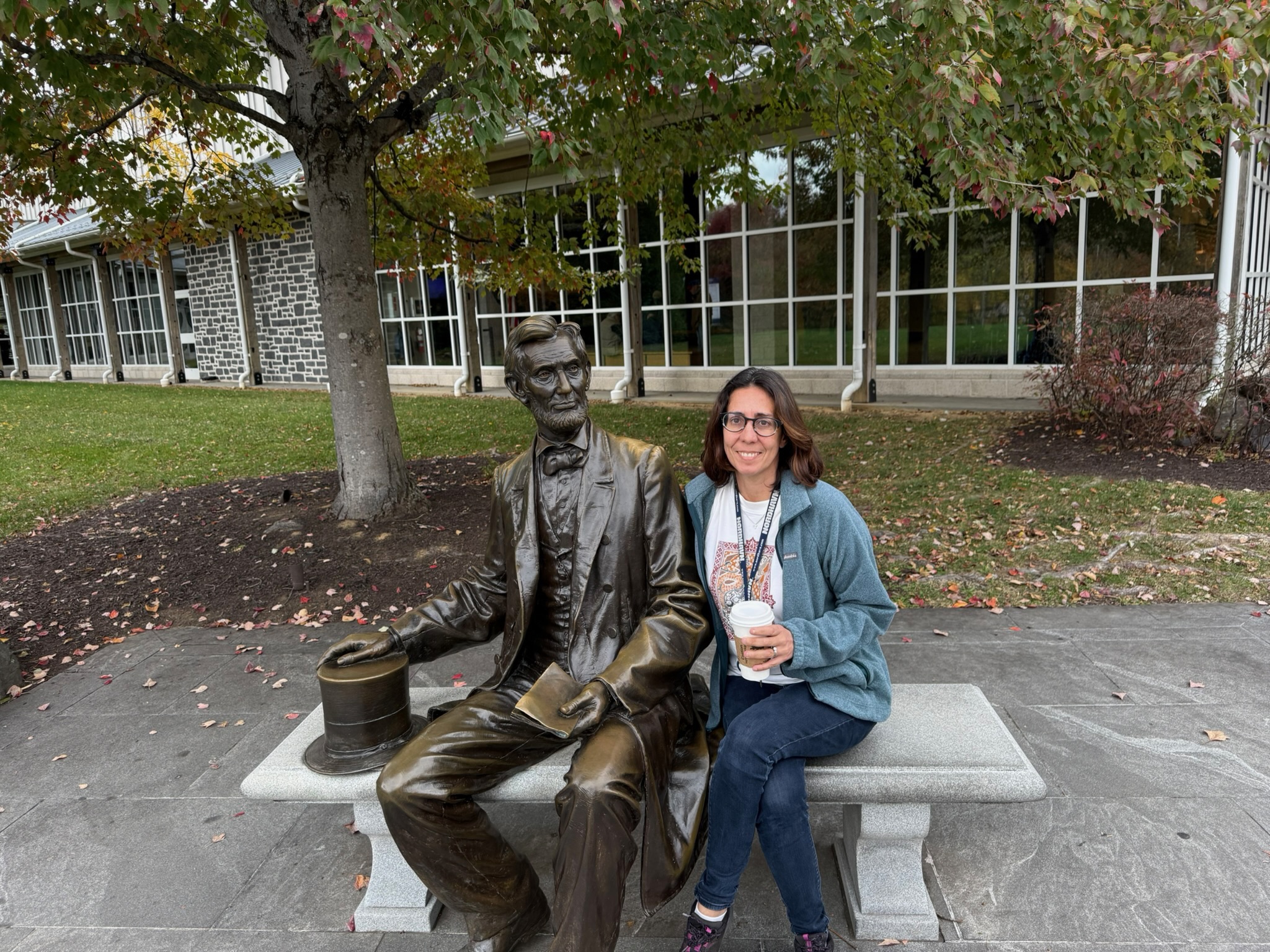
The autumn leaves were lovely.
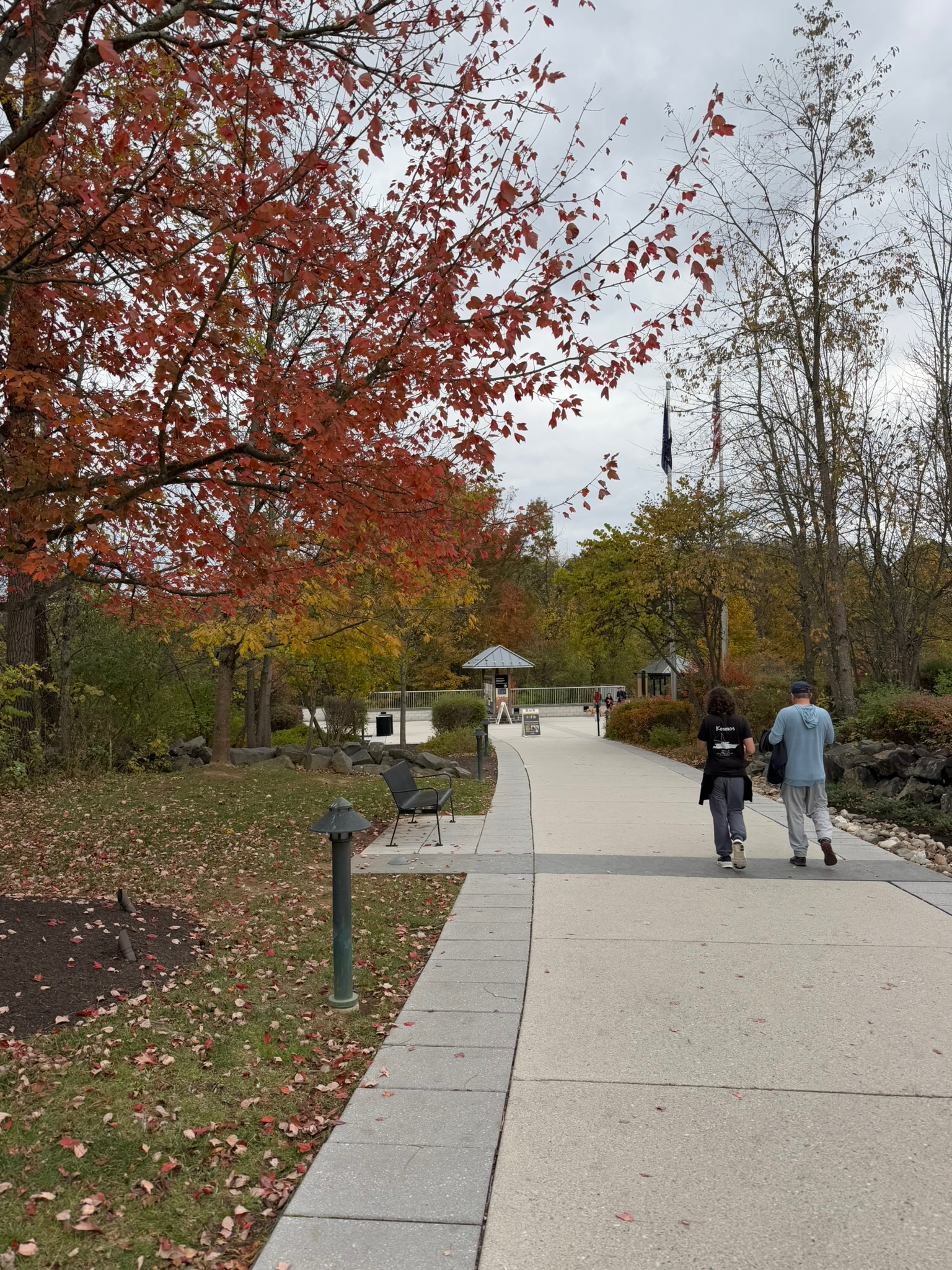
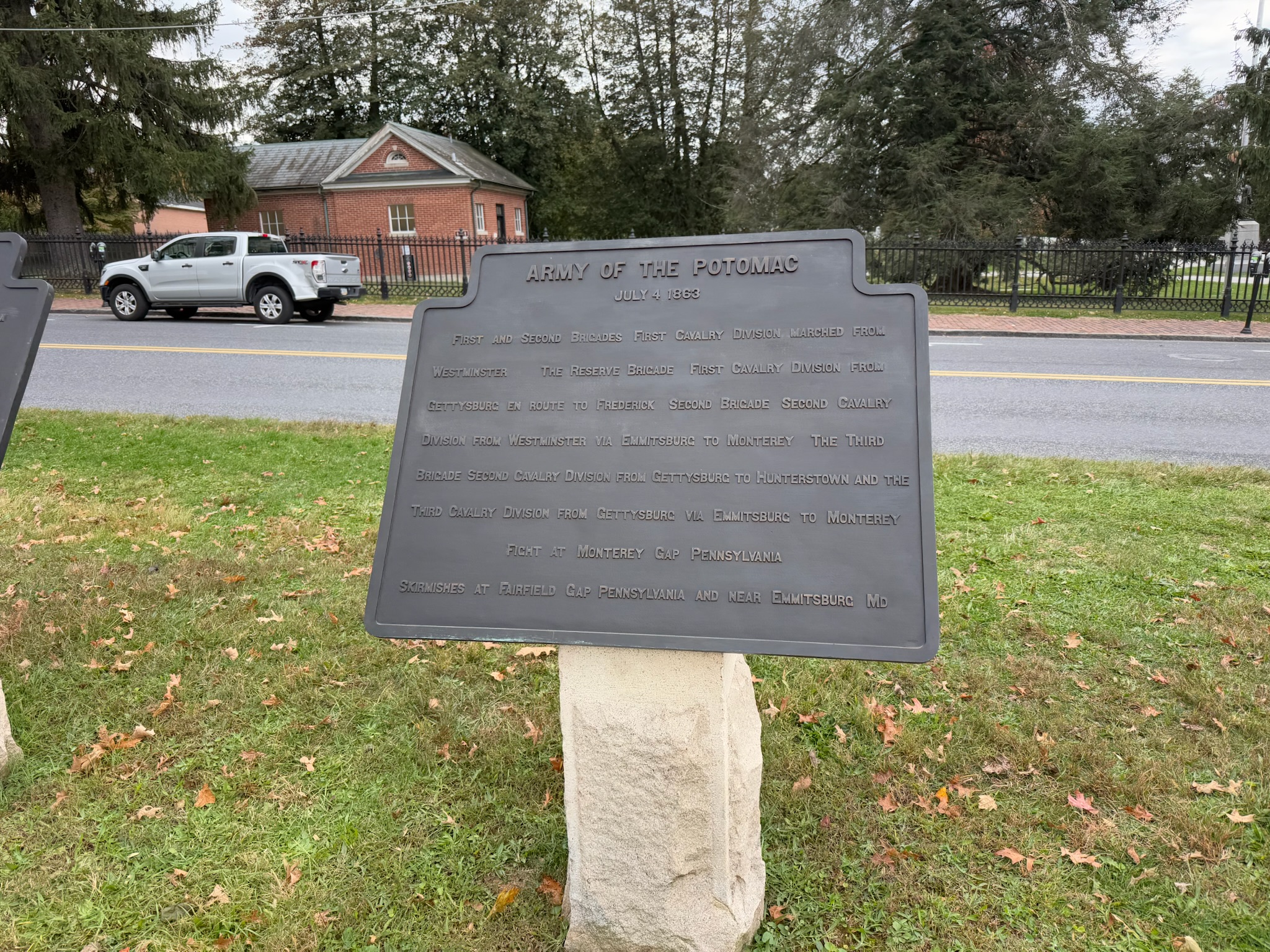
Back in the car, Eric and Keith wanted to go straight back to Kosmos, but Christi was adamant about making a stop to look at the statues on the east side of the street. Eric parked in a lot on the north side of the battlefield grounds. Eric and Keith stayed in the car. It was getting cold out, and they weren’t interested enough in the statues to brave the cold. The street was lined with a series of plaques that described the movements of the various corps as the prepared for and fought the battle.
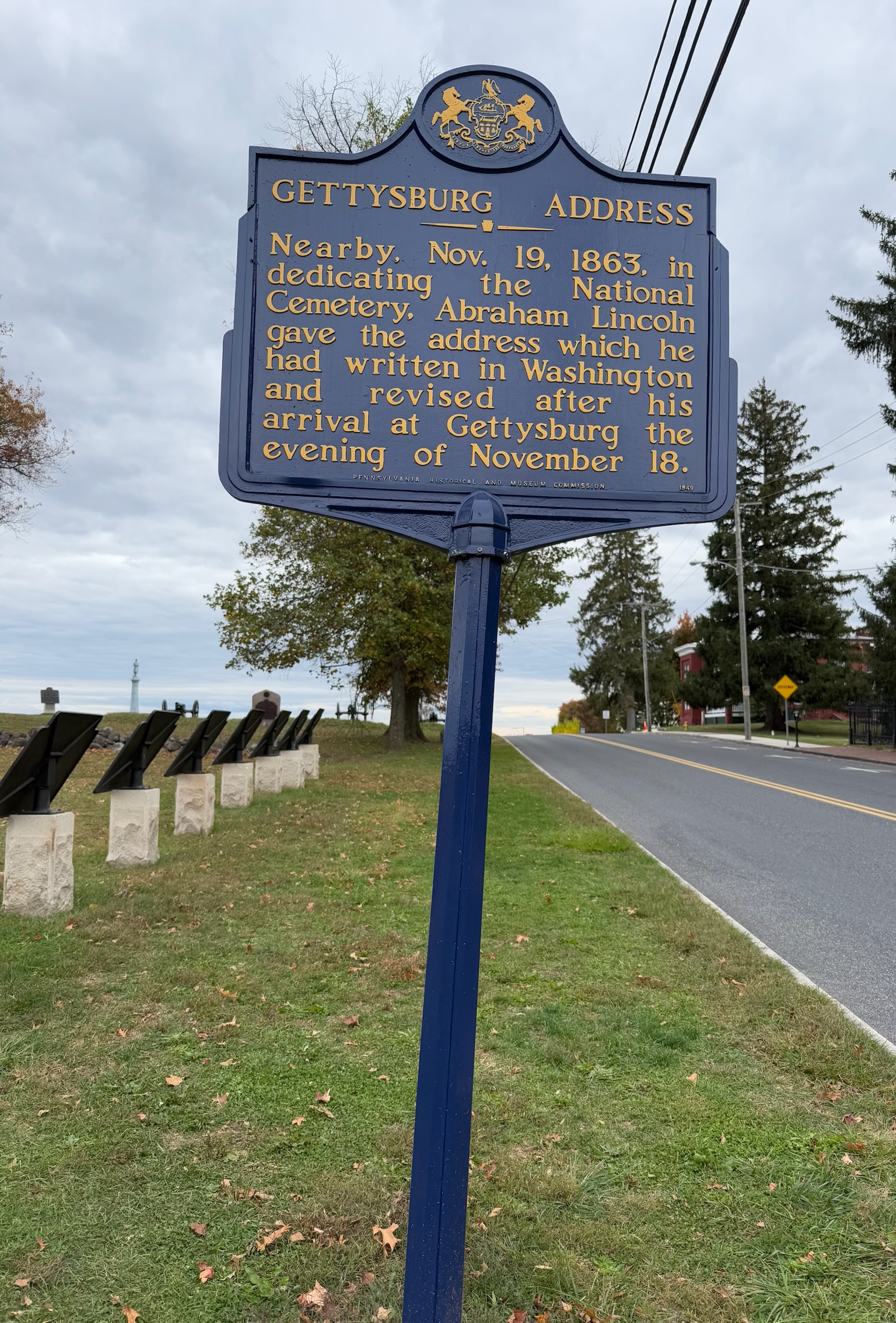
Front view of one of the plaques
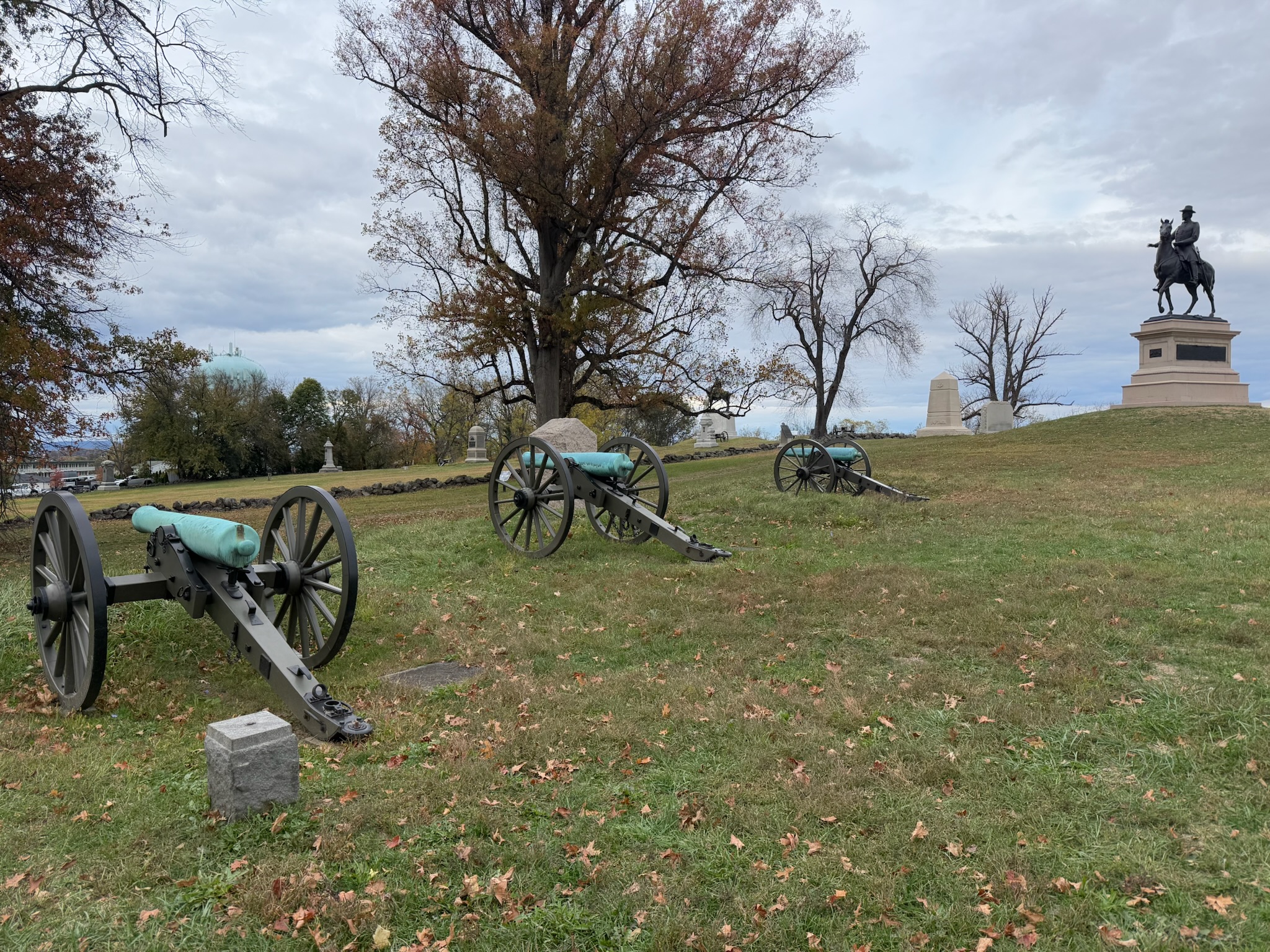
Most of the statues were dedicated to a specific corps division. The inscriptions on many of the statues told the story of the accomplishments and losses of the men in that division. A few of the statues, especially the ones with men on horses, were for specific individuals. We’d read in the museum that each item was carefully placed in the location most significant for the person/people being memorialized (ie, where the troops were slaughtered or slaughtered the other side).
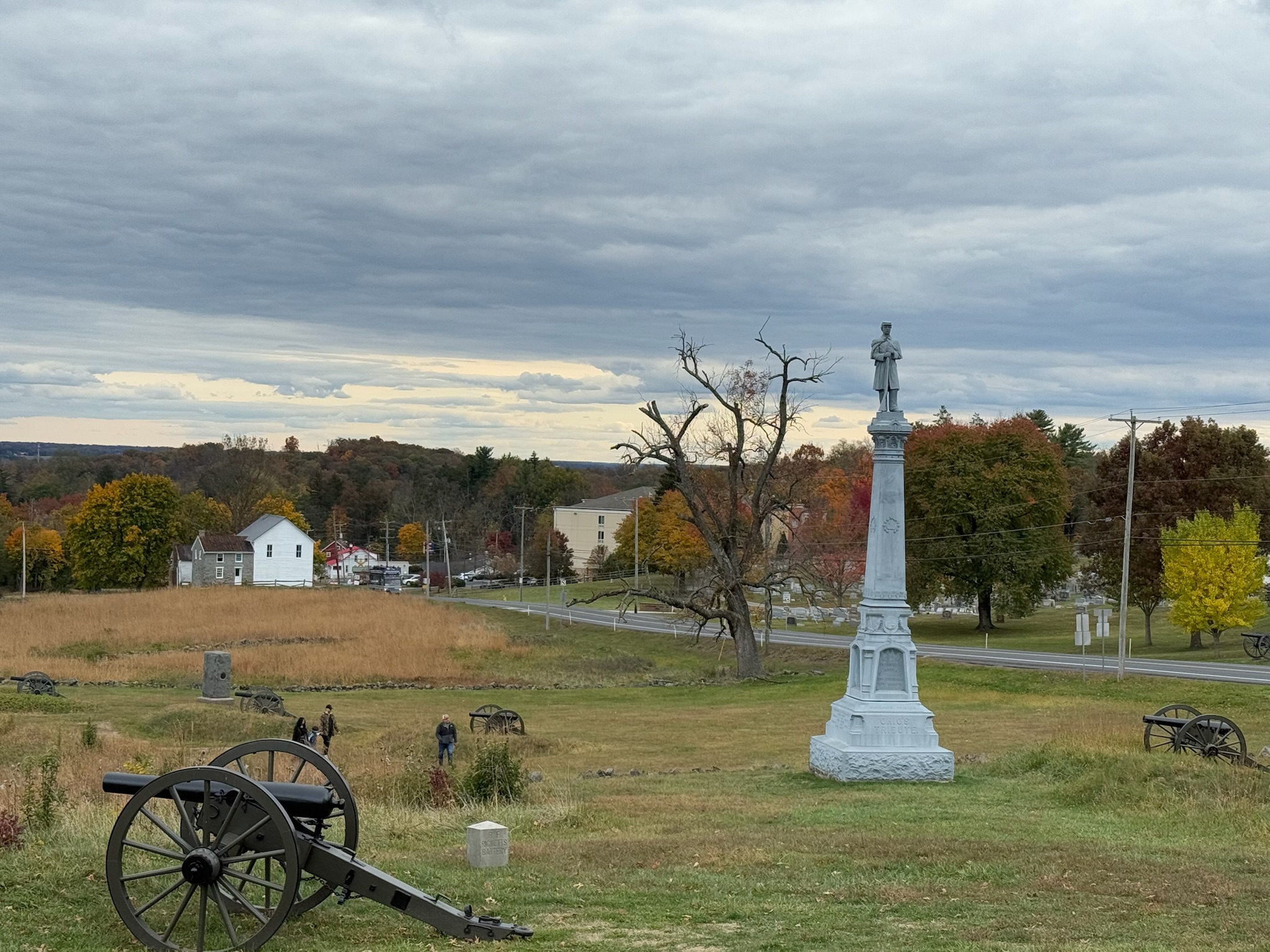
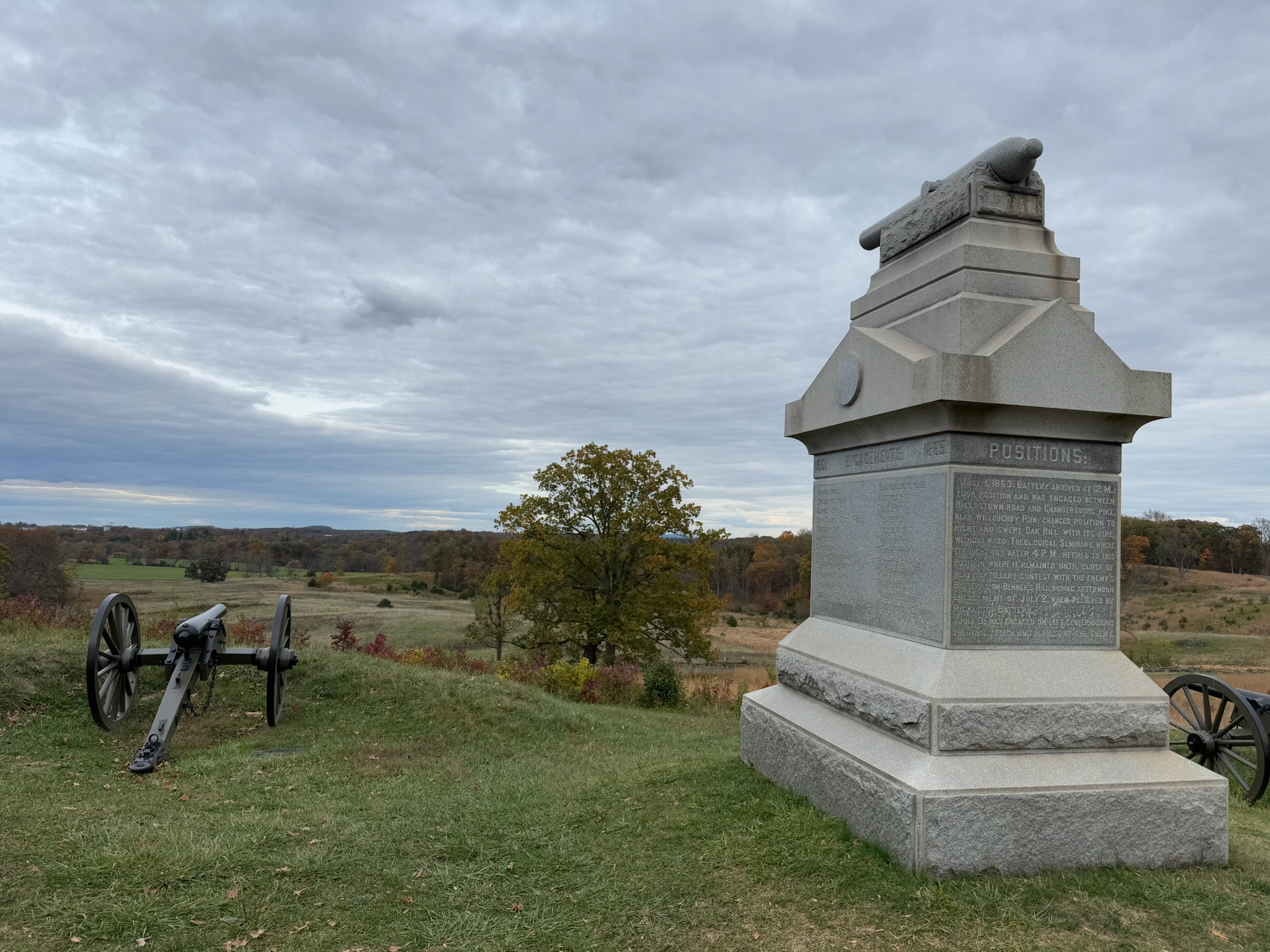
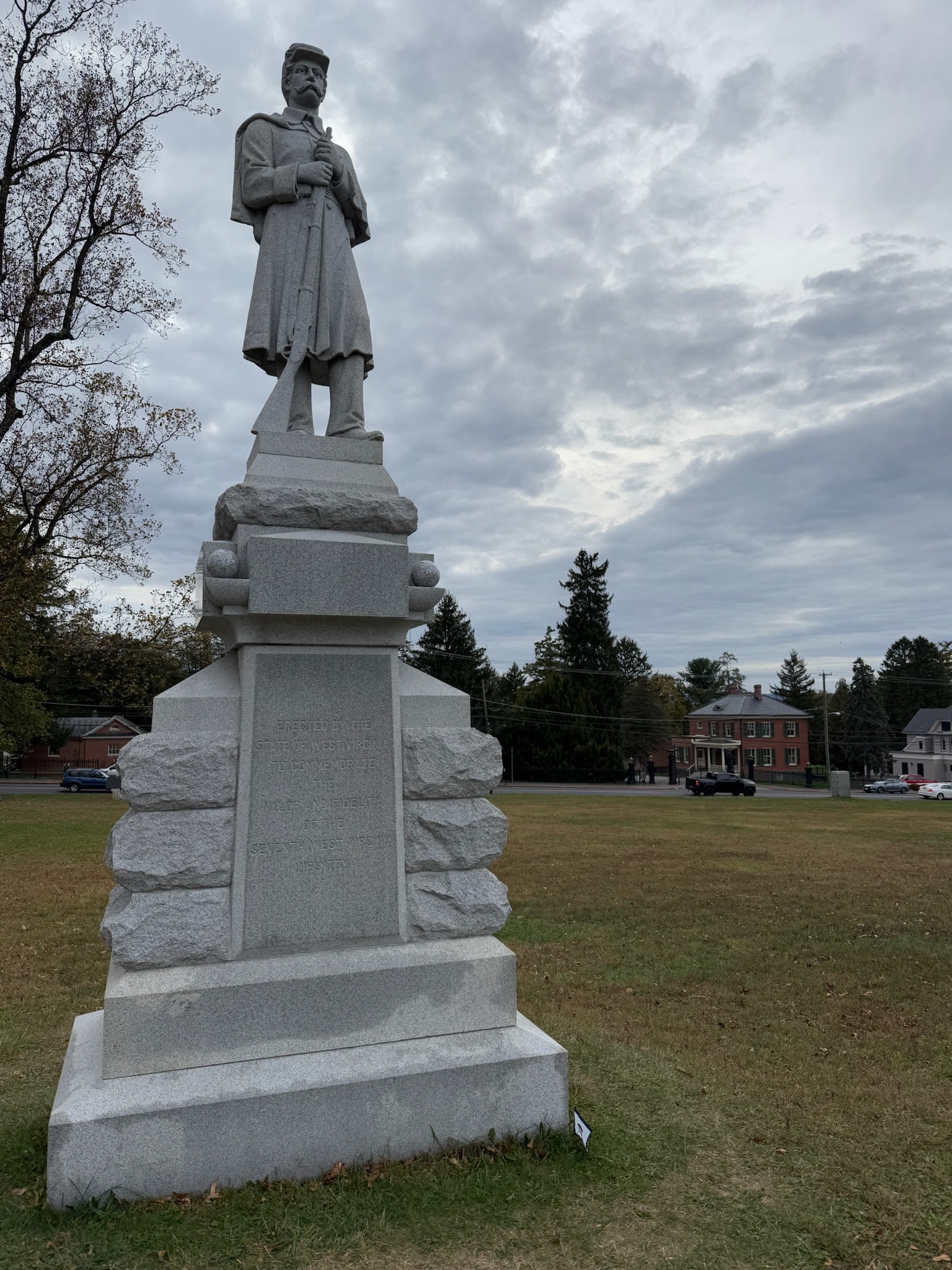
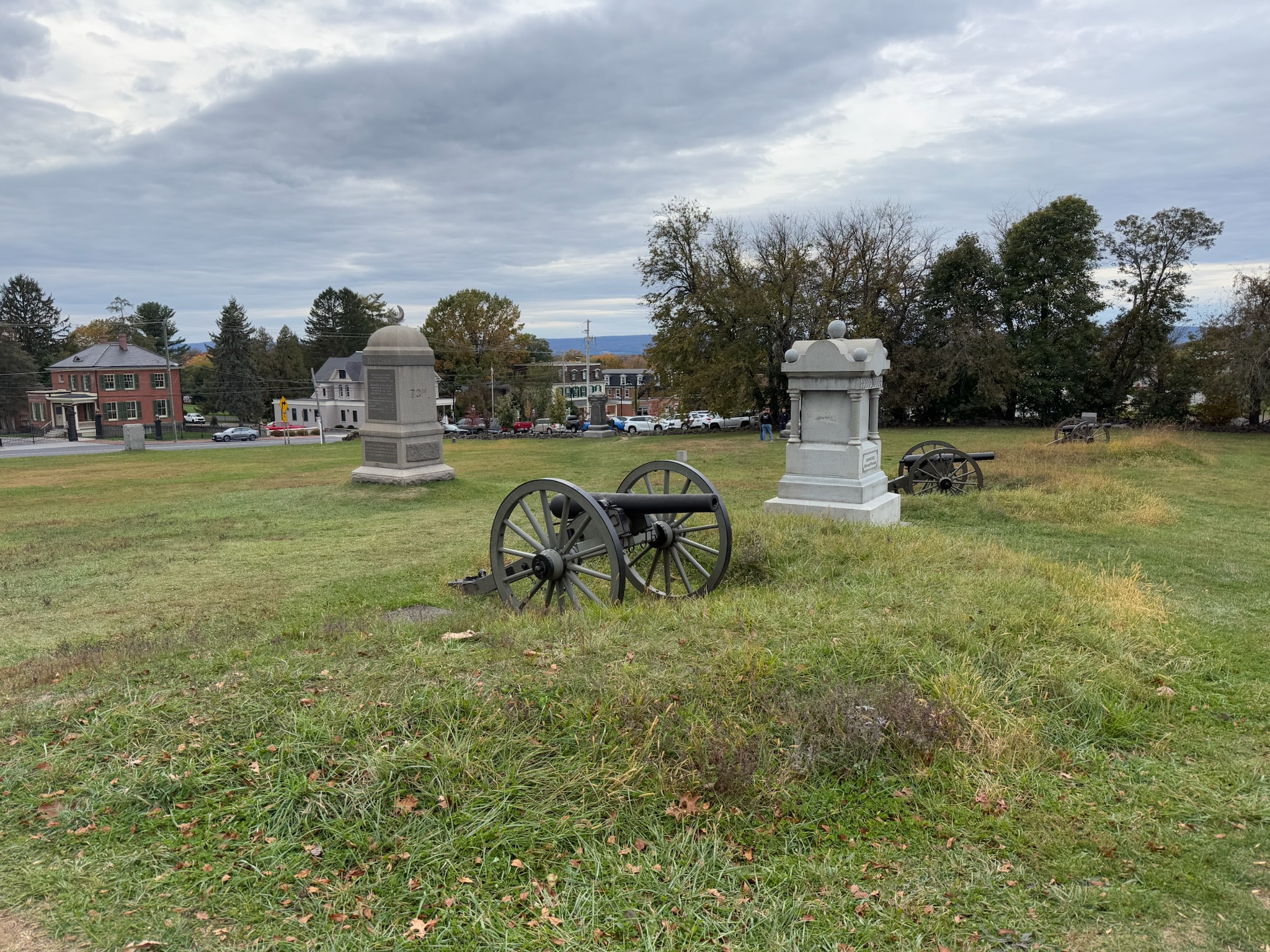
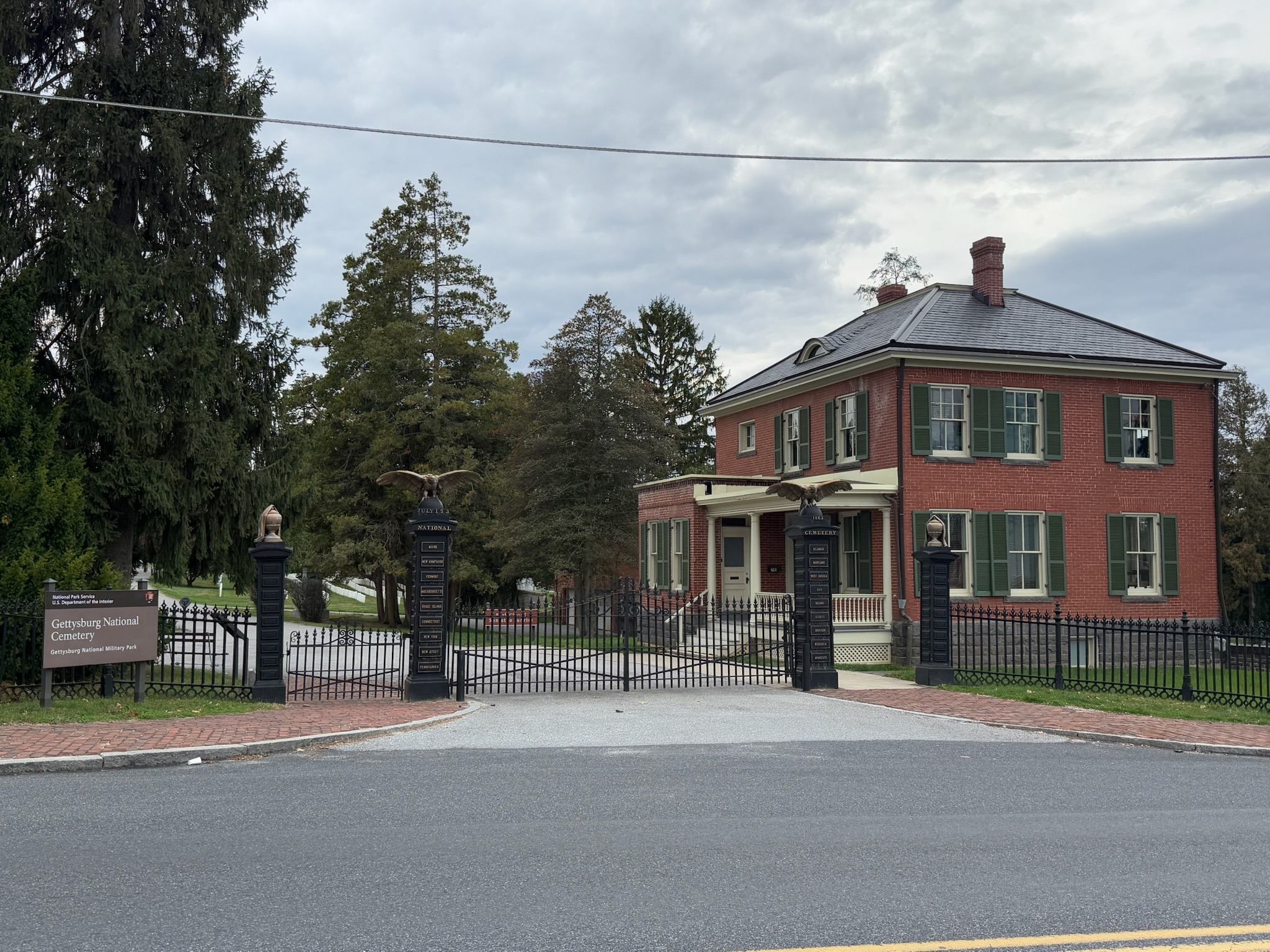
There were two cemeteries on the west side of the street, one on each side of the National Military Park. The Soldier’s National Cemetery, which was on the north side, looked to be closed. It looked like the burial area was discreetly tucked away from the road.
On the south side was Evergreen Cemetery, which had a sign saying “Lots Available.” This was the cemetery filled with obvious headstones that we’d seen on our way into town. We’d mistaken it for the Soldier’s National Cemetery.
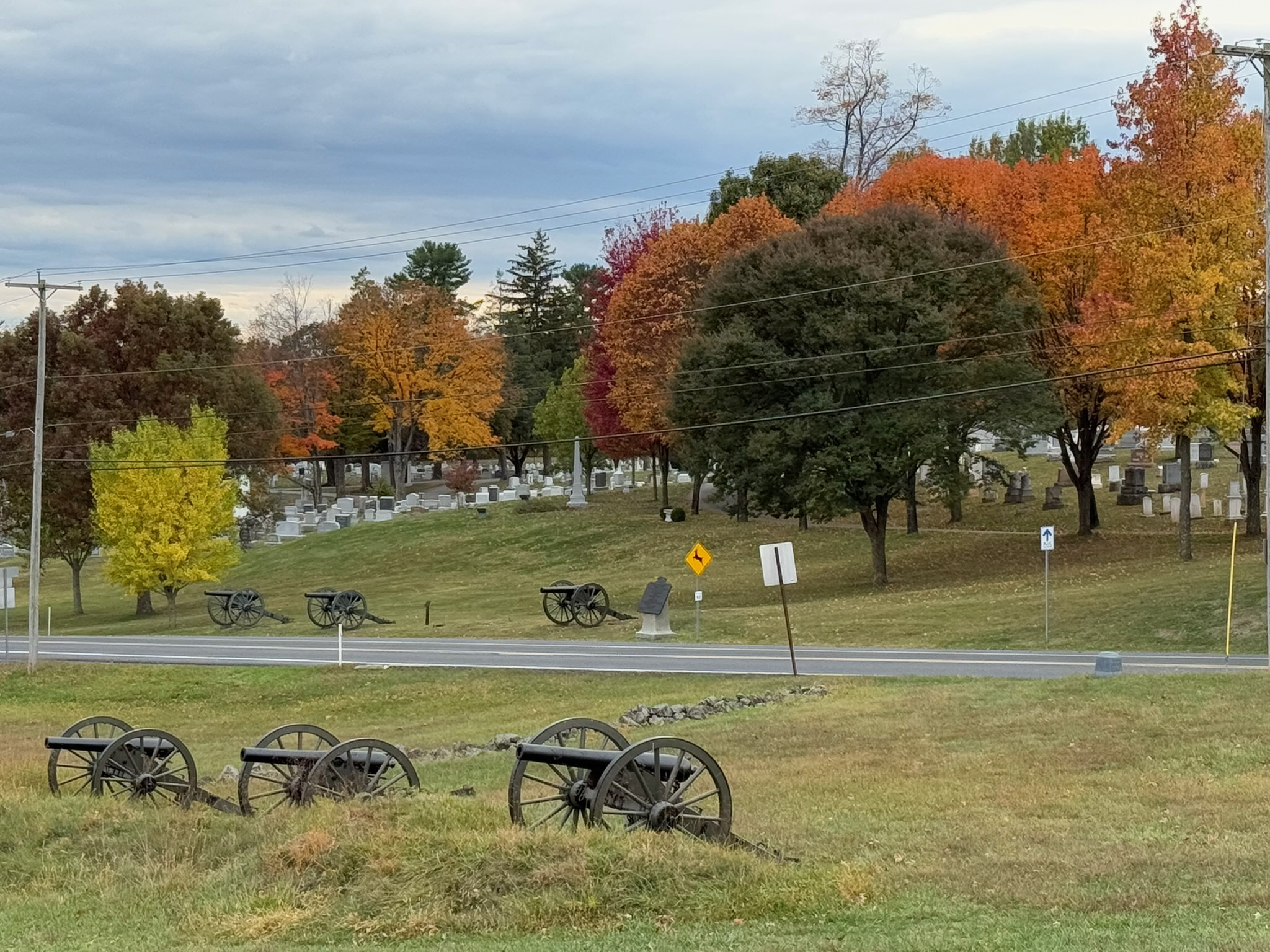
Since it was cold, Christi didn’t dawdle long on the battlefield. We considered getting dinner in Gettysburg before heading back, but we were still full from the giant lunch that we’d had. We took the same route back to Annapolis, and the drive back was just as lovely as the drive up had been.