Continued… Upon arrival at the tavern, we were immediately ushered into a room that was lined with chairs. Fortunately, we’d arrived just as the doors were opening and got seats. Within minutes, it was standing room only. A black woman came in and told us she was one of the slaves who had worked at the tavern. She gave us her personal background. If we recalled correctly, she was sold away from her mother at around 12-ish to the tavern and that the people at the tavern became like surrogate family to her. She gave us the tour through her eyes as a slave.
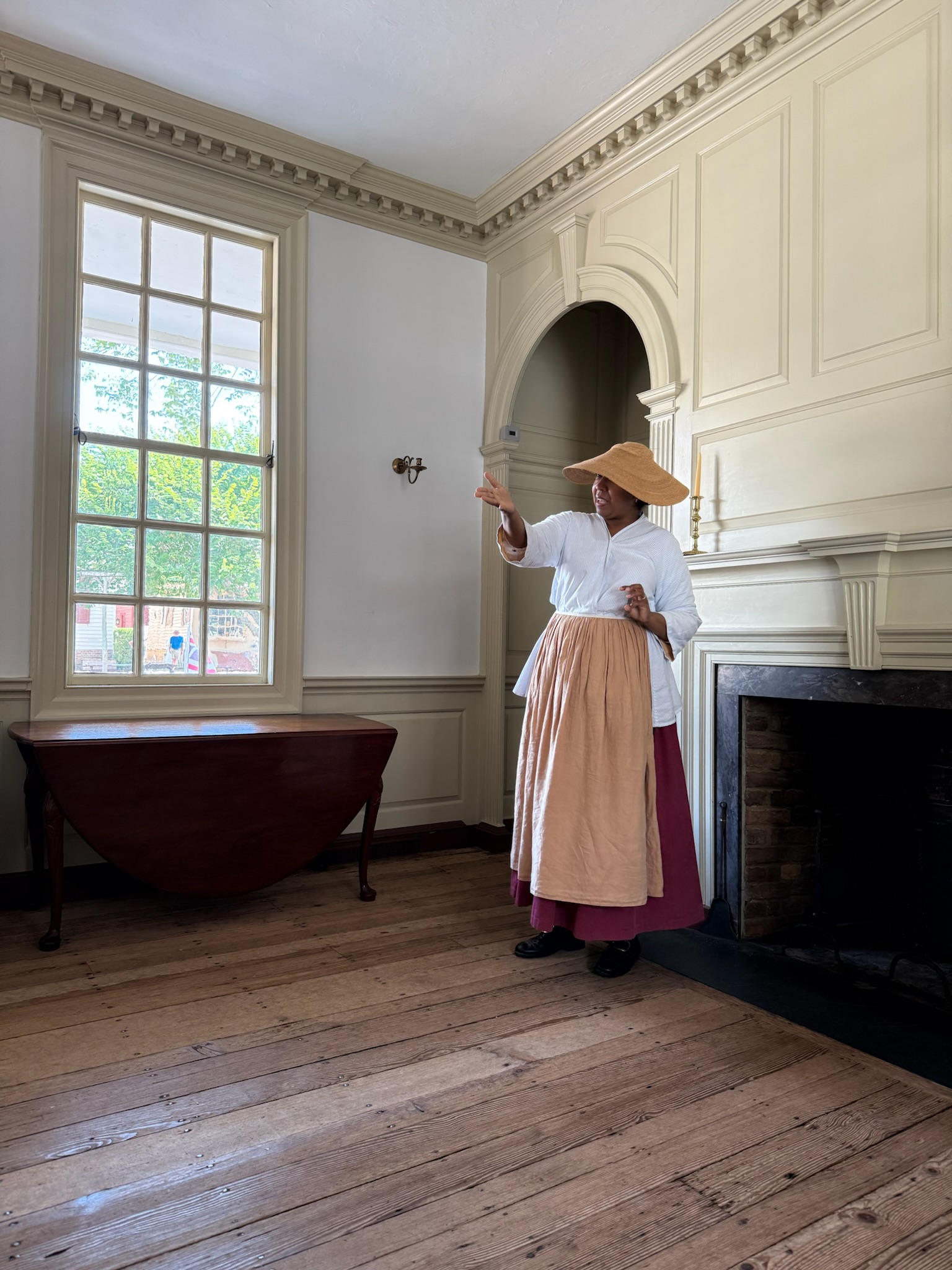
The Raleigh Tavern was established around 1717 and burned down in December 1859, so this building was a reconstruction. They had provided guests with lodging, food, drinks, entertainment, and a stable for their horses. She’d said that not everyone got a private room — rooms were often shared with several others, often strangers. And not everyone got a bed — sometimes people slept on the floor.
She gave us some background on the importance of taverns back in the pre-revolutionary era. Basically, few venues could host big events, so taverns were a popular venue. The Raleigh regularly hosted balls when the court and legislature were in session, making it a high profile networking location.
Taverns became pivotal as the rebellion gathered steam. The patriot rebels certainly couldn’t meet in the Capitol building or Anglican Church as they were controlled by the British. They couldn’t meet in any of the other churches because of the laws about keeping doors and windows open, and they certainly couldn’t meet outdoors where any passer-by would hear their subversive talk. So taverns became critical places for planning. It was in this tavern that the Continental Congress was first proposed.
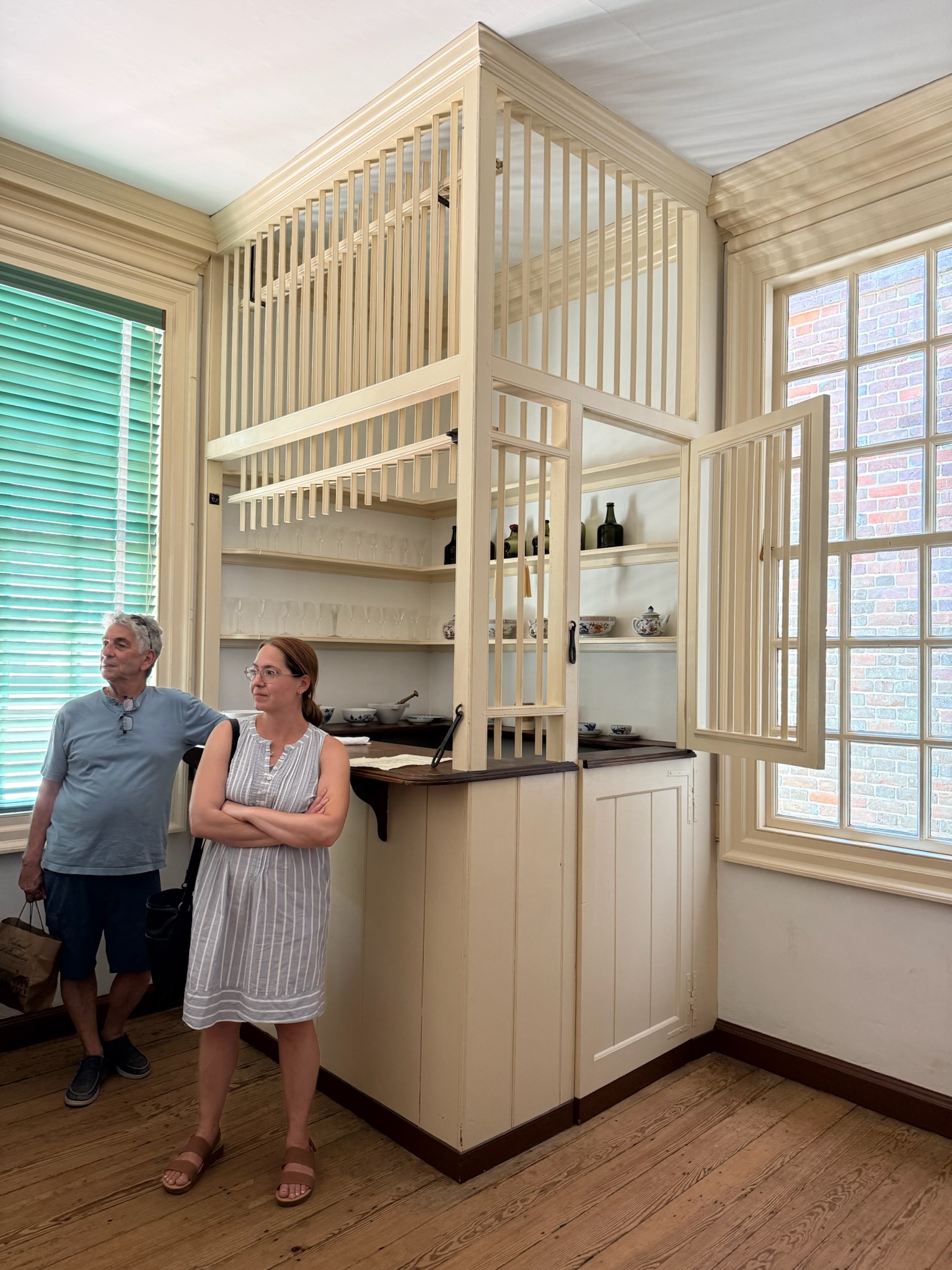
We went into the next room, which looked a lot like the coffeehouse, with a small beverage service area and a table with several chairs. A game, a newspaper and a book were laid out, indicating how the patrons spent their time in here. She gave more information about taverns, such as they sold liquor, beer, wine and ciders, which added to their popularity.
Then we went into the Apollo room, a large room that was frequently used for meetings and parties, and were seated.
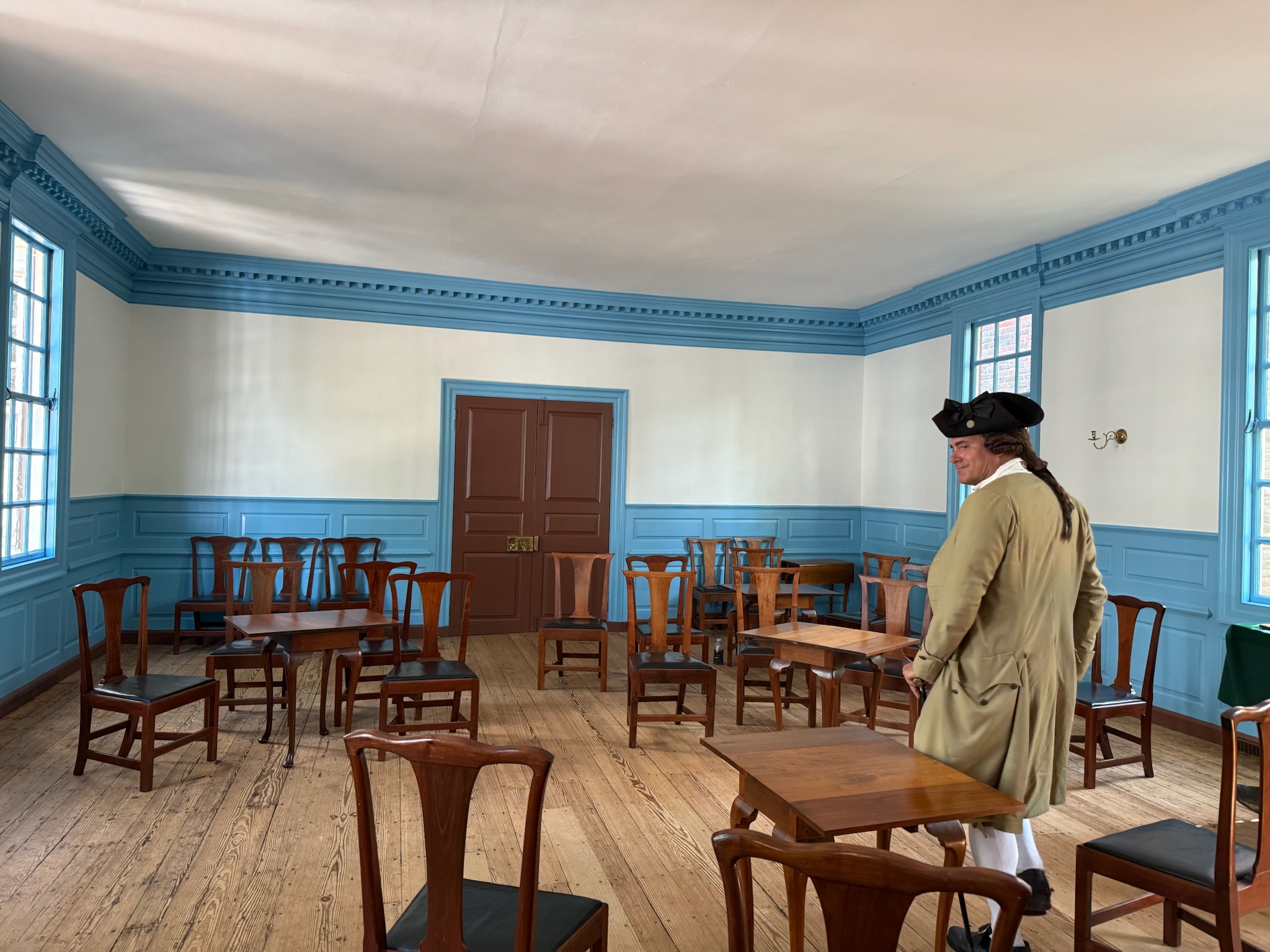
Three actors came into the room. One was portraying Patrick Henry, we think the second one was Thomas Jefferson, but we’re not sure if we’re remembering that right, and we can’t remember the name of the third character. This was a reenactment (of sorts) of a real meeting that took place at this very tavern, where they discussed whether we should go to war with Great Britain. They pretended like the audience was fellow patrons and tried to engage us in the discussion. Patrick Henry talked about the need to increase taxes to pay for the upcoming war. The character whose name we couldn’t remember was focused on repealing a law that prohibited arts, such as plays and symphonies, during times of war.
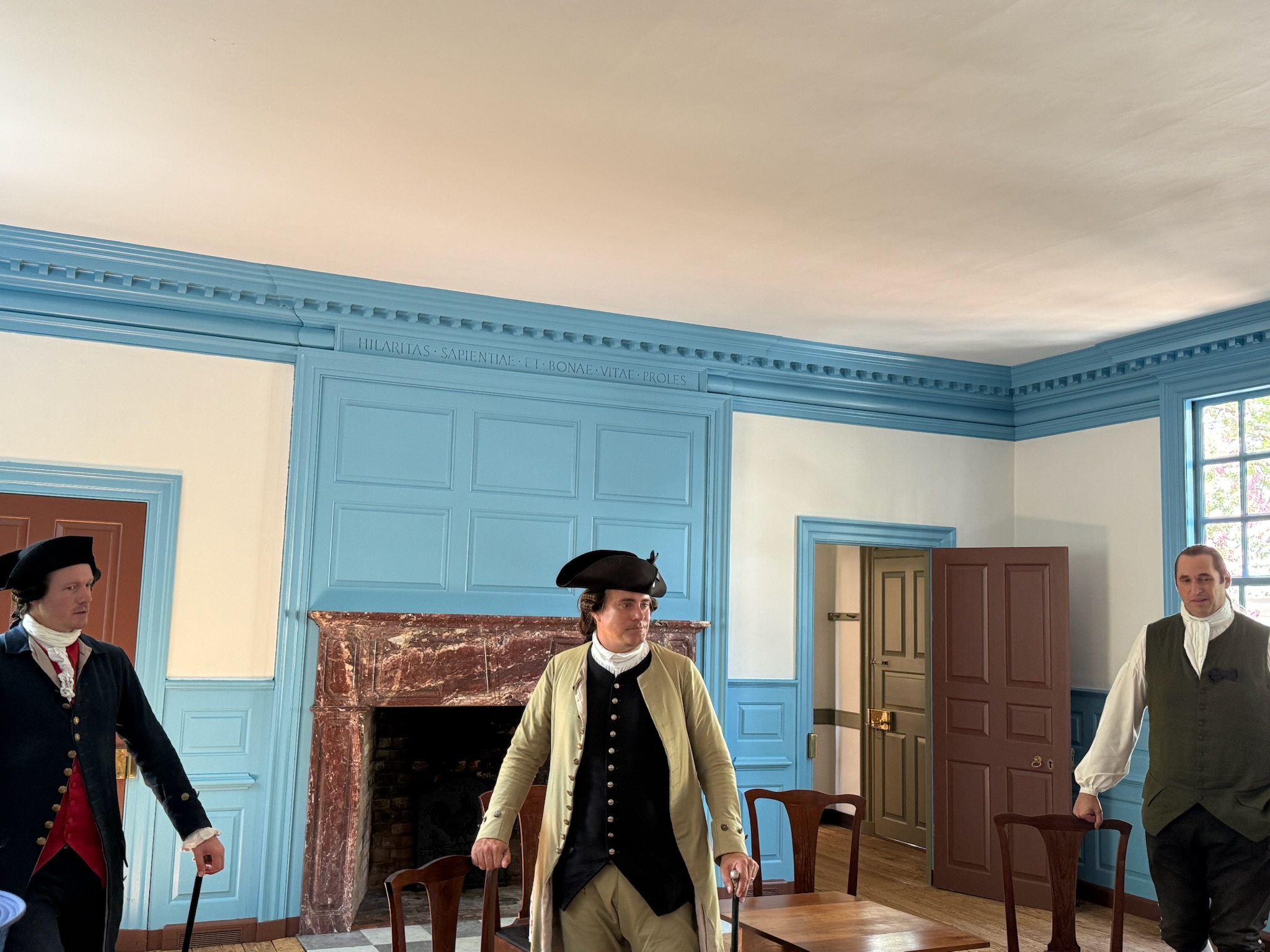
When the meeting was over, we walked through the dining room.
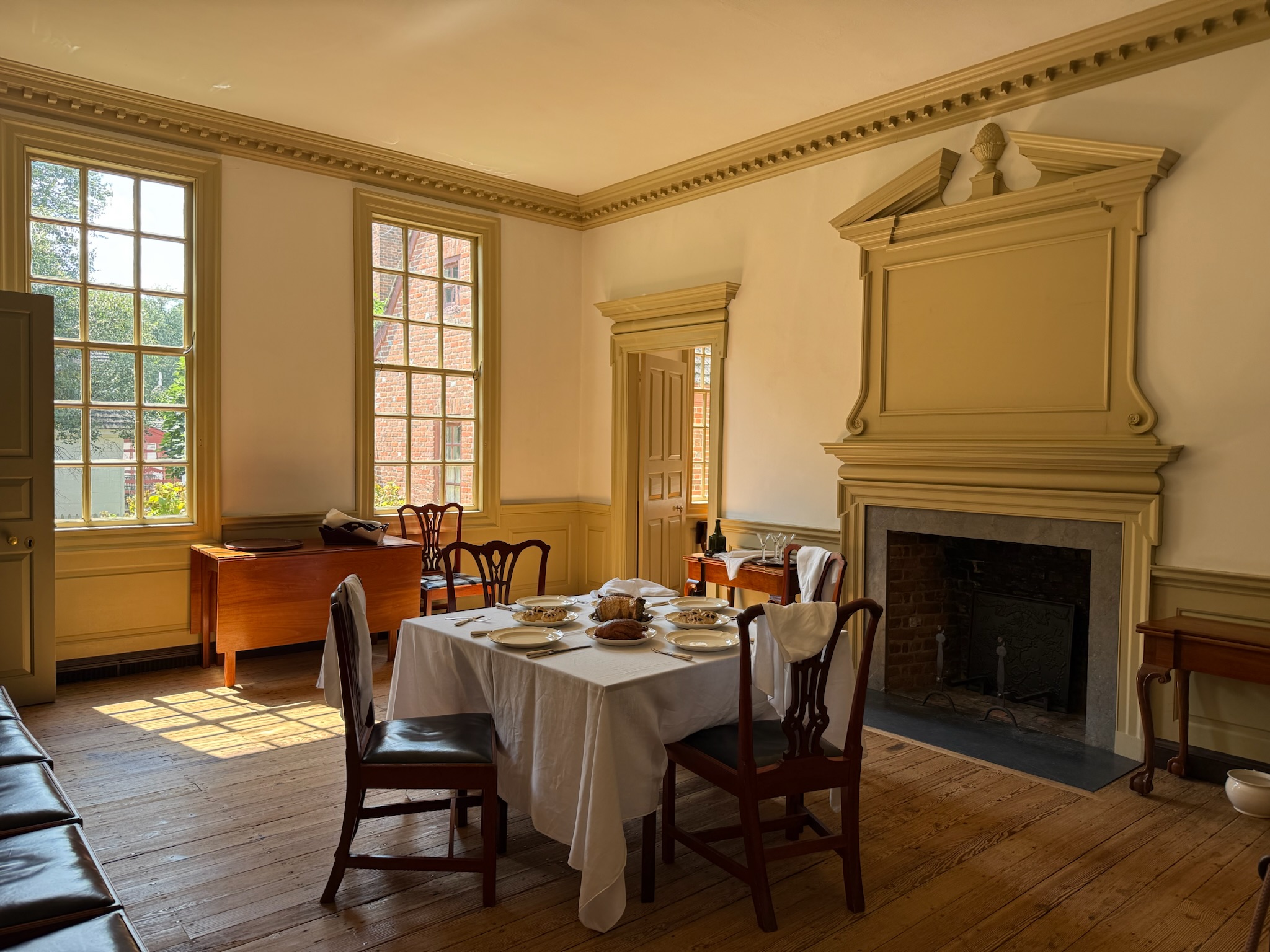
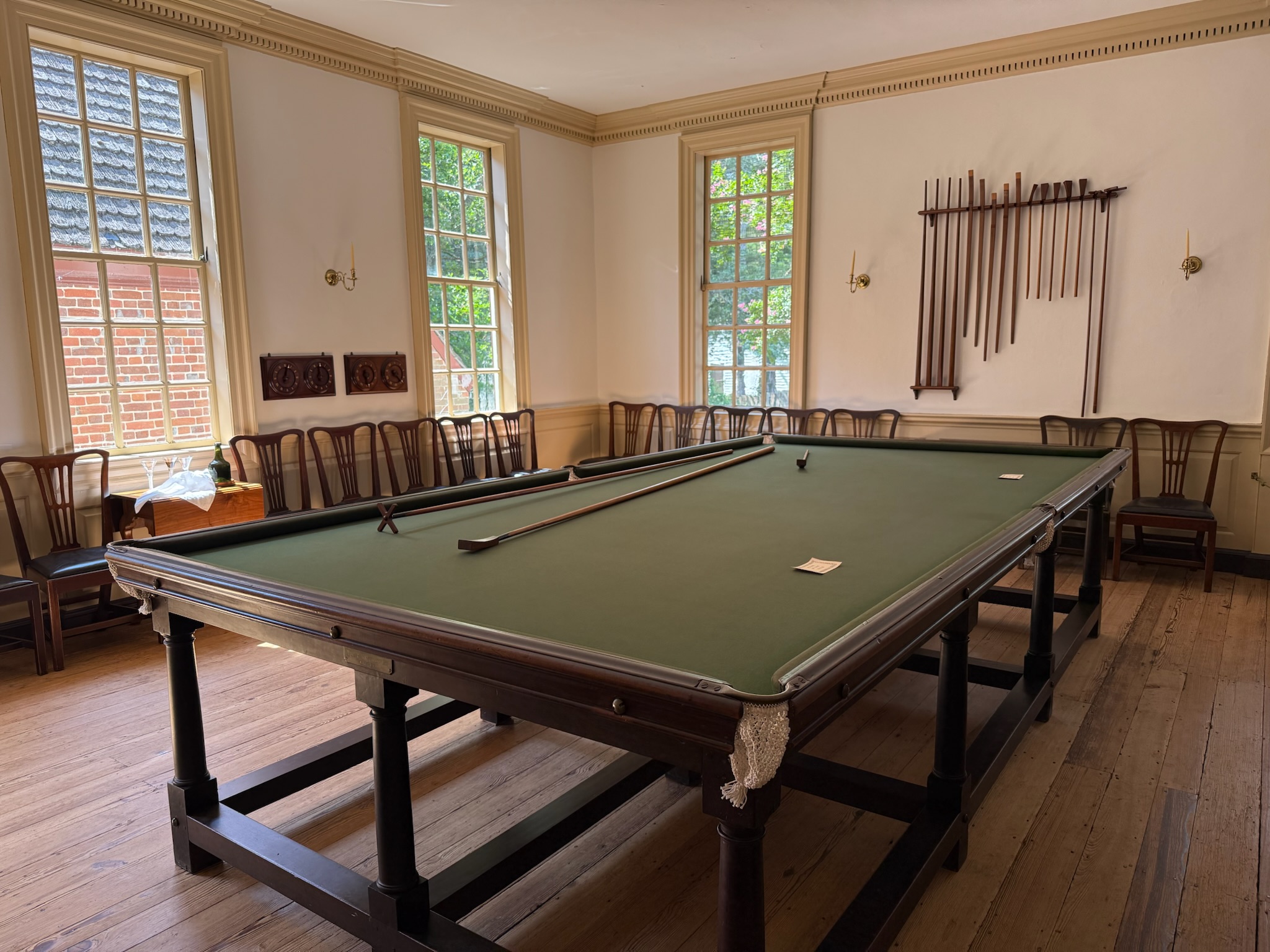
And into the very back room, which was a game room with a pool table.
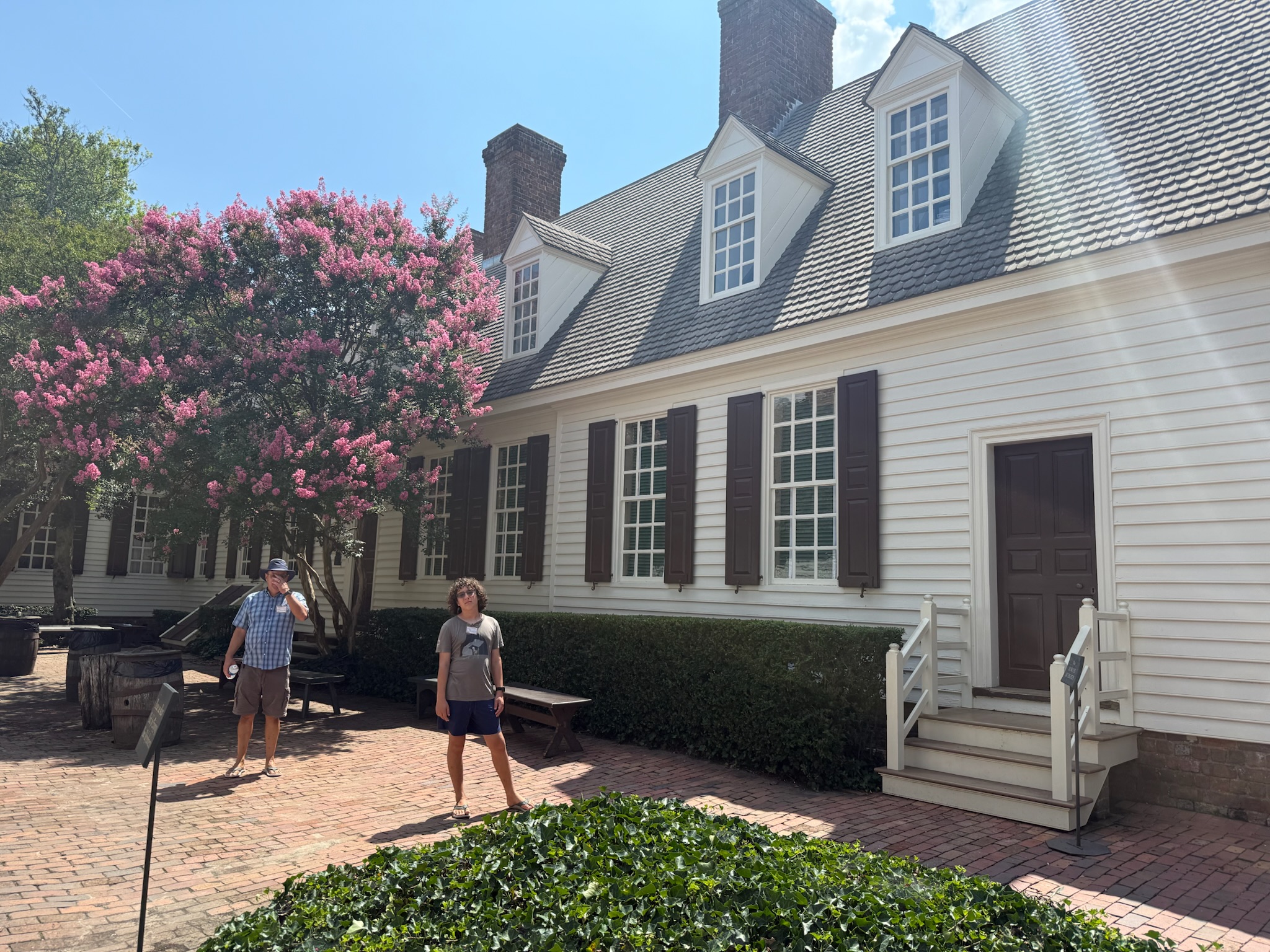
They didn’t take us upstairs. Instead, we exited from the game room, which let out into the small courtyard between the bakeshop and the tavern.
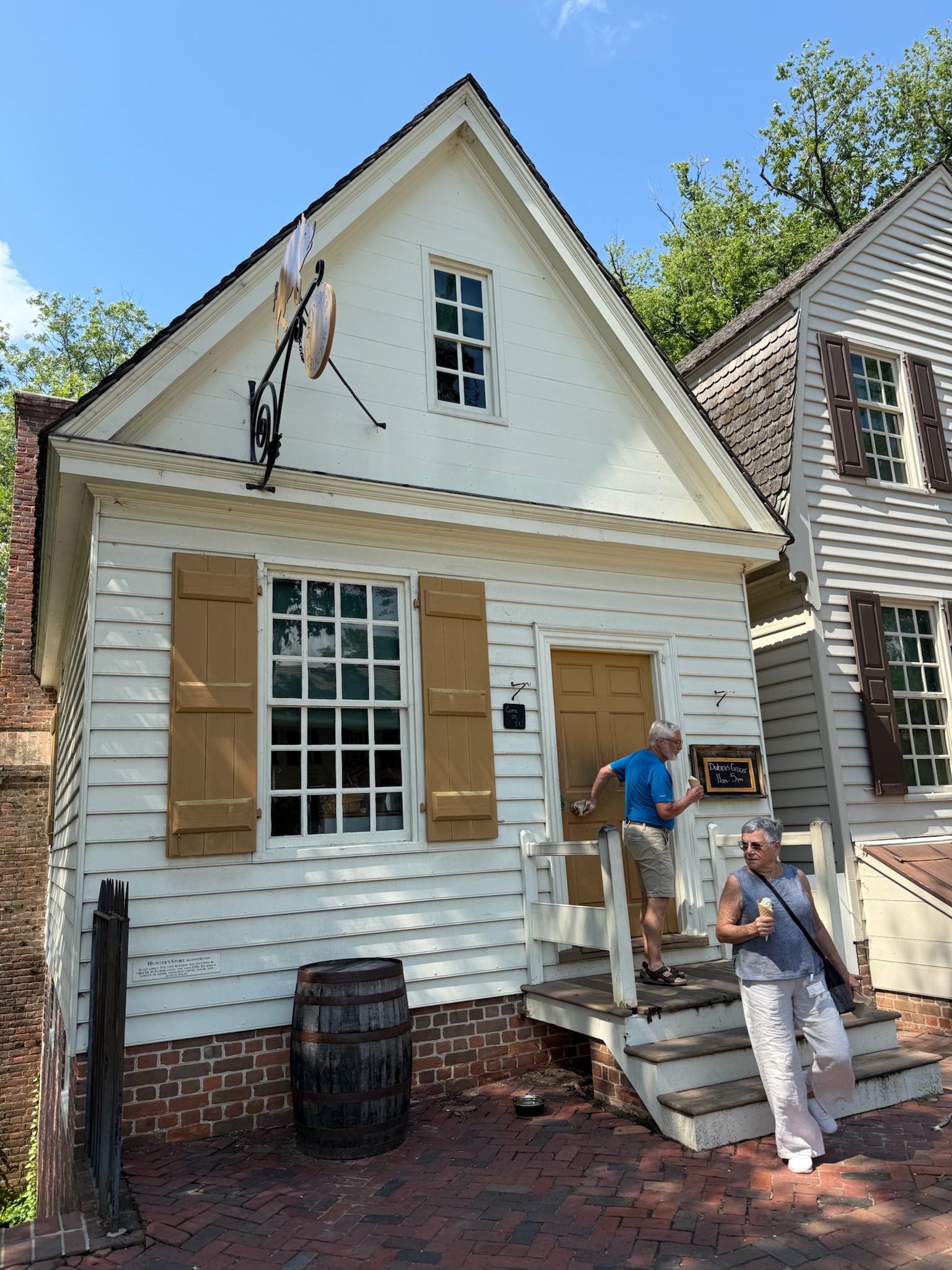
Our next stop was to get soft serve ice cream at The Dubois Grocer. There was only one lady working and she was swamped, so it took a while. According to the sign, this store was a reconstruction. The original store was built in 1772 and was used as a grocer selling goods such as coffee and sugar until the late 1770s.
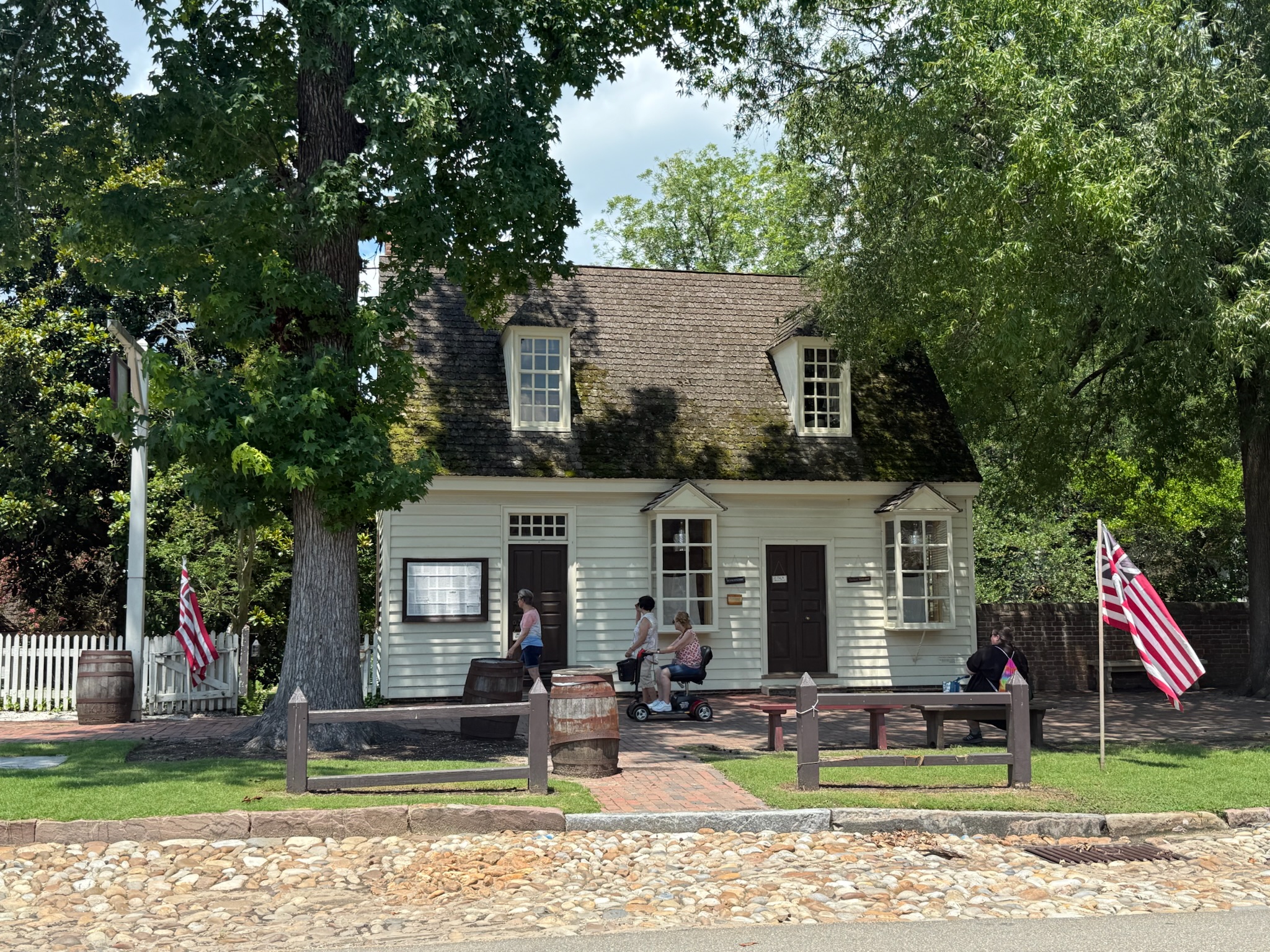
Next door to the ice cream shop were the book binder and printer. The printer was closed, but the book binder was open.
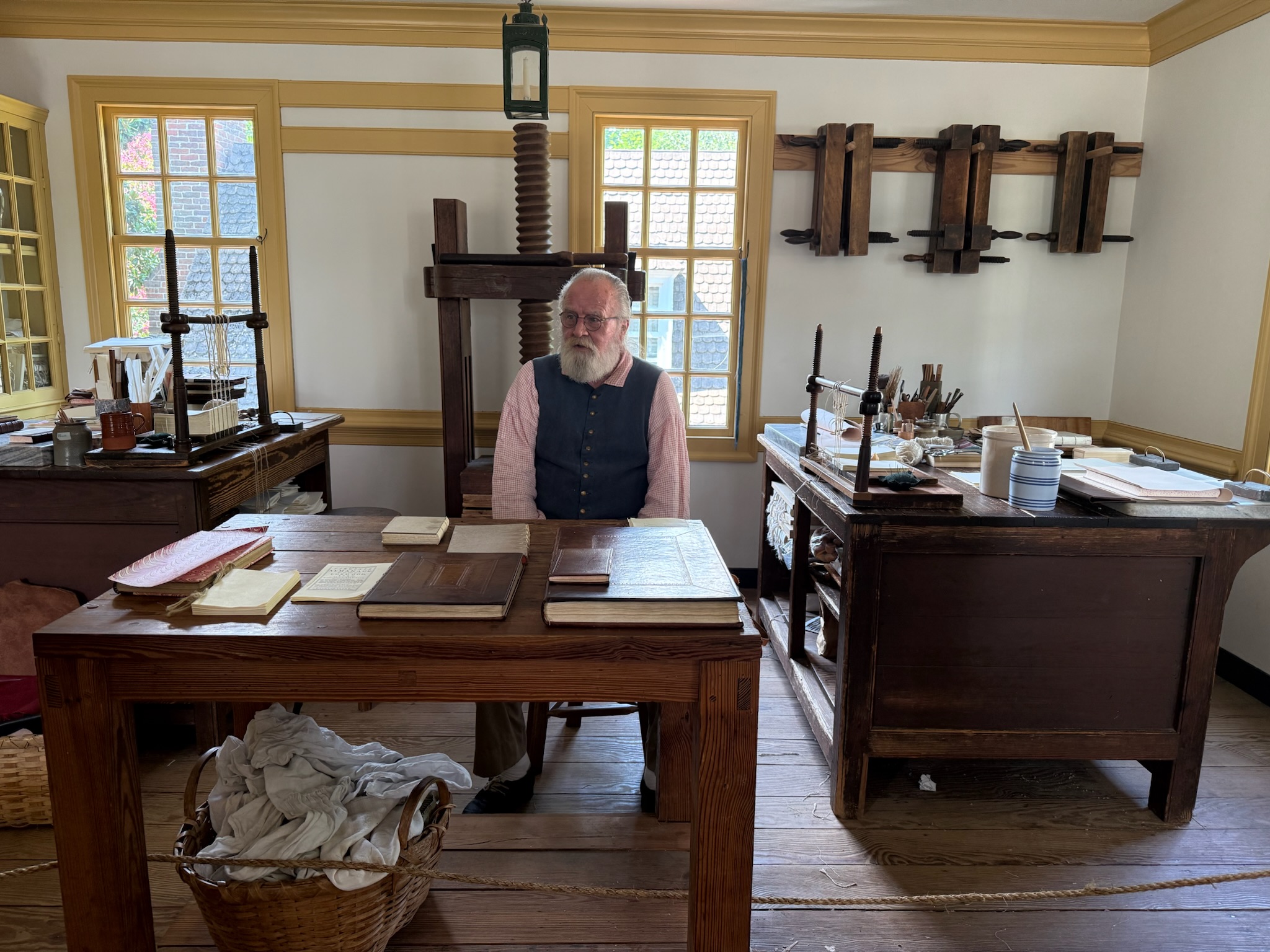
Back then, pages were almost sewed together with several strands of yarn. He explained why books with covers always had ridges in the spine — it was the strands of yarn that had been covered by the leather. Leather covering was used to protect the paper inside. In this photo, to the left of the gentleman, you can see a book in the middle of being bound.
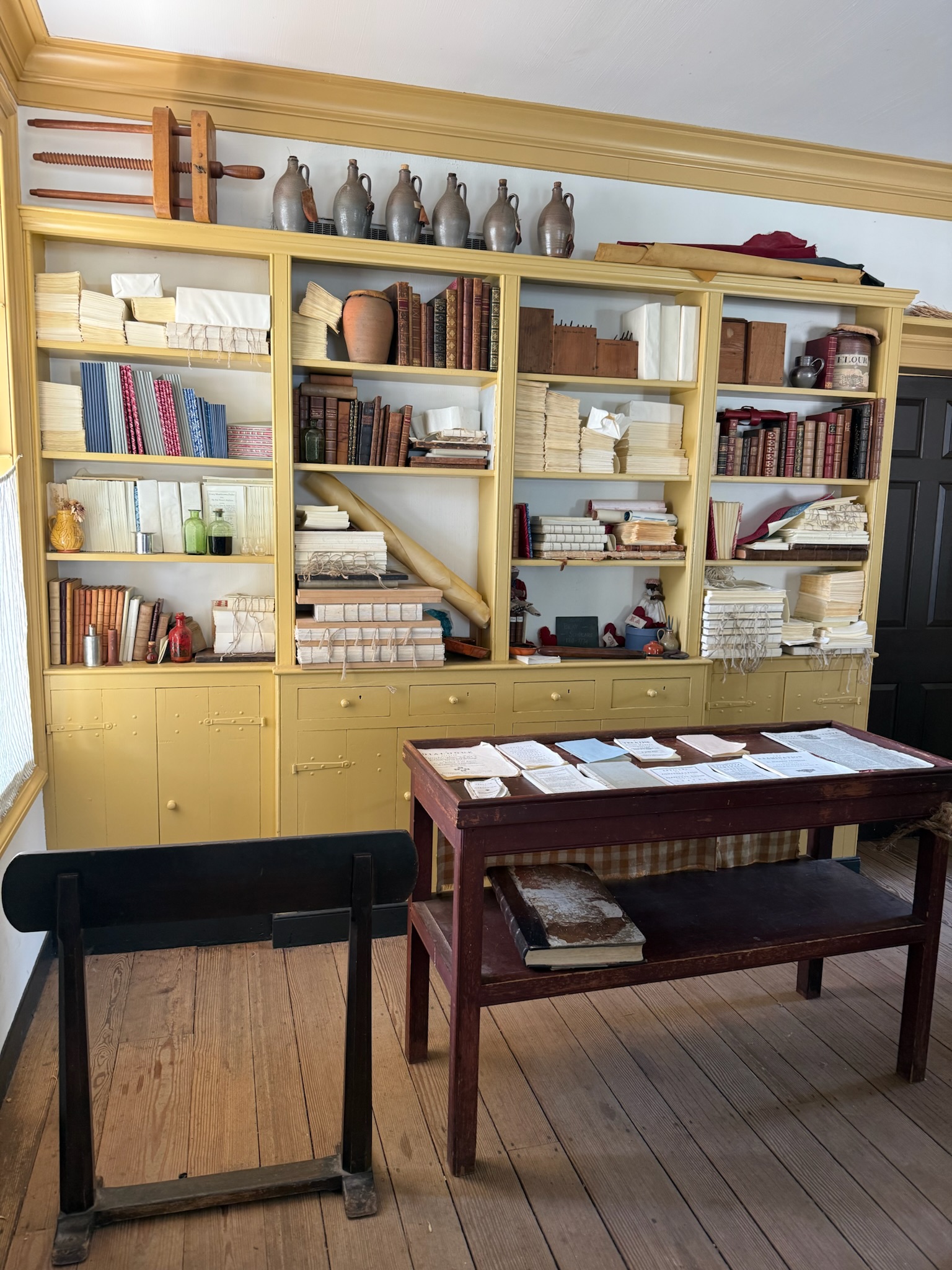
The majority of the books he made were blank so people could write in them. The majority of printed items were thin, uncovered pamphlets, as printing was cost prohibitive.
Our next stop was the leather shop, which was in a small house behind the printer/book binder building.
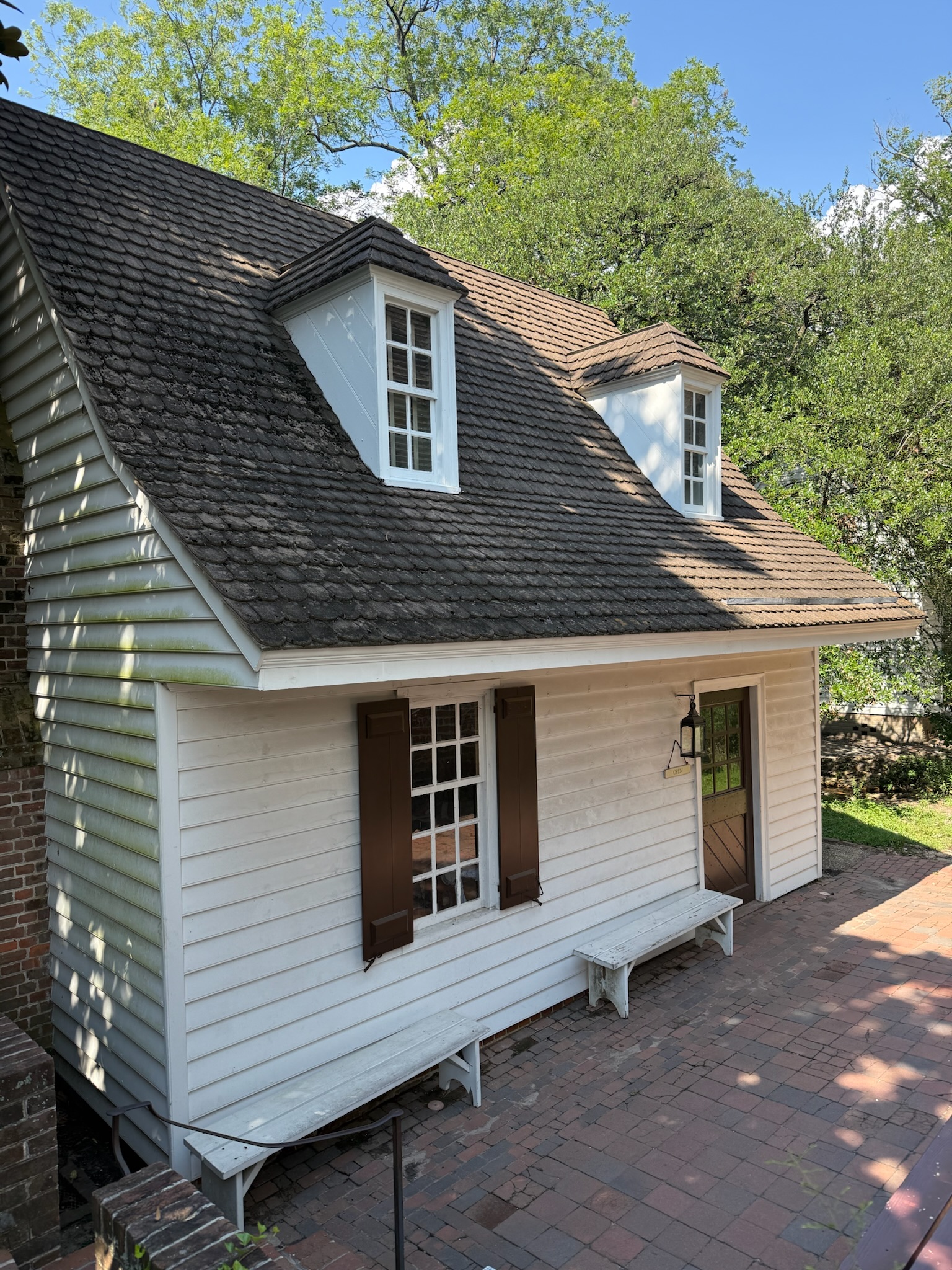
They made the shoes and leather breeches (durable pants for farm work) for the actors here in Williamsburg. They explained which types of animal hides were used for different products — some were thinner and softer and some were thicker and more durable. They didn’t cure the leather here — the tanner cured the leather, and they procured it from the tanner.
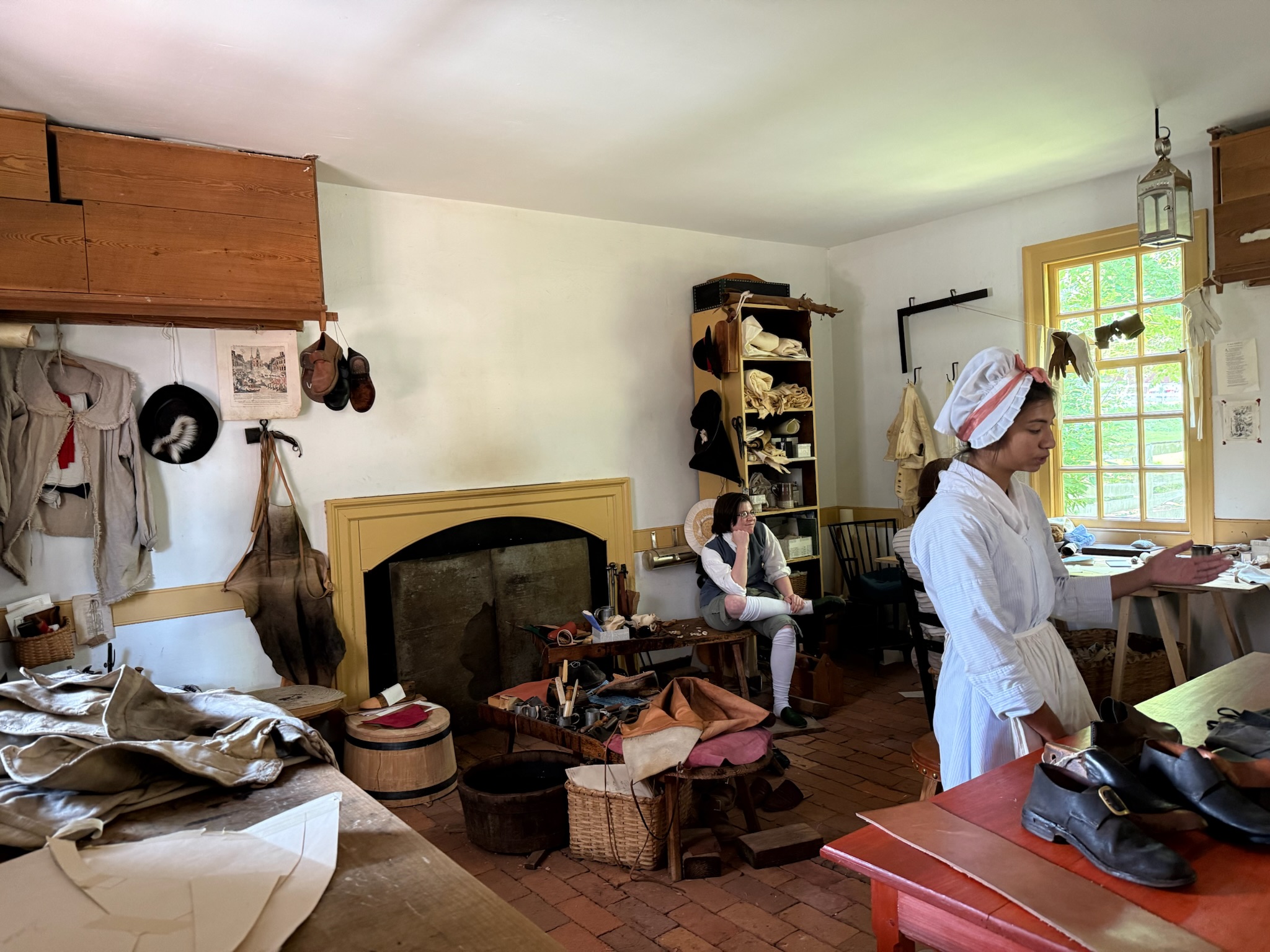
After only a couple of minutes, Keith said that the shop smelled awful and insisted that we leave immediately, so we didn’t find out much about the trade.
There had been several military displays throughout the day at specified times, but Keith hadn’t wanted to go to any of them because he didn’t want to walk in the heat. As we happened to be walking by, one was just beginning.
Christi wanted to stay and watch the whole thing, but Keith adamantly insisted we needed to immediately leave Colonial Williamsburg. This was kind of out of character for Keith, as he was most interested in the military displays and would normally want to stay and watch it. We compromised by agreeing to go to one more foundation building — air conditioned — on the way to the bus stop.
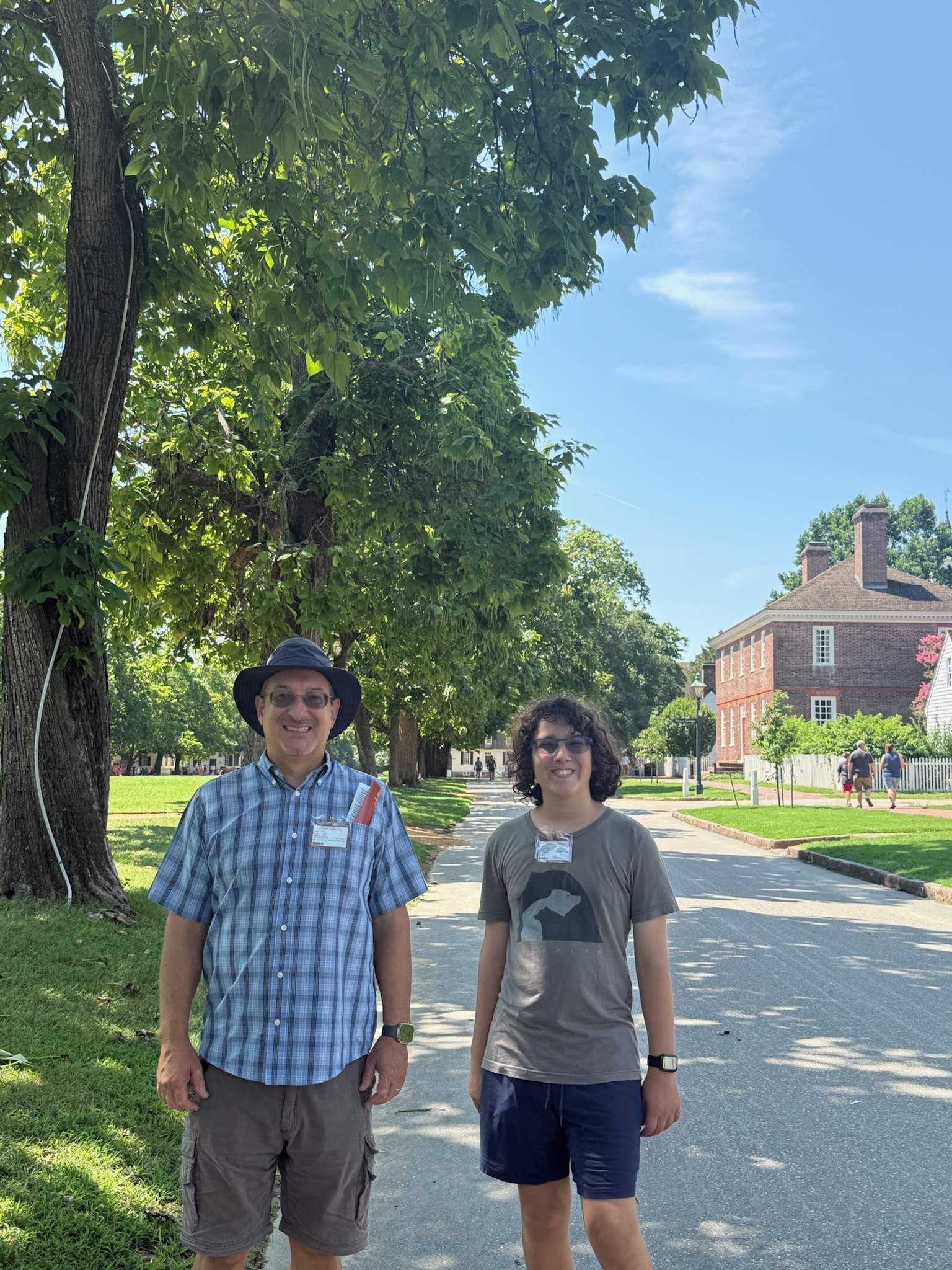
Our last stop was the George Wythe House, which was one of the most southernmost houses on the Palace Green. It was the brick house in the right background of this photo.
We’d actually met the character George Wythe earlier in the day as we were walking down the street. He’d said he didn’t think we were from around there and asked where we were from. When we said California, he laughed and said that was a hilarious joke — we must have meant we lived so far away that it may as well have been California. It was a stark reminder of how difficult travel was back in that era.
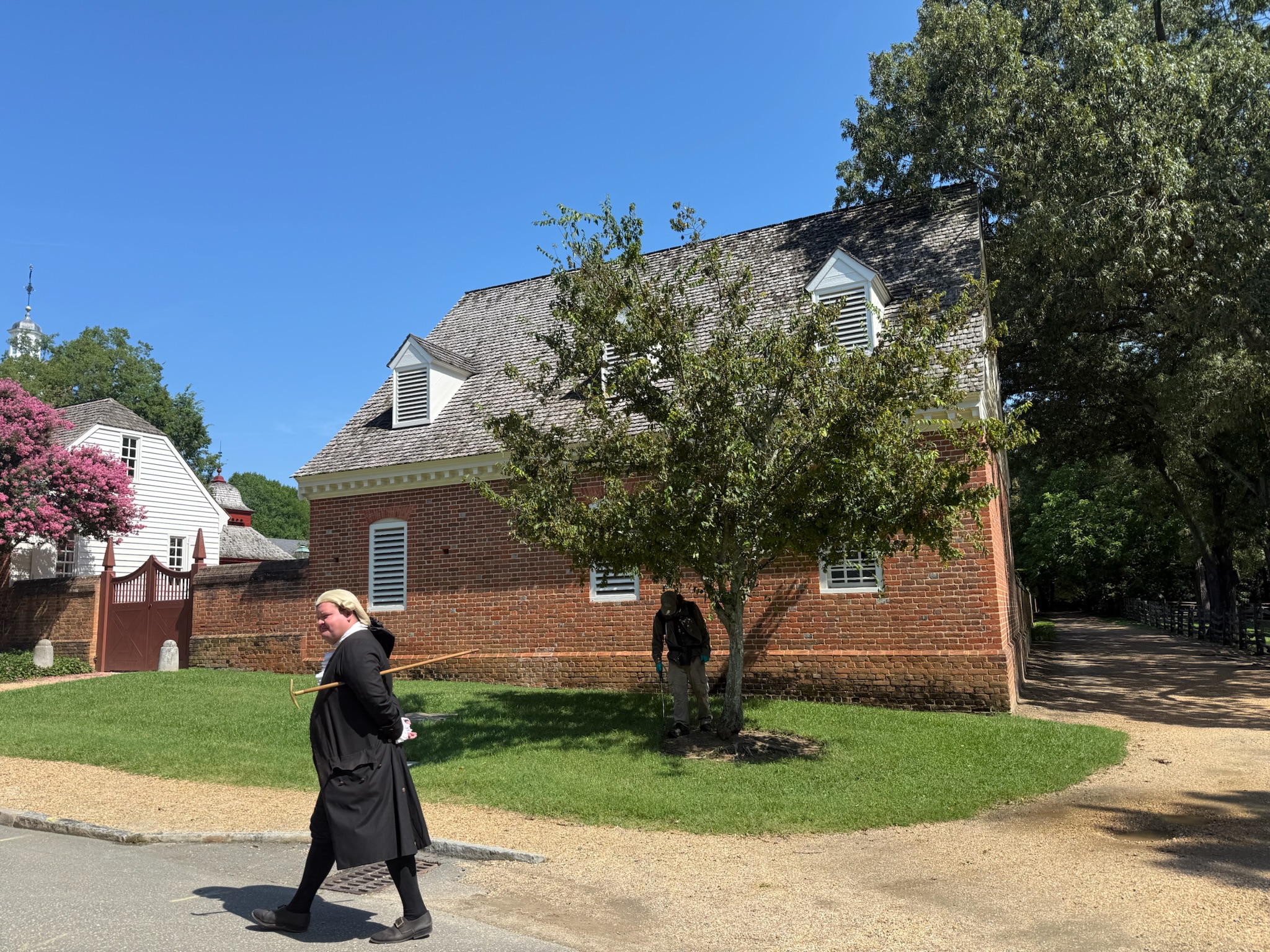
Wythe had a local law practice and trained apprentice lawyers, including Thomas Jefferson, who became his life-long friend. Mr. Wythe taught his law students out of this home. Wythe later became the first professor of law at an American College (College of William and Mary), served in the House of Burgess, was a delegate to Virginia Conventions, attended the Continental Congress in 1775, was the first Virginian to sign the Declaration of Independence, and was a delegate to the 1787 Constitutional Convention. George Washington had used this home as his headquarters in 1781 and had likely planned the siege at Yorktown from here. After talking with Mr. Wythe, we were interested in seeing his home. We were greeted in the foyer by a gentleman.
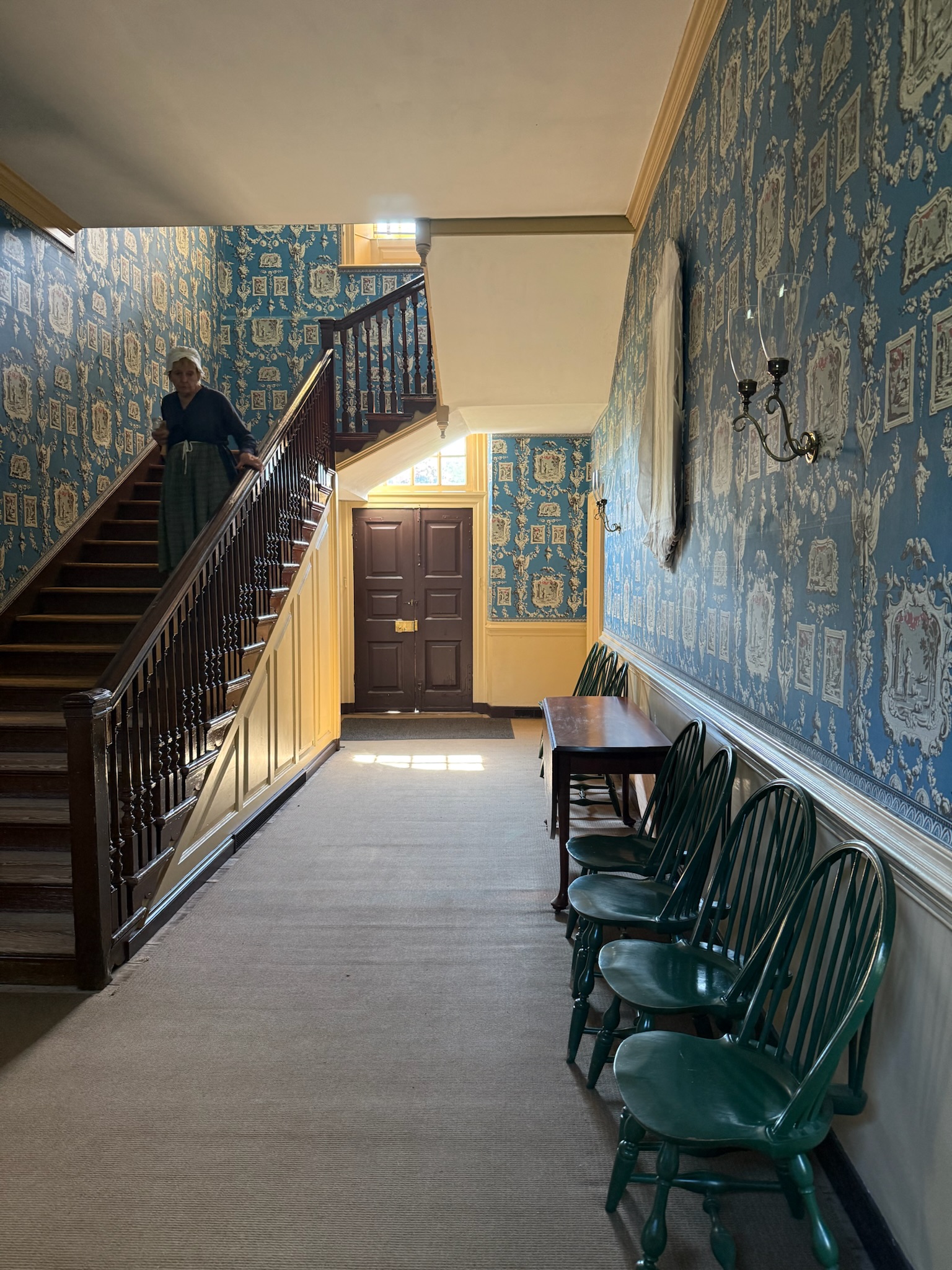
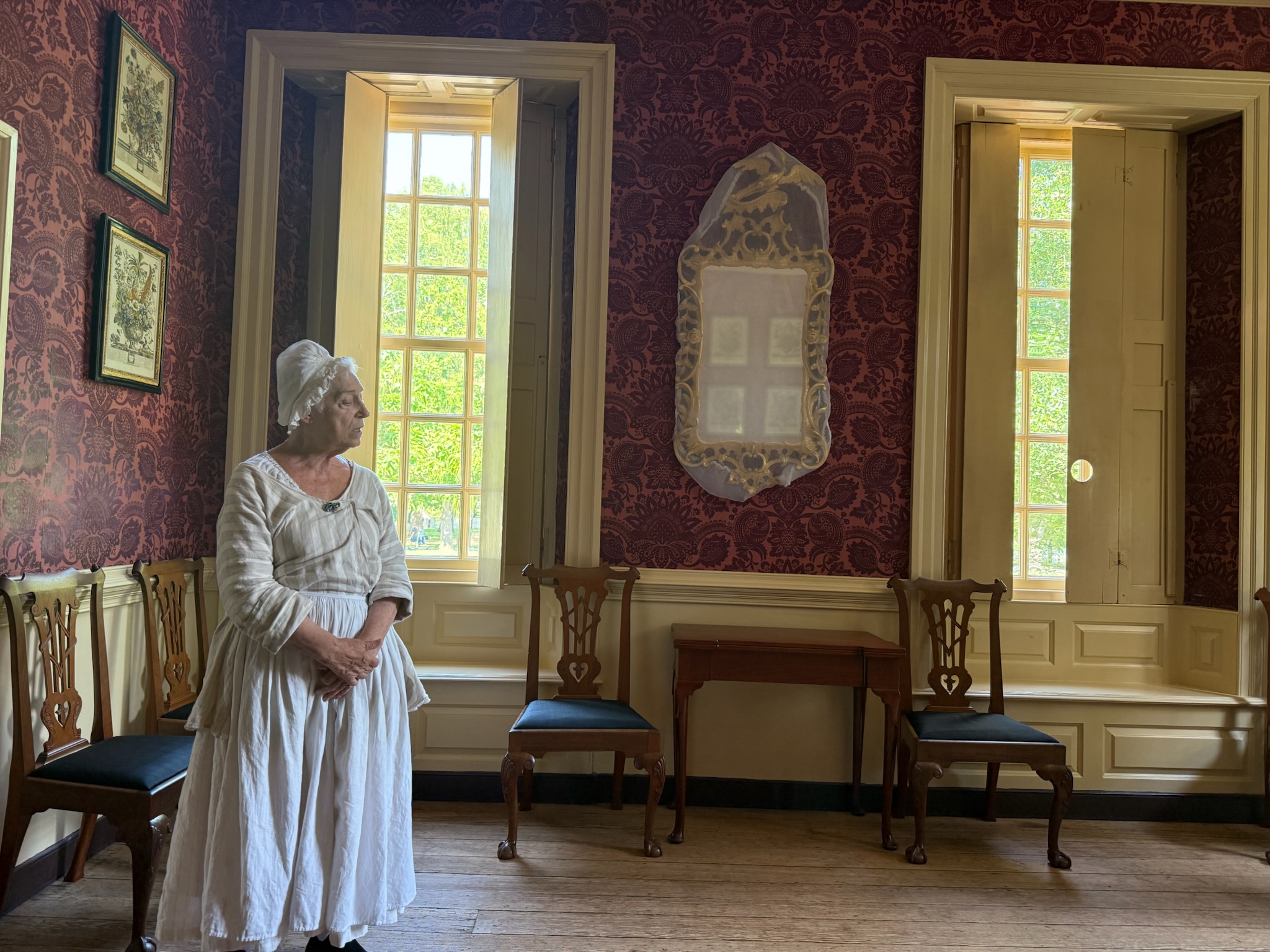
He ushered us into a room to the left of the entrance. A female tour guide explained that this was the original home, which was built in 1755 by George Wythe’s father-in-law. The property was gifted to George and Elizabeth after their marriage. She didn’t mention them having any children, however, she said that often the law apprentices lived in the home with them, so the house was often full. Even though he opposed slavery, he owned slaves who served in the house. We forget how many slaves he owned, but the guide said it a small number compared to the other monied families in Williamsburg.
This was the parlor. It was also the room that George Washington had overtaken as his headquarters. The floor boards were the original boards installed in the house. It was an untreated wood, and because they’d been left untreated, were durable — we were standing on the same floor boards in 2025 that George Wythe had stood on in 1775.
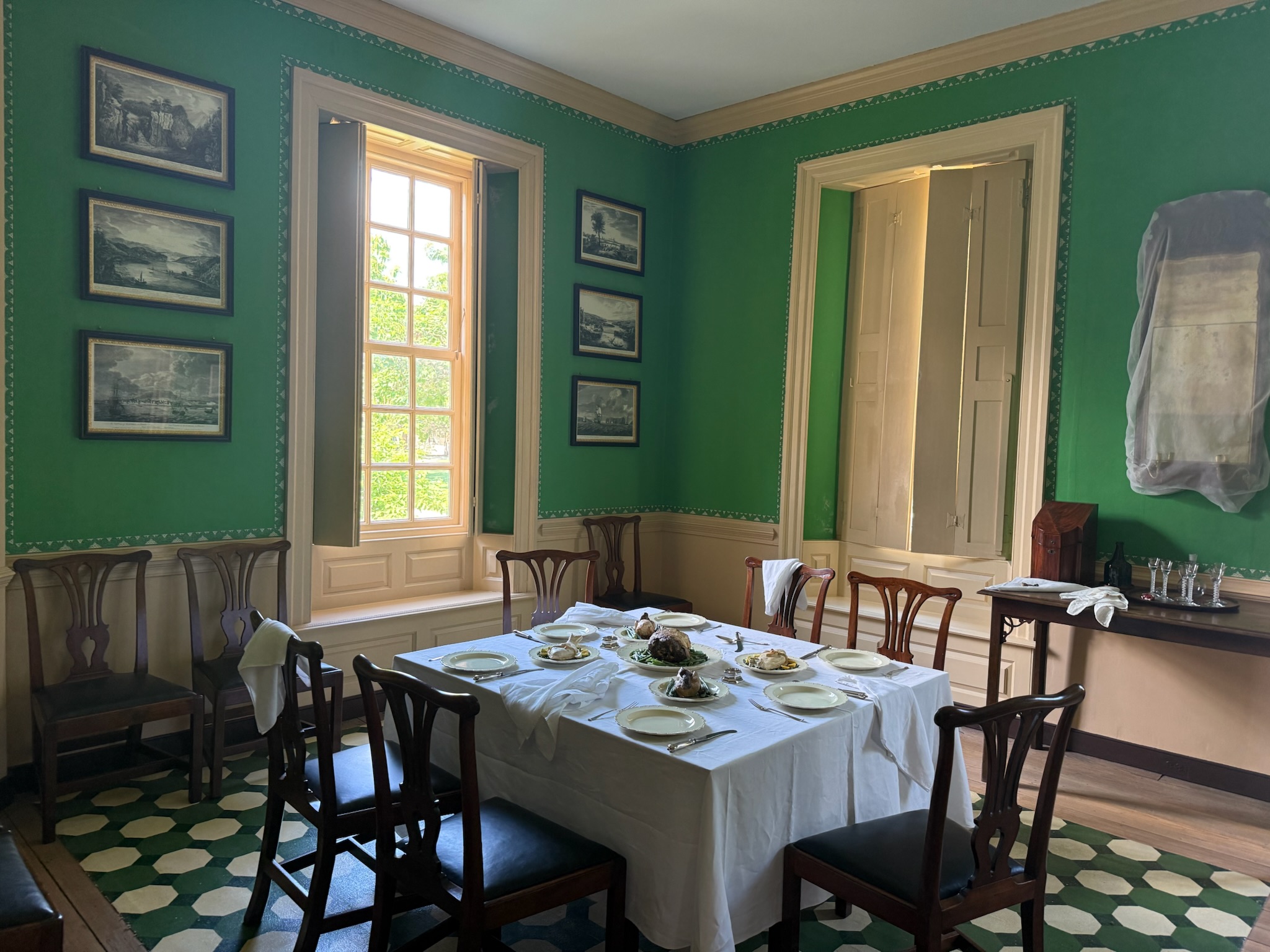
From there, we visited the dining room, on the other side of the foyer.
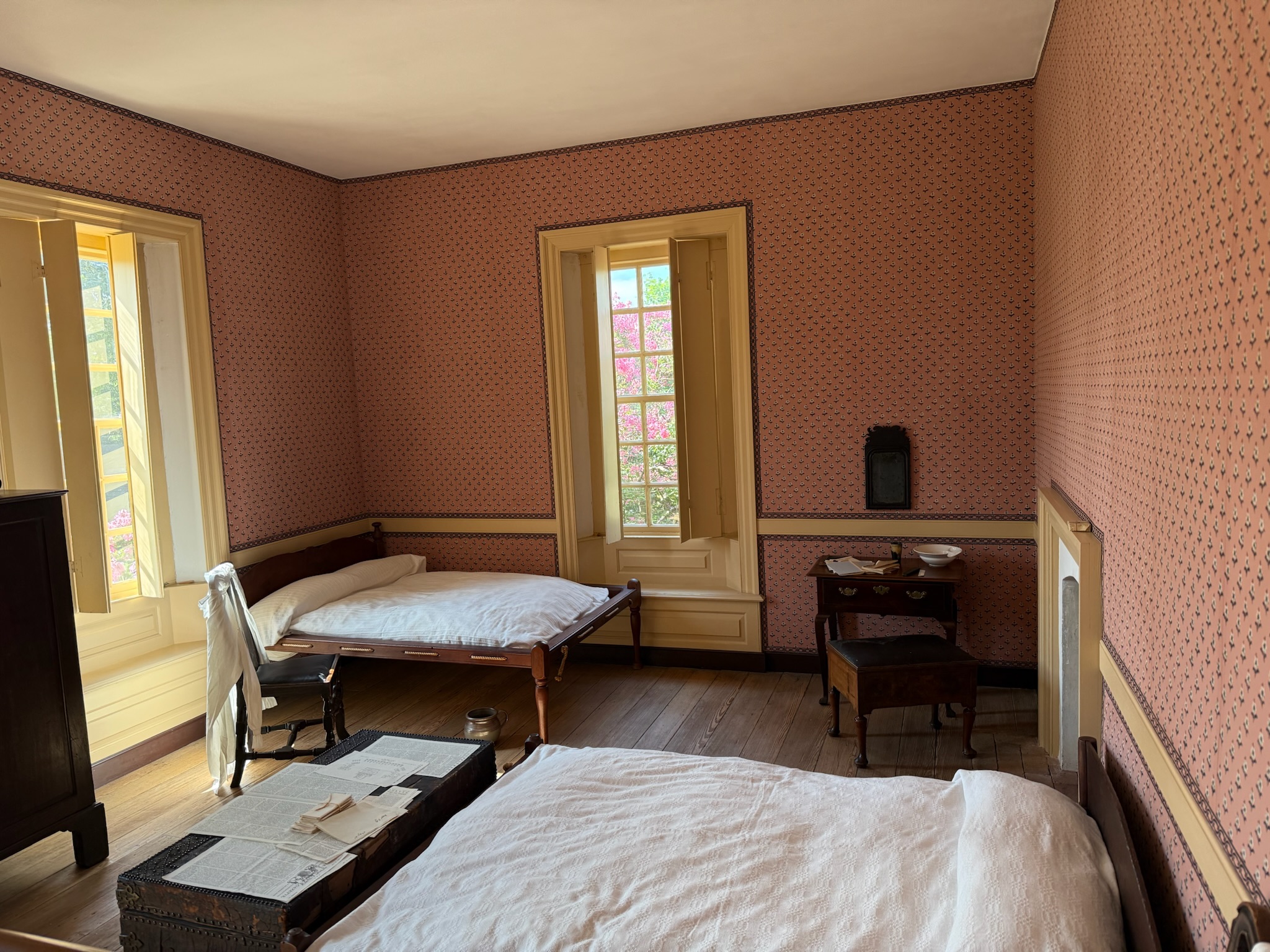
Then we went upstairs. There were 4 bedrooms. Three of the rooms looked very similar to one another.
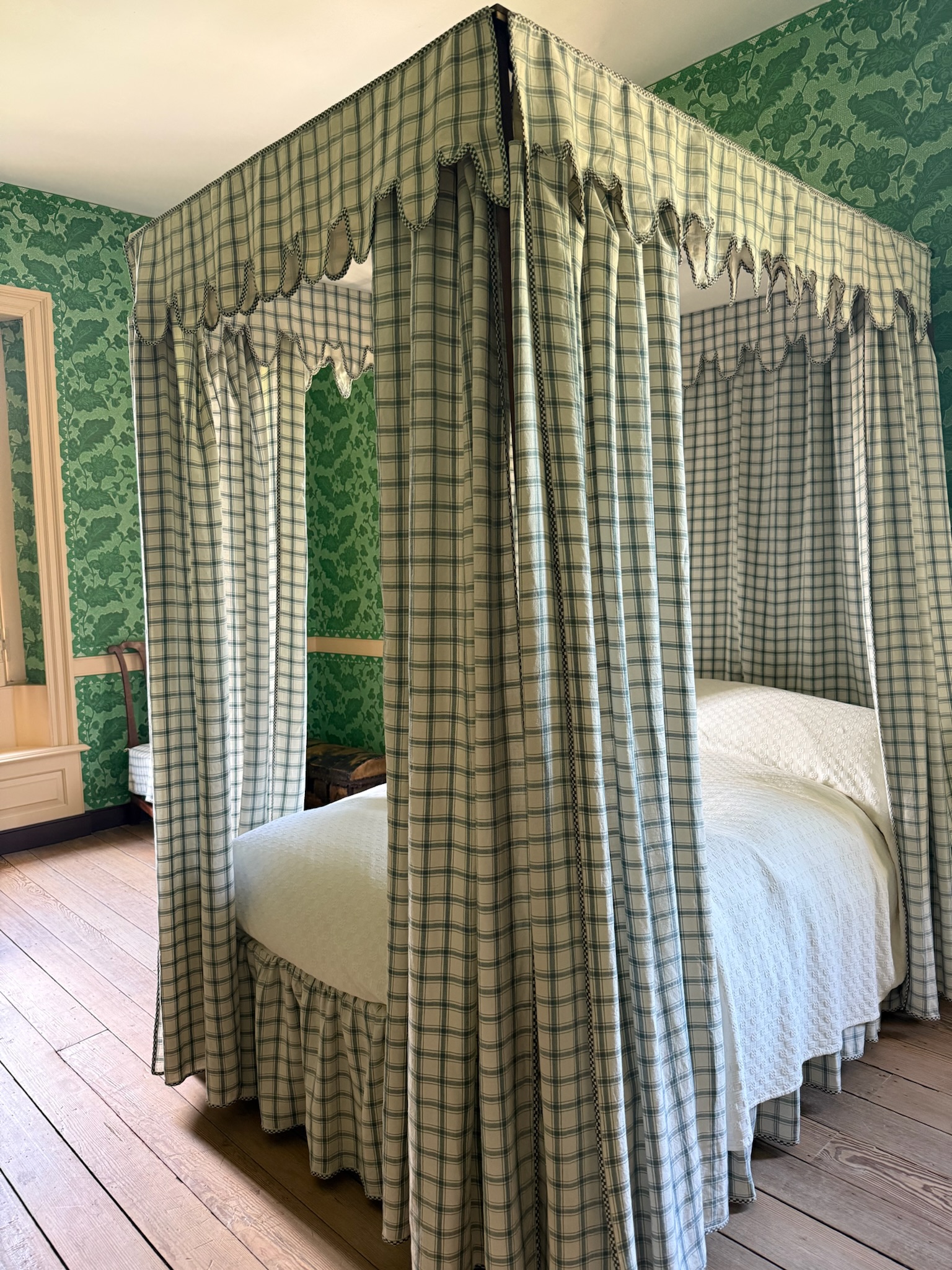
The last room was a little different.
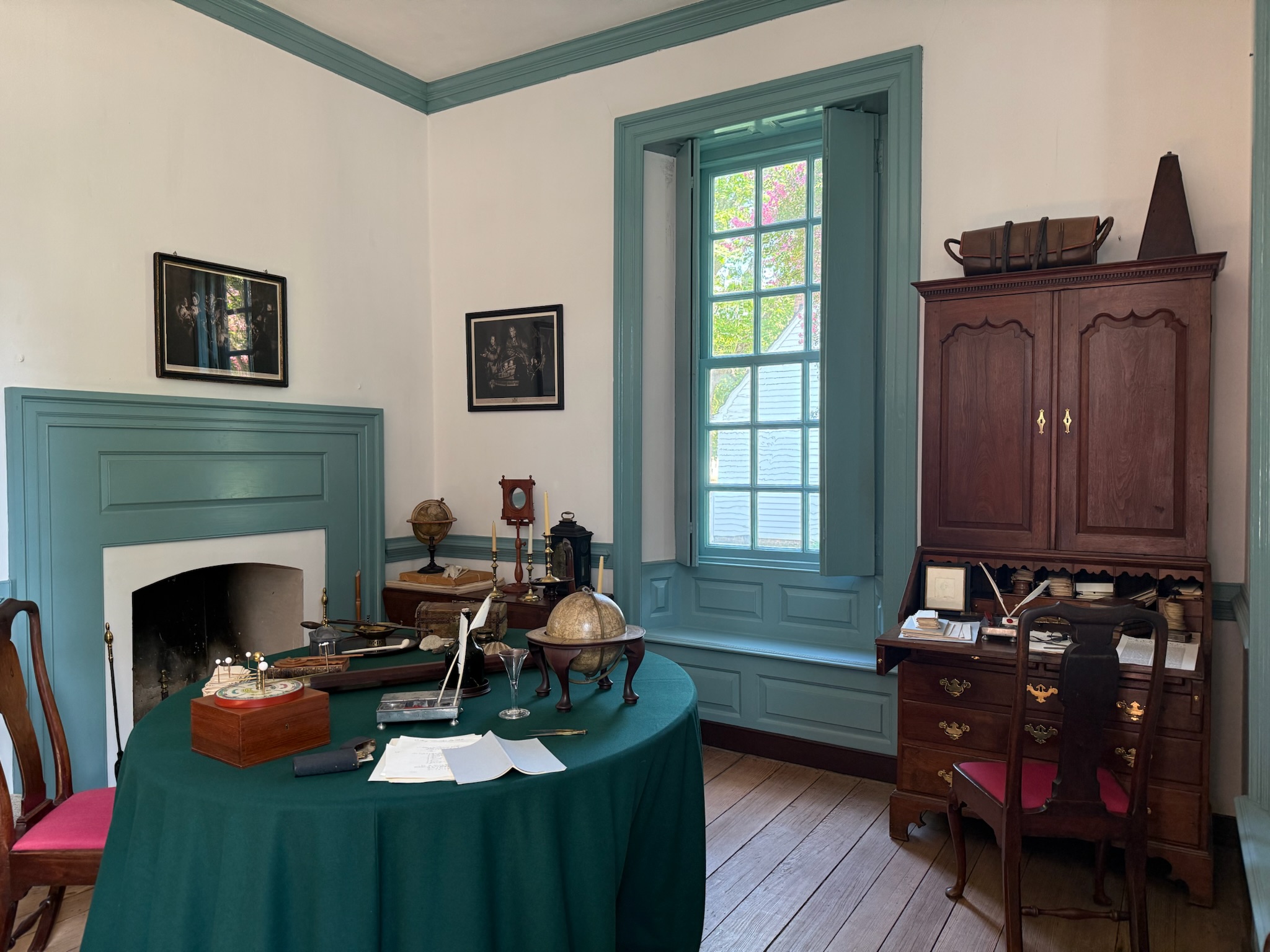
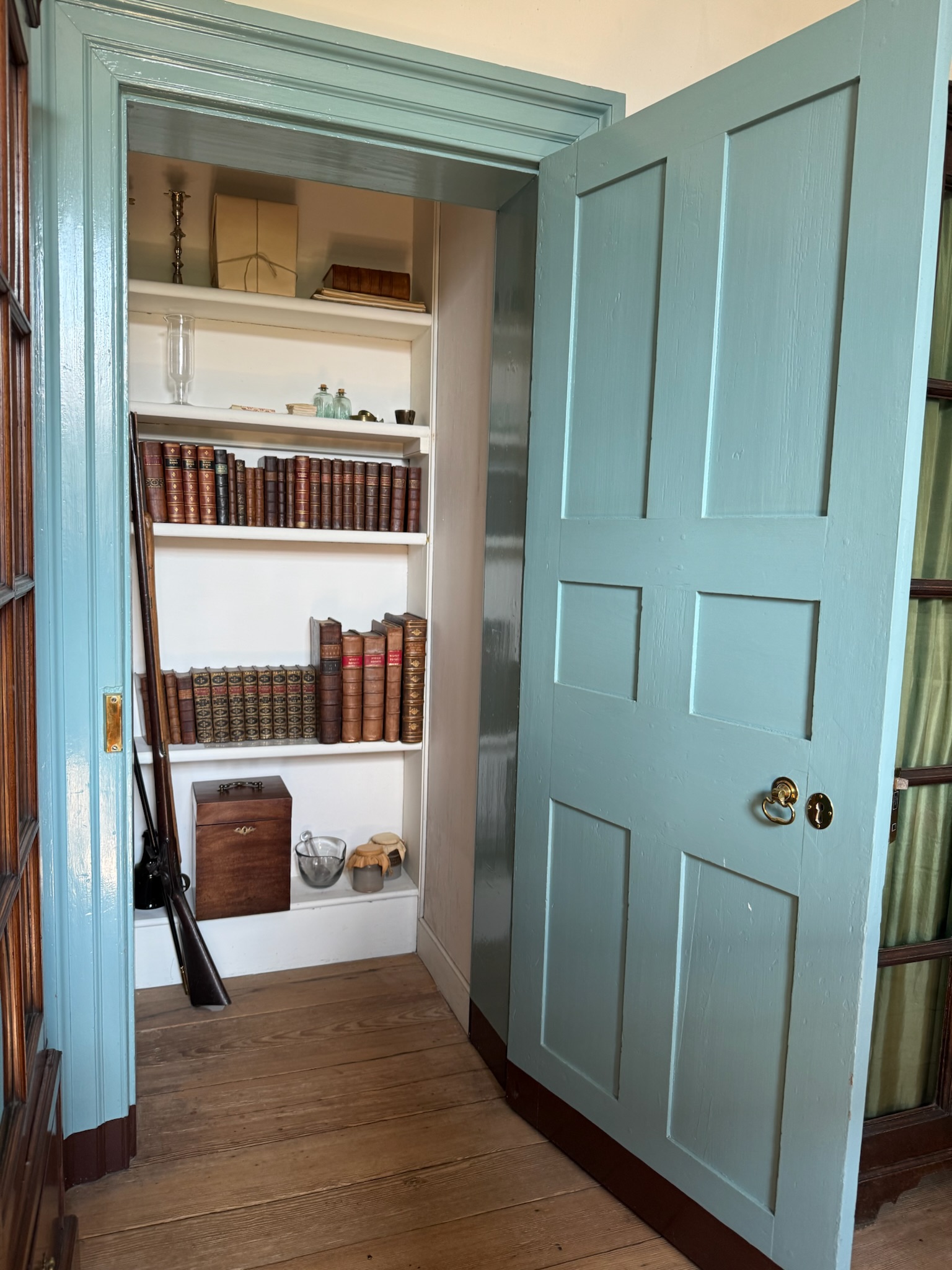
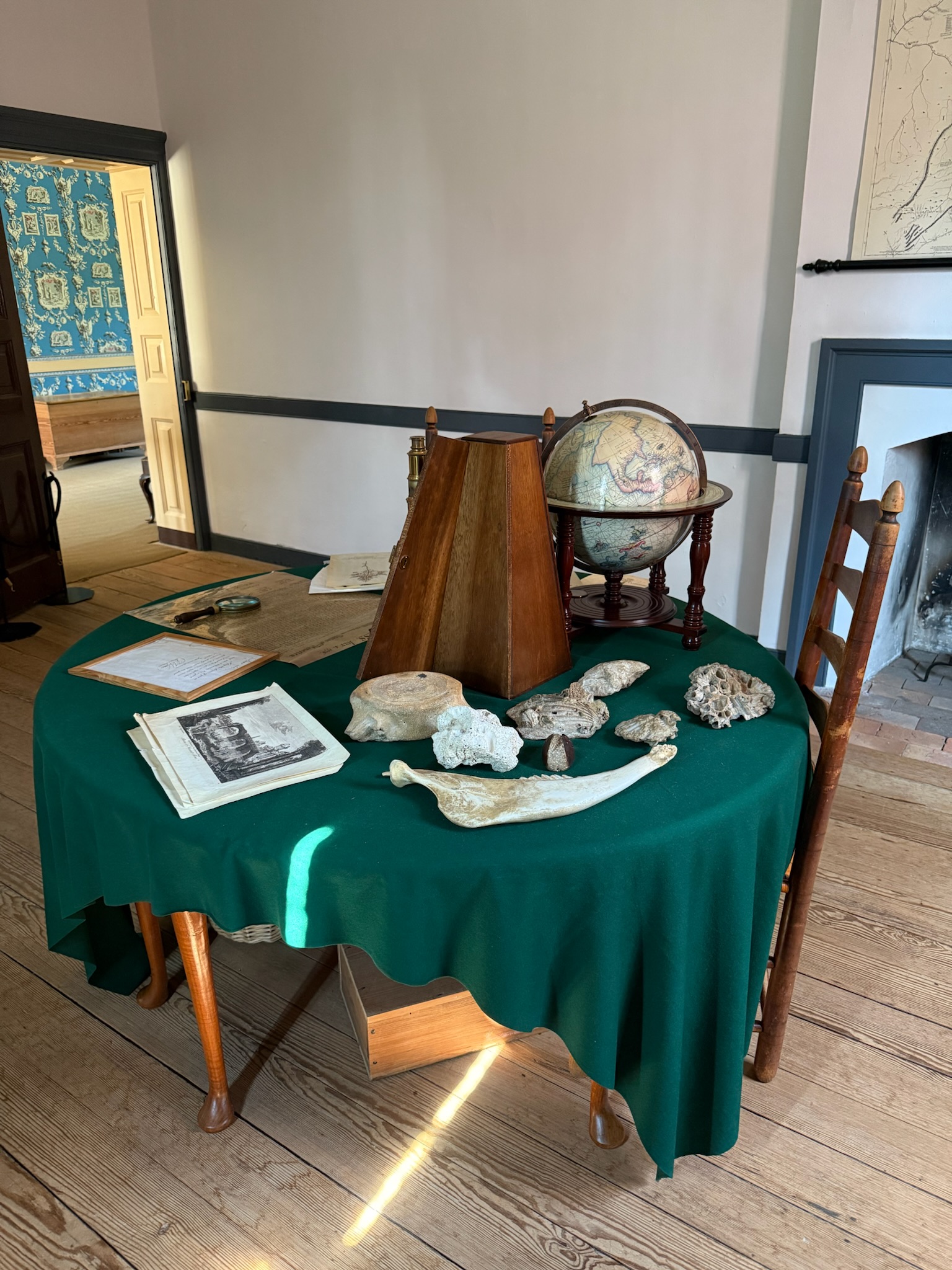
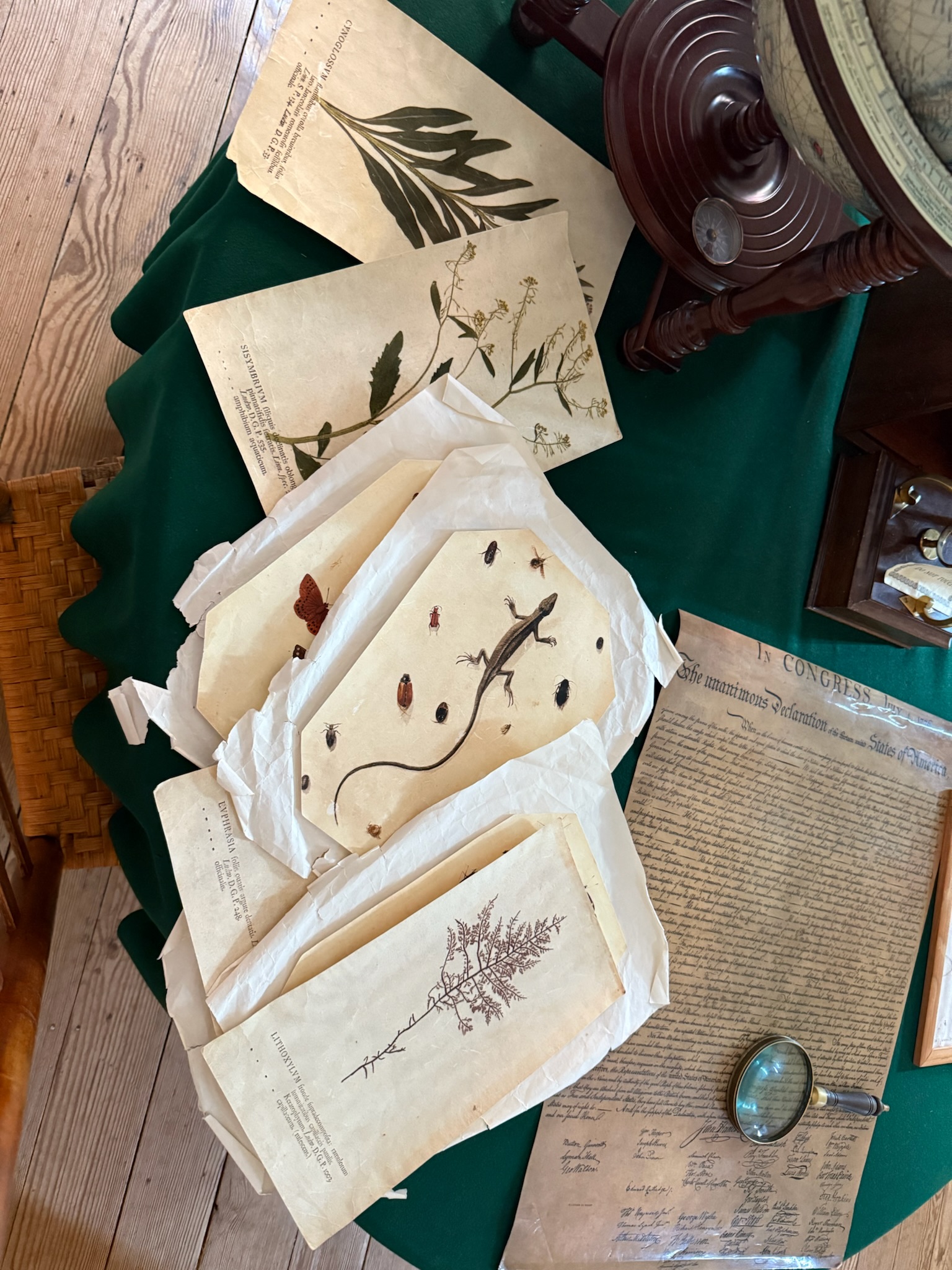
Mr. Wythe had two offices. He was very much of the Enlightenment Era mentality, and thus was dedicated to understanding the world through observable nature and scientific inquiry, which he called “natural philosophy.” He taught this natural philosophy to his law students, too. He was interested in a wide variety of topics, so there was an eclectic assortment of books and other items.
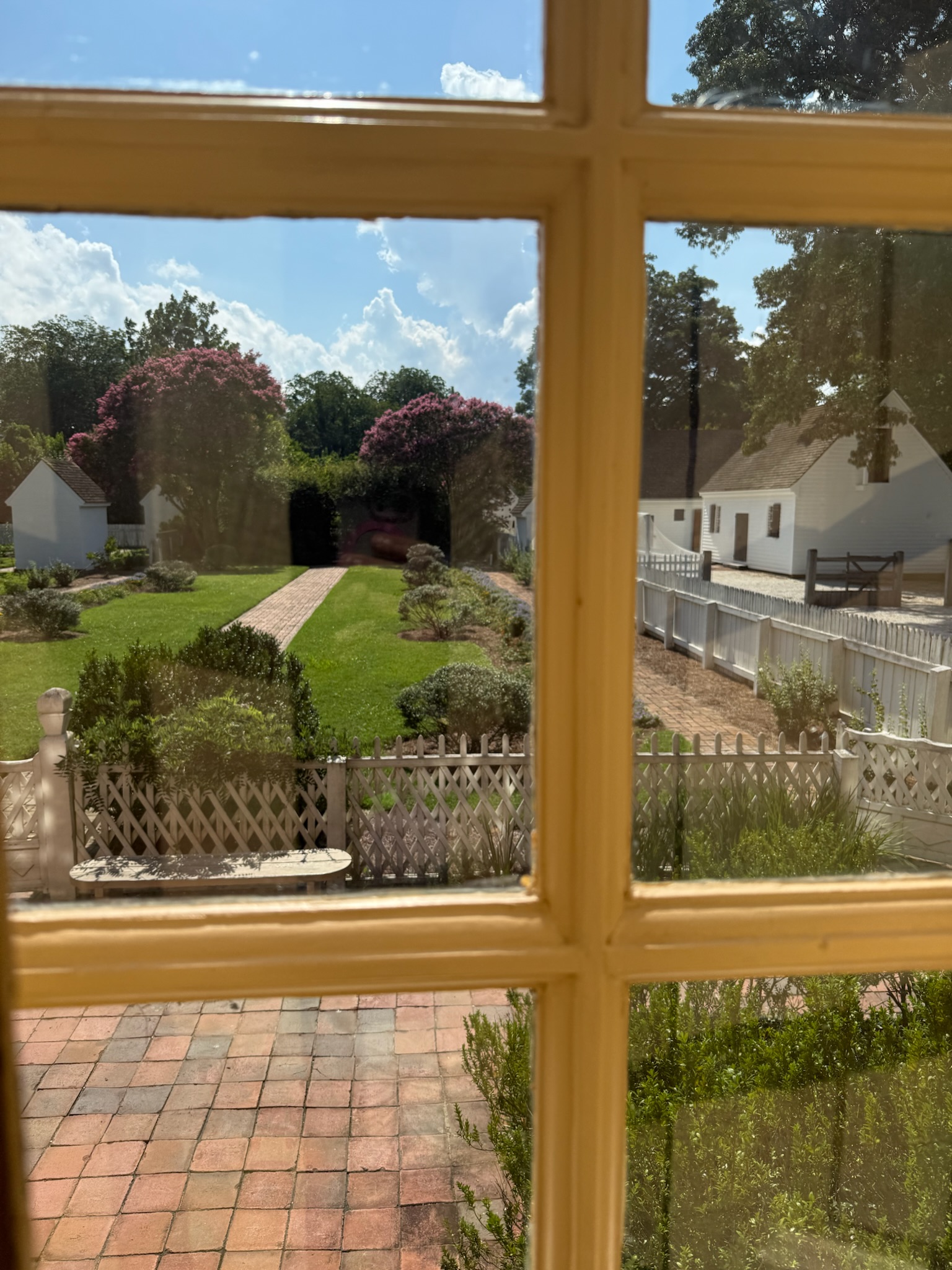
This was the view of the back yard and outbuildings from the back rooms.
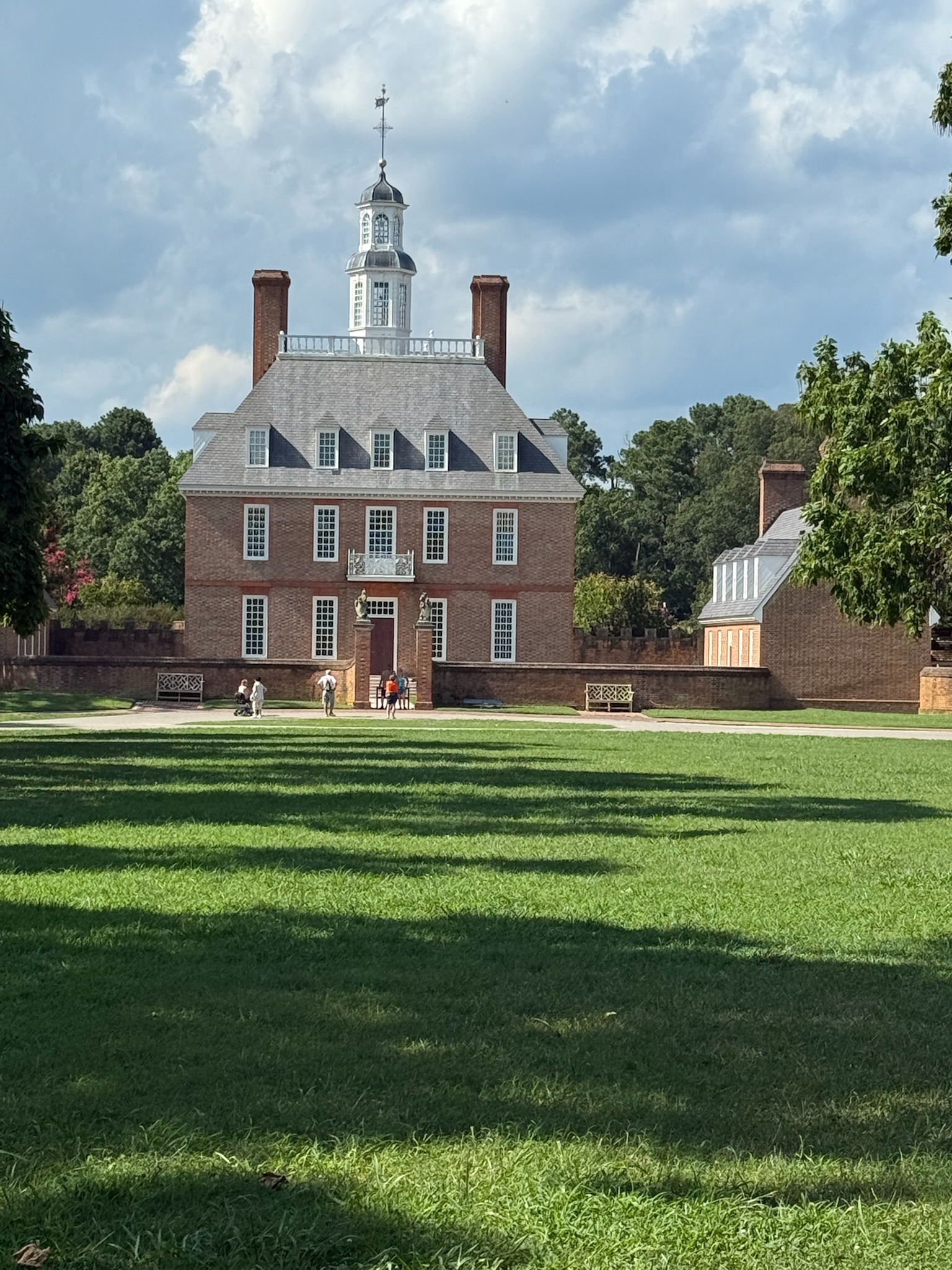
The guides in the house had given us a lot of fascinating information, but at this point, our brains were full, so we didn’t absorb much. It was now 1630. We headed back to bus stop 1. We got a great shot of the palace on the way.
The bus picked us up after only a couple of minutes, and we were hoping we could arrive back at the visitor’s center in time to catch the tail end of the movie. We were glad that we’d gotten on at stop 1. The bus had quickly filled up; halfway through the loop it was standing room only. It took a half-hour to do the whole loop. By the time we returned at 1700, everything at the visitor’s center was closed.
All in all, we’d walked 4.5 miles in the extreme heat. We were all exhausted. We drove straight back to the boat and went to bed early.