continued… In August 1776, a fleet of 30,000 British soldiers arrived in New York Harbor. Washington and his men were driven out of New York and New Jersey into Pennsylvania. On Christmas night, Washington and his men crossed the Delaware River during an icy storm to launch a surprise attack on a garrison in Trenton, New Jersey. The Patriots took 900 prisoners. In an equally bold move, on January 3, 1777, Washington managed to sneak around a large British force and launch a surprise attack on a rear detachment in Princeton, New Jersey. It was another victory.
In September 1777, the Patriots lost a battle at Brandywine, Pennsylvania, and Philadelphia was occupied by the British. In October 1777, Washington doubled down and attacked Germantown, Pennsylvania, but lost again. However, in October 1777, the Patriots won a battle at Saratoga, New York. The soldiers spent the winter of 1777 – 78, in Valley Forge, Pennsylvania. The severe weather and lack of food caused hardship for the soldiers, but Washington had brought in a Prussian veteran to train the soldiers. By the end of the winter, he’d turned the rag-tag squadron into a disciplined and effective fighting force.
In February 1778, France and the United States signed a Treaty of Alliance and a Treaty of Amity and Commerce. France now officially recognized the United States as an independent nation, set up a trading relationship with them, and agreed to protect US trading ships and ports. In doing so, France had officially entered the war. France’s naval power turned the tide.
Once France entered the war, King George decided that the best strategy was to focus on taking the south. The north seemed to be locked in a stalemate with each side winning some and losing some battles. King George believed there were more Loyalists in the south, and thus, with the locals on their side, would have more decisive victories in the south.
The early joint campaigns with the French failed. In December 1778, the British took Savannah, Georgia. In August 1789, the Patriots attacked the British at Camden, South Carolina and failed. In May 1780, the British took Charleston and captured 5,500 Continental troops. At this point, British General Cornwallis was put in charge of the British troops in the south. Though the Continental Army in the south was mostly wiped out, the few of them left, along with several small militia groups, kept fighting small skirmishes where they utilized guerrilla warfare tactics. While they lost the majority of these skirmishes, they succeeded in drawing the British farther inland, away from their supply ships.
The next big battle was in March 1781, at the Guilford Court House in North Carolina. British General Cornwallis won the battle, but suffered heavy losses. As Charles James Foxx said “Another such victory would ruin the British army.” Seriously weakened, Cornwallis decided to move his army up to Yorktown and set up his winter base there.
Meanwhile, four regiments of French soldiers had joined Washington’s men up north. In August 1781, Washington and his French counterpart, the Compte de Rochambeau, hatched a plan to trap Cornwallis at Yorktown. The Continental army endured a grueling 400-mile march south. Meanwhile, in early September, a French navy fleet under Admiral de Grasse successfully stopped British naval reinforcements that had been sent to help Cornwallis, so Cornwallis was low on troops and supplies. After the battle, De Grasse ran from the Chesapeake and the British followed him, leaving the mouth of the Chesapeake unguarded. Another French naval fleet then moved his troops into the Chesapeake, and now Cornwallis was blocked from being able to escape by boat. The Continental Army arrived in Williamsburg on September 26. Two days later, the 15,000 troops surrounded the encampment at Yorktown, both on land and on the river. 1/4 of the troops were the American Continental army, 1/2 were French soldiers, and 1/4 were militia.
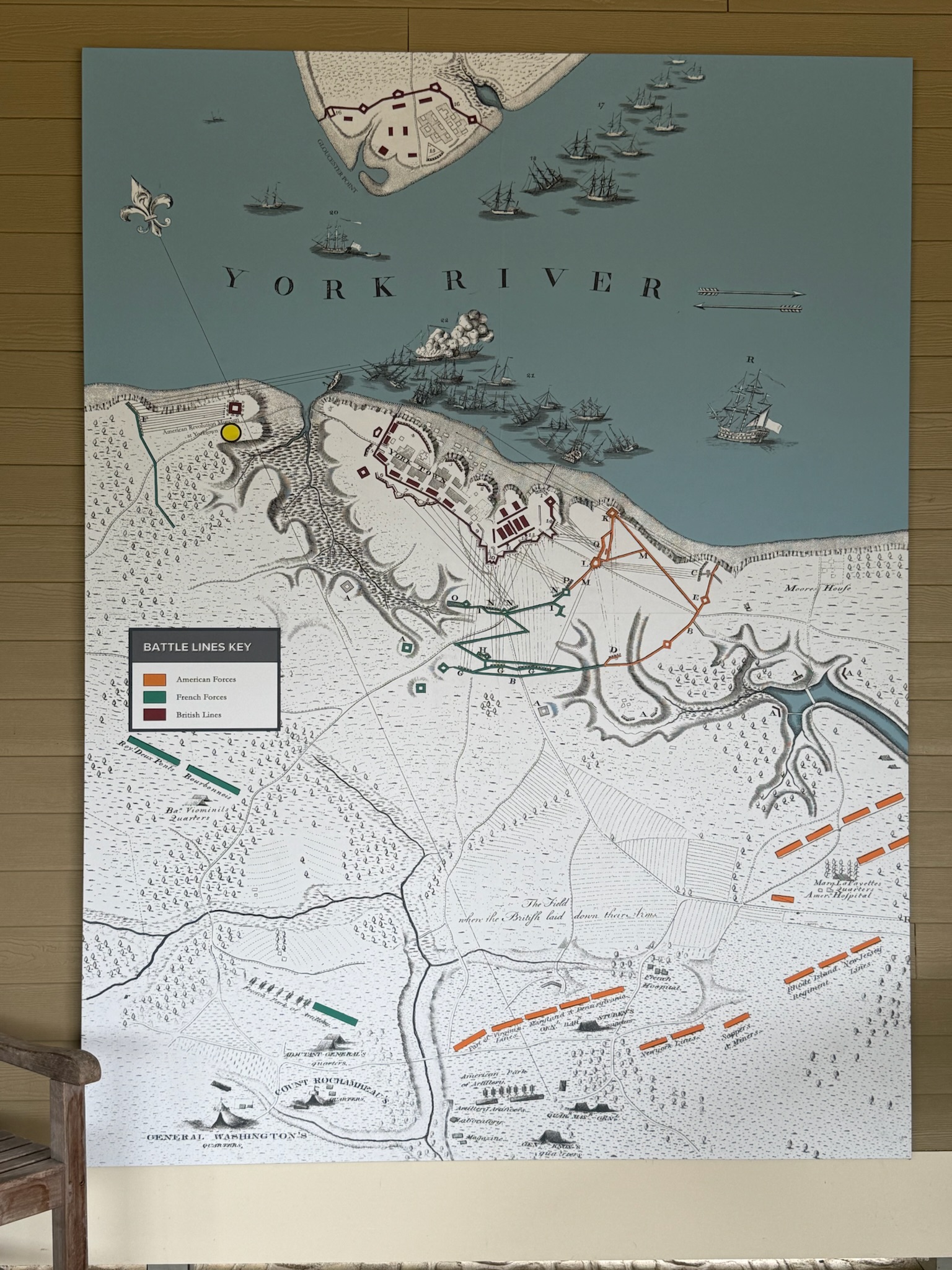
On October 6, during the night, the Patriots began digging siege lines. Three days later, they start bombarding the British with military fire. October 14 was the high point of siege, when Patriots capture redoubts 9 and 10 during the night, allowing them to bring their artillery closer to the British. At this point, the patriots were shooting 1,500 rounds of artillery per day, more than one round per minute. By October 16, British supplies were running low. Due to a bad storm, Cornwallis failed to escape across the York River. The next day, he began discussing terms for surrender. On October 19, Cornwallis surrendered and 7,000 British troops were captured. This loss was the last straw for the British Empire. The war was expensive and unpopular with the public, who believed it was unwinnable. In March 1782, formal peace negotiations began, with the primary concern being land boundaries.
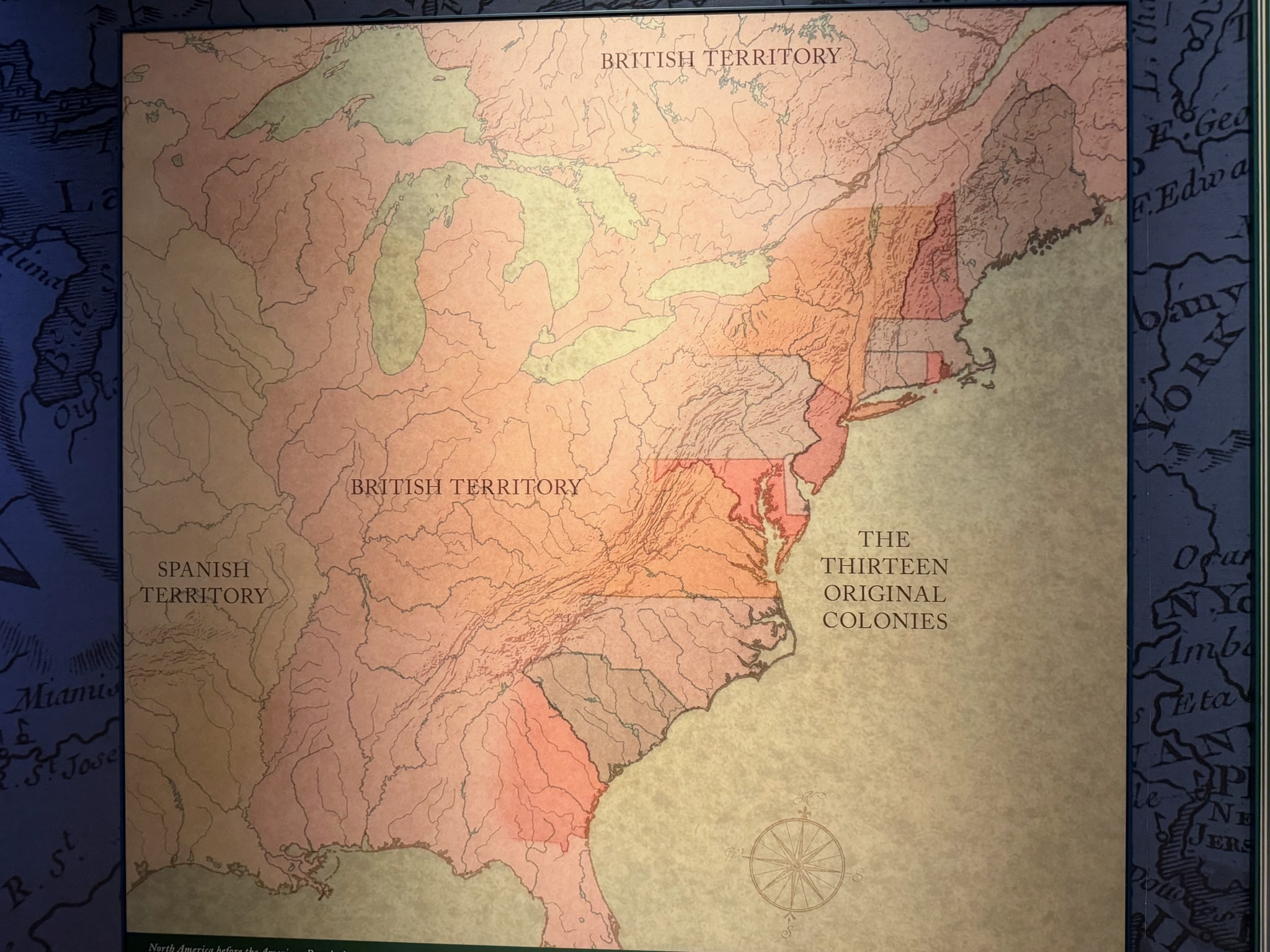
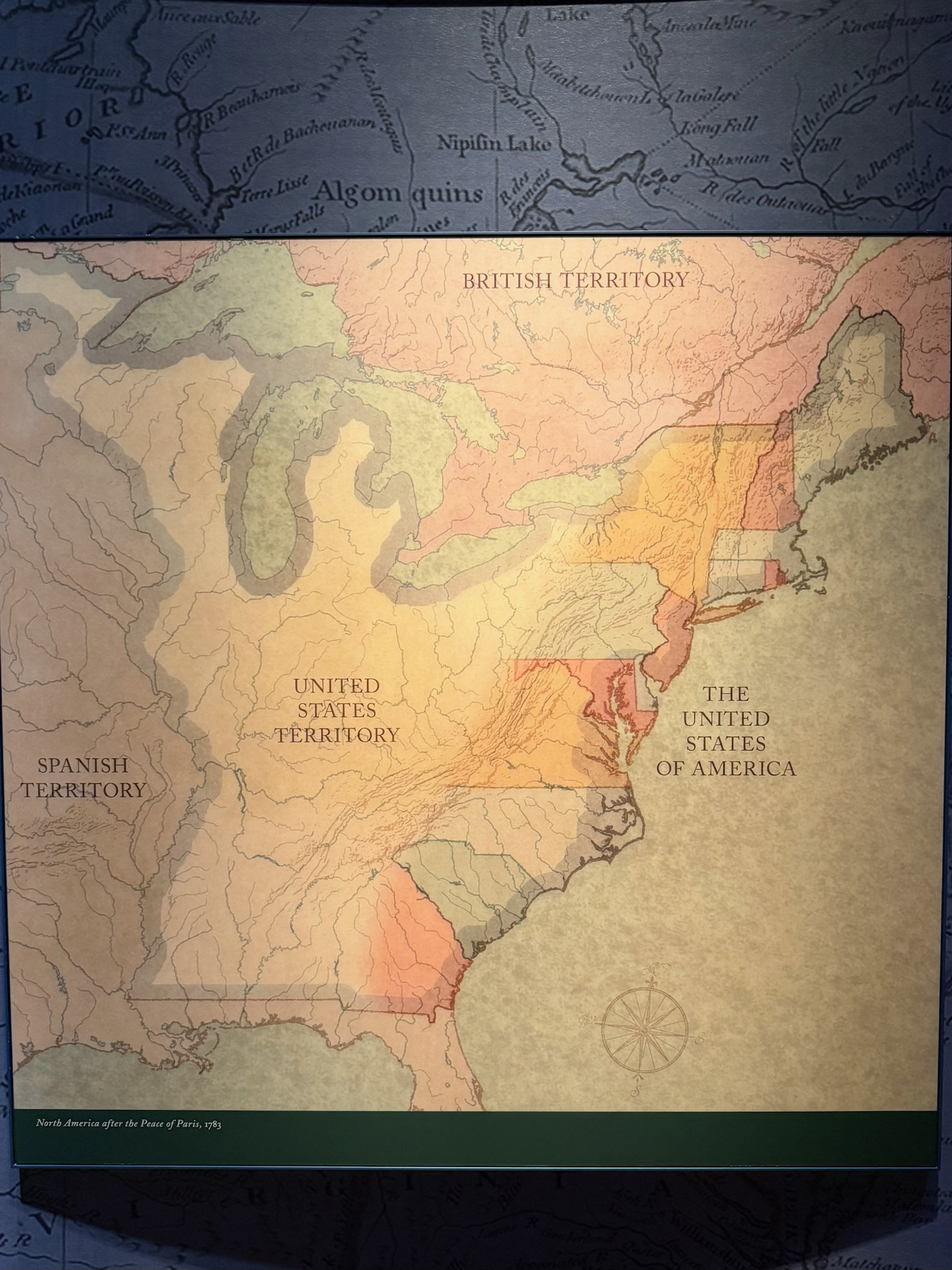
Even with peace negotiations underway, the fighting didn’t end until the negotiations were completed – though it sounded like there were no more giant battles, just skirmishes. A tentative agreement was signed on November 5, 1782. The final treaty was signed on September 3, 1783 in Paris and is now referred to as The Treaty of Paris. The last British troops left the new nation in November 1783.
At this point in the museum, there was a small theater that showed a video re-enacting the last battle. The video had incredible special effects; in addition to the usual surround sound and special enhanced lighting, the theater was filled with scents and vibrations. Keith loved the video and watched it twice.
Once the movie ended, we went back to the museum exhibits. The next few exhibits focused on the aftermath: what happened to various groups and the struggles the new nation faced.
The British had relied heavily on the Loyalists, AKA Tories, and Native Americans to fight for them. It was estimated that about 20% of Americans were Loyalists, however, the British had a hard time recruiting white Loyalists to serve. As we’d learned in Ft. Monroe, Loyalists were severely punished for their political views, so they’d learned to keep their mouths shut. The British enticed slaves to escape and fight, promising them freedom when the war ended. Between the whites and blacks, only about 1/3 of the fighting forces were Loyalists. The information here conflicted slightly with the information at the Mobile Museum. Here, they said 60,000 Loyalists fled the US after the war, and up to 10,000 of them were black former slaves. It also noted that many escaped to Florida, which was then a British colony that had not been fighting for separation. However, when the war ended, the majority of Loyalists stayed in the US, particularly the ones who had been quiet about their views and thus hadn’t had their property confiscated.
The war was devastating for the Native Americans. Some of the Native American tribes fought for the Tories, some fought for the Patriots, and some remained neutral. Both the Patriots and Tories were especially harsh and vindictive towards the Natives on the other side. Both the Tories and the patriots considered the neutral tribes to be on the other side. After the war ended, the Americans refused to honor previous peace treaties made with the British.
Since the British were having a hard time getting enough soldiers who were already in America, the British brought in German mercenaries to supplement the troops. At points, as many as 1/3 of the troops were mercenaries. It was estimated that 5,000 Germans stayed in the US after the war.
Meanwhile, since the Americans had a poor navy, the Americans had commissioned 2,500 privateers, which were privately-owned ships paid to attack and seize British merchant ships. Over the course of the war, nearly 2,000 ships were seized. The proceeds of the seized cargo was divided up between the ship owner, crew and the American government. This strategy forced British warships to focus on protecting their merchants versus focusing on attacking the colonies.
After declaring independence back in 1776, the Continental Congress worked on forming a central government as the war raged around them. By November 1777, they had adopted The Articles of Confederation, which was the first constitution of the US, but it wasn’t ratified by all 13 states until 1781. The states were sovereign entities and the national government had limited powers. Each state had one vote, regardless of population.
Once peace was achieved, they found it impossible to have a functional government with such extreme limits. They had no power to levy a federal tax, so they couldn’t raise revenue to pay back the war debts. They had no power to draft, so they couldn’t create a national military nor pay for a volunteer military — and they needed one to keep the British accountable to the Paris Treaty. And with no federal court system, there was no mechanism in place for resolving disputes between the states, especially regarding competing claims on which states owned the newly acquired lands out west. The new leadership was also having trouble regulating commerce, especially interstate.
The US experienced an economic depression from 1784 – 1787. Unsurprisingly, Great Britain bought less US exports. A shortage of capital restricted the expansion of domestic industries. Small farmers were increasingly going into debt; people were losing their farms to foreclosure and going to debtors prison. People began to petition and protest, demanding relief. In the autumn of 1786, there was an organized, armed rebellion in western Massachusetts called Shay’s Rebellion. It took until February 1787 for Massachusetts’s militia to quell the rebellion.
A few factors eased the depression. The primary was building a trade relationship with other European nations and China. Commercial banking also began with the Bank of North America. Some individual states offered loans, tax breaks and/or protective tariffs to help grow certain industries such as iron, steel, textiles, paper, pottery, shoes and gunpowder, and the industries did eventually grow into powerhouses — however, sometimes policies that helped one state harmed another, which increased the need for the federal government to be able to resolve disputes between the states.
There was a big debate about how to fix these federal problems. Federalists wanted strong federal powers, but the Anti-federalists feared the power could lead to tyranny all over again. In May 1787, the Federal Constitutional Convention met about revising the Articles of Confederation. They decided to scrap it altogether. Instead, they implemented a radical new system of government that had been, up until that point, just a popular Enlightenment theory on how an ideal government would operate: a strong federal government with a separation of powers and a system of checks and balances.
There would be three branches of government: the executive, the legislative and the judicial. The legislative would have two houses: the senate, where every state had two representatives, and the House of Representatives, where the number of representatives was proportional to the population of that state (slaves counted as only 3/5 of a person).The Bill of Rights was also created to protect individual rights, which quelled the fears of the Anti-Federalists. This frame work balanced freedom with order, rights with responsibilities, and ensured that the government would serve the people.
In September 1787, delegates at the Philadelphia convention agreed on a final draft of the new federal constitution and sent it to the states for approval. In April 1789, the first congress under the new constitution convened in New York, and George Washington was inaugurated as the first US president.
During the Revolutionary years, more and more people opposed slavery since it directly contradicted the principals of freedom that were the foundation of the United States. By 1784, five states had passed laws to end slavery altogether in their own states, and most states had banned the importation of international slaves. The Continental Congress discussed a federal ban, but for the states that relied on agriculture, it wasn’t politically or economically viable to end slavery. So the federal leadership kicked the can down the road by inserting a provision in the constitution that trans-Atlantic slavery couldn’t be banned for at least 20 years. This museum didn’t say this, but we remember reading at one of the other museums that the leaders had reckoned that within 20 years they would have worked out viable economic and political alternatives.
All throughout the museum were displays about individuals who had played important roles on both sides of the conflict during the era that the museum covered — maybe as many as 1/5 of the displays were on the various individuals. We learned more information on people who we’ve frequently heard about, such as John Adams and Benjamin Franklin, and we learned about many people that we’d never heard of before, such as John Sullivan. Sullivan was a general in the Revolution credited with decimating the Iroquois settlements in Western New York (the Iroquois were allied with the British), and later became governor of Connecticut.
Probably the most interesting was Benedict Arnold. We knew he was a traitor, but we’d never learned what he’d actually done. For five years, he’d commanded Patriot forces, playing major roles in American victories. The sign said “No officer was more imaginative, daring or courageous. Despite his success, he was not promoted. Frustrated and bitter,” Arnold became a double-agent for the British in 1779. In 1780, he was commanding the fort at West Point, where he was planning to “lose” to the British, but the scheme was caught by the Patriots. Arnold then joined the British army, where he led forces in battles against the Patriots in Virginia and Connecticut. He left America in 1782.
Another interesting person was a Spaniard named Bernardo de Galvez who was governor of Louisiana. From 1779 – 1781, he waged a military campaign against the British in Mississippi, Alabama and Florida. This diverted the British military away from the Patriots. He was credited with helping the Patriots win the Revolutionary War with these diversions.
After we finished at the museum, we went back to the military area for the cannon firing demonstration… to be continued…