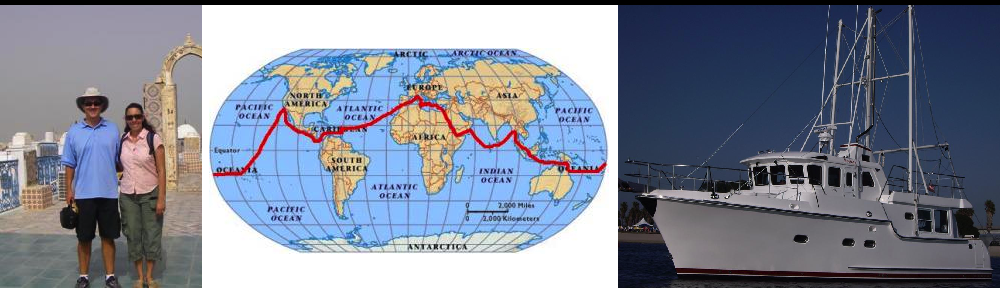
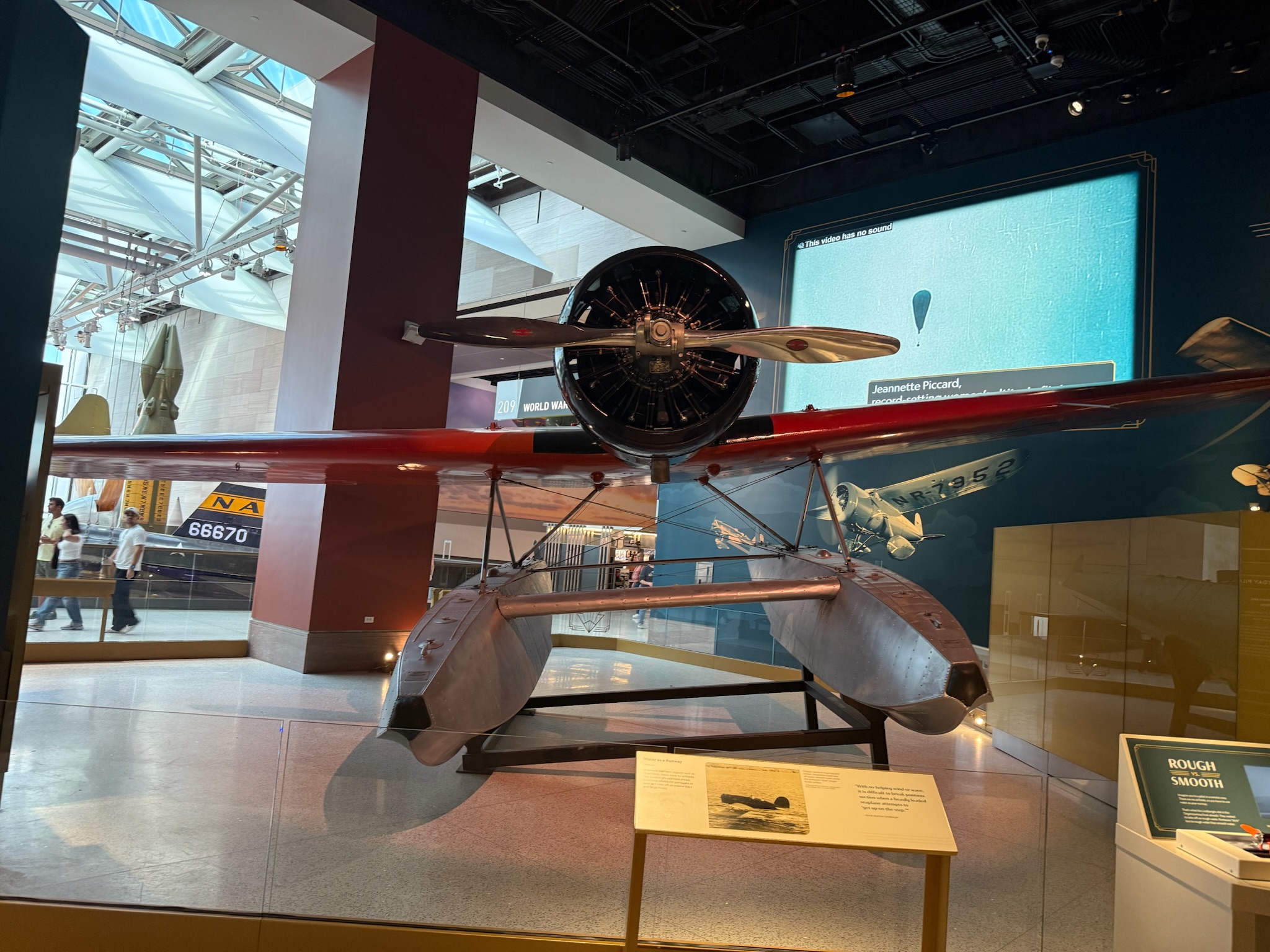
continued... Charles Lindbergh went on to set more records. The one that we found most notable was In 1931 and 1933, he and his wife, Anne, traveled in an airplane to five continents via never-before-flown routes. Ships supplied them with fuel and oil. They carried supplies to maintain and repair the plane and did the work themselves. They tried to plan stops where there was lodging and meals, but they often slept in the plane and ate canned rations. Sometimes, the landings were on a body of water and they’d spend the night anchored. When they knew they would be doing a water landing, they’d switch their wheels for pontoons.
Anne was one of the first women — maybe even the first — to get a glider pilot license in 1929. She earned her pilot’s license in 1931. He operated the radio (in morse code) and took over flying when Charles slept or took sextant sightings. We believe this was the Lindbergh’s plane.
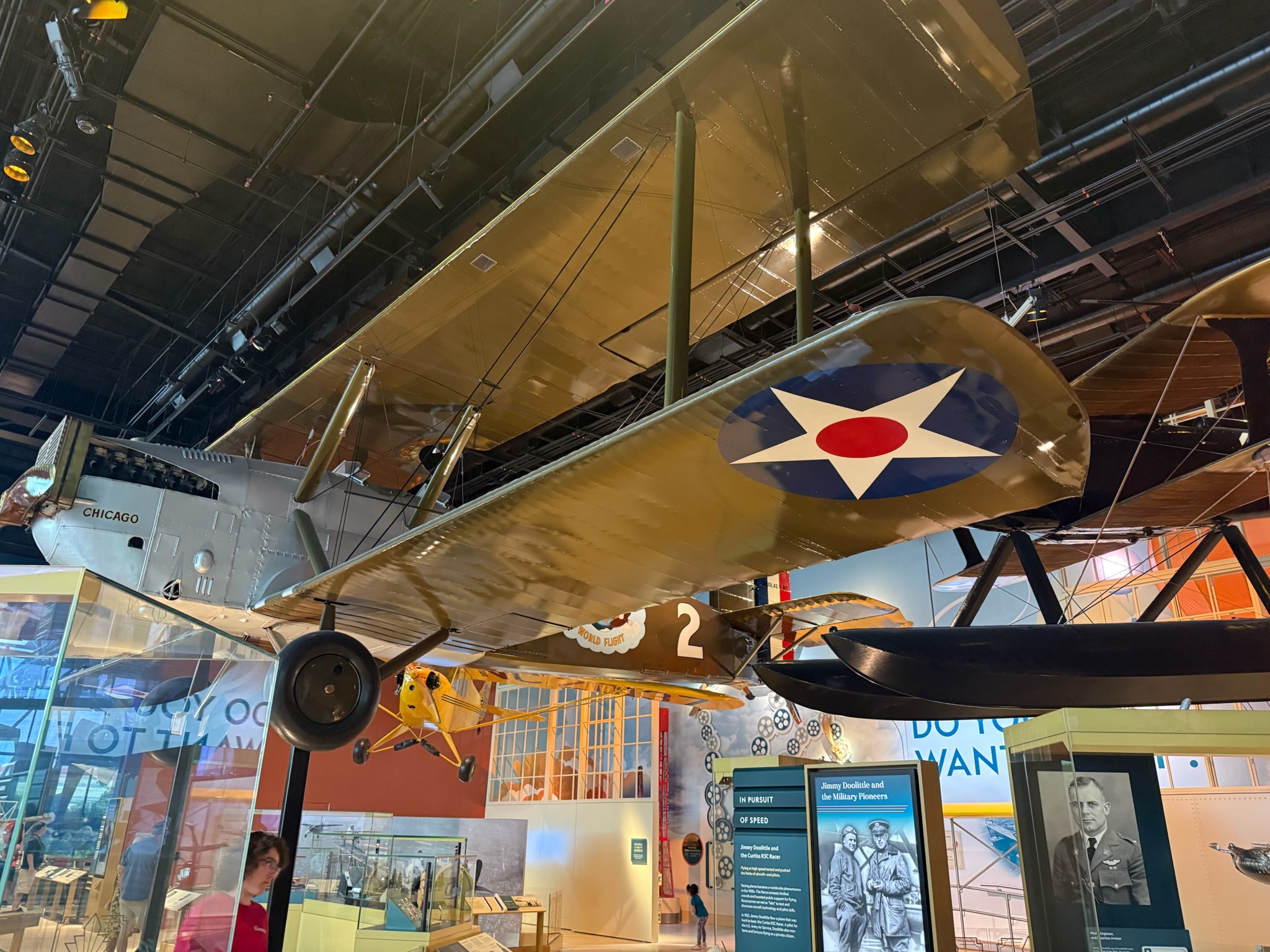
Another large display was about the US Army’s around-the-world trip in Douglas World Cruisers in 1924. The craft had originally been a torpedo bomber that had been modified after World War I. The goal was to prove that an airplane could make it around the entire globe and to show the value of the new US Army’s Air Service. They sent out four of these 2-seat biplanes, each with 2-men crews. Seventy-four landing sites had been pre-selected. US Navy escort ships followed below. At each landing site, the ship’s crews helped with maintenance, repairs, and refueling. The ships carried 35 replacement engines. Like the Lindbergh’s they often had to change back and forth between wheels and pontoons. The signs didn’t say how the Lindbergh’s managed to switch between the two, but for the Douglas World Cruisers, the ships would lift the planes out of the water with a crane. Two planes completed the 27,553-mile journey, which spurred global air travel and trade. We think this was the plane, but again, it was hard to match the planes hanging from the ceiling with the signs on the ground.
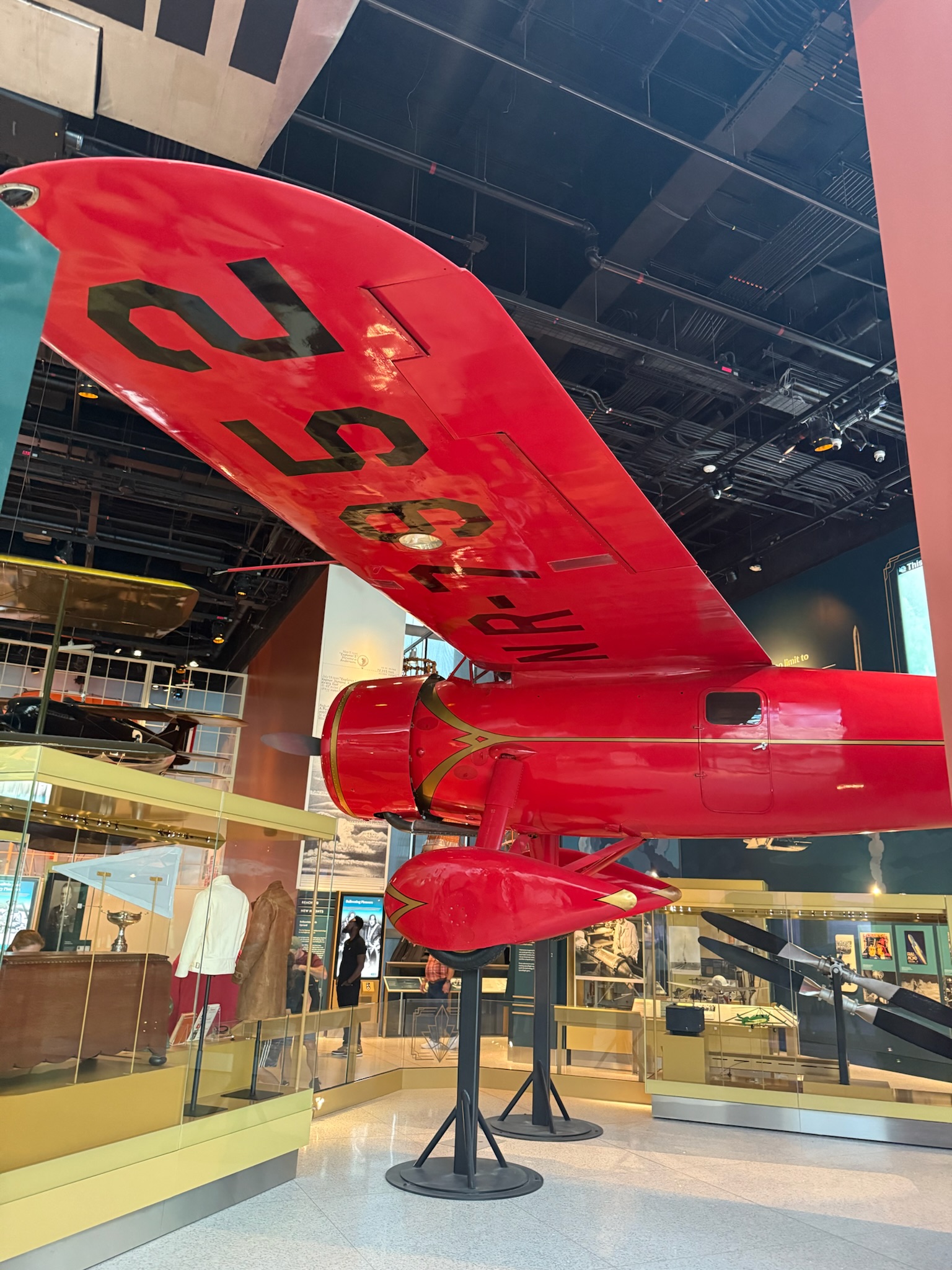
There was a display about notable record-setting pilots that were female or black, including Jackie Cochran, Amelia Earhart (who broke numerous records before disappearing on her around-the-world trip), and C. Alfred Anderson and Albert E. Forsythe (who were the first black people to fly roundtrip across the US). This was a Lockheed Vega 5-B, which once belonged to Earhart. Apparently, the Vega was used in many record-breaking flights by many different pilots.
There were displays about people who were pivotal in bringing the black community into the world of aviation. Cornelius Coffey, John C. Robinson, and William Powell had each focused on helping blacks become pilots and mechanics by starting associations, schools, publications and all-black air shows.
There was a display about Barnstormers, people who went around the country doing aviation stunt shows and giving airplane rides. Many were previous WWI pilots… and many were people who didn’t really know what they were doing. The shows were very popular across the country… but they weren’t safe. Barnstorming came to an end in 1926 when the government began licensing pilots, mechanics and aircraft.
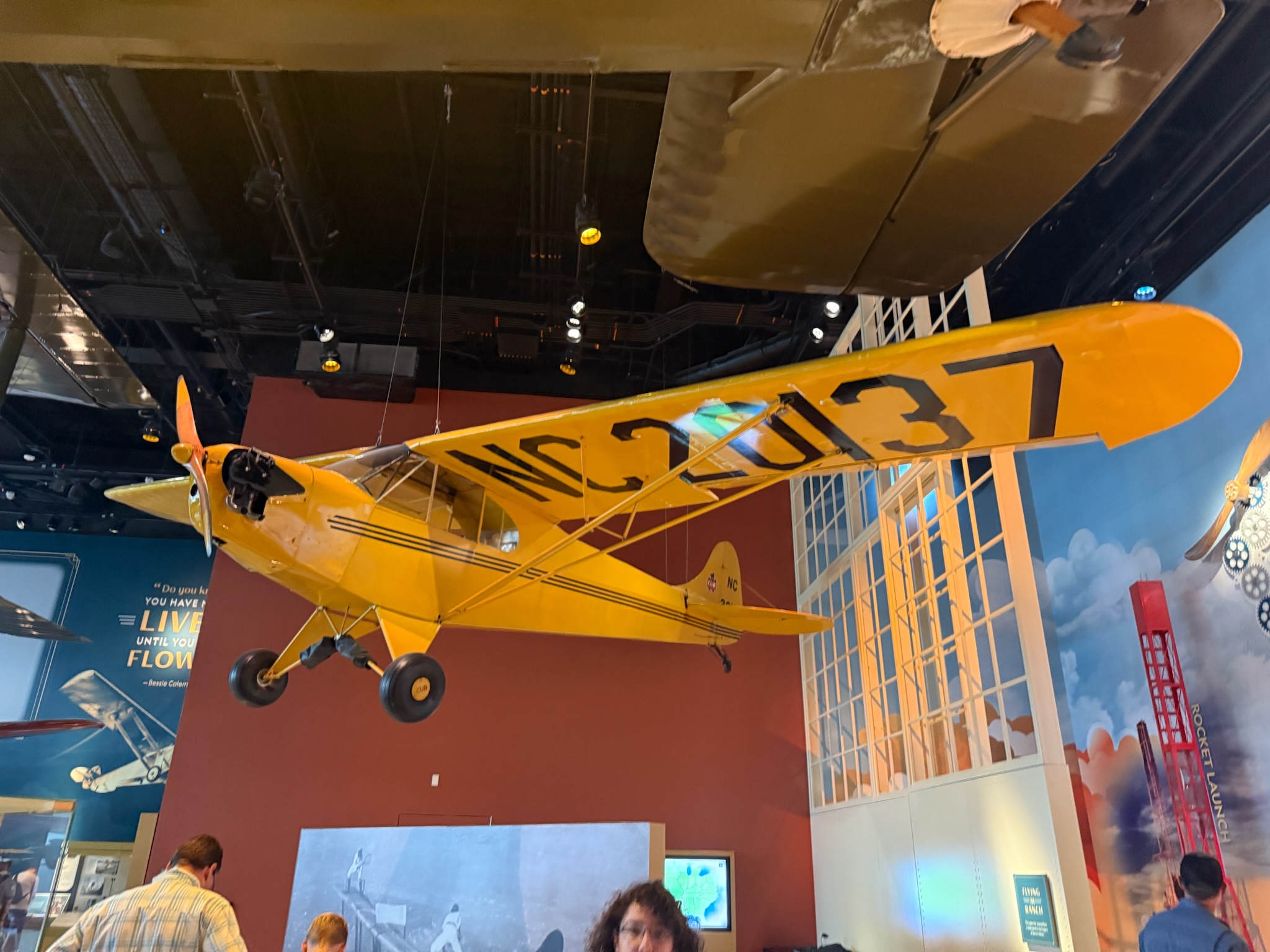
Barnstorming allowed everyday Americans to see planes up close, and it led to an airplane rage. In 1928, 1500 people had pilots licenses, and by 1938, 25,000 people had licenses. There was also a demand for affordable aircraft for personal use. Light planes were introduced, which were easier to fly and less expensive than other aircraft. The most popular was the Piper J-2 Cub, which we think is what is in the photo below.
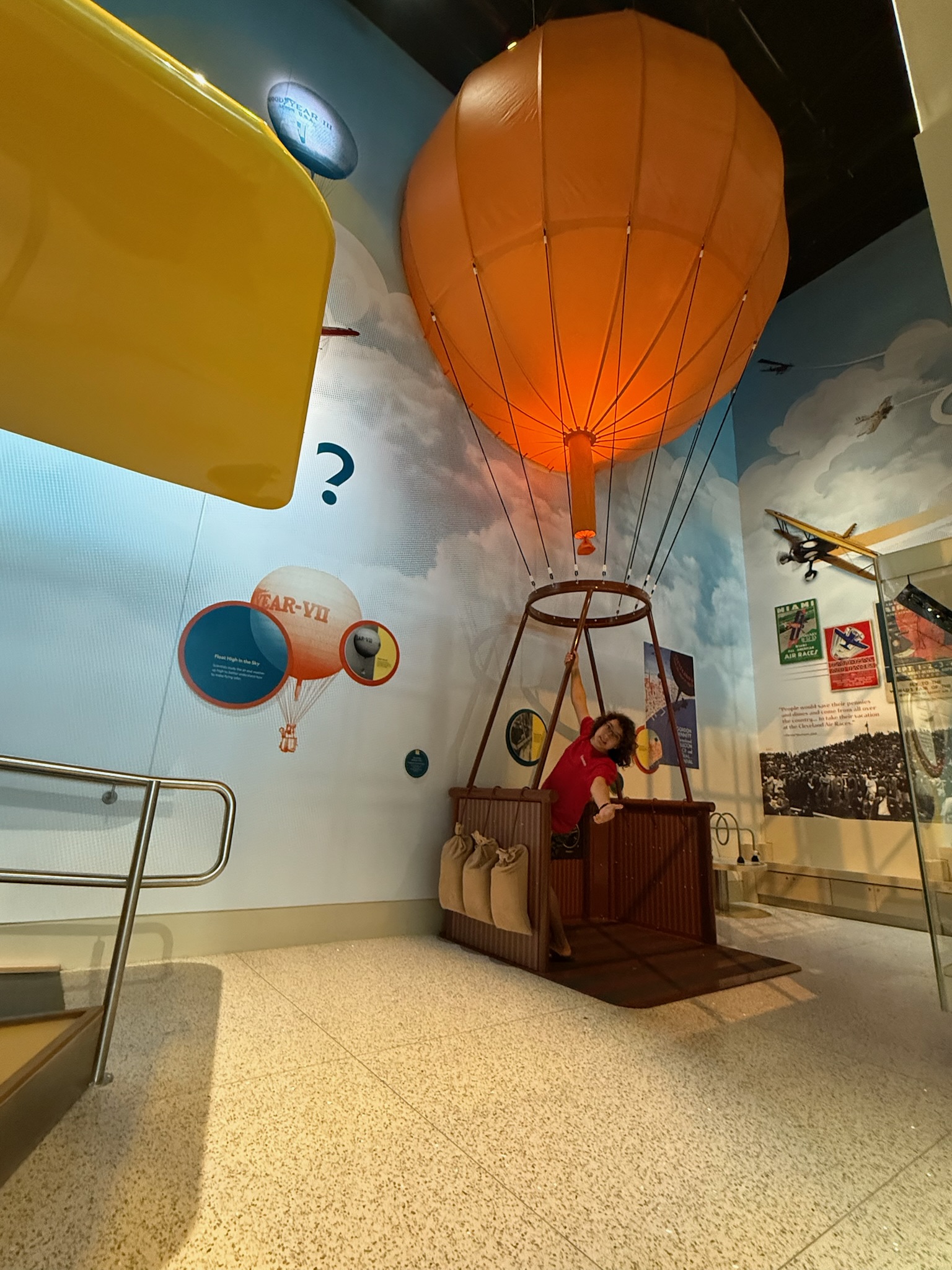
There was a display about hot air balloons. From 1931 – 1939, Belgium, Poland, Spain, the USSR and the USA competed to see who could go the highest. In 1934, the first person to reach the stratosphere was an American woman named Jeanette Picard, rising over 57,500 feet. No further details were given, but it must not have ended well because another sign said that it wasn’t until 1931 that the first people safely returned to earth after reaching the stratosphere.
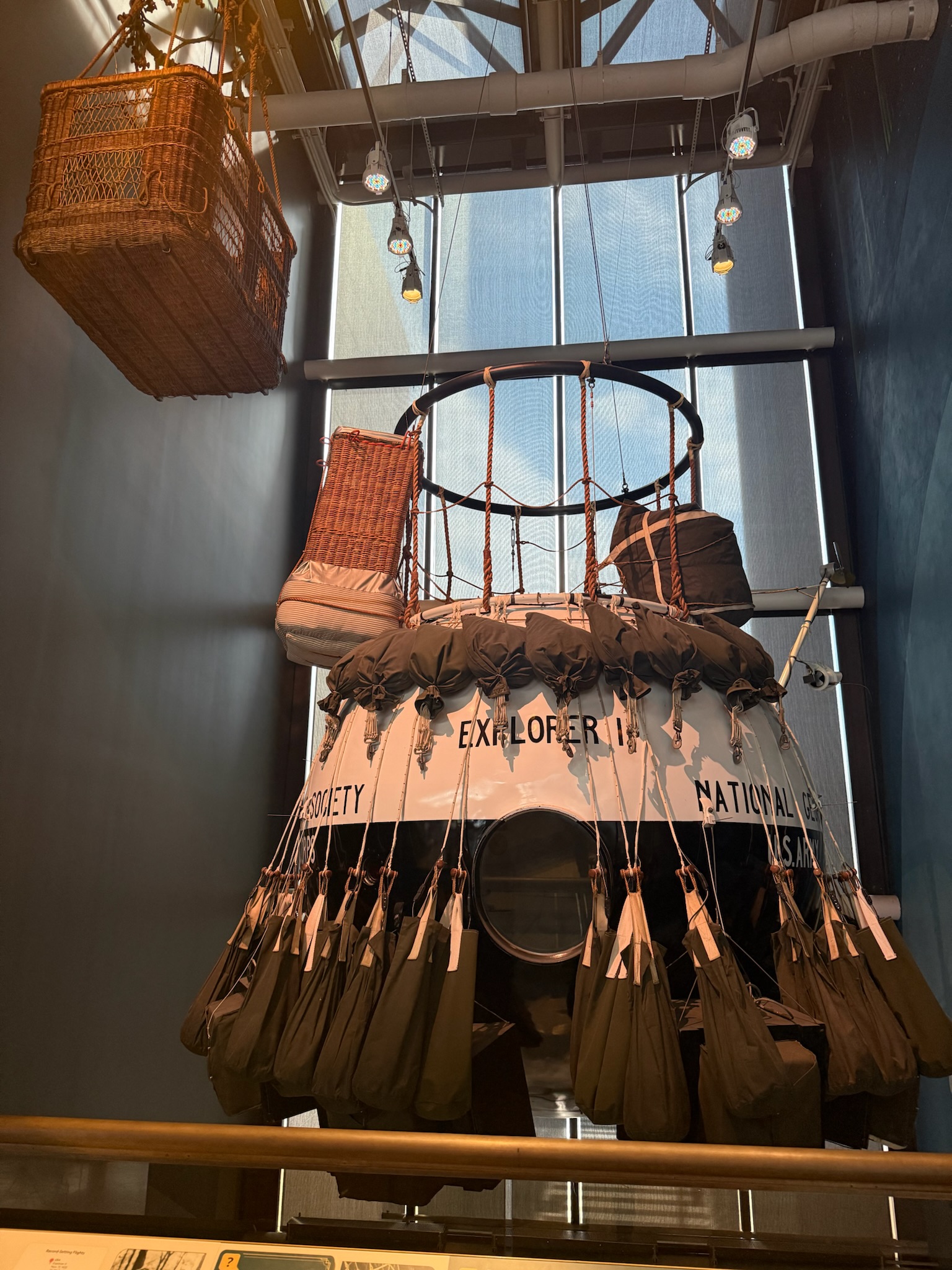
In 1935, Explorer II set the new record, rising to 72,395 feet — and that record held for over 20 years. They also safely returned to earth. This was the carriage of the Explorer II. It had a pressurized cabin and instruments onboard to study the upper atmosphere.
There was a display about rockets. Supported by the Smithsonian, Robert Goddard invented and flew a liquid-fueled rocket in 1926, and it changed how the world saw space flight, including ushering in an era of science-fiction.
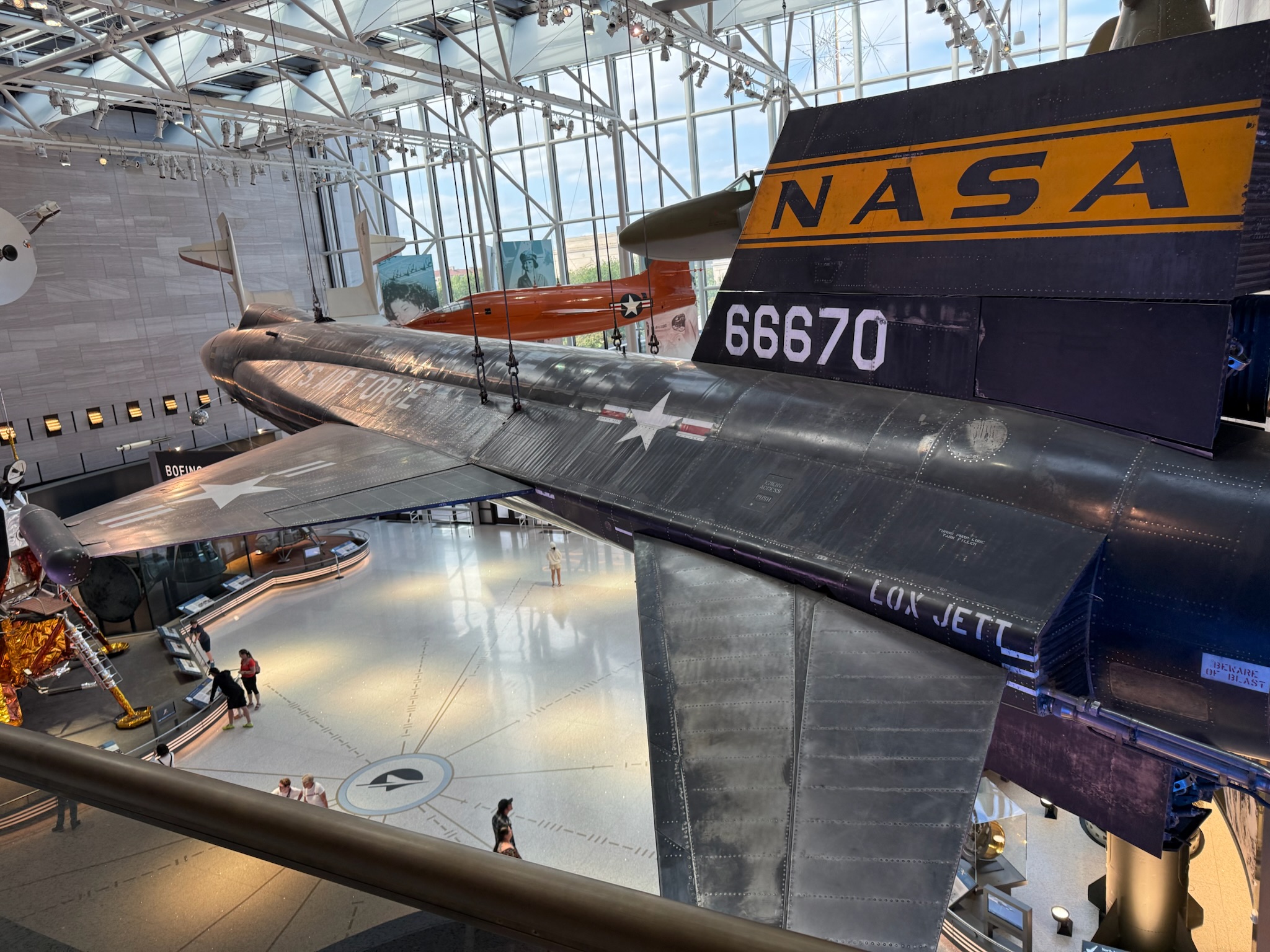
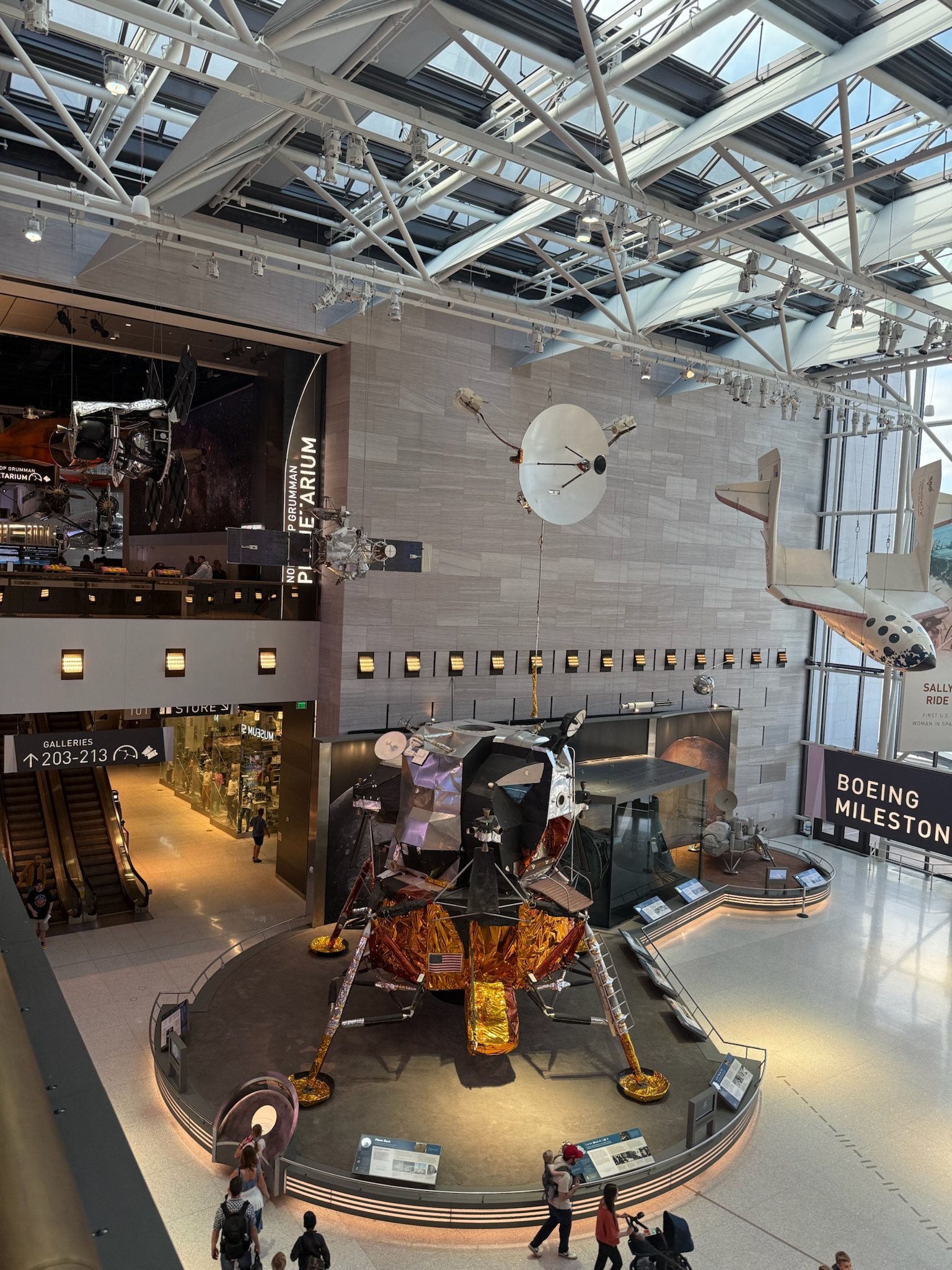
After we finished in the Pioneers of Flight room, we went back down to the west end of the building. Here were a couple more shots of the spacecraft in the foyer, taken from the second-floor hallway.
The next room we visited was called Exploring The Planets. According to the signs, ancient people thought the visible planets (Mercury, Venus, Mars, Saturn, Jupiter) were merely wandering stars. It wasn’t until Galileo used a telescope in 1609 that people understood that planets were spheres with surfaces and features while stars were simply fixed points of light. At first, astronomers focused on how the planets moved, but eventually astronomers became more focused on what they were like as individual worlds.
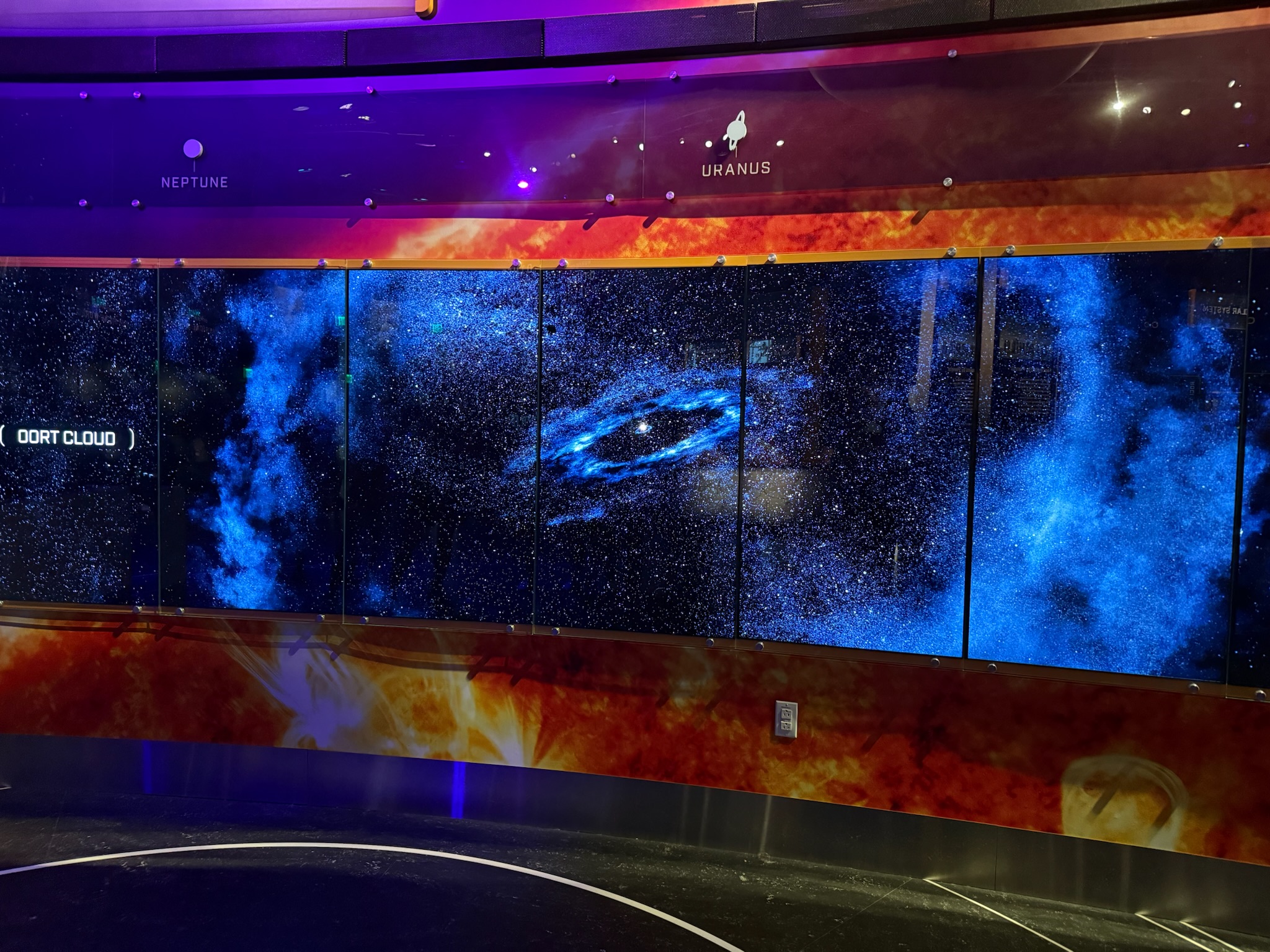
The first exhibit that we saw was about comets. Comets were bits of dust, rock and ice that clumped together into small bodies that resembled dirty snowballs. They formed in the Oort Cloud that surrounds the outer reaches of the solar system.
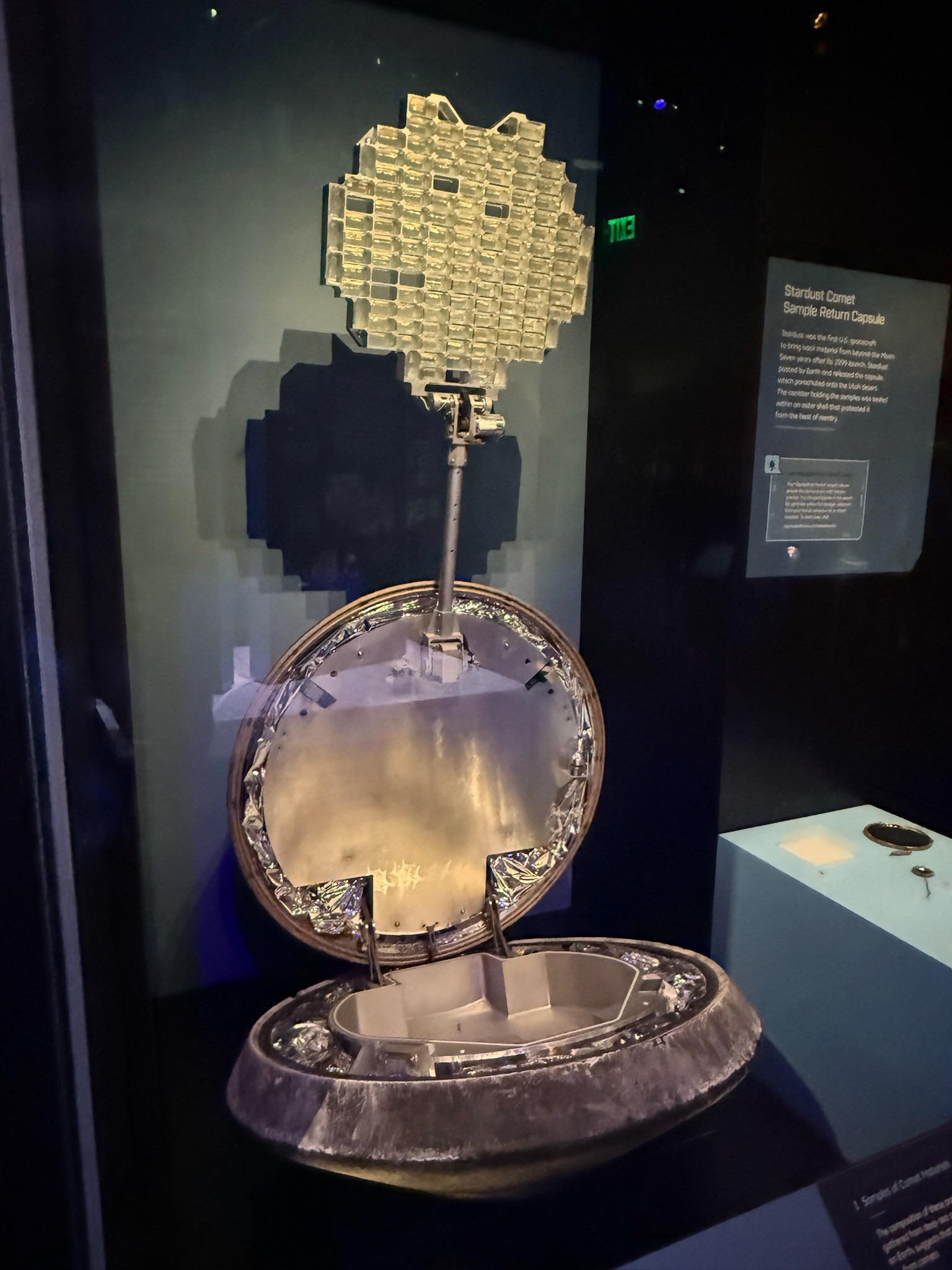
NASA’s Stardust probe was launched in 1999. In 2004, it flew through the tail of comet Wild 2 and collected tiny particles. In 2008, Stardust passed close to Earth and released the capsule, which parachuted to the Utah desert with the samples. it was the first spacecraft to bring back material from beyond the moon.
In 2004, the European Space Agency launched Rosetta. In 2014, it was the first spacecraft to orbit a comet’s nucleus. Rosetta followed the comet for months as it headed towards the center of our solar system. A lander names Philae landed on the comet’s surface.
Closer in to the sun, but still beyond Neptune, was a donut-shaped region called the Kuiper Belt, which contained countless icy bodies, some quite large. Pluto was the largest body in the Kuiper Belt.
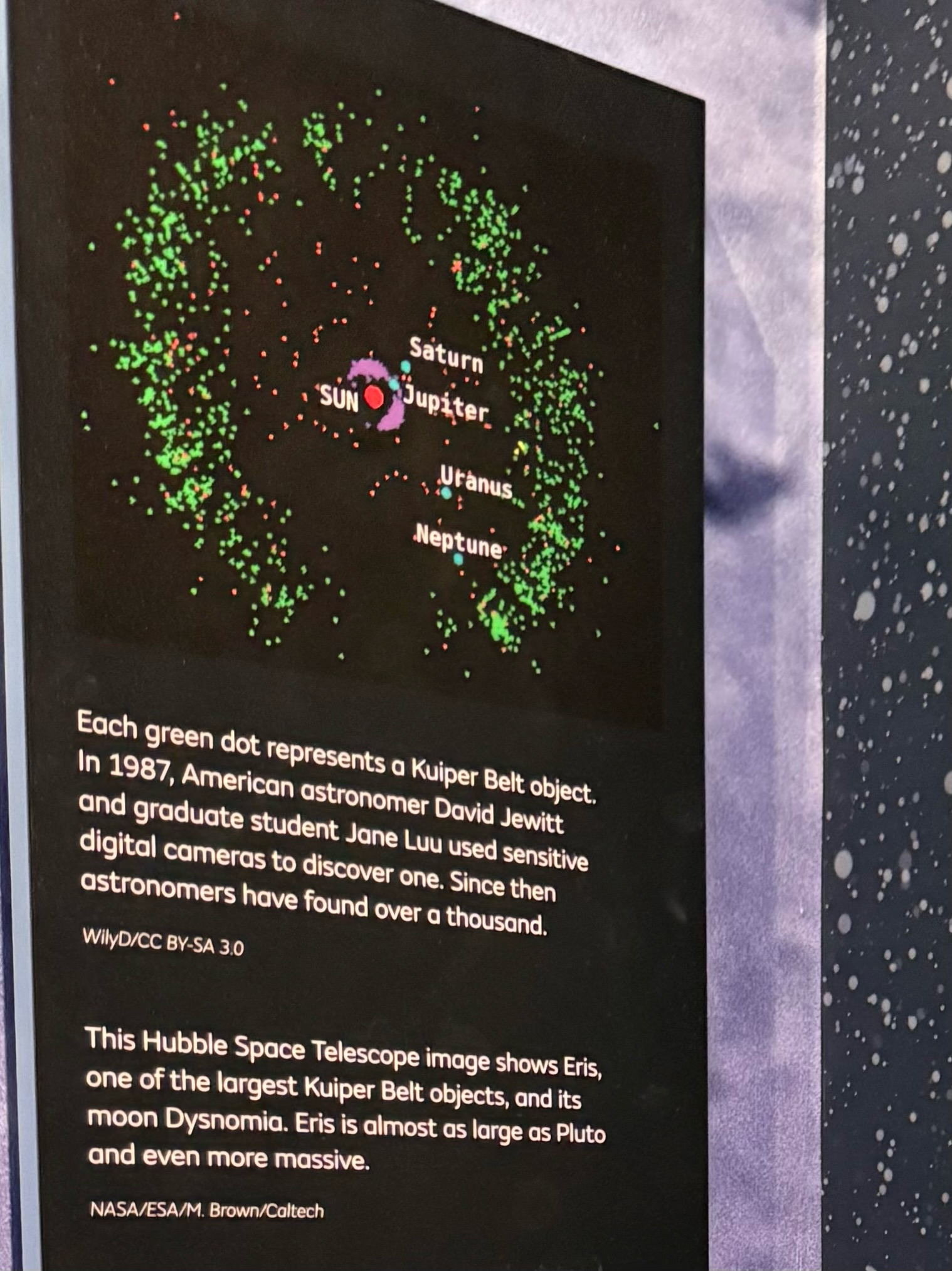
Pluto was discovered in 1930. They’d been looking for another planet because astronomers believed another planet was needed to explain motions in the orbits of Uranus and Neptune. They later realized that the region Pluto was in, the Kuiper Belt, was an entire collection of objects. The next signs explained the debate about what defines a planet. To be continued…