continued… When Pluto was discovered in 1930, the scientific community agreed it was a planet. In 1987, another very large object was found in the Kuiper Belt. Since then, over a thousand more objects have been discovered. While Pluto was the largest, one named Eris has more mass and also has a moon. In 2006, the definition of planet was altered to be a celestial body that: a. is in orbit around the sun, b. has enough mass for its gravity that it has (nearly) a round shape and c. has cleared other large objects from the region of its orbit. Pluto did not meet criteria C. A new category was created: dwarf planet, which Pluto met the criteria for. Eris was also categorized as dwarf planets.
New Horizons was the first spacecraft to explore Pluto and its moons. It revealed that Pluto and moon Charon have dramatic landscapes and altered surfaces that were surprisingly young. It has passed Pluto and is currently in the Kuiper Belt.
The last “real” planet in our solar system is Neptune, and before it is Uranus. Uranus was discovered in 1781 by William Herschel, Neptune was discovered in 1846 by Johann Gottfried Galle. Both are icy gas giants, which means they have small rocky cores, but the majority of the planets are made up mostly of gas and ices — so they don’t have solid surfaces. Both are blue/green in color, which comes from high concentrations of methane. Both have faint rings — Uranus’s has thirteen and Neptune has six.
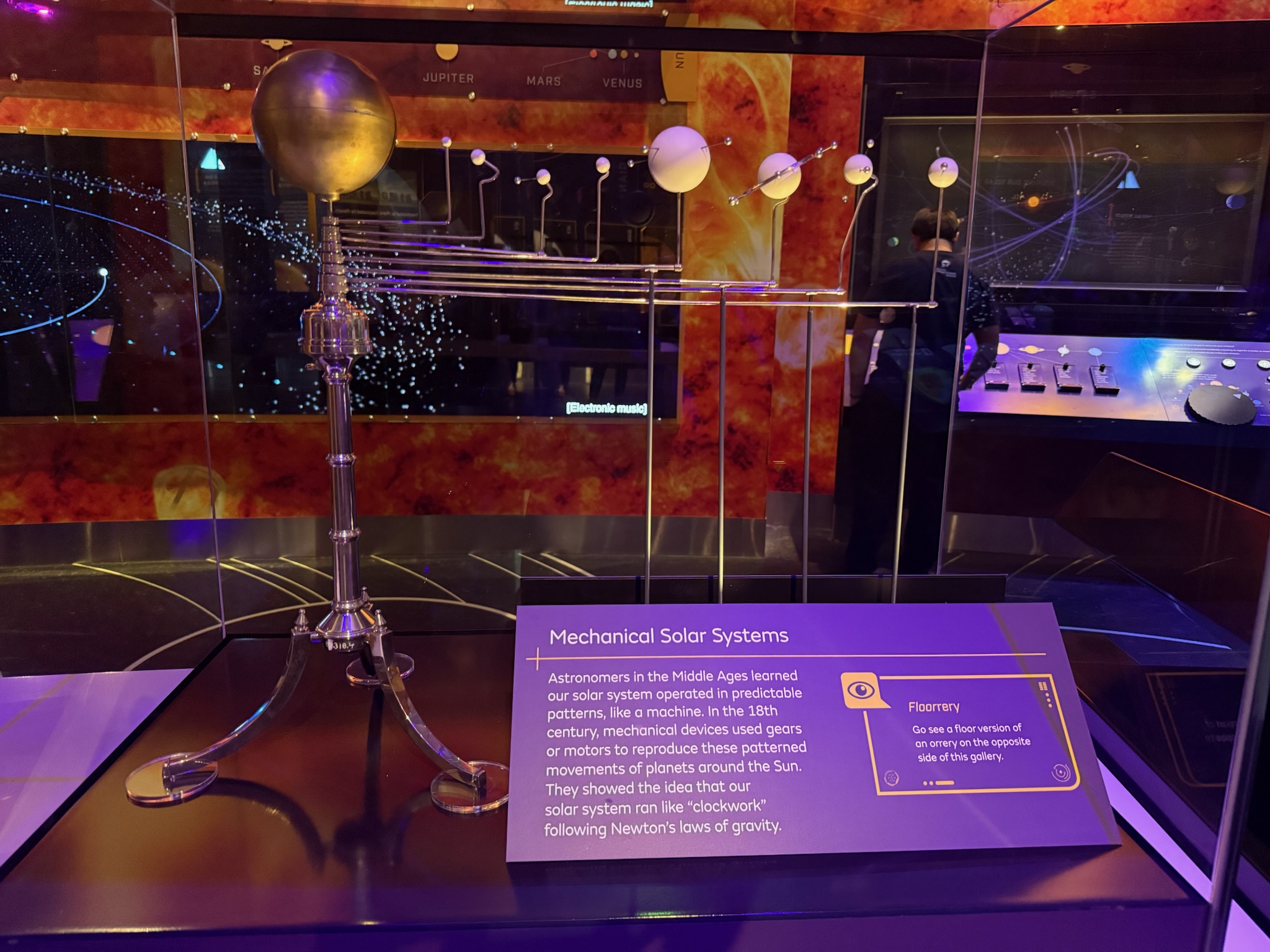
Next was Saturn, which was a gas giant made up of mostly hydrogen and helium. On Saturn, the hydrogen is in a liquid metallic form. It has a large, highly visible ring system that was first documented by Galileo. The rings are mostly ice with some rocks, and the rocks vary in size from dust to boulders.
Jupiter was another gas giant made up of mostly hydrogen and helium. Like Saturn, the hydrogen takes a liquid metallic form. Jupiter also has rings that are so thin and faint that they’ve never been seen from Earth, just from space probe telescopes.
All four gas giants are considered “outer planets,” which means they are located outside the asteroid belt. Each have several moons that are surprisingly diverse, and there were several signs with details about many moons that are of particular interest to scientists.
The last four planets (from outside in) are: Mars, Earth, Venus, Mercury. All four are rocky planets that formed in the inner solar system.
After the brief overview of the planets and some of their moons, there were extensive displays about the various factors that shape the surface of planets, including volcanic activity, tectonics, erosion, shrinkage and asteroids. Each planet/moon has a different atmosphere and composition, so these factors have different effects on each of the planets/moons.
Volcanoes are one of the biggest landscape alterers. They can either spew geyser-like plumes or they can manifest as volcanic plains, where the lava comes up out of fissures instead of exploding. While lava on the inner planets is made up of hot molten rock and gasses, on cold planets and moons, the lava may be water vapor, ices, gas and/or dust. Magma intrusions are when the volcanic matter settles bellow the surface, causing the surface to push up and crack. Channels are when a lava flow carves a channel into the surface.
On the rocky plants and our moon, shrinkage is another factor. They each have hot cores. The cores shrink, causing the lithosphere (crust and upper mantle) to wrinkle. Another factor for the rocky planets is tectonics. Internal forces can cause the crust to shift. Either portions of the crust get pushed together to create mountains, ridges, fault scarps, or they get pulled apart, creating troughs and valleys.
Erosion is another biggie. In planets with atmospheres, wind, water, ice and gravity break down rock into soil and move the soils around, thus changing geological features over time. Asteroids are rocks hurtling through space. In planets with atmospheres, asteroids usually burn up before hitting the ground. Asteroids that manage to break through a planet’s atmosphere are called meteorites. The impact from meteorites can significantly change the landscape. In planets and moons without atmospheres, asteroid impacts are frequent and create significant amounts of erosion. Small asteroids break down planetary rock into dust. Big asteroids create craters and basins.
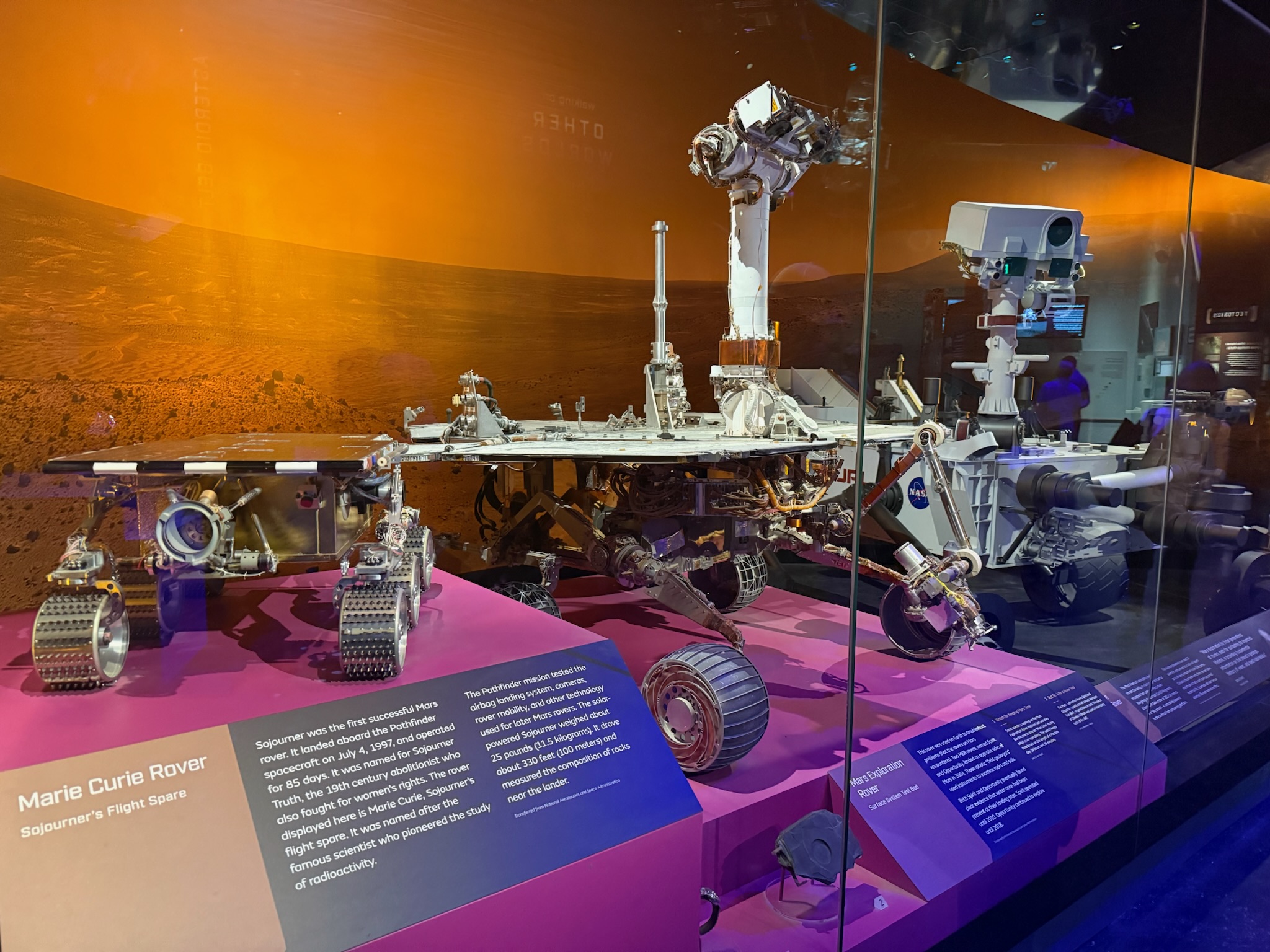
The next series of displays was about the various spacecraft that have been exploring outer space since the 1960s, including telescopes, probes and rovers. We’ve already mentioned information gleaned from the spacecrafts New Horizons, Rosetta. and Stardust, and there have been many others. Spacecraft must be carefully engineered to survive. In space and on other planets, the conditions can be harsh, including exposure to intense radiation and solar heat, meteorites, and crushingly dense atmospheres. Probes have to control descent, land safely, collect and send data in these harsh environments. In order to make the spacecrafts survive, they utilize radioactive material for heat, radiators for cooling, and thermal blankets to insulate the electronics. For craft going to the inner planets, solar energy is used, but for exploration beyond Jupiter nuclear energy is utilized.
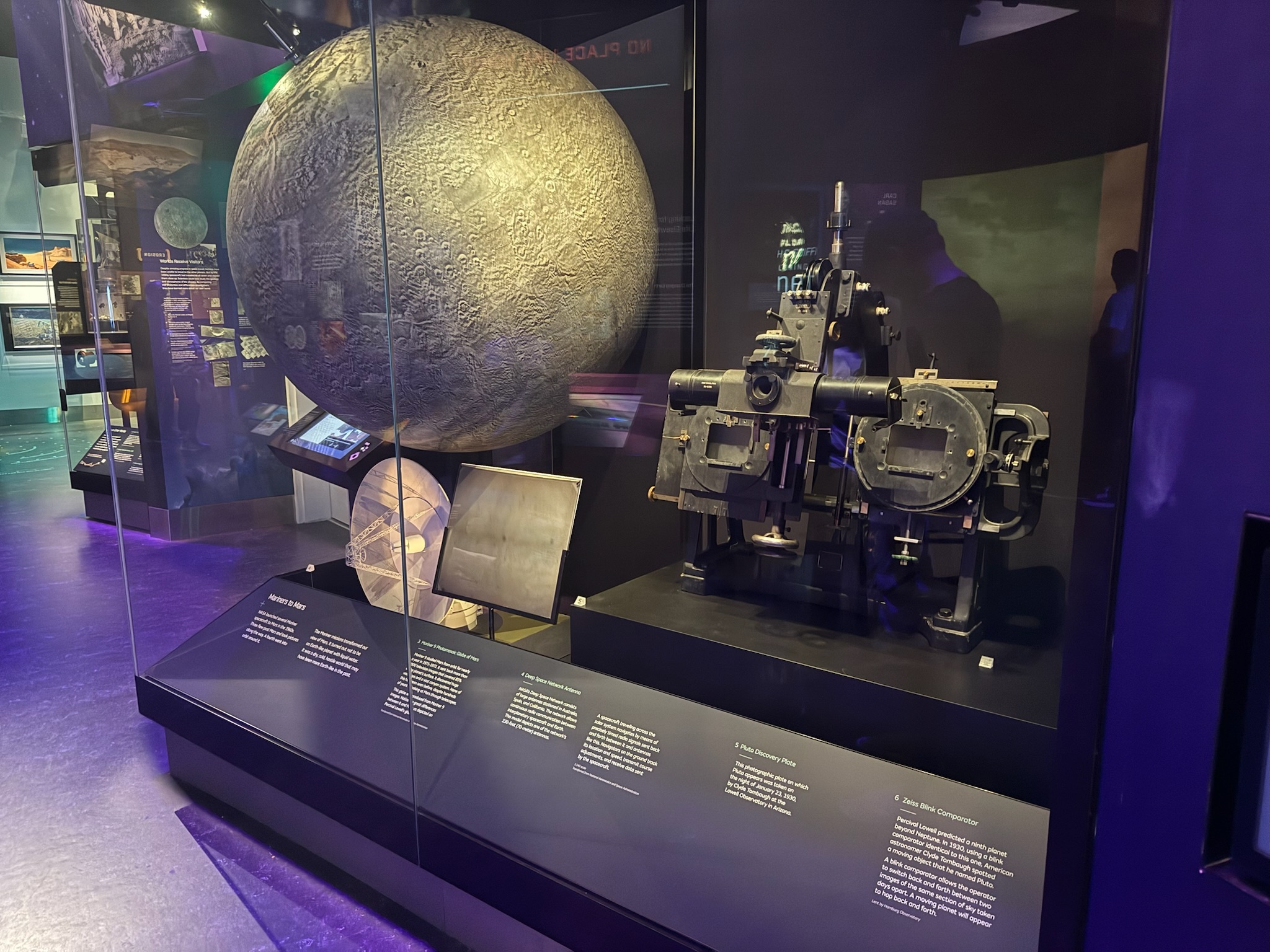
The next series of displays was about exoplanets — planets rotating around other stars in the galaxy. The Kepler Space Telescope was launched in 2009 and was the first spacecraft designed to look for exoplanets Kepler has confirmed that there are thousands more planets in our galaxy.
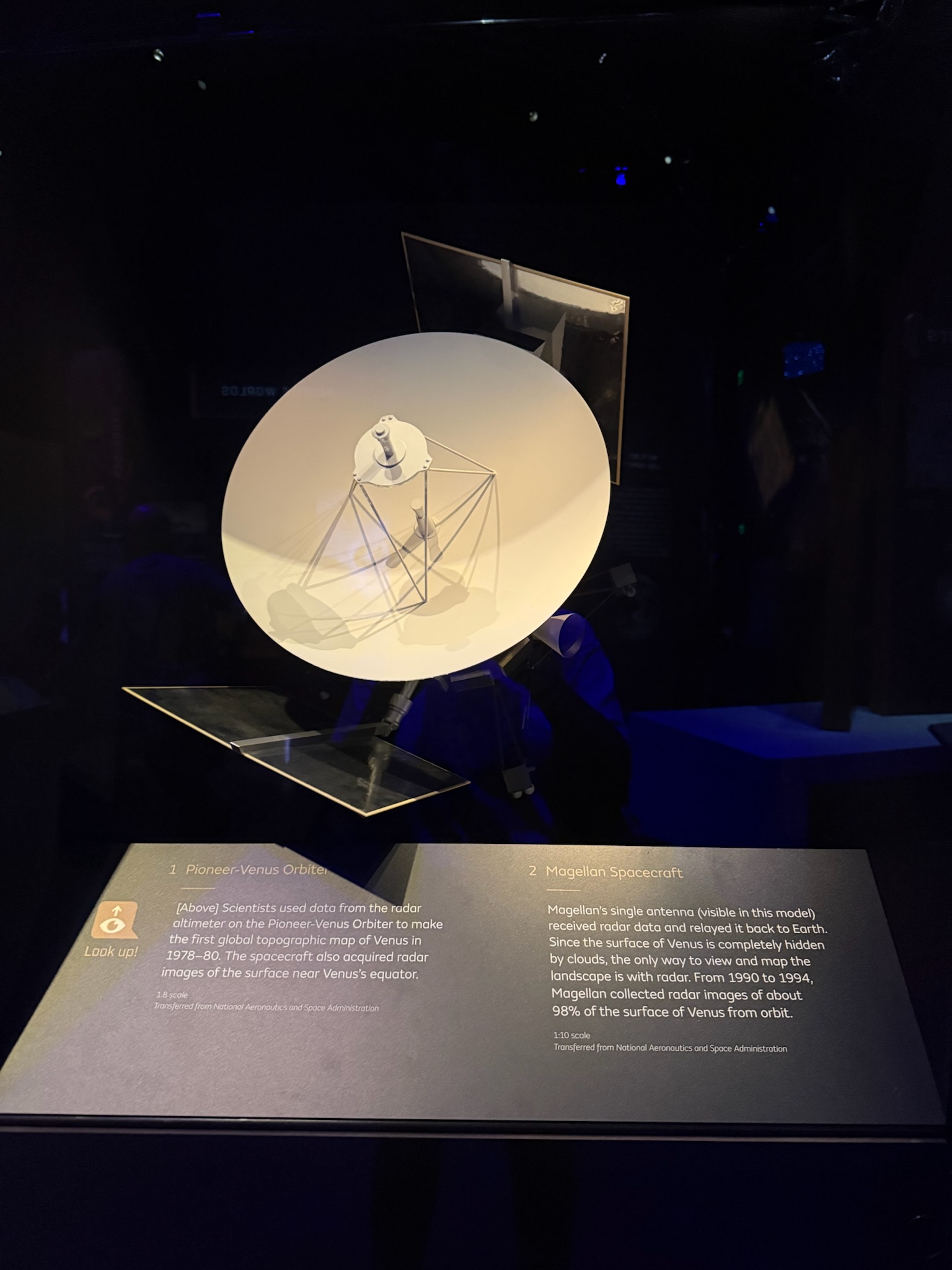
When we finished in this room, it was 1530. Our brains were full and we were tired, but we pushed ourselves to keep going. We walked across the hall to a room called Nation of Speed. The sign said that the American culture had a fascination with speed. The room seemed to be devoted to various culturally iconic vehicles — from bicycles to missiles — tied to speed records.
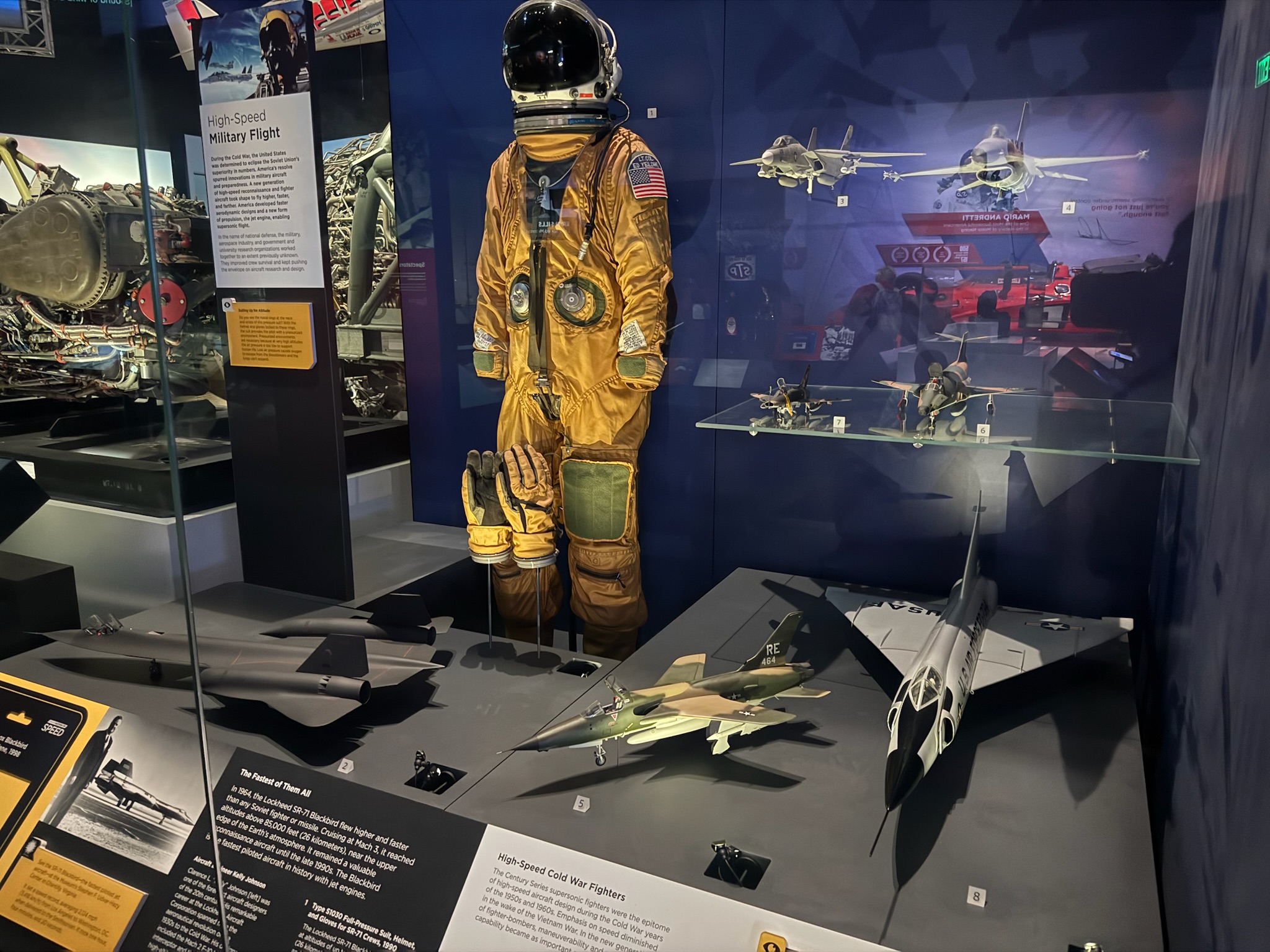
There was a focus on military achievements. One of the many vehicles highlighted was the SR-71 Blackbird, which cruised at Mach 3 and altitudes above 85,000 feet. It still holds the title for the fastest piloted aircraft with jet engines. There was a real A-12 Blackbird, which was the predecessor to the SR-71, at the Air & Space Museum in San Diego. Our guide had spent a lot of time talking about them as they were built in California.
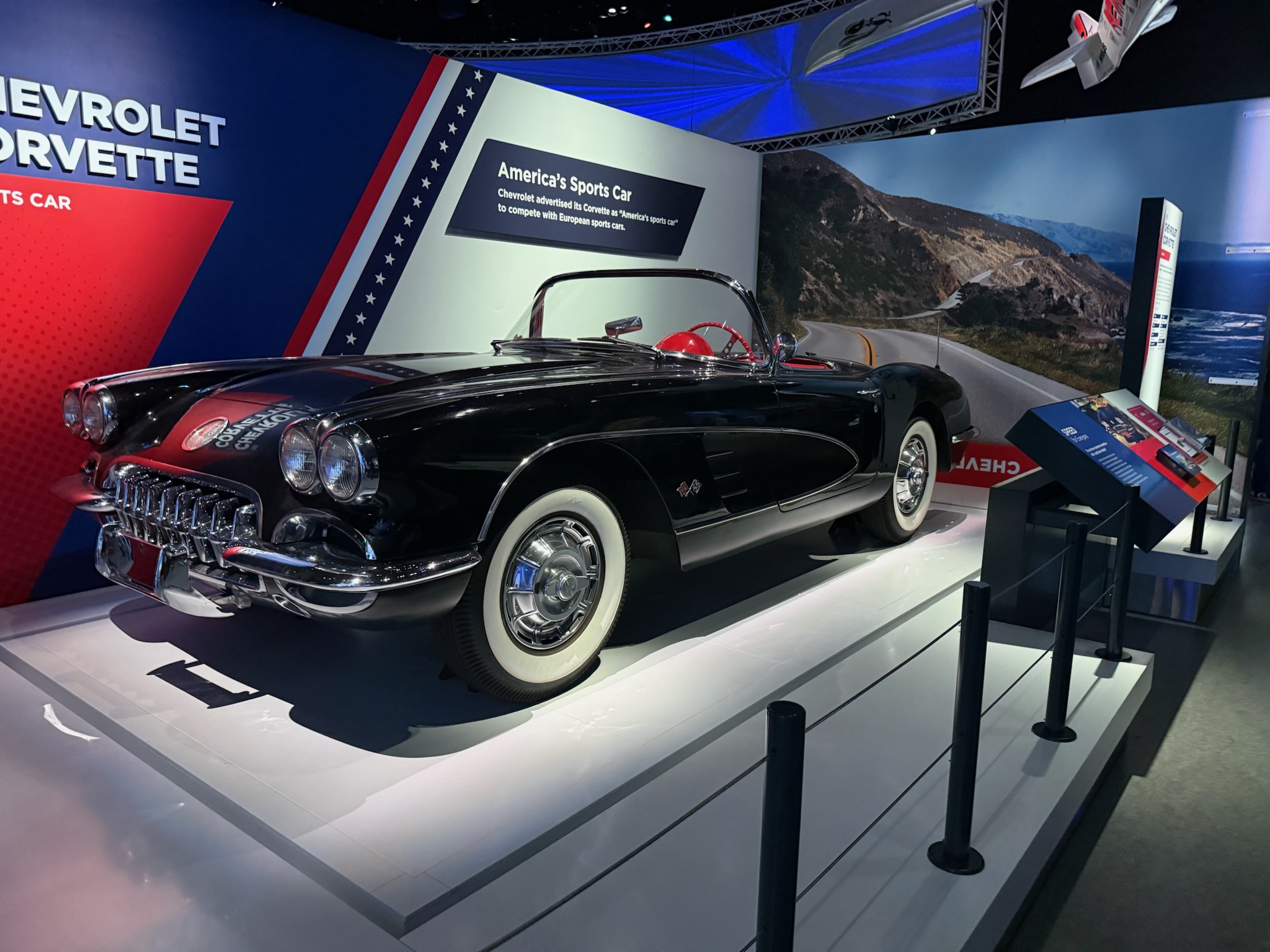
A fun item on display was a 1959 Chevy Corvette. The astronauts on the Mercury mission all drove them, as did some subsequent Apollo astronauts.
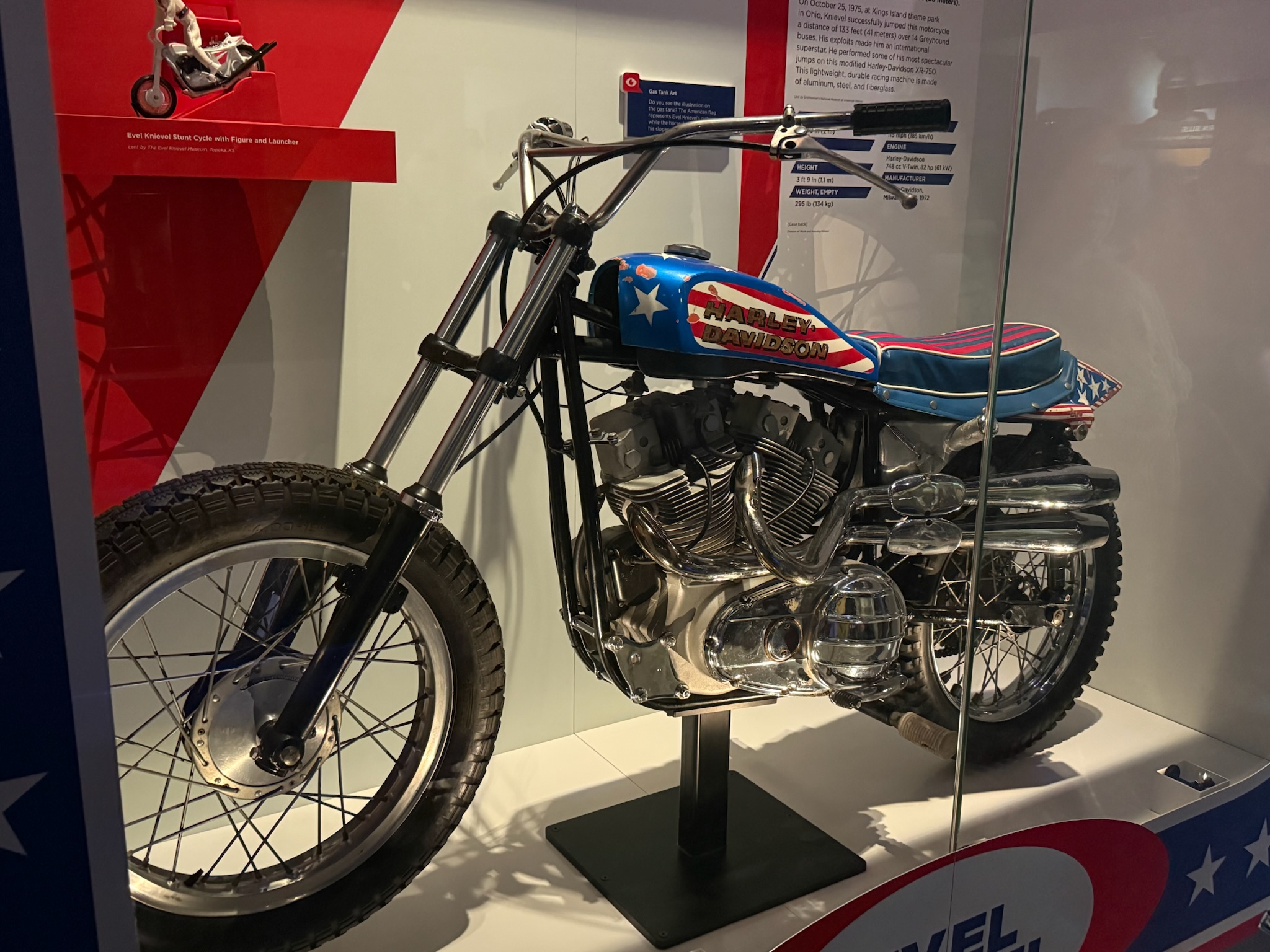
Another fun item was Evel Knievel’s motorcycle, a modified Harley-Davidson XR-750. In 1975, Knievel successfully jumped this motorcycle 333 feet over 14 greyhound busses.
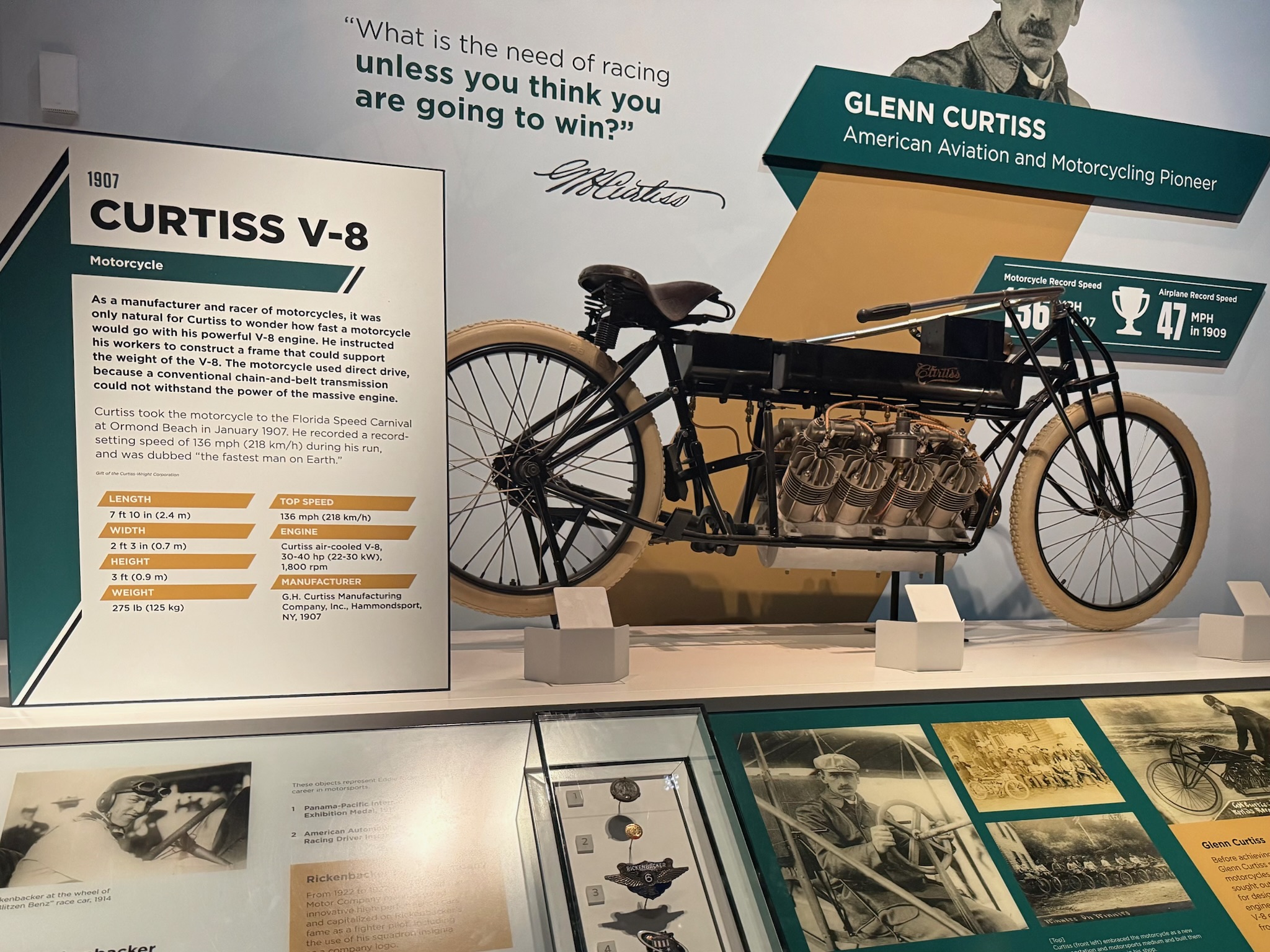
Curtiss airplanes had been discussed extensively in the Wright room, WWI room and The Pioneers of Flight room, so we were kind of surprised to find that Glenn Curtiss had started out as a motorcycle manufacturer and champion motorcycle racer. He made the first V-8 lightweight motorcycle. He also won the world’s first air race in one of his planes.
There was a section on boat racing records, including the America’s Cup. There was a section on car racing, which had information about some unique land racing vehicles and a display about Mario Andretti, who was the only driver to win the Indianapolis 500, the Daytona 500 and the Formula 1 World Championship.
Because we were tired, none of us got much out of this room. We’d been at the museum for 3-hours now. Since we weren’t absorbing any more information, we decided to call it a day. We felt a little guilty about leaving. We still hadn’t seen one of the rooms on this floor and three rooms on the bottom floor. We also hadn’t gone to the Planetarium or the IMAX theater. And, for the record, the western third of the museum was being renovated, so under normal circumstances, we would have still had more than half the museum left to see!
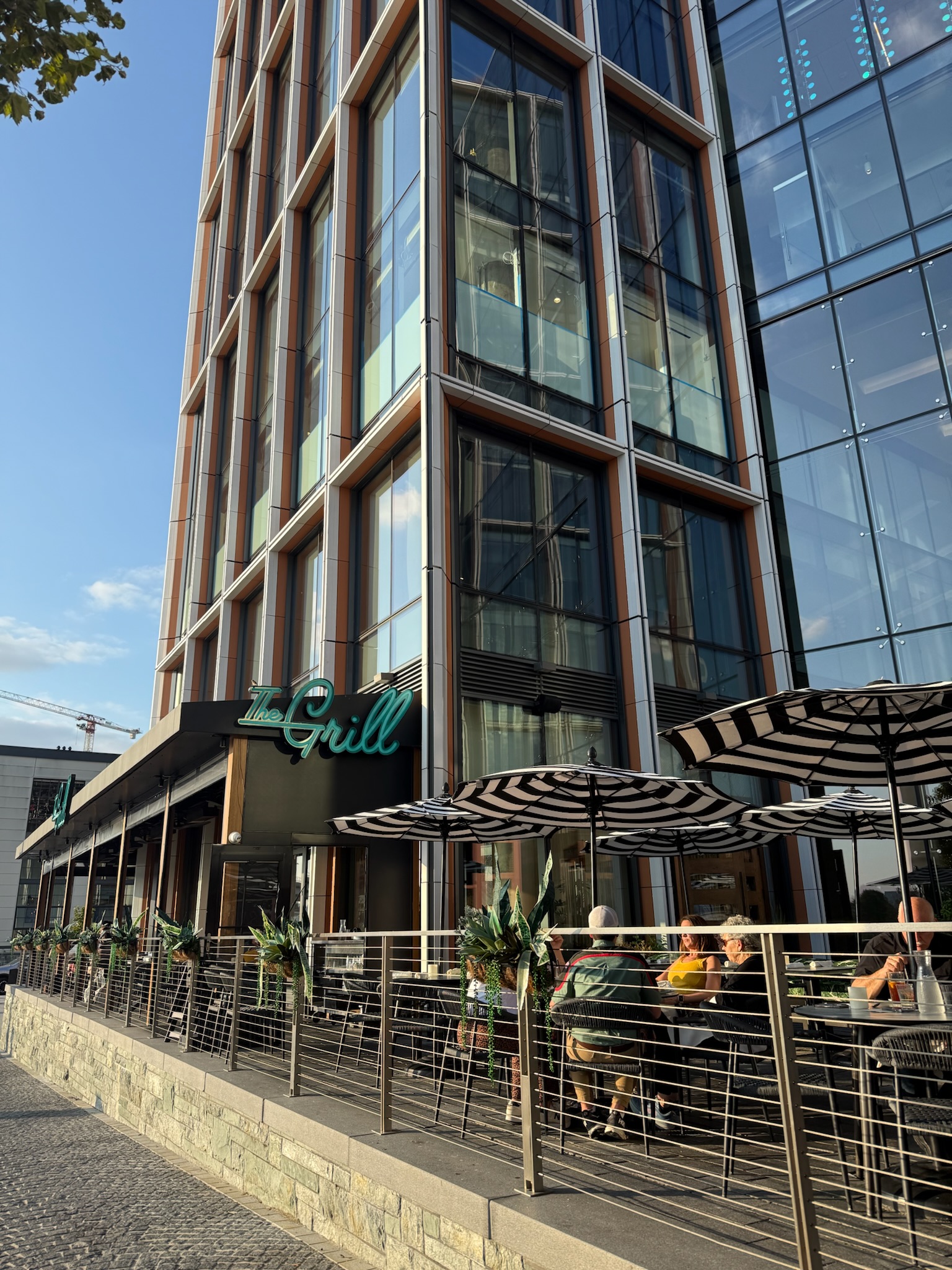
We said goodbye to Blue Heeler, walked to the shuttle stop, and caught the shuttle back to The Wharf. We were getting hungry, so we decided to get dinner before we went back to Kosmos. We went to a restaurant called The Grill, which had a 3-course prix-fixe meal for $39 that they offered on weekdays from 1600 – 1800. Since it was 1615, we took advantage of the special! The food was great and good value for the money with the special. That said, if paying full price, we’d probably say it’s expensive relative to the portion sizes.
We wanted to take a moment to mention something that has perplexed us. We were told that after the tragic accident in January of this year where a jet and helicopter collided near Ronald Reagan airport, helicopters were no longer allowed to fly by the marina. Yet helicopters seem to go by the marina fairly often. We’re not sure if we were given bad information or if these helicopters qualify under the exception for police, medical, air defense, and presidential transport flights.
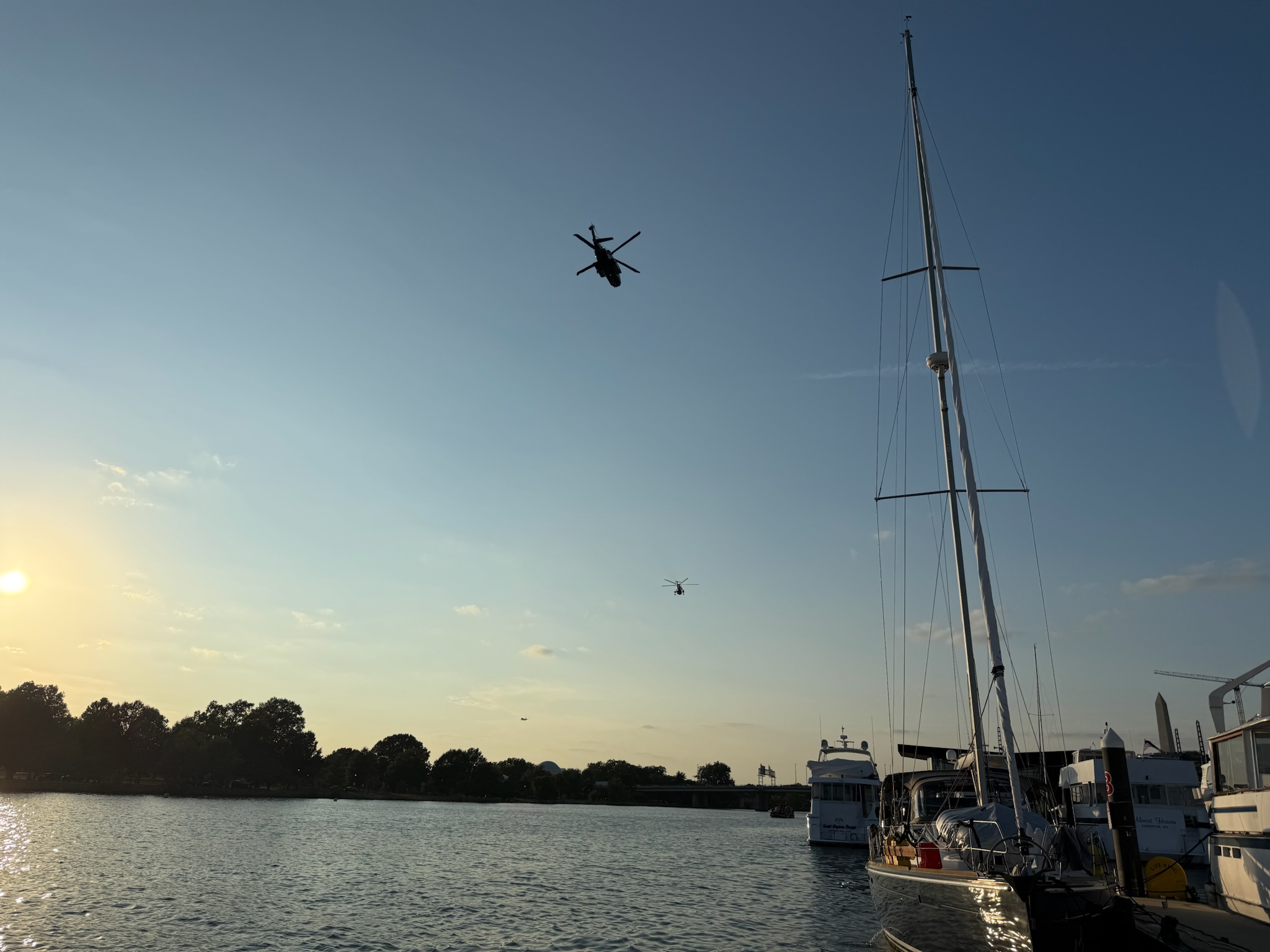
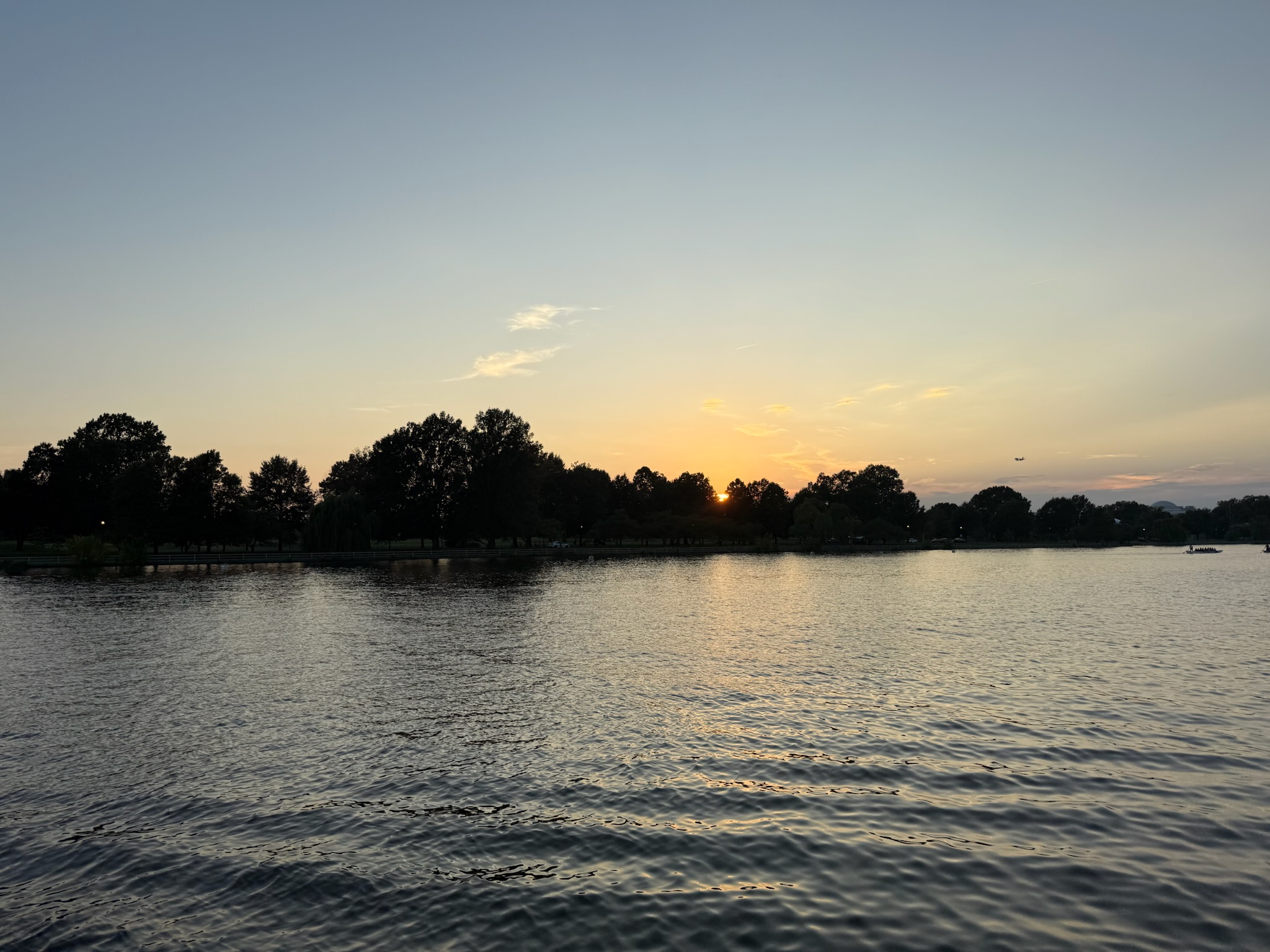
And what we could see of the sunset.