
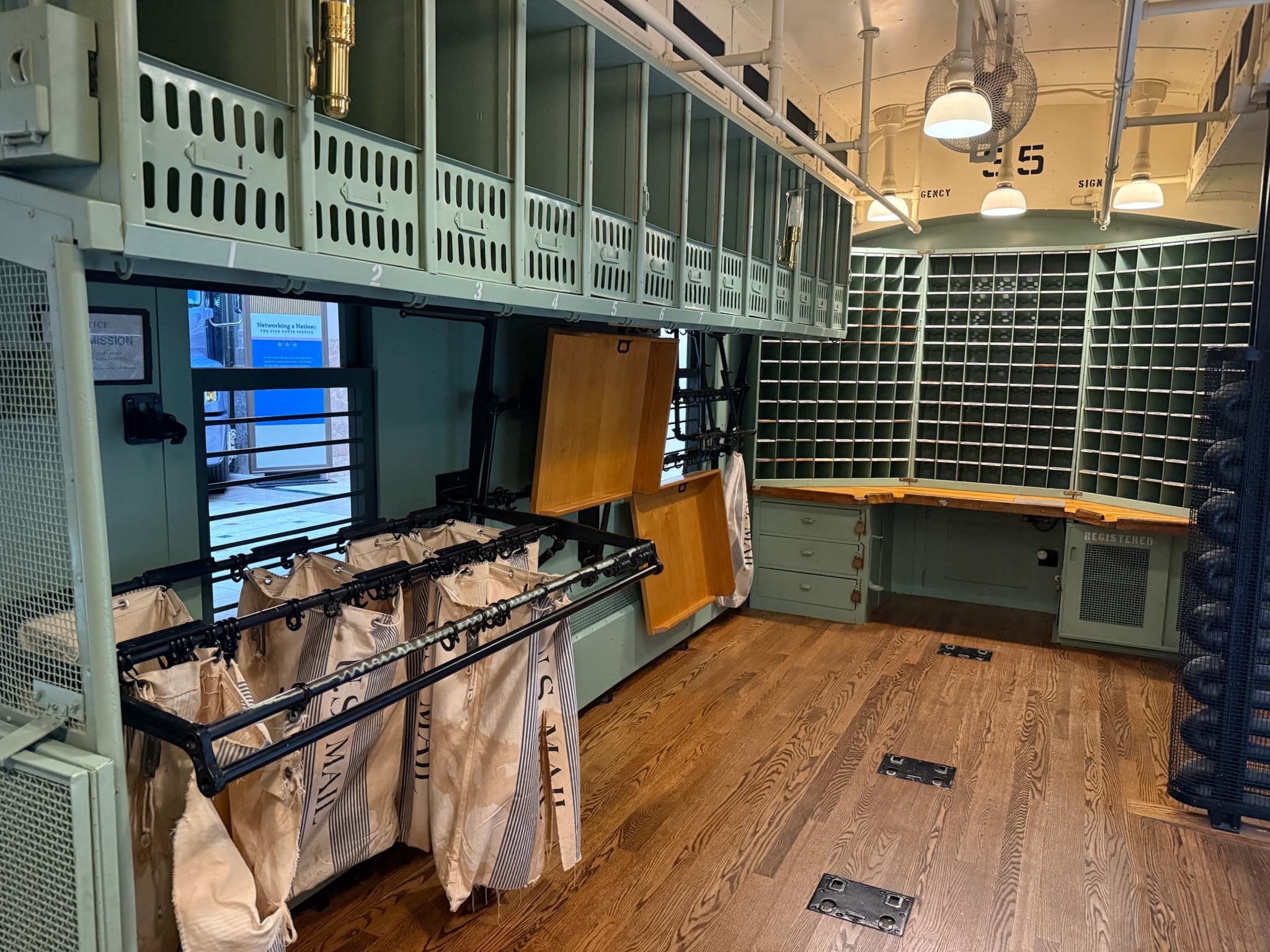
continued… Next we moved over to the section about trains. After the Civil War ended in 1866, the Post Office started placing clerks on trains to sort the mail while in transit. It was the mainstay of postal operations for almost a century. The clerks worked long hours and their job was dangerous as railway accidents were common. Processing mail on trains ended in 1977 after three decades of declining railroad traffic.
In the 1940s, as trains stopped servicing small towns, the Post Office began implementing busses to transport the mail to these small towns. They had clerks onboard to sort mail in transit as was done on the trains.
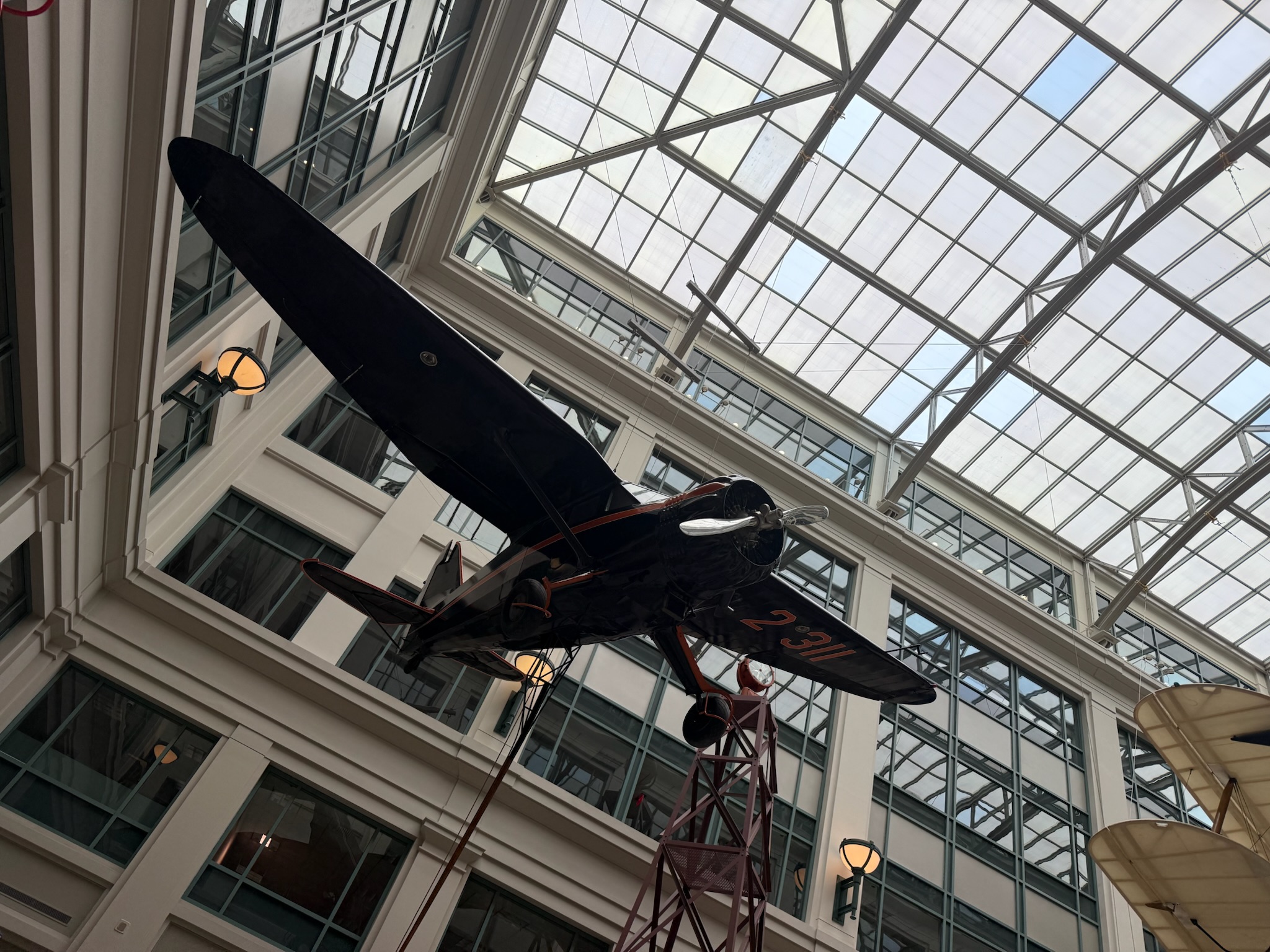
With the airplanes that had been given to them from the military in 1918, the Post Office Department built and operated the nation’s airmail service, establishing routes, testing aircraft and training pilots. In 1922, they also constructed a beacon system to guide pilots, which was similar to the one used in the military. Regularly scheduled night services began in 1924. Airmail pilots were expected to fly in bad weather in order to maintain a schedule. Over 200 pilots were hired; 34 died flying the mail. The postal airmen service was nicknamed “the suicide club.” We found out that Charles Lindbergh had been an airmail pilot.
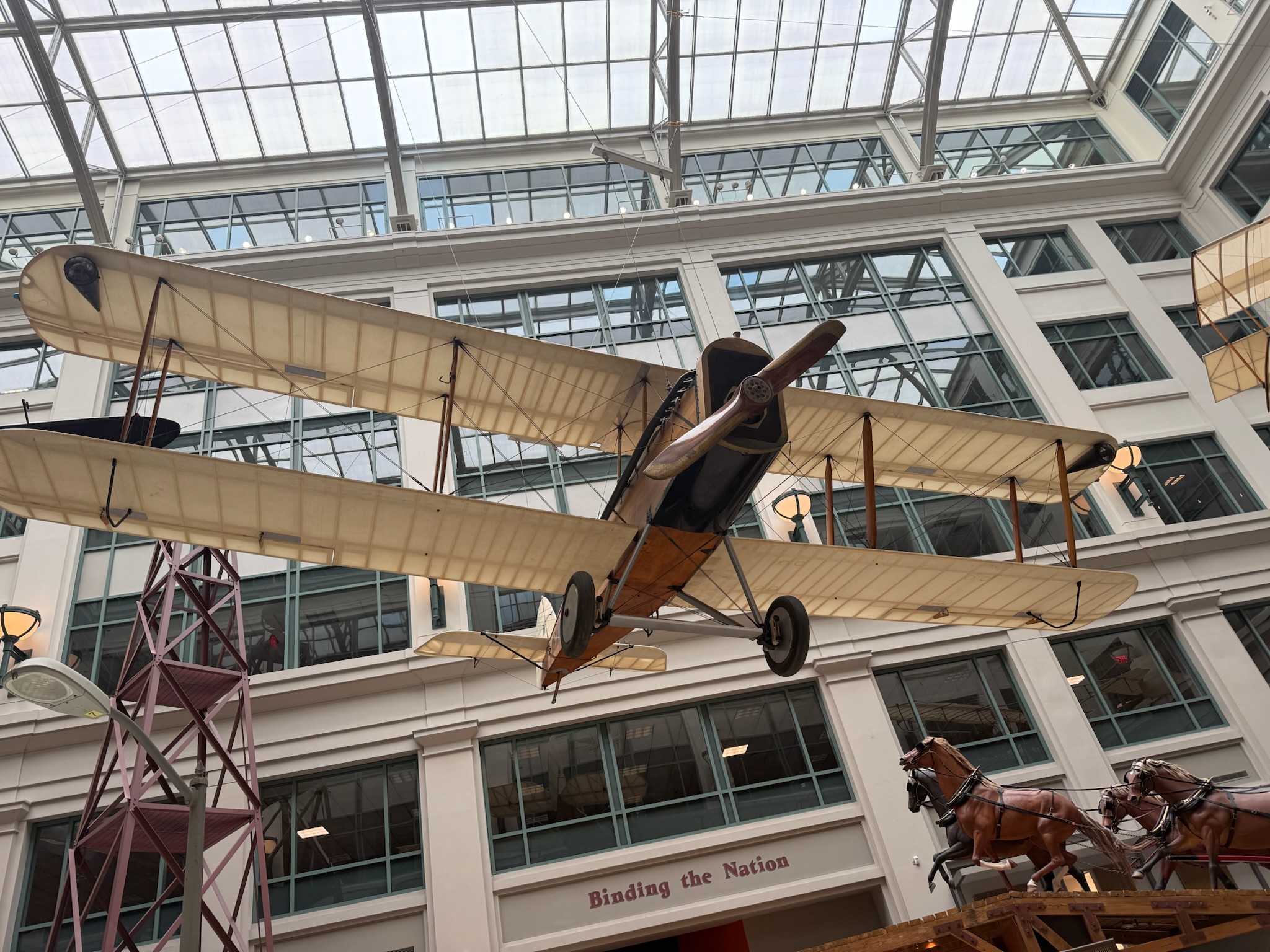
Legislation was passed in 1925 and another bill in 1926 allowed the Post Office to sub-contract out the flights. The Department turned the aviation service over to private contractors in 1927 and the Commerce Department took over the beacon system. As we’d learned at the Air & Space Museum, using airplanes to deliver mail was probably the most important factor leading to the growth of the aviation industry. Thanks to contracts with the Post Office, private companies invested in larger and safer planes, eventually facilitating passenger traffic. In the second half of the 20th century, passenger traffic overshadowed mail cargo. By 1975, airmail had become such an integral part of mail service that the post office stopped charging extra for air mail. In 1971, Federal Express created a shipping system specifically for airfreight. In 2001, the US Postal Service and FedEx teamed up, giving the Post Office better air networks and centralized information technology, and giving FedEx extended reach to all addresses in America.
Next we went to an exhibit about the Star Route Service. Between 1803 and 1853, the United States more than doubled in area. In 1862, The Homestead Act was passed, giving 160 acres of land to anyone who improved it and lived on it for 5 years. Thousands of people spread out across the west. The post office dealt with the rapidly expanding mail service needs by creating the Star Route Service in 1845. They hired contractors to deliver to the new routes and allowed them to use any form of transportation that they chose, such as boats in the Great Lakes, dog sleds in Alaska, and mules in the Grand Canyon. The Star Route still exists (though now the Post Office determines acceptable delivery forms). This section had signs about some of these unique routes with accompanying maps. Most also had artifacts, such as saddles and skis. These routes were seriously entertaining, but must have been just awful for the contractors delivering the mail.*
We moved into one of the rooms off the central hall, which had an exhibit on the early history of the Post Office. Initially, the colonies were all isolated from one another. Colonists were more focused on mail to/from England than they were from the other colonies. It was the British government that decided it needed an inter-colonial postal system so the colonies governors could communicate with one another. The first postal route was set up in 1673 by the British governor of New York and New Jersey, with intermittent service between New York and Boston. The 268-mile path that they created followed Native American trails. First it was called King’s Best Highway, then Boston Post Road and is nowadays called US Route 1.
In 1692, a postmaster was appointed in each of the British colonies and in 1693, they began implementing weekly mail service routes, utilizing mostly boats and some horse riders to carry letters on behalf of the British post. By 1753, Benjamin Franklin was the postmaster general for all the colonies. He organized a weekly mail wagon between Philadelphia and Boston, with riders traveling day and night in relays. This cut the delivery time between the two cities in half.
It is important to note that at this point, King George III had been in power for 15-years and the colonists were becoming more and more upset with the way he ruled. Inter-colonial communications were rapidly increasing as people in different colonies started strategizing on unified methods to counter the king. Britain only hired loyalists to work for the Post Office, who were required by a ministerial mandate to open and read correspondence. They’d refuse to deliver subversive mail and the notify authorities. Colonial leaders boycotted the British post and debated creating an independent American post.
Fun fact! In early days, mail was delivered to a town’s tavern or inn, which doubled as the post office. The postal worker would sound a horn to let residents know the mail had arrived. Residents would stop by to socialize and collect their mail.
Another fun fact! In the Crown post, the receiver paid the postage, not the sender.
In 1774, William Giles Goddard presented a plan to the brand new First Continental Congress to create a new postal system to counter the Crown’s post featuring open communication, freedom from government interference, and the free exchange of ideas. An elected committee would select the Postmaster General and have the authority to fix rates and establish routes. In 1775, Goddard’s plan was adopted and implemented. Benjamin Franklin was appointed the first Postmaster General and Goddard the first Postal Surveyor, whose job was to travel as needed to investigate the postal routes and inspect the mail. The job of Postal Surveyor has evolved into what is now the Postal Inspector. The Crown’s postal system went out of business a few months later.
One sign that stood out to us was one about Goddard’s sister, Mary Katherine, who we’d read about in the Museum of Industry. In 1775, she became Baltimore’s first Postmaster General for the newly established American Post Office. She held that job for 14 years, until the new Postmaster General determined that the job wasn’t suitable for a woman. She was replaced with someone unqualified, which outraged the community. Over 230 Baltimoreans presented the Postmaster General with a petition to reinstate her. He did not.
*shortly after writing this post, Keith had to read “Call of the Wild” by Jack London for school. It was about a particular dog’s life, and for a couple of chapters, he worked as a sled dog delivering mail in the Yukon for the Canadian Postal Service. It sounded horrendous.