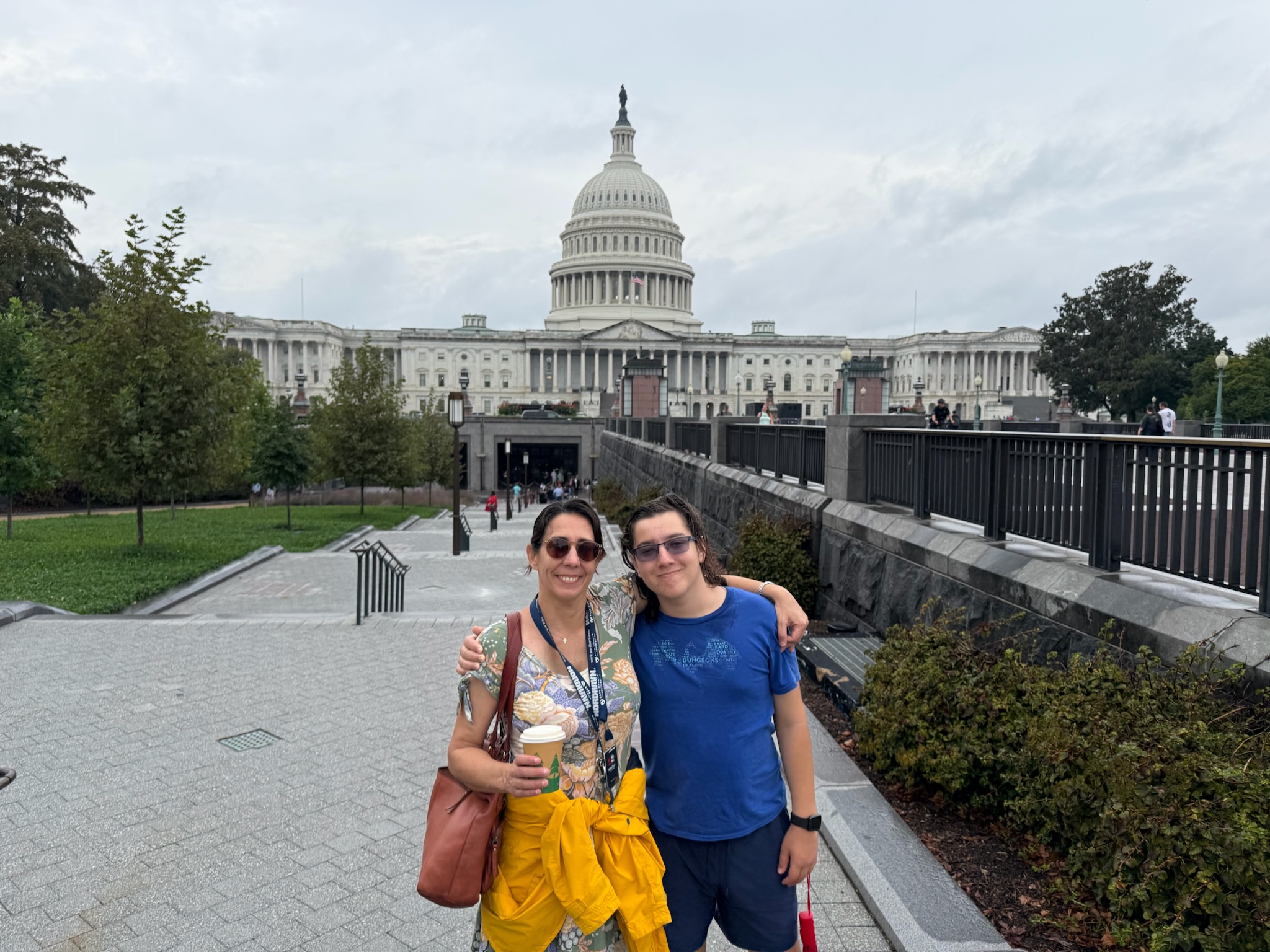
Thursday, Sept 25 — Several weeks ago, we’d booked tickets to take a tour of Congress for today at 1020. The confirmation had said to arrive at least a half-hour early for the security screening. Since ride shares were so much faster and easier than the free shuttle or Metro, we hailed a ride share and were dropped off in the east side of the building near the Visitor’s Center entrance at 0945. Much to our surprise, the entrance was underground.
When we arrived, there were only a few people in the line to enter the building. But within one minute, a large group of high school students arrived, and the line was suddenly very long. Talk about perfect timing! We were through the security check within a few minutes. Once waved through, we had no idea which way to go. Someone asked us if we were there for a tour. When we said yes, he directed us to take an escalator up to the next level.
We came to a large room dotted with statues. Each statue had the name of a state on it. We later found out it was called The Emancipation Hall.
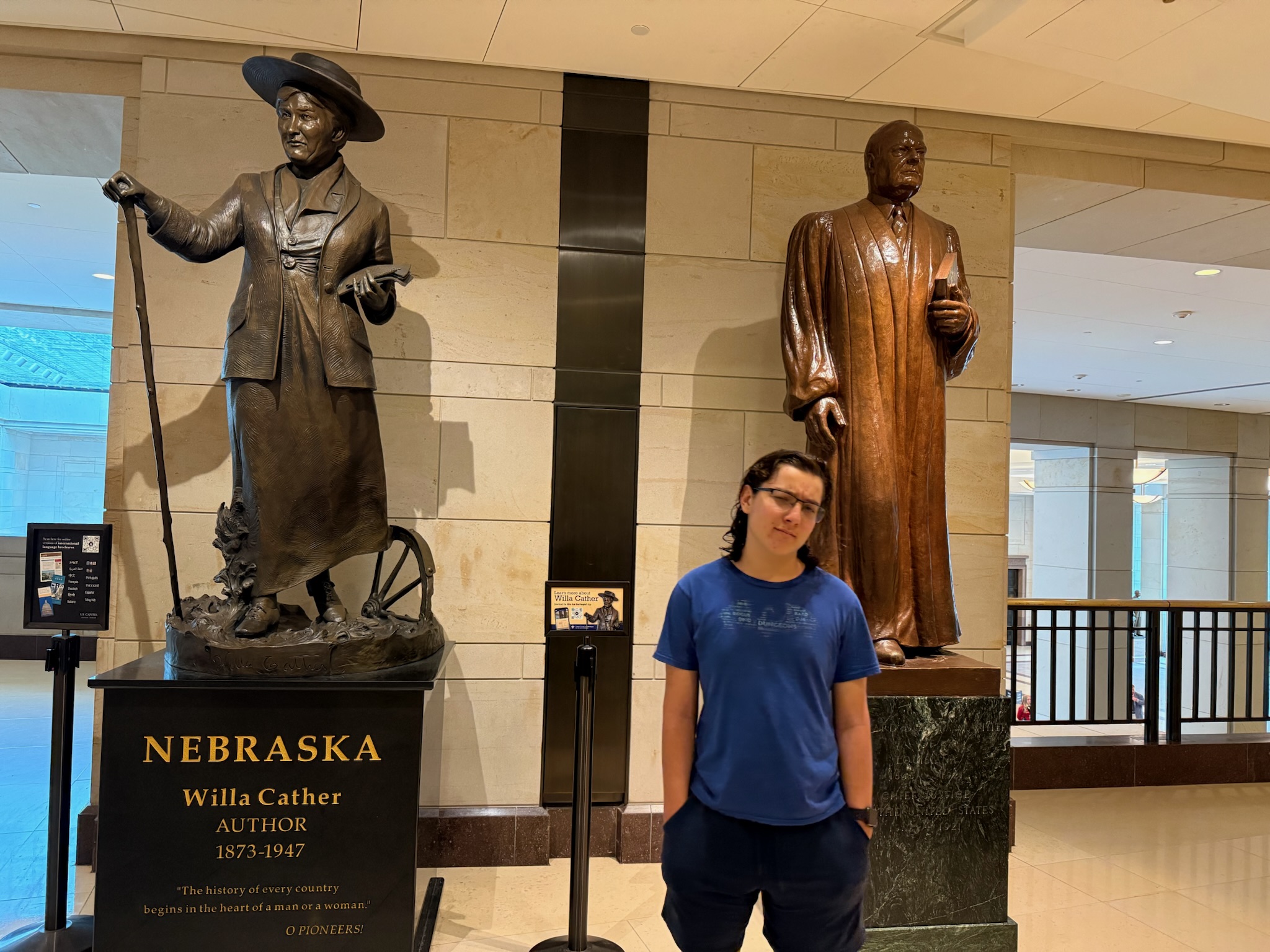
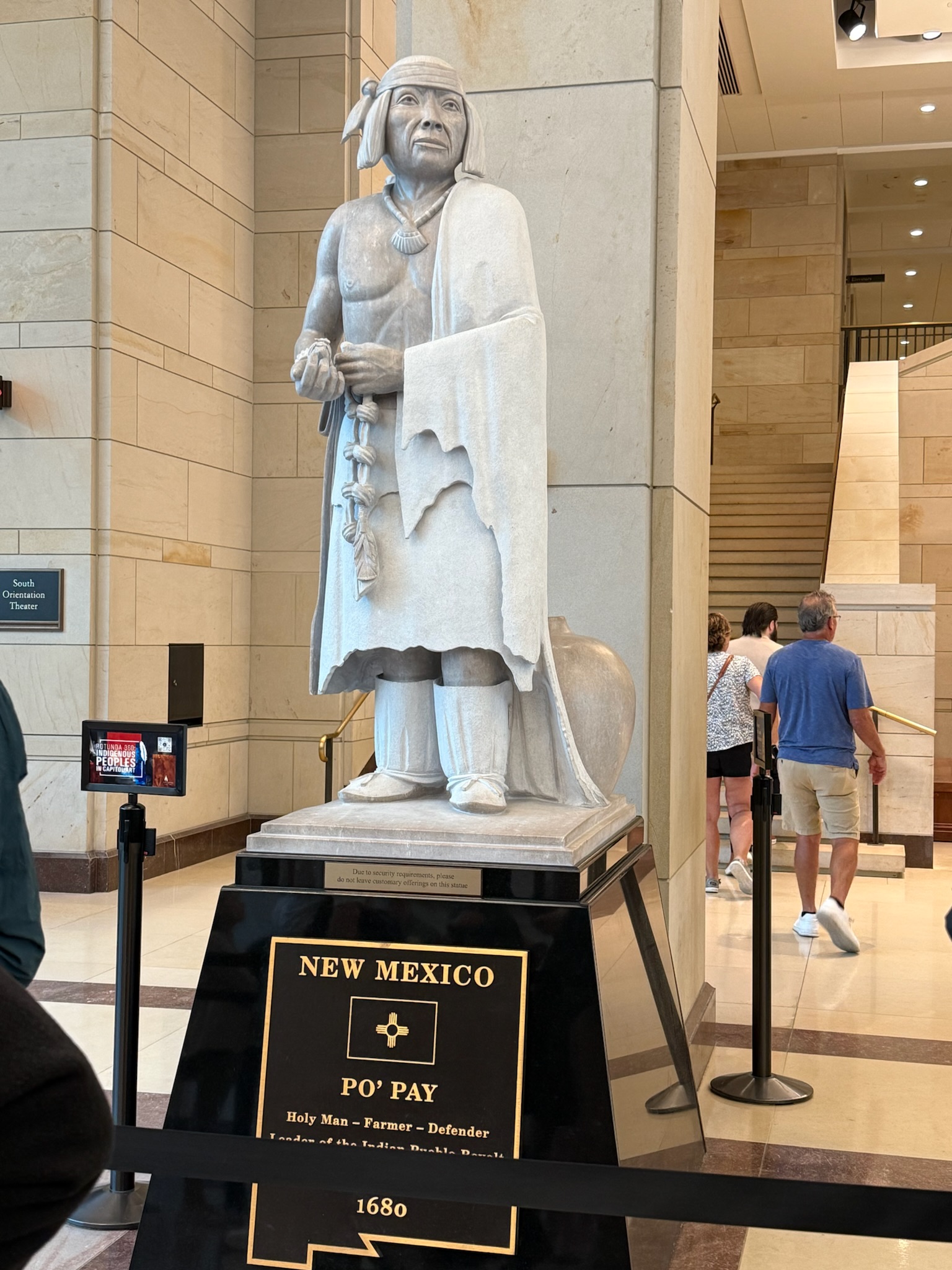
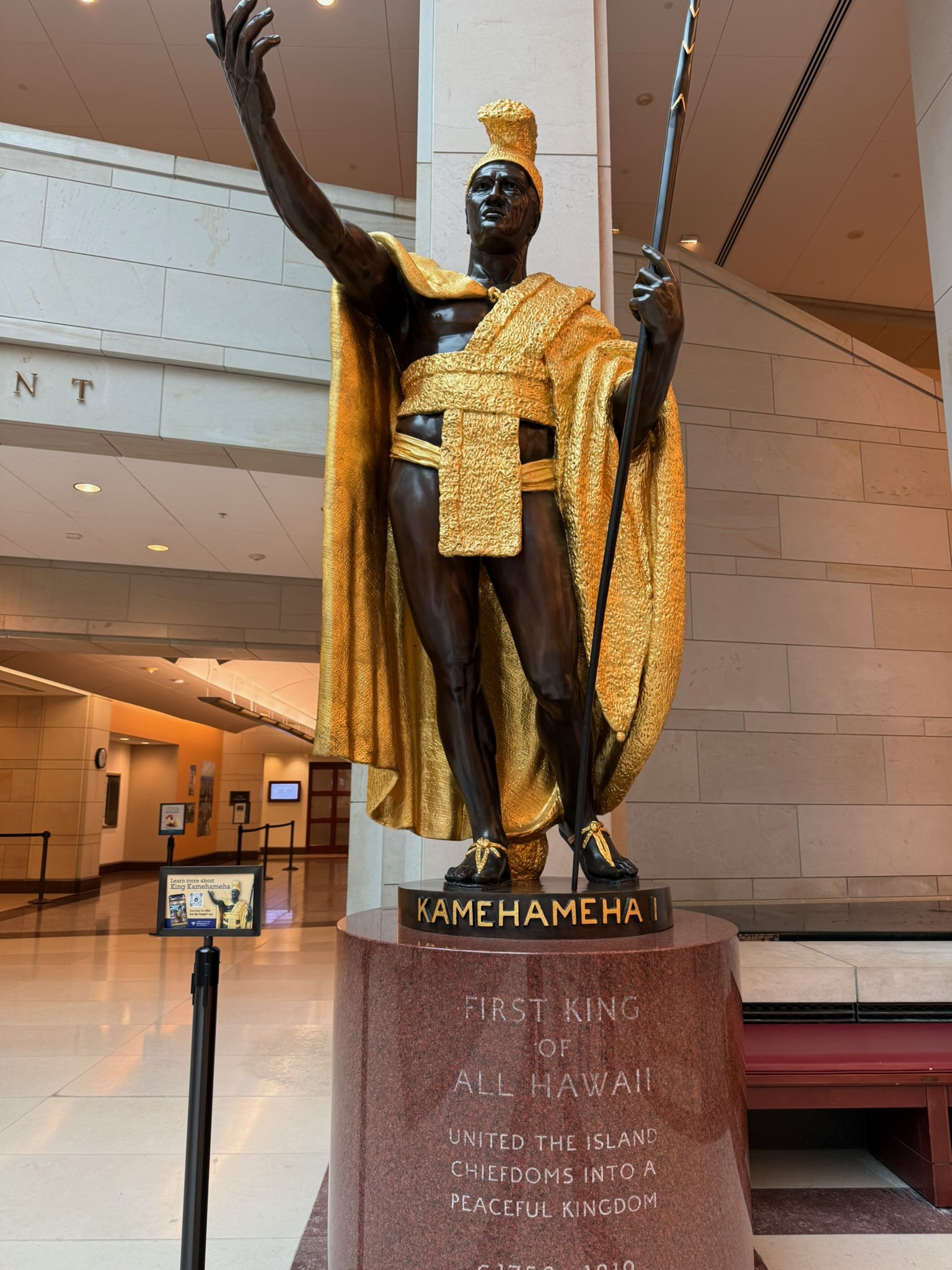
We were directed to get into a line to check in.
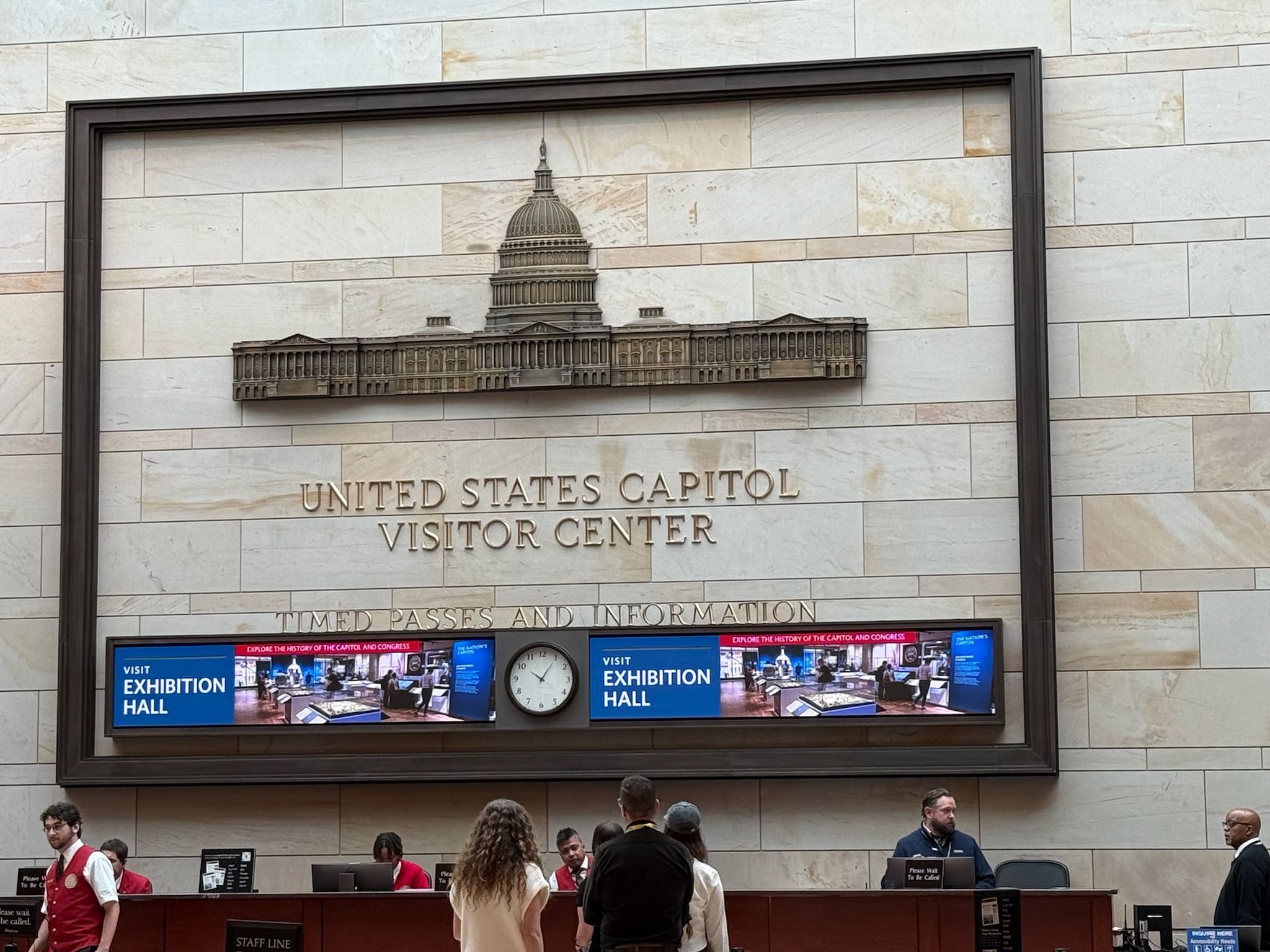
The person who checked us in said that there were some slots open for the 1000 tour if we wanted to go in sooner. We said yes. He directed us to another line in a corner of the room. We were only in line for a couple of minutes when the group was ushered into a movie theater.
We were shown a 13-minute film about how Congress works. As we’d learned in Yorktown, as part of a compromise to balance power between highly populated and less populated states, the legislative branch of the government was set up as a bicameral system — meaning there were two separate houses: the Senate, where every state had two representatives, and the House of Representatives, where the number of representatives was proportional to the population of that state. One house would approve legislation, then pass it on to the other. If it was approved by the second house, it went on to the president to be signed into law. Both the Senate and the House of Representatives met in this building to conduct business. The building also is where presidential inaugurations are conducted, where the president gives his annual State of the Union address, and where foreign leaders address Congress. Special meetings and events are often held on the grounds, including the awarding of Congressional medals and free concerts on Memorial Day and the 4th of July.
Once the film ended, we were directed to exit through doors at the top of the theater, so we exited one floor up from where we’d entered. We were herded into a hallway and split up into several lines. A man in a red coat walked down our line, handed each of us a headset and indicted that we should put it on. Once everyone in the group had a head set, he introduced himself as our tour guide and explained that he would be communicating to us through the headsets. He was hilarious! While explaining the rules, he had us laughing out loud — and he only got funnier as the tour progressed. He was British, so there were several jokes about a Brit wearing a red coat working in Congress.
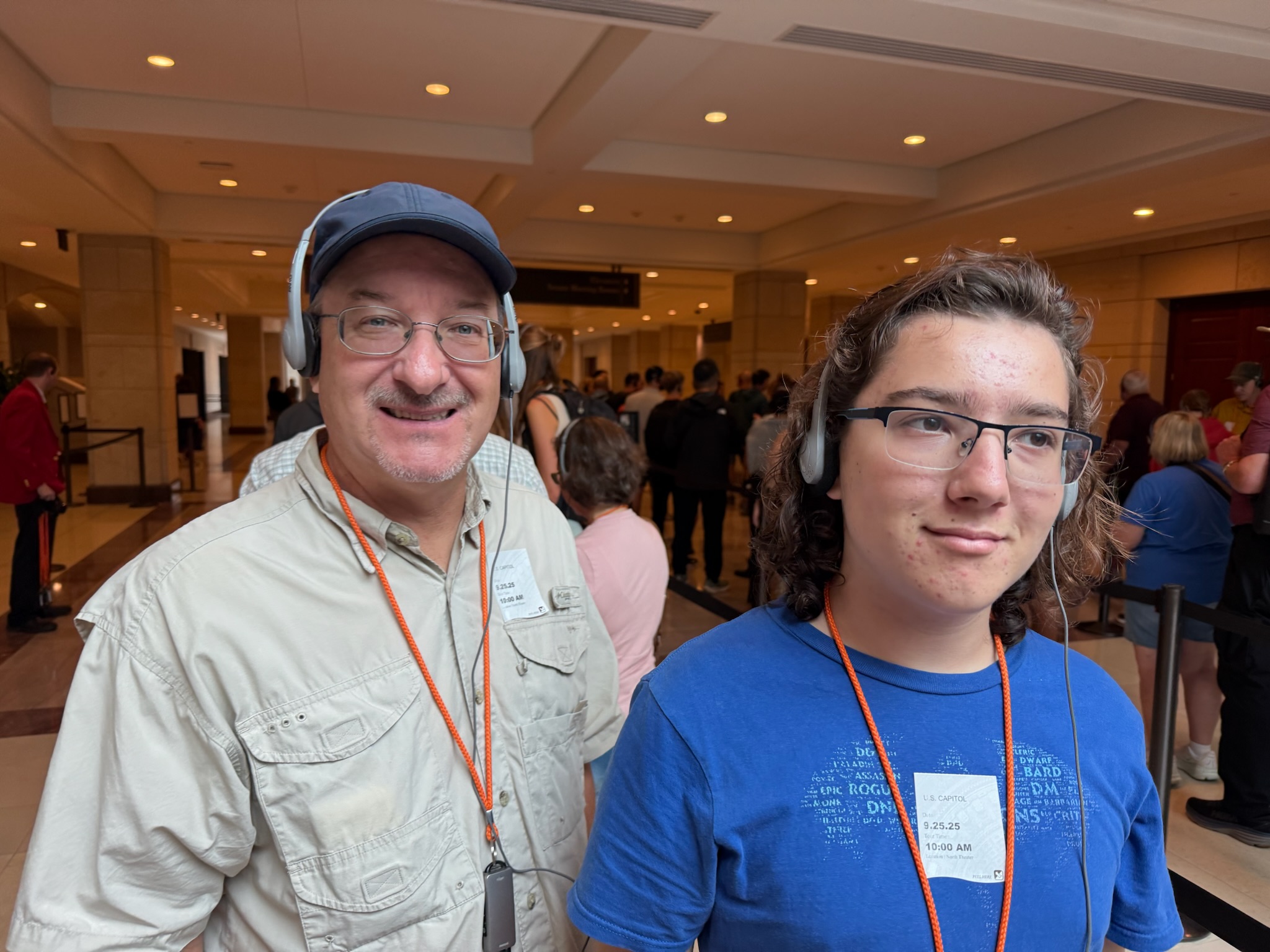
We followed him up an escalator.
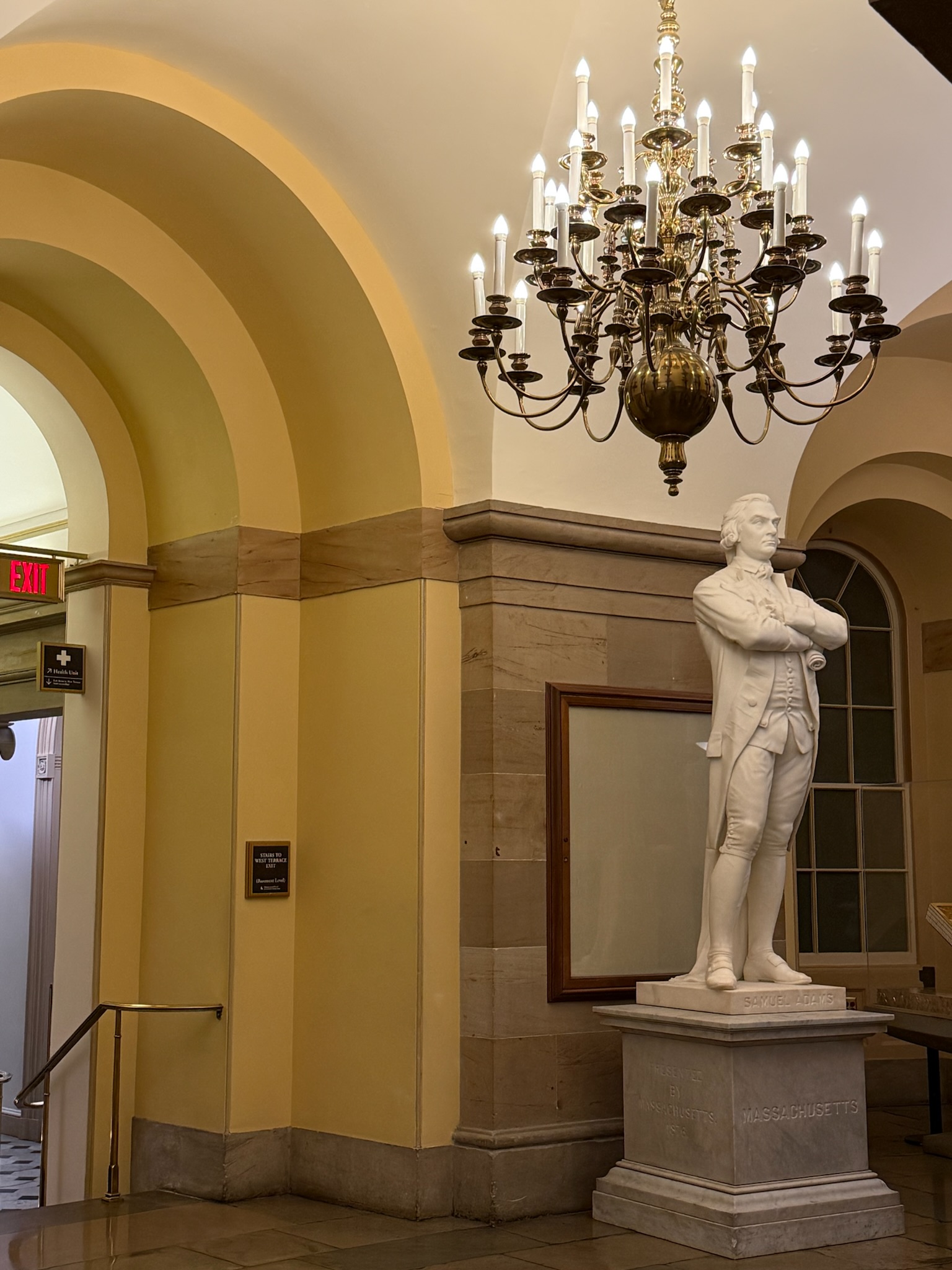
He took us to a round room lined with statues that he said was nicknamed “The Crypt.” We believed this room was under the rotunda, but we weren’t certain. Unfortunately, it was difficult to get photos as the room was packed with large tour groups like ours and small tour groups that he said were conducted by congressional interns. But we got a few.
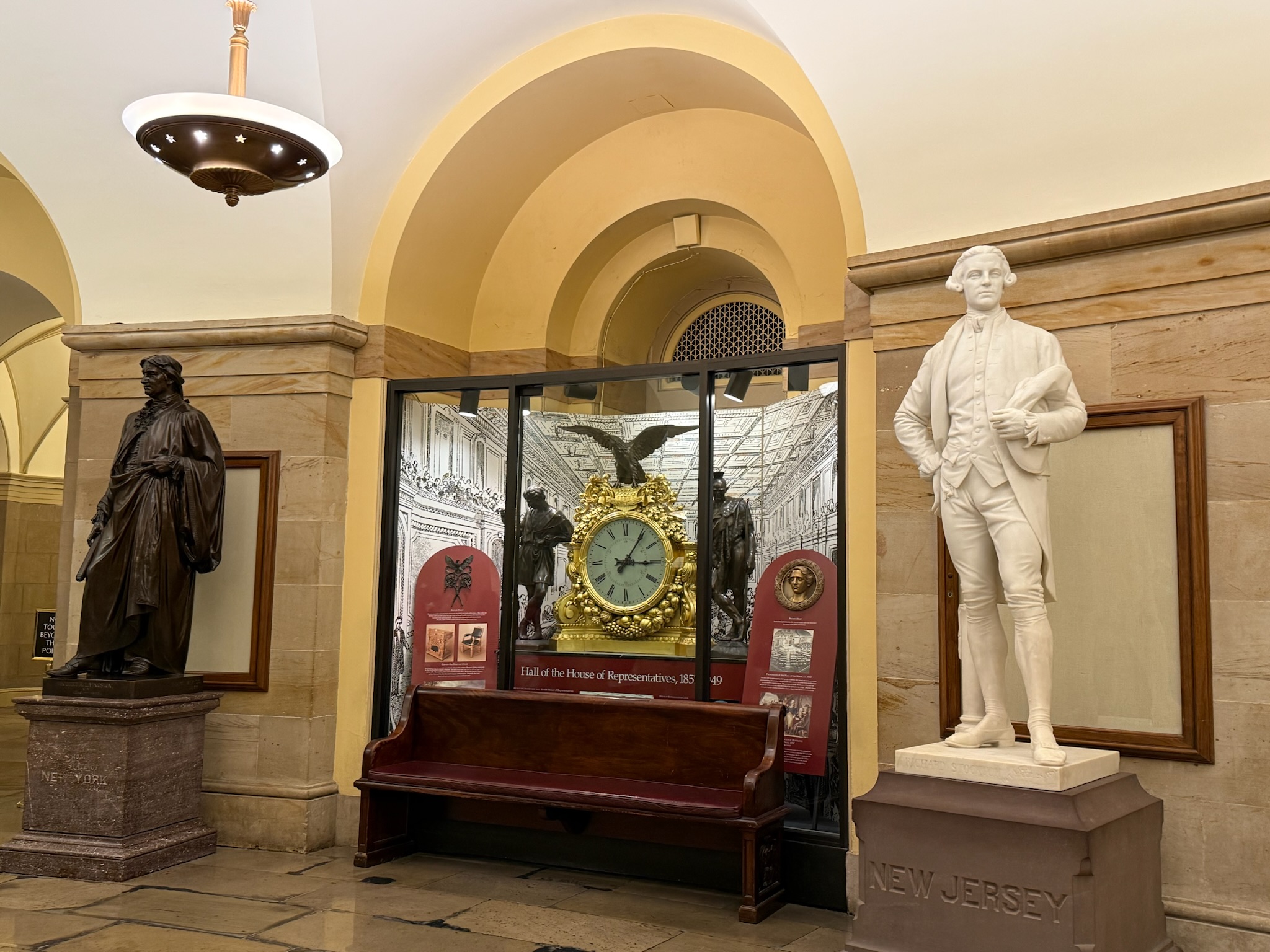
This room was quite literally the center of Washington DC. As a quick reminder, what is now DC had been nothing but farmland when the US became an independent nation. George Washington had chosen this location in 1791 to build a master planned, ten-mile square, Capital city for the brand new nation.
Our guide said that, geographically speaking this room wasn’t the perfect center, but it had been when the city was first designed. The city’s architects had broken the city up into four quadrants. This room was intentionally put at the center and the rest of the city, including the road system, was laid out around it. There was stone in the middle of the room to mark the meeting point of the four quadrants. It was supposed to be good luck to touch the stone, and we watched a conga line of people go up to it and touch it as he spoke. He wouldn’t let us touch it, though.
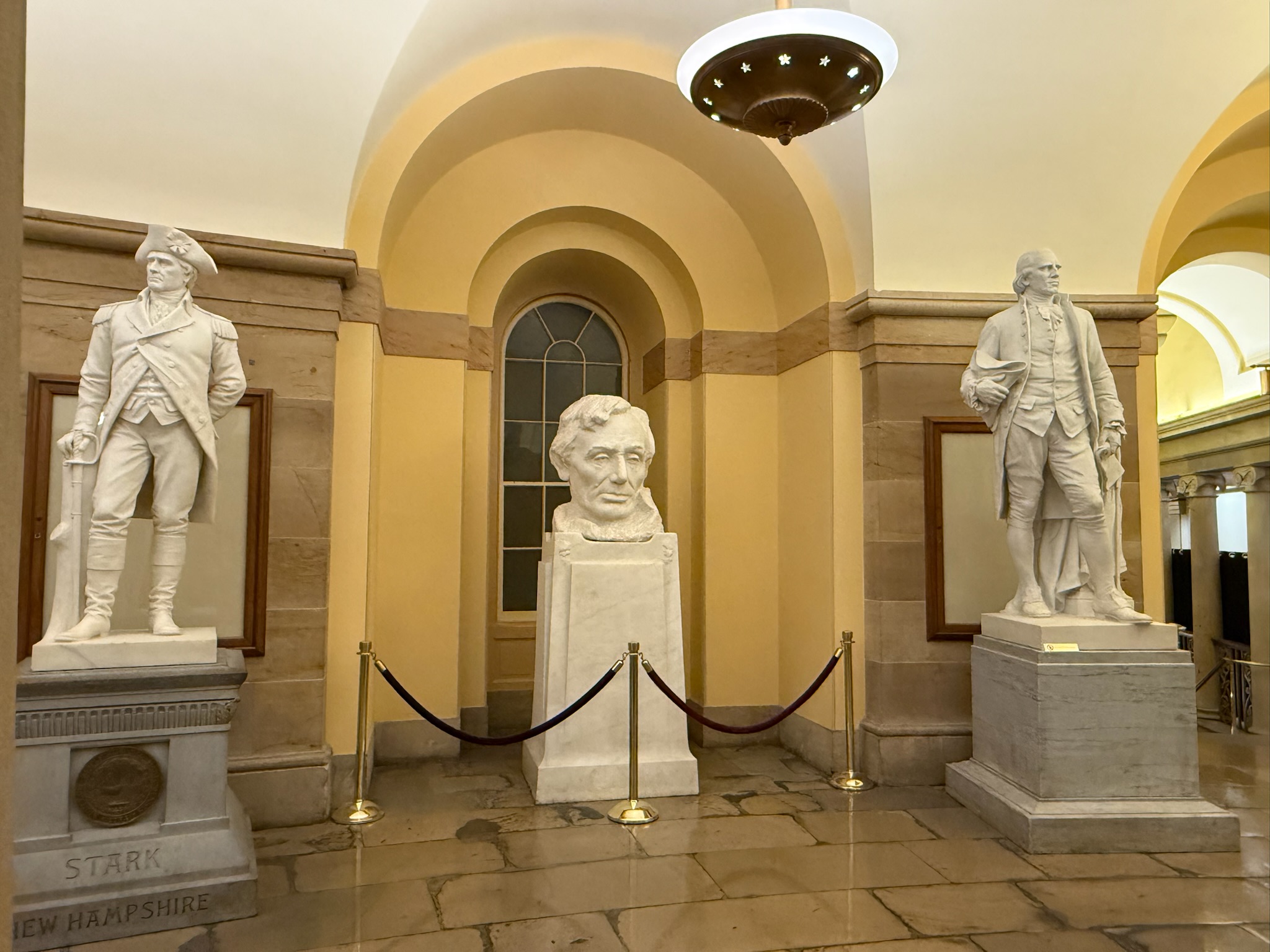
The guide said that the reason the room was nicknamed The Crypt was because it contained George Washington’s tomb. We were confused by this, because we’d just read at the Library of Congress that Washington was buried at his home in Mt. Vernon. He explained that this room was specifically built to be George Washington’s mausoleum. Congress had wanted Washington’s body to be exhumed from Mt. Vernon and moved here, but the family wouldn’t go along with it. While Washington’s tomb is still here, it is empty and only a symbolic final resting place.
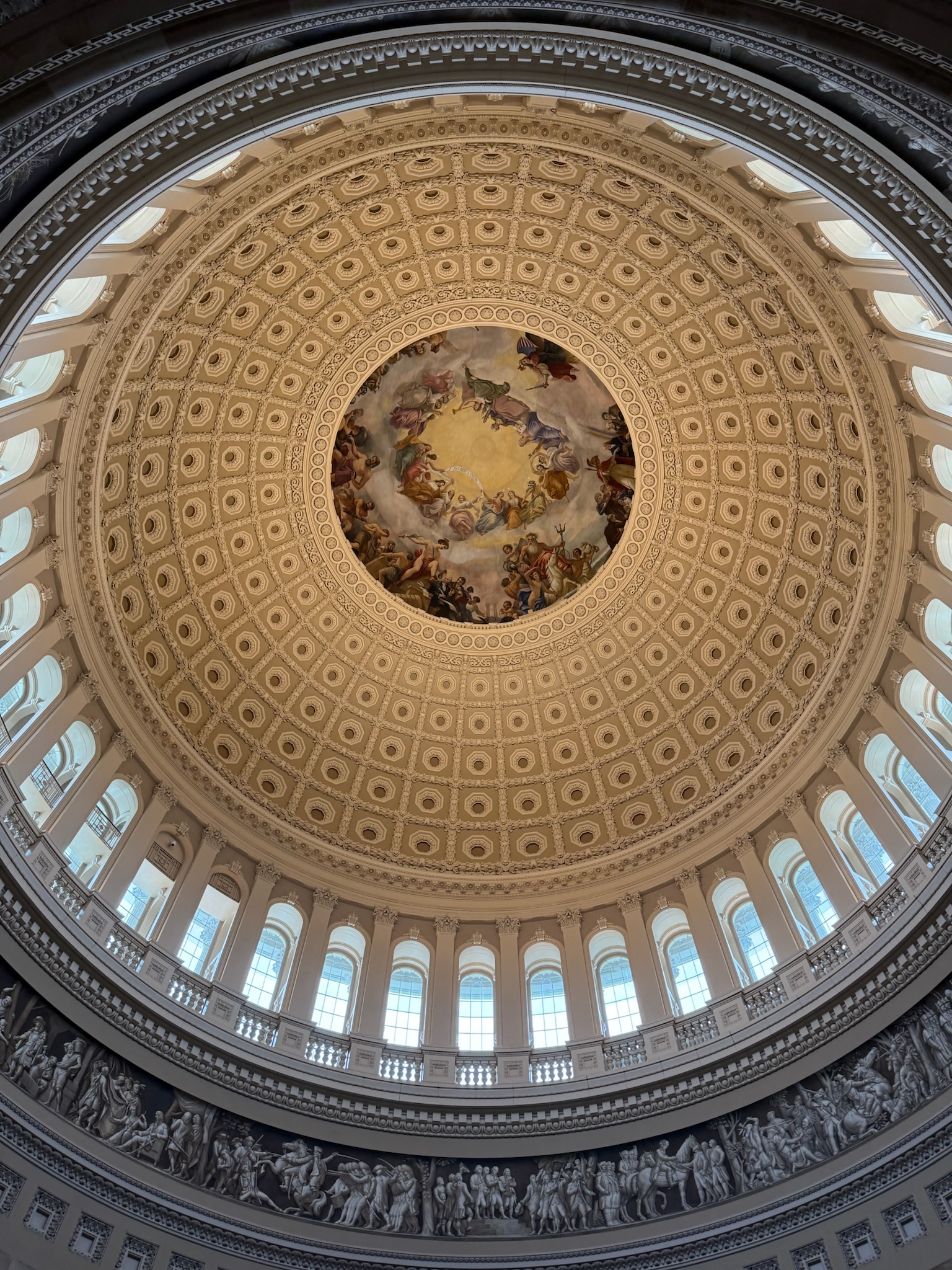
We headed up a floor to the iconic rotunda, which connected the two wings of the building. The rotunda wasn’t completed until 1826. They had completed the two wings first, leaving an empty space in between for the rotunda, and they hadn’t yet started construction when the British burned down DC in 1814. Since the wings had been built of brick and sandstone, the exterior walls of the two wings had survived. It took them until 1819 to gut and rebuild the interiors, which they completed before getting started on the rotunda. The original dome over the rotunda was low and made of copper and wood. During the Civil War, it was upgraded to what still stands now, which was completed in 1866.
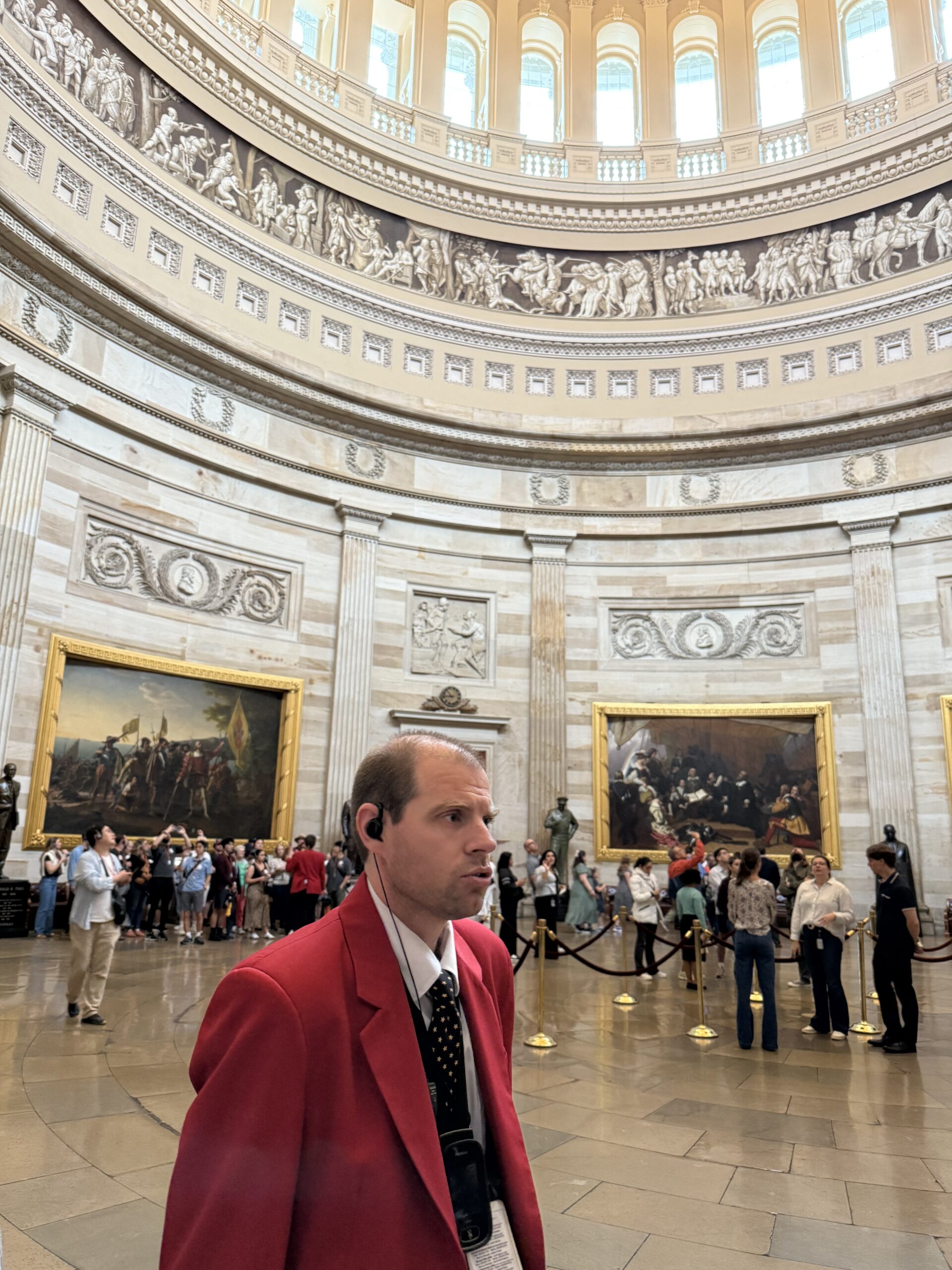
Since the room was so large and crowded, it was tough to get photos that adequately reflected the grandeur, so here is a video scan of the entire room.
The dome was 90-feet wide and 180-feet high. It looked like it was made out of marble, but it was actually made of cast iron. The painting in the center was called “The Apotheosis of Washington” and was painted by Constantino Brumidi. It looked like it was small and flat, but it since it was 180 feet up, our perspective was skewed. It was actually bigger than a basketball court and dome shaped. The painting showed George Washington rising to the heavens, flanked by the allegorical figures Liberty/Authority and Victory/Fame. Female figures represent the 13-states and other figures represent war, science, marine, commerce, mechanics and agriculture. At the time, Congress spent $40,000 to have that painting made, which is $1,379,000 in today’s money.
Four of the giant paintings depicted scenes from the American Revolutionary War and were painted by John Trumbull, an aide-de-camp to General Washington during the war. The rest of the paintings depicted events associated with the exploration and settlement of the US.
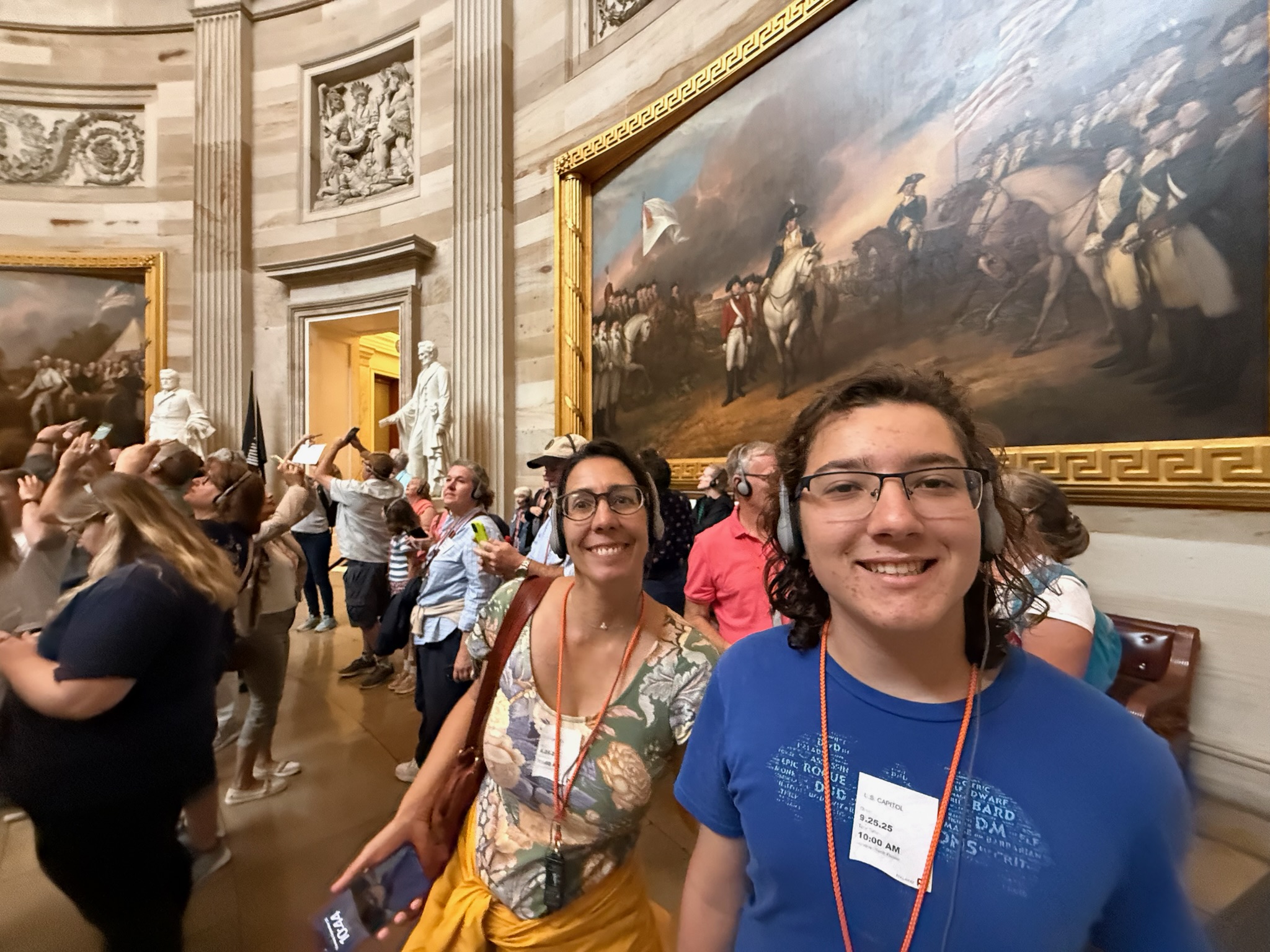
The rotunda served as a ceremonial space. Visiting heads of state were often received in the rotunda. Many historic events have been celebrated here. Since the time of Abraham Lincoln, funerals and viewings have been conducted here for presidents, members of Congress, military heroes, and eminent citizens. On January 7 of this year, former President Jimmy Carter’s body was brought here. A memorial was done in this room, then it was open 24/7 until the morning of January 9th so the general public could pay their respects. On the 9th, his body was moved to the National Cathedral for his DC funeral (Carter’s body was then transferred back to Georgia for a private family funeral and burial). If we remember correctly, our guide said that former President Kennedy’s viewing only lasted 18 hours, and in that short time, ¼ million people went to the rotunda to pay their final respects.
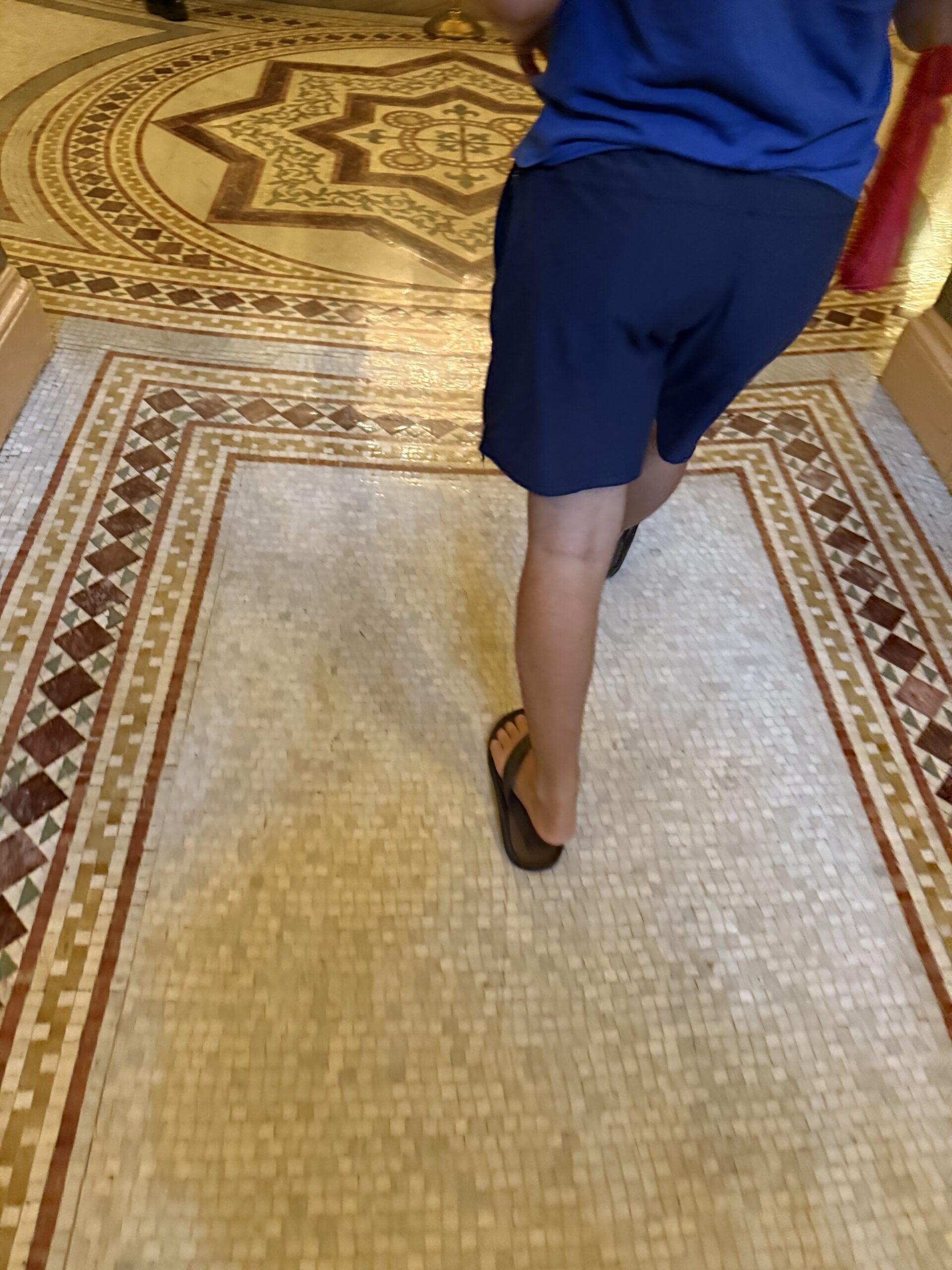
We moved into the north wing, AKA the Senate wing, which was connected to the rotunda via an odd hallway with elaborate mosaic flooring and a colorful ceiling.
According to our guide, the interns who do the private tours tell tourists that this chandelier was salvaged from the Titanic. He said that origin story was a lie; though it was true that it had been purchased used. If we remember correctly, the original owner had imported it from Europe, but it was purchased domestically.
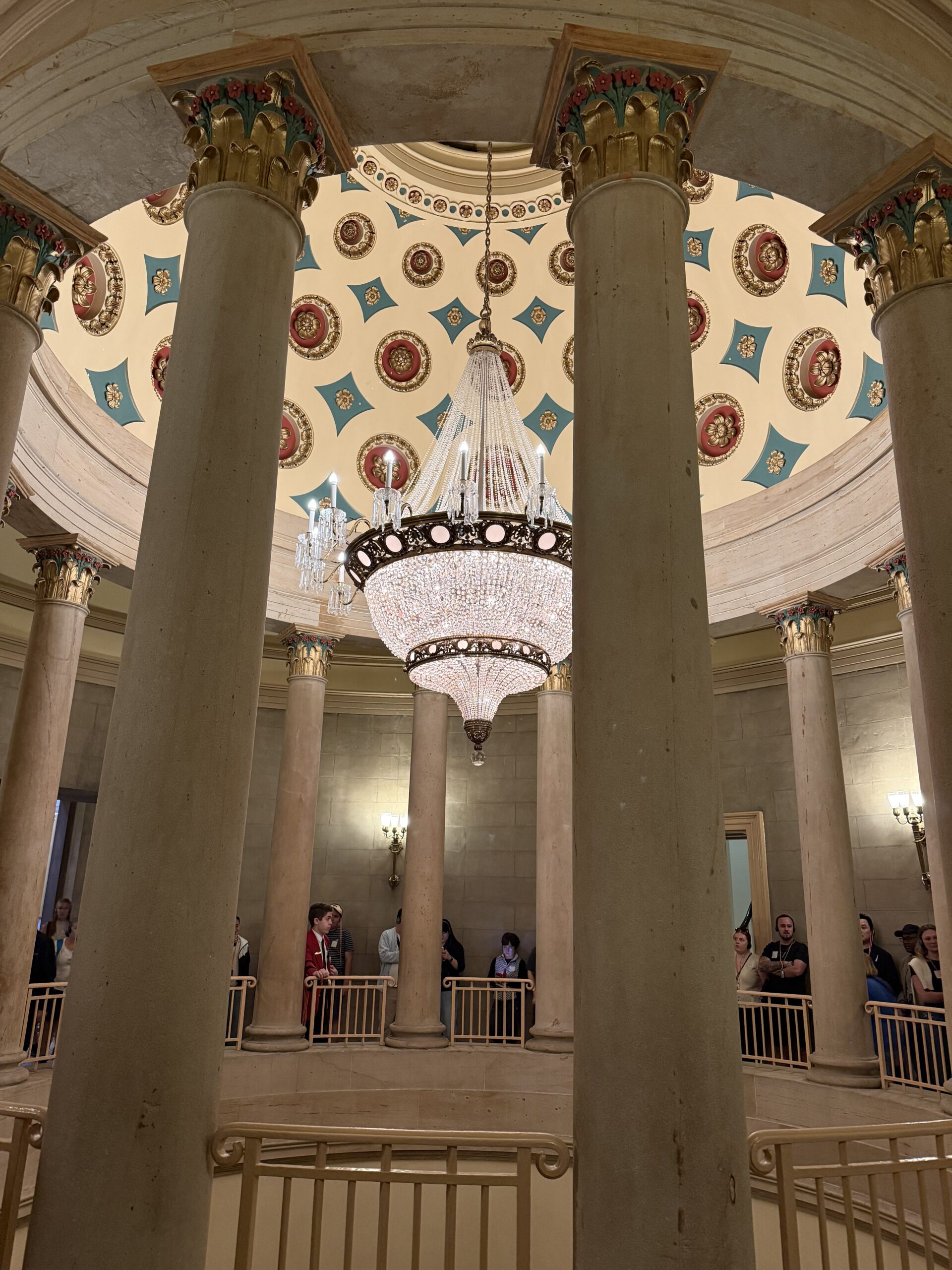
It connected to a small foyer.
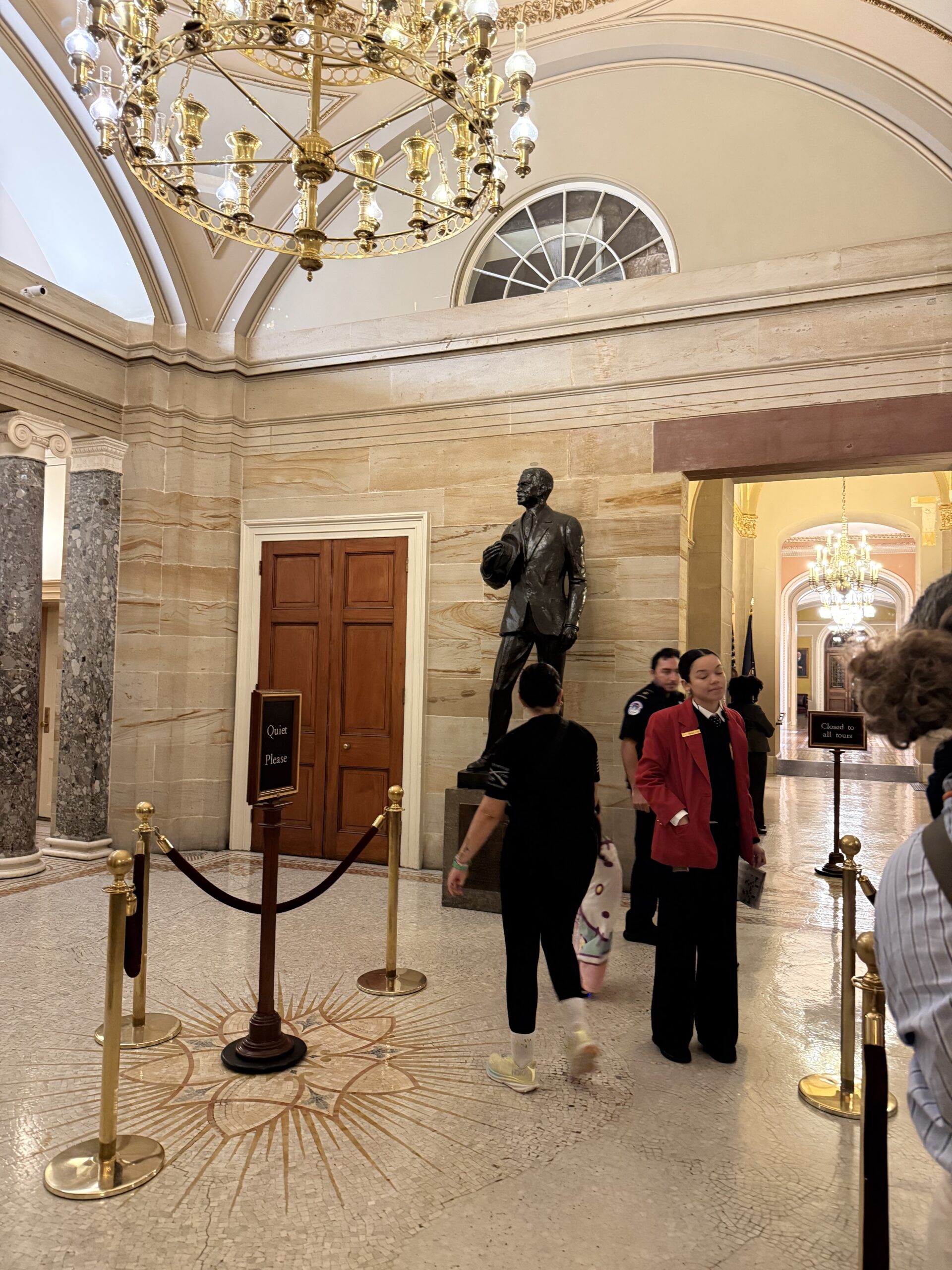
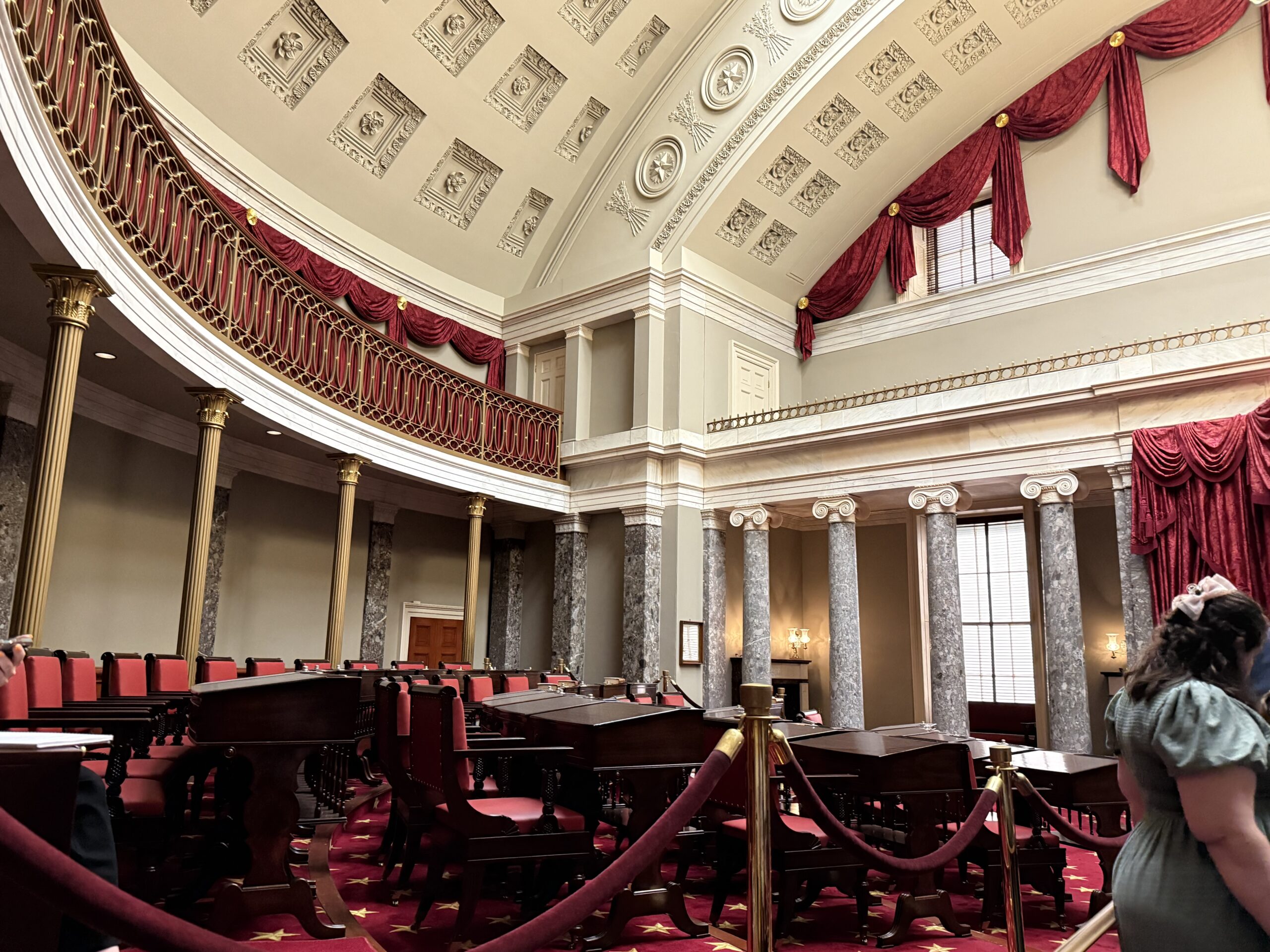
The foyer led to The Old Senate Chamber. Construction on the Capitol began in 1793. In 1800, Congress moved from their temporary location in Philadelphia to the still unfinished north wing. It sounded like from 1800 – 1810, the Senate utilized a room on the ground floor while this room was being completed. The Senate met in the Old Senate Chamber from 1810 – 1859. Our guide said that the room was still sometimes utilized for committee meetings and other congressional activities, so it was frequently not available for tourists to see. We were lucky!
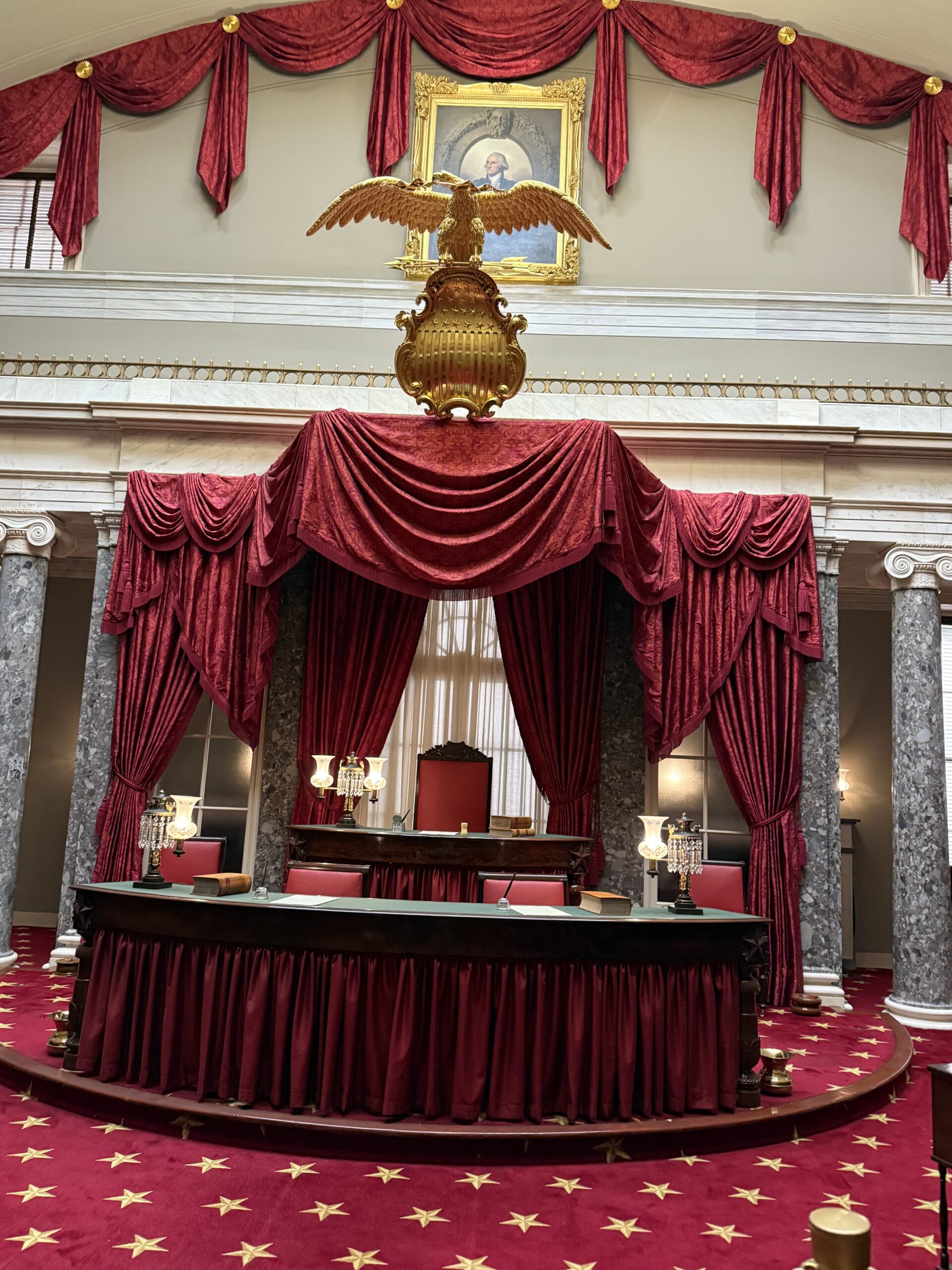
This was the view to the left of the entrance; the right side looked much the same.
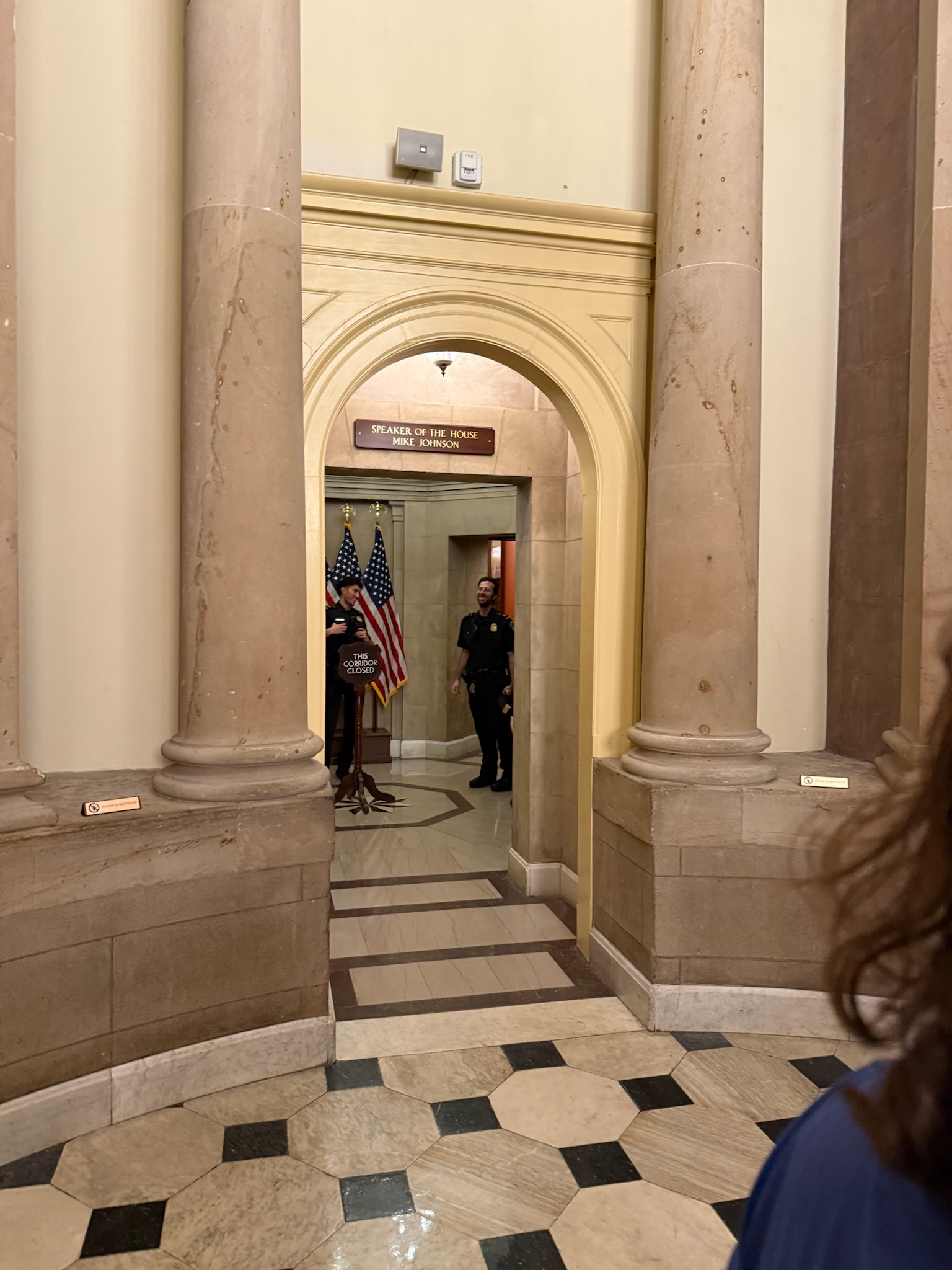
We backtracked through the foyer and mosaic-laden hallway into the rotunda. We crossed the rotunda and walked through a doorway on the opposite side into another hallway that connected us to the south wing, AKA the House wing.
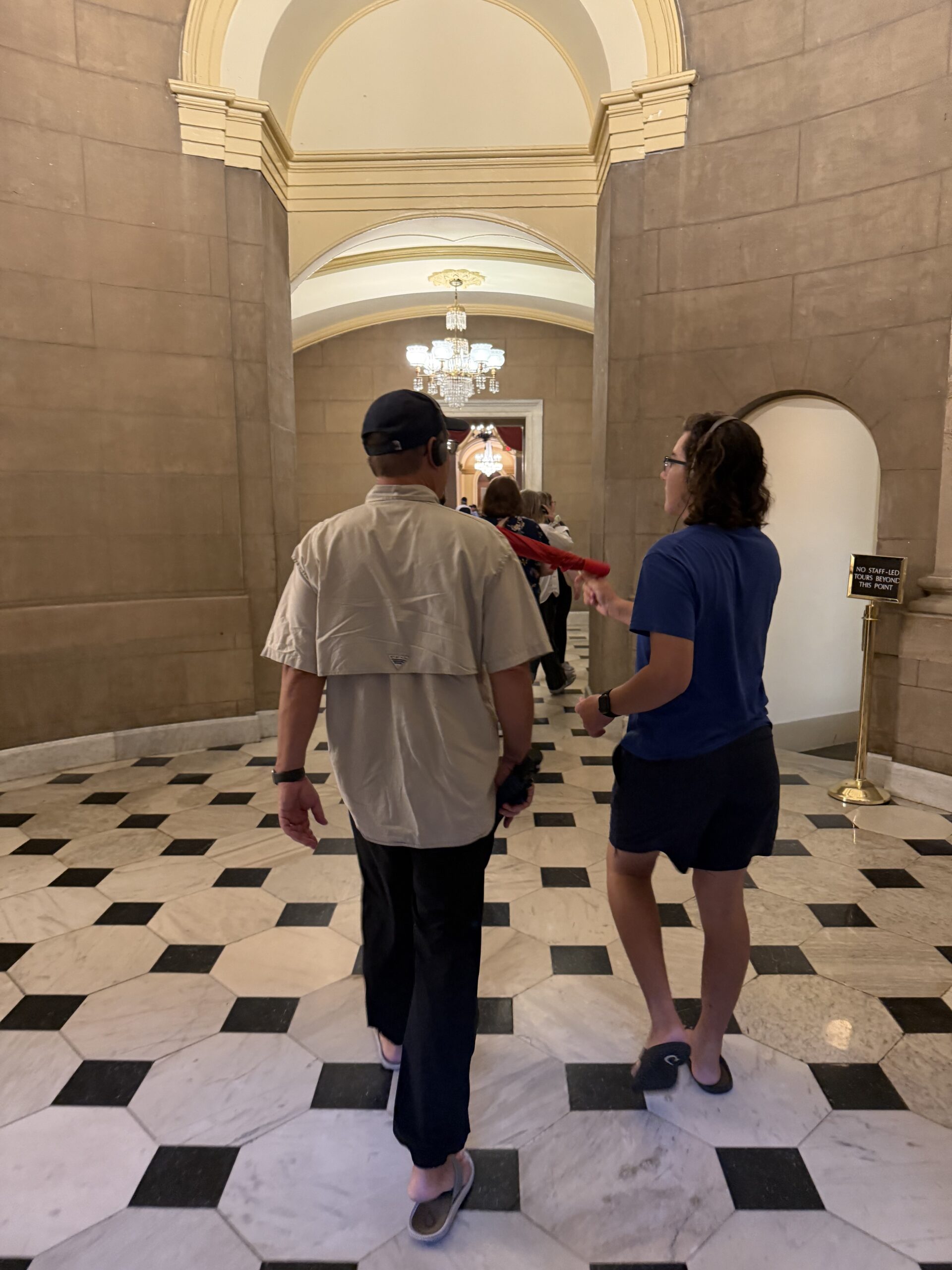
As we walked down the hall, we passed the office for the Speaker of the House.
The hall led to… to be continued...