
continued… There was an exhibit about notable addresses to Congress that took place here in the Capitol. Interestingly, John Adams, who was president in 1800 when the Capitol opened, was the first and last president to speak to Congress in person in a joint session (meaning both the Senate and House legislators were in attendance) in the Capitol for over 100-years. Woodrow Wilson restarted that tradition of in-person communication in 1913. In the interim, the president simply addressed the legislators in writing.
The first foreign dignitary to address congress was the Marquis de Lafayette in 1824, though he addressed each chamber separately instead of having a joint session. The first foreign head of state to address Congress in a joint session was King Kalakaua of Hawaii in 1874. In 1939, King George VI became the first reigning British monarch to visit the US. His successor, Queen Elizabeth II of England, came to the Capitol several times, and the Pope came once in 2015. Other notable leaders were Russian President Boris Yeltsin, who came only six months after the collapse of the USSR and British Prime Minister Winston Churchill, who visited three times.
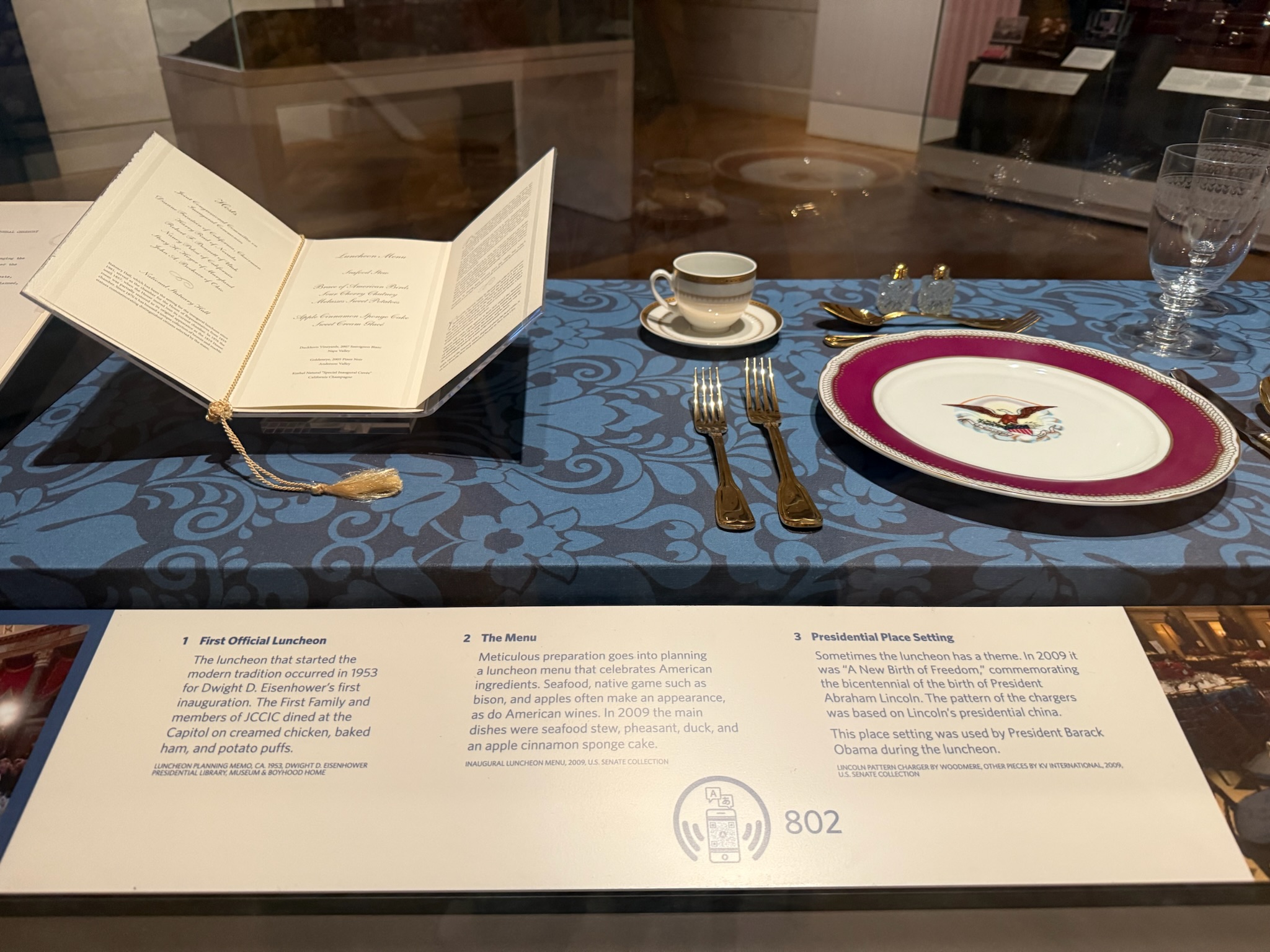
As previously mentioned, presidential inaugurations were conducted here. There was a display about how the exact location has changed over the centuries (going from inside to outside, then from the east side to the west side), the extensive logistics to prepare for the event, what they do in inclement weather, etc. What we didn’t know was that there was a luncheon held in Statutory Hall afterwards. With only 232-seats, It was the “the most exclusive event in Washington.” Only the legislators in leadership and on the inauguration planning committee, the vice president, former presidents, and special VIPs were invited. The tradition began in 1953 with Dwight Eisenhower.
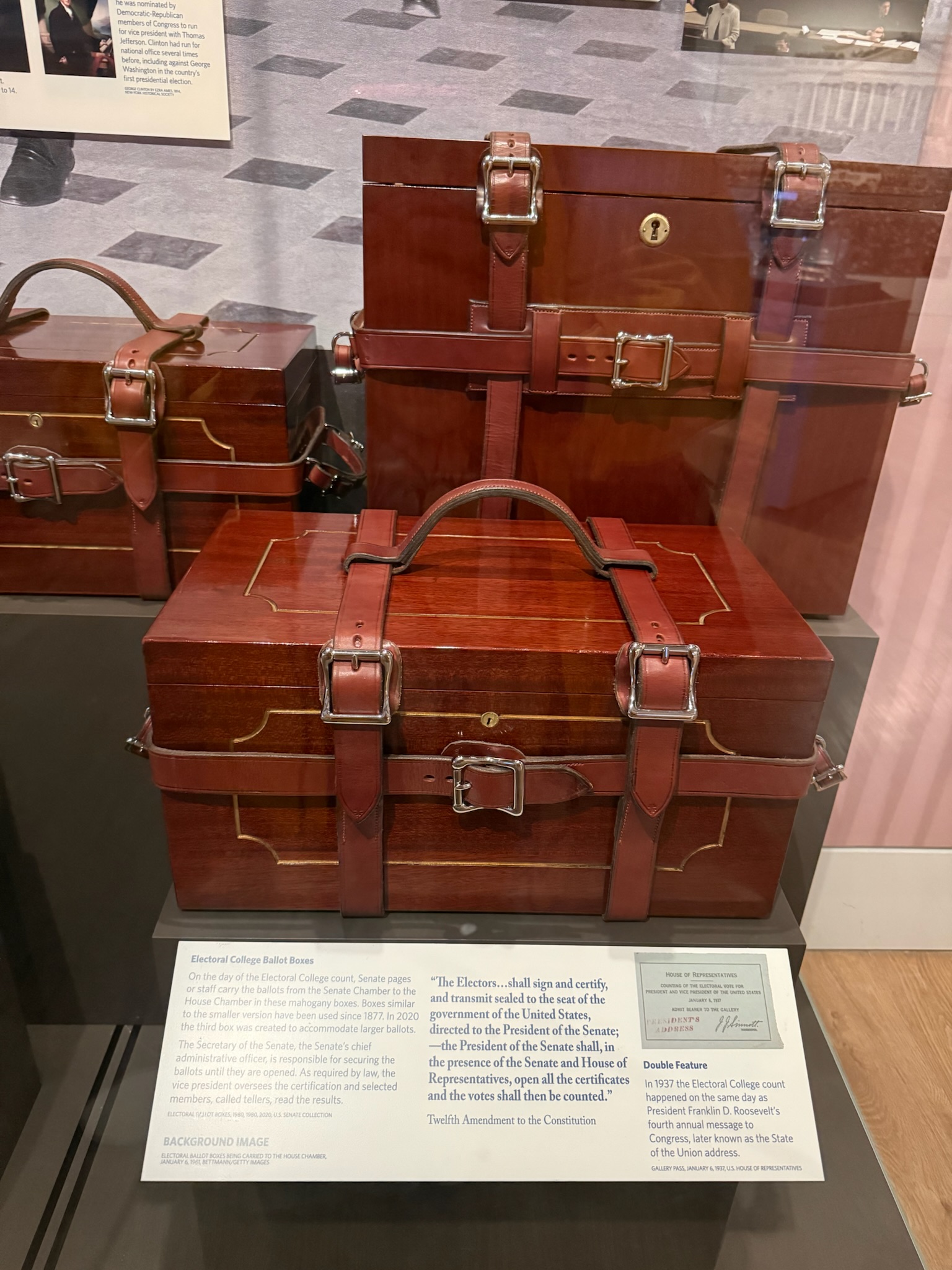
One of the Congressional duties that we neglected to mention earlier was counting the Electoral College votes. There was a big display on that. As much as people like to say America is a Democracy because we vote for leaders, our founding fathers intentionally structured the US as a Constitutional Republic (for those confused, the Pledge of Allegiance says “I pledge allegiance to the flag of the United States of America, and to the Republic for which it stands…). Democracies work by mob rule, so minorities often can lose rights if the mob says so. Constitutional Republics have built in protections for the rights of the minorities.
One of these protections is called the Electoral College System, which weights votes so that less populated states have a more powerful voice than they would have in a true Democracy. This is why there have been occasions when a presidential candidate lost the popular vote but still won the election. The system is too complicated to get into here, so we’ll just say that each state has its own election in November and then sends Electoral College votes to the Capitol. There was a special mahogany case created specifically to carry Electoral College votes.
The vice president counts the Electoral College votes and certifies the winner on January 6. There were several signs about VPs having to certify their own defeat, such as Nixon when Kennedy won in 1961 and Harris when Trump won in 2025. There were also several signs about contested elections, including in 1800, when Jefferson and Burr had both gotten the same number of votes and the House had to choose the winner. Another was in 2000, when Bush was declared the winner despite the fact that the Florida Electoral College votes were extremely questionable due to apparent election irregularities. There was a large exhibit devoted to the 2021 debacle, which we won’t get into since it is still such a controversial hot-button topic.