
continued… Metal coins were first made in the 7th century BC, originating independently in two different parts of the world: Lydia (now Turkey) and China. In the 5th century BC, India also started making metal coins. The coins from Lydia and India were small and round, the ones from China were shaped like farming tools. Metal became a popular choice for currency because the metal in and of itself had a functional value — the coins could be melted and used for other purposes, if needed. All sorts of metals were used, including copper, iron and tin, but the most popular were gold and silver. The value of a coin was determined by the type of metal it was made from and the weight of the coin. Gold and silver stayed the most popular metals for coins for thousands of years — until the mid-20th century. The photo below has some ancient coins.
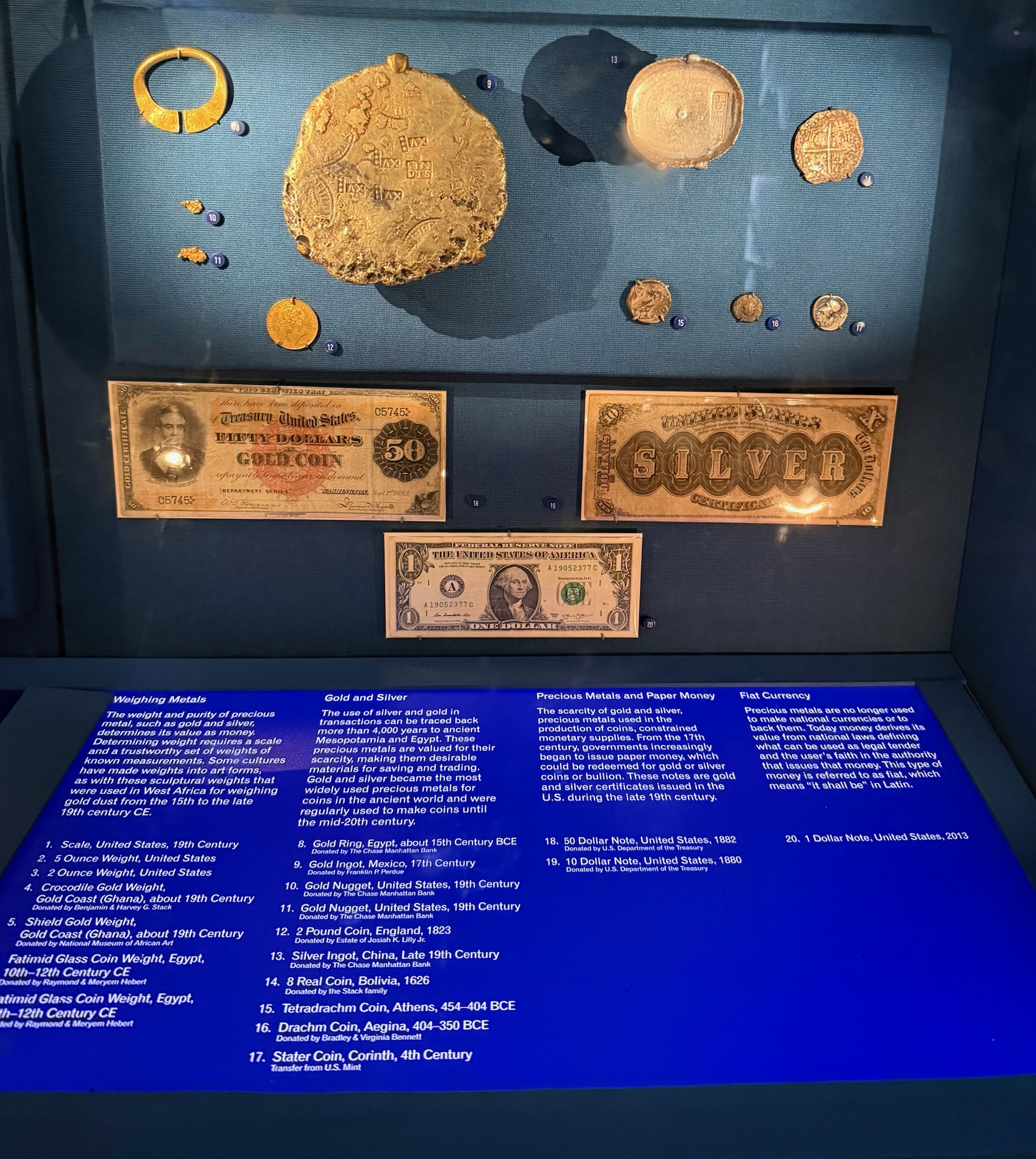
The word money evolved because in Ancient Rome, coins were minted in the temple to goddess Juno Moneta. At first, Moneta referred to where coins were made, but eventually came to mean the coins themselves. All throughout the exhibit, the signs talked about how the images and words chosen to be put on money reflected the country’s identity, history, heritage, leadership and values. For example, Egypt has pyramids and hieroglyphs on their money, reflecting their roots in ancient history. Many countries have images of important leaders and/or religious words/images inscribed on their money, indicating their culture values these people and/or religious beliefs. The language the money is inscribed in indicates who the intended users are, so some countries have multiple languages on their coins. For examples, many languages are spoken in India, so India has several languages on their money.
Paper money was first used in China in the 11th century and became a popular alternative to metal coins in the 17th century. Because gold and silver were scarce, the money supply was constrained. To help ease the constraint, governments increasingly used gold and silver certificates — pieces of paper that could be redeemed for the quantity printed on the paper. In the photo above, there was a note redeemable for a $50 gold coin and a note redeemable for a $10 silver coin. We’ll address the current $1 fiat note further below. In recent decades, some countries have moved from paper to notes that look like paper but are actually made of polymer (plastic).
Money was a persistent problem for American colonists. Great Britain restricted colonists from importing coins, so there was a perpetual coin shortage. Alternative currencies were used, such as nails, beaver pelts, wampum and foreign coins. In the 1652, Massachusetts began producing its own coins. In 1690, Massachusetts began printing paper money. Eventually, all 13 colonies printed their own paper money, and when the states unified, the federal Continental Congress also printed paper money.
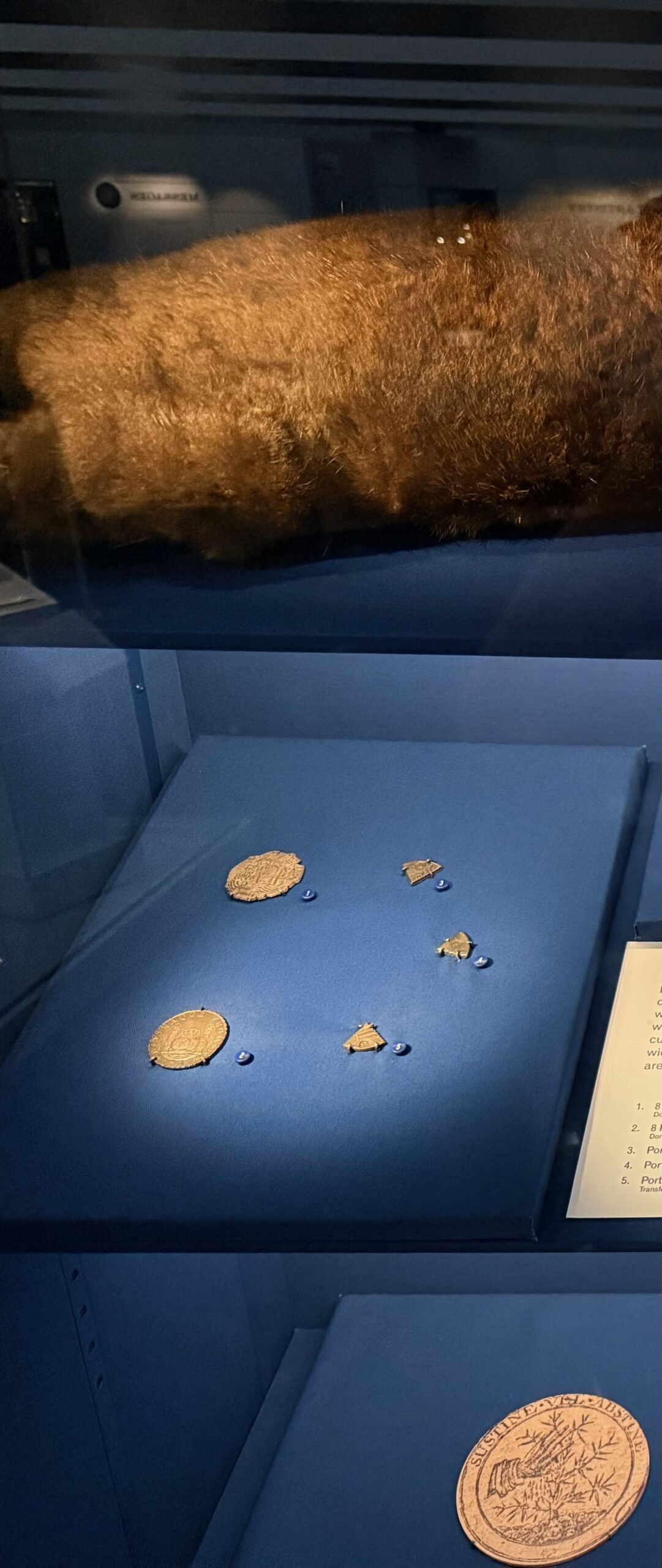
Fun fact: the Spanish silver coin called Pieces of Eight could be cut into 8 pieces to make small change. This was such a popular coin worldwide that it could be considered the world’s first global currency.
There was an incredibly vague, one-paragraph explanation of fiat currency, so we will fill in the gaps that the museum left out. In 1933, the United States stopped issuing notes that were redeemable for the actual metal coins. Instead, they started issuing debt notes — for each dollar printed, the US government owed the Federal Reserve (which, despite its name sounding governmental, is actually a privately owned bank) that dollar back plus interest. However, people had faith that the debt notes were a stable and reliable currency because the amount of paper money that could be issued could not exceed the amount of precious metal reserves that the United States held. In other words, the US had enough to in savings to cover the debt owed to the Federal Reserve.
The definition of fiat currency is a type of money that is issued by a government and is not backed by a physical commodity like gold or silver. In 1971, the United States completely converted to a fiat currency when it abandoned the “money in savings” limit and just started printing however much money Congress needed to cover what it spent. A good analogy is they went from a rule that they couldn’t spend more than they had saved to a rule where they could charge up unlimited credit card debt. Most of the major countries did the same within a relatively close time-frame to the US.
The value of a fiat currency comes from the trust and confidence that people have in the government that issues it. “The market” determines that the total value of a country’s money is X based on its economic and political strength, then it divides the total value by the amount of currency issued (ie, the number of dollars, pounds, euros, etc that have been printed) to determine the value per unit of currency. This is why international currency trading values go up and down — the value of a currency wavers depending on the political and economic situation in each fiat country, and it also wavers depending on how many units of currency are in circulation. So, if it looks like there may be economic turmoil in a country, the international trading value of their currency will drop until things are stable again. Or if a country starts printing a lot of money, the value per unit will drop.
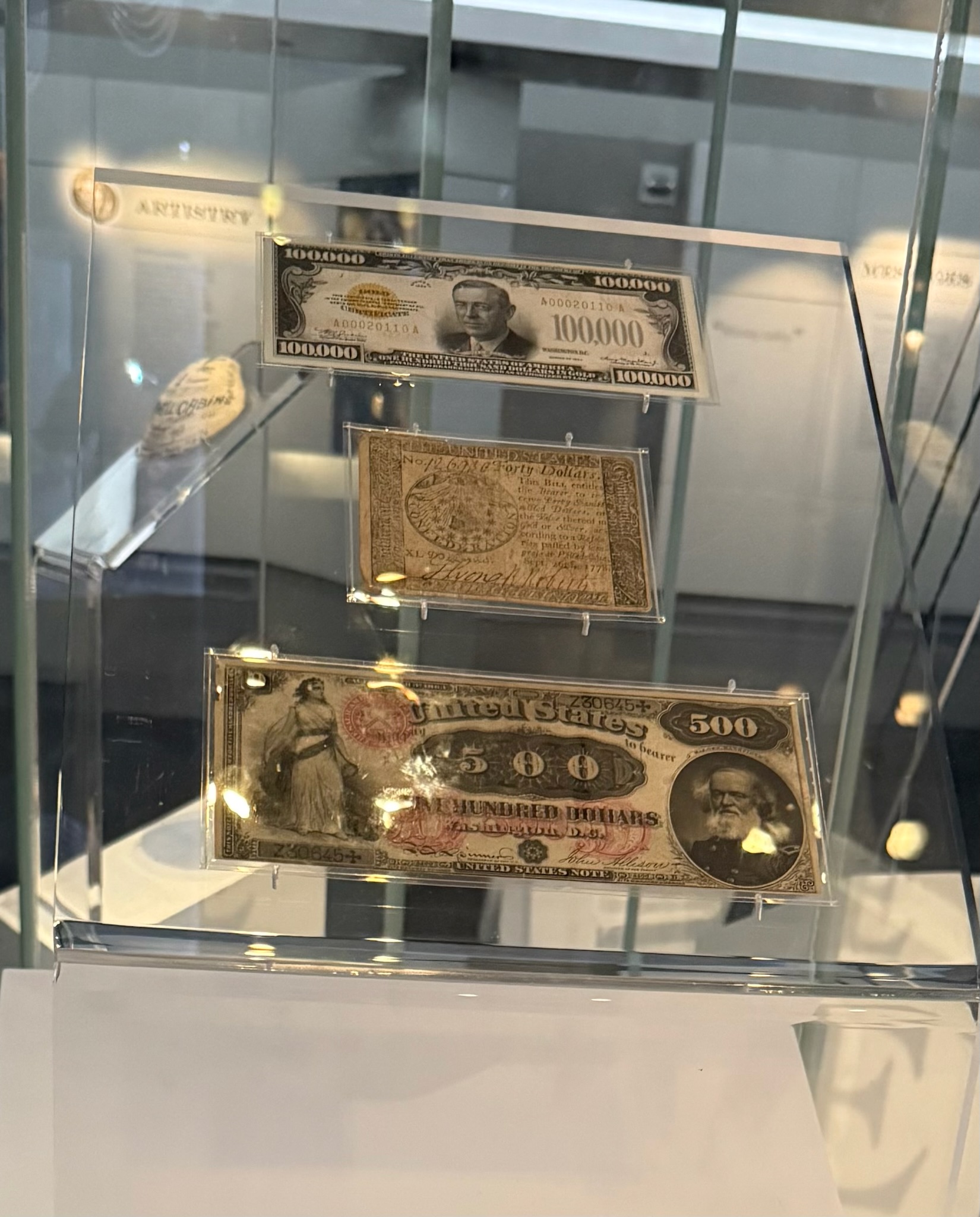
Back to the museum… The largest paper denomination the US ever issued was the $100,000 gold certificate, issued in 1934 as a means for Federal Reserve Banks to transfer money between one another. They were not for public use and it was illegal for individuals to own them.
There was a small exhibit on “innovations in payments” that have occurred over the last century that have allowed people to pay without using physical currency, such as credit cards, debit cards, and online payment apps. There was a tiny display on cryptocurrency. The one paragraph description basically said that cryptocurrencies were generally not issued by governments or other authorities, but were instead generated by computer protocols. They rely on an electronic peer-to-peer network to exist and the value was agreed upon by the users based on the limited supply. Then it warned that cryptocurrency could be traced, so don’t even think about using it for illegal stuff.
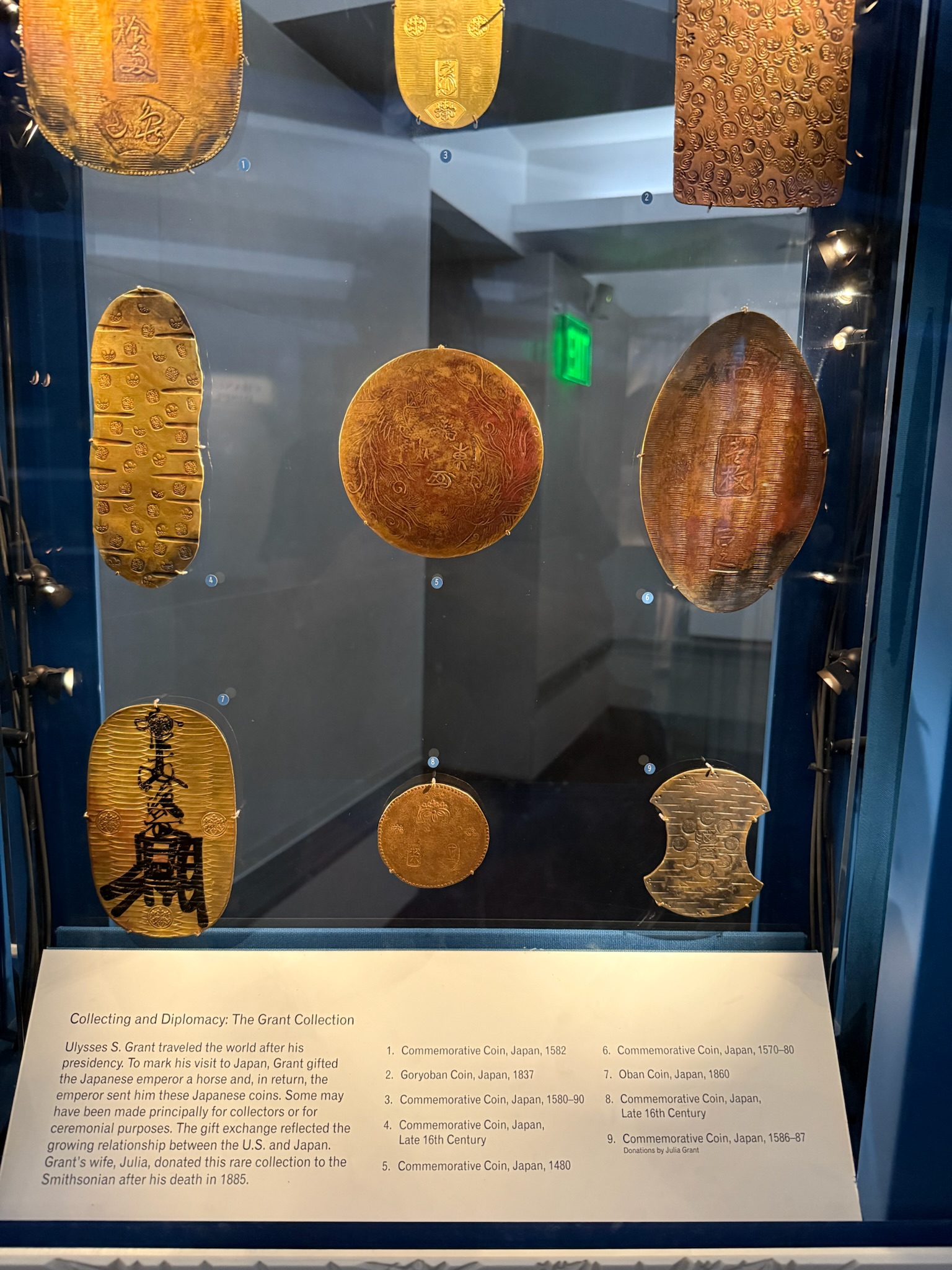
A lot of the exhibit focused on coin collecting, which was one of the oldest and most popular hobbies in the world. The Smithsonian has 1.6 million pieces in its coin collection, and that number was always growing. Just as the Smithsonian Postal Museum only had a small percentage of their stamp collection on display, this museum only has their newest acquisitions and items on temporary loan out on display. This was President Grant’s Japanese coin collection, which his wife donated to the Smithsonian after he passed away.
A sign explained that, just as the Post Office makes new stamp designs specifically for stamp collectors, the US Mint has also made a point of creating a variety of coins specifically for the purpose of collecting. There were many coins featured that had had limited print runs, making them more valuable than the more widely circulated coins. It mentioned that, for some of these limited runs, the Mint employees made a few unauthorized extras — and the Secret Service is still looking for the people who have possession of these unauthorized coins. Some of these unauthorized coins they were still looking for were really old, such as 1804 and 1933!
They also had displays highlighting especially artistic coins/paper money that had been made throughout history, with small blurbs about how engraving was done for coin die and printing plates for paper.
Once we finished in the money room, we moved on to a room called “American Enterprise”…to be continued…