
continued... The next section was “The Corporate Era: 1860s to 1930s.” The sign said that this was when America made the turn to be a primarily urban nation. Businesses got big; so did scales of production. Working together, the US government and big businesses used military and political power to dominate world trade. They controlled sources of raw materials, secured markets for selling finished goods, controlled intellectual property through patents and regulations, and protected American manufacturing through tariffs.
One of the first big businesses was Singer sewing machines. The sewing machine was breakthrough technology. Issac Singer patented improvements to it in 1851. But what made it big was the utilization of the new business models: factories, international distribution networks, sales offices all over the world and clever marketing all came together to make Singer a household name.
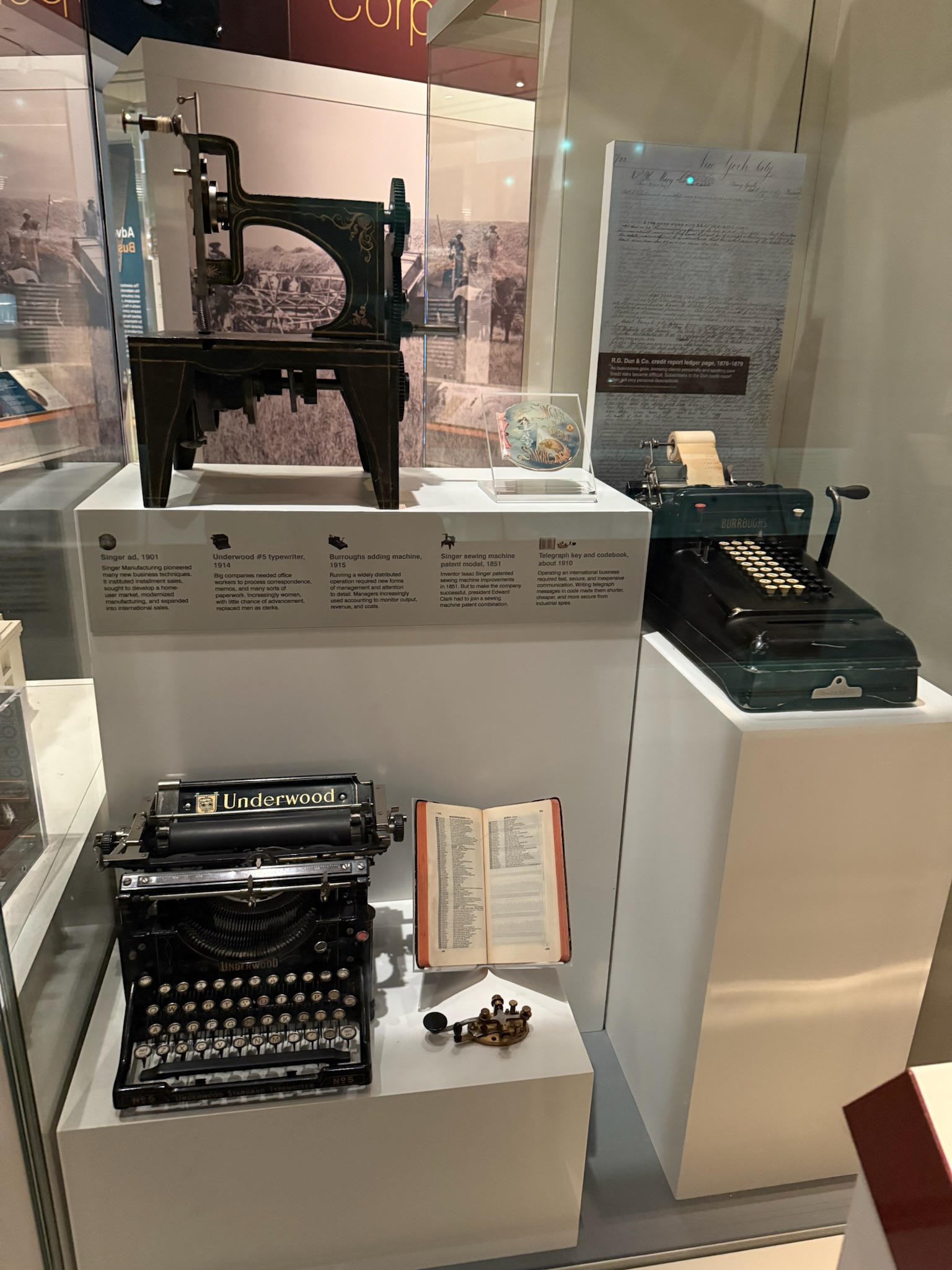
Another signs talked about the strategies that were utilized by big business was to eliminate competition. They did this by merging with competitors to create monopolies, by absorbing suppliers and distributors so no competitor could access materials/the market, and with kickbacks, price fixing, bribery and secret deals. AT&T, Carnegie Steel, and Standard Oil were mentioned as specific examples of companies that managed to become monopolies in each of their industries.
Two more things changed society even more: a flourishing middle class and large department stores. As businesses grew, so did the power of unions. Unions negotiated terms for the work pace, length of the work day, safety standards, hiring/firing practices and pay. With better working conditions and pay, the middle class grew. Meanwhile, eager to spend their wages, people were attracted to new “palace like” stores with large selections and set prices. The stores were so big that people could spend the whole day shopping! These department stores also began to allow people to buy items on credit. During the 1920s, 80% of household appliances were purchased on credit. Also during the 1920s, organized crime exploded, thanks to Prohibition creating a giant black market for alcohol.
There was a large societal culture shift with cosmetics use. Prior to 1900, few women used cosmetics and the products mostly came from France. Wanting to look beautiful like the women in the talking pictures, cosmetic use exploded. So did the cosmetics industry in America.
The agriculture sector collapsed after World War I, due to a combination of lack of global demand and droughts. As more people abandoned farming and moved into cities to take jobs in the manufacturing sectors, the remaining farmers focused on how to make their lands yield more. Traditional practices such as seed saving and crop rotation gave way to specially bred/engineered seeds that had higher yields, fertilizers, pesticides, and gas-powered machinery. Mass production of tractors, making them more affordable for farmers, was an instrumental factor in this evolution.

Electricity was widely adopted in cities around the turn of the century. Centrally generated electricity allowed businesses to open in new places and to become more efficient by utilizing tools with electrical motors. However, the electrical systems were mostly monopolies run by large corporations.
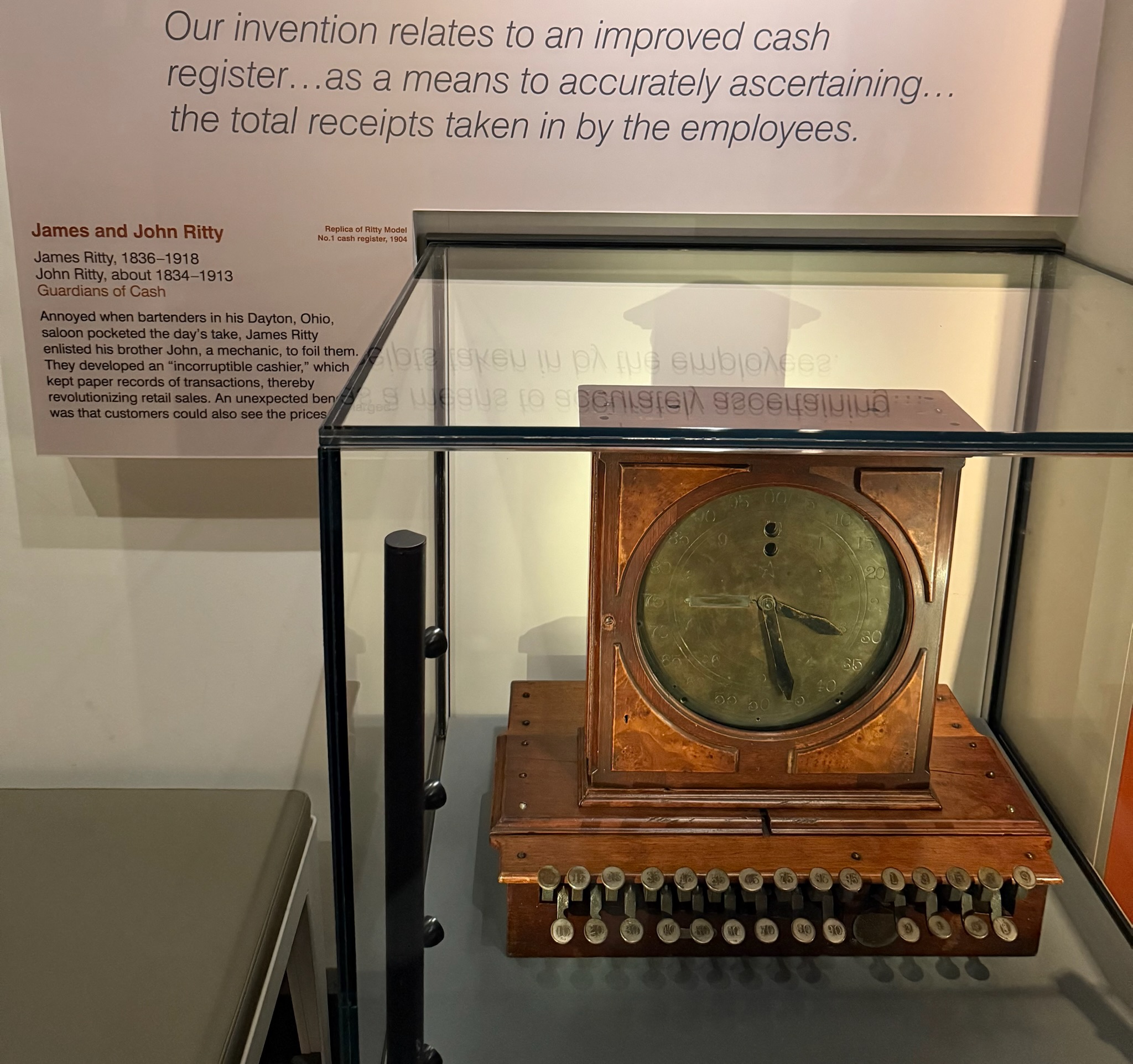
Some of the people spotlighted were inventors, including: Thomas Edison, who invented electric lighting systems and talking dolls; Alexander Graham Bell, who invented the telephone; Leo Baekeland, who invented plastic; and Gideon Sundback, who invented the zipper. Several other people were spotlighted who had improved on an existing invention: James and John Ritty invented a cash register that printed paper receipts and King Gillette invented disposable razors. And there was Ida Rosenthal, who did not invent the bra, but loved the new invention and created the Maidenform company to make and distribute bras.
Another interesting person spotlighted was James DeWolf, who was a Senator from Rhode Island during the 1820s. DeWolf was also a wealthy and prominent slave trader. He evaded the anti-slavery laws by using Cuba as his slave depot. It seems that Congressional representatives evading laws is a long standing American tradition. ?
The next section was “The Consumer Era: 1940s – 1970s.” The transition between the two eras was the Great Depression. A sign listed many of the social welfare programs that were created under President Franklin Roosevelt’s “New Deal,” such as the Federal Deposit Insurance Company (FDIC) to regulate banking, the Works Progress Administration to create federal jobs, and the Rural Electrification Administration (REA) to bring electricity to rural areas so that farmers could implement modern tools, such as milking machines. The interventionist initiatives made government bigger so that it could regulate businesses more and help citizens more.
We decided that we didn’t want to finish “American Enterprise” and moved on to the next gallery, which appeared to be a traveling exhibit about… to be continued...