
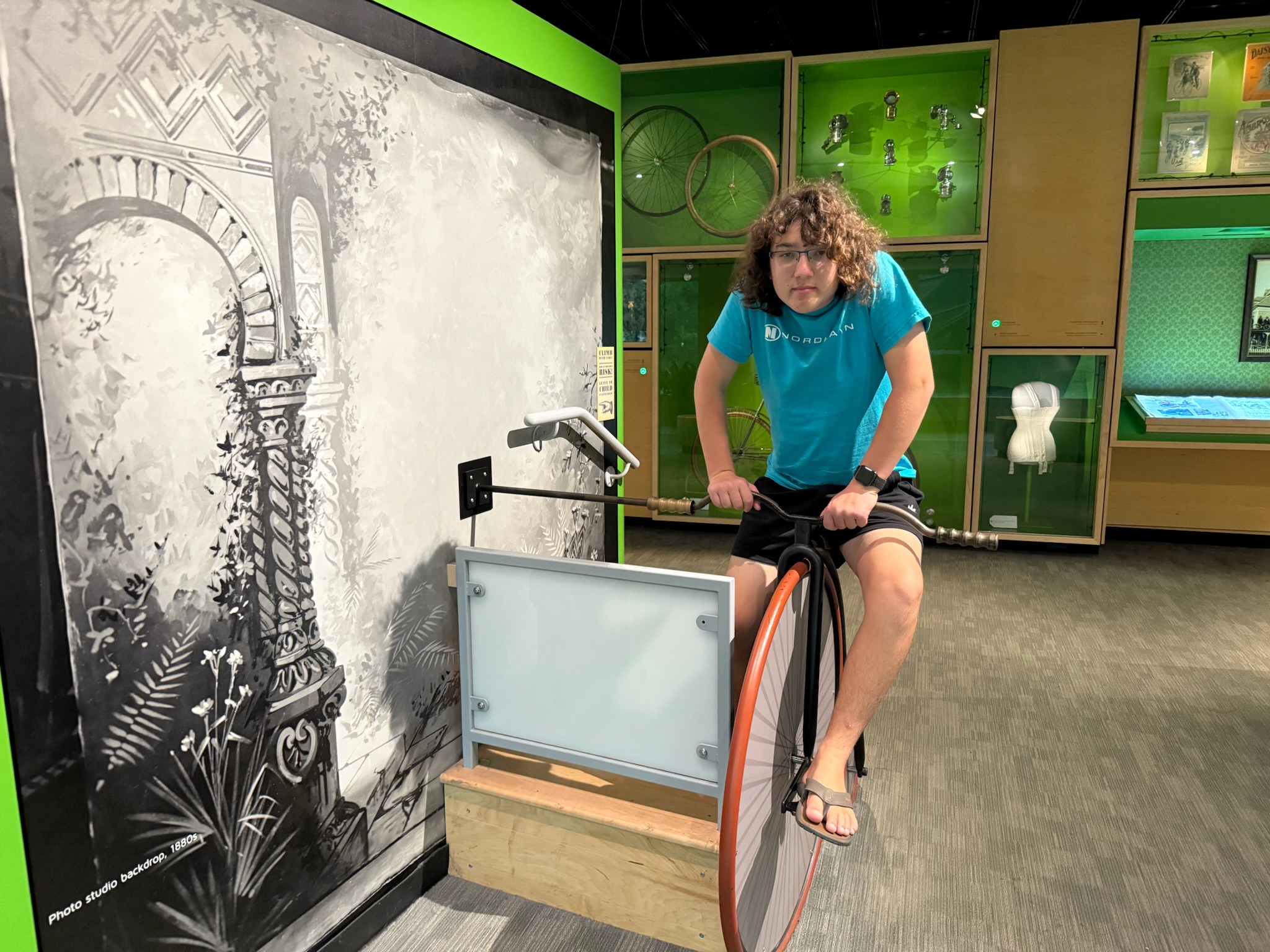
continued… We moved on to the next gallery, called “Object Project.” It appeared to be a small traveling exhibit about innovations that transformed America. It included: the bicycle, off-the-rack clothing, electric lighting, telephones, appliances (examples were microwaves and vacuums) and computers, among other items. Christi thought the most interesting part of the exhibit was the comment that mass produced clothing led to Americans dressing alike.
Next we went to a gallery called “Change Your Game.’ It was about innovations that helped improve sports in one way or another. Most talked about methods to prevent cheating, such as drug testing, and to avoid bad referee calls, such as the “instant replay.”
Some of the items featured were revolutionary products. Most were upgrades to existing products, such as a better photo-finish camera, better tennis racket, better skis, better skateboard wheels, etc. One of the more interesting upgrades was a lightweight, easy-to-maneuver wheelchair that sports could be played in. Interestingly, in the category of transformational upgrades, was a controversial prosthetic called the Flex Foot Chetah. Opponents argued that this prosthetic gave users an unfair mechanical advantage.
There were only a few truly novel product featured. One was the first sports bra, called the Jogbra, which was invented in the 1970s. It was made out of jockstrap material. The female inventors couldn’t convince businessmen to put them into stores, so they wound up selling the Jogbras via mail order. They advertised in sports journals.
None of us were into sports, so for us, the most interesting aspect of the exhibit was a game where you could invent rules for a sport that the simulator made up.
We moved on to the next gallery, called “Food Exhibition,” which was about how food in the United States changed from 1950 and on. The first exhibit was about Julia Child. The sign said that for forty years, she helped to facilitate these food changes. As we’d learned at the Spy Museum, Julia had worked for the OSS during World War II. It sounded like her future husband, Paul, was one of her OSS coworkers while she was stationed in China. They married after the war. In 1948, Paul — who still worked for the American government — was assigned to a position in Paris. In Paris, she attended the prestigious Cordon Bleu cooking school.
In 1961, Paul retired and they moved to Cambridge, Massachusetts. Also in 1961, Julia and two of her French chef friends published a revolutionary new cookbook for Americans that gave detailed step-by-step instructions, including which tools to use and warnings about potential things that could go wrong. Over the years, she published another 13 cook books.
In 1962, she was invited as a guest on a public television show that did book reviews to talk about her cookbook. Instead of just talking, she demonstrated how to make an omelette. The response from viewers was so enthusiastic that the station gave her a cooking show. “The French Chef” was a hit show that ran for ten years. Childs became a cultural icon.
The museum had her actual kitchen on display — the one where her cooking show was filmed! She’d donated it to the Smithsonian in 2001. Her kitchen contained tools and equipment that she’d acquired between the late 1940s and 2001, making it a time capsule for the last half of the 20th century.
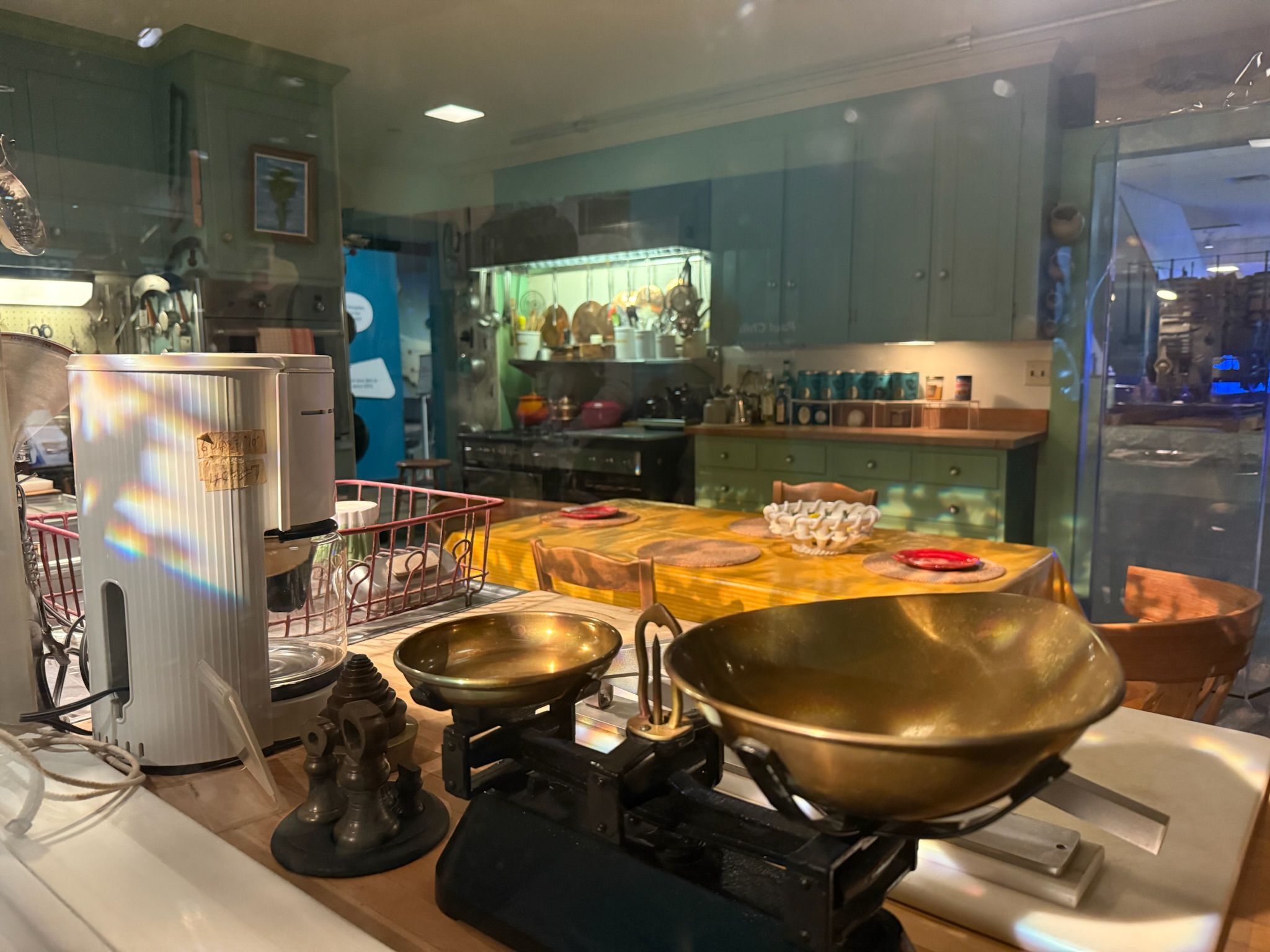
According to the signs, traditionally, kitchens had been hidden away in the back of the house. However, in post-war America, people wanted to show off their modern labor-saving appliances. Kitchens became status symbols, and architects began designing homes with the kitchens prominently placed at the front of the house near the living and dining rooms.
There was an exhibit on products that had been developed before and during World War II that were utilized in American kitchen products after the war. New types of plastics, non-stick coatings (such as Teflon), and freezer-to-oven glass (CorningWare), and microwaves were among the products that changed what we cooked with. The next display was on other types of kitchen appliances that changed how Americans cooked, such as food processors, electric knife sharpeners, crock pots, instant pots, etc.