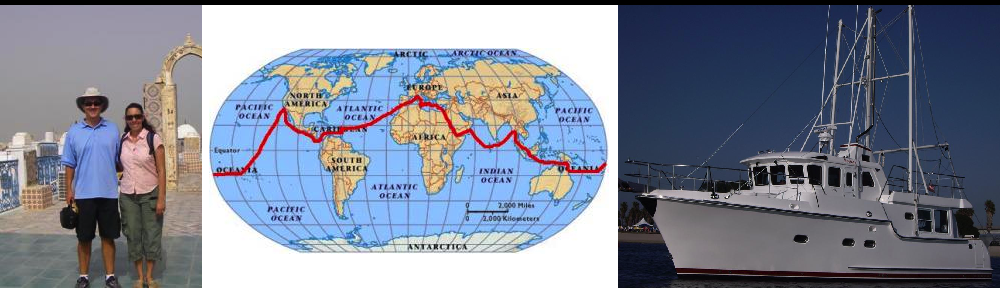
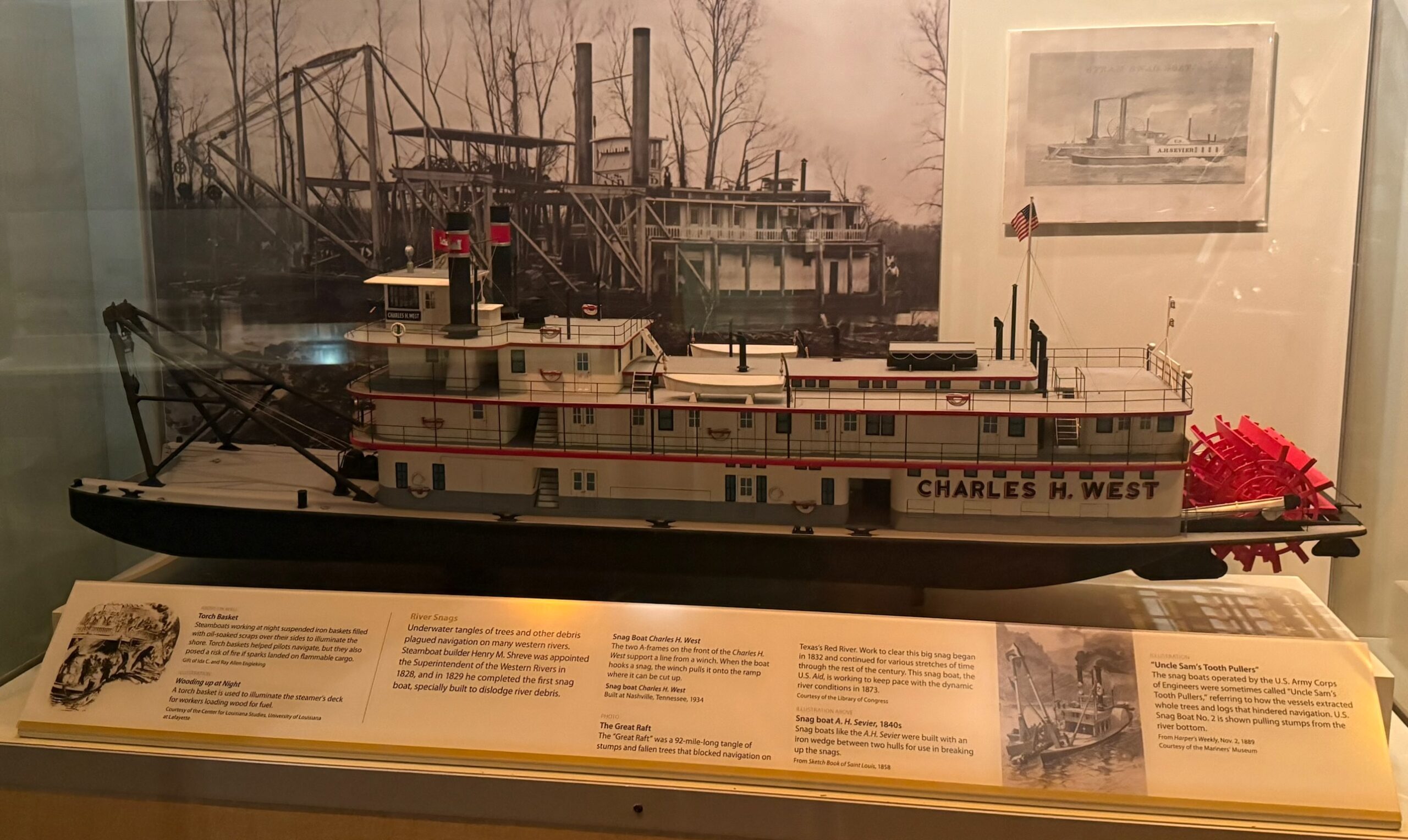
continued… A sign talked about how inland waterways regularly changed with silt, sandbanks, debris, ice floes, shifting channels, changing currents, changing depths with precipitation (or lack thereof), etc. In the 1800s, hundreds of river boats wrecked as a result of these difficult to foresee hazards. River pilots needed to be aware of subtleties such as the color of the water and the ripples and swirls to deduce potential issues. They also ran the boats at night, often illuminating the shore by suspending iron torches over the side of the boat. Unsurprisingly, a lot of boats burned down.
Lighthouses and lightships marked hazards and helped mariners to identify their exact locations on charts.
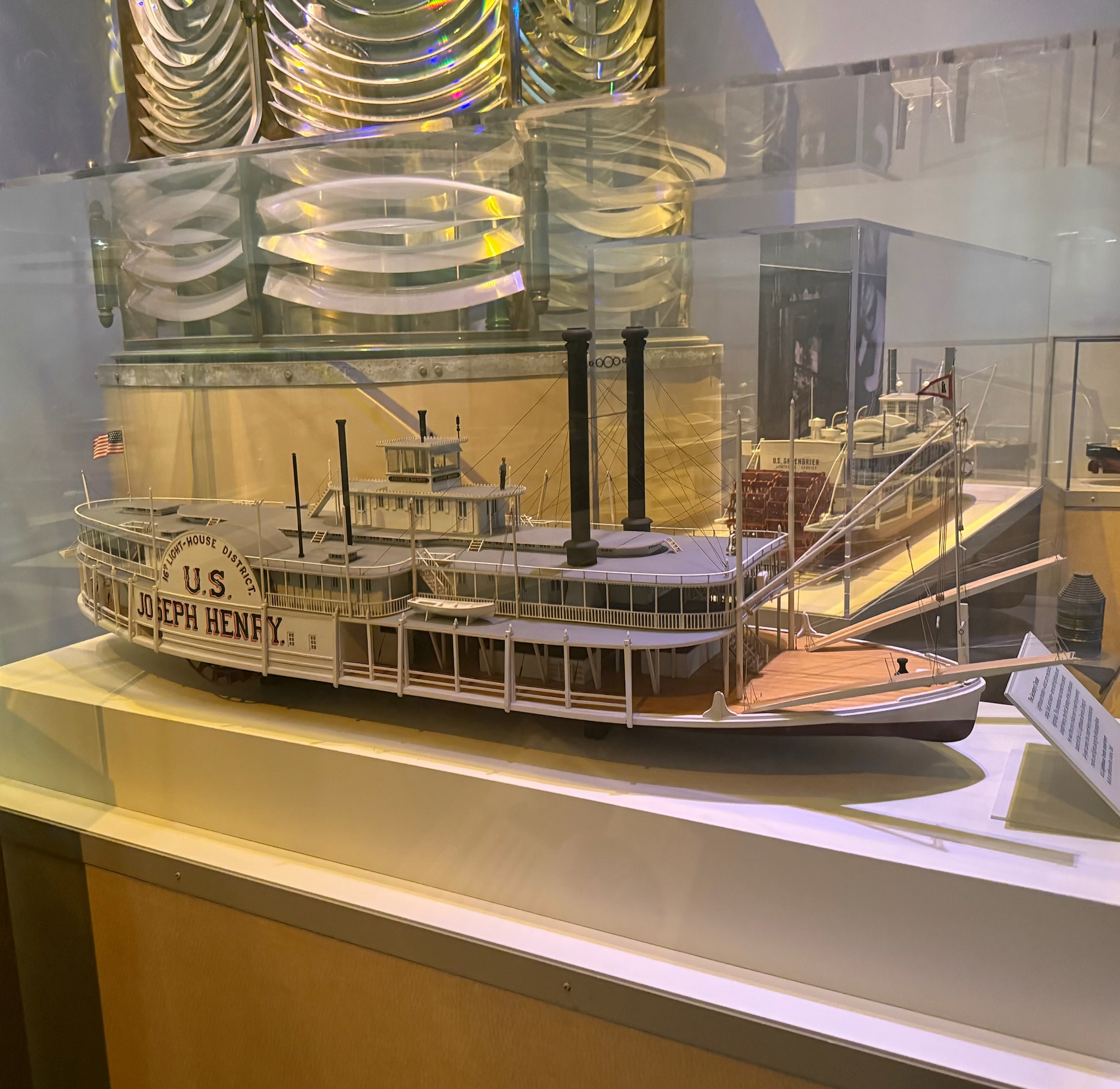
Dredgers removed excess silt and sand. Snagboats, first created in 1829, removed debris. If we understood properly, they dragged a line on the ground supported by winches. When then line caught on something, the winches would pull the line and debris that was caught on the line up.
The next exhibit was about fishing for a living. The first display was about cod fishing. The cod in what is now New England/Canada were huge. In the mid-1880s, they began to be harvested on an industrial scale. By the late 1880s, nearly 400 code fishing boats were based out of Gloucester, Massachusetts and the majority of fisherman were immigrants, particularly Portuguese.
The schooners they used had large holds for fish and supplies, and were designed for speed. With fishing becoming so profitable, the boats got bigger and faster — and less safe. The big sails made them top-heavy and prone to capsizing. The long bowsprits were nicknamed “widow makers” since it was dangerous to climb out onto them to tend to the sails. Between 1866 and 1890, more than 380 Gloucester based schooners and their 2,450 crew never returned. Pressure was put on the industry to develop a safer fishing boat.
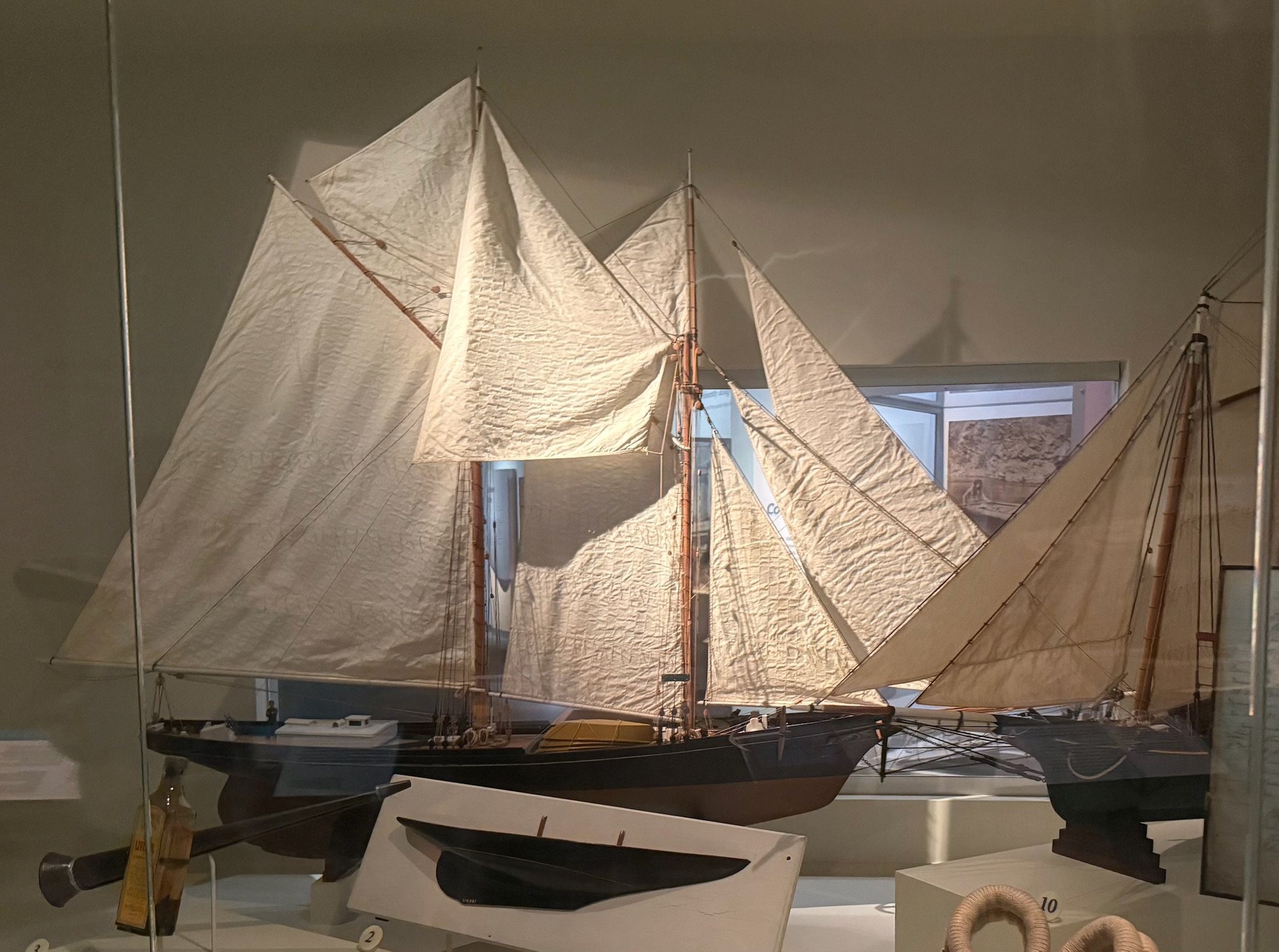
In 1901, Thomas A. McManus designed a schooner that had a short, deep hull with a rockered keel for stability and no bowsprit. It was a whole year before someone ordered one to be built. This type of vessel was nicknamed a “knockabout” and became popular.
Later in the 20th century, diesel powered trawlers replaced schooners. With the rise of trawlers came a lot of foreign boats that depleted the cod population. In 1977, the US and Canada both banned foreign boats from the fishing grounds. The Americans and Canadians expanded their fleets and further depleted the cod. In the 1990s, the US and Canada agreed to close off George’s Bank, one of the most popular cod fishing grounds.
The next display was about Chesapeake Oysters. Oysters tended to go bad pretty quickly after being caught, so they couldn’t be harvested until the mid-1800s, when it became possible to pack them in ice and take them to canneries for preservation. The demand for oysters was huge, and by the mid-1800s, watermen were hauling in millions of bushels of oysters. The harvest peaked in the 1884 – 1885 season with 15-million bushels of oysters taken from the bay. Tension between the watermen was so fierce that Maryland created the Oyster Police to keep peace in the oyster grounds.
In the early days, watermen used dugout canoes with sails. In the 1860s, bugeyes, which were basically bigger canoes with two masts and three sails, became the popular waterman vessel as they were good for dredging — and dredging was the most efficient way to catch oysters. By the late 1800s, skipjacks, single masted V-bottomed vessels became the popular waterman vessel because they were also good for dredging and were easy to build, operate and maintain. Even after gas and diesel-powered boats came along, skipjacks remained popular because it was illegal to use a dredger with a boat with an engine.
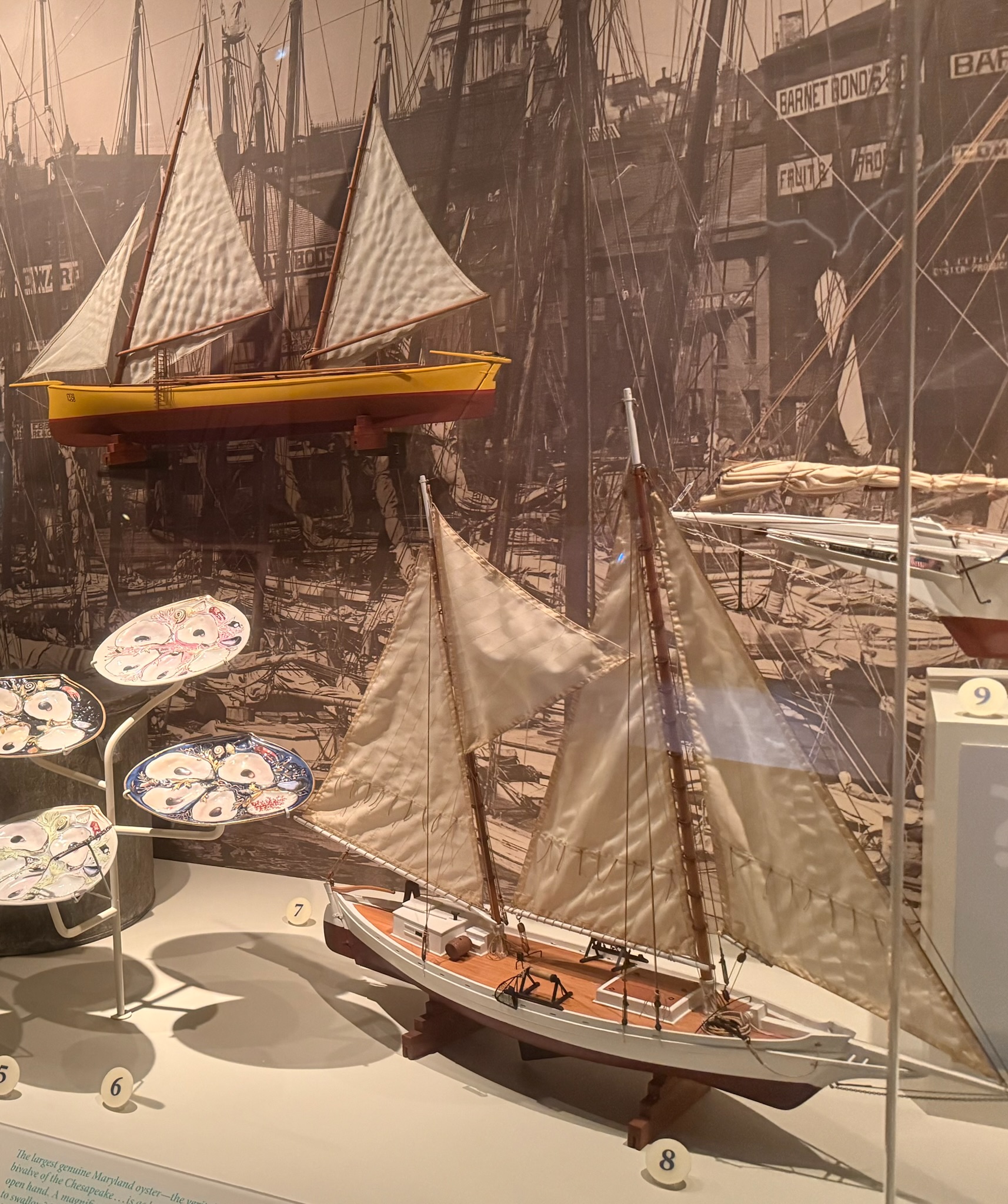
Throughout the 1900s, oyster harvests continually declined. Despite limits on harvests and programs to seed oyster beds, the oyster population never rebounded. Two viruses, MSX and Dermo continue to decimate the small remaining population. Experts agreed that the failure to rebound was a combination of over harvesting, pollution, silting and disease.
There was a display on the importance of salmon fishing along the Columbia River, on the northwest coast of the US. Traditionally, salmon had been a staple of the diet, economy and cultures of the indigenous tribes. In the 1860s, entrepreneurs set up canning facilities and commercial salmon fishing exploded. By 1883, it was rated as one of the most valuable fishery in the world. That year, they produced 30.2-million one-pound cans. However, the fish were rapidly depleted. While overfishing was part of the issue, the bigger problem was that the spawning grounds had been affected by mining, agriculture, logging, urbanization, industry and hydroelectric dams. In the late 1800s, the salmon business expanded north into Alaska.
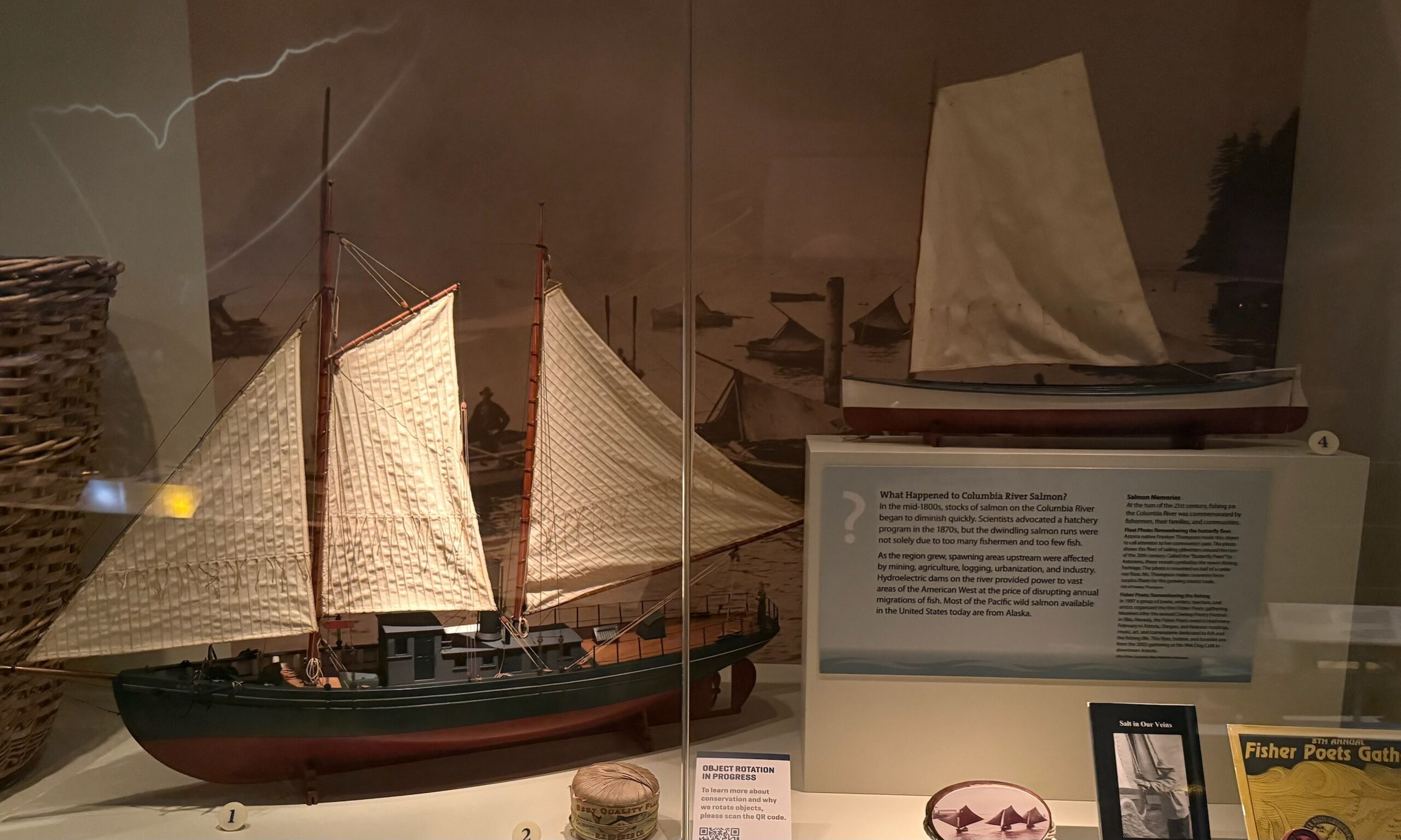
Between 1850 – 1900, the Native American population declined by 95% due to disease and displacement, while the non-native population increased by 1,000%, with a particularly large influx of Scandinavian immigrants. One sign talked about the plight of the Salish tribe. Forced off their lands in the late 1800s, they lost access to the salmon, but in 1974, the Supreme Court gave them rights to 50% of the harvestable salmon in their area, allowing them to return to their indigenous way of life as fishermen.
The next exhibit was about how ocean travel became a big tourism business. Thanks to steamships, by 1870, crossing an ocean became safer and faster. Meanwhile, the American economy was prospering and wealthy Americans were eager to travel for fun, which was considered a mark of status. The wealthy wanted to travel in luxury. While poor immigrants still made up the bulk of the passengers on ocean crossing vessels, ships began to focus on creating luxury accommodations on the upper decks for the wealthy travelers on par with fine hotels and restaurants. Every few years, a bigger, safer, faster, and more luxurious ship was launched.
In 1882, Congress passed the Exclusion Act, which barred Chinese laborers. Up until then, Chinese immigrants had been the majority of the passengers on steamships crossing the Pacific. In the 1920s, Congress again changed immigration laws to halt the flow of Japanese and European immigrants, which drastically reduced the number of passengers crossing the Atlantic. To make up for the loss of low-end passengers, the steamship companies began to market their ships to the flourishing new middle class as delightful ocean-going experiences for everyone — a smart, safe, affordable and fun to travel internationally.
During the 1960s, commercial flights overtook sea voyages as the most popular way to cross an ocean. Since they couldn’t compete with planes for speed, the marketing shifted to focus on the fun and relaxing experience of being on a ship. Cunard lines ad campaign was “Getting there is half the fun!”
The next exhibit was about the role of the Maritime Marines, which were private merchant ships… to be continued…