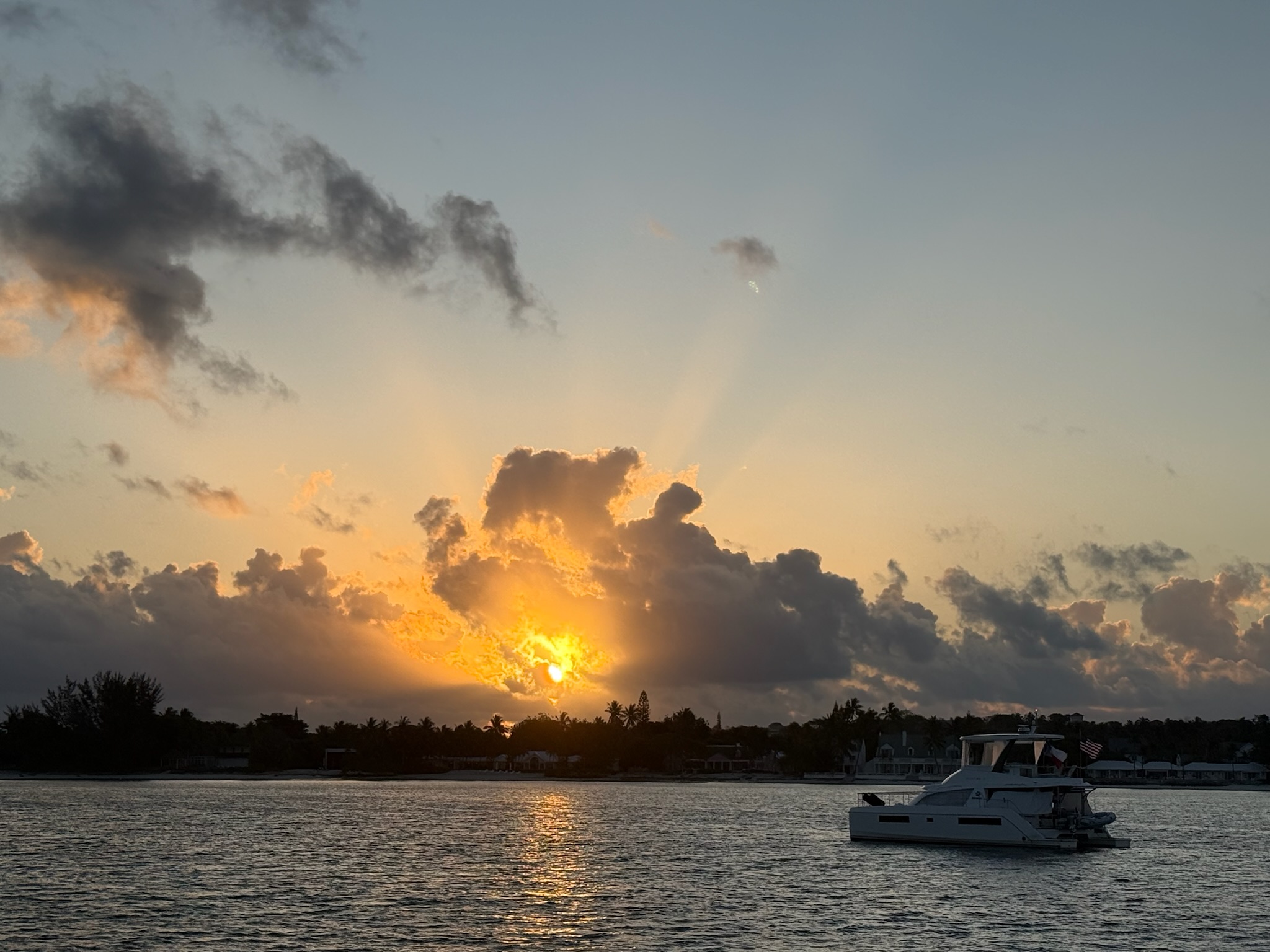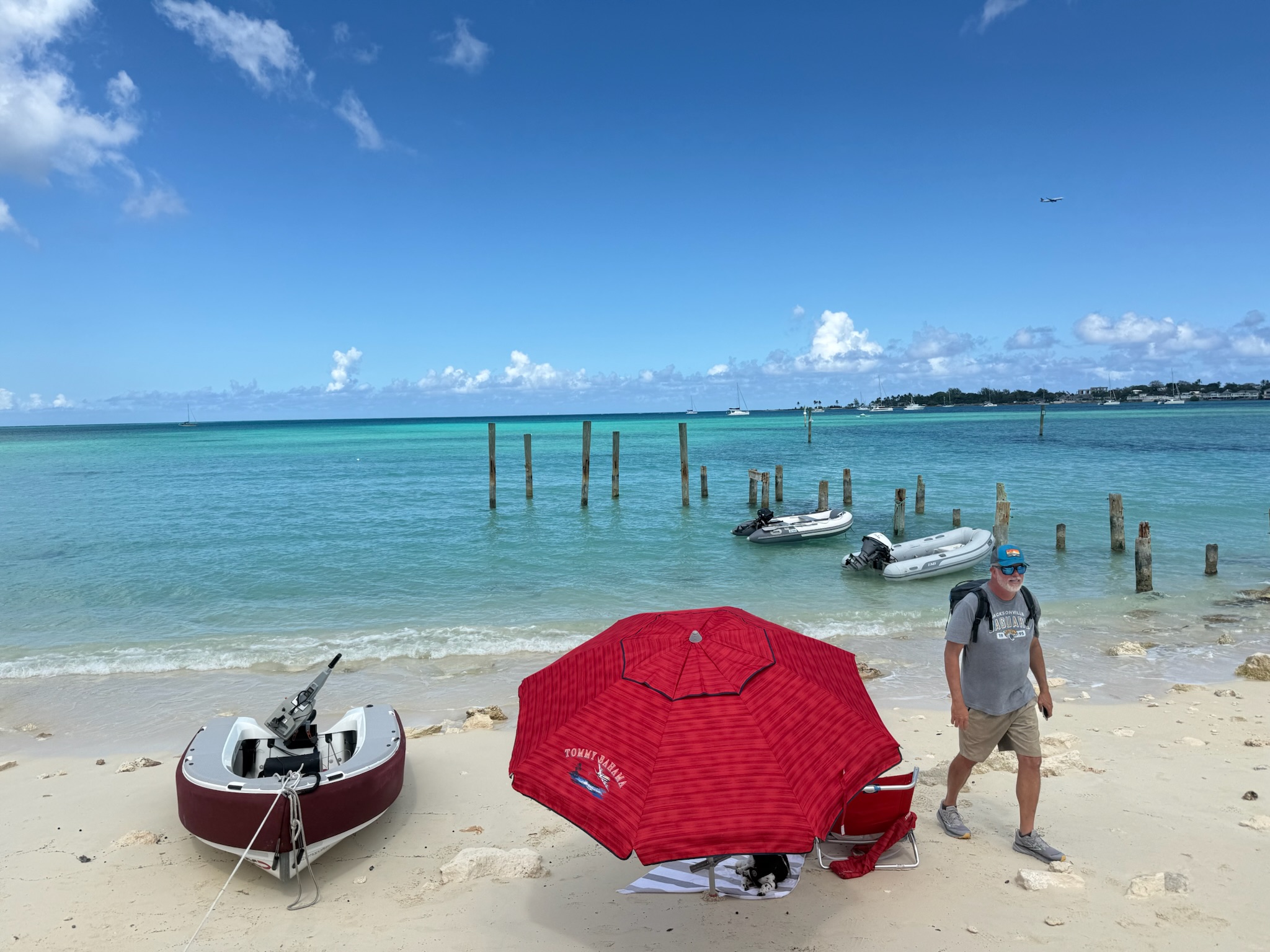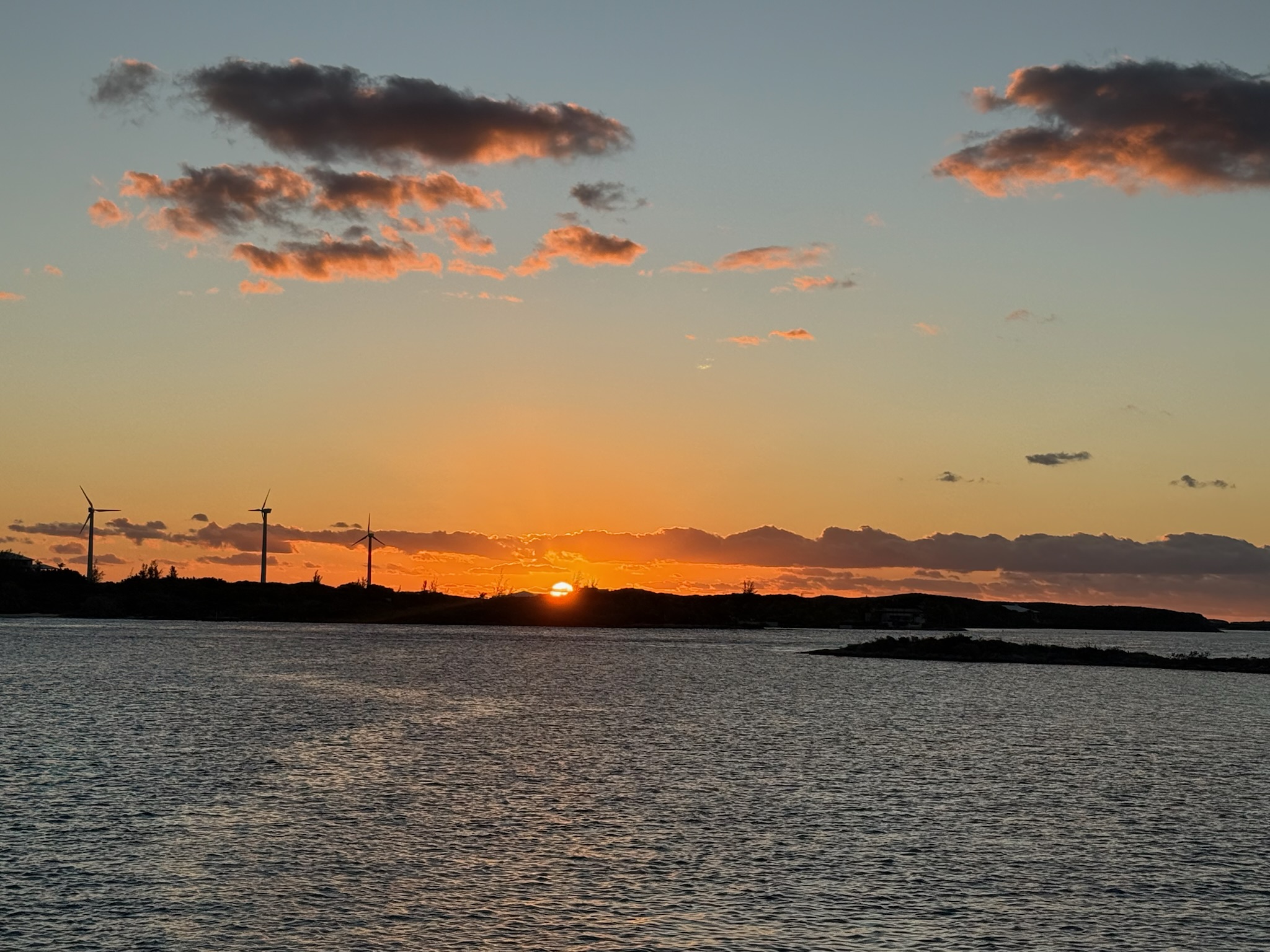
It was a chiily morning – only 66 degrees Farenheit! But it was 45-degrees in Florida and snowing in Baltimore, so it much warmer here in the Exumas than the rest of the US East Coast.
Eric celebrated the New Year by making a French toast breakfast with the coconut bread that we’d bought from Lorraine’s mom. This coconut bread was different than the one we’d gotten in Cat Island. In Cat Island, it was basically white bread with a hint of sweetness and a hint of coconut. Looking at it, you’d never realize it wasn’t plain white bread. Lorraine’s mom’s bread was basically white bread with a swirl of coconut jam in the middle — like a jellyroll cake but with bread instead of cake. The jam was made from tiny pieces of real coconut. Eric and Christi loved it and thought it made phenomenal French toast. Keith wasn’t a coconut fan and said he preferred French toast with regular bread.
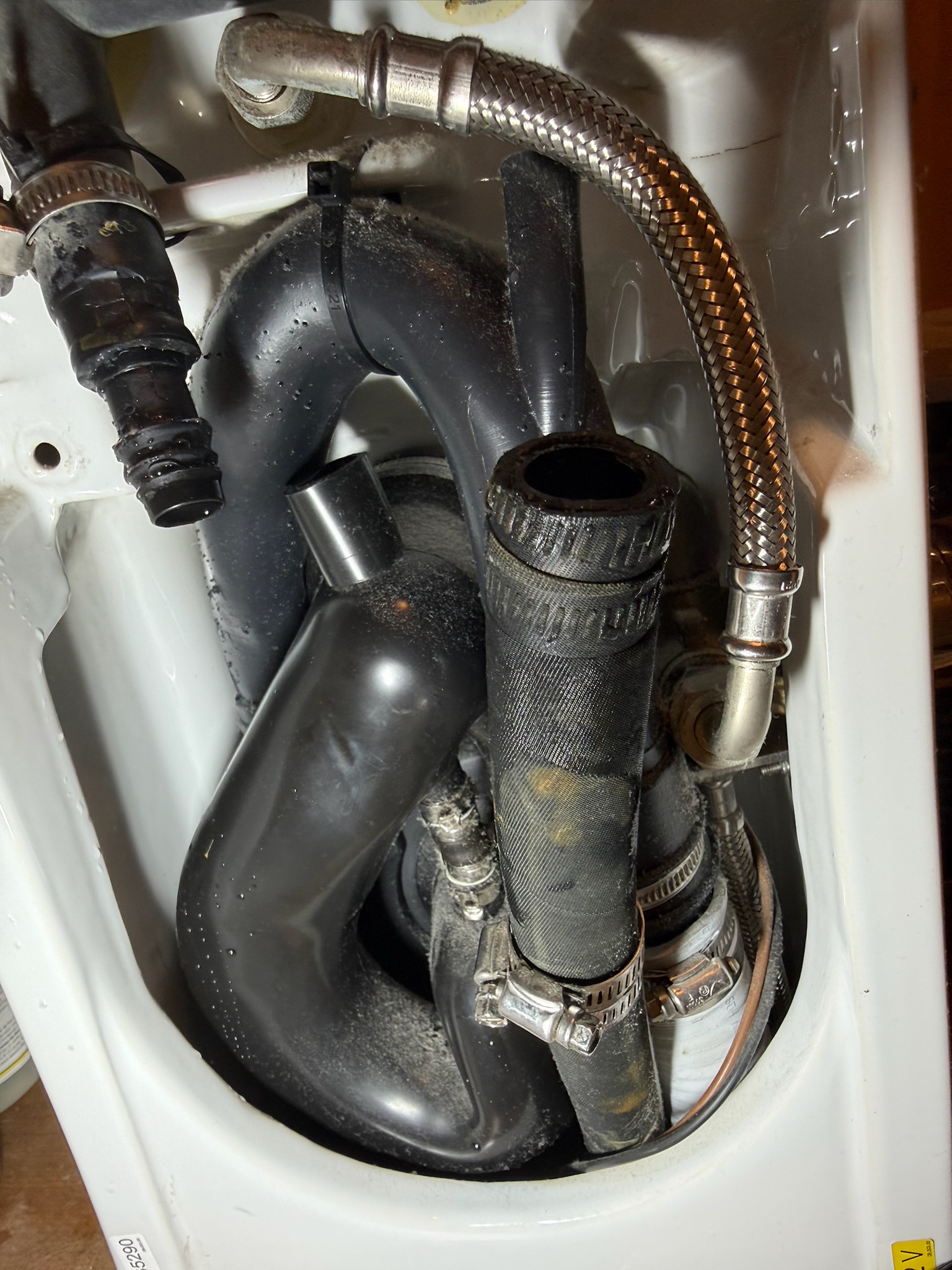
After breakfast, Eric did a little gaming to help psych himself up for tackling the toilet. The first step was to clear out the closet. Then he had to disconnect the water pipes from the toilet. The water in the outgoing pipe spilled, which was stinky.
This week has been fun. On Saturday, we went to cryptography museum. It was quite boring and a super long drive to get there. I learned that the old computers were really really big. For lunch we ate at a Thai restaurant.
Cette semaine était amusante. Samedi nous sommes allés au musée de la cryptographie. C’était très ennuyant et un voyage très long pour y aller. J’ai appris que les anciens ordinateurs étaient très grands. Pour le déjeuner nous avons mange à un restaurant Taiwanese.
continued… The next exhibit was about the role of the Merchant Marines, which were private maritime ships. Private Maritime ships have been a critical component of this county since its inception, so we found it odd that the exhibit started with a brief summary of Word Wars I and II, then skipped ahead to the modern day.
It sounds like during the World Wars, maritime ships and seamen were conscripted to help the war efforts by delivering troops, supplies and equipment to deployed military ships and overseas bases. It was a job even more dangerous than the active duty Navy. Thousands of merchant marine ships were sunk; at least 10,000 merchant marines died in the line of duty. But since they weren’t actual military, they didn’t receive government benefits or pensions for their service. In 1988, the US government finally recognized the service of the Merchant Marines and granted them benefits equivalent to other servicemen. But by that time, only half of the people who had served in the Merchant Marines during WWII were still alive.
Right after entering World War I, the US military hired The American International Shipbuilding Corporation to built a fleet of merchant marine ships to service the Navy at a facility in Hog Island, Pennsylvania. At its peak, it employed 30,000 workers. In all, they built 122 ships in four years. None saw service in World War I. The huge cost of creating Hog Island for ships that were never used was controversial and prompted a Congressional investigation.
In anticipation of entering World War II, in 1936, the US began building two more fleets of merchant marine ships: the Liberty and the Victory. They’d learned in WWI that standardized was more efficient, hence only two types of identical ships produced. The US expanded existing shipyards and opened more, with a total of 18 shipyards in various coastal cities all over the county. The US built 3,300 ships over the course of the war; by 1943, three ships a day were being launched. Sadly, the goal was to build ships faster than the Germans could sink them. Also, when World War II started, the fleet of ships built at Hog Island were put into service.
For the modern Maritime Industry, the signs talked about some of the different specializations, with a model of each type of specialty ship on display: Tankers for Liquid Natural Gas (LNG), oil tankers, cruise ships, fishing trawlers, container ships, and car carriers.
Left: factory trawler, right top: container ship, right bottom: car carrierContinue reading →
continued… A sign talked about how inland waterways regularly changed with silt, sandbanks, debris, ice floes, shifting channels, changing currents, changing depths with precipitation (or lack thereof), etc. In the 1800s, hundreds of river boats wrecked as a result of these difficult to foresee hazards. River pilots needed to be aware of subtleties such as the color of the water and the ripples and swirls to deduce potential issues. They also ran the boats at night, often illuminating the shore by suspending iron torches over the side of the boat. Unsurprisingly, a lot of boats burned down.
Lighthouses and lightships marked hazards and helped mariners to identify their exact locations on charts.
The US Joseph Henry was a lighthouse tender, which maintained day marks and lights along the Mississippi River. It also carried mechanics, fuel, water and cargo to both lighthouses and lightships. Behind it is a Fresnel lens, which was innovative technology that made lighthouses visible from much farther away.
Dredgers removed excess silt and sand. Snagboats, first created in 1829, removed debris. If we understood properly, they dragged a line on the ground supported by winches. When then line caught on something, the winches would pull the line and debris that was caught on the line up.
Snagboat
The next exhibit was about fishing for a living. The first display was about cod fishing. The cod in what is now New England/Canada were huge. In the mid-1880s, they began to be harvested on an industrial scale. By the late 1880s, nearly 400 code fishing boats were based out of Gloucester, Massachusetts and the majority of fisherman were immigrants, particularly Portuguese.
continued... The overarching theme in the exhibit on the changes in the way Americans ate was convenience. At the Museum of Industry, we’d learned that by the 1880s, canning food had become an important industry that continued to grow in the 20th century. We’d also learned that other types of food processing became important industries at about the same time, such as meat processing to make foods like sausages and deli meats, etc. According to this museum, by 1900, ready-to-eat convenience foods had became an important staple in American diets.
These convenience foods were made possible thanks to innovative technologies that allowed for mass production. For example, in 1840, a machine was invented that made 1500 tin cans per day. Prior to that, a can maker could only produce 60 tin cans per day. Had the machine not been invented, canning could never have become a giant industry. As time marched on, more and more of these technologies were created, and there was a steady rise in the types of convenience foods that became available in the marketplace. Some examples this museum gave were automated donut making machines (1950), a tortilla making machine (1950), a machine harvester (1955) and a carrot stick slicer (1959).
Convenience stores, such as 7-11, became popular in the 1940s. Convenience stores were usually small stores that primarily stocked foods and drinks intended to be consumed while on the go, though they also usually carried a few staples such as milk and eggs. Giant supermarkets became popular with the rise of suburbia, where there was space to build giant stores with ample parking lots.