
continued… We moved on to a room called “American Enterprise.” It focused on how the American economy changed throughout the history of the country. An entire wall of the room was covered with photos and short biographies of key people who were prominent through the eras.
The first section was “The Merchant Era: 1770s to 1850s.” The signs said that this was an era where it was difficult to find financial security, and many people wound up in debtor’s prison, in poor houses, or aided by fraternal orders who helped the poor. At this point in history, there was abundant land (much of it stolen from the Native Americans) and vast natural resources to fuel economic opportunities. The government encouraged agriculture, industry, transportation, and global trade.
At the beginning of this era, most Americans were farmers who labored with simple tools. In the market economy, they sold food products and purchased a wide variety of items, such as nails and textiles. Artisans who made specialty products, such as cloth or shoes, were usually farmers who did the artisan work as a side job. The artisans did their crafts from home or a small shop when they had time.
But entrepreneurs who adopted new manufacturing technologies and systems of production changed the structure of society. People left farming to work full time at manufacturing facilities. Work was centralized, regulated, and supervised. Greater efficiency led to lower costs to consumers. Products became standardized. In one generation, the art of being a cobbler pretty much died since factory made shoes were so inexpensive relative to handmade shoes. The new work mode changed culture — now people no longer set their own hours, worked from home, or worked at their own pace. Rather than one artisan doing an entire project, there was a division of labor. People made the products the way the boss wanted them made, not the way they wanted to make them.
Another thing that was pivotal in transforming the economy was artificial light, which became widely used in the early 1800s. It allowed for more time in the day for work, leisure activities and consumption.
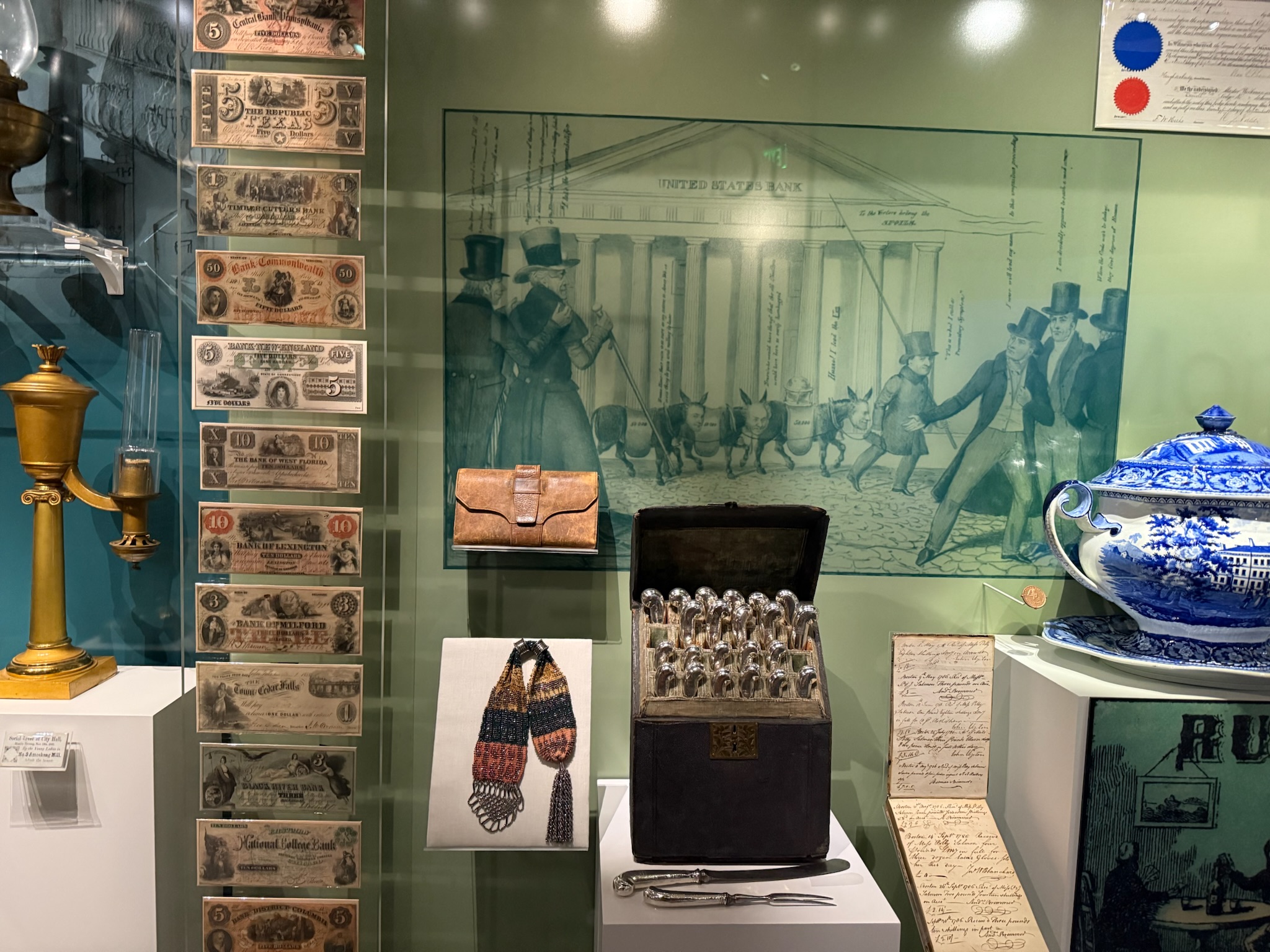
We were surprised to find a display on money. The signs said that physical coins issued by the government were scarce, so many banks, insurance companies, railroads and factories printed their own paper money. Gold miners would take the gold they’d mined and have gold coins privately minted. The sign said that one of the reasons the government opened a mint in San Francisco was because it was close to the gold!
As for some of the people of the era… we learned that Paul Revere was a silversmith and goldsmith and supplemented his income by engraving copper plates and being a dentist. We learned that the first textile mill in the US was established by Samuel Slater, an immigrant who had committed industrial espionage. He had worked in a mill in England, then came to the US and duplicated the machines in his own mill. We learned that DeWitt Clinton pushed for the Erie Canal to be built while he was governor of New York. Critics had called it “DeWitt’s Ditch,” but ultimately, it cemented New York City’s position as America’s financial capital.
Interestingly, one of the people highlighted was Stephen Burroughs, who was a prolific counterfeiter of paper money. We found it strange he was featured in “American Enterprise” instead of in the “Numismatics Gallery,” which had a whole section on counterfeit money and security measures taken over the years to make it harder to counterfeit.
Another wall of the room had an exhibit on advertising. Advertising in newspapers and journals began about 1750. By 1850, advertisements on billboards, buildings and fences became common in cities. Direct mail advertising, such as mailing out coupons or free samples, also became a popular strategy, too. A new job developed: advertising agents, who designed and placed ads. As mass production grew, so did the need for advertising to create a demand for these products. In the 1850s, patented medicines started branding as a way to differentiate their product from others on the market. The job of advertising agent evolved into advertising agencies, where many employees worked on every aspect of advertising, including researching markets, designing packaging, creating slogans and branding, and planning and coordinating campaigns.
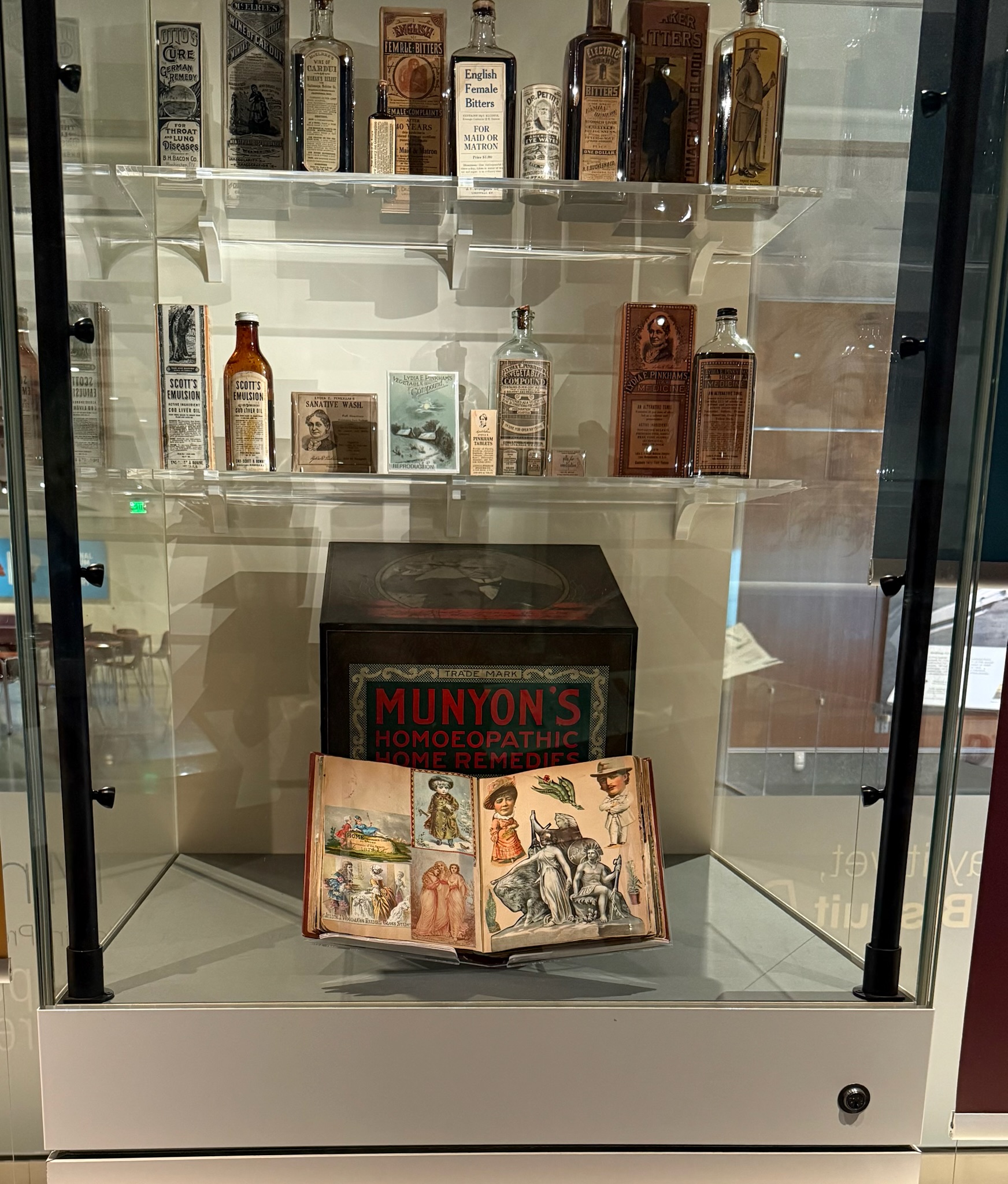
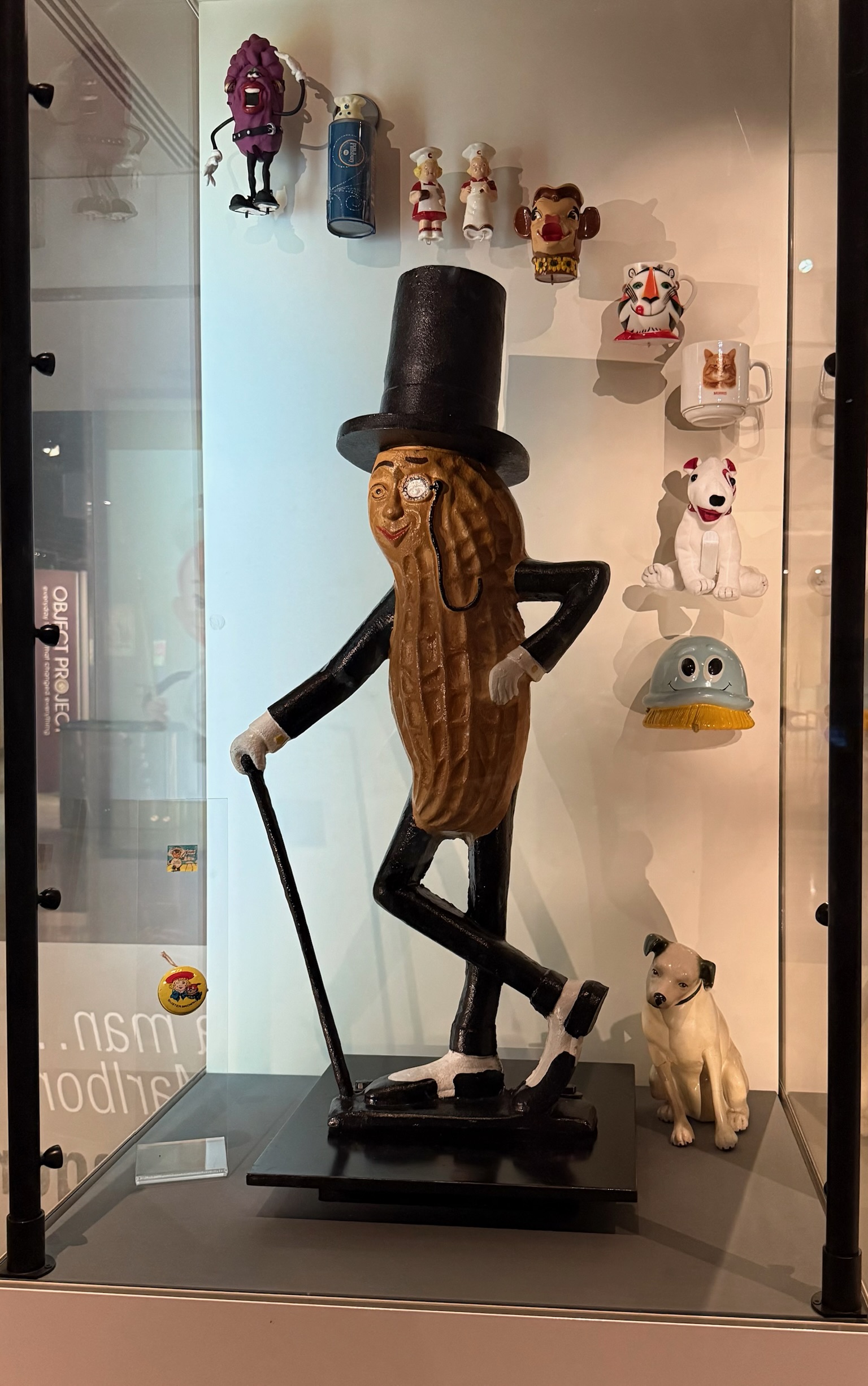
This display listed many milestones in advertising: such as in 1910, Gillette was the first company to use a sports figure to endorse a product and 1922, WEAF in New York became the first radio station to sell air time for advertising. One line mentioned that in 1942, the American Department of War started using advertising to create public support for World War II. There were lots of examples of branding displayed. Here were some iconic spokespeople (or rather, spokescharacters).
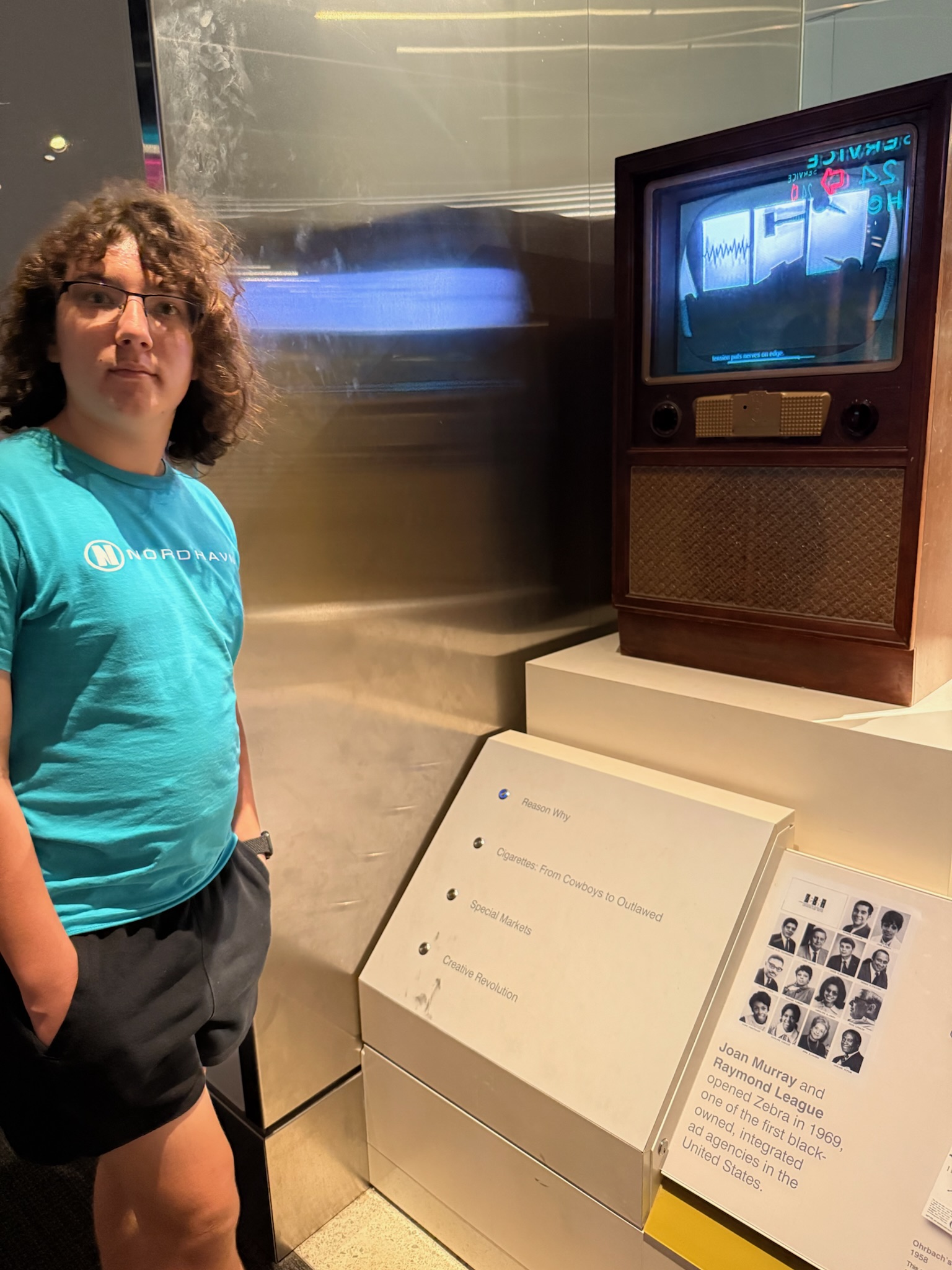
A TV set played some iconic commercials. Eric and Christi try hard to shield Keith from advertising, and after watching the ads, he said “Wow. Those songs really get stuck in your head.” Now he understood why, as older adults, Eric and Christi can still sing the jingles from commercials that they’d watched as small children.
While we suppose that citing milestones is what a museum was supposed to do, we felt like the museum didn’t emphasize enough just how much advertising has changed every aspect of American society. Advertisers have done a tremendous amount of psychological testing to understand how to influence people’s behavior, and this advertising influence has certainly helped to shape American culture and behavior. But this understanding has also changed the way business was done in many other fields, including psychology, government propaganda, spying and all sorts of other industries. A great documentary on the topic is the BBC’s “Century of the Self.”
The next section was “The Corporate Era: 1860s to 1930s.”… To be continued…
Thanks for bringing history to life! That was a fun jaunt. Especially intrigued by the development of fiat money.