continued… There was a large exhibit on the agriculture industry. Clewiston was dubbed “America’s Sweetest Town” because it is home to The United States Sugar Company, Florida’s largest producer. Here was a model of the plant.
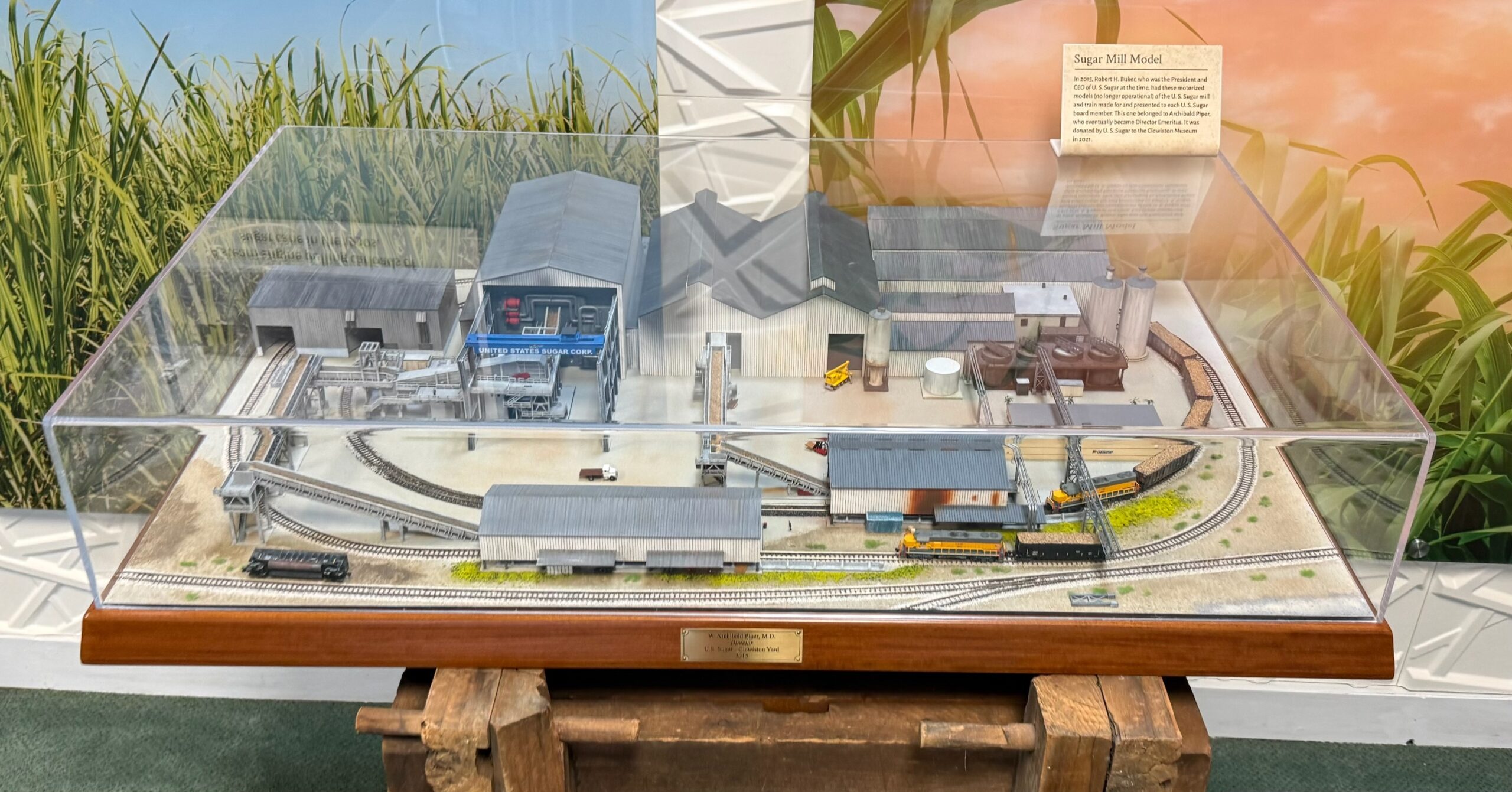
In 1925, a group of investors bought a giant tract of land to create a sugarcane plantation. Interestingly enough, the principal investor also owned a company that produced Celotex boards, which were made from the fibrous remains of sugarcane after the sugar was processed out. Sugarcane became the predominant crop in the Clewiston area and Southern Sugar Company was the largest employer and property owner. One of their biggest early challenges was drainage. They dug canals to help the water go away and planted trees to help absorb the water that stayed. They bought a defunct sugar mill from another part of Florida and moved it to Clewiston. The mill opened in January 1929. Nine months later, the stock market crashed and the Great Depression set in. In 1930, they went bankrupt and were planning to halt production. One of the creditors and major shareholders, Charles Stewart Mott, stepped in to save the operation. He formed US Sugar and bought out Southern Sugar a few months later.
Mott was able to overcome the drainage problems that had been plaguing Southern Sugar. He also enlisted help from sugarcane experts to develop varieties that grew better in Florida. He had special rail cars built that could run on the train tracks when the ground was too soft for trains. He also had special tractors built with enormous tires that could pull the cane wagons in the soft, mucky soil. By 1940, US Sugar was farming and processing over 20,000 acres of sugarcane per year.
He believed that US Sugar “is part of the community, and what is good for the community is good for us.” As such, he invested heavily in the Clewiston community. Mr. Mott sounded like an extraordinary man. He was part of the applesauce family, but he made his mark on society by manufacturing axles for the new automobile industry. His small business was eventually incorporated into General Motors. Mr. Mott was a director for GM until he died at 97 years old. GM gives him a lot of credit for keeping them solvent during the Great Depression.
Today, U.S. Sugar was still an important part of the community. There were over 400,000 acres of sugarcane in the general area, with 75,000 of it in Clewiston. Ranching (growing cattle) has also been an important part of the Clewiston area’s agricultural industry since the very beginning. US Sugar also grew cattle for about 40 years, producing many national champions. In the 80s, they switched from cattle to citrus. They also experimented with other crops, such as lemon grass, sweet potatoes and ramie (which was a textile fiber that the Egyptians used to wrap their mummies in). None of those were profitable and were discontinued.
Ranching was still important to the Clewiston community. One of the most efficient and productive ranches in the United States was Hilliard Brothers, which was located near Clewiston. Other foods grown locally include: sweet corn, cabbage, celery, green beans, citrus, radishes and leafy vegetables.
Next was an exhibit with more information about The Herbert Hoover Dike. The first dike was 68 miles along the southern shore and 16-miles along the north shore, created from dredging from the lake, and included hurricane gates and other flood control devices. It cost $19,000,000 and took until 1937. The final structure was three stories high and had a base as wide as a football field. The northwest and northeast sections didn’t receive a dike because of higher elevations and smaller populations.
In the 1950s, it was determined that Lake Okeechobee needed to be treated as a reservoir and maintained at higher levels. The channeled the water in the Kissimmee River, raised the height of the existing dike and added a dike around the portions where they hadn’t built one. The final structure was 115-miles long, 36 feet high, and was dedicated as The Herbert Hoover Dam in 1961. President Hoover attended and made a speech — one of the last before passing away.
We finally came to the display on the Seminole Indians. There was virtually no history mentioned, so it wasn’t what we’d been looking for, but it was interesting none-the-less. Per the signs, The Big Cyprus Seminole Reservation, one of the two reservations in the Everglades, covered 52-acres and was home to over 600 tribal members.The location was remote — 45-miles from the closest developed area. On the reservation, they grew citrus, vegetables and have one of the largest cattle operations in the country, and apparently host rodeos. They were leaders in economic enterprise throughout Indian Country and part of the international business scene. They have all the essentials of any modern community, including an impressive school. Seminole children did not begin attending school until the 1950s.
We’ll fill in a few details about the history. Our understanding was that the Seminoles had originally lived in other parts of Florida, but when the US federal troops began forcing Native Americans to move west, the Seminoles hid in the Everglades. Even though the Everglades were inhospitable to humans, they managed to survive in the swamp and have been there for 150 years.
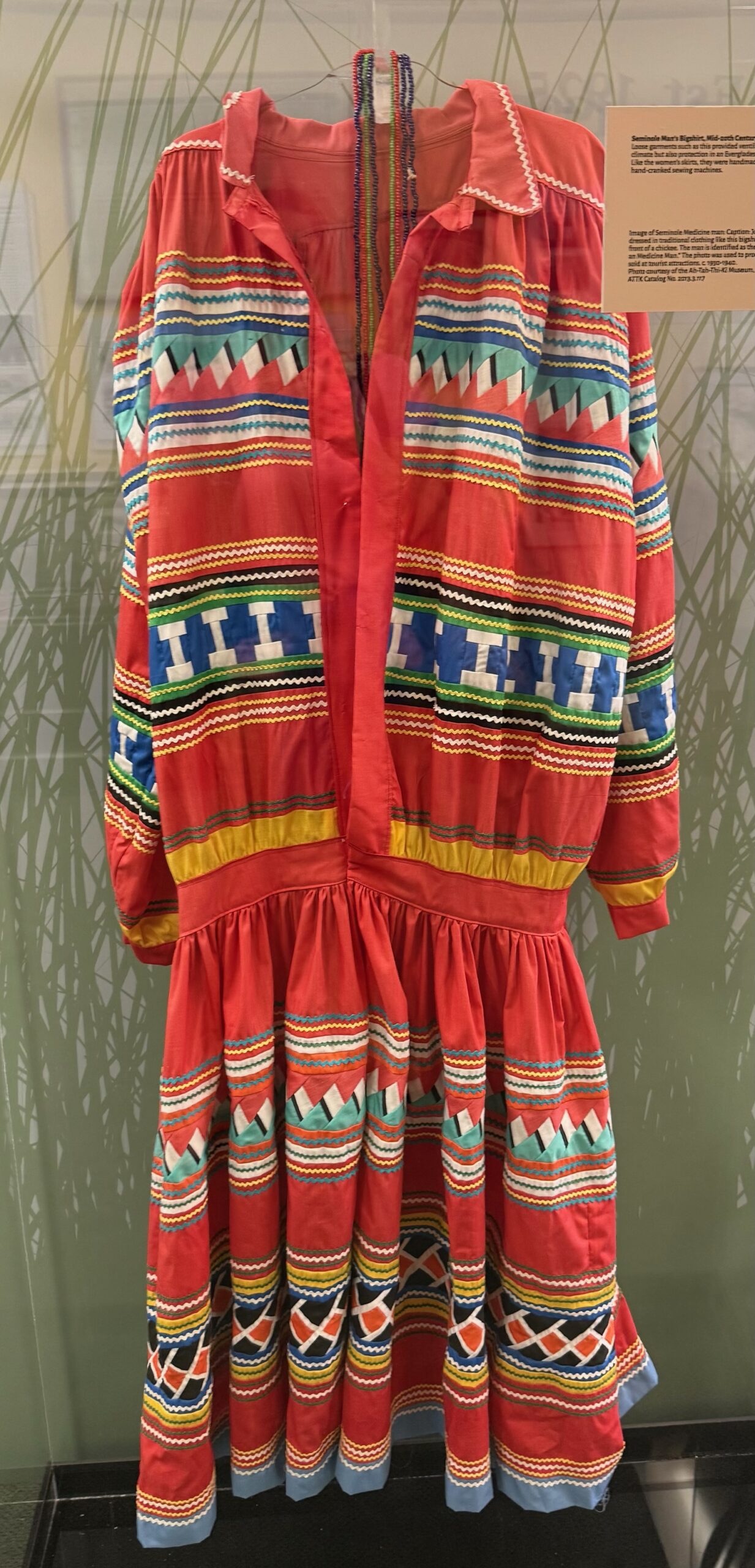
The next exhibit was about their unique clothing. They established a communication system called Patchwork, where they made long, thin strips of simple, geometric designs that were sewed onto the fabric as decorations. Each design had a specific meaning. Thus, the clothing communicated specific messages via the various designs sewn onto the fabric. Patchwork communication apparently began with the advent of the hand crank sewing machine. The earliest designs were “fire,” “rain,” and “rain and storm,” and were only two colors. The Patchwork communication system has expanded over time. Now, the designs were multi-colored and told of important legends and nature stories.
The final exhibit was on World War II, and it was extensive. The primary focus was on Riddle Field, which was west of Clewiston. In September 1941, it became home of the Number 5 British Flying Training School (5BFTS). It sounds like the British were no longer able to train pilots at home, so they contracted with Riddle McKay Aero College to do the training. The facility had barracks, a mess hall, infirmary and recreational facilities. The pilots were trained with Boeing Stearman PT-17, the North American At-6 Texan, and the Vultee BT-13. The courses were 6-months long and included navigation and night training. By the time the facility closed in 1945, 1,879 cadets had enrolled in the program and 1,452 earned their airmen wings. The people of Clewiston welcomed the cadets with open arms, and they had a big social impact on the community. There were several displays about the training program, Riddle field, people who died in training, and specific details about the life-long relationships that were built. It was sweet and touching.
There was also a display about a Prisoner of War (POW) Camp, which was apparently close by, that opened in 1944 and housed German prisoners. The core contingent was more than 300 prisoners captured from Rommel’s elite Afrika Corps. The POWs were put to work as laborers to the sugarcane industry, required to work 8-hours per day and were paid 80 cents per day. For a while, they socialized with the Riddle Field cadets, but eventually the authorities made them stop because they were supposed to be enemies. The camp closed in September 1945.
The museum was small, but well-done. It was both informative and cute. We said our goodbyes to Martha and Christy and headed back to North Palm Beach. We took a different route back, which went around the lake. We were hoping for a glimpse of the water, but thanks to the giant dike, this was the only view we got.
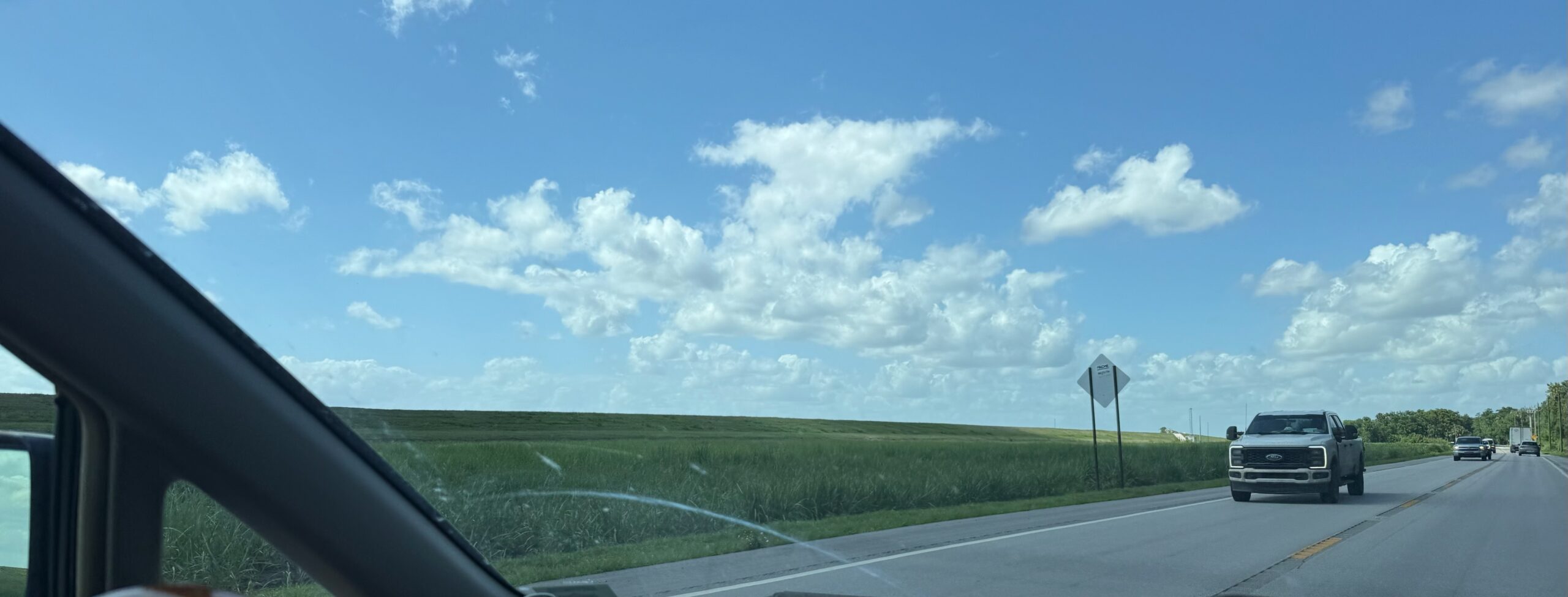
The signs at the museum had said that there were hiking trails on top of the dike, so people could see the lake and wildlife on the trails.
The drive back was uneventful. Since Christi did not feel like cooking, we had dinner at a restaurant called Sushi Jo, which was located in a strip mall directly across the street from the turtle sanctuary. We picked it because it had some great happy hour specials. After dinner, we went to a Gelateria called Matty’s that Johnny and Joanne had recommended. It was wonderful.