continued… The next exhibit was on the early inhabitants of the Kissimmee River Valley and Lake Okeechobee areas. The Kissimmee River Valley, which began just south of Orlando, was the primary source of water to Lake Okeechobee. Lake Okeechobee was the second largest natural freshwater lake contained entirely within the contiguous 48 states. It covered 730 square miles, 467,000 acres, and was only 9 – 12 feet deep (3 – 4 meters). It was 30 miles long (north to south) and 33 miles wide (east to west). Many of its shallow, grassy areas were similar to the Everglades. The lake was the centerpiece for the South Florida’s Water Management District’s network of canals and water storage. And as we learned yesterday, the lake directly fed the Everglades.
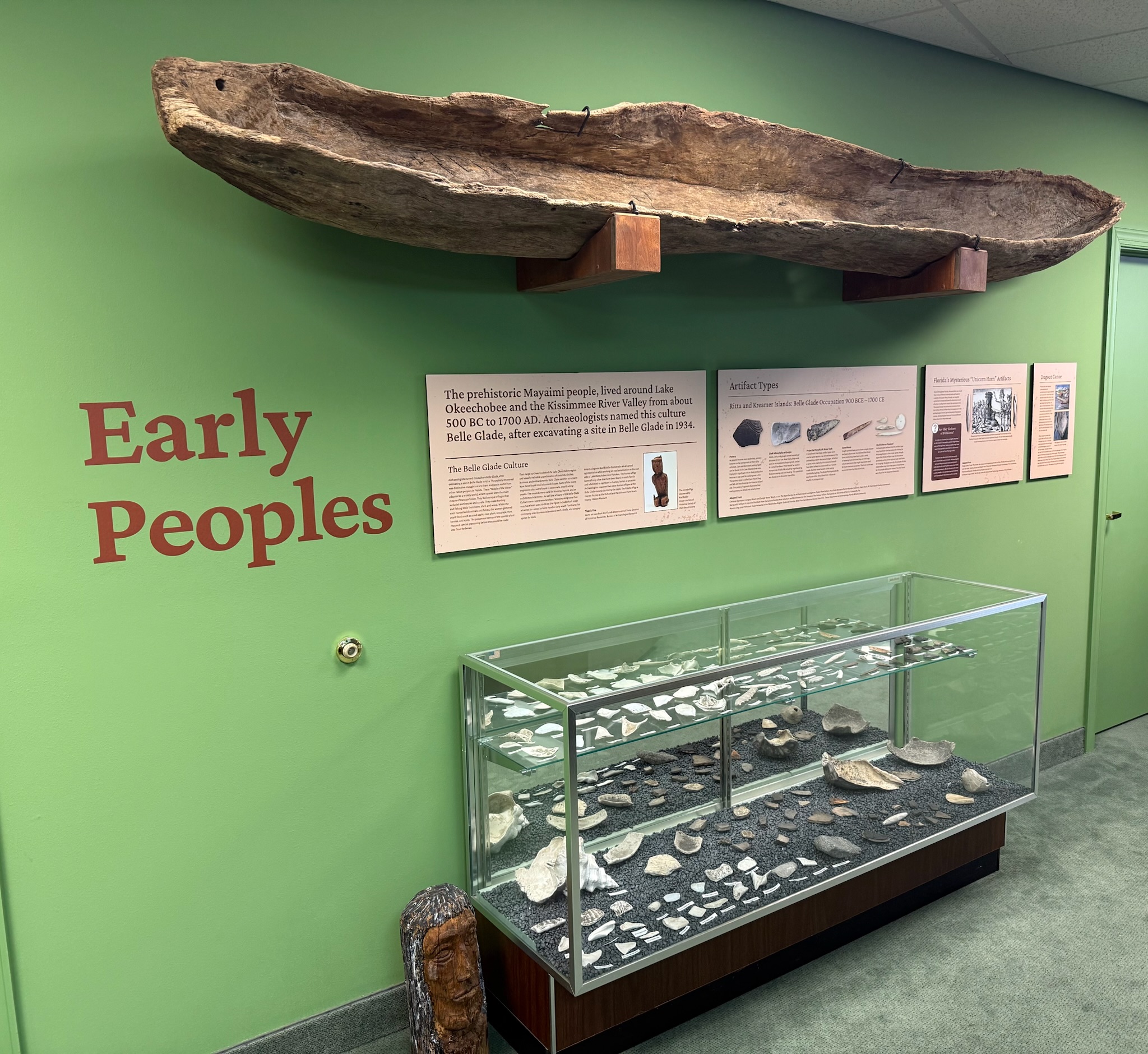
The prehistoric people of Southern Florida were called the Mayaimi people. The group that lived In the Kissmissmee River Valley and Lake Okeechobee were a distinct subculture that have been named the Belle Glade people. Lots and lots of structures and artifacts have been found. There was a display with pottery, tools and decorations, as well as a canoe. Some of the tools were made of materials that were not found in the Kissmissmee River Valley and Lake Okeechobee area, but were indigenous to other parts of Florida, indicating that trade lines existed amongst the various sub-tribes.
Interestingly enough, Florida has over 400 ancient dugout canoes, which was the highest concentration in the world. They range in age from 500 to nearly 7,000 years old. Per the sign, Florida’s soil was wet and boggy, so wood decayed slowly. If a wooden canoe got stuck in muck without oxygen, it didn’t deteriorate. The old canoes were usually found during times of drought, when the low water levels exposed the mud.
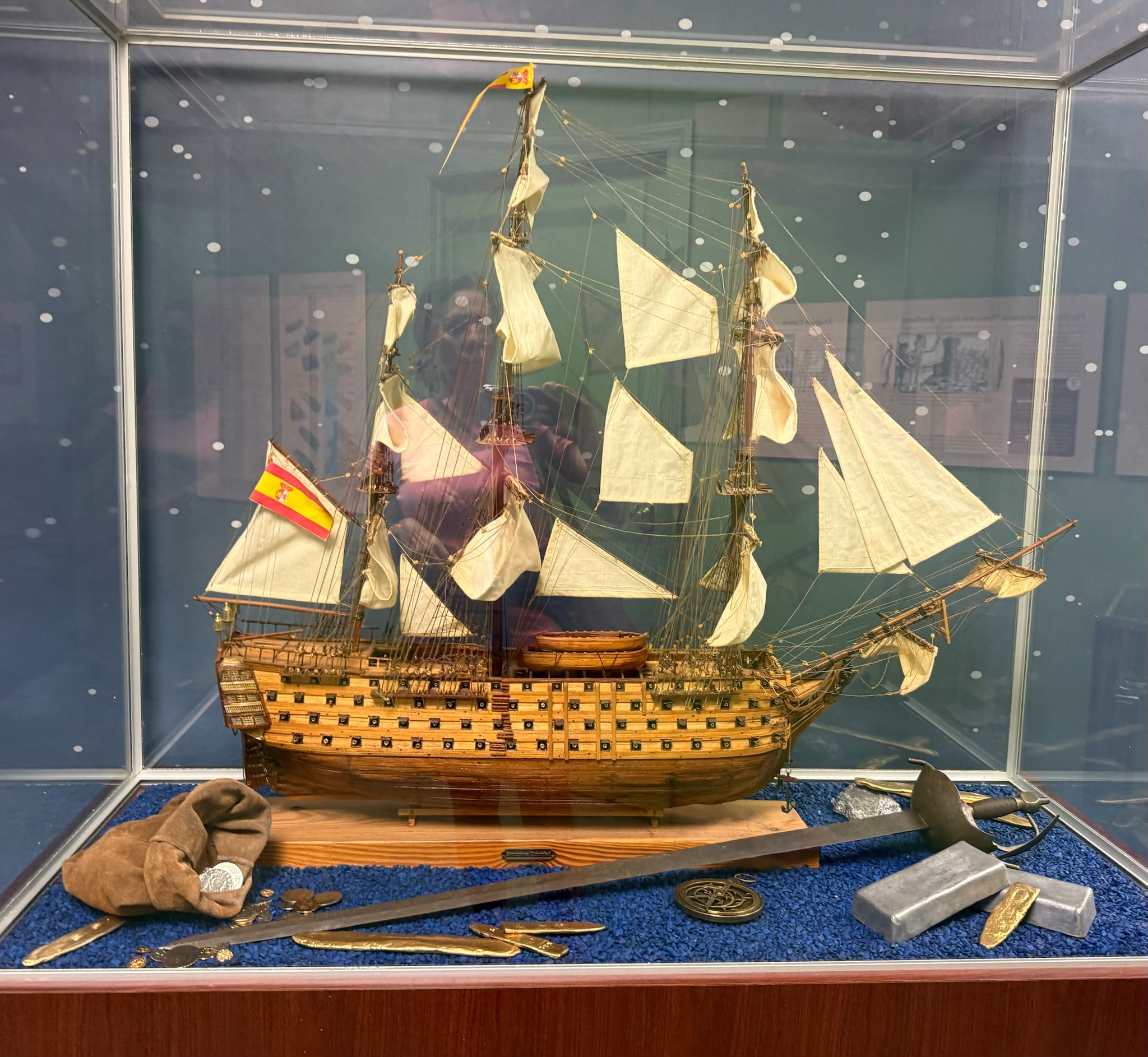
The next exhibit was about the Spanish invasion. It was apparently common for Spanish ships sailing from Central/South America to wreck in the shallow waters of Florida. The gold, silver and other treasured they had stolen would wash up onshore. Quite bit of Spanish treasure has been found in the Kissmissmee River Valley, Lake Okeechobee area, and the Everglades. There were stories of people finding gold in strange places — one guy was digging his tires out of the mud and another family was pulling up plants and gold was attached to the roots. It was believed the indigenous people made trips to the coast, found the treasures scattered along the shore, and took them back to their homes. Here was a model of a Spanish Galleon, which was the main type of ship utilized during the era when Spain ruled Florida.
The next exhibit was about the town itself. What was now Clewiston was originally called Sandy Point. Sandy Point and nearby areas along the southern shore of the lake first began to be settled by farmers in the early 1900s. Crops did well in the fertile soil, but there were struggles with bugs and flooding. A muck dike and drainage canals were built to help control the flooding. In 1919, Captain J.J. O’Brien and his wife, Marian, decided to create a master planned resort town. They bought large amounts of land in the area and paid to have the railroad line extended to reach Sandy Point, which began service in 1921.
Agriculture flourished until 1922, when there was abnormally heavy rain that led to massive flooding. In 1923, they enlisted a banker named Alonzo C. Clewis to partner with them — hence the name change to Clewiston. They hired a prestigious city design architect named John Nolan, as well as surveyors and engineers to lay out the infrastructure plans for the 4-mile waterfront community, complete with tourist lodging, a shopping district, a business district, segregated housing, schools, parks and green spaces. As a side note, Mr. Nolan studied under Fredrick Olmstead, Sr. Olmstead was extremely prominent in his day, and his son, Fredrick Olmstead, Jr was just as prominent (if not more so). He even had a small island in the C & O Canal named after him with a memorial plaque.
The agricultural industry eventually recovered, but apparently the residents didn’t like the O’Briens anymore and they were run out of town in 1924. The signs didn’t say what happened to Mr. Clewis, but he apparently exited the picture, too. In 1926, the O’Briens built the Watanabe Hotel, named after a couple of the earliest residents of the area who had been recruited to run the hotel (since the O’Briens weren’t welcomed in town anymore). The hotel also doubled (quintupled?) as a bank, general store, hardware store and post office. Also in 1926, the state granted Clewiston a city charter, but because of circumstances detailed below, they delayed organizing the city.
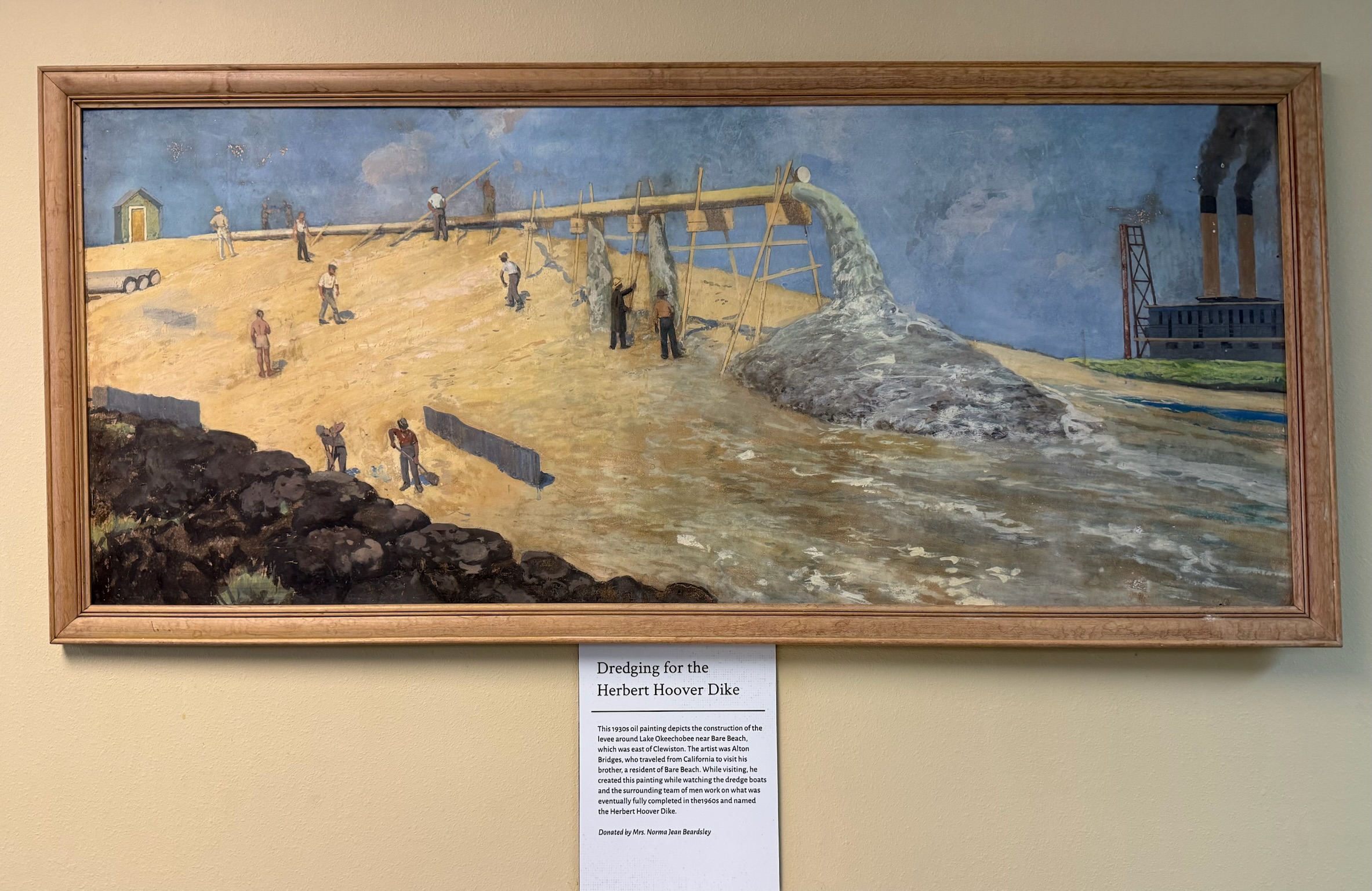
In 1926 the area was hit by hurricanes and experienced devastating flooding. While no one died in Clewiston, 300 – 500 people died in the general area. In 1928, the area was hit by another hurricane, and this time over 2,500 people died (again, none in Clewiston). The 1928 storm ranks as the second biggest loss of life due to a hurricane in American history. In 1929, President-elect Herbert Hoover visited, and congress authorized the construction of a giant levee to protect the communities around the lake. The US Army Corps of Engineers began construction in 1931, and Clewiston was suddenly no longer a waterfront town. Also in 1931, Clewiston finally organized itself into an official city.
Some alterations had to be made to Nolan’s master plan, such as relocating the colored housing to a less flood-prone area, but as the town grew, they actually stuck closer to the master plan than most towns do.
The next series of signs were about various buildings that were iconic to the town. The Clewiston Inn was built along the shoreline in 1926. The building survived both hurricanes, but was destroyed by fire in 1937. It was rebuilt in 1938 and was apparently still operating as a hotel. In 1991, it was placed on the U.S. National Register of Historic Landmarks.
There was a famous restaurant called The Old South BBQ Ranch that was “more of an attraction than a restaurant,” that was adorned with old relics that made it a makeshift historical museum. The waitresses wore cap guns strapped to their waists and would occasionally have mock gunfights. Half a million people visited the restaurant every year. It opened in 1956, when US Highway 27 was the main north-south road through Florida and a lot of car traffic moved through Clewiston. It closed in 1999 when the state took the property to widen the road.
They mentioned the beautiful train station that was constructed in 1928 and torn down in the 1970s, the movie theater that opened in 1941 and was placed on the U.S. National Register of Historic Landmarks in 1998, the various schools constructed over the years as the town grew (initially the schools were segregated), and other significant community structures, such as a recreation center and a public swimming pool.
The next exhibit was about the fishing industry. The first commercial fishing operation began in 1883. While many species of fish inhabited the lake, catfish was the primary target for commercial fishermen (apparently because they tended to overpopulate the lake). The fish were transported up the river by steamship. Later, as rail lines were brought to Florida, the boats took the fish to the closest accessible rail depot, where the fish were transported to far away places, such as St. Louis, Kansas City and Omaha. It sounded like the catfishing peaked out around 1945, though was still an existing industry.
Meanwhile, in the early 20th century, as transportation infrastructure improved and it became easier to get to Lake Okeechobee, it became a popular destination for recreational fisherman. By the middle of the century, the lake had a reputation as one of the top bass fishing destinations in the U.S., known for its black (largemouth) bass that get up to 12-pounds (5,45 kilos). Clewiston was apparently the bass fishing capital of the country!
There was a large exhibit on the agriculture industry. Clewiston was dubbed “America’s Sweetest Town” because… to be continued…