continued… They perused most of the exhibits on the first floor while they waited for the volcano/ice cave tours to begin. The majority of the displays were about Iceland’s history, with about half focusing geological history and the other half human history.
With volcanoes, geysers, glaciers, earthquakes, a divergent tectonic plats and erosion, land was created and destroyed faster in Iceland than anywhere else in the world. Iceland first formed 64-million years ago, about the time that a cataclysmic event changed Earth. It sounded like it was initially connected to Greenland and Europe via land bridges, so animals could come and go. Thanks to continental drift and erosion, the bridge between Iceland and Europe eroded 10-million years ago. They missed the sign explaining when/how they separated from Greenland.
Over the millions of years, there have been at least five ice ages and also periods where the planet was so hot that there was little to no ice on Earth. There were points in time where Iceland was completely buried under snow and ice, and the land was devoid of flora and fauna. There were times where the temperature was so balmy that there was a wide variety of flora and fauna, including redwood trees. There were a lot of signs about various specific volcanic eruptions and the amount of land the eruption added to the island, as well as some signs that explained areas affected by glacial erosion. There were also a few that explained how some unique geological features, such as psuedocraters, formed.
Changes to the ocean’s currents (the Gulf Stream and the Atlantic Meridional Overturning Circulation [AMOC]) also affected Iceland’s development, temperatures (in and out of the water) and sea life. A rise of invertebrates being pushed in from other areas brought a rise in creatures that ate them, including whales and walruses. Twenty species of whales inhabited the waters around Iceland, and twelve of them were commonly seen. A sign explained how whales fed at the bottom of the ocean and then went up for air — often pooping on the surface. Doing this cycled the nutrients in the water from the bottom up to the surface, providing nutrients to the photosynthesizing creatures that lived on the surface. Other signs gave more detailed information on some of the species.
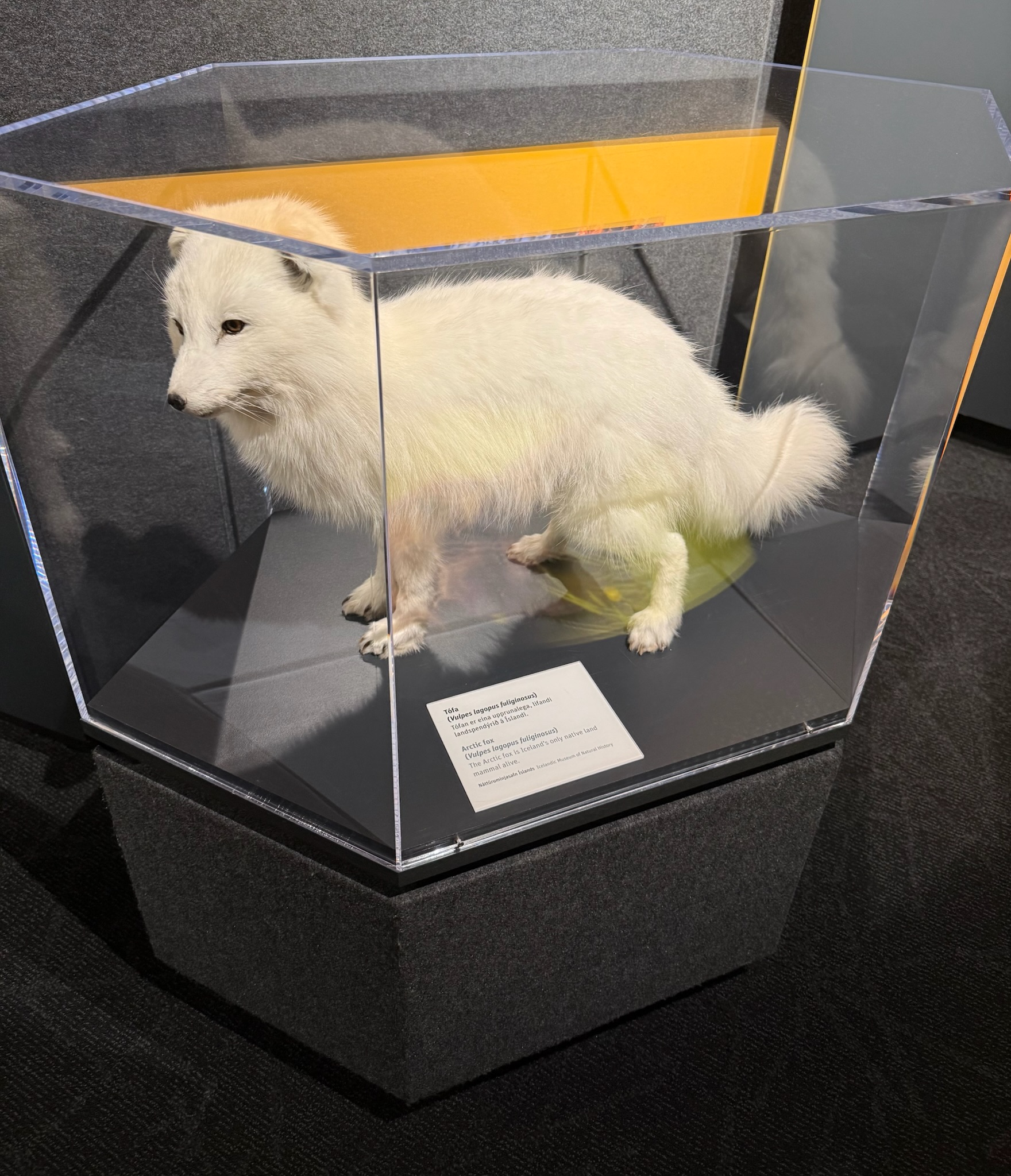
The only indigenous terrestrial mammal to Iceland in the current era was the Arctic Fox. They were omnivores that would eat just about anything, changed color from grey-blue when it wasn’t snowy to white when it was, lived in pairs, and had 4 – 6 cubs each spring.
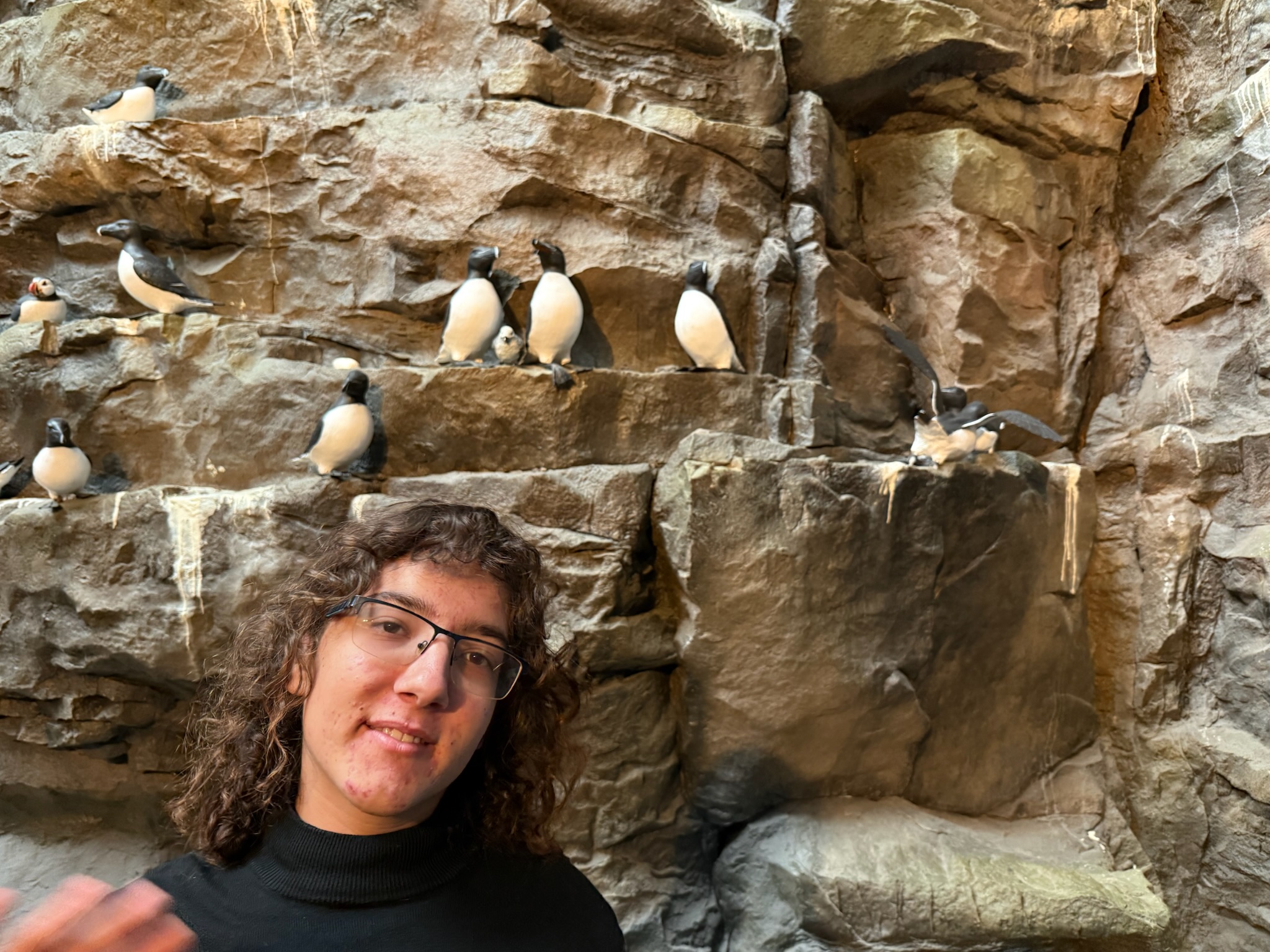
While they didn’t have many mammals, they did have lots of varieties of birds, particularly seabirds, that liked to nest along shoreline cliffs. Puffins were the most common bird, with 40% of the world’s population breeding in Iceland. The Atlantic Puffin was considered to be critically endangered. Razorbills were also common.
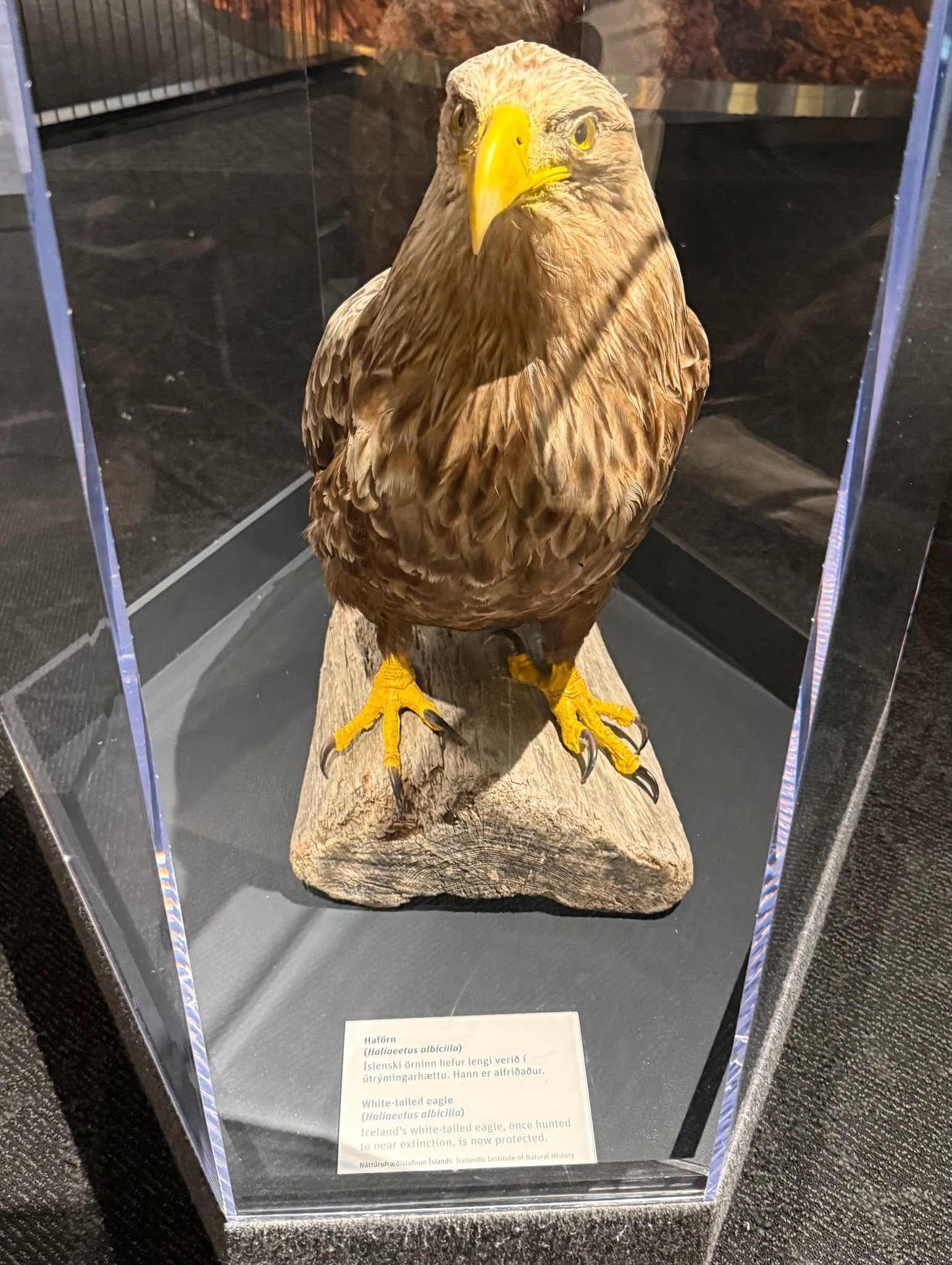
They also had white tailed eagles, which were nearly hunted to extinction, but were making a comeback now that they were a protected species. There actually weren’t many signs about the bird life. Instead, there was an informative video.
On to the human history section… It sounded like the person officially credited as being the first human to set foot on Iceland was Norse Viking Naddod in 850. He was sailing from Norway to the Faroe Islands and was blown off course, landing on the east coast of Iceland. He named the island Snowland. Many dispute that Naddod was the first to discover the island. In 325 BC, the Greek explorer Pytheas visited a place he’d named Thule. The description of Thule sounded just like Iceland.
In 855, Swedish Viking Garðar was the first to circumnavigate Iceland (with a crew) and confirmed that it was indeed an island. They built a house in Húsavík for the winter. In the spring, three of his crew opted to stay in Iceland while the rest went back to Sweden. He named the island Garðarshólm after himself.
In 870, Norwegian Flóki Vilgerðarson and his crew sailed to Iceland tried to create a settlement in the Westfjords. The winter did not go well and all his cattle died. He named the island Iceland and went back to Norway. In 874, Norwegian Ingólfr Arnarson and his family arrived with a small band of people and some Irish slaves to create the first lasting settlement in Iceland.
More settlers from Europe followed. The colonists brought cattle, sheep, pigs, goats, dogs, mice and horses. Prior to that, there were no herbivores on the island. Within a few centuries, the settlers had wiped out 80% of the trees on the island. By 930, walruses were hunted to extinction on the island.
In 930, the chieftains from across the island gathered together to form a parliament known as the Iceland Commonwealth. The same parliament still exists today, making it the oldest continuous parliament in the world.
In 1104, the Hekla volcano erupted and buried an entire community. The airborne debris, AKA the tephra layer (including ash, pumice, and other fragments), settled over half the country.
From 1402 – 1404, 1/3 of Iceland’s population was wiped out by the Black Plague.
In 1415, there was the first dispute of many between Norway and England over cod fishing rights in Icelandic waters.
In the early 1600s, Basque whalers set up whaling stations in Icelandic waters and nearly wiped the species out.
In 1783, the Laki volcano erupted. The eruption lasted for eight months and pumped out 120 megatons of ash and sulfuric dioxide. The sulphuric haze covered Europe and made it as far as Asia and Alaska. The sun was dimmed, lowering the temperature in the northern hemisphere by 1.5 degrees celsius for almost three years. In Iceland, between the poisonous air and the famine that followed, 10,000 people — 1/5 of the population — died. The lower temperatures led to the island being encircled by polar ice. In 1784, a large earthquake swarm created more than 35 new hot springs.
In 1844, a flightless bird species in the Alcidae family called Great Auks that inhabited the island were hunted to extinction.
In 1904, they construct their first hydropower plant. Over the next few decades, several more hydropower plants were built. In 1908, the locals start using geothermal water from the natural hot springs to heat their homes. Parliament also created a forest service to rehabilitate the lost forests and protect remaining forests. In 1913, Parliament banned whaling. Over the decades, they passed more legislation to protect the environment and wildlife.
In 1924, they started using geothermal energy to heat greenhouses and began growing potatoes and other vegetables. In 1930, they created their first national park, Þingvellir, to protect and preserve the area’s natural beauty. Over the decades, several more national parks were created. In 1940, Icelanders start growing bananas in greenhouses, becoming the northernmost country in the world to produce the crop.
In 1944, Iceland became a fully independent country. None of the signs that we saw mentioned who had controlled it prior, so we consulted the inter-tubes, which said it was Norwegian kingship until 1380, then under Denmark until independence. In 1948, the first Iceland whaling company began hunting in the local waters — so much for that whaling ban!
From 1963 – 1967, a volcanic eruption off the south coast of Iceland created a new island. In 1973, there was a sudden eruption on the island of Heimaey. The locals saved the harbor by pumping cold seawater on the hot lava to quickly cool it and stop it from advancing.
Between 1958 – 1976, there were three more cod wars over UK ships fishing in Icelandic waters. The 561 years of dispute was finally resolved through NATO mediation in 1976.
In 1982, the International Whaling Commission (IWC) temporarily banned whaling, which Iceland complied with. In 1986, Iceland began issuing permits to catch whales to the Icelandic whalers for “scientific purposes,” but apparently the whales were being sold to Japan for food. The world was outraged and boycotted Icelandic seafood for a while. In 1992, Iceland withdrew from the IWC. In 2006, it began issuing commercial whale hunting licenses, which garnered worldwide protests. The protests must not be too strong since it didn’t seem to be affecting tourism.
In 2010, the Eyjafjallajökull volcano erupted from March to June, with a significant explosive phase that caused widespread air travel disruptions across Europe, cancelling over 100,000 flights. In 2011, there was another major eruption at the Grímsvötn volcano from May 21 to May 28, producing a 20 kilometer ash plume that disrupted air travel across Northwestern Europe. The latest volcano eruption happened in 2024. Lava flowed for six months and covered an area of 56 square kilometers, about the size of Manhattan. They expected more eruptions to come from this fissure (we suppose it was possible that another eruption had already happened and the sign was out of date).
At 0930, we lined up for the tours. We were promptly escorted into… to be continued...