Continued… We were promptly escorted into a small amphitheater with uncomfortable bench seating. They showed a film of a recent volcano eruption with footage taken from drones above the crater. It was shown on a big screen and was very impressive footage – there were even shots looking into the crater. There were lots of images of lava exploding out of the crater. There was an image of people standing at the edge of the crater where they could easily be killed by particles from exploding lava. There was footage of a crowd standing at the edge of a flow, congregated right where the lava stopped.
From there, we were escorted into another room. It looked like a small theater with a movie screen, a flat floor, and individual seats. We were directed to sit down. These seats were much more comfortable. At first we thought it was going to be another lava movie, but it turned out to be a 3-D simulator ride. The floor was glass and the movie was projected on three of the walls, the ceiling, and under the floor. The story was that we were inside a drone. It drove down under the water very deep into a volcanic crater. The crater was somehow protected from the water and was dry inside, which felt like a plot hole in the story. The drone landed on the dirt floor, then zoomed forward to where the lava was pushing up through a fissure. We flew over the fissure, then had to escape up quickly to outrun the lava. Then we were flying over the crater and the ride ended. Keith said the ride was creepy and he didn’t like it. Christi liked it better than Keith did, but she didn’t love it. She probably would have liked it more if it were a mellow experience than a death defying thrill ride.
When the ride ended, the group was escorted into the ice tunnel. It was the only indoor ice tunnel in the world, and it was a recreation of the tunnel that Eric had gone to yesterday. It was real ice and they kept the temperature at 32-degrees Fahrenheit. There was a main tunnel that was tall enough to stand in and a few off shoot tunnels that were lower — we needed stoop over to get through those. There was the volcanic ash lines that Eric had told us about.
There was simulation of the crevasse that Eric had told us about.
And there was an ice chair in there, too.
Eric had told us that the tunnel made a circle with only one entrance and exit, but the simulation had a different exit. Keith liked being in the tunnel and liked playing in the snow.
He wanted to stay for a long time. We thought eventually we’d be shooed out, but the staff let us stay in there as long as we wanted. Eventually, Christi decided she’d had enough and left. Keith came out right behind her.
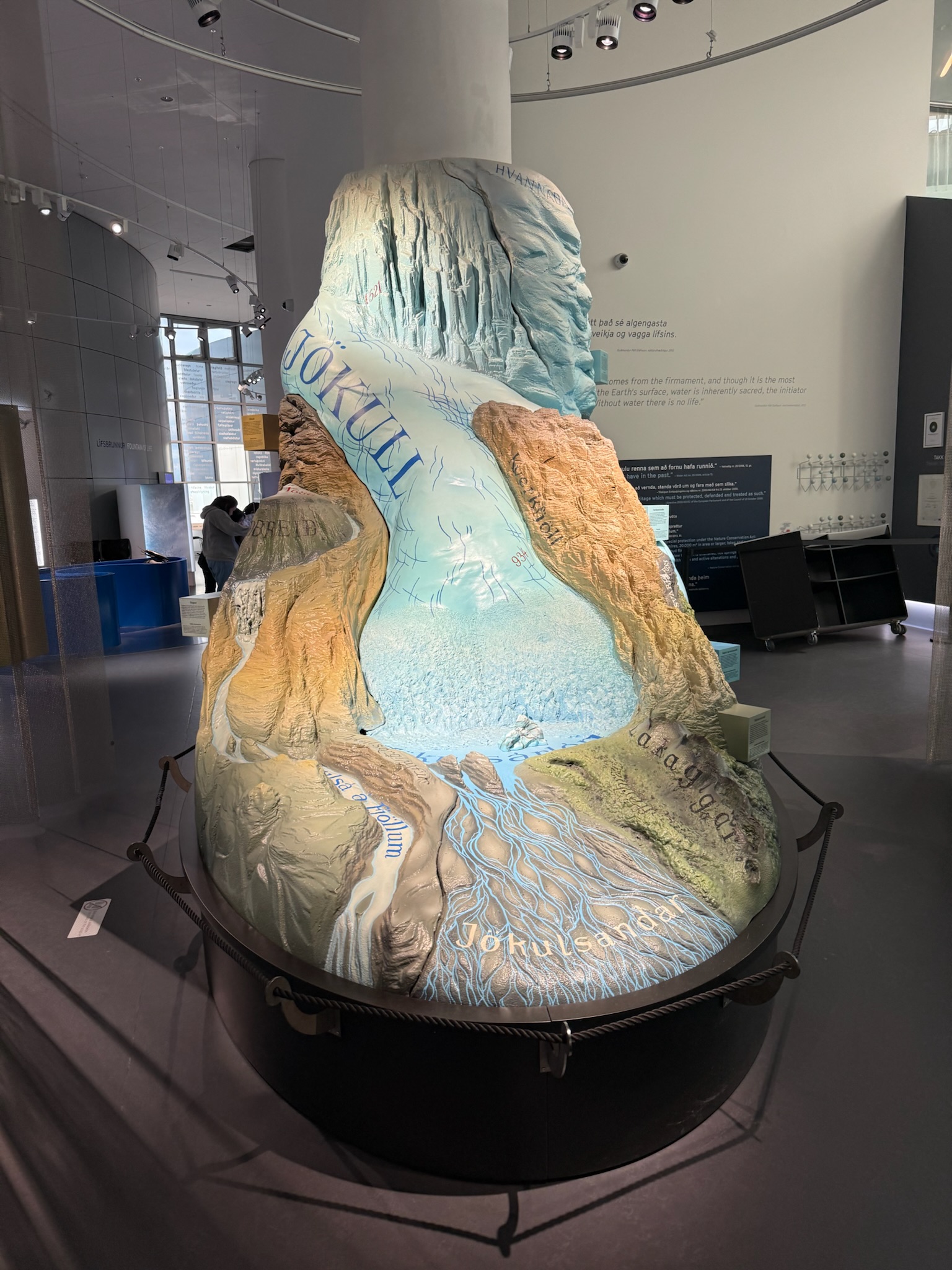
The exit let out at the base of a staircase up to second floor. There really wasn’t any choice but to follow the staircase up. The area near the staircase had a display on glaciers. Glaciers were made from snow that built up year over year in areas of high snowfall, so they were found in the polar regions and in the highest mountains of every continent except Australia. 10% of Iceland was currently covered by glaciers. The delicate, airy snow flakes were broken down into ice crystals from the weight of the snow falling on top of it, so the outer layers were less dense than the deeper layers.
They were powerful forces — pushed by gravity, they moved sediment with them, often drastically changing the topography of an area. Depending on the type of glacier and how it moved, it could create jagged cliffs, sharp mountains, narrow fjords, or valleys (which often became lakes or fjords). Movement in the underside of a glacier was slower than on top because of the friction created as it slid along the ground. In Iceland, under the right conditions, glaciers sometimes moved several meters per day. Glaciers were classified according to shape, relationship to the topography, and temperature conditions within the ice. There were models showing the shapes of each of the different types of glaciers and where in the country each type could be seen.
Ice caps were large expanse glaciers that engulf the landscape, hiding the topography beneath (though mountain peaks make poke out). The Vatnajökull was the largest icecap in Iceland, with a surface area of 7,800 km. It covered several volcanoes, mountains, plateaus and valleys. Piedmont glaciers flowed through valleys and spread out in lobes when they reached a flat area of land, creating moraines (ridges of soil and rock that had been displaced by the glacier as it slid down). The Múlajökull in the central highlands was one. Valley glaciers flowed between the walls of steep mountains, carving the valley into U shapes. Eysteri-Tungnahryggjokull was an example found in the north. Cirque glaciers form in bowl shaped depressions on high mountain slopes. Jökull in the east was an example. Calving was when a large chunk of ice broke off the main part of the glacier. If the big chunk happened to fall into the ocean, it became an iceberg. Not many glaciers calved in Iceland, and one the most notable was in the Jökulsárlón glacial lake in the south.
The next set of exhibits was about Iceland’s fresh water. Iceland’s glaciers store 3,500 km3. Glacial melt water fed rivers and lakes, and transported nutrient rich sediment to support animal and plant habitats, including for the marine life along the coast. The fresh, cold water running into the ocean had an influence on the currents and climate by changing the ocean’s temperature and salinity. Interestingly, in the west and southwestern parts of the country, the land was sinking by 4 mm per year, but in the southeast it was rising 6 mm per year due to the glaciers melting. The reduction of weight was lifting the land up.
Iceland also had notable natural springs, which were among the largest in the world. They were generally located around lava fields and fissure areas in volcanic zones. And, of course, Iceland had plenty of runoff rivers, where excess water from seasonal precipitation collected.
Iceland was famous for its geothermal waters, which was when water on or under the surface was heated by hot rocks. In the active volcano zones they tended to be high-temperature geothermal areas, outside the volcano zones were generally low-temperature areas. Hot springs were when the water was heated to a bathtub temperature. Steam vents were when pools of water boiled and the steam was released into the air. Mud pots were when hot water combined with naturally occurring acids and microbes to dissolve soft rocks, creating pools of bubbling mud. Iceland was one of the few countries known for geysers, which was where underground pools of water heated unevenly. The cool water on top blocked the steam from the boiling water below from being released. Pressure from the steam built until it exploded, and the water was shot up into the air as part of the explosion. Then the process of water heating started all over again. The video below was of a geyser simulation in the lobby. The geyser erupted every few minutes.
River water from both glacial melt and natural springs was harnessed to power hydroelectric plants, which generated more than 60% of the country’s electrical energy production. The geothermal water was used to heat buildings (almost all buildings in Iceland were heated with geothermal water), in swimming pools and fish farms, greenhouses and snow-melting systems. The steam from the geothermal waters was used to generate electricity in geothermal power stations and supplied about 1/3 of the country’s electricity.
With so much water, wetlands were a prominent part of Iceland’s landscape until the 20th century, when about half the country’s wetlands were drained and converted to pastures. Iceland was now working on reclaiming wetlands.
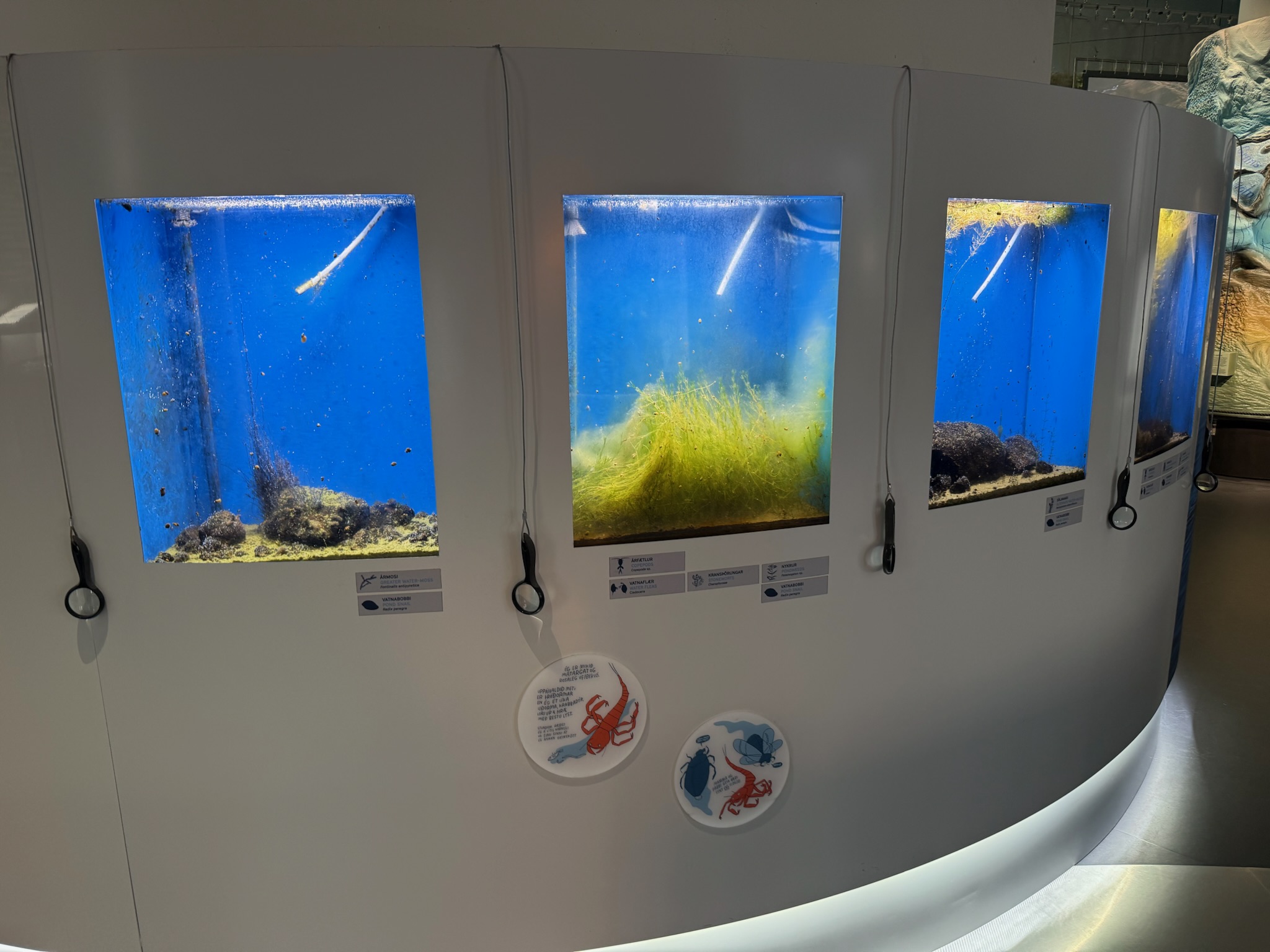
The display moved on to indigenous aquatic species that made up the freshwater ecosystems. 3,400 organisms lived in Iceland’s freshwater. 1,000 of them were bacteria, 600 animals, 500 plants, and 900 chromist (including algae). Of the animals, fish and birds only totaled 60. The rest were invertebrate species, such as worms, arthropods and mollusks.
There as information on some of the more critical species. Non-biting midges were the most common insects in Iceland, with over 80 species. They looked like mosquitos. Like mosquitos, they laid their eggs in water and the larvae were an important food source for the fish and birds. If we understood the signs correctly, amphipods were a tiny crustacean (.7 cm) that had inhabited the polar regions 50 to 100-million years ago when the weather was warmer, but had mostly died out during the coldest points of the ice ages. However, they’d managed to survive in the geothermal areas of Iceland — the only animals believed to have survived — and their descendants were still part of the ecosystem. They also had Arctic tadpole shrimp, which grew to be 3 – 4 cm long.
For fish, the three-spined stickleback was the most common freshwater species, and there were two varieties. It was a small fish that was eaten by birds and bigger fish. They featured four types of charr, the smallest 12 cm and the largest 60 cm. Salmon were born in rivers, move to oceans, then go back to the rivers to spawn. Also featured were specific species of algae, aquatic plants, snails, beetles, and other insects.
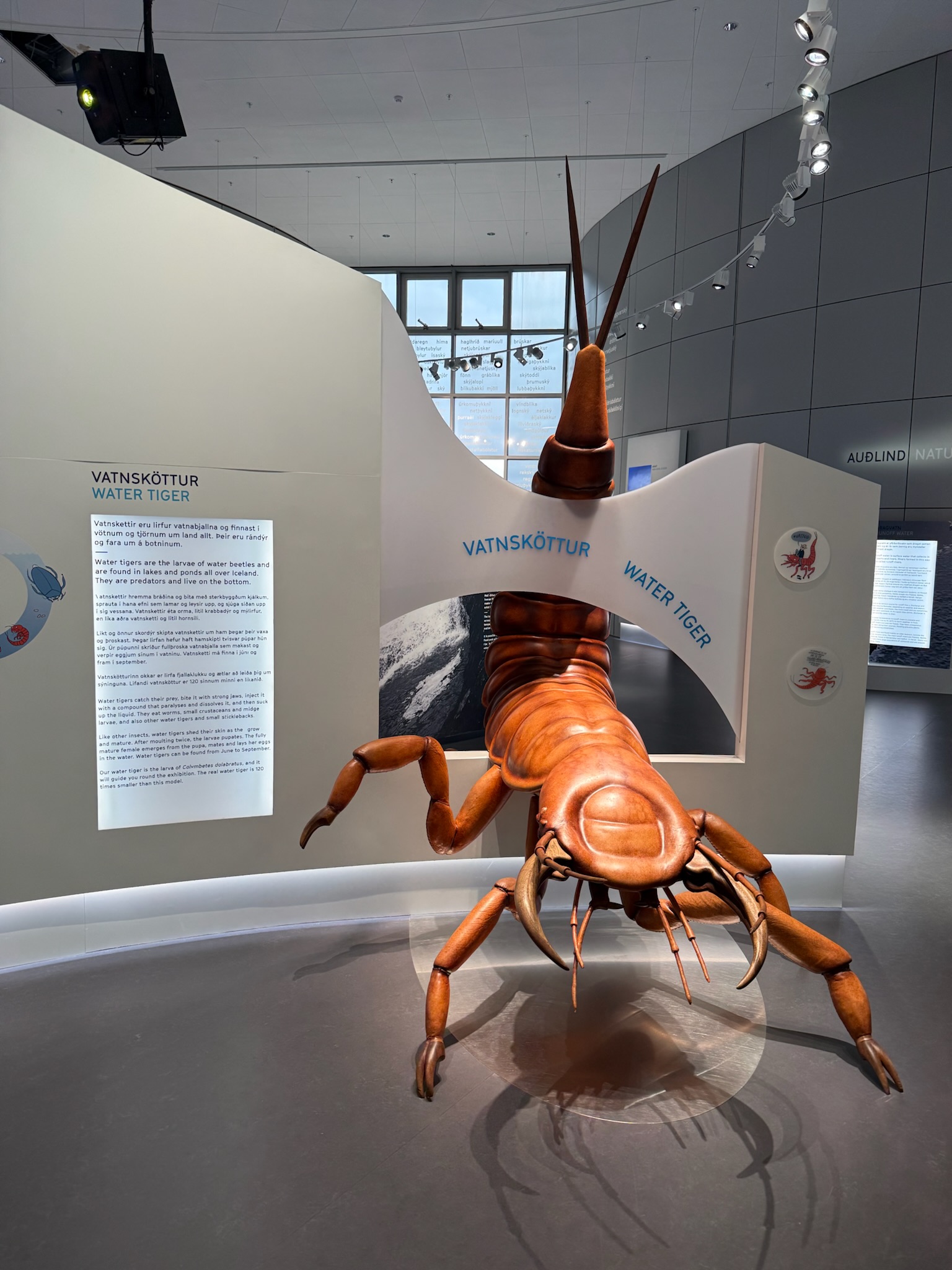
There was a gigantic exhibit on water tigers, which were the larvae of water beetles that lived on the bottoms of bodies of water and ate worms, small crustaceans, small sticklebacks and other water tigers. Like butterflies, the larvae pupated and emerged as water beetles. The sign was clear that the model was 120 times bigger than a typical water tiger. It seemed like a really odd thing to spotlight so dramatically.
There was a sign that detailed the water-related natural disasters that Iceland struggled with, such as avalanches, rock slides, mud slides, flooding and surprise blizzards. An eye raising one was sometimes sea ice would drift over from Greenland, and there were years when polar bears were on the ice and came onshore. They were technically protected by the government, who tried to return them to Greenland, but locals were allowed to kill if they became a threat.
We noticed it was nearly time for the IMAX movie to begin, so we headed back down to the first floor and lined up outside the IMAX theater… to be continued…