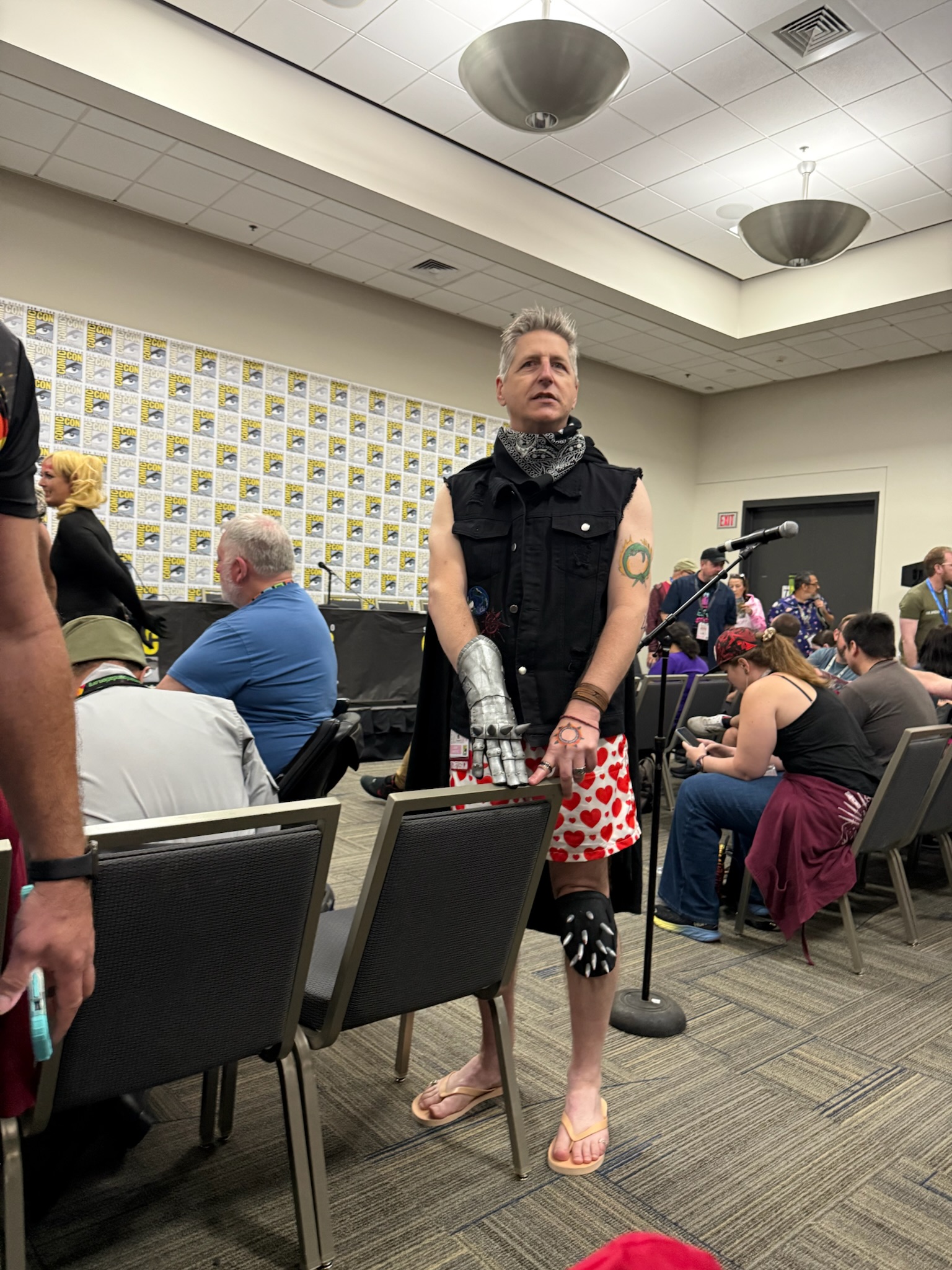
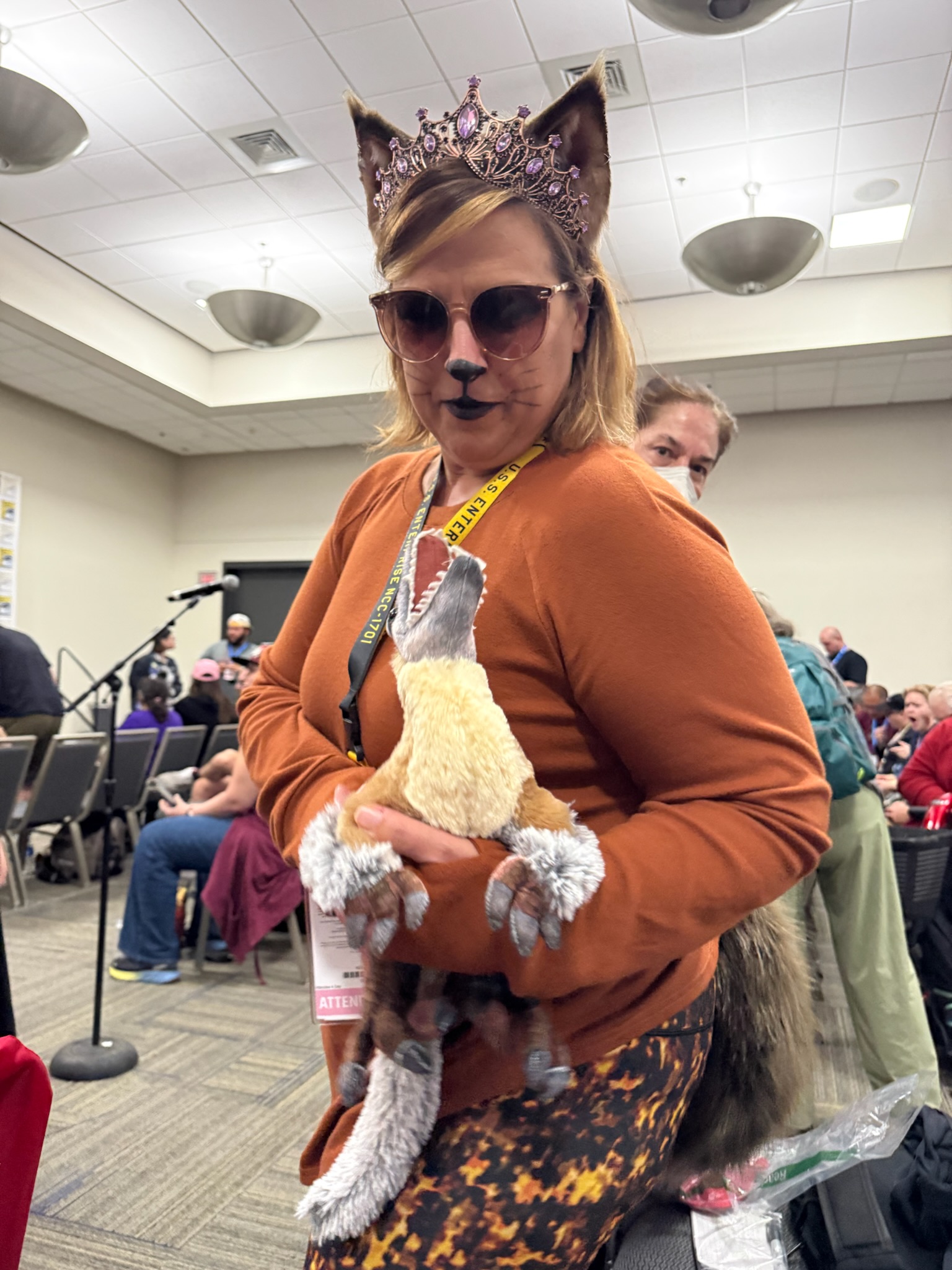
Dungeon Crawler Carl CosplayerPrincess Donut Cosplayer
This week has been amazing. On Saturday, we went to Comicon for our last day there. We went to a panel with Matt Diniman and the narrator of Dungeon Crawler Carl, Jeff Hays. After the panel, we went to an event sponsored by Audible. It was at an arcade, and both Matt Diniman and Jeff Hays were there. It had free food and arcade games, as well. We waited in line for two and a half hours before we got in. Matt had to go do something else, but we still got a picture with him as he was leaving. We also got free mugs, and Jeff even signed one of them for me!
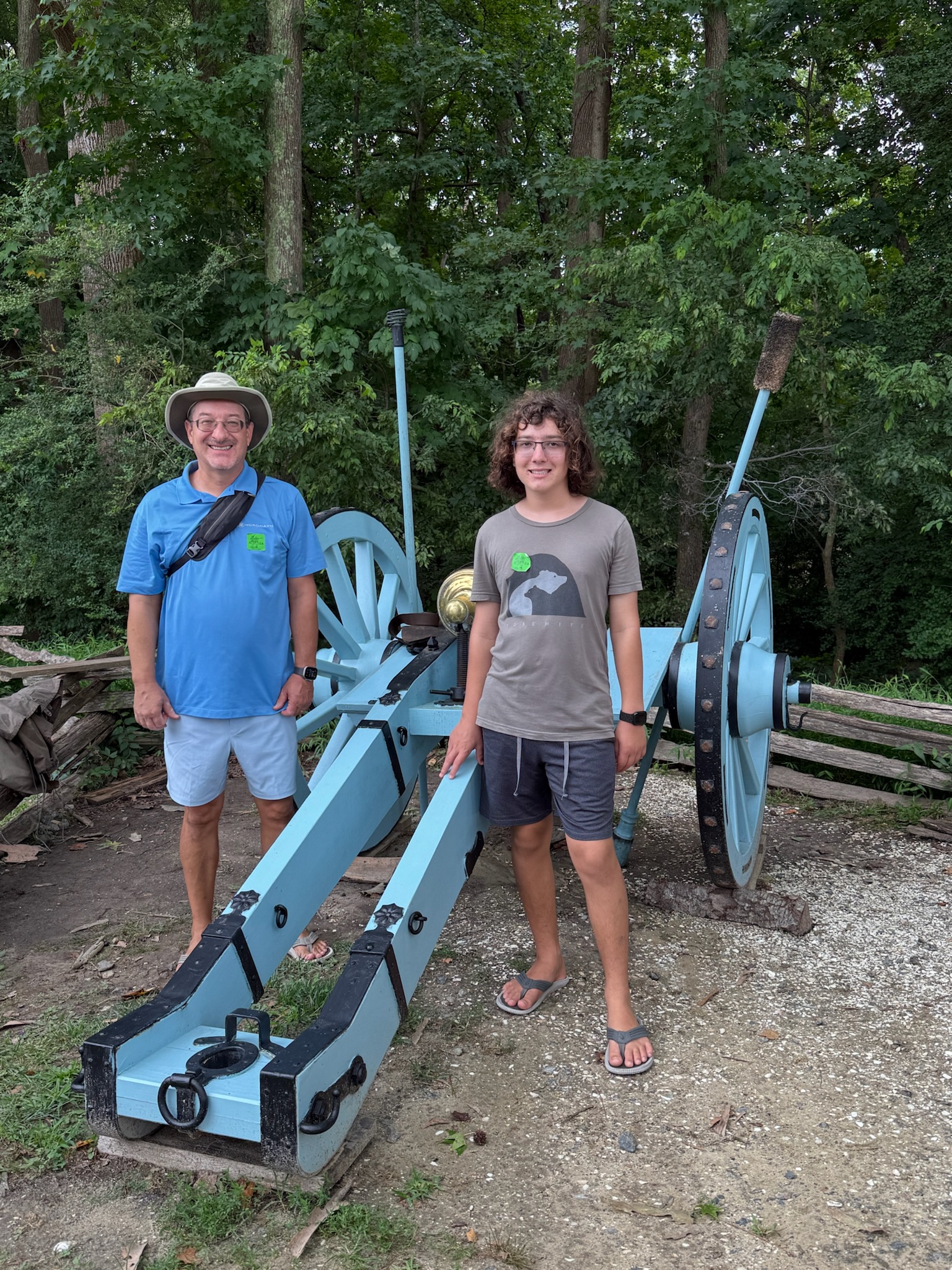
Continued… After we finished at the museum, we went back to the military area for the cannon firing demonstration. The Americans had multiple types and sizes of cannons. The first line of defense was the big canons. The French army had brought heavy siege cannons that fired 16 – 24 lb shot, which did serious damage to the base, but they couldn’t be easily moved. The Americans also had field canons, which were mobile, shot straight and were meant for disrupting lines (columns) of soldiers. The Americans also had 8″ howitzers. The howitzers were also smaller and could be moved around the battlefield where needed. They would shoot up over walls and could hit people behind walls. And they had mortars. The British only had light artillery that fired 3 – 6 lb shot, so the Americans had superior weapons in this battle.
Just as the bayonet on the end of the musket was more important to the troops as a psychological fear tactic than as a weapon, cannons were also more of a psychological fear tactic than a physical danger to the opposing soldiers.
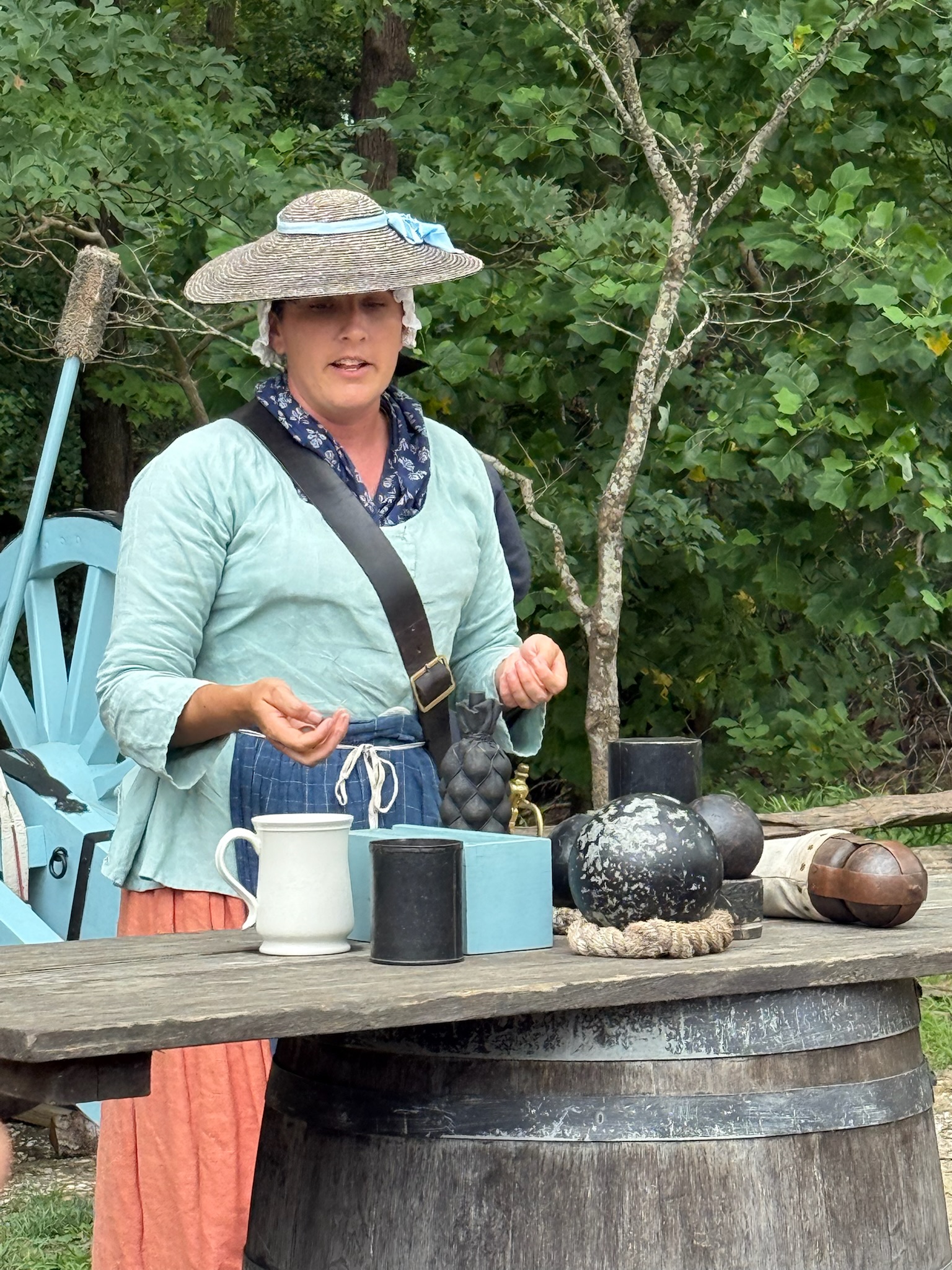
The character talked about the various types of ammunition that was used. Classic cannonballs had explosives inside them, hard shells were solid, and grape shot blew up in the air and sent shrapnel everywhere. mortars,
Just as the bayonet on the end of the musket was more important to the troops as a psychological fear tactic than as a weapon, cannons were also more of a psychological fear tactic than a physical danger to the opposing soldiers.
When they did the field demonstration, they went through each step of the process of loading and shooting the canon very slowly, and they had kids from the audience doing the various steps (although they had the kids use imaginary gunpowder and fire). There were quite a few steps involved! Someone’s job was to do the math on the angles and distance to ensure that the targets were hit. One of the things we found interesting was that they had two soldiers standing still next to the canon mouth when it was fired. It was completely safe to be there since the canon jerked backwards. The reason they did this was so that the other soldiers could put the cannon back at the same exact spot for the next shot (or, if they had missed, to ensure that this time it would be put in a better spot to not miss the next time). She mentioned that the soldiers stationed next to the cannons probably lost their hearing very quickly. Then they had the kids back away and showed what it looked like in real time to load and shoot the canon. It was definitely loud and smoky!
At this point, we’d seen the entire site, so we went to the Historic Yorktown Riverfront (where the ships were clustered together in the middle of the map), for dinner. It was a small cluster of adorable buildings about a mile east of the museum. We were pleased to see there was free parking in a parking garage on the south side of the street.
continued… In August 1776, a fleet of 30,000 British soldiers arrived in New York Harbor. Washington and his men were driven out of New York and New Jersey into Pennsylvania. On Christmas night, Washington and his men crossed the Delaware River during an icy storm to launch a surprise attack on a garrison in Trenton, New Jersey. The Patriots took 900 prisoners. In an equally bold move, on January 3, 1777, Washington managed to sneak around a large British force and launch a surprise attack on a rear detachment in Princeton, New Jersey. It was another victory.
In September 1777, the Patriots lost a battle at Brandywine, Pennsylvania, and Philadelphia was occupied by the British. In October 1777, Washington doubled down and attacked Germantown, Pennsylvania, but lost again. However, in October 1777, the Patriots won a battle at Saratoga, New York. The soldiers spent the winter of 1777 – 78, in Valley Forge, Pennsylvania. The severe weather and lack of food caused hardship for the soldiers, but Washington had brought in a Prussian veteran to train the soldiers. By the end of the winter, he’d turned the rag-tag squadron into a disciplined and effective fighting force.
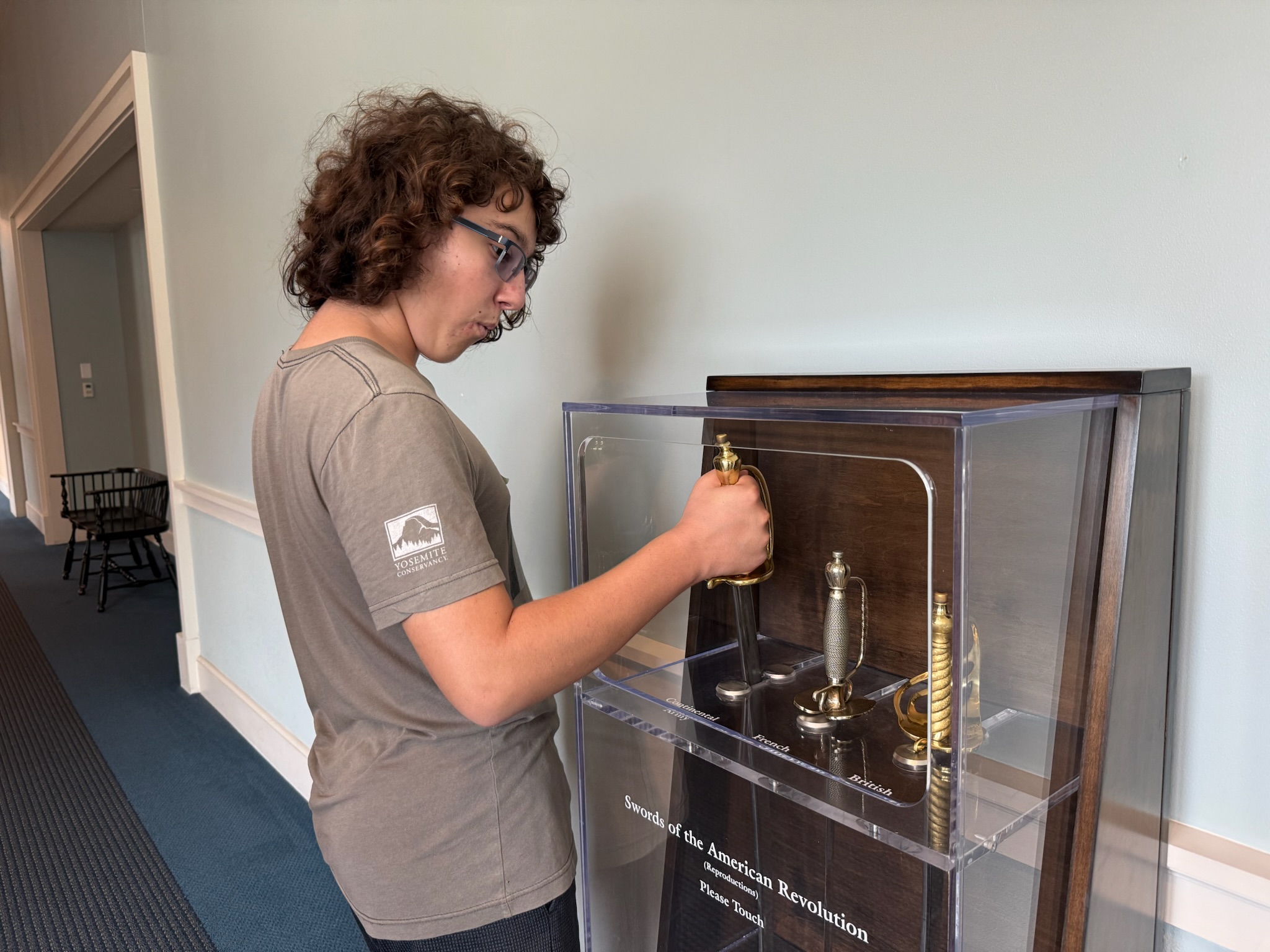
Keith checking out the swords carried by each of the country’s militaries
In February 1778, France and the United States signed a Treaty of Alliance and a Treaty of Amity and Commerce. France now officially recognized the United States as an independent nation, set up a trading relationship with them, and agreed to protect US trading ships and ports. In doing so, France had officially entered the war. France’s naval power turned the tide.
continued… We hustled from the farm back to the Continental Army encampment to see the musket demonstration that was about to begin. We wound up talking to the soldier for a solid twenty-minutes. Special forces may have used rifles for specific purposes, but the general forces only used muskets. Muskets were the military weapon of choice because they were easy to learn how to use, quick to load, could be mass produced, and had standard size shells. However, they were not accurate. While rifles were accurate, back then rifles were all custom made for each user, took a long time to reload, were harder to learn, and all the rifles had different sized shells. He explained that for hunting, you only had one shot, as the animals would run away after that shot, so accuracy was important. But for the type of warfare they did during the revolutionary era, quickly reloading to fire off more shots was more important than each shot being accurate. He had said that during the civil war, when more rifles were used, the percentage of hits was the same with rifles as muskets because most soldiers weren’t taking careful aim.
He explained that the soldiers fought in tight formation lines because they needed a barrage of bullets fired at once to have a chance to hit enemy soldiers. It also ensured the soldiers could hear the orders being communicated. The soldiers stood shoulder to shoulder, fired muskets on command, reloaded as quickly as possible, and continued to shoot upon command until the ammunition ran out. It sounded like the soldiers took the bayonet off during the firing, and on command all put their bayonets back on the end of the rifle. It made a loud click-click sound. He said that the hundreds of click-clicks would terrify the other side and make them want to run away — the bayonet clicking was actually more important as a psychological fear weapon than an actual weapon. If the other side didn’t cede, they would rush across the battlefield and try to stab the opposing troops with their bayonets.
The soldiers wore bright colored clothing because they wanted their own side to easily see and identify them. The weapons, especially the cannons, were loud and made a lot of smoke, so it was hard to see and hear in the middle of a battle. The heavy smoke obscuring visibility was where the term “fog of war” originated.
continued… After seeing the entire Continental Army encampment, we went over to the farm. This recreation was based on a real farm owned by Edward Moss that had existed at that time. We don’t remember the details now, but he had a lot of acres, so this was a tiny microcosm of what the actual farm was like.
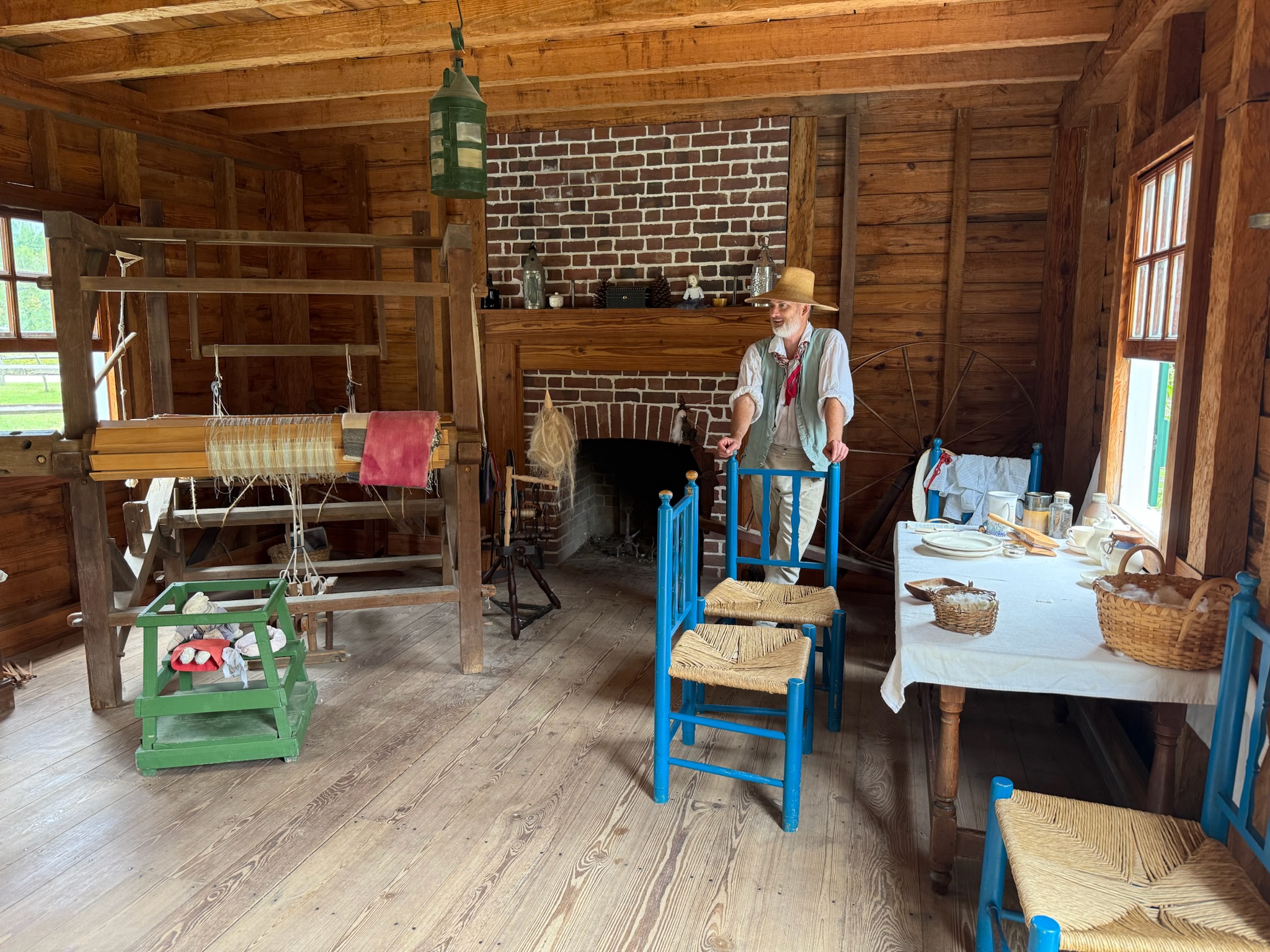
The house was two rooms. There was a spindle wheel in the parlor, and “Edward” was making thread. He explained that prior to the rebellion, textiles were imported from England. But when the Patriots had ordered a boycott of all British goods, people had to start making their own textiles. He said that thread was made out of a variety of materials. The easiest and most popular yarn material was wool, but today he was using cotton. Even though cotton grew well in Virginia, it was unpopular because it was difficult to separate the seeds out (the cotton gin had not yet been invented).