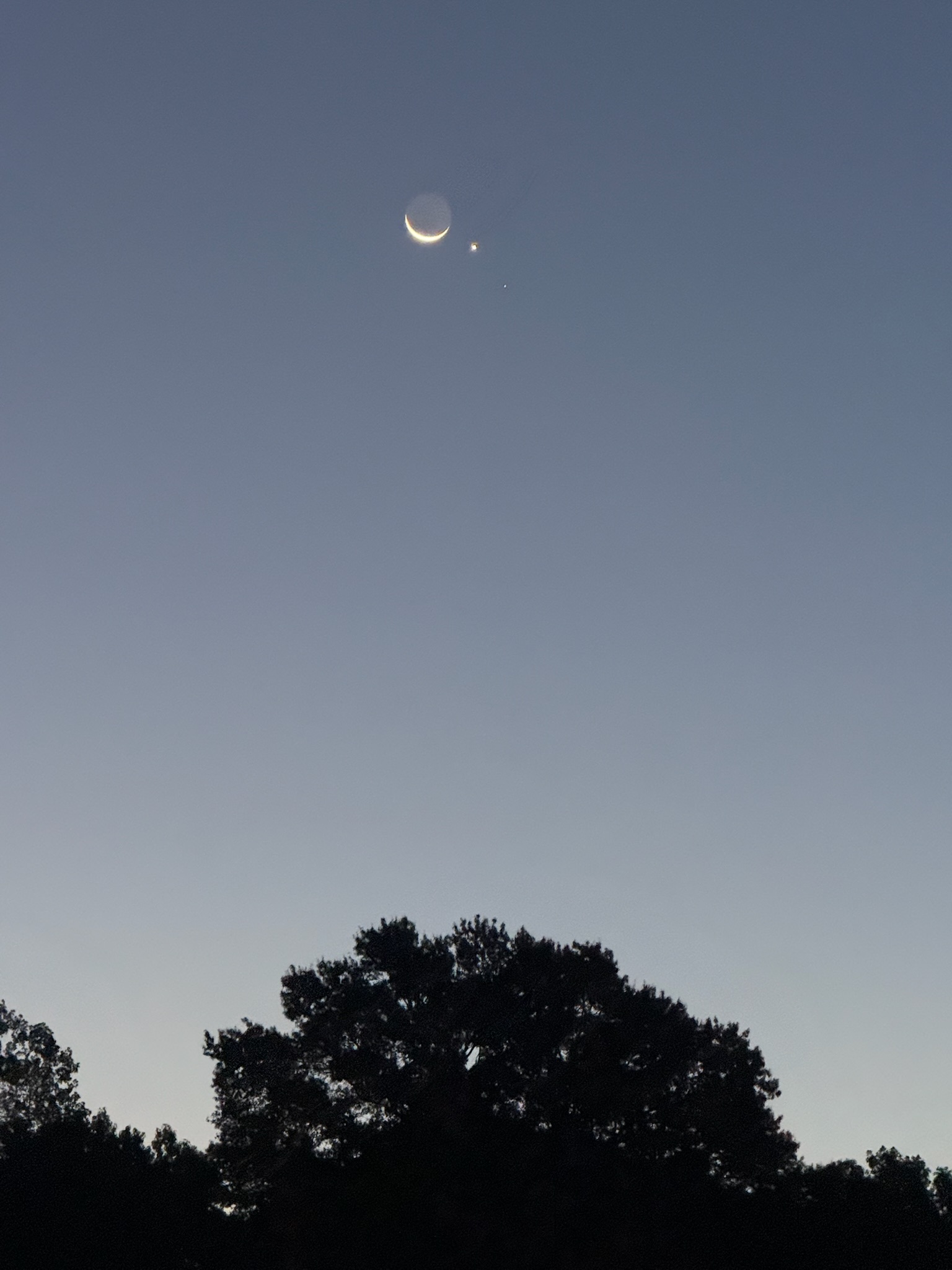
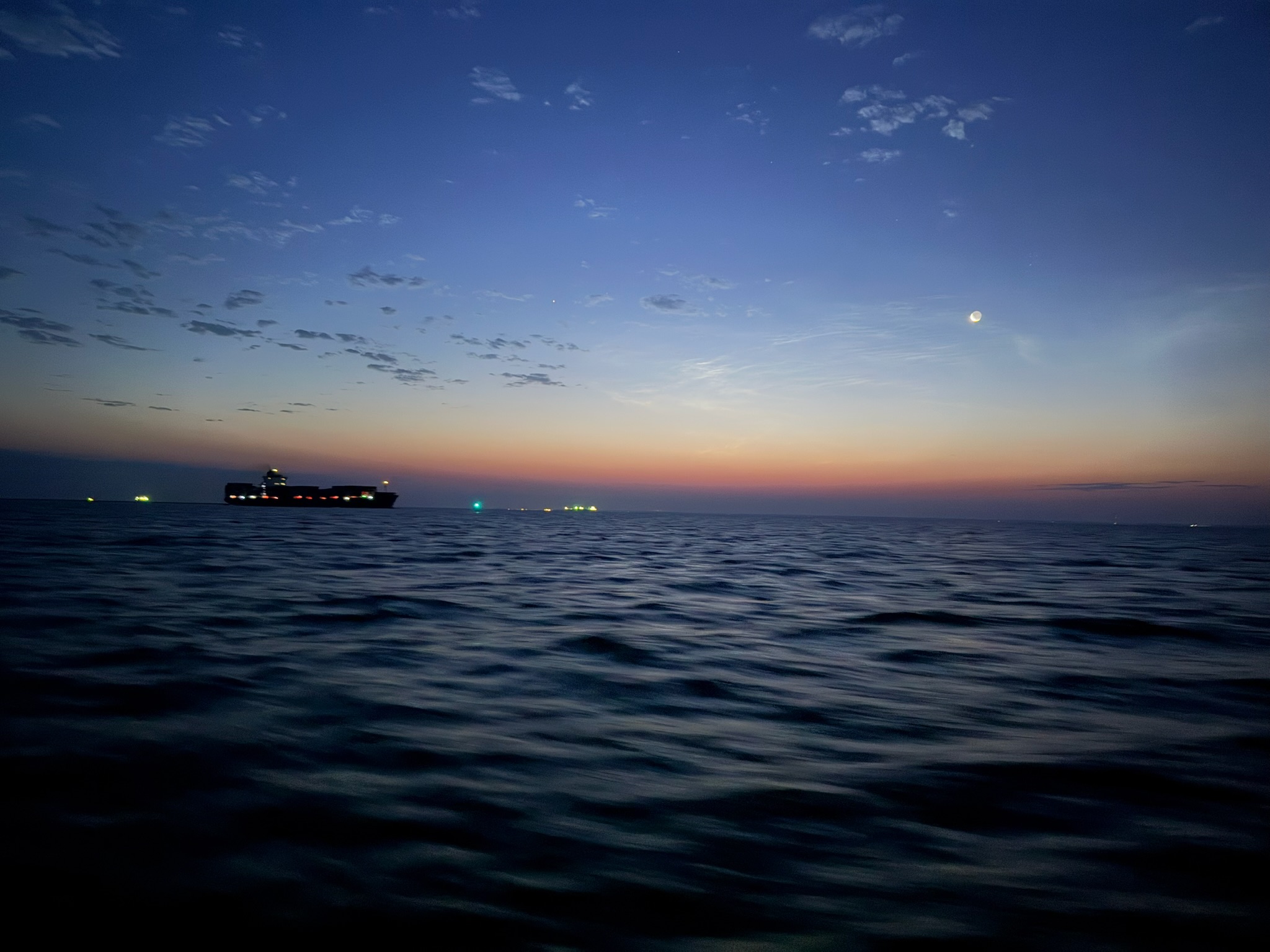
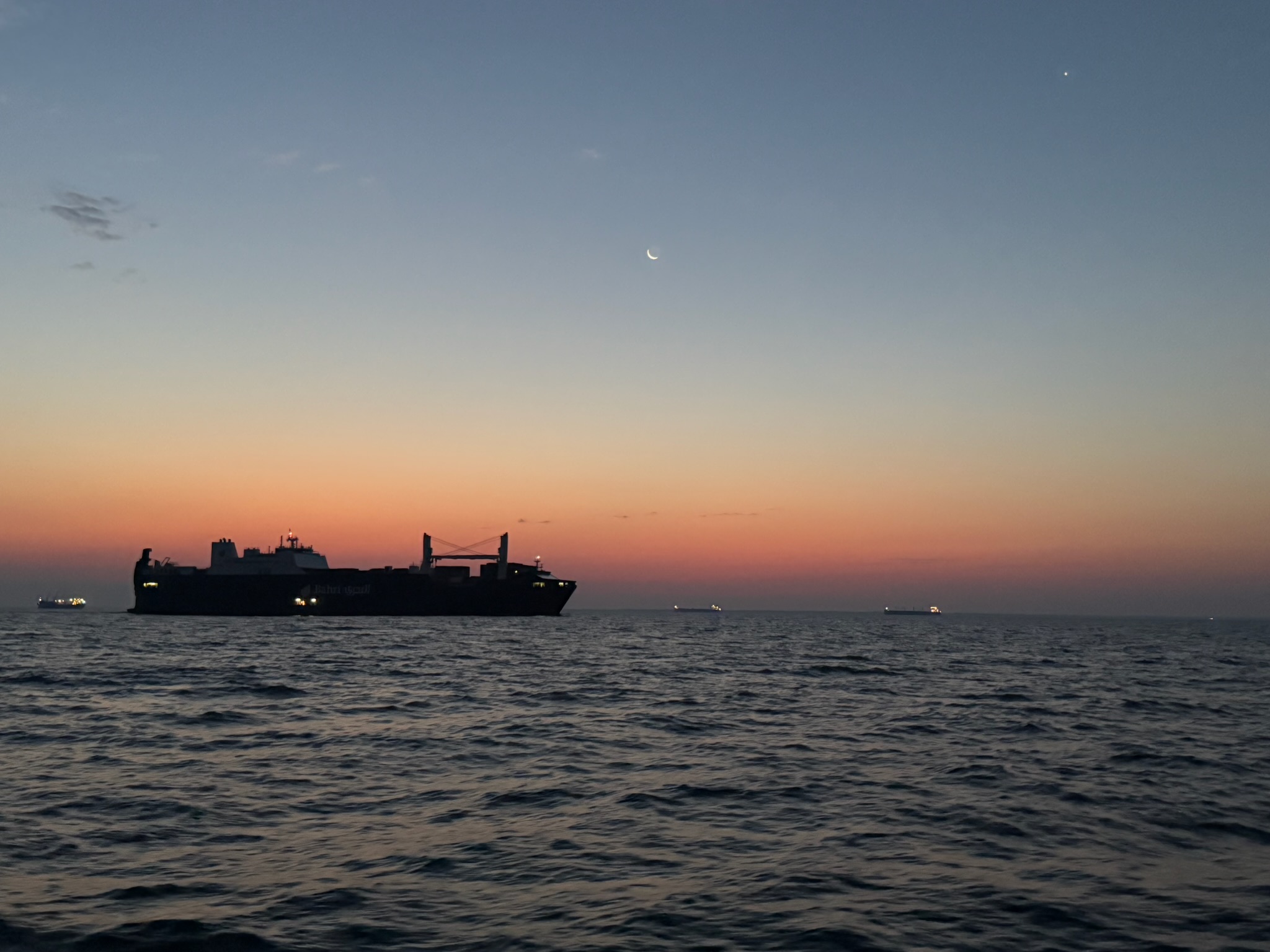
Friday, Sep. 19 — We again wanted to get an early start on our passage, so we got up at 0530. Much to our dismay, the mid-stateroom toilet was broken. Unfortunately, there was no time to worry about it this morning. Fortunately, we have two heads (bathrooms), so we were fine. Here was the crescent moon and a nearby planet glowing brightly pre-dawn.
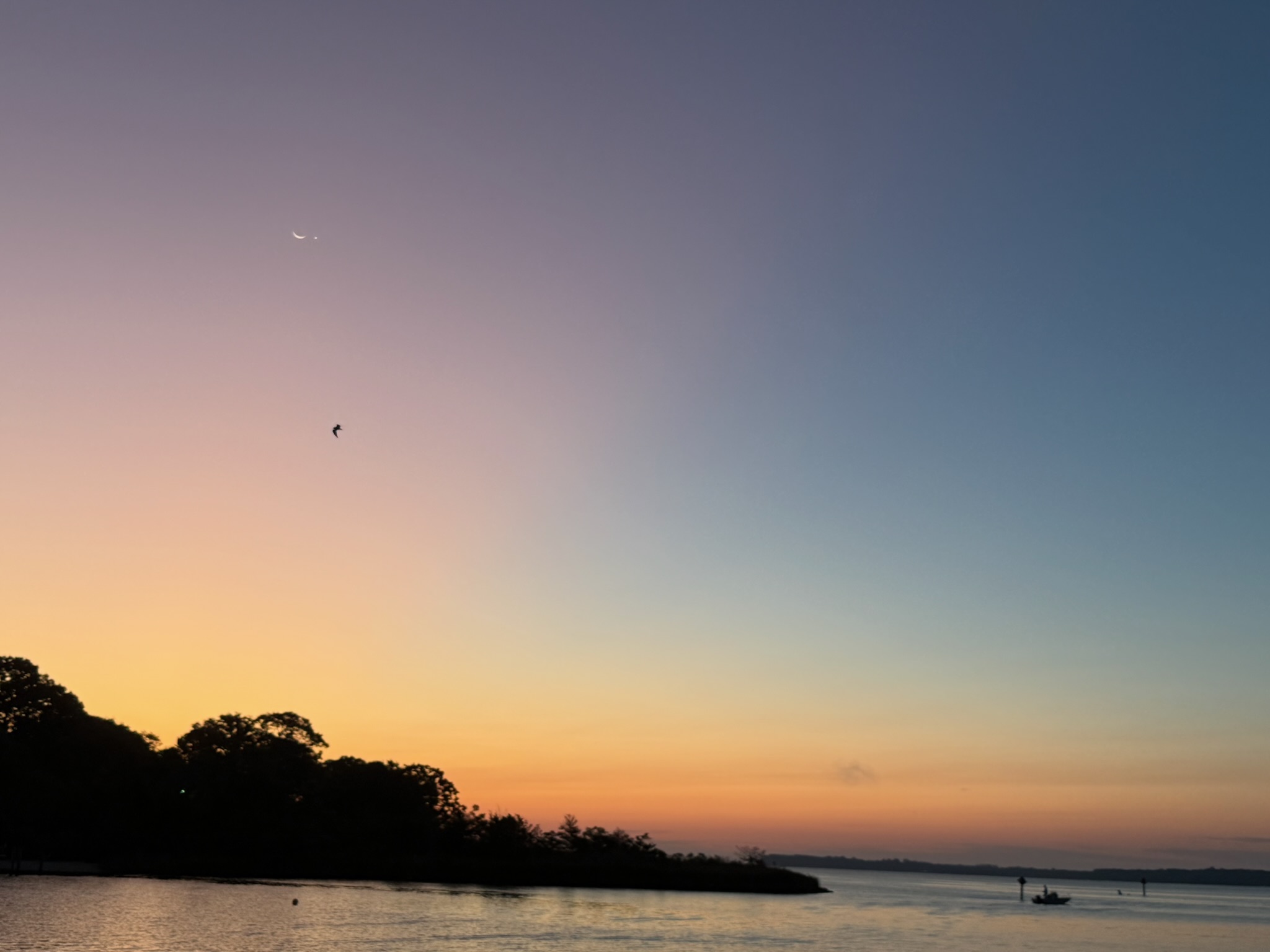
Today the skies were clear, so when we pulled up anchor at 0620, there was enough light to see where we were going. That said, the anchor chain was very muddy, and we did need a flashlight in order to wash the chain. It was a glorious morning, with the sky taking on a rainbow of colors throughout the pre-dawn.
Thursday, September 18, 2025 — Eric has been worried about the transit that we we’re about to make to DC. One of his concerns was speed: we were going to be going upriver against the current. To help maximize speed, he wanted the bottom clean. Even though the bottom hadn’t been too bad the last time it was cleaned in Baltimore, the extreme amount of growth we’d gotten in Little Creek had Eric worried that there may be enough growth to slow Kosmos down.
Eric has been trying to get the diver to come to do another bottom cleaning for over a week now. The diver is very busy in general, and recently had some issues that caused him to be backlogged. The diver promised Eric that he would do the bottom this morning at 0530. Christi was dubious that he’d really show up, but we still got up at 0430 to shower before he arrived (we try not to run water when the divers are working).
We were not surprised when the diver cancelled. But in good news, we were completely ready to go at first light, which was 0620. First light didn’t mean good visibility, though. It was totally overcast, making it a very dark morning. The cloud cover was so thick that we couldn’t see any hint of the sunrise.
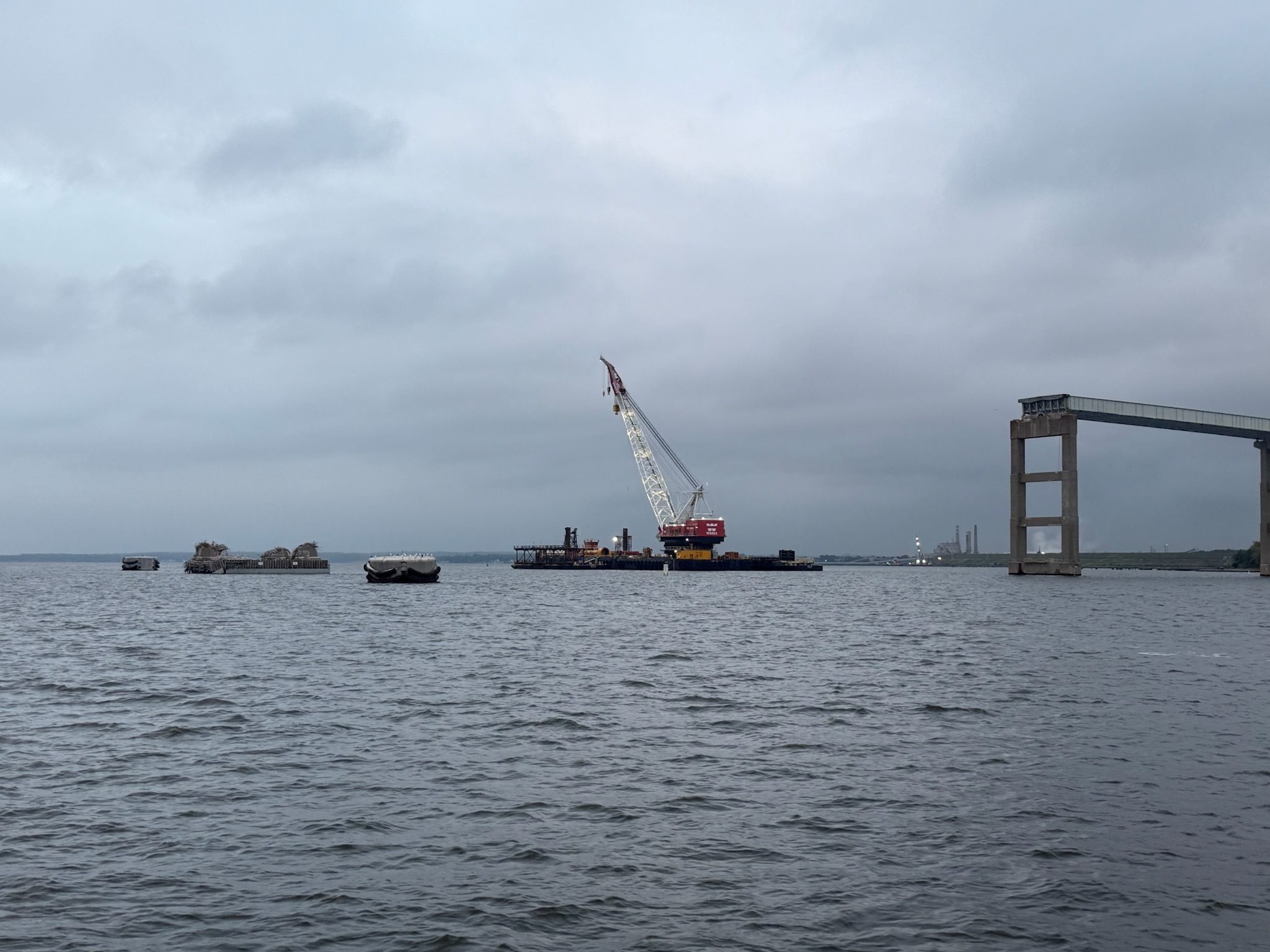
As soon as we’d turned on the radio, we heard regular warnings to be careful near The Francis Scott Key Bridge as they were doing demolition work to the remains in order to clear the way for the construction of the replacement bridge. We were glad to hear they were finally getting started on a new bridge.
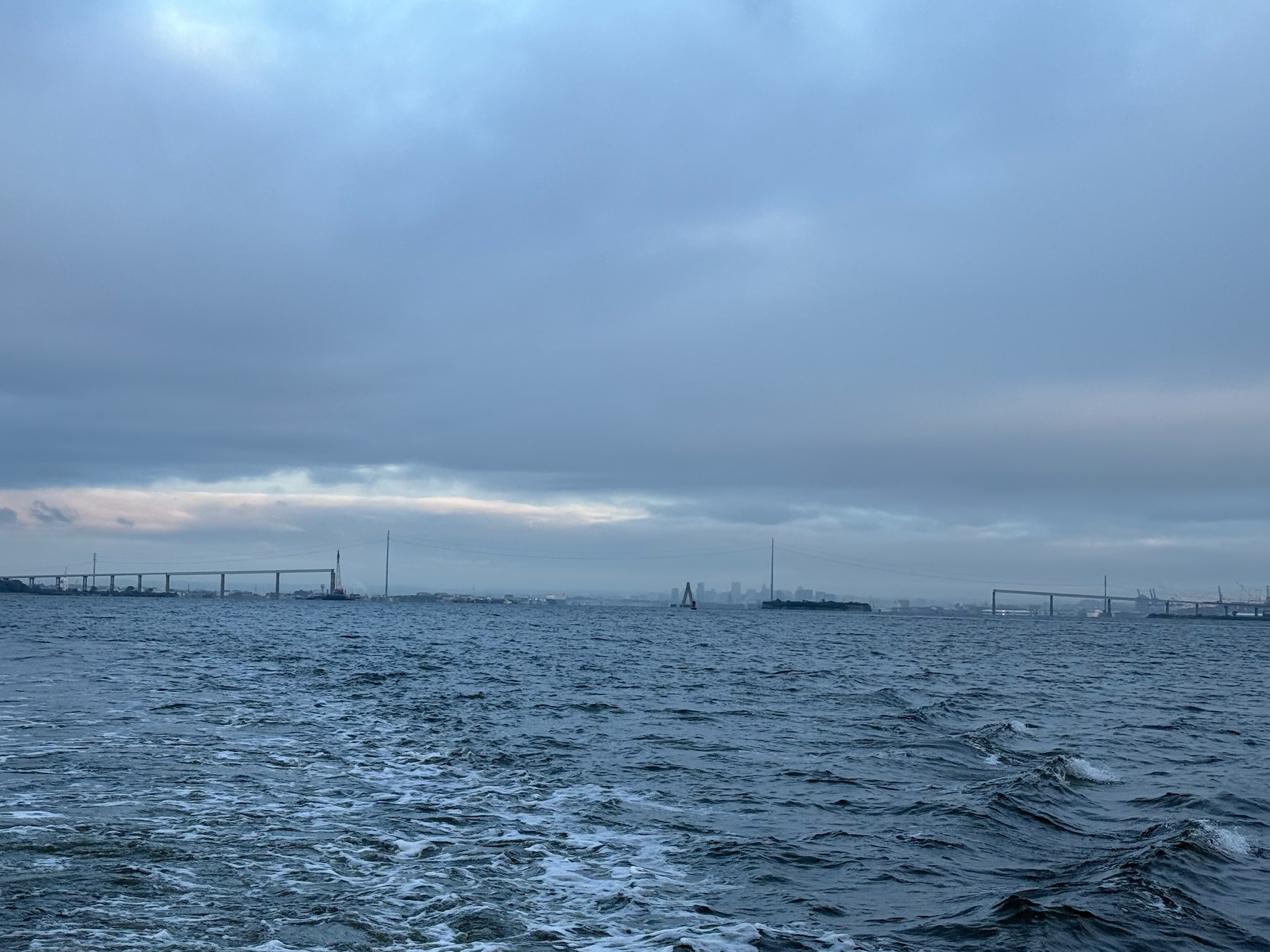
Looking back at the Francis Scott Key Bridge remains and Baltimore.
This week has been fun. Saturday and Sunday were both boring passage days. On Monday, we arrived in Deltaville. The marina we were at was nice enough. A boat with kids was having a potluck, so we went for a while, but then the marina said we had to move the boat to a different slip. On Tuesday, we went to a restaurant called The Galley, which had good food. I tried Old Bay for the first time, and it was really good. Unfortunately, mom couldn’t get much to eat because Old Bay has pepper in it. When we got back, we went to the pool with the two kid boats.
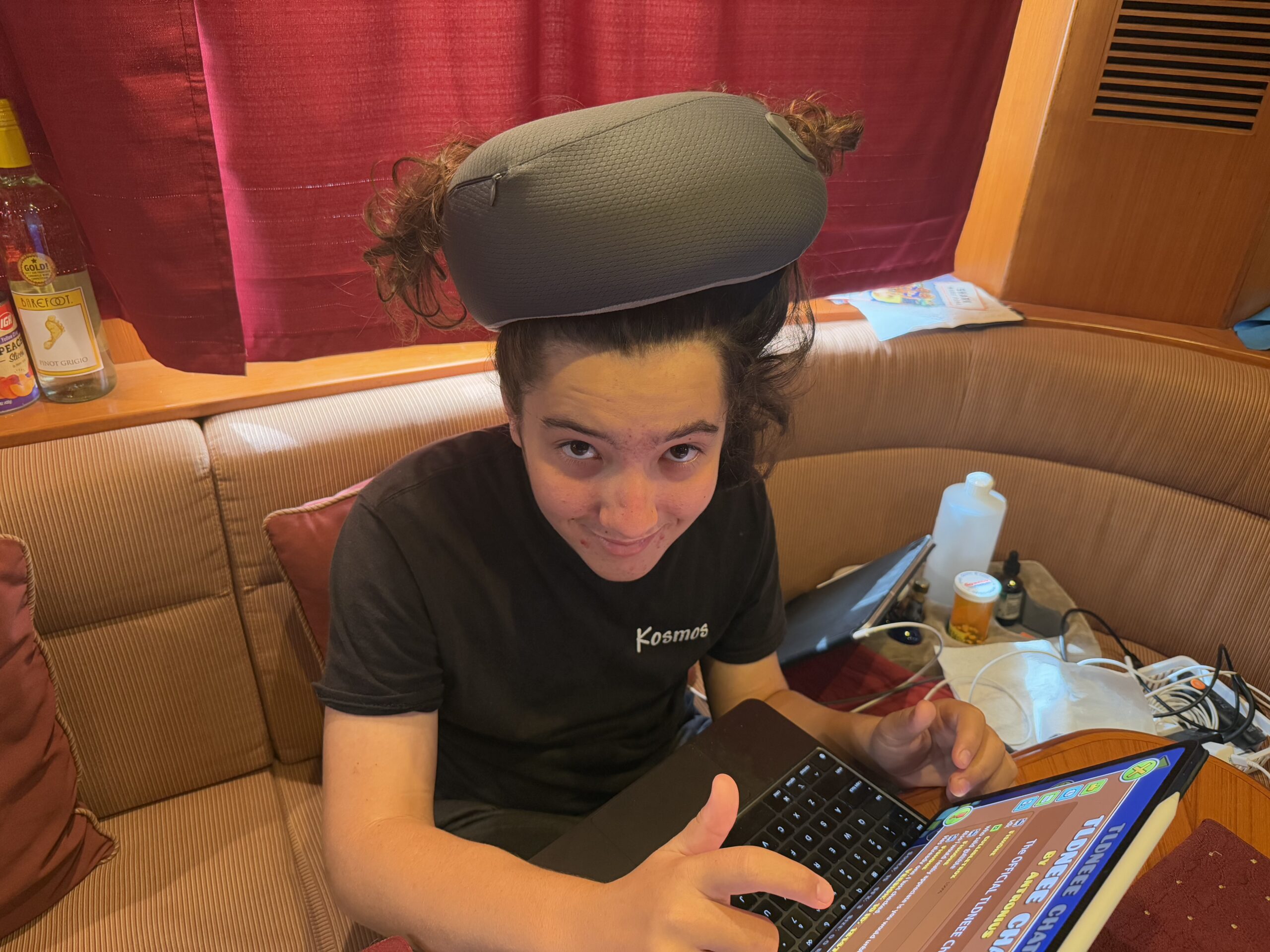
Keith entertaining himself on passage
Cette semaine était amusante. Samedi et Dimanche étaient des jours de voyage ennuyant. Lundi, on est arrivé à Deltaville. Le marina était plutot simpa. Des bateaux avec des enfants faisaient un potluck, donc on y est allé, mais après la marina a dit qu’on devait déplacer le bateau. Mardi, nous sommes allés à un restaurant qui s’appelle Le Galley, qui avait de bon nouriture. J’ai essayé Old Bay pour la première fois, et c’était très bon. Malheureusement, maman pouvait ne pas manger beaucoup parce que Old Bay est cuisiné avec du poivre. Quant on est rentré, j’ai joué à la piscine avec les enfants des autres bateaux.
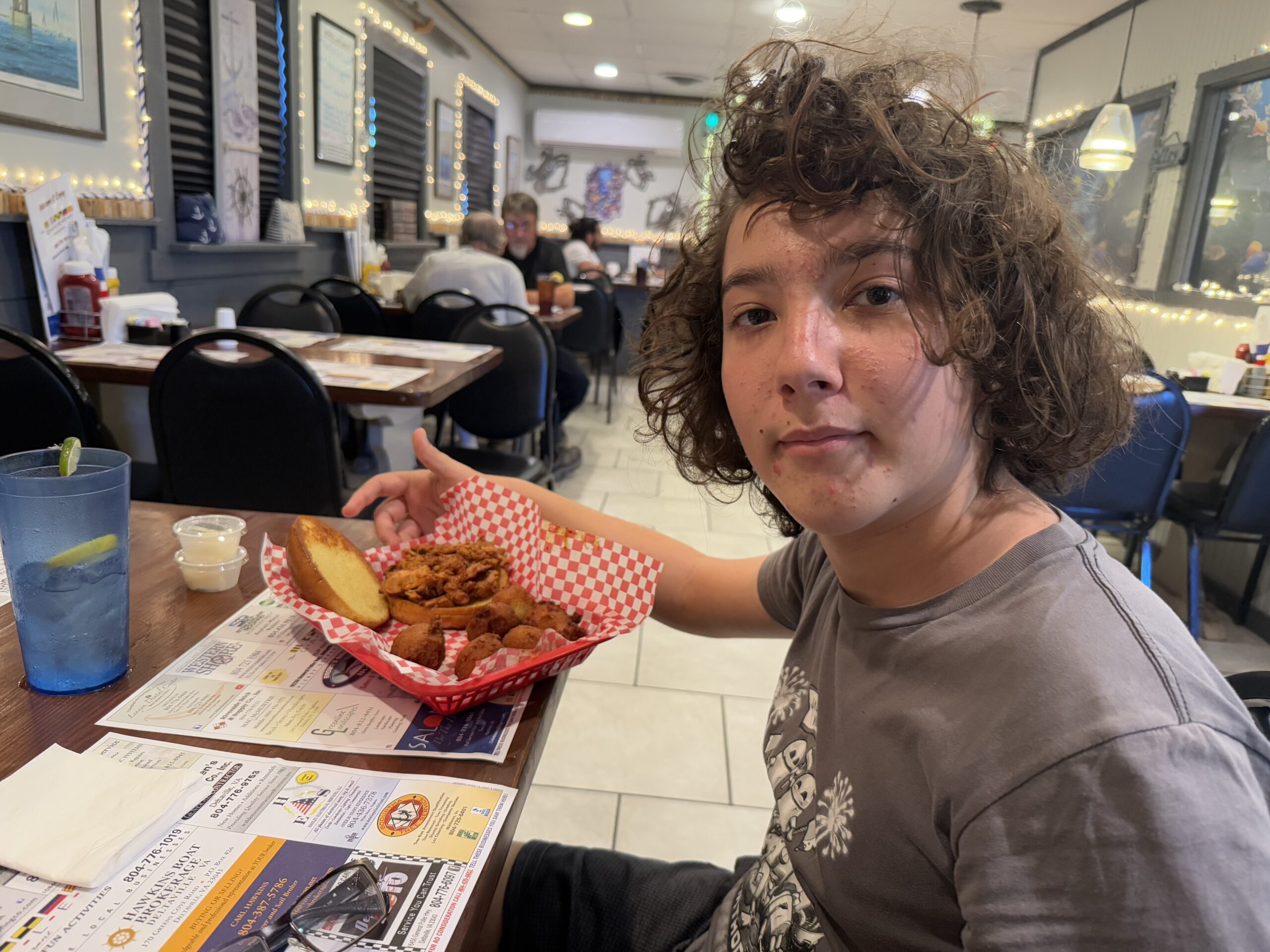
The Galley, where almost everything had Old Bay Seasoning in it
On Wednesday, dad went to the local boat store, and after that we said goodbye to one of the kid boats, who was leaving. After that we played a card game with the other kid boat, which was fun. On Thursday, we went to lunch at a restaurant called The Table. We happened to find the other kid boat there. We ate lunch with them, then went back to The Table with them for dinner. On Friday we took Kosmos to a city called Norfolk. It was an eight hour passage, and it was kind of rough for the first part. We had dinner at the marina and later had dessert with one of mom’s friends that lives nearby.
Mercredi, papa est allé à la boutique locale pour les bateaux, puis on a dit au revoir à un des bateau avec enfants qui partait. Apres ça nous avons joué à un jeux de cartes avec l’autre bateau avec des enfants, qui était amusant. Jeudi, nous avons mangé le déjeuner à un restaurant qui s’appelle La Table. On y a vu les autres enfants du bateau. On a mangé le déjeuner avec eux, puis on y est retourné ensemble pour le dîner. Vendredi, nous sommes allés en bateau à une ville qui s’appelle Norfolk. C’était un voyage de huit heures, et la mer était plutôt agitée pour la première partie. Nous avons dîné à la marina et plus tard nous avons pris un dessert avec l’un des amis de maman qui vit à proximité.
Friday June 27 — As we’d learned the hard way, we needed to leave at a higher tide or else we’d be grounded. We untied at 0550. The day was grey and overcast, and the sun was not visible behind the cloud cover. At first, the sea conditions were surprisingly uncomfortable, with sea spray regularly coming over the bow. It calmed down within an hour or so, though.
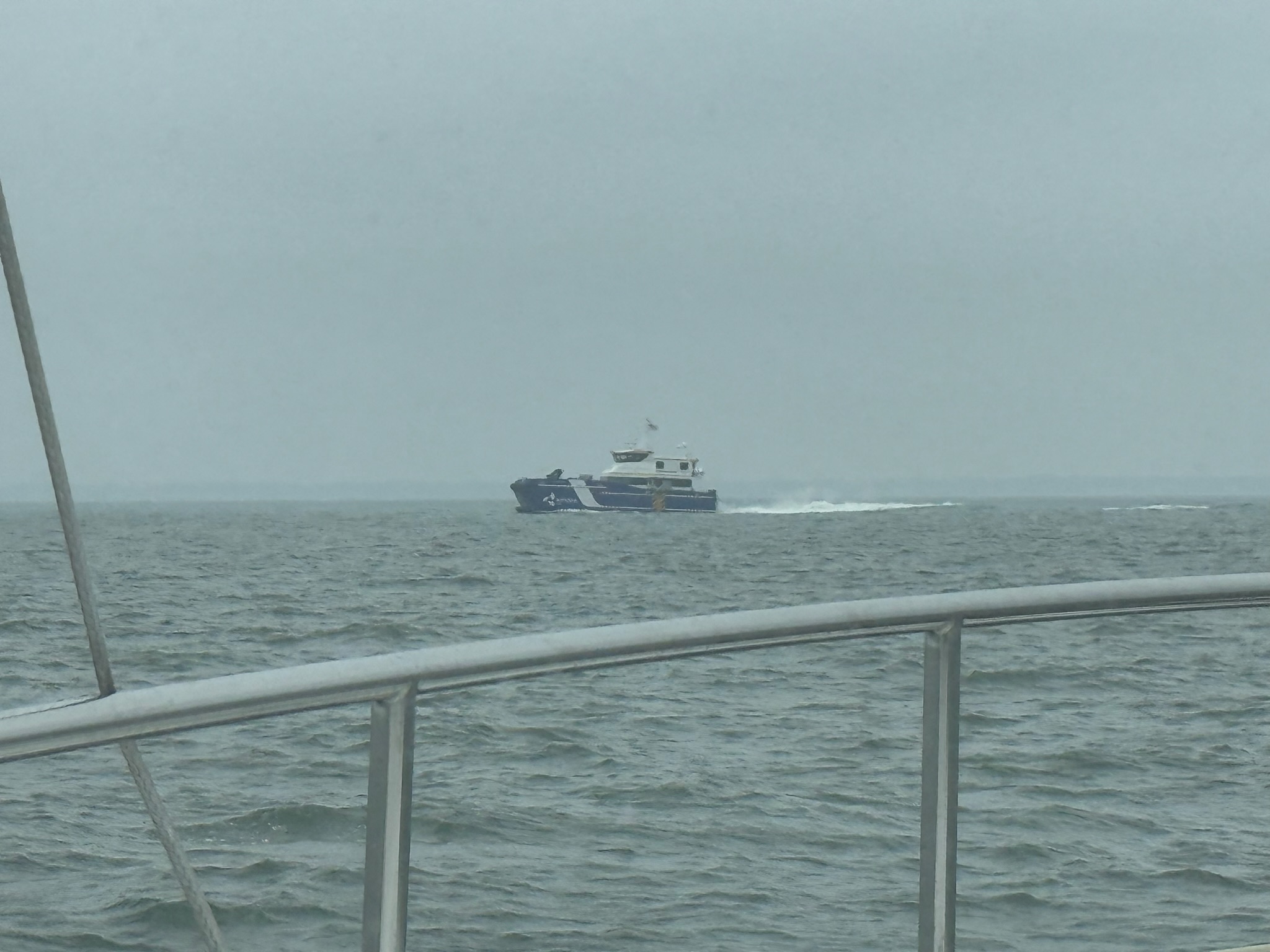
For the majority of the trip, we had 2-foot swells and 3-foot wind chop and light wind. There was a fair amount of traffic, and all kinds of boats, including sailboats, trawlers, tiny fishing boats, etc. There were several small craft that AIS identified as “MC experimental” that appeared to be military vessels doing circles. There was a small ship that particularly caught our attention. AIS identified as “High Speed Vessel” that looked like a small research vessel. Later, we found out it was a service vessel for a near-by off-shore wind farm.
Crossing the shipping lane was a little scary. At different points in time, we were on a collision course with 2 different vessels, so we needed to alter course each time to avoid them.
It was hot and humid outside, so Eric ran the generator and the salon and downstairs A/C units the entire 7.5-hour trip.
Monday, June 23 — By midnight, we could see the lights of Virginia Beach. It was definitely a big city! We’d also exited the Gulf Stream, so our speeds were back to normal — 6-knots at 1650 RPM.
We entered the mouth of the Chesapeake in the wee hours of the morning. Once inside, we hit an adverse current and had to increase RPMs to 1900 to maintain a speed of 6-knots.
We ran on the edge of, but not inside the shipping lane, hoping that would keep us safe from both big ships and fishing traps. One of the scary things about going through an area know for traps at night was that we wouldn’t be able to see the markers on the traps. There was a steady conga line of shipping containers. We also passed a military vessel while it was still dark. Since the vessel looked huge on radar and tiny as we passed it, we believe it was a submarine. Fortunately, with the long days, we weren’t in the dark for long.