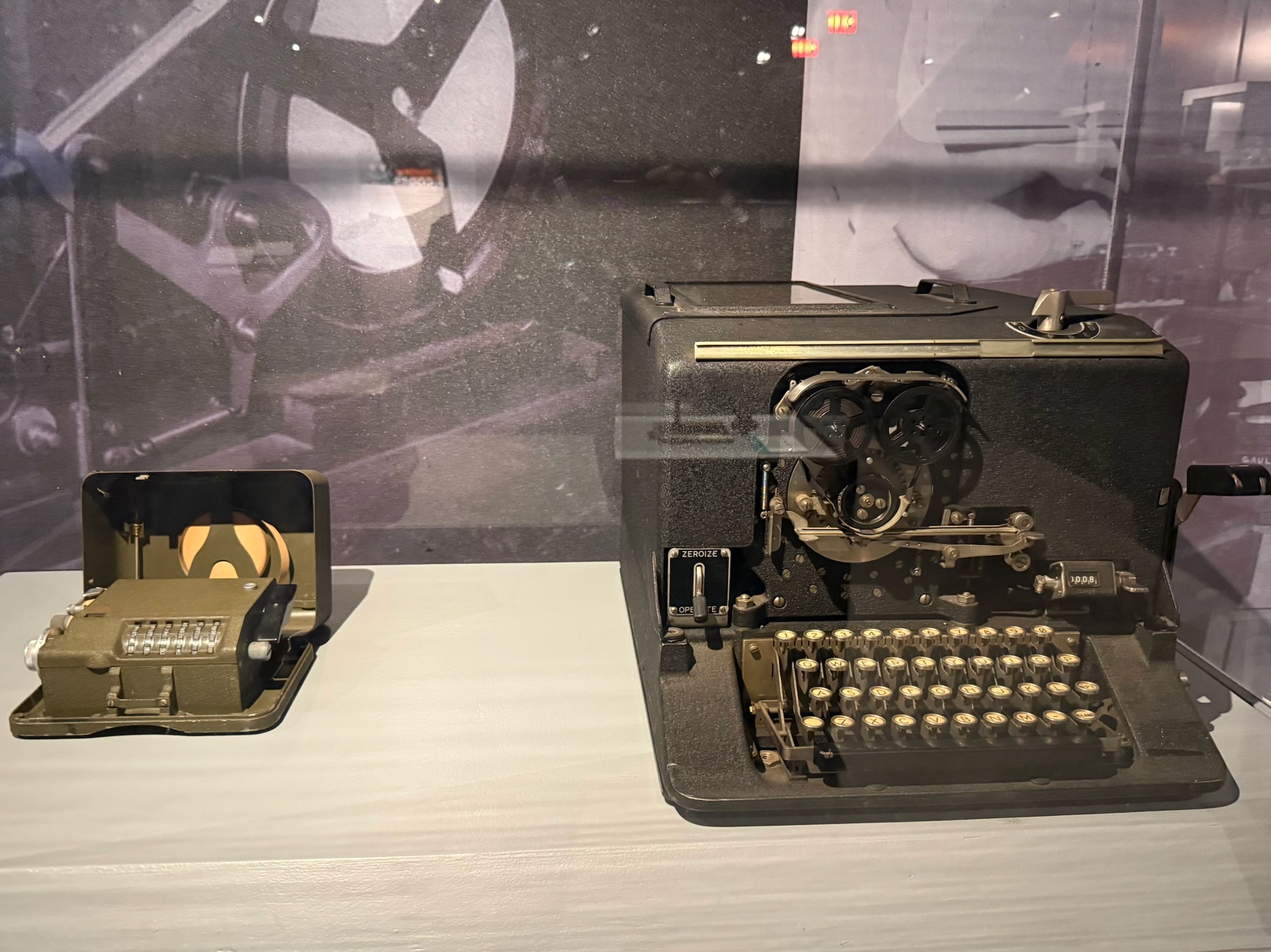
continued... Here were some American machines used in World War II. The little machine on the left was a portable unit. 140,000 were built during WWII. They were also utilized in the Korean and Vietnam Wars, as well. The bigger one to the right was the first production model of an Electric Cipher Machine. The Navy called it CSP-889 (later renamed to ECM Mark II) and the Army called it SIGABA.
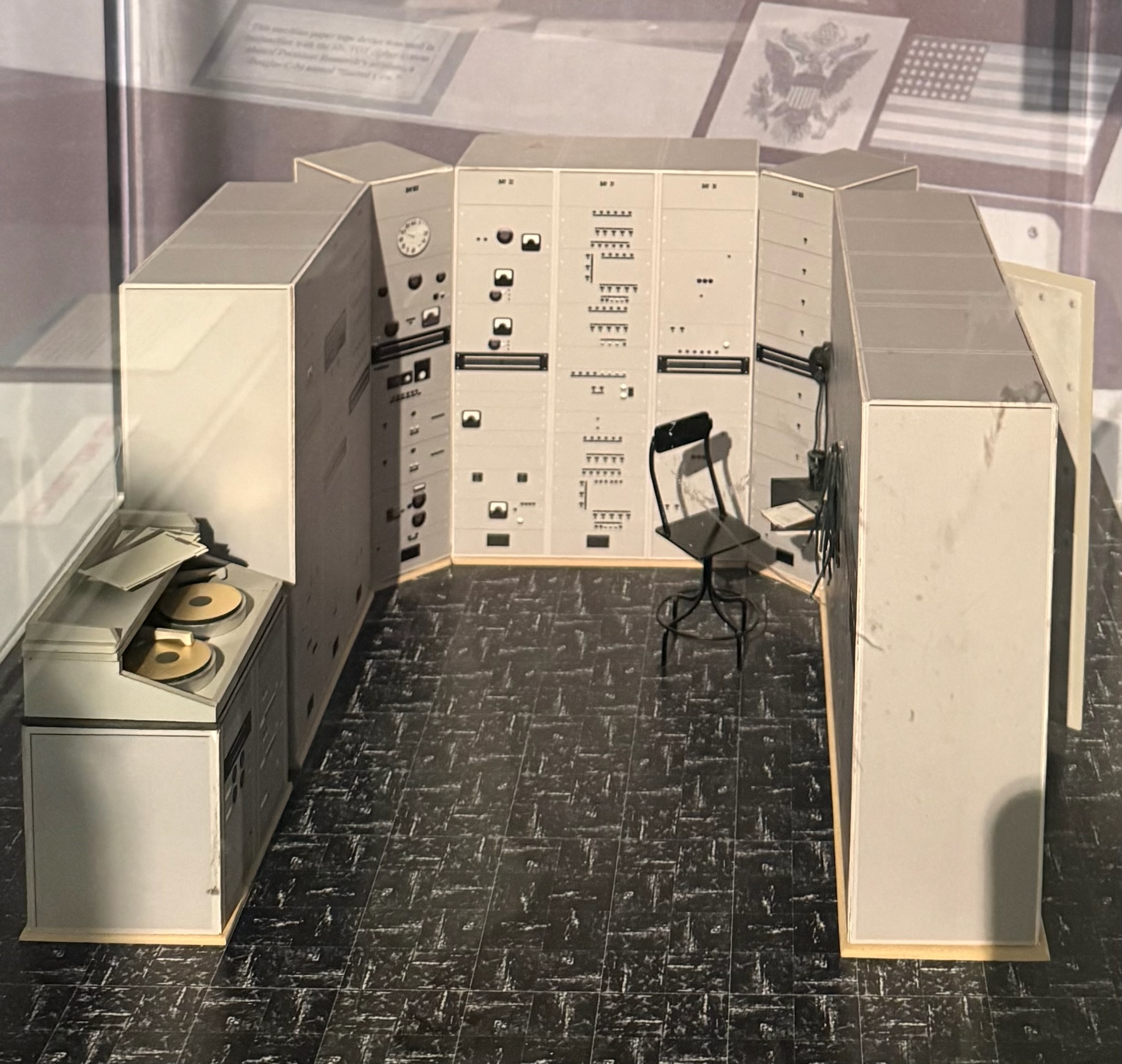
They also could do voice encryption. We believe this was a model of a SIGSALY machine that produced encoded records. There were two turntables that synchronized the sending and receiving ends. When played on a regular record player, they just sounded like random noise. A matching record at the receiving end could unscramble them. They held about 12-minutes of content. They were in service from 1943 to 1946.
Saturday, Sept 27 — First thing this morning, Eric went to move car. His plan was to move the car out of the lot and then park right back in it. However, the lot was closed – cars could only leave, they couldn’t enter. Since it was so early in the morning, he decided to see if he could find street parking along The Wharf. He found a spot, but the tire popped when he bumped into the curb while parallel parking. Then he noticed the sign said 10-minute parking. Argh!
He changed the tire with the donut in the trunk, then went to the car rental agency at the airport to exchange cars. The staff in the office told him they couldn’t help him until after he called into the customer service line. He was very frustrated about being on hold for 7-minutes while the staff at the counter were twiddling their thumbs. Fortunately, the agency exchanged the car with no issues, though they did charge $100 for the tire. And he’d forgotten to fill the tank up before returning the car, and we are still waiting to find out what they’re going to charge us for the gas.
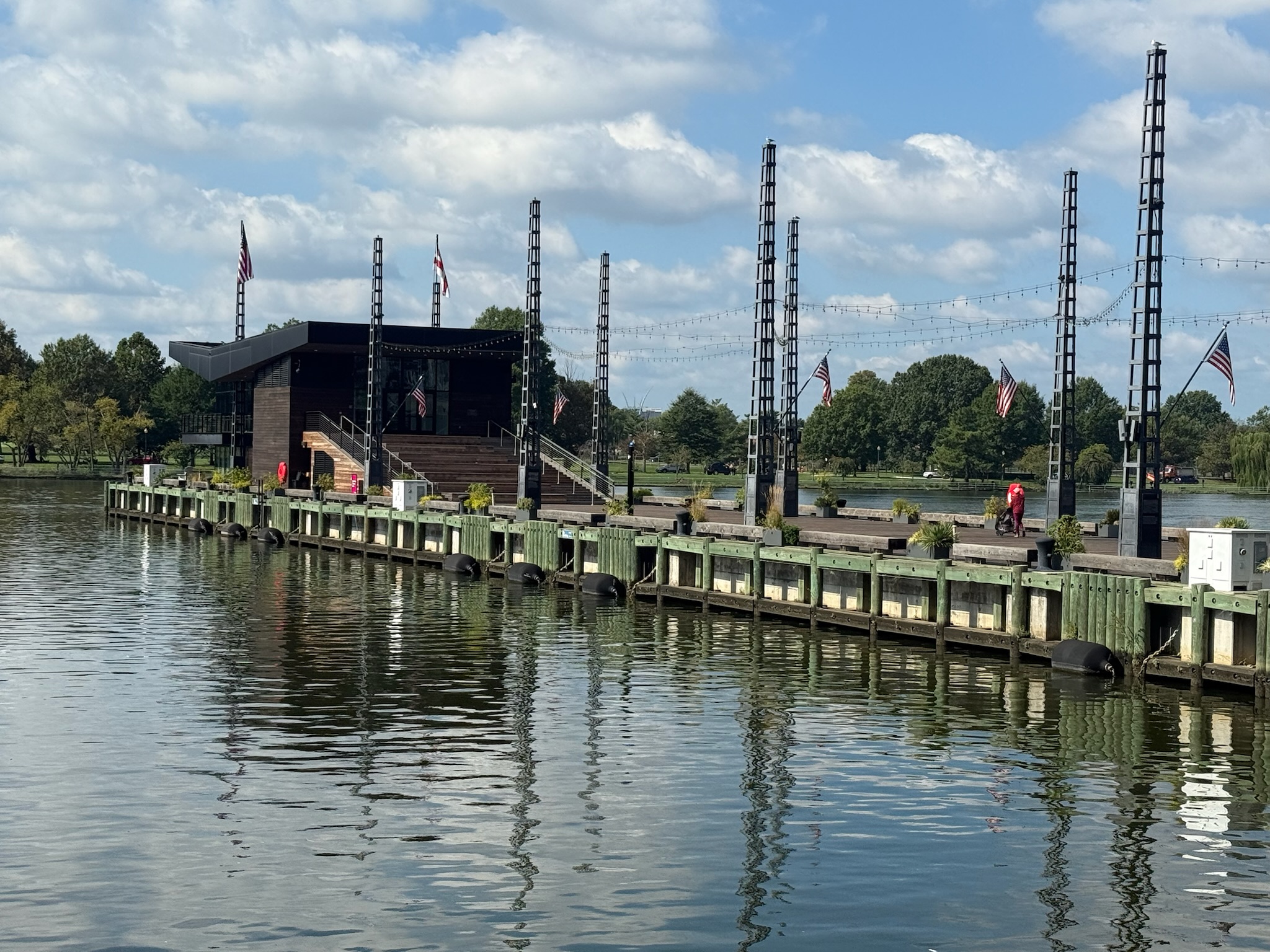
Meanwhile, on The Wharf, there was a big event. Christi and Keith watched a giant crowd of people congregate on the pier to the west of the marina, with loud music playing. The music stopped and the whole crowd moved to the boardwalk and started walking east. They thought it may have been a fundraiser walk, but weren’t sure. Here was a photo of the pier after the crowd cleared out.
Once Eric had the replacement car, he headed back to The Wharf. He drove around for a solid half-hour and couldn’t find a parking spot anywhere. Much to his frustration, many of the lots and garages were closed on the weekends. He gave up and finally parked at the outrageously expensive Wharf parking garage. We tried to hurry, but since we hadn’t realized there would be a rush to leave, none of us had really gotten going on the day yet. By the time each of us showered, ate breakfast and got everything ready to go out for the day, almost two hours had passed. The parking fee was $24.00.
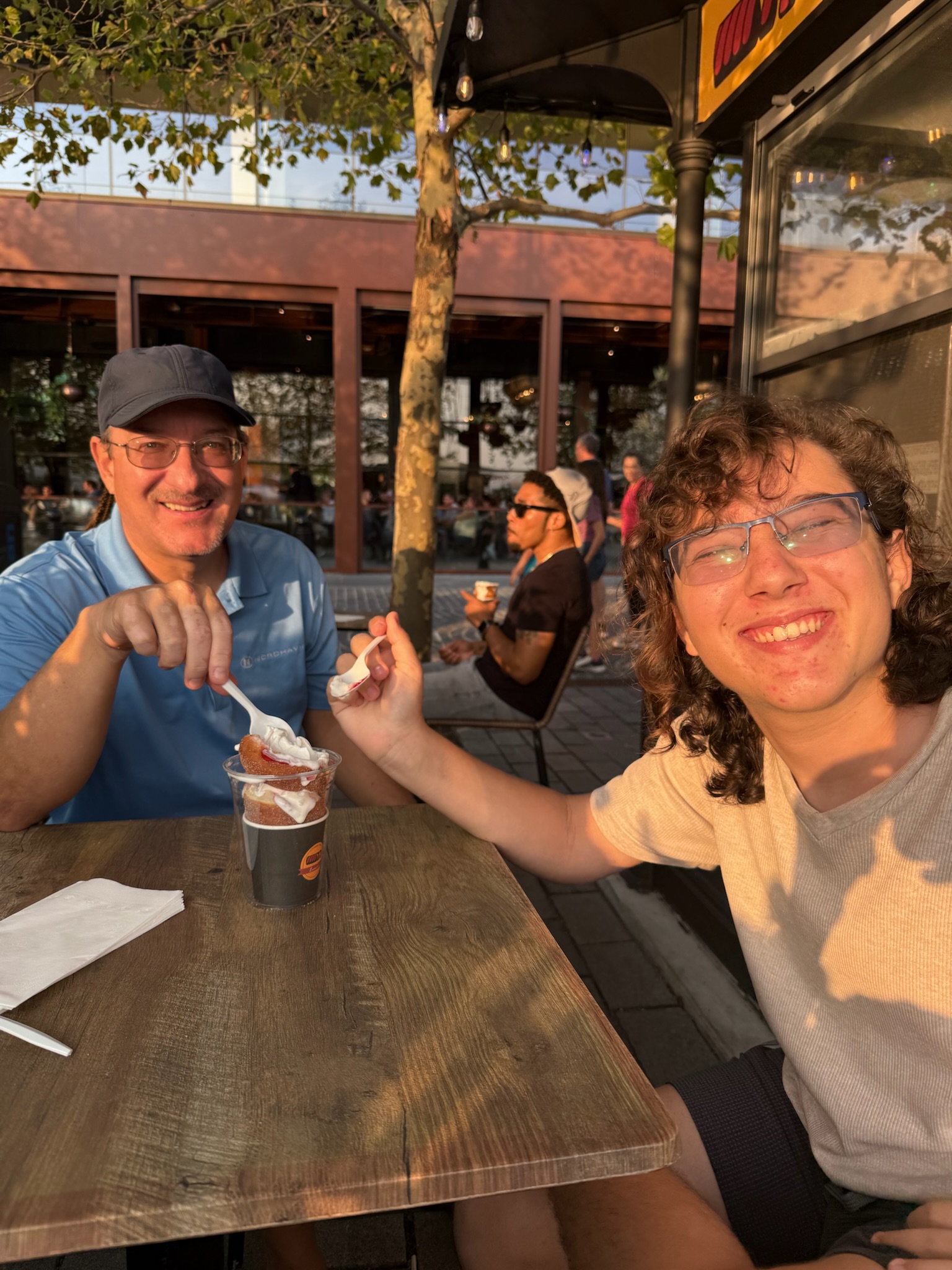
This week has been… well, painful is the wrong word. Maybe… interesting would be the right word, I guess? On Saturday, we arrived in Washington DC. All we did was rest for the whole day except for going out to dinner. We went to a really good Mexican fusion restaurant, then we had these things called “Chimney Cakes” for dessert.
Cette semaine était… douloureuse mais c’est pas le bon mot. Peut être… intéressante c’est le bon mot. Samedi nous sommes arrivés à Washington DC. On s’est reposé pour toute la journée sauf quand on est sorti pour manger le dîner. Nous avons mangé à un restaurant de fusion Mexican, puis nous avons mangé des choses qui s’appellent des “Chimney Cakes” pour le dessert.
Friday, Sept 26 — When we saw Jeff Merrill, he had invited us to join his panel of cruising experts at the upcoming Trawlerfest in Baltimore. We had already arranged to rent a car at the airport this morning so we could drive to Baltimore. First thing this morning, Eric went to pick it up. He took the free shuttle to the Metro stop, and took the Metro to the airport. Eric was expecting the Metro to be crowded during rush hour on a weekday, but it was pretty quiet. He was a little disconcerted to find that it was quite a long walk from the airport Metro stop to the car rental place.
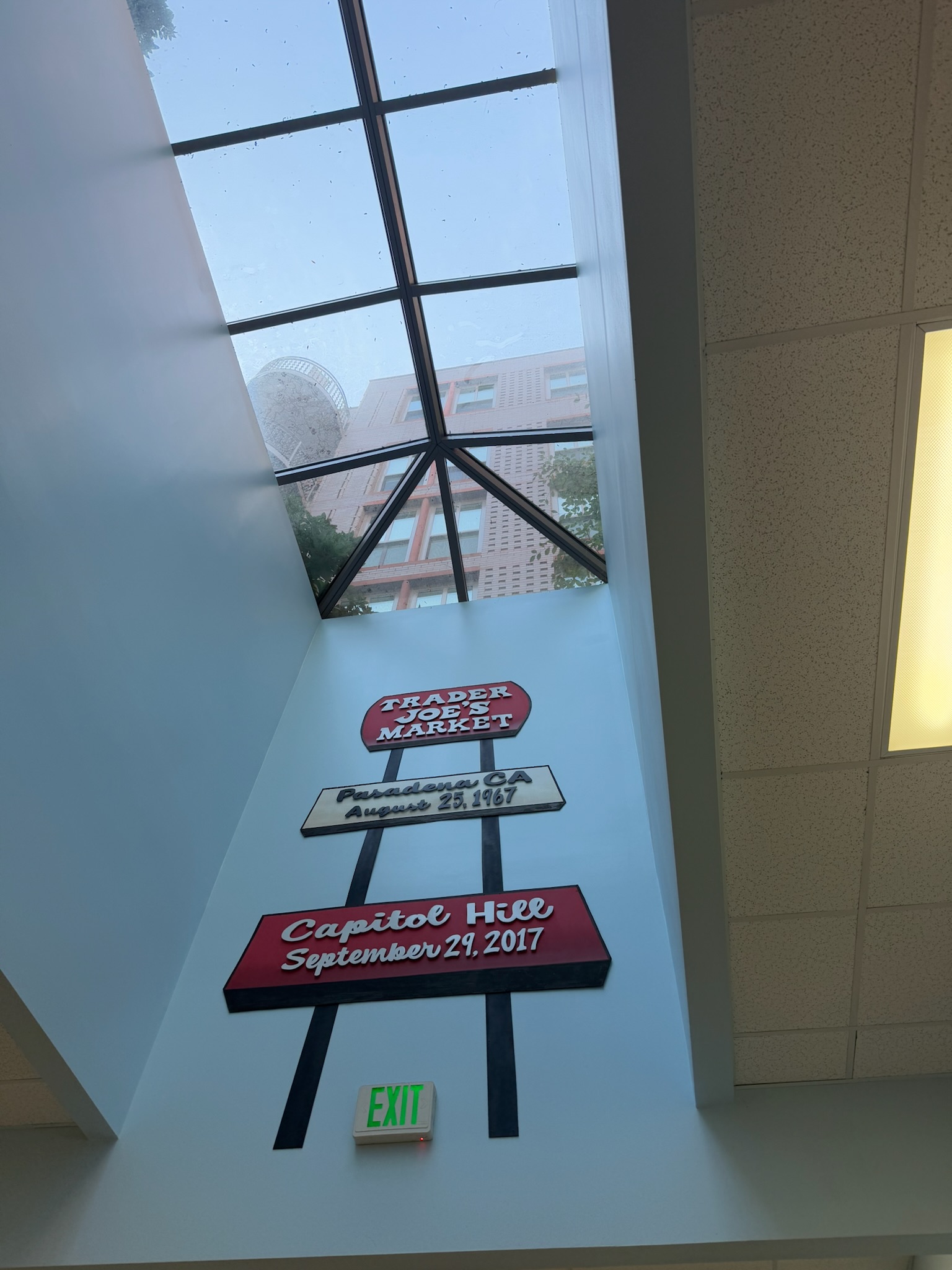
Our panel wasn’t until 1500, so we took advantage of having a car to do a big grocery store stock up. Eric picked up Christi and Keith from The Wharf and we headed to Trader Joe’s, which was our favorite place to get passage foods. The neighborhood that it was in looked a lot like Baltimore, made up primarily of small, tightly packed row homes. The parking lot was under the building, and we had a hard time finding the entrance. Trader Joe’s customers were required to park in designated spots deep down in the garage. Parking was free for the 1st hour with validation and $11.00 after that, so we were careful to finish our shopping before the fee kicked in.
Much to our surprise, the store was underground, on the same level as the designated parking spots.
There was a small exhibit on Congress’s investigational powers. They mentioned a few examples: A committee investigating organized crime in interstate commerce convened from 1950 – 1951. It was one of the first televised hearings, so it garnered a lot of attention. The Wherry-Hill Investigations of the 1950s sought to expose gay federal employees. And in 1975, the Church committee investigated “unlawful or improper conduct by intelligence agencies.”
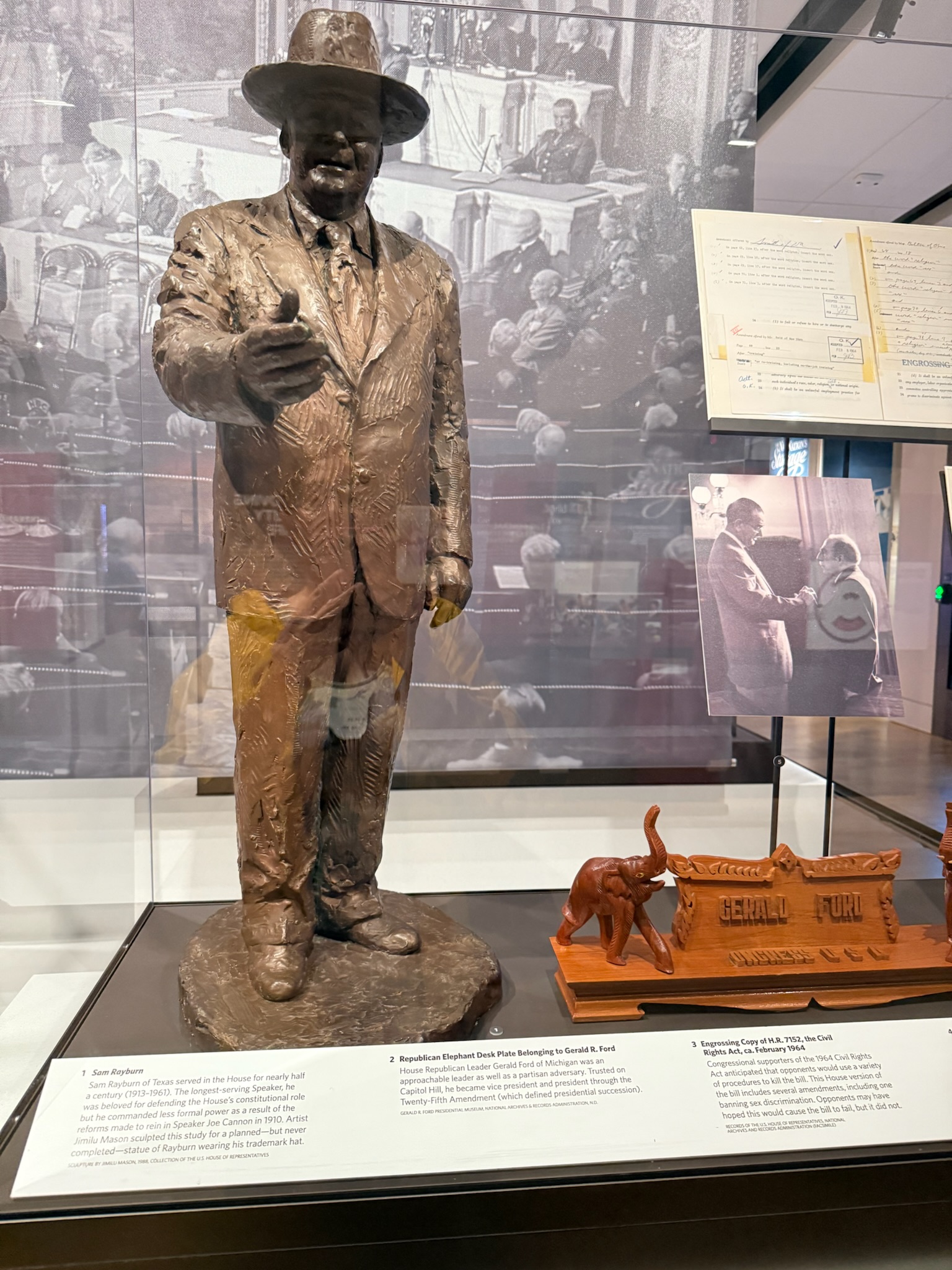
The item on the left was a maquette, or mini-version of a proposed statue, of House Representative Sam Rayburn, who served from 1913 – 1961. The statue was never made. The wooden item to the right of the sculpture was a desk plate belonging to Gerald Ford. Ford was the only president who wasn’t elected as president or VP. When Nixon’s VP, Spiro Agnew, resigned in 1973, Ford ascended from House Minority Leader to VP. When Nixon resigned in 1974, Ford became president. The document above is a copy of H.R. 7152, The Civil Rights Act, which was passed in 1964.Continue reading →