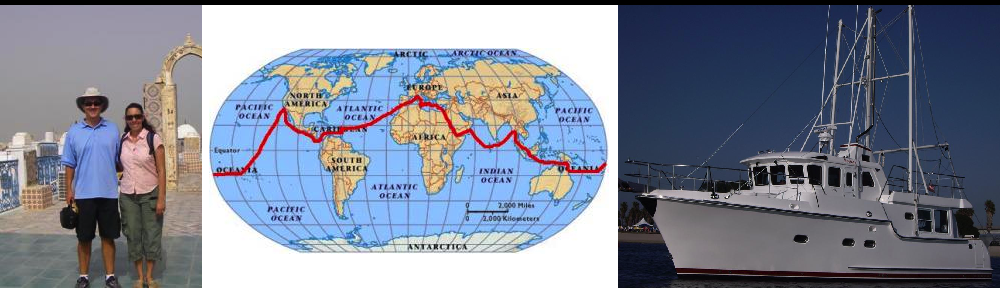
Welcome to Siracusa, Sicily, Italy

By 0200, radio was quiet. The Monkey Boy must be out of range now.

We arrived at around 1000 local time. From the distance, we could see the walls of the fort in the water. We had emailed the marina a few days ago to try to get a reservation, and they never responded. We pulled inside the marina, where a worker signaled us to go around back to the outside floating docks. We went where directed, and saw he was standing in front of an open spot. The slip wasn’t much wider than Kosmos. Eric backed Kosmos in slowly, as Christi stood in back pushing us off the boats on either side to help keep centered. The worker tied up the back lines for us and handed us two mooring lines. Eric walked the first line to the front attached the first line with no problem. The second line was too short to tie off. The guy on the boat next to us saw Eric was struggling and jumped from his boat onto ours. The two of them tied one of our ropes to the mooring line to make it long enough to tie off.

Oh, and to clarify how the mooring lines work. The boats always back in. The mooring(s) is/are where the nose of the boat is. There are lines that go from the sea wall/floating dock to the mooring. You take the rope from the sea wall and walk it to the front of your boat, then pull on the line to get it as tight as you can, then tie it to a cleat (metal bar installed around the boat and on docks specifically meant for tying lines on to) at the front of your boat. Since the lines spend most of their time underwater, they are disgusting, full of algae and barnacles. The lines get your hands and clothes all dirty. They are nicknamed “slime lines”. We found out that most of the marinas in the Med use this system (though D-Marin in Turkey has old fashioned moorings where you have to use your boat hook to grab the mooring line or have someone in a dinghy hand it up to you).

Once we were securely berthed, we gave the marina worker a crew list and our vessel documentation. Since we are checked into the EU that is apparently all the paperwork we need to do. We didn’t seem to need to go and visit any authorities. Hmmm. It seems too good to be true that the paperwork is virtually non-existent.

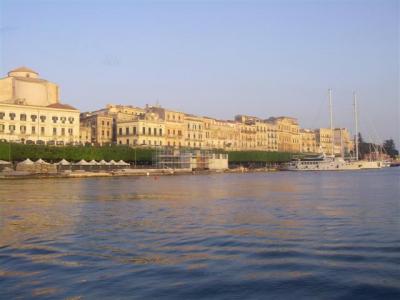
It was weird to stand in the cockpit (back deck) and stare out at buildings that are hundreds of years old. Many are run down, but considering how old they are, they really don’t look that bad. A lot of them have fancy facades and appointments, and in their day were probably glorious. We haven’t actually been docked so close to a historic area before, and we found it to be sort of awe inspiring.
imgp6346-small.JPG

We were starving, so went in search of food. The old part of Siracusa is called Continue reading
Passage to Bali, Crete and Visiting the Family

Now that it was once again safe to run the engine, we pulled out first thing yesterday morning to go to the anchorage in Bali, Crete. In the bay at Agios Nickolaos, we were protected from the wind and big seas. As soon as we rounded the corner to leave the bay, we were smacked with 30 knots of wind on the nose and big waves that smashed into the bow relentlessly. This lasted about 2 hours before things started to calm down. The wind dropped to the low 20’s and the wave force reduced enough that we could open up the pilot house doors. It became an overall OK ride since the waves are not as steep and rapid as the last few trips we have made.

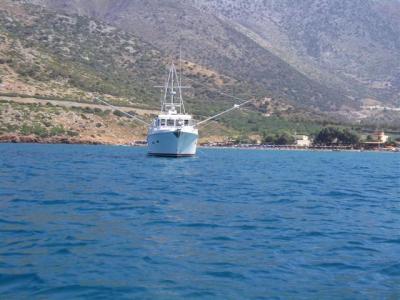
After 10 3/4 hours of paralleling the north shore, we pulled into the anchorage. We have long dreamed of the day we would pull up to Costa’s and Maria’s hotel and drop anchor outside their door. It was an exciting moment for us. And for them, too. Maria said was thrilled when she glanced out the window and saw Kosmos in the bay. She said she frantically waved to us, but we didn’t see it.

The wind was coming at just the right angle to make the anchorage rolly. To make matters worse, there were two speed boats doing circles around us. One pulling people on inflatable tubes, the other pulling parasailers. Argh. Paravanes were definitely a must in here. We put out the paravanes and brought down the dinghy. Getting the dinghy down in the rocking bay was not easy. We can’t remember if we have mentioned this or not, but we think that the paravanes make Kosmos look like she has a force field around her, like if you get too close you will be zapped with a tremendous electrical shock. We always laugh about it when they are down.

imgp6141-small.JPG

We puttered over to the small port. Maria told us Continue reading

Welcome to Izmir, Turkey

Izmir, formerly called Smyrna, was occupied by humans between 6500BC and 4000 BC. It was settled by Greeks around the 10th century BC. It is believed that the famous author Homer was born in Smyrna. In 95 AD, the apostle St. John wrote a letter addressed to seven fledgling churches located in what is now western Turkey, Smyrna being one of them. The letter was canonized as part of the bible and is called The Book of Revelation. Under the Ottomans, Smyrna emerged as an important port city and became multi-national and contemporary. They also exported many popular products to Europe, such as raisins, figs, and carpets, and were known for their unique musical style. Smyrna was the center of the war between the Turks and Greeks post WWI, which left the city completely destroyed. Today it is the third largest city and second largest port in Turkey.

We were still on the main highway, and we drove about half way around the bay before we realized we were lost. We pulled over at a gas station and asked for a map. No maps. Eric remembered that he could pull up a map on his cell phone. He expertly navigated his way into downtown using the cell phone. From what we could see, there were sections of town from the turn of the century that were neglected and dilapidated, and sections of town that are brand new and gorgeous, and everything in between. The buildings here are colorful, which is a stark contrast to Bodrum where they are all white. The bay has a large commercial container port area that dominates a big section of the bay. There is a fleet of military ships in the bay near the container port area. The roads are really great — wide and well maintained, with excellent signage. All the streets are two ways, many with nicely landscaped medians. The drivers are just as bad, though, and driving is still pretty scary. And, despite the fact that this is a huge, contemporary city, we saw goats running in the road at one point. Here is a typical street in downtown.

imgp5893-small.JPG

We had skipped lunch and were starved, so we made a stop for food at a little hole in the wall along one of the main roads. The boy behind the counter spoke no English at all. He pointed to Continue reading

Dry Dock Work and Touring the Bodrum Peninsula

Our first task of the day was to wash out the chain locker. We cleaned out all the salt and dirt and picked up all the debris that had collected at the bottom. It wasn’t nearly as dirty as we had expected it to be, but there was more debris in the bottom than we expected, which affects the water’s ability to drain.

Once the locker was done, Eric Continue reading