Mafia Strongholds, Wax Museum, and Being Fed in Crete, Greece

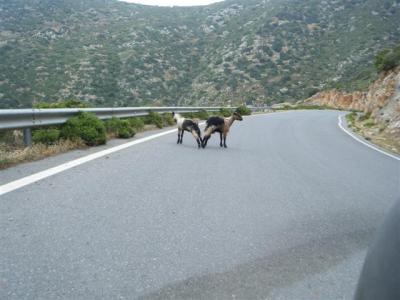
Wednesday, May 20 This afternoon Andronikos, Eric and Christi set out to go to an archeological site called Axon, located in the mountains. We followed the same road that we took the day we took the day we went to the monastery and cave last summer. Last year it had been and the hills were dry. Right now the hills are verdant and green, with the flowers in full bloom. It is absolutely gorgeous. Just like last year, we saw lots of goats running around on the hills and several hanging out on the road.
mar-may2009-849-small.jpg

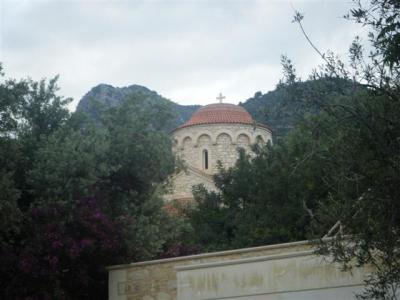
We passed the monastery, but before we got to the cave we turned off onto a different road. We passed through several more small villages. One of them was the village where we had gone to the wedding with 3,000 guests a few years ago and has a reputation for being one of the most traditional villages left today. In another village, we spotted a 16th century church that looks like it is still in use. We tried to go in, but it was closed.
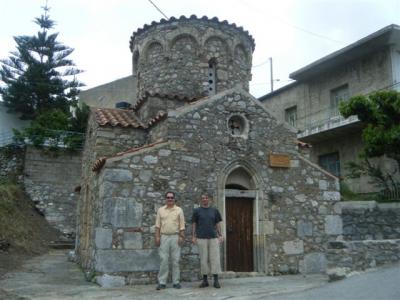
mar-may2009-851-small.jpg

The towns are nothing more than Continue reading
My Brother’s Big Fat Greek Wedding

Sunday May 17 — Today was the big day. The wedding began at 1430. Eric wasn’t feeling good, so he spent the morning resting. The women spent the morning obsessing about minute little details. The men waited anxiously, looking at their watches every 5 minutes until it was finally time to get ready. Costas has had a beard for a while now and his male friends decided the beard needed to go and forcibly shaved it off.

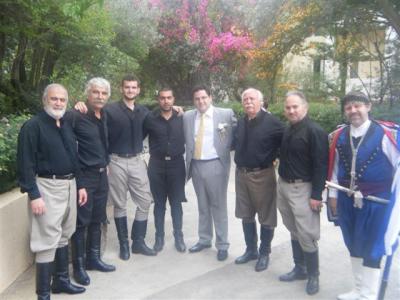
We arrived at the church 20 minutes before the ceremony was supposed to start. The tradition is that everyone stands outside and waits for the bride to arrive. The groom meets her outside and they walk in together, then everyone follows them in. It was a small wedding with only 900 guests, and the courtyard outside the church was jam packed. Were we being facetious when we said “small wedding?” No. In villages, the whole village is invited, and weddings with as many as 5,000 guests are common. We went to a wedding with 3,000 people once a few years ago. It was crazy. In the cities, though, weddings tend to be much smaller. We noticed a few men were dressed in traditional Cretan costumes. Here are some of the more traditional dressers posing with Costas.

mar-may2009-557-small.jpg

The church is at the top of a hill, with a long path that leads from the parking lot up the hill. Here is a shot of it from the parking lot.

mar-may2009-530-small.jpg

We knew the bride had arrived when Continue reading

Reflections on How We Have Changed Since We Were Last in Ensenada

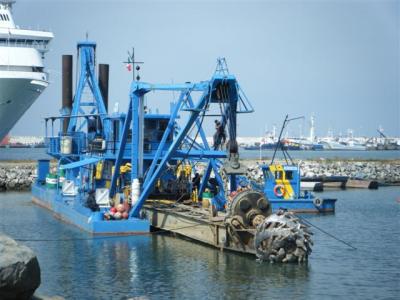
This morning we went out to breakfast as soon as we got up at another favorite restaurant of ours, El Rey del Sol, in downtown Ensenada. It is also just a few blocks from the marina, but in the opposite direction from Los Veleros. The marina is built next to a river, and we noticed a different kind of dredging machine in the river. Eric wants one.

mar-may2009-204-small.jpg

We walked by the new construction near the marina and were kind of surprised to see that little is done beyond the frame. This project has been planned for several years now, and grading work had begun while we had Kosmos here. And, come to think of it, the sign was gone. There used to be a big sign saying a museum was going to be built here. We wonder if that means the museum project has been abandoned.

Along the rest of the walk, everything else looked much the same. Several buildings were occupied by different businesses than before, but the buildings still look the same. There are a lot of coffee houses now. Coffee houses must be the new rage.

The restaurant was Continue reading

History of the Mexican Republic

Mexico’s 1,972,550 square kilometers in size and has an estimated population of 111 million people. It is bordered on the north by the United States, on the South by Belize and Guatemala, on the west by the Pacific Ocean and on the east by the Caribbean Sea. Mexico has an incredibly rich history, particularly in regards to the remarkably advanced indigenous people groups. It is believed that the original humans migrated from Siberia (it is believed there used to be a land formation that sank in what is now the Bering Strait) in migratory waves started in 60,000 BC. Somewhere between 7000 and 3000 BC, the people in central Mexico began cultivating agriculture. They went from being nomadic hunters and gatherers to settling into permanent villages. Throughout what is today Mexico, there were dozens and dozens of different ethnic tribes that influenced one another, and at various points in time sometimes conquered one another, too.

Mexico’s “mother culture” is considered to be the Continue reading

History of the Republic of Nicaragua

Nicaragua is the largest nation in Central America at 129,494 sq kilometers big, but is also the least densely populated with a population of 5.5 million. It is bordered by Honduras to the north, Costa Rica to the south, the Atlantic to the east and the Pacific to the west. The country’s name is a derivative of “Nicarao”, one of the most powerful indigenous leaders at the time of the Spaniard’s arrival, and Aqua, which means water and represents the large lakes in the region.

Evidence has been found in Nicaragua indicating that humans lived there at least 6000 years ago, and maybe even as far back as 8,000 years ago. When the Continue reading