continued… We moved on to a room called “American Enterprise.” It focused on how the American economy changed throughout the history of the country. An entire wall of the room was covered with photos and short biographies of key people who were prominent through the eras.
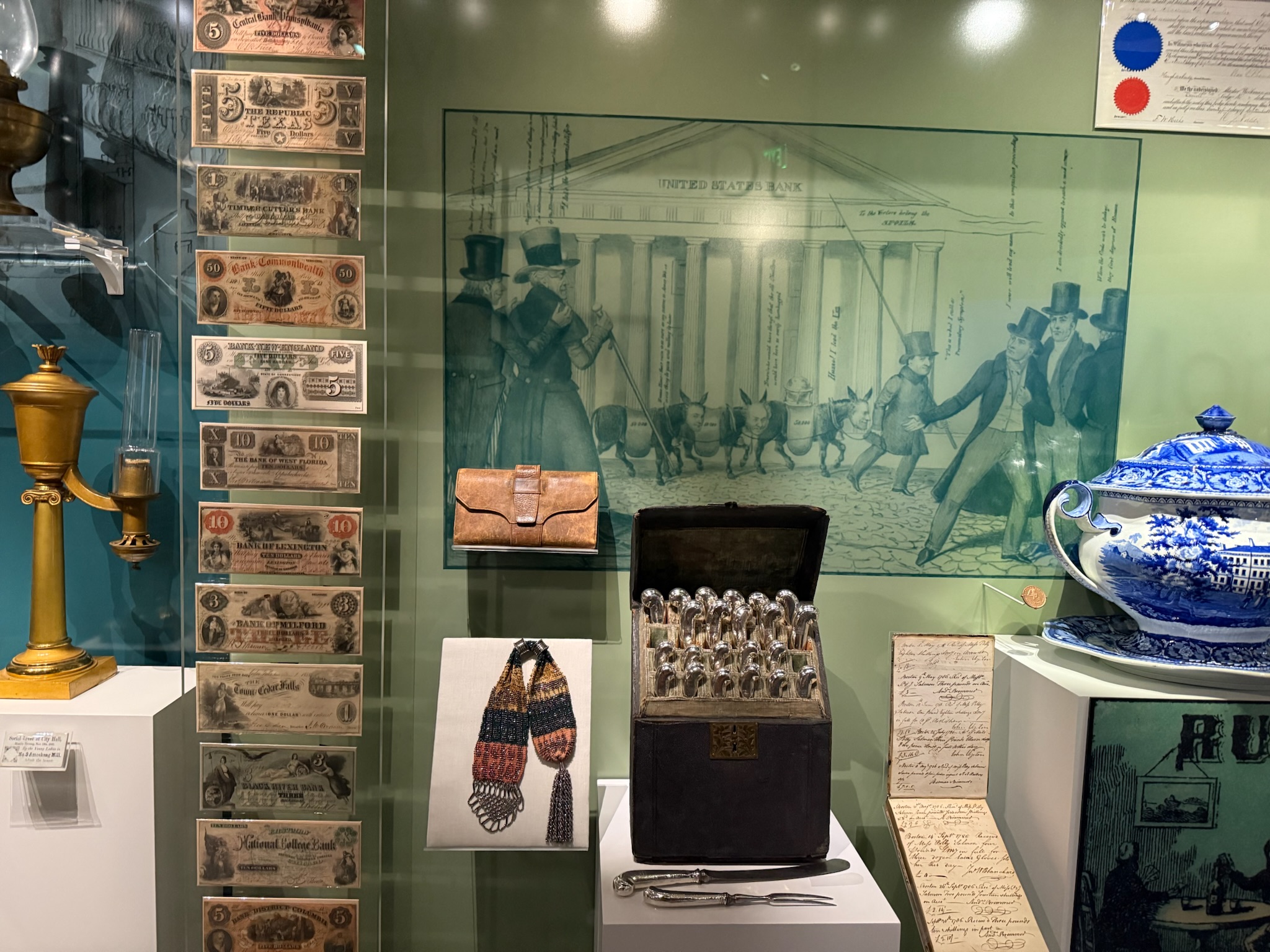
The first section was “The Merchant Era: 1770s to 1850s.” The signs said that this was an era where it was difficult to find financial security, and many people wound up in debtor’s prison, in poor houses, or aided by fraternal orders who helped the poor. At this point in history, there was abundant land (much of it stolen from the Native Americans) and vast natural resources to fuel economic opportunities. The government encouraged agriculture, industry, transportation, and global trade.
At the beginning of this era, most Americans were farmers who labored with simple tools. In the market economy, they sold food products and purchased a wide variety of items, such as nails and textiles. Artisans who made specialty products, such as cloth or shoes, were usually farmers who did the artisan work as a side job. The artisans did their crafts from home or a small shop when they had time.
But entrepreneurs who adopted new manufacturing technologies and systems of production changed the structure of society. People left farming to work full time at manufacturing facilities. Work was centralized, regulated, and supervised. Greater efficiency led to lower costs to consumers. Products became standardized. In one generation, the art of being a cobbler pretty much died since factory made shoes were so inexpensive relative to handmade shoes. The new work mode changed culture — now people no longer set their own hours, worked from home, or worked at their own pace. Rather than one artisan doing an entire project, there was a division of labor. People made the products the way the boss wanted them made, not the way they wanted to make them.
Another thing that was pivotal in transforming the economy was artificial light, which became widely used in the early 1800s. It allowed for more time in the day for work, leisure activities and consumption.