Diving Cliff and Snorkeling Near the Venezuelan Embassy

This morning we returned the car and ran some errands. One was the boat store, where we had the shock of a life time. They had one and only one Shurflo 5.7 pump in stock. We couldn’t believe it! The store doesn’t normally carry them, it was special ordered for someone who never picked it up. We bought it and are happy to have a proper spare again. A second errand was for Eric’s SCUBA equipment. The hose that attaches the gauges to the tank is leaking, so he bought a new hose. And, Christi got a much needed haircut.

Once errands were done, we went back to the boat. Eric changed his hose, which turned out to be a harder task than he had anticipated. Then we loaded all our dive gear in the dinghy and headed up the coast to a dive spot called Cliff, near where the fancy neighborhood starts. We tied to the mooring and worked on getting in. Hard dingies are not really good for diving as they tip easily. Getting into your gear on board and jumping off with your tank strapped on you isn’t a good plan. So, Christi got in the water, then Eric handed her the tank and BCD. She put everything on, then Eric handed her his rig. Then Eric got in and put everything on. We were ready to roll and hadn’t even flipped the dinghy. High 5!

Being as we hadn’t gone up the coast very far, the dive site was similar to the one behind our boat. There are a lot more soft corals here, both more species and more of each species. The only ones we can identify are the giant sea rods, which are a good 5 6 feet tall, and the sea plums, but there are many more varieties. We also saw a few basket starfish, which look like a plant, not like a fish. A basket star is the creature that latched onto Christi’s hand and wouldn’t let go in Guadeloupe, reminiscent of a space alien latching on to a host human in a science fiction movie.

However, this site has less fish and less variety of fish. The most exciting fish that we spotted is a midnight parrotfish. It is gigantic, as in comparable in size to a Napoleon. It looked all black with iridescent blue markings on its face, but when we looked in the fish book, we realized it was dark blue, not black. We have never seen anything like it before. It was really exciting. This must be the spot for abnormally large fish, because we also saw an unusually large trumpet fish. We saw a couple different species of file fish that had very odd designs on them. One of them was also quite large. And, finally, we saw a fish in the distance that Eric thinks was a very large fish and Christi thinks is a small shark.

Getting out was the exact opposite of getting in. Eric took his rig off. At the same moment he pulled himself up on the port side of the boat, Christi yanked with all her might on the starboard side to keep the dinghy from flipping. He got in with no problem. We put in both sets of rigs, then Christi hopped on, with Eric carefully counterbalancing her weight. Another high 5!

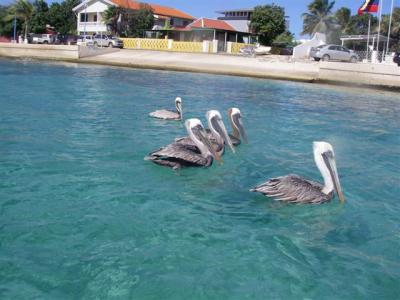
After diving, we unloaded our rigs aboard Kosmos, then went snorkeling in front of the Venezuelan embassy, which is just a couple boats over from us. We were told there is a lot to see there. When we pulled up in the dinghy, six pelicans immediately landed in the water right next to us. They watched us intently. We watched them back intently, amused that they were so interested in us. Apparently, the fishermen will clean fish here and throw them the scraps, so they were waiting expectantly. We eventually got tired of the staring contest and got in the water.
imgp9770-small.jpg

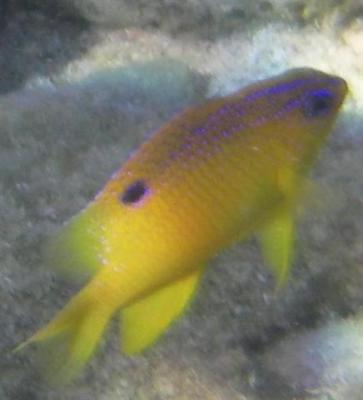
The area is rocky, there is little coral growth, and there weren’t many fish. But, there was a good variety of fish to look at, and we got some decent photos. We heard a turtle is frequently sighted here, but we never saw it. The first is a juvenile longfin damselfish. It will turn brown when it matures.
juvenile-longfin-damselfish-small.jpg

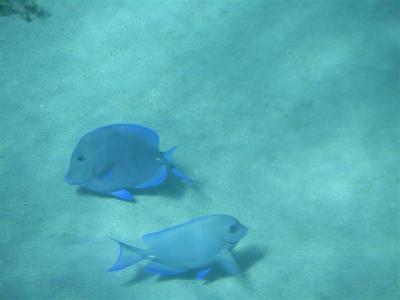
This picture is neat because you can see how easy it is to confuse fish species. The fish in the background is a blue tang. We’re not sure what the fish in the foreground is, but with similar color and shape, it is easy to mistake it for a blue tang.
imgp9789-small.jpg

Here is a sergeant fish. The silver variety is the Continue reading
The Mangazina di Rei

Continued from yesterday”¦ After we finished at the museum, we headed to Rincon to go to the Mangazina di Rei cultural center. It is housed in the second oldest stone building on the island, built in 1824, which was originally built as a food and farm tool storage center. The center tries to actively preserve the cultures and traditions of 100 years ago. We expected it to be a museum where you wander around at your own pace, but it was actually a guided tour. We joined a tour group about halfway through the tour. The group had just gone out into the gardens.

In the gardens, they grow the plants that were used for every day living, from food to export crops to materials for tools. They pointed out a tamarind tree, then gave us some tamarind juice to taste. It tastes kind of like beans and sugar and is different. They pointed out a calabash tree. Calabash are inedible, hard, and round, and are good for making assorted tools and cookware, such as bowls, ladles, and so forth. The musical instrument maracas (the shakers popular in Latin American music) are made from calabash, too.

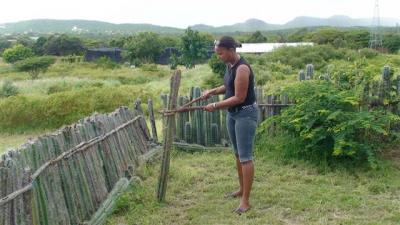
They showed us candle cactus, which are used to make the living cactus fences. For some reason, they can only be cut on a full moon in the dry season or they rot. The guide showed us the tools they used to cut, move, and replant the cactus along the fence. The cactus cuttings form new roots and become a living fence.

dsc02259-small.jpg

The guide also pointed out the kadushi cactus that they make a traditional soup from, and also explained how they cut and skin the cactus to get at the pulp inside. The cactus is absolutely enormous, but only young shoots are eaten.

They showed us the plants that sorghum flour is made from, which was the staple of the traditional diet. Sorghum is Continue reading

SCUBA and Chores in Kralendijk

Since the wall behind the boat is so large and expansive, we wanted to explore it some more. Yesterday was another gray day, with frequent showers that brought very heavy rain, which disappointed Eric. He likes to dive when it is sunny and everything in the water is all lit up. But we dove anyway. We did two more dives along the wall, the first dive exploring more to the south, the second dive exploring more to the north. On the first dive we stayed at 60 feet, and on the second dive we went to 70 feet to check out the life a little lower on the wall. On the second dive we experienced just a little bit of current, but none on the first dive. We could seriously dive this spot a thousand times because there is so much to see!

On the first dive we pretty much saw all the same things we mentioned yesterday. In addition, we saw Continue reading

SCUBA Diving in Kralendijk

Today we intended to spend the whole day SCUBA diving. The plan had been to hop in the dinghy and head to one of the moorings nearby. But, yesterday we had forgotten to do the most important thing on our errand list: buy dive tags. Since we were going ashore anyway, we decided to get breakfast. We were excited to find that several places offer hearty breakfast menus. We picked a place where the food was good, but the service was painfully slow. Then we went to a dive shop near the restaurant to buy the tags.

It has rained a lot the whole time we have been in the Caribbean, which is odd since it is supposed to be the dry season. In Guadeloupe and Antigua, it was usually an odd squall or two each day, though we had a few days with more rain. In Dominica, we had several days where the squalls consistently came through every couple of hours. In our short time in Bonaire, we have experienced squalls every couple of hours, just like Dominica. Usually, they are fairly hard rains that last only a few minutes. Anyway, while in the dive shop, another one rolled through. This one was probably the biggest Continue reading

Welcome to Kralendijk, Bonaire, Netherland Antilles

After midnight, we were hit with several squalls that agitated the seas, so the ride became even more lumpy and no fun. There still was virtually no moon, so we enjoyed the luminescent stars in between the storms. It was still rough at dawn. It was a bit hazy out, so even though we were close to Bonaire, we couldn’t actually see land until 0745.

We approached from the southeast side of the island. Kralendijk, the main city on the island and the only place boats are allowed to moor (anchoring is prohibited in Bonaire waters except under special circumstances), is on the west coast, in the center of the island. We rounded the bottom of the island at 0945 and headed north on the west coast. The minute we were on the west side, in the lee of the island, the seas instantly flattened out. We were so happy.

The ride along the coast was pleasant. We saw a nice rainbow. We saw several schools of flying fish leaping along the water in unison. One school in particular was absolutely enormous. We watched a few people kite surfing.

The southern side of the island is flat and low and the northern end is hilly. The town seems to be right where the hills meet the flat land, in the center of a nice bay. From what we could see, it looked like neither the north or southern ends of the island had any buildings on them whatsoever. So, as we headed up the coast, at first it was empty land, then eventually there were a few buildings that looked like residences along the water, then some buildings that looked more like hotels, then the town center. There are no big high rises at all. There was a cruise ship in port. Just a few miles west of town, in the bay, is the low, flat island of Klein Bonaire, which is apparently vacant land. Near Klein Bonaire we could see what looked like a smaller cruise ship waiting to pull in. However, we had eavesdropped on a conversation between this ship and the port captain on the radio and knew it was not a cruise ship at all, but Continue reading