Checking In and Crossing Paths with Old Acquaintances

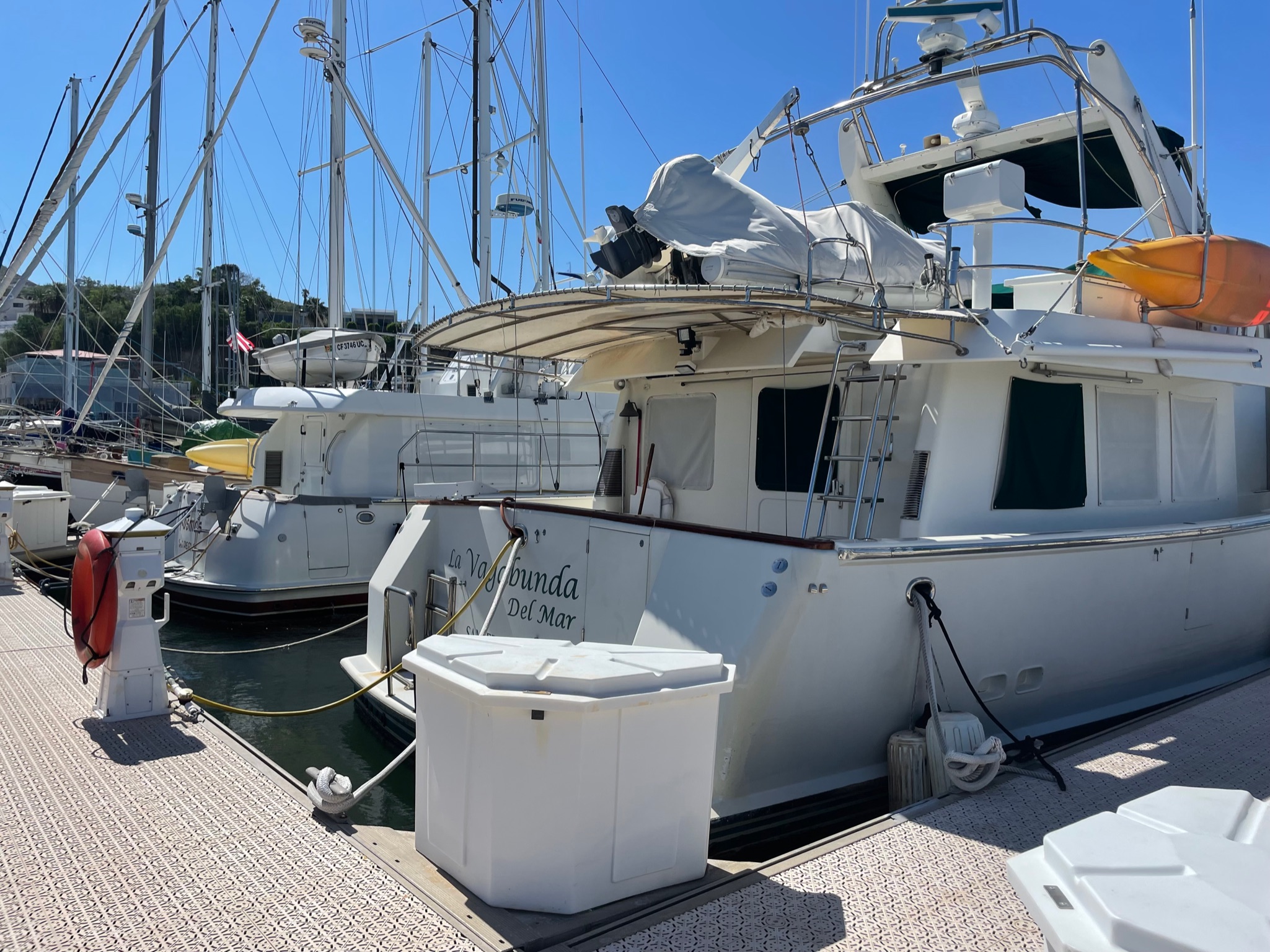
Continued from yesterday”¦ Almost as soon as we were situated, a catamaran named “Gone Native” pulled into the space we had just vacated. In a crazy small world story, it turns out that we know them. In early 2007, a friend of ours had arranged for us to meet some people who actively cruise half the year. They were really nice people who gave us a lot of good tips and advice. At the time, their boat was in Europe. We hadn’t had contact with them since. And, suddenly, here they were! Like us, they are about to stop cruising for a while and are taking their boat home to California.

In another odd coincidence story, we are now directly across from a boat named Cosmo. It was around 1115 and we were puttering around on board. Eric heard someone knocking and calling out “Hello”, but it wasn’t at our boat, so he didn’t pay attention at first. Then he looked out and saw the person was knocking on Cosmo and realized it must be the quarantine officer. Eric brought him aboard. The quarantine paperwork took 20 minutes. The only thing he wanted to see was our trash, which he looked through briefly, then left.

Now it was time to go to the Port Captain’s office. We walked out to the street and quickly caught a taxi that took us to the next bay over, Santa Cruz. Bahia Santa Cruz is definitely geared at tourists. A large cruise ship dock makes up a breakwater that splits the bay in half. The sea wall lining the inside of the breakwater is completely covered by small power boats with bimini tops, clearly intended for taking tourists on sightseeing cruises up and down the bays. There were two small military vessels in the back, too. The boardwalk is a collection of tourist shops, quite a few of them vacant. There are large hotel and/or condo complexes on the hill that separates Bahia Santa Cruz from Bahia Chahue, some of them only half completed. On the backside of the shops, on the outside of the breakwater, is a small beach.

dscf0771-small.jpg

dscf0775-small.jpg

The Port Captain’s office is in and amongst the shops. There were several armed military officers lounging around near the office. You walk in the door to see Continue reading

History of the Mexican Republic

Mexico’s 1,972,550 square kilometers in size and has an estimated population of 111 million people. It is bordered on the north by the United States, on the South by Belize and Guatemala, on the west by the Pacific Ocean and on the east by the Caribbean Sea. Mexico has an incredibly rich history, particularly in regards to the remarkably advanced indigenous people groups. It is believed that the original humans migrated from Siberia (it is believed there used to be a land formation that sank in what is now the Bering Strait) in migratory waves started in 60,000 BC. Somewhere between 7000 and 3000 BC, the people in central Mexico began cultivating agriculture. They went from being nomadic hunters and gatherers to settling into permanent villages. Throughout what is today Mexico, there were dozens and dozens of different ethnic tribes that influenced one another, and at various points in time sometimes conquered one another, too.

Mexico’s “mother culture” is considered to be the Continue reading

History of the Republic of Nicaragua

Nicaragua is the largest nation in Central America at 129,494 sq kilometers big, but is also the least densely populated with a population of 5.5 million. It is bordered by Honduras to the north, Costa Rica to the south, the Atlantic to the east and the Pacific to the west. The country’s name is a derivative of “Nicarao”, one of the most powerful indigenous leaders at the time of the Spaniard’s arrival, and Aqua, which means water and represents the large lakes in the region.

Evidence has been found in Nicaragua indicating that humans lived there at least 6000 years ago, and maybe even as far back as 8,000 years ago. When the Continue reading

The Drive to Heredia – Part 2

Continued from yesterday”¦ Not too long after we had checked the GPS, the road finally shifted to be both up and down, and while we had plenty of uphill stretches of road, we slowly but surely were losing altitude overall.

At about 1630, we rounded a bend a saw a huge city below. This must be San Jose. The road quickly descended and dropped us into the heart of the city. This was where we got totally confused. Lonely Planet has 4 detailed maps of San Jose, each of a different neighborhood, and we had a hard time finding the map we were on and figuring out how it connects with the map of where we were going to. Part of the reason we couldn’t figure out what map we were on was that we couldn’t find a street sign anywhere. Eventually, we managed to get oriented and had a vague idea of where we needed to go.

At one point, while the light was red, some street performers ran out into the intersection and juggled what looked like bowling pins until the light turned green. That was definitely amusing.

imgp0453-small.jpg

We found the right street and followed it. It happened to be Continue reading

History of the Republic of Costa Rica

Costa Rica is located between Panama and Nicaragua, with coasts on both the Atlantic and the Pacific. It is only 51,100 kilometers square and has an estimated population of 4.25 million people. Human habitation can be traced back more than 10,000 years. Little is known of the cultures that existed pre-Spaniards, and the various histories we have consulted conflict greatly. What is known for sure is that the locals lived in about 20 autonomous tribes, all with distinct cultures and customs. Some sources say Costa Rica was a sparsely populated backwater with 20,000 people. Others say it had a flourishing population of 400,000, with some of the first pottery making villages in the Americas, and was part of an extensive trade network amongst the Americas. None of the impressive stone architecture that characterized the more advanced civilizations of Mesoamerica to the north and the Andes to the south has been found, and only one historical site has been found that indicates a large city (10,000 people). Some sources say the city indicates a once great civilization, other sources disagree.

Columbus and his crew were the first white men to arrive. Their ship had been damaged in a hurricane, and they made an emergency stop near Puerto Lim¢n on September 18, 1502. Columbus Continue reading