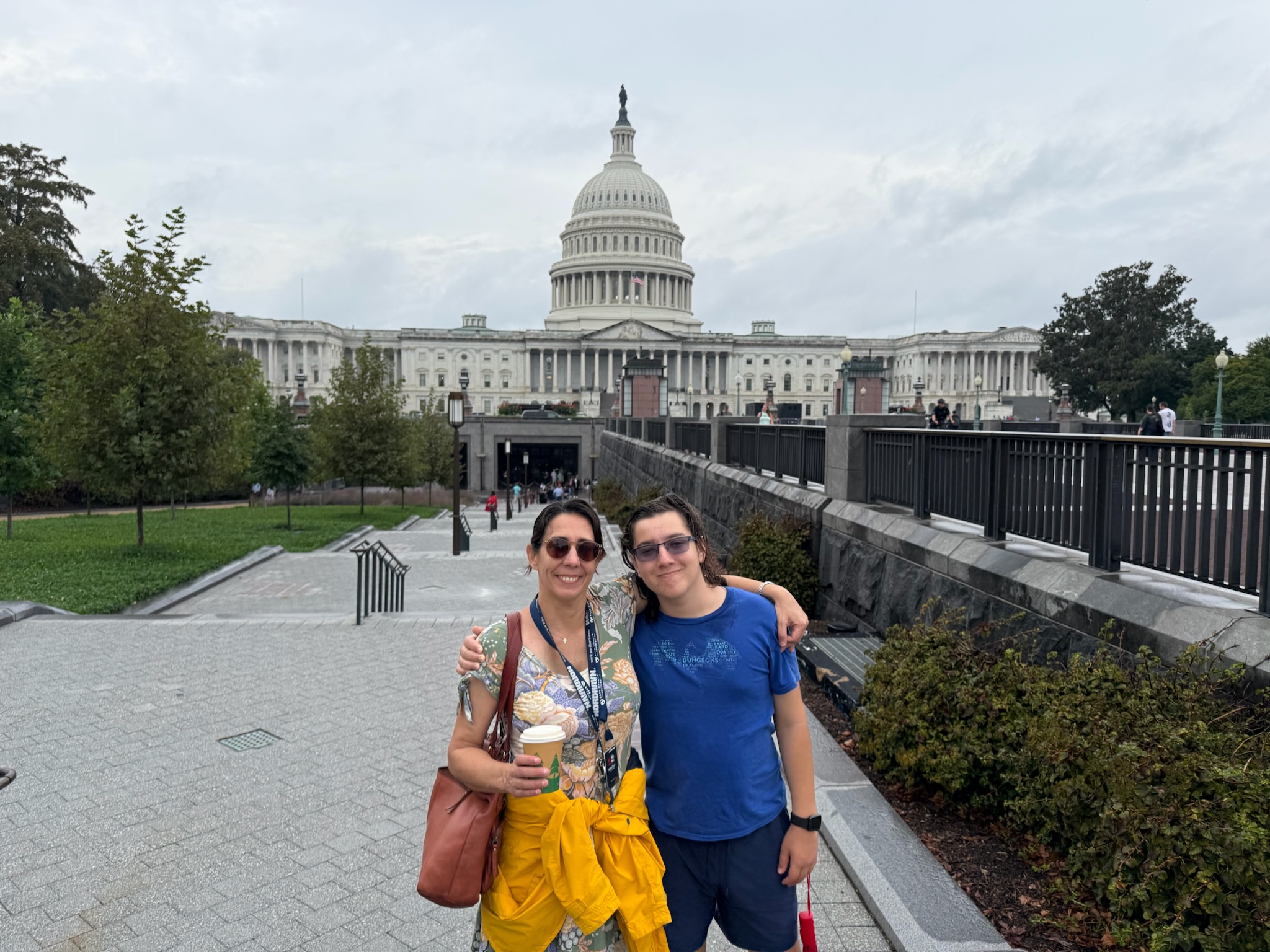
Thursday, Sept 25 — Several weeks ago, we’d booked tickets to take a tour of Congress for today at 1020. The confirmation had said to arrive at least a half-hour early for the security screening. Since ride shares were so much faster and easier than the free shuttle or Metro, we hailed a ride share and were dropped off in the east side of the building near the Visitor’s Center entrance at 0945. Much to our surprise, the entrance was underground.
When we arrived, there were only a few people in the line to enter the building. But within one minute, a large group of high school students arrived, and the line was suddenly very long. Talk about perfect timing! We were through the security check within a few minutes. Once waved through, we had no idea which way to go. Someone asked us if we were there for a tour. When we said yes, he directed us to take an escalator up to the next level.
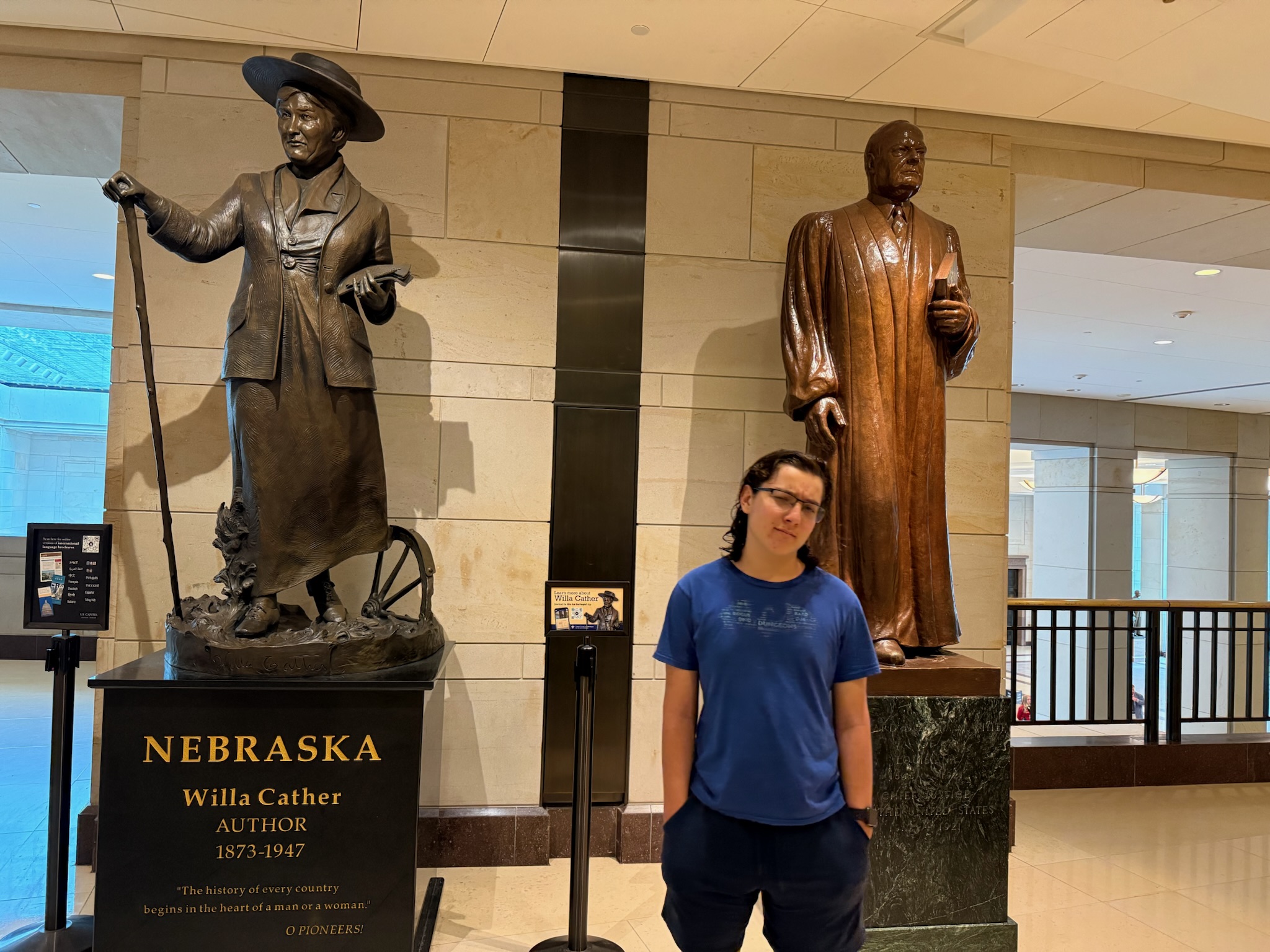
We came to a large room dotted with statues. Each statue had the name of a state on it. We later found out it was called The Emancipation Hall.
The guy to the right was Edward Douglas White of Louisiana, who was a lawyer, state legislator, US Senator and Chief Justice of US Supreme Court. Continue reading →
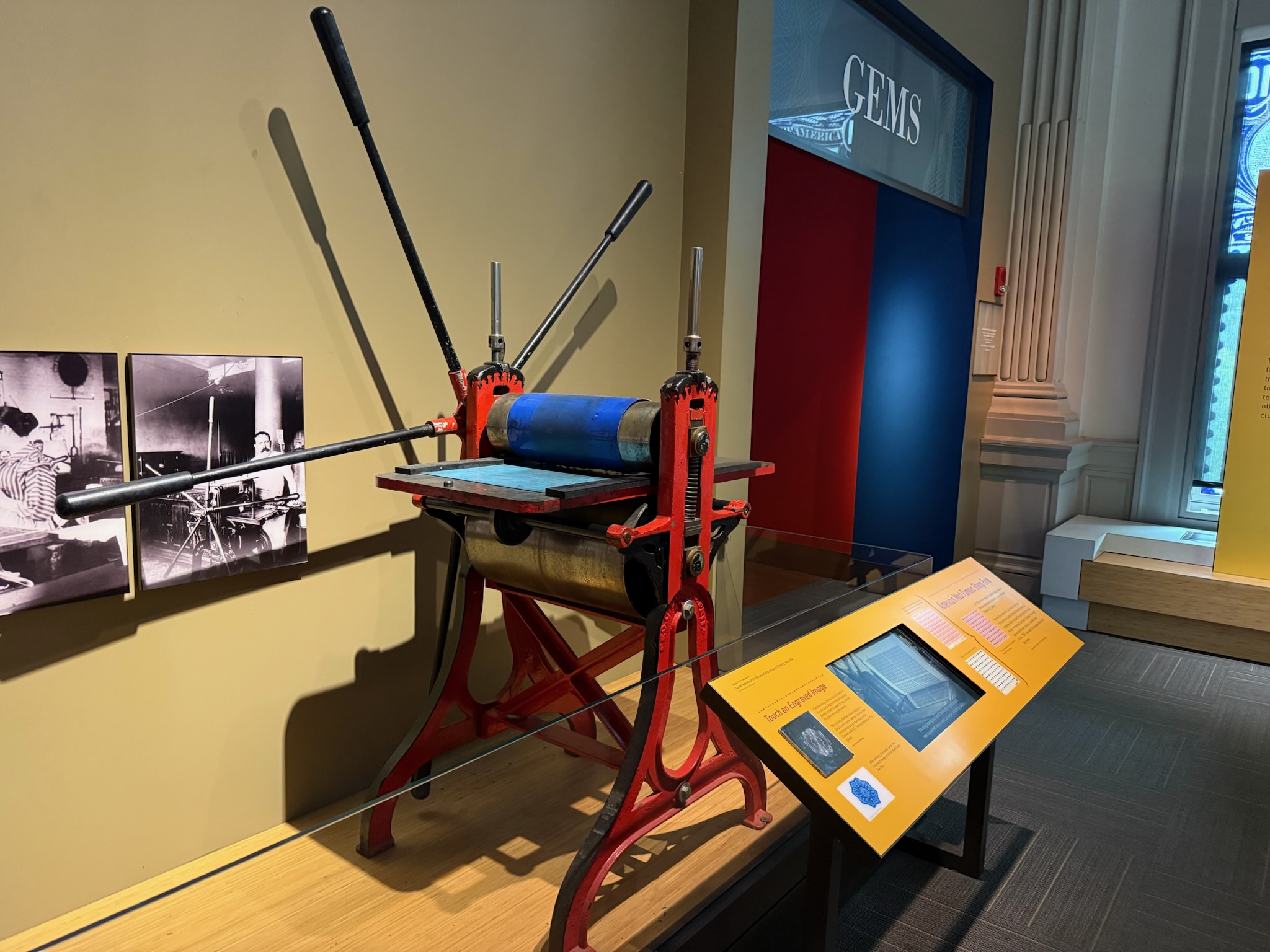
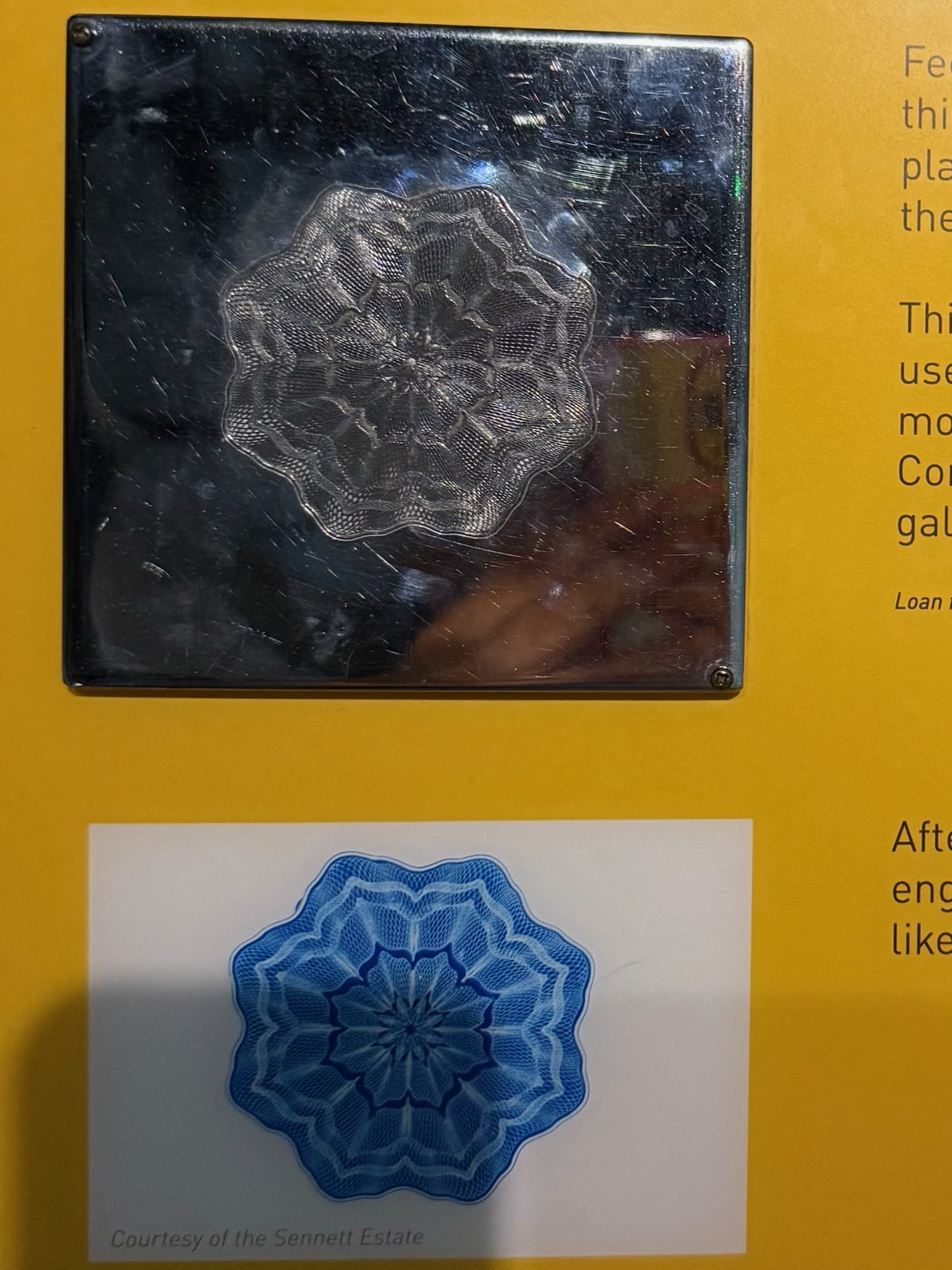
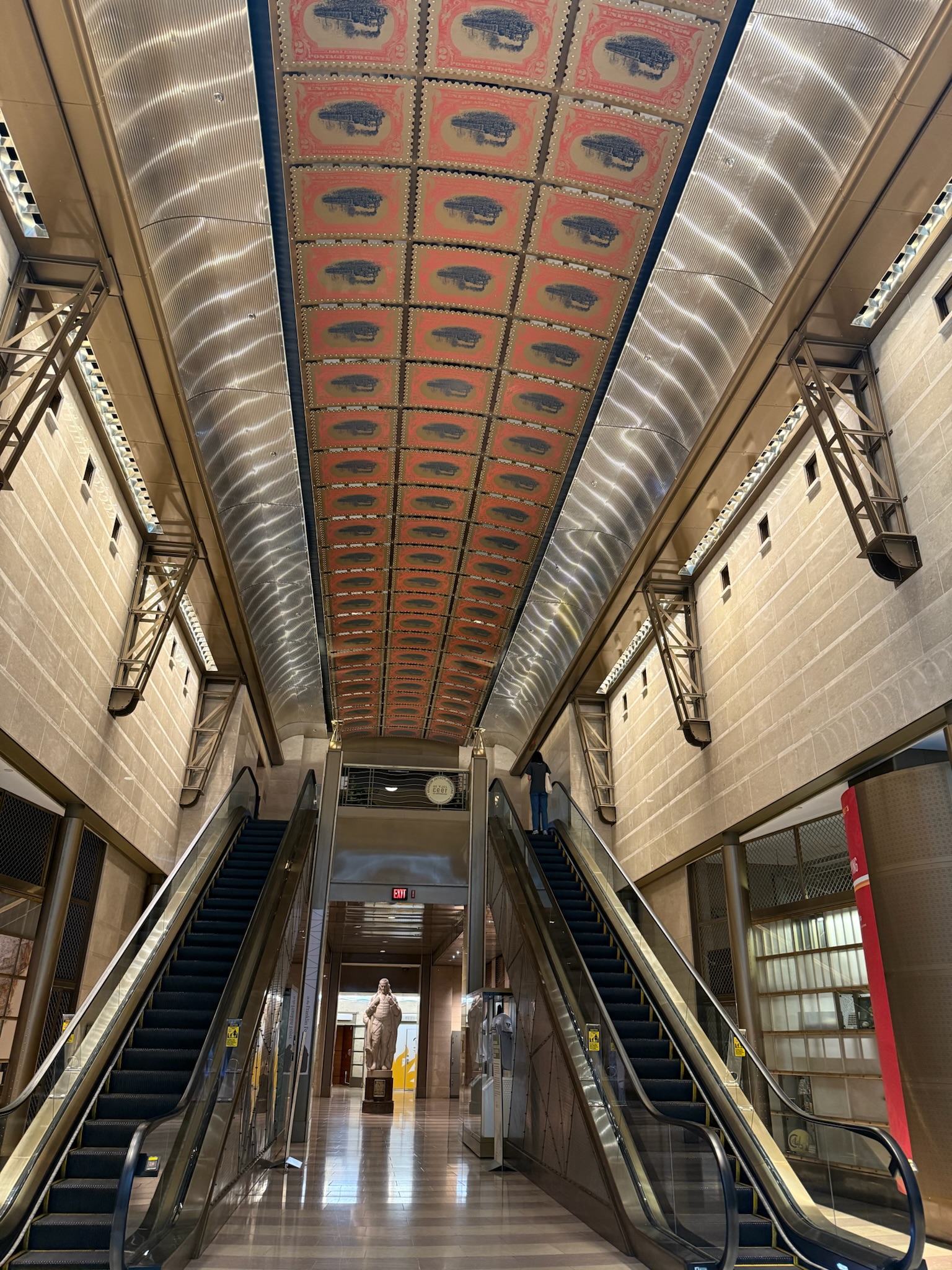
continued... Prior to the early 1900s, stamps were printed on small hand presses called a Spider Press.
They utilized flat plate presses with recessed engraving to create a sharp image. They usually had fancy frames and were 1 – 2 colors. They could only utilize one color at a time, so the multicolored stamps had to be impressed separately with each color. This led to considerable variation among stamps and some errors. These early stamps with errors were some of the most valuable to stamp collectors.
continued… Once we finished in the Postal Inspector room, we went across the hall to a room about the partnership between the Post Office and the department of Defense for mail services to remote military personnel. Mail service has always been incredibly important for them. Life responsibilities were — and often still are — conducted through the mail, such as receiving and paying bills or voting via an absentee ballots. Personal correspondence was just as important. For a long time, mail was the only way for servicemen to communicate with their loved ones, so mail service was critical for the morale of the troops. Even as more methods of communication have been implemented over the decades, ensuring timely mail continues to be an important facet of military operations — especially during war times. The Department of Defense provides large subsidies to reduce the cost of mail going to/from military personnel stationed abroad, especially in combat zones — some types of mail are free.
Up until World War I, postal employees handled military mail. When the US first joined the war, some postal employees went to Europe to process the mail, but soon the military created the Military Postal Express Service staffed by soldiers to replace the civilians in the war zone. The Post Office handles service for bases within the US; the military operates the overseas military post offices. There is a military post office at every duty station. We remembered seeing one on the USS Wisconsin. The military has a separate address system that adapts as troops change locations. Delivering mail to the front lines can be challenging and dangerous. Like the Star Route contractors, the military has tried an assortment of creative and innovative delivery strategies. One time, in 1959, they tried shooting a Regulus 1 missile full of mail from a submarine to Florida. The sign did not say what the results were, but we’re assuming not good since they never attempted it again.
There was a display about a special Christmas operation in 1918. World War I had ended in November, but the majority of troops were still stationed overseas at Christmas time. The military, Red Cross and Post Office teamed up to organize a letter writing and holiday care package campaign to lift the spirits of as many overseas soldiers as possible. 46-million letters and 15-million parcels and print matter were delivered to soldiers in Europe. Meanwhile, the overseas soldiers sent 40-million letters to the US. The displays explained what an incredible logistics feat this was, given the limitations of that time.
There were signs detailing other ways that civilians have used the mail to help the military personnel. For example, people would go to hospitals and write letters on behalf of soldiers who were unable to write themselves (due to injury, illiteracy, etc). It mentioned a lot of organizations that have also done letter writing/package campaigns and organized pen-pals for the soldiers. And it mentioned some companies that some companies donate equipment that facilitates correspondence through the mail. For example, back in the day when it was rare and expensive, companies shipped equipment so that the soldiers could record themselves speaking, then mail the record/audio tape home.
The display had quite a few touching old letters from service personnel with their original envelopes. There were also some voice recordings that had been sent through the mail that we could listen to. Also of note, there was a sign acknowledging that during war times, censors checked all mail going to/from military personnel and to/from civilians in foreign countries to make sure that no sensitive information that could jeopardize national security was in them. The censors were trained to look for codes and secret inks.
continued... After World War II, the Post Office couldn’t hire people or buy machines fast enough to keep up with the ever increasing volume and they were taxed to their limits. In order to help move mail faster, in the early 1960s, they created the Zoning Improvement Plan — AKA ZIP code — system. The first number indicates region, second and third number city and the last two indicate the specific post office it goes to. Now ZIP codes are used to shape everything from voting districts to marketing campaigns.
It sounds like in the 1960s, they also began implementing machines capable of reading the printed word, meaning that humans didn’t have to process the mail anymore. In 1982, the Post Office starting putting barcodes on mail so that machines could process the mail even faster. The barcodes started with the zip code, but as mail processing has become more sophisticated, they’ve added more numbers to the barcode. Nowadays (at least when the exhibit was made) it’s a 31-digit barcode that sorts the specific route’s mail into the order in which it is delivered.
In the early days of barcoding, postal workers hand-typed the information into barcode printers. Over the years, the machines have become sophisticated enough that they can read the address, print and affix their own barcodes, and sort the pieces of mail into appropriate sorting bins without any human intervention. The machines can even read all but the worst handwriting. If an address is undecipherable, the machine takes a photo and sends it to a Remote Encoding Center, where a person figures out the address, sends it back to the machine, and then the machine prints and affixes the barcode.
By 1787, it was clear the new government wasn’t working out because of the severely limited ability to function. This was when they began drafting the current Constitution and Bill of Rights. The first amendment in the Bill of Rights was as much about protecting mail service from censorship as protecting dissenters, journalists, etc. From what we gathered, it sounded like during the interim years, the Post Office just kept running as it had been since it was created in 1775. In 1792, legislation specific to the Post Office operations was finally passed. Back then, news was most commonly spread through the mail. Congress understood that mail and newspapers were both critical components that made the engine of the Republic run. Congress decided that rates for newspapers would be lower than letters in order to help facilitate the spread of information. Back then, newspapers were often only one letter size page. Because the letters were subsidizing the newspapers, letters were expensive to mail. Congress also forbade Postal workers from opening mail unless it was undeliverable as addressed. While the contents were still considered private, the workers could try to discern from the contents where the letter was supposed to go.
In 1800, the Post Office began using the “hub-and-spoke-system” that is still in use today. Certain post offices were selected as distribution centers, where mail for large areas was processed and sent on.
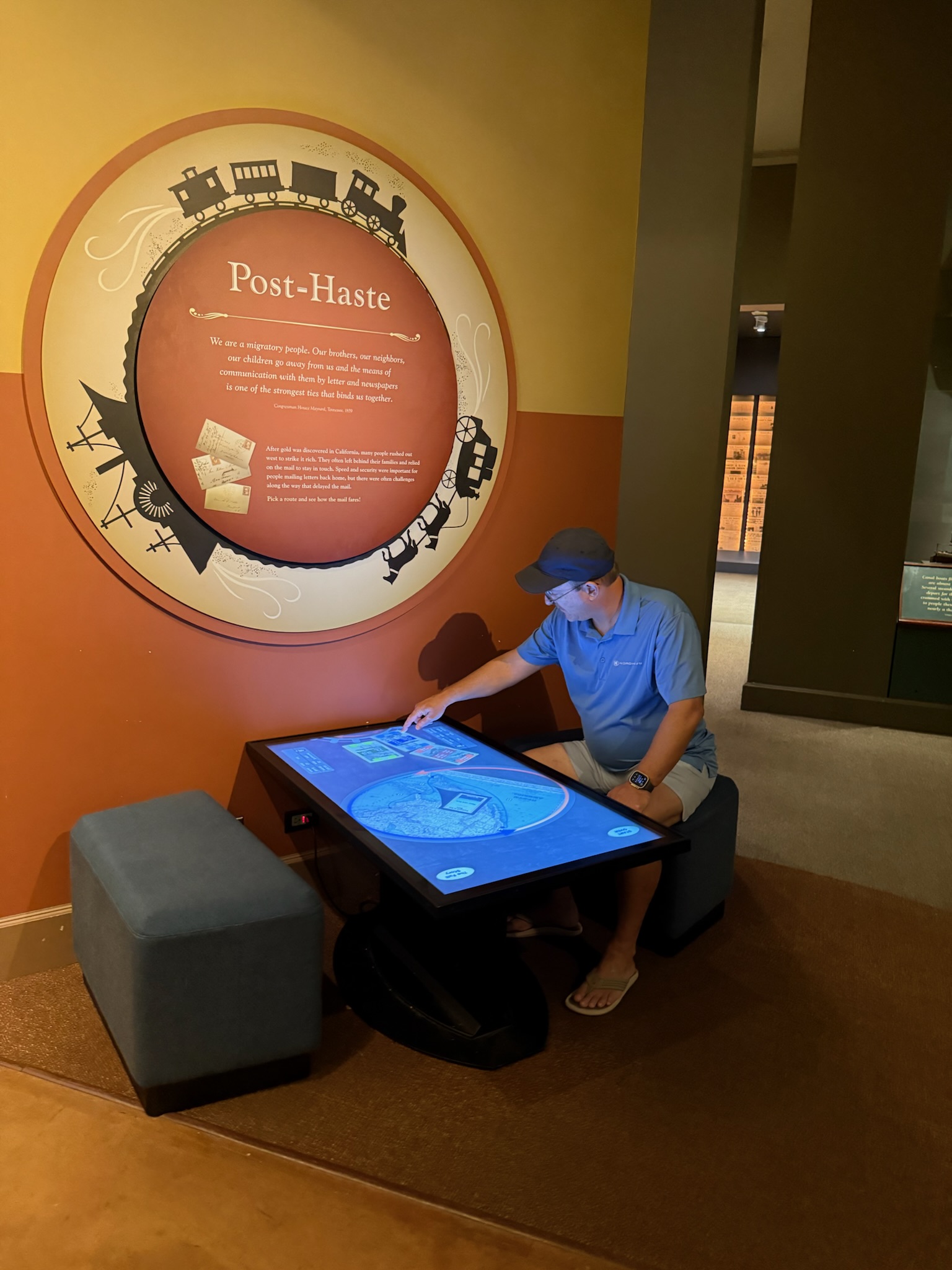
When gold was discovered in California in 1848, getting mail to/from California became a priority. The Post Office contracted with several shipping companies. Some ships went all the way around Cape Horn, but the faster service was by splitting the route up: Ships on the east coast going between the US and Panama/Nicaragua, an intermediary to carry the mail across the isthmus, and ships on the west coat going between Panama/Nicaragua and San Francisco.
By 1851, mail could get all the way across the country via three overland routes, but each route only ran once a month. A twice-weekly single overland route was established in 1857. The Post Office awarded the contractor who worked the route, John Butterfield, a six-year contract at $600,000 per year. When establishing routes out west, Congress was concerned with more than just the mail. Congress understood that civilization would form along the mail routes, so establishing the route was a critical piece of growing the nation. One of the last displays in the room was a game where you could see the challenges that were faced on each of the western routes.