Welcome to Chania, Crete

Since we failed at playing tourist yesterday, we were determined to get some sightseeing in today. We decided to go to Chania (pronounced Han-yah), located on the northern coast of Crete about an hour and a half west of Bali. Our “Lonely Planet” says Chania is even more quaint and charming than Rythmeno. The old city has been continuously occupied for the last 6,000 years. When the Venetians took over, they Continue reading

Food, Glorious Sunsets, and Attempted Sight Seeing in Crete

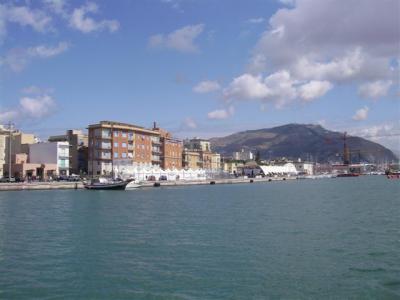
Yesterday evening, Christi finally started to feel better, which was a relief. She was really beginning to worry about it taking so long to recover. In the evening, we went out and explored town some more. We walked down some streets we hadn’t taken before and found a nice little short cut to the swimming beach and line of restaurants on the other side of the commercial harbor. Here is a shot of the marina from one of the streets we were on.

imgp5169-small.JPG

We picked a restaurant and sat down. We ordered the stuffed lamb, and we are happy to report it was unbelievably good. The lamb was stuffed with Continue reading

Food and More Food in Greece

Our flight back to Crete was at 0530, which meant we were up at 0245 and out the door by 0330. We were surprised that the bus to the airport was full. Early morning flights must be common. Flying with a sinus infection is not fun. We were back to Kosmos by 0800. Christi self-medicated and went to bed. It has been 4 days now, and except for occasionally rousing for food and restroom, she has stayed in bed pretty much the entire time.

While Christi slept, Eric worked on a few chores around the boat, including fixing some chips in the gel coat, more cleaning in the engine room, trying again to hunt down the exact spot of the starboard stabilizer leak (it is somewhere near, or at, the locking pin or the cylinder), and the never ending task of organizing. A Nordhavn 57 pulled into the marina the day we got back from Athens. It is always fun to find a fellow Nordhavn on our travels. Eric spent some time chatting with the owner and helping him with some boat maintenance and repair issues. But Eric spent the vast majority of his time on the most important task of all: complete the quest in his video game, Oblivion. He is pleased to report he finished his game and saved the world.

We figure now is a good time to get caught up on our food reporting. We tried a dish called seafood saganaki. We were expecting the battered, pan fried cheese topped with seafood. We were very surprised when out came something akin to a stew with a rich tomato sauce. It was really good.

seafood-saganaki-small.JPG

Another staple of Greece is souvlaki, which the rest of the world calls kebabs. Pictured here is a souvlaki sandwich, on pita bread, topped with tomato, onion and French fries.

souvlaki-close-small.JPG

We tried a dish that consisted of Continue reading

Ancient Ruins of Athens – Ancient Agora and More

Continued from yesterday”¦ Once we had gone through the museum, we headed to another well preserved building, the Church of the Holy Apostles. It was built in the 11th century over the ruins of a 2nd century AD building called the Nymphaion. We have no clue what kind of building the Nymhaion could have possibly been, but the name is certainly intriguing. The church was restored in the 1950’s. The church looks pretty similar on the outside to the other churches around Greece we have seen so far. The inside is only partially restored. They found some of the original wall paintings, so the walls are mostly white with big chunks of ornate, but faded, art splashed here and there on the walls. There isn’t much in there by way of furniture, either.

imgp5127-small.JPG

imgp5132-small.JPG

We made our way Continue reading

Ancient Ruins of Athens – Olympeion and the Ancient Agora

Continued from yesterday”¦ we walked a few blocks to the Olympeion, which is a temple constructed to honor Zeus, the god of the sky and king over all the gods of ancient Greece. The site has been considered a holy place to Zeus since 600 BC. In the early days, they simply worshipped in an empty field. Over the years, several efforts were made to build a temple. The work would start, only to have the project abandoned for one reason or another. Many years later, the work would start again, only to be abandoned again. The temple was finally completed in 132 AD, under Roman Emperor Hadrian. It was one of the most impressive temples of the Roman Empire, with 104 columns. There were two enormous statues inside of equal size, one of Zeus and one of Hadrian. In the 5th century BC, the temple began to deteriorate. During the Middle Ages, the temple was converted to a Christian church, and under the Ottomans a mosque was built on the site. By 1852, only 16 columns were left standing. A storm knocked one of the columns over. It was believed that the falling of the columns liberates evil, and an outbreak of cholera at about the same time was blamed on the column’s fall.

This site isn’t anywhere close to being as put back together as the Acropolis is. There is the foundation of the temple in the middle of a field. There are a few columns left standing on the foundation. There is the one column that fell in 1852, still lying where it fell. The building was enormous in its day, very large and very tall. We were fascinated by the fallen column. Standing, the pillars look like they were carved from one giant piece of marble, but really they carefully carved are discs stacked together.

dsc01703-small.JPG

dsc01700-small.JPG

On the grounds is another impressive monument, called Continue reading