Crew for Atlantic Crossing Wanted

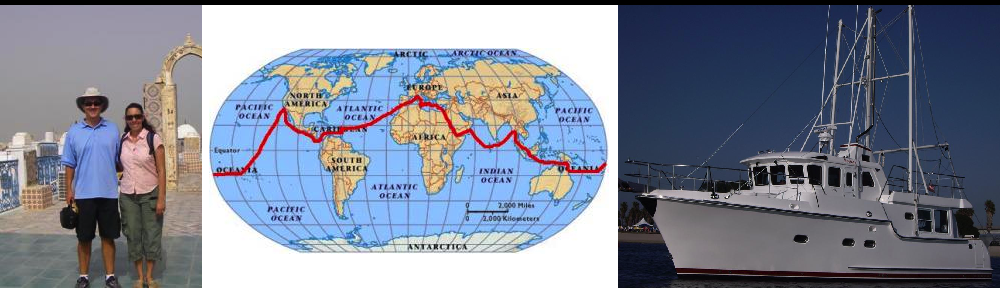
Are you ready for some adventure? We are looking for one person to join us as crew on our Atlantic crossing passage from the Canary Islands to Barbados. Pending weather, we plan to depart the Canary Island’s the last week of November 2008. The 2,670 nautical mile passage will take approximately 18 days. One of the most important qualifications is experience in rough seas. We have to know you can handle it if the seas get rough and stay rough for the whole 18 days. Long periods in rough weather can be difficult on you physically and emotionally.

We do four hour watches, so you will be on watch for four hours, have eight hours off, and then back on watch. If you are interested, contact us and we will send you more information about what you can expect and your crew member responsibilities. We will also send you an application to fill out and return.

Ancient Ruins of Athens – The Acropolis

This morning, we went to the Acropolis. It was a pleasant 20 minute walk down a gently sloping hill. We turned onto Dionyssiou Areopagitou Street, nicknamed the “Walkway of the Gods”, which runs along the south side of the famous historical monument. The street is closed to car traffic. Near the intersection, there are quite a few tourist shops, but they quickly give way to private residential buildings with no shops on the first floor. It is clear by the upkeep of the buildings that this street is a high rent district. The walk is lined with trees and plants, and there were several street musicians performing.

imgp4972-small.JPG

We got to the entrance. “Acropolis” means “high city” and it sits at the top of a flat topped rock, 150 meters (490 feet) above sea level. We stood at the base of the mountain, warily eyeing the distance to the top. Our bodies were mad at us from the last three days of serious hill and stair climbing we had done, and we knew our bodies would be even more unhappy with us after this hike up. Why is every holy temple so far up a hill?

The Acropolis (the top of the rock) has been used as a Continue reading

Meteora Monasteries and the Battle of Thermopylae Monument

Continued from yesterday”¦ The first thing we saw as we walked in was the landing for the pulley system. We peeked over the edge. It is a long, long way down. Neither of us could imagine being transported in and out of the complex on that. It looks perilous. We went to the old carpenter’s shop, with a variety of general tools, such as saws and pliers. We toured the cellar, which housed an assortment of hand made farming tools and food processing equipment, such as wine vats and milk churns. The monks were completely self-sufficient. They farmed in the valley below and made their own food products, including cheese, yogurt, wine, olives and olive oil. We also saw the large kitchen and the old cookware from the days before modern stoves and ovens.

There are three churches on site, but we only visited one of them, the Transfiguration of Jesus. The church is post-Byzantine in architecture and décor, incredibly ornate, and surprisingly small. Every inch of the church is covered in paintings of Jesus and the saints. We went into several other rooms that are now museums of sorts. The large dining room is now an art gallery. The infirmary now houses ancient manuscripts, icons, woodcarvings, ornately decorated clothing, etc. It also has an area devoted to modern day martyrs, people who have fought for “our faith and our nation”. Another room documents the history of Greece, with artist renderings of famous moments, costumes, folk art and so forth. We walked around the grounds, which are beautifully landscaped and quite lovely. We enjoyed the view of the valley below. It is a pleasant place, definitely the type of quiet sanctuary that is ideal for a religious retreat.

imgp4882-small.JPG

imgp4900-small.JPG

The next stop on the tour was the Holy Monastery of St. Stephen, built in the 1500’s. The guide chose this particular one because Continue reading

Welcome to Meteora, Greece

Continued from yesterday”¦ When we left from the hotel, the bus headed northeast, slowly winding its way down the steep mountain towards the beautiful ocean below. Once we got to the shore of the Gulf of Malis, we turned northwest into a large valley of farmland.

We were surprised to find that a big chunk of this valley is man made land. Our tour guide told us 70% of Greece is mountainous, but our guidebook said 80%. We wonder if the disparity in the numbers has to do with all this relatively recently reclaimed land we have been driving through the last couple days?

We climbed up a narrow mountain range. As we neared the top, we could see ahead of us was yet another large farm valley, called the Plain of Thessaly. This is a natural valley. As we descended, we could see our destination ahead, the closest of the mountains at the north end of the valley, somewhat isolated from the rest. It is called Meteora, which means “suspended in the air”.

As we drove through the Plain of Thessaly, we found out that we were in the heart of central Greece, in an area known as the “bread basket”. This area gets the most annual rainfall, and is the most fertile. The day was almost over, so we stopped at a hotel about 5 km away from the mountain for the night.

We piled back in the bus at 0830. We drove the 5 kilometers to the town at the base of the mountain, called Kalambaka, then the bus began to wind its way up. It wasn’t until we were climbing into the hills that we realized this mountain houses a series of sharp, vertical sandstone rocks. We stopped at a viewpoint and got out. The guide pointed out Continue reading

Delphi and the Pythinian Games

The ancient city of Delphi is cut in half by the highway. We had only gone to the larger portion of the city above the road with the tour group. This morning we were up bright and early to go see the section below the highway, which holds the gymnasium, the temple of Athena, and a few treasuries.

In yesterday’s post we mentioned that in the early days of the oracle, the goddess Gaia was the one communicating the messages, and that in later years it was Apollo who spoke to the people. There is actually a story in Greek mythology that explains the change. Gaia, the earth goddess, established the oracle and sent her daughter, Python, the serpent, to protect it. Python became enemies with the god Apollo, son of the great Zeus. Apollo rode up the mountain to Delphi on a dolphin’s back (Delphi means dolphin in Greek) and slew Python. Apollo began a tradition called the Pythian Games to celebrate his victory over Python. Contestants from all areas of Greece gathered in Delphi every four years to face off, in hopes of winning the sacred prize of a crown of laurel (bay leaves).

We have our doubts as to whether all of the information in that story is historically accurate, but we can say that that the Pythian Games were definitely real. Historians believe they began in the 6th century BC, and that they were the pre-cursor to the Olympic Games. The tradition of the Pythian Games continued until the city of Delphi was essentially closed by the Roman/Byzantine emperor. When the Olympic Games began, they were held in different years than the Pythian Games. Being as they were both on a four year cycle, there was never a conflict.

The Pythian Games initially started out as a musical competition. Later poetry, acting, and painting were added. These contests were held in the theater pictured yesterday. Eventually sports were also added, as was chariot races. Some of the sporting competitions were held in the stadium mentioned yesterday, some in the gymnasium we were about to enter into today. Just like the Olympics today, the Pythian Games were a huge deal in their day. While there wasn’t a monetary prize, winning the laurel wreath carried tremendous prestige. Cities supported their representatives with full force. Tons of spectators went to Delphi to watch the games, bringing a lot of wealth into the city. For several weeks before and after the games (and of course, during), there was a pan-Hellenic cease fire so that people could travel safely to Delphi and back. There were huge festivals and ceremonial rituals that went on for several days before the games actually began.

We walked over to the ruins, passing by two ancient drinking fountains, one from the early classical era and one from the Roman age. Delphi is on a river, and they channeled the river water into the fountains. It doesn’t look so good for drinking out of these days. We looked down at the gymnasium. Yup. It looks like the field at every school gym. It is a large, mostly flat area, complete with an oval dirt track. Beyond the oval track is a straight stretch of track, probably for contests like the high jump. The rest of the flat ground has groupings of stone blocks neatly laid out, presumably the remains of assorted gym accoutrements.

imgp4749-small.JPG

imgp4742-small.JPG

Below the gymnasium is an area that houses the temple of Athena and the treasuries. The temple of Athena is probably Continue reading