Dana Point Nordhavn Dock Party Tuesday, May 26

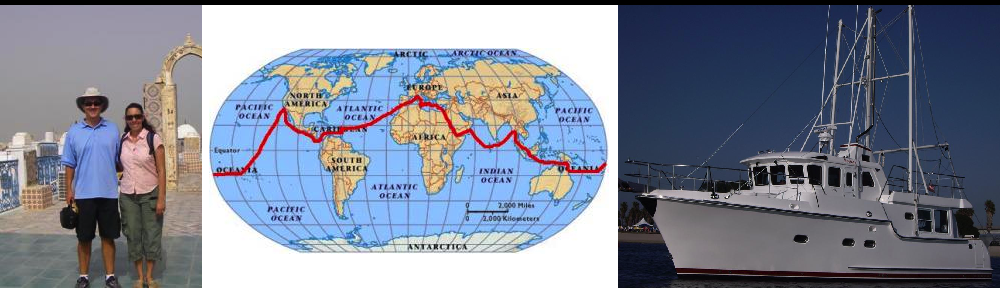
Once again we interrupt blog time with a real time announcement. We will be in Dana Point on Tuesday, May 26 to celebrate our circumnavigation with the staff of Nordhavn. They will be having a dock party at 4pm. If you can make it, send us an e-mail. Address and directions: 24703 Dana Drive, Dana Point, CA 92629, directions.

Alas it will not be an open house to see Kosmos, but it will be a chance to see us and a bunch of the Nordhavn folks that made our trip possible. We hope to see you there!

The Mangazina di Rei

Continued from yesterday”¦ After we finished at the museum, we headed to Rincon to go to the Mangazina di Rei cultural center. It is housed in the second oldest stone building on the island, built in 1824, which was originally built as a food and farm tool storage center. The center tries to actively preserve the cultures and traditions of 100 years ago. We expected it to be a museum where you wander around at your own pace, but it was actually a guided tour. We joined a tour group about halfway through the tour. The group had just gone out into the gardens.

In the gardens, they grow the plants that were used for every day living, from food to export crops to materials for tools. They pointed out a tamarind tree, then gave us some tamarind juice to taste. It tastes kind of like beans and sugar and is different. They pointed out a calabash tree. Calabash are inedible, hard, and round, and are good for making assorted tools and cookware, such as bowls, ladles, and so forth. The musical instrument maracas (the shakers popular in Latin American music) are made from calabash, too.

They showed us candle cactus, which are used to make the living cactus fences. For some reason, they can only be cut on a full moon in the dry season or they rot. The guide showed us the tools they used to cut, move, and replant the cactus along the fence. The cactus cuttings form new roots and become a living fence.

dsc02259-small.jpg

The guide also pointed out the kadushi cactus that they make a traditional soup from, and also explained how they cut and skin the cactus to get at the pulp inside. The cactus is absolutely enormous, but only young shoots are eaten.

They showed us the plants that sorghum flour is made from, which was the staple of the traditional diet. Sorghum is Continue reading

SCUBA and Chores in Kralendijk

Since the wall behind the boat is so large and expansive, we wanted to explore it some more. Yesterday was another gray day, with frequent showers that brought very heavy rain, which disappointed Eric. He likes to dive when it is sunny and everything in the water is all lit up. But we dove anyway. We did two more dives along the wall, the first dive exploring more to the south, the second dive exploring more to the north. On the first dive we stayed at 60 feet, and on the second dive we went to 70 feet to check out the life a little lower on the wall. On the second dive we experienced just a little bit of current, but none on the first dive. We could seriously dive this spot a thousand times because there is so much to see!

On the first dive we pretty much saw all the same things we mentioned yesterday. In addition, we saw Continue reading

Settling in Bonaire and Minor Watermaker Trouble

Yesterday didn’t get off to a good start. First of all, we had intended to get up early. We wanted to get all of our errands run in the morning so we could spend the afternoon SCUBA diving. But we wound up sleeping late, which put us behind schedule.

Our morning routine at anchor/mooring is to turn the generator on to charge the batteries and make water when we get up. Eric turned on the watermaker and was dismayed to see the high pressure pump didn’t go on. Eric suspected that Continue reading

Welcome to Kralendijk, Bonaire, Netherland Antilles

After midnight, we were hit with several squalls that agitated the seas, so the ride became even more lumpy and no fun. There still was virtually no moon, so we enjoyed the luminescent stars in between the storms. It was still rough at dawn. It was a bit hazy out, so even though we were close to Bonaire, we couldn’t actually see land until 0745.

We approached from the southeast side of the island. Kralendijk, the main city on the island and the only place boats are allowed to moor (anchoring is prohibited in Bonaire waters except under special circumstances), is on the west coast, in the center of the island. We rounded the bottom of the island at 0945 and headed north on the west coast. The minute we were on the west side, in the lee of the island, the seas instantly flattened out. We were so happy.

The ride along the coast was pleasant. We saw a nice rainbow. We saw several schools of flying fish leaping along the water in unison. One school in particular was absolutely enormous. We watched a few people kite surfing.

The southern side of the island is flat and low and the northern end is hilly. The town seems to be right where the hills meet the flat land, in the center of a nice bay. From what we could see, it looked like neither the north or southern ends of the island had any buildings on them whatsoever. So, as we headed up the coast, at first it was empty land, then eventually there were a few buildings that looked like residences along the water, then some buildings that looked more like hotels, then the town center. There are no big high rises at all. There was a cruise ship in port. Just a few miles west of town, in the bay, is the low, flat island of Klein Bonaire, which is apparently vacant land. Near Klein Bonaire we could see what looked like a smaller cruise ship waiting to pull in. However, we had eavesdropped on a conversation between this ship and the port captain on the radio and knew it was not a cruise ship at all, but Continue reading