Welcome to Portsmouth, Dominica

At midnight we heard a loud crash on the top deck. It was windy and rainy and very dark out from the lack of stars and moon. We turned on the lights and looked out the back windows. Everything looked fine. The kayaks, dinghy and dock boxes were all secure. Eric went outside briefly and glanced at the top deck. All looked fine. We couldn’t figure out for the life of us what caused the crashing sound.

About the same time as the crash, the wind calmed down some and the seas started to improve a little. By 0100, we were in the lee of Guadalupe and the ride became smooth and nice. The wind was blocked by the big mountains on Basse Terre, so it died down to 3 5 knots. There are definitely a lot more lights at night on Guadeloupe than on Antigua, but it is no surprise since Guadeloupe has 450,000 people and Antigua only has 72,000.

We left the shelter of Guadalupe at about 0400 and it was instantly back to not being a fun ride. At sunrise, Dominica was visible, but the big mountains were mostly enshrouded in clouds. As morning progressed Continue reading →
History of Dominica

Dominica is not the same place as the Dominican Republic. Dominica (dah-mah-nee-kah) is an independent country made up of a single island, located in between the French islands of Guadeloupe and Martinique. The Dominican Republic (Doh-min-ick-an) shares the island of Hispaniola with Haiti, several hundred miles northwest of Dominica. Dominica is 290 square miles and has a population of 72,400. It features the highest mountains in the Eastern Caribbean. It has fertile soil and plenty of rainfall, making it the “bread basket” of the Caribbean.

The first inhabitants on the island are believed to be Continue reading →

Start of the Passage from English Harbor to Portsmith, Dominica

Yesterday was chore day. Eric changed the forward racor fuel filter, changed the generator racor fuel filter, changed the main on engine fuel filter, changed the generator on engine fuel filter, changed the transmission oil and filter, ran the wing engine, and replaced the sea strainer for the diaphragm bilge pump. Eric also put the storm plates back on the salon (living room) windows, which we had taken down for the boat waxing. He also put Lanicote corrosion protector on the screws for the storm plates.

Christi did laundry, cleaned, and did the never ending and thankless job of reorganizing storage spaces.

This morning we walked over to Falmouth Harbor to go Continue reading →

Nelson’s Dockyard Museum: Part 2

Continued from yesterday: The work was grueling, the conditions were extreme, and the sailors were paid almost nothing. If the crew didn’t move fast enough, they were severely punished. One of the more common punishments was being flogged (whipped). The whip they used was called “cat-o-nine-tails,” which had one handle with 9 cords. It was kept in a canvas bag. When the cat came out of the bag, someone was getting beaten, hence the term “don’t let the cat out of the bag.” Another method of punishment was making them hang on to the top of the mast for several hours. In bad weather and rough seas, this was horrible. Another was they would tie a man to a rope and dunk him repeatedly in the water. And yet another punishment was cleaning the head (toilet). All the punishments were always public and everyone had to watch except the skeleton crew needed to keep ship moving.

There was one ship surgeon on board, and no other medical staff. If you got hurt in battle, basically the only treatment available was Continue reading →

Nelson’s Dockyard Museum

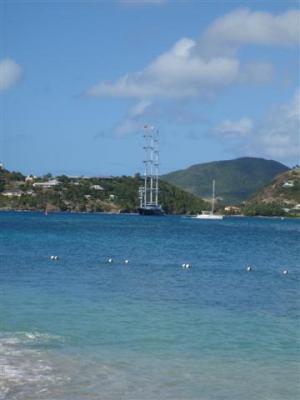
Once again, we started the day with a trip to Pigeon Beach. Interestingly enough, when we arrived, the famous sailing ship “The Maltese Falcon”, one of the largest private sailing vessels in the world, was anchored in the bay. Wow. It is huge. It has a unique sail rigging that makes it distinctly recognizable. After some sun and swimming, we headed back to the boat. John was leaving today, so he got ready to go.

p1120369-small.jpg

p1120370-small.jpg

We had a few hours to kill before heading over to the airport, so we went to the museum here in Nelson’s Dockyard. It is small, but incredibly interesting. Most of the Continue reading →