Monastery of Atali

In the History of Greece post, we gave general information. Here is some more specific information that is significant to today’s post. Crete was one of the areas that the Venetians won when they conquered Constantinople in 1204, and the Venetians ruled until 1669, when the Ottoman Turks wrested control of Crete from them. In 1821, Crete joined in the Greek war for independence, but Crete remained under the control of the Ottomans until 1898. During the 1800’s, there were numerous rebellions by the Greeks. Many Christian churches and monasteries hid the rebels, and in the mid 1800’s, the Ottomans began destroying these religious institutions in an effort to squash the rebellions. They also killed many clergymen, believing them to be ringleaders of the rebels.

This morning Costas took John and us to visit the Monastery of Atali, devoted to John the Baptist, on the hills above the town of Bali. The Greek word “monasterion” means “place for doing something alone”. In the Greek Orthodox religion, monastaries are a community of either men or women who devote themselves to serving God and choose to live apart from the secular community. They are the original commune, where everyone lives and works together in service to God. They are generally built in out of the way places.

The exact date the Monastery of Atali was established is unknown, but it was during the Byzantine period. The monastery was renovated in 1635, under the Venetians. In the mid 1800’s, it was partially destroyed by the Turks and all of the monks were murdered. The monastery continued to exist quietly in its partially destroyed condition until 1941, when the last of the monks died. It sat vacant for 40 years, where it was looted and the forces of nature continued to erode the buildings. In 1983, Father Anthimos and the Department of Byzantine Antiquities began restoring it.

As we pulled up to the monastery, we were impressed by the beautiful, lush gardens. A few low, stone buildings were barely visible behind the array of trees and bushes.
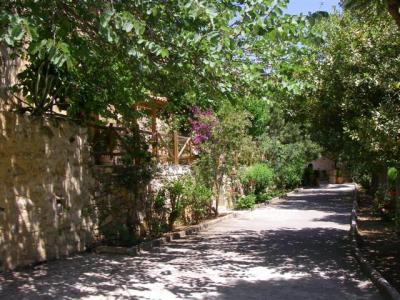
iera-monestary-3-small.JPG

The garden completely covers the grounds. It is quiet and serene, and with all the foliage surrounding you, and as you walk around, you definitely feels as if Continue reading
Welcome to Bali, Crete, Greece

We were in bed early and slept soundly. We are always so darn tired after a passage. When we did finally get up, we got right to work scrubbing down the exterior of the boat. The salt was really caked on and we had a hard time getting it off. It took some serious scrubbing. We now have a renewed appreciation for the South Pacific, where it usually rained hard for an hour every day, washing away all the salt and dirt. We rarely washed the boat there — nature kept it clean for us. And when we did wash it, very little scrubbing was needed. We miss that.

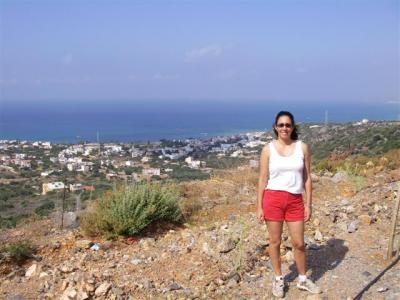
When we were finally done, we got Kosmos situated so we could be gone a couple of days and we headed to Bali (not to be confused with Bali, Indonesia) along the main highway. The drive is beautiful. About a third of the road is inland, the other two thirds along the water. The highway is well maintained, with good signs. Crete is mountainous, with very little flat land anywhere that we could see. The road winds up and down the mountains, so you get incredible vistas from mountain peaks and close ups of the foliage in the troughs.

view-along-highway-to-bali-small.JPG

The vast majority of cars on the road are Continue reading

Kosmos in Sea Magazine July 2008 and Site Updates

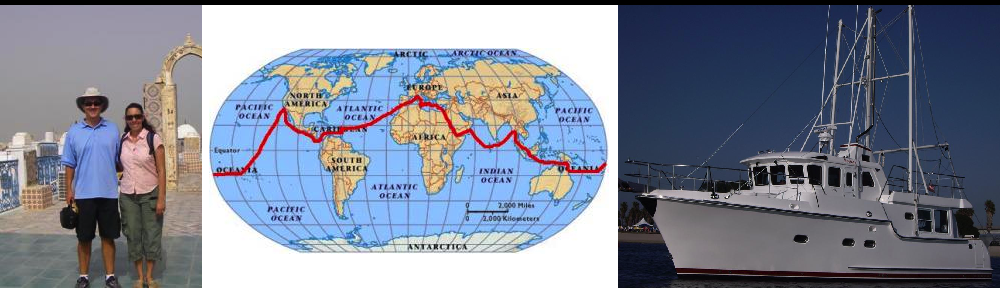
On page 21 of the July 2008 Sea Magazine you will find a Nordhavn advertisement with a picture of a Nordhavn 43. It is Kosmos! The ad is about us. It even links to the blog, so hello to any new readers out there. They interviewed us for the ad when we were in Thailand. That picture of Kosmos was taken at Ko Muk. The ad mentions we are “working our way from Australia through Southeast Asia”. Well, print media can be a bit behind the times. That was many thousands of miles ago! See the new map on top of the Travel Summary page for an overview of our route so far. Also, we added a few more stories to the Highlights page, and some pictures.

Welcome to Agios Nikolaos, Crete, Greece

By sunrise, we were in more protected waters and the seas calmed down significantly, becoming a pleasant ride. At 0645, we rolled up 3,333 hours. We left San Diego with 333 hours, so we have done exactly 3,000 hours at sea since leaving home. We are at 17,875 miles, so our average speed has been 5.96 knots. We are averaging 1,375 miles a month. We have been seriously moving.

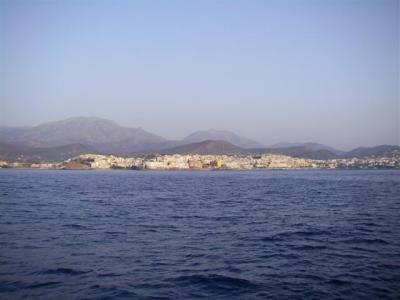
We neared our destination, the town of Agios Nikolaos on the island of Crete around 0700. From the distance, it looks just like all the photos you see of the Med, with blocky buildings nestled in tall hills along the shoreline.

view-coming-in-1-small.JPG

We pulled into the marina, where someone was waiting to assist us. We backed into our spot and threw him two lines, which he tied to the sea wall. Then he handed us each a mooring line, which we pulled up to the front of the boat, securely fastening each side on a separate mooring. No dropping the anchor, which was good. We were snugly tied up between two very large yachts. Within a few minutes, the marina guy, Stratos, Continue reading

The History of Greece

Present day Greece is located in the Southeastern portion of Europe. Mainland Greece is bordered by Albania, Macedonia (formerly Yugoslavia) and Bulgaria on the north and Turkey on the east. The mainlands of Turkey and Greece form a horseshoe shape, connecting at the top of the arc. The body of water between them is called the Aegean Sea, and most of the islands in the Aegean are part of Greece.

Greece is a surprisingly Continue reading