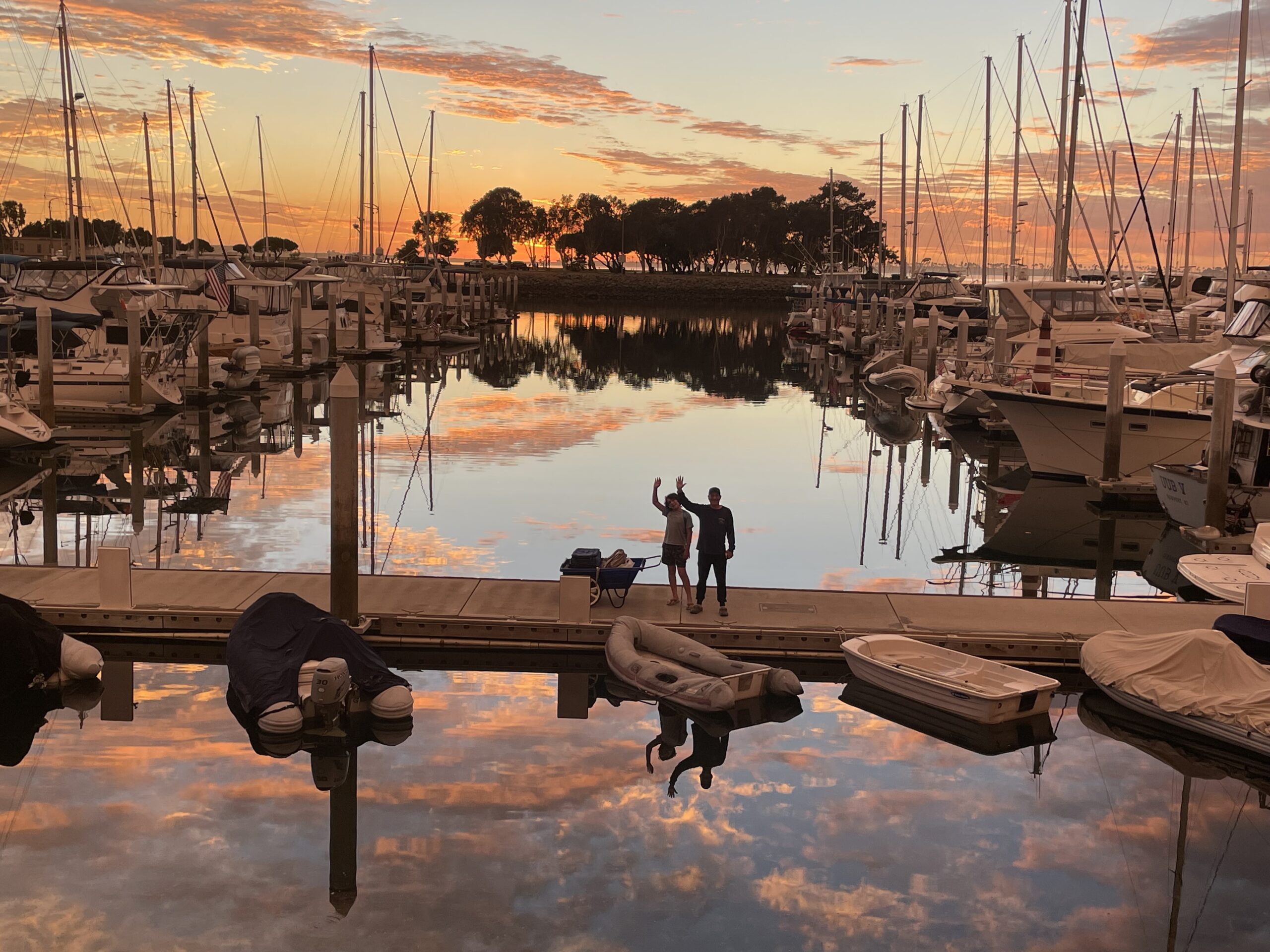
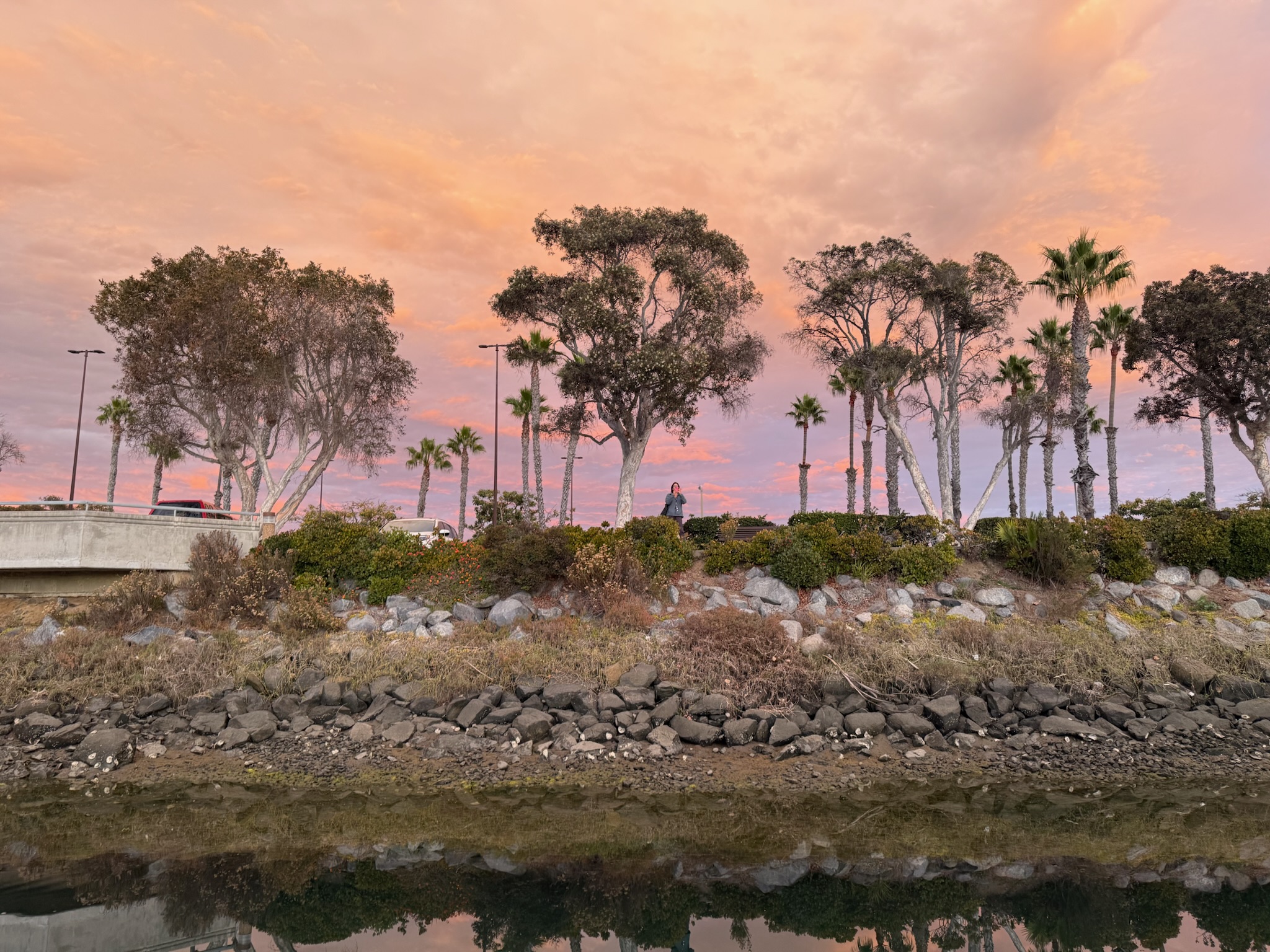
Here are a couple of sunset photos, taken on Friday, which was our last night in Chula Vista (southern San Diego Bay)
On Saturday, we moved to the Police Dock, the only overnight public dock in San Diego Bay — and most importantly, the closest dock to the mouth of San Diego Bay.
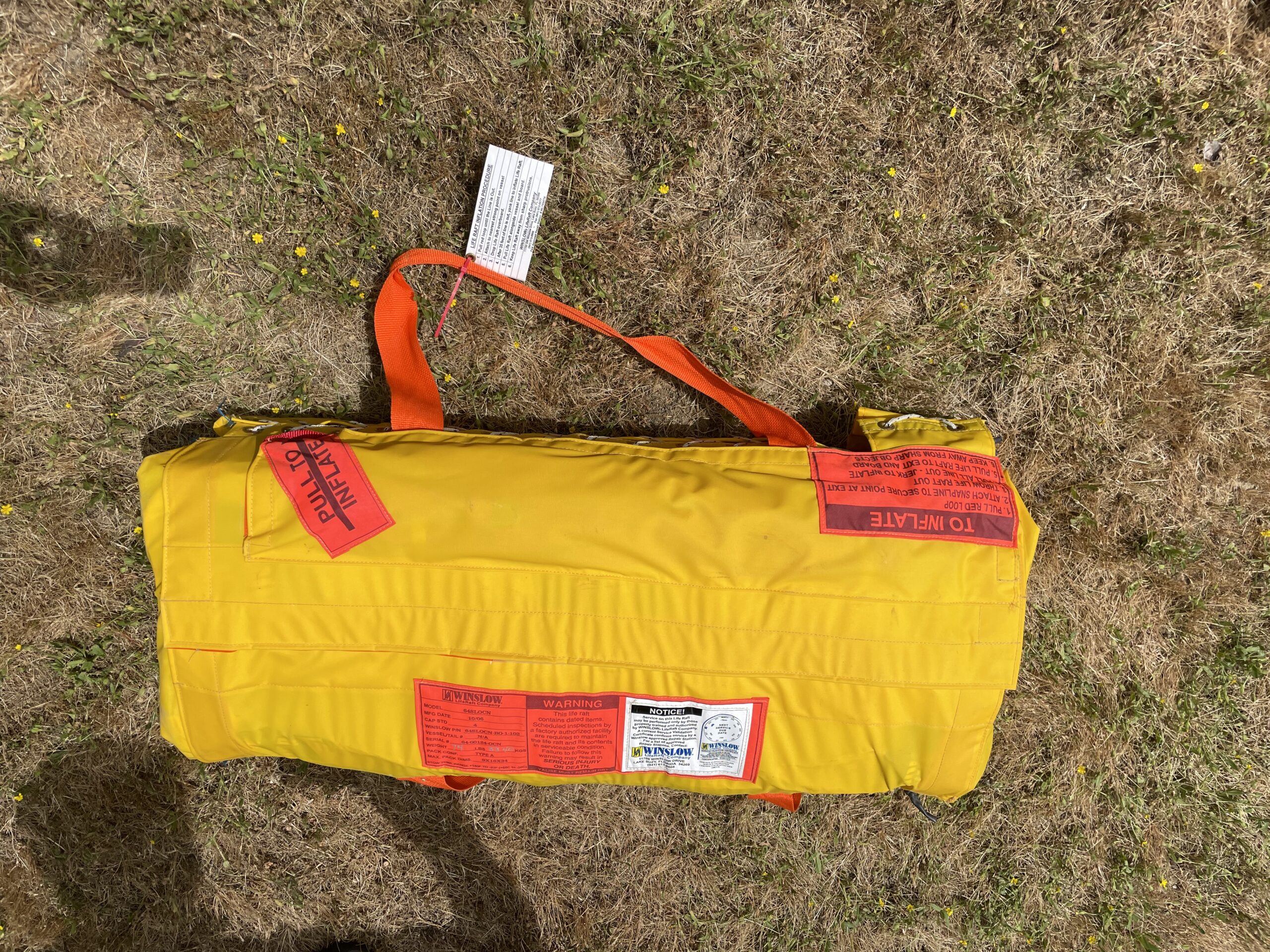
When Kosmos was new, we bought a six-person Winslow life raft that was vacuum-sealed for extended life. We got a Maxi model with food, water, EPIRB and lots of great features. All these years, we kept it under the settee in the salon, so it was very protected. Even though it was 18 years old, we believed it was still in good shape thanks to the protected location.
Unfortunately, our insurance company wouldn’t recognize such an old life raft, so the insurance company insisted we get a new one before going to the Sea of Cortez. We chose the Winslow Ultra-Light Offshore four-person model that has all the same non-perishable goodies, but does not have perishable items in it. Our old life raft was 70-pounds — there was no way Keith nor Christi could launch it without help. The new life raft is 35-pounds, which Christi and Keith can each manage alone.
Our ditch bag was a large, heavy duffel bag. We’ve replaced it with three water-proof backpacks (one for each of us). One of the backpacks has the perishable things that were previously in the life raft; the other two have the rest of the contents of the old ditch bag. With the bags on our back, our hands will be free to launch the life raft and deal with other things.
We decided it would be a great safety training exercise to inflate the old life raft. Our friend, Marty, joined us. Marty gave us a lot of helpful information. Here is a video Marty took of it:
Joshua Tree national park was amazing! The first day we drove there. We stopped to get food at a place called Farmer Boys. We went to my friend Heath’s campsite.
Le parc national de Joshua Tree était incroyable! Le premier jour nous avons conduit jusqu’à Joshua Tree. Nous nous sommes arrêtés pour manger à un restaurant qui s’appelle Farmer Boys. Après ça nous avons conduit jusqu’à l’emplacement de camping de mon ami Heath.
The family that we went camping with in Yosemite last year invited us to go to Joshua Tree National Park with them and several others for spring break. Joshua Trees are the largest species of the yucca genus (evergreens with sword shaped, tough leaves and white flowers). In addition to a large collection of Joshua Trees, the park is also famous for giant piles of rocks dotting the desert landscape, and people come from all over to climb these rocks. The park is also popular for stargazing. It has many hiking trails, too. Christi adores Joshua Tree. Eric and Keith had never been.
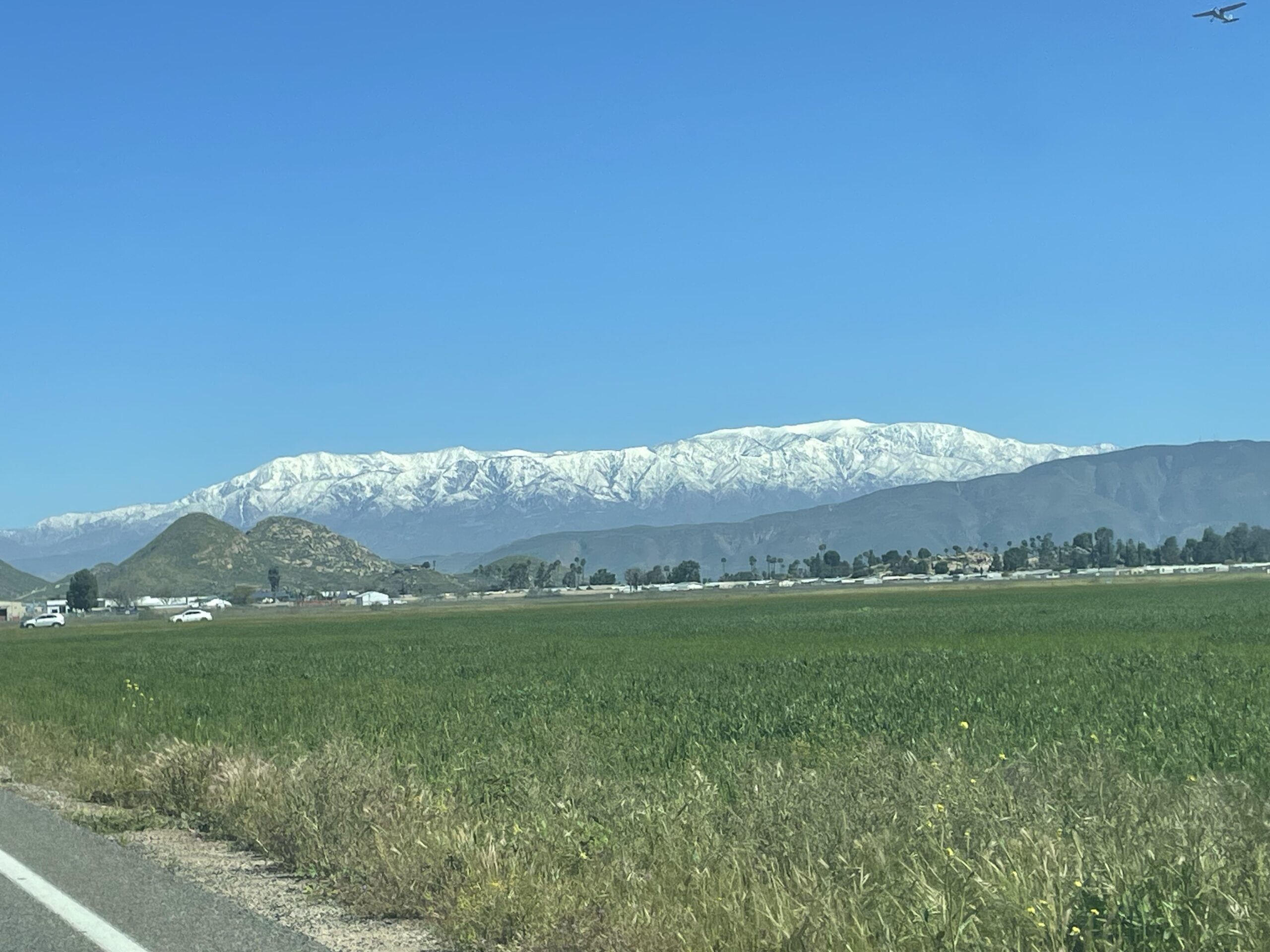
On Tuesday, the weather was clear and sunny. The three-hour drive northeast from San Diego to the high desert was beautiful. Southern California has had an unusually wet and cold winter, so the landscape was greener than normal and full of flowers, with snow capped mountains in the distance.
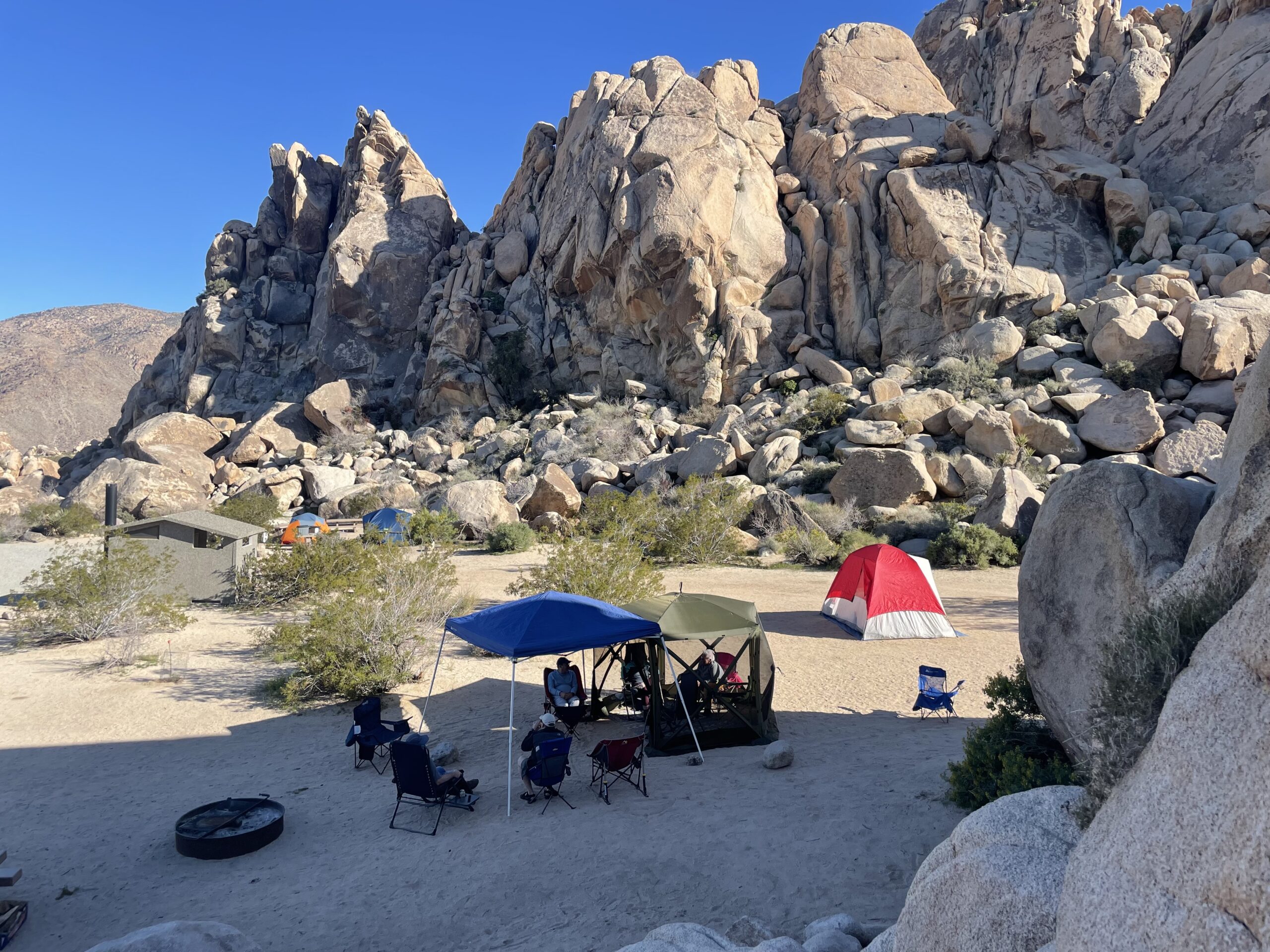
The campsite was located in Indian Cove, a small alcove on the outskirts of the park, conveniently located right off the main highway. While the temperatures were balmy during the day, it was cold at night. We’d decided it would be too cold for tent camping, and renting an RV was more expensive than renting a cabin/house. What was great about Indian Cove was that it was next to a residential area, so we were able to find a place that was only a 5-minute drive. With many national parks, such as Yosemite, it can be quite a long drive between the park and the closest amenities outside the park.
We arrived at the campsite at around 1400 (2:00 pm). Here’s a photo taken from atop one of the surrounding rock formations.
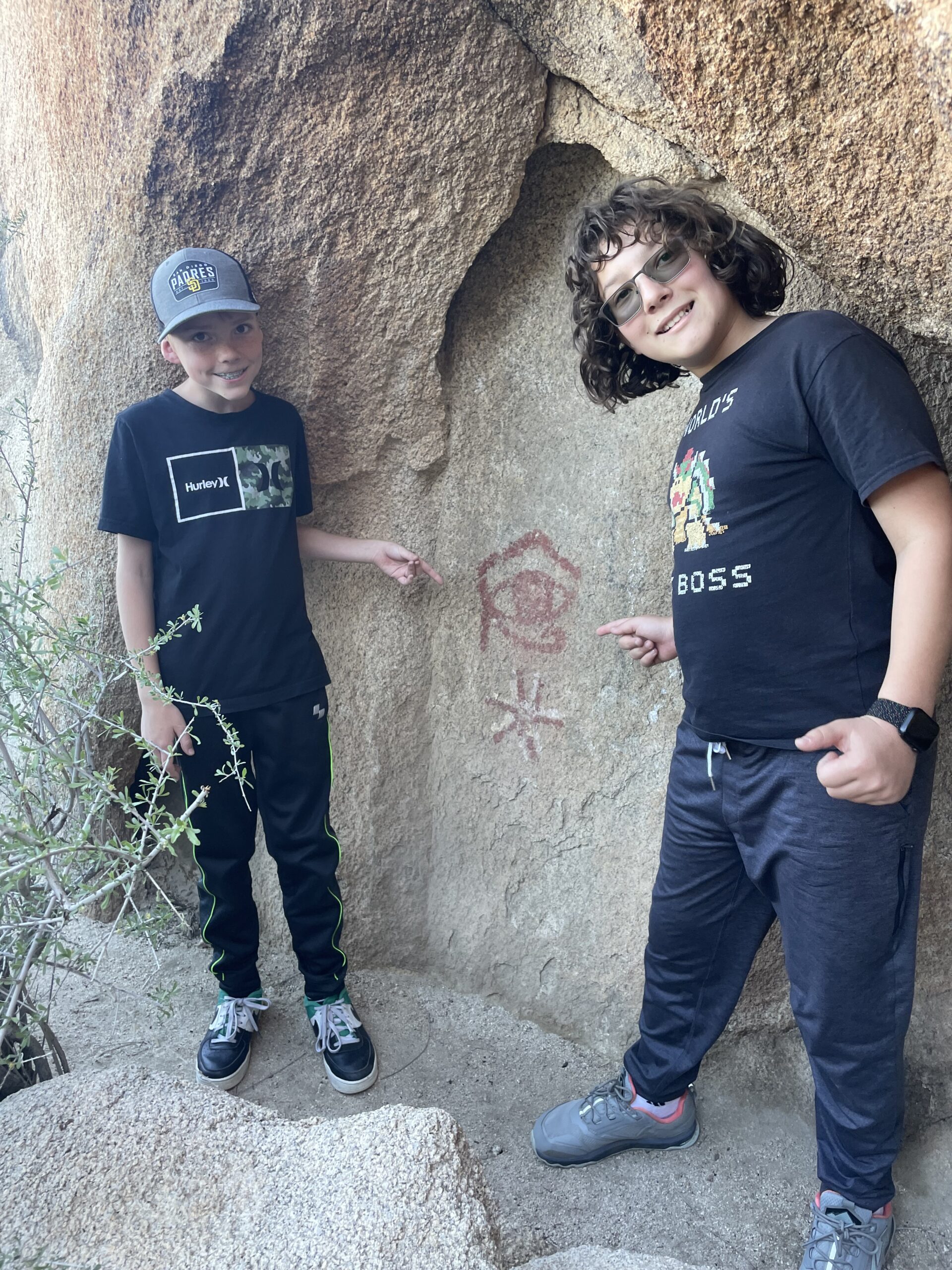
The boys spent the afternoon climbing rocks and playing a game called “Joe’s Gas Station.” Christi and Eric did a little bit of rock climbing, too.
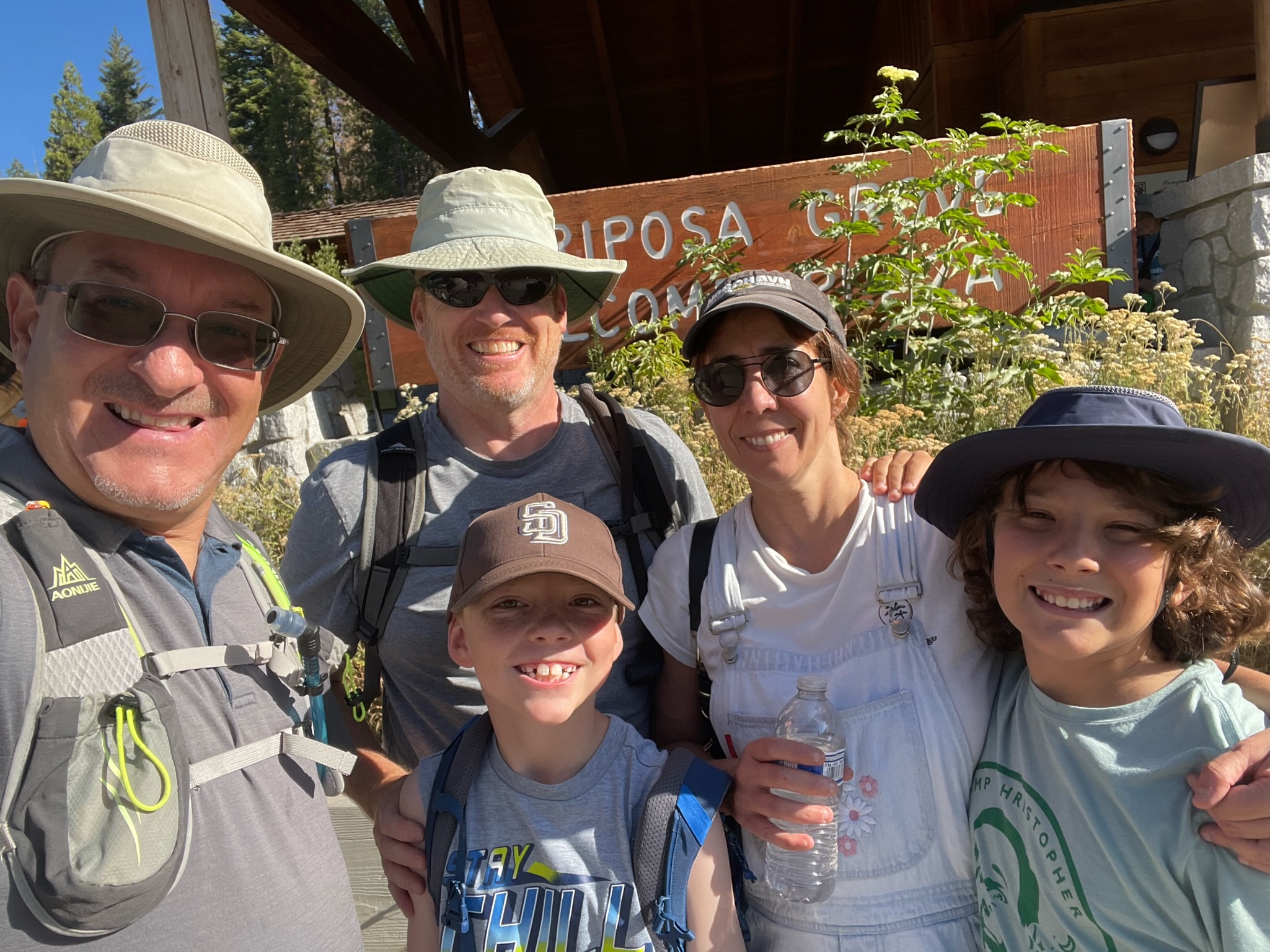
Yosemite was very fun. It took a long time to get there. The first night we stayed outside the park in an Air B&B. We stoped in the Mariposa Grove. We saw a GIGANTIC tree! Teddy Roosevelt himself stood in front of it a long time ago. For all I know, that tree convinced Teddy to create national parks.