continued… They perused most of the exhibits on the first floor while they waited for the volcano/ice cave tours to begin. The majority of the displays were about Iceland’s history, with about half focusing geological history and the other half human history.
With volcanoes, geysers, glaciers, earthquakes, a divergent tectonic plats and erosion, land was created and destroyed faster in Iceland than anywhere else in the world. Iceland first formed 64-million years ago, about the time that a cataclysmic event changed Earth. It sounded like it was initially connected to Greenland and Europe via land bridges, so animals could come and go. Thanks to continental drift and erosion, the bridge between Iceland and Europe eroded 10-million years ago. They missed the sign explaining when/how they separated from Greenland.
Over the millions of years, there have been at least five ice ages and also periods where the planet was so hot that there was little to no ice on Earth. There were points in time where Iceland was completely buried under snow and ice, and the land was devoid of flora and fauna. There were times where the temperature was so balmy that there was a wide variety of flora and fauna, including redwood trees. There were a lot of signs about various specific volcanic eruptions and the amount of land the eruption added to the island, as well as some signs that explained areas affected by glacial erosion. There were also a few that explained how some unique geological features, such as psuedocraters, formed.
Changes to the ocean’s currents (the Gulf Stream and the Atlantic Meridional Overturning Circulation [AMOC]) also affected Iceland’s development, temperatures (in and out of the water) and sea life. A rise of invertebrates being pushed in from other areas brought a rise in creatures that ate them, including whales and walruses. Twenty species of whales inhabited the waters around Iceland, and twelve of them were commonly seen. A sign explained how whales fed at the bottom of the ocean and then went up for air — often pooping on the surface. Doing this cycled the nutrients in the water from the bottom up to the surface, providing nutrients to the photosynthesizing creatures that lived on the surface. Other signs gave more detailed information on some of the species.
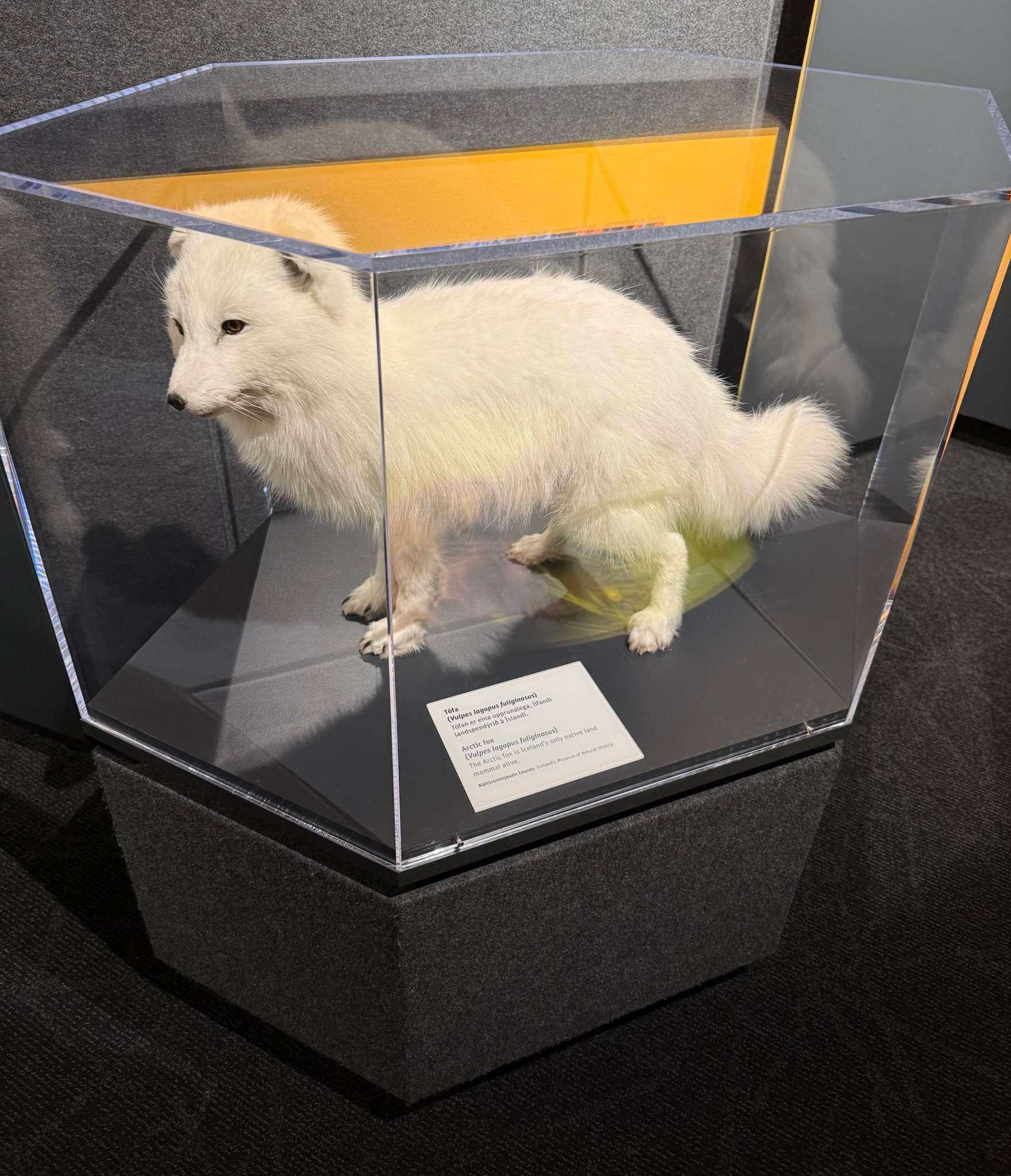
The only indigenous terrestrial mammal to Iceland in the current era was the Arctic Fox. They were omnivores that would eat just about anything, changed color from grey-blue when it wasn’t snowy to white when it was, lived in pairs, and had 4 – 6 cubs each spring.